This 12-episodes Summer 2023 series adapts a light novel series which is yet another alum of the Japanese writer-incubator website Shōsetsuka ni Narō. Though it came in largely unheralded – and was not popular enough to get picked up for episode reviews by Anime News Network – it featured an interesting spin on a standard romcom premise: the male co-protagonist fell in love with the female co-protagonist during middle school and doggedly pursued her even into high school years, without success but to the entertainment of their classmates. However, one day he had the epiphany that his unrequited pursuit of his idol might be just a nuisance to his idol, so he decided to back off and just admire and support her from afar. His decision seemed justified when she soon gathered a gaggle of classmates around her, ones who had been keeping their distance because of him. But though she benefited in some senses, is that what his idol actually wanted?
In an age when stalking is an all-too-real problem, seeing a young man realize on his own that he’s going too far and back off is heartening. However, that alone wouldn’t make for a series, so the humor and light drama which follows builds on how protagonist Wataru Sajo’s change-up affects relationship dynamics for both him and Aika Natsukawa, the subject of his affection. For Wataru, not obsessing over Aika opens him up to potentially-romantic encounters with at least three other girls (four, if you’re interpreting liberally). Two of these come about because of a job he gets to replace all the time and effort he was spending on Aika, and the third (and possible fourth) result from him being approached by another girl who basically saw an opportunity once he no longer seemed fixated on Aika. (And this is discounting one girl who seemed interested in briefly testing the romantic waters with him after a break-up with her long-time boyfriend.) None of those ever gets serious (though he technically does go on a daylong date with one of them) and the crushes are mostly one-sided towards him, perhaps because he hasn’t entirely let go of Aika. Watching Wataru’s interactions with these girls is usually the less interesting side of the series, though his flippant style of doing things can have its appeal.
The more interesting side of the series is Aika’s situation and what Wataru backing off may or may not mean to her. At first, it looks like she’s just thrown off by not having to deal with Wataru’s persistent attention anymore, to the point that she asks if something is wrong with him, but even early on some suggestions are dropped that she might not have minded the attention as much as she let on. As the series progresses and more of Aika’s backstory gets revealed, the series’ greatest conceit comes into focus: ironically, Wataru’s semi-stalking may have actually benefited her in the long run. She was certainly feeling isolated in middle school because her home situation (having to look after a young sister while her apparently-single mother worked), and she may have gained her best friend Kei’s attention because of Wataru’s openly-displayed interest in her. In high school, Wataru’s open pestering called enough attention to her that she soon picked up a circle of sympathetic classmates once he clearly backed off. Though the way he did it was less than ideal, he did, effectively, forcibly drag her out of her isolation, and even if she doesn’t openly admit it, she seems to intuit and appreciate that.
Frankly, this sends a mixed message, as Aika’s continued interest in Wataru could easily be interpreted as Wataru getting rewarded for behavior that even he admits was stalkerish. This is a romcom rather than a drama, however, so the writing is clearly not interested in serious exploration of that aspect. Aika spends the rest of the series dancing around whether or not she has real feelings for Wataru and to what degree. The end of the series leaves this frustratingly ambiguous – they’re clearly at least friends, but are they more? – but that may be the point. If the series has an underlying theme, it’s “you have to develop a new dynamic on how to relate to others as your relationship with those others changes.”
Wataru is a bit of a character himself; he’s smart-mouthed in a way reminiscent of Sakuta in Rascal Does Not Dream of Bunny Girl Senpai, but far less sardonic. With Aika mostly being a reactive character, the weight of keeping things lively falls more to Aika’s friend Kei, who is much more keenly perceptive than either Wataru or Aika and seems to delight in teasing both and poking at anyone else who comes within her range. Wataru also has to deal with a somewhat imperious older sister and a Morals Committee member who alternates between trying to hook Wataru up with her shy friend/underling and trying to recruit him; she’s one of those proper types who easily gets flustered when teased even a little. And of course there’s Aika’s kid sister, whose cute factor is so overwhelming that even Aika can’t resent her for the impact she unwittingly had on Aika’s middle school social life. The boyfriend Aika later picks up seems terribly bland by comparison (which, again, may be the point), while other girls Wataru deals with vary between being precociously social, painfully shy, and looking and acting more mature than she actually is. The only pairings which have real romantic vibes are the central one and a side couple who become a factor in the plot at one point, however.
While the storylines and characters have some merit, the series is crippled by one of the season’s weakest artistic efforts. (And yes, I’m aware I’m saying that in a season which has visual disappointments like My Unique Skill Makes Me OP Even At Level 1.) Character and setting designs are pleasant enough, but the animation effort headed by Studio Gokumi regularly struggles to stay on-model, which gives the artistry an overall rough look at times. The series doesn’t need stellar art or animation for what it’s doing – it has hardly anything which could constitute an action scene, for instance – but a certain minimum standard could at least be hoped for here. This is, for better or worse, also a visually tame series, with even swimsuit scenes for beach episodes looking very mild. Musical support, meanwhile, is fully adequate but also fully unremarkable.
Overall, this series is by no means a flop, but I can’t help but feel that a better series was possible here. The series struggles for energy whenever at least two of Wataru, Aika and Kei are not involved and perhaps spreads its focus a little too thin. Still, the atypical dynamics of its central duo lend the series enough appeal to make it watchable.
n anticipation of the upcoming release of what may well be Hayao Miyazaki’s final movie, Fathom Entertainment is rereleasing many of Miyazaki’s past films in American theaters as one-night-only events. Last month, they did so with Porco Rosso, The Wind Rises, and Princess Mononoke. Since the latter is near and dear to my heart (and since I don’t have good topics amongst newer anime to write about this week), I’m going to use my visit to its special showing as an excuse to do something I was never able to do during my time at Anime News Network: write a full review for it.
In terms of anime titles that are intimately important to me, Princess Mononoke may rank second only to Akira (my gateway title). It was my first Miyazaki film, the first anime I ever saw in a theater (during its 1999 theatrical release in the States), and my first anime on DVD; in fact, I bought my first DVD player for Christmas in 2000 specifically so I could play that acquisition. I also consider it the best of all of Miyazaki’s films; Spirited Away has better visuals and technical merits overall and a more widely-accessible story, but Princess Mononoke is no visual slouch and has the most mature, thoughtful, and cohesive story of all of Miyazaki’s works. (I should qualify here that I have somehow missed seeing both The Wind Rises and Lupin III: The Castle of Coglisotro, so I have not truly seen all of Miyazaki’s full-length productions.)
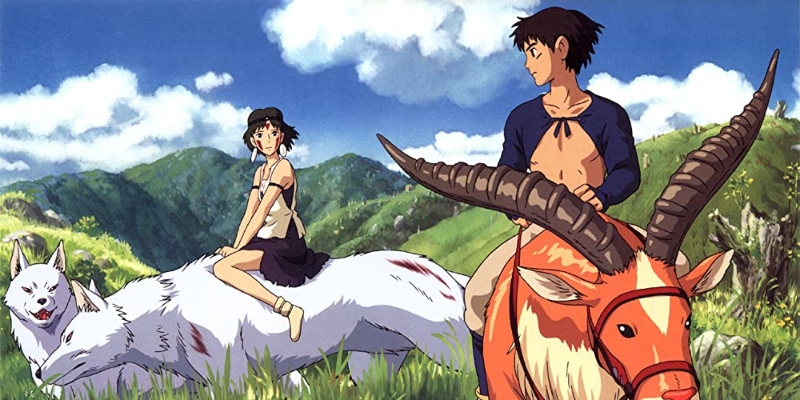
At 133 minutes, Princess Mononoke is the longest animated project Miyazaki has ever directed. It tells the story of Ashitaka, the last prince of the isolated Emishi people. (This was an actual ethnic group which fought against the establishment of the Yamato Empire empire during the 8th century A.D. but was largely integrated, pushed out, and/or wiped out by the early 9th century. They were renown for being masterful mounted archers – as Ashitaka is in the film – but they rode horses rather than elks.) His time is one where ancient Beast Gods still exist, and he is pushed into action when a corrupted boar god attacks his village. In slaying the boar, Ashitaka is tainted by its corruption and becomes cursed himself. Though the curse gives him great strength, it will also eventually kill him, and his one hope to avoid that is to travel west in search of the source of the iron ball found in the boar’s body, which apparently drove the boar god mad. In his travels, he first comes across the monk Jigo, then later San, a human girl who seems to be living with giant wolves.
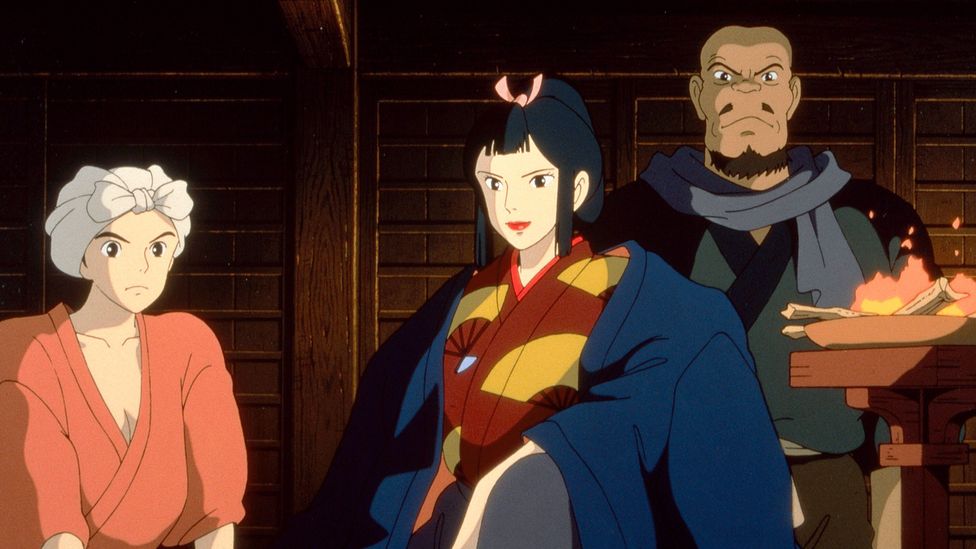
Those encounters, and the discovery of some badly-injured men, lead Ashitaka to Iron Town, a walled village led by Lady Eboshi and built around the smelting of iron ore. There he learns that Lady Eboshi and San – whom Eboshi refers to as “Princess of Beasts” (aka “Mononoke-Hime”) – are mortal enemies in the struggle between the Beast Gods who seek to protect the forests and the humans who seek to expand and secure their industry. A third faction is a samurai warlord who seeks control of Iron Town’s profitable iron, while the monk Jigo leads a fourth in the form of agents of the Emperor seeking the head of the Spirit of the Forest, which is said to grant immortality. Within these conflicts, Ashitaka must struggle to find if there is a way for him to live and a place for San, who is caught between the beast and human worlds without fully being part of either.
Many of Miyazaki’s movies have environmentalist themes as a crucial element, and nowhere in his body of work is that more foundational to the story, or more smoothly integrated into it, than it is here. The central theme – the struggle between nature and man – plays out in the most literal sense here, with a setting on both the figurative and literal border between the decline of the ancient Beast Gods and the rise of humanity. One of the most interesting aspects of the movie is that it largely does not play favorites here. These are life-or-death struggles for both sides, and both sides have their sympathetic elements; like most of Miyazaki’s movies, there isn’t really a true villain. The Beast Gods can’t be seen as evil because they are just protecting their long-standing homelands, but neither is Lady Eboshi a true villain for using her guns and tactics to drive them away. She can be harsh when circumstances demand bold leadership, but her compassion is beyond reproach, too; in Iron Town, she has made a home for former prostitutes and lepers, and she is much beloved and respected for this; they may jokingly say that she wants to “rule the world,” but she is clearly devoutly determined to carve out a place for humanity and advance her people into a new era. If any character who actually appears is a villain, it’s Jigo, who seems to have the most selfish motives but, again, calling him evil doesn’t quite fit.
Some themes, story elements, and artistic stylistic elements present here carry over from Miyazaki’s 1984 movie Nausicaa of the Valley of the Wind, to the point that calling Princess Mononoke a more refined version of Nausicaa wouldn’t be a big stretch. Whereas Nausicaa was capable of being fierce, she usually only used violence as a last resort, but that’s San’s default nature. San is also a much more flawed and reckless character than the almost-too-perfect Nausicaa, which has long made me wonder if Miyazaki didn’t eventually realize that he had idealized Nausicaa too much and designed San specifically with that in mind. Unlike Nausicaa, this one also has a male co-protagonist; in fact, the viewpoint is much more often Ashitaka’s than San’s. Though he has one of the milder personalities in the movie, Ashitaka nonetheless serves well as a noble figure who doesn’t hesitate when action is required and can provide an outside perspective to those caught in the entrenched beast-vs-human conflict. Though he proves to be an indomitable fighter, he is ultimately more valuable for recognizing where priorities should ultimately lie and convincing those on both sides (who often wonder about his motives) to do what’s really necessary to survive.
Another marked difference is that, unlike Nausicaa, Princess Mononoke is primarily a pessimistic tale. It may be awash in natural beauty, but a lot of bad things are happening, whether it’s samurai attacking a farming village, landslides long having wiped out another, the death and destruction from the human/beast battles, or the suffering on all sides. The movie even climaxes in an essentially apocalyptic scenario. A recurring theme is “life is a struggle, but you have to find a way to live,” whether it’s San’s situation, Ashitaka’s curse, the beset citizens of Iron Town, or the disease-ravaged lepers. This is most embodied in one beautiful scene midway through the movie where the Spirit of the Forest heals Ashitaka’s grave injuries but does not remove his curse; Ashitaka may have earned some grace, but he still has to solve his own problems. (This lends a great irony to the climax of the movie.)
If the storytelling has a flaw, it’s in the romantic aspect. Ashitaka is clearly struck by San at first sight, and San more gradually grows to appreciate him as well, but the story just doesn’t have room for their relationship to develop much beyond reciprocation and working together for mutual interest, and truly tender moments between them are few. That makes San’s semi-confession to Ashitaka at the end of the movie ring a bit hollow. But the movie isn’t meant to be a love story at its core, so this isn’t a big problem.
The beauty and impact of the movie shows most in its artistry and animation. Small animation flaws can be spotted if one looks closely, but this is still an impressively-animated endeavor, whether it’s the jaw-dropping complexity of Ashitaka’s early fight against the corrupted boar god (where the corruption constantly squiggles all over the boar like a wave of greasy worms), the terrific fight scene between San and Eboshi in Iron Town, the graceful movements of the wolves and elk contrasted to the lumbering movements of the boars, or the incredible imagery of the Spirit of the Forest approaching the wounded Ashitaka, where every one of its steps causes plants to quickly grow and then decay. The settings are also equally beautiful, whether it’s awe-inspiring primeval forest, the bold functionality of Iron Town, the scenic vistas Ashitaka travels across, or even all the little details of the Emishi village at the beginning. Character animal, and spirit designs have some typical Miyazaki flavor but also shine and carefully distinguish source cultures with even simple differences in clothing design; my one slight gripe here is that San’s apparel seems a little too neat for the way she lives, but she is also one of the most unconventional-looking of all of Miyazaki’s heroines, with the image of her face stained with blood from trying to suck out her wolf mother’s wound being a common advertisement. (The cute little kodoma spirits were also enormously popular, but, frankly, I found them more creepy than cute.)
While many of Miyazaki’s films have substantial action components, Princess Mononoke is easily his most graphic film. Limbs get torn off, decapitations happen, one character gets shot in the back with a firearm, and numerous humans and beast get killed. There’s probably also more blood in this one than in all of Miyazaki’s other movies combined, as well as some occasionally somewhat racy dress for some of the ex-prostitutes. This movie pulled an official PG-13 rating in the States, but consider the movie at the high end of that range; rating it R would have probably been justified.
As beautiful as the movie looks, and as strong as its themes are, the musical score by long-time Miyazaki collaborator Joe Hisaishi binds it all together and elevates the content further. This is also my favorite soundtrack out of all of Miyazaki films, and I still to this day have the official OST in circulation in my musical collection. It soaring orchestral themes and dramatic or melancholy numbers perfectly capture the tone of each scene, whether characters are awed, alarmed, or frightened by what’s going on. Hisaishi has done a lot of great work over his long career, but this is definitely some of his best.
The theatrical event I saw used the English dub made for the movie’s American release. As was common for anime movies at the time, it was given an all-star Hollywood cast rather than done through normal anime dubbing channels (although a few familiar anime dubbing voices do pop up in minor roles, like KT Vogt), with somewhat mixed results. Great casting choices and performances include Billy Crudup (later Dr. Manhattan in Watchmen) as Ashitaka, Minnie Driver as Lady Eboshi, and Jada Pinkett-Smith as ex-prostitute crew leader Toki. A more questionable choice is Clair Danes (who had become a teen star for the TV series My So-Called Life and the movie Romeo + Juliet) as San. Her acting isn’t horrible, but her voice is too deep and rough and she only fully hits the right notes in San’s fiercest scenes. Billy Bob Thornton is also a mixed bag as Jigo, but the problem there may be the English script; he sounds fine in the role, but at times it feels like he’s rushing to get in more dialog than what actually fits the scene. The biggest trouble spot is Gillian “X Files” Anderson as the wolf Moro. Her voice doesn’t fit, and she never truly sounds like she’s embodying the character, but this was also a weird casting choice in Japanese, where her voice sounded more male. (The Japanese voice actor was a relatively famous drag queen.)
I have found that this movie is not necessarily to everyone’s tastes, especially if they are not at least borderline anime fans, and anyone who expects more typical family-friendly anime fare from animation may be in for a big shock. (Disney certainly was when they acquired the title back in the late ’90s sight-unseen, which was probably why its theatrical release at the time was so limited in both theaters and promotion.) Still, it stands as a legitimate animation classic in general, and is one that every anime fan who’s a teen or older owes it to themselves to check out if they’ve never seen it.
Last week, I did a run-through on the various isekai titles for the Summer 2023 season. Despite isekai tending to dominate the fantasy genre these days, this season still had numerous fantasy series that did not involve that trope; at least nine, in fact, and maybe more depending on how loosely you interpret “fantasy.” (I generally classify supernatural tales set in modern day or a real-life historical setting as being in the “supernatural” genre instead, so I am not including Ayakashi Triangle, My Happy Marriage, or Malevolent Spirits: Mononogatari here by definition.) Like with isekai last week, I have not seen all of the titles in this category, but I am current on enough of them to make this exercise worthwhile.
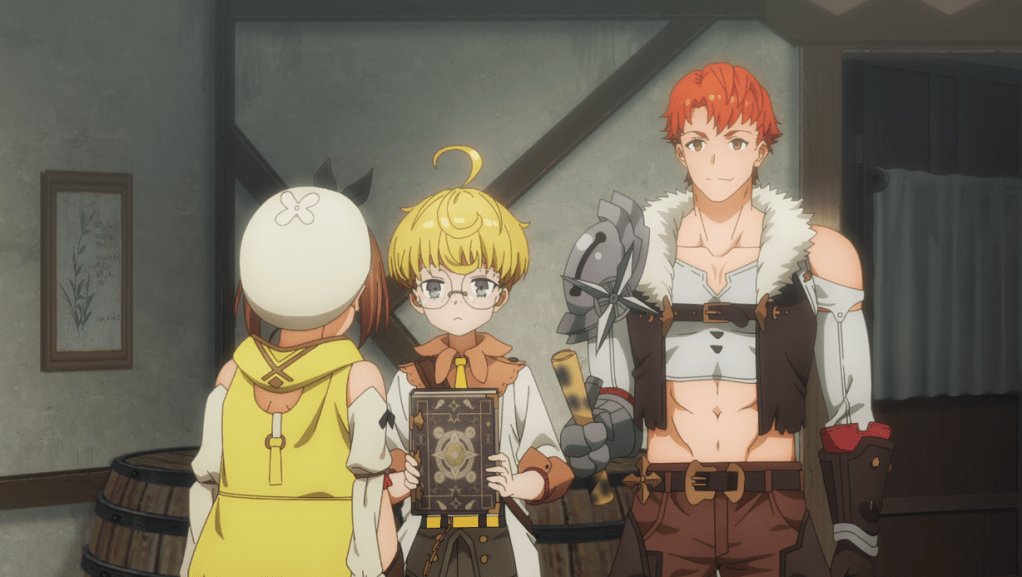
Atelier Ryza: Ever Darkness and the Secret Hideout
Episodes So Far: 9
Got through two episodes of this one before it became a “too full viewing schedule” casualty. It’s a pleasant enough series, and its cheery, bright, simple-minded appeal would make for good stress-relief viewing. Vague hints of mysteries surrounding the backstory of the town Ryza lives in are just intriguing enough that I might go back and finish this one at some point. And no, the emphasis on Ryza’s thighs in episode 1 wasn’t a fluke!
Bleach: Thousand Year Blood War, part 2
Episodes So Far: 8
Rating: B-
Technically this one should probably be classified as a supernatural title, but since the entirety of this block of episodes takes place on other worlds, I’m counting it as a fantasy title for this purpose.
This part could be summed up in two words, for better or worse: “typical Bleach.” Nearly all of these eight episodes consist of the Quincies’ second assault on the Seireitei, and with that comes the predictable array of freaks with extreme powers going head-to-head with named Soul Reapers showing off their own new tricks and/or upgrades (or tricks that simply hadn’t been revealed to this point) in showy battles, while lesser Soul Reapers get wasted. Of those new tricks, the prettiest is undoubtedly Rukia’s new ice form, but the most intriguing development is Kenpachi Zaraki finally achieving the Shikai form of his zanpakuto and the very strong resulting implication that Yachiru may actually have been the spirit of his sword in human form. (Or at least I don’t see any other reasonable way to interpret Yachiru disappearing, with her clothes and equipment left behind, at the time the new form manifests.) Kenpachi seems unaware of this connection, too, but looking back at everything shown about their characters, this twist makes sense. In terms of interest factor, the development outshines even Ichigo’s dramatic return from his training and Chad and Orihime finally getting back into action after being sidelined most of the current arc.
The problem is that all of this has a decided “been there, done that” feel. It’s a good thing that this is the franchise’s last story arc because it is running out of ideas, though it still pulls off some visually impressive sequences from time to time.
Classroom for Heroes
Episodes So Far: 8
Rating: C+
Conceptually, this one reminds me a lot of the Winter ’23 season’s The Iceblade Sorcerer Shal Rule the World, but it uses a far more playful take on the same basic concept – i.e., that an ultra-powerful teenage hero-type has retired after his battles and is now attending school, where he finally gets to make friends and attend classes like any normal teenager. How OP he is despite being limited to 15% or less of his original power is the series’ biggest running joke, but hardly the only one; he already has a dragonling who regard him as her “parent,” is about to get a companion that is a robot guardian, has tamed the dual-personality (female) Demon Lord, and in general keeps getting in one ridiculous situation after another. Predictably, there’s a tsundere redhead who’s also a (literal) hothead and an Emotionless Girl who’s a leftover from an Artificial Hero program, and oh, yeah, the king is such a fun-loving idiot that you have to wonder how the kingdom gets by. Don’t expect much substance here and this might be a fun, simple-minded view, but it sets near the bottom end of my weekly viewing list.
Helck
Episodes So Far: 8
Rating: B-
The concept here is an amusing one: in the wake of the Demon Lord’s defeat at the hands of a human Hero, the Demon Empire must hold a contest to find a new Demon Lord. The problem is that a jovial, well-liked human is actually the front-runner for the title, and he’s so buff and awesome at everything that no amount of sabotage by the contest runners can thwart him. (That is, in fact, an early running joke.) This irritates Vermilio, who, despite her small stature, is possibly the most powerful (and certainly the most volatile!) of the surviving Demon Generals. She does everything she can to find out if Helck is engaged in some devious plot, including going undercover to spy on him. That results in them getting stuck on a remote isle for a few episodes while those back home have to deal with winged humans invading from the human realms.
On the plus side, the series does have some intriguing aspects, such as why Helck is now antagonistic towards his fellow humans, what the Human King is trying to accomplish, and Vermilio’s constant struggle to figure out if Helck is as genuinely good as he seems. (And also why Vermilio doesn’t just step up to be the next Demon Lord herself!) But despite a predominately light-hearted tone, there are darker elements in the background, including Helck being wanted for murder in the human realms and a warning to Vermilio that he may be seething with darker emotions under the surface. However, the sillier parts are sometimes just so ridiculous that they interfere with taking other parts seriously, and outside of Vermilio and Helck, the cast doesn’t amount to much. This is a series that I really want to like (especially for Vermilio), and it can be fun, but I am still finding it hard to get enthusiastic about it.
Reign of the Seven Spellblades
Episodes So Far: 8
Rating: B
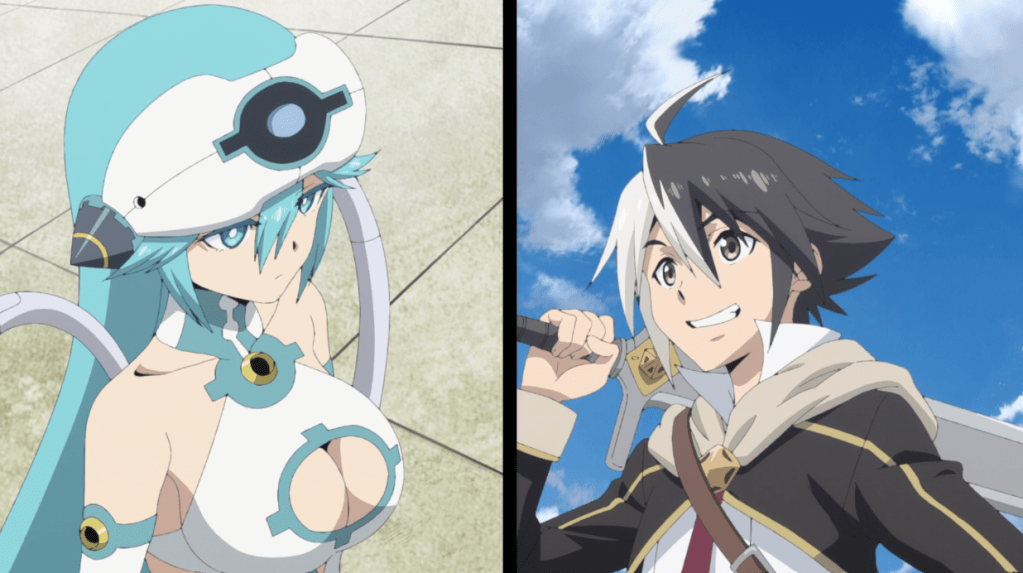
Initially, this one looked like a Harry Potter clone, and even after eight episodes it still has not entirely escaped that impression despite largely eschewing the sense of wonder about magic prevalent in the first few Harry Potter novels/movies. However, the series has started to stake out some fresher territory by showing early on the depths of the scheming going on at the school, and that one of the protagonists was deeply enmeshed in that scheming before even coming to the magic academy. The sense of the story operating at two levels, with the protagonist not just stuck at the bottom level, makes this distinctly more compelling. Nanao being a character who’s plenty easy to like and root for is another plus, as do the generally good technical merits and some slick action scenes. The “reversi” concept used in episode 6 is also an interesting idea, and I did like that a magic school series actually bothered to bring up that certain types of magic might work differently for different sexes or posit that flying brooms are actual living creatures.
Not everything works here, especially how much of a drop-off there is in cast appeal beyond Nanao and (to a lesser extent) Oliver. However, there’s enough promise of a bigger developing picture that I can look forward to this one each week.
Sacrificial Princess and the King of Beast
Got through three episodes on this one before it became a viewing casualty, so I am not current enough on it to comment.
Saint Cecilia and Pastor Lawrence
Only got through one episode on this one, so no coverage here beyond its Preview Guide entry.
Sugar Apple Fairy Tale
Only got through two episodes of the first season before it became a “too full schedule” casualty.
The Misfit at Demon King Academy
Episodes So Far: 2 new ones this season, 8 total
Rating: 3.5 (of 5)
The second season of Misfit was pretty convoluted in its plot and word-building to begin with, and taking two seasons off between the original airing of episode 6 and the airing of episode 7 did not help. I highly recommend at least skimming through the first six episodes before moving on with episodes 7 and 8, as there are all sorts of details spread across previous episodes which need to be held in mind for 7 and 8 to make any sense. The trip back in time is allowing the series to fill in some important swaths of backstory gaps without resorting to info dumping, but it has also reduced the spotlight shining on Anos, whose unshakable confidence and balance of arrogance and caring nature is the main reason to watch this one. Despite being hard to follow at times, the story is doing a reasonably good job of challenging the indomitable Anos while developing further the setting’s unusual take on the nature of Spirits and the complexity of millenia-spanning schemes.
Yohane the Parhelion – Sunshine in the Mirror
Even though I’m not a Love Live! fan, this alternate-setting story still looked mildly interesting. Alas, it was a casualty of a very full viewing roster for the season, so I can only offer Preview Guide coverage of it.
The Summer season features seven isekai titles and one reverse-isekai title. I have followed six of these beyond the first episode (the exceptions being Sweet Reincarnation and The Great Cleric). With all of these series now having completed at least half of their season run, let’s take a look at how each of them is faring.
(Note: Order below is based on the order in which they debut each week.)
Mushoku Tensei: Jobless Reincarnation s2
Episodes so far: 8 (including episode 0)
Rating so far: B+
Episode 6 dredged up a whole big controversy involving the episode’s blasé application of slavery, and then episode 7 followed it up by having him effectively kidnap two beast girls who dared destroy one of his Roxy figures. I’m pretty sure that whole sequence was intended to be an exercise in earthy humor, but the original writer’s sense of comedic execution has been shaky before, and that whole sequence was more uncomfortable than fun.
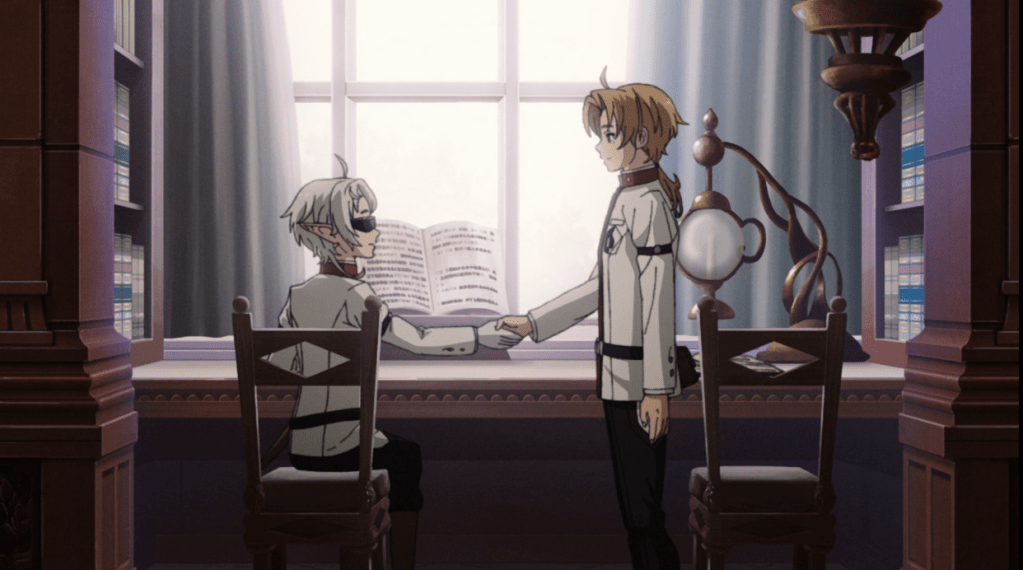
It’s a shame that this more objectionable content is getting in the way, because it is overshadowing a very welcome development: Rudy being reunited with Sylphie at the Magic Academy. Of course, he’s not currently aware that Fitz is even female, much less Sylphie, but seeing the way she’s bonding anew with him as a teenager as she patiently waits for him to figure it out has been quite enjoyable, and new apprentice-not-slave Julie is suitably endearing. The new setting has also introduced plenty of new characters (and the return of a previous one!) and a large number of possible story angles, so there’s lots of fodder her for a good run the rest of the season. (And novel readers assure that the sketchiest parts are now past, too. . .)
Reborn as a Vending Machine, I Now Wander The Dungeon
Episodes So Far: 7
Rating: B
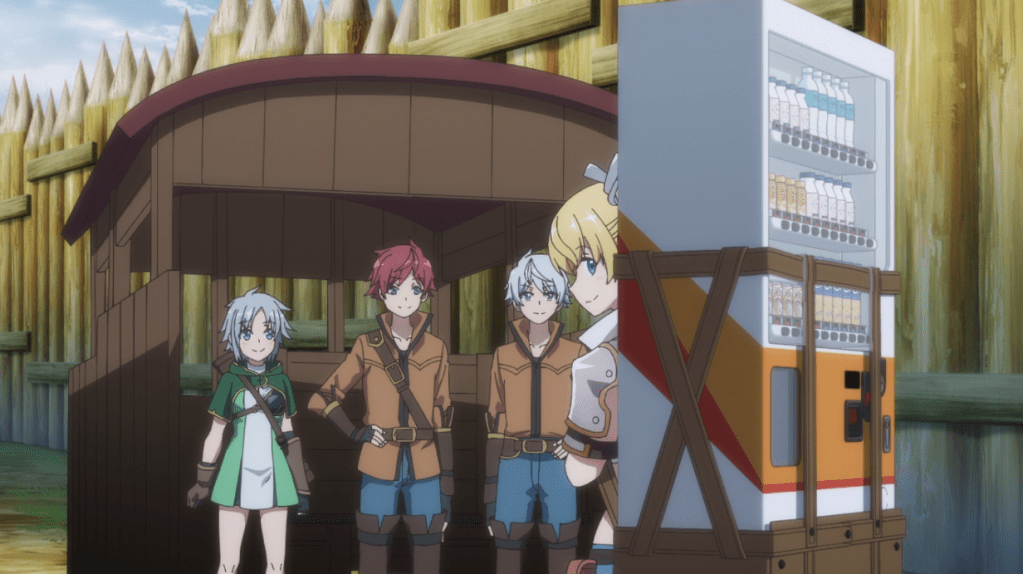
This isn’t a great series by any means, and it has certainly had some issues with artistic quality control (the last couple of episodes have looked a bit rough), but the series is making the most out of its bizarre spin on standard isekai fare. A lot of the credit for this goes to the central characters. Boxxo is quite engaging in the way he has to find creative ways to do even basic things like communicate, but Lammis is nearly as much of a star as his veritable partner. She has an invitingly cheery personality, is sexy without being sexualized, is sharp enough to quickly figure out how to communicate with Boxxo, and looks completely natural both carrying Boxxo around in a harness and attacking like a pugilist. I also love the creative ways that the story works in the vending machine angle in every episode. This one could be appreciable even by those who are not normally isekai fans.
The Devil is a Part-Timer! s2 p2
Episodes So Far: 6 this half (18 overall)
Rating: B-
This one has also had some occasional artistic quality control issues, though not as much so as Vending Machine. While these six episodes have had some moments, overall the second half has not risen above the largely-lackluster delivery of the first half. A lot of the blame for this involves the series having to slog through some of the franchise’s weakest source material, though Emilia’s return to Enta Isla (and especially her failure to come back on schedule) is pushing the story towards one of the most plot-dense parts of the overall storyline. The introduction of Emilia’s father and Alas Ramus’s “younger sister” Acieth are also promising developments, but even so, the production only occasionally accomplishes the flair which made the first season so much fun to watch. At least in this case we know that the franchise is capable of better, and scenes like the one shown above are still juicy, so there is legitimate hope for more.
The Most Heretical Last Boss Queen: From Villainess to Savior
Episodes So Far: 7
Rating: B
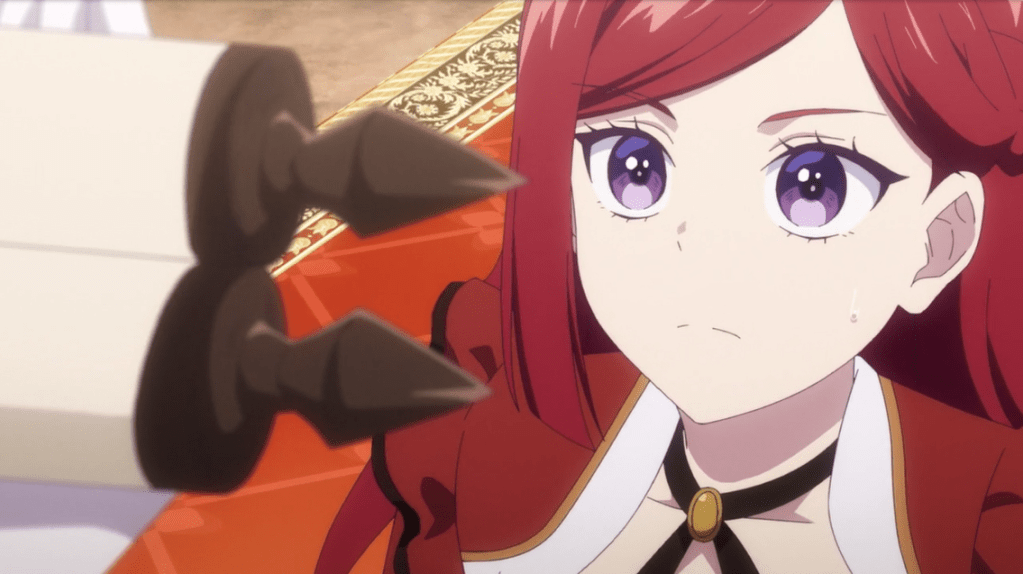
This one has also had some artistic issues, though more because of limited animation than artistic consistency. That aside, it has been a surprisingly engaging series, with Pride being desperate to avoid descending into the wickedness that distinguished her role in the game but still adopting a somewhat fatalistic attitude towards that outcome; she even still regards here younger sister Tiara (the protagonist of the game) as the “true Queen” even though she’s formally been recognized as the heir apparent. Seeing how she takes advantage of her strength as the game’s “last boss” has also been a treat, as has seeing the way she has engendered more trust and loyalty than she fully appreciates by changing the direction of several key characters. It’s not on the same level as last season’s How Raeliana Ended Up at the Duke’s Mansion because it lacks a true foil for Pride and a sense of mystery, but it has established some of its own appeal.
My Unique Skill Make Me OP Even at Level 1
Episodes So Far: 7
Rating: C+
Artistically-speaking, this is one of the weakest series of the whole season (not just among isekai). Its storylines so far have also been far from exciting. Still, the story has just enough plusses to make it barely-watchable. One of these is the enjoyable and wholesome relationship between Ryota and Emily, though the series has yet to clarify if Emily is a member of a shorter race or just a small human; her demeanor certainly suggests that she’s older than the child she looks like she is. The other is some somewhat interesting world mechanics, where food production is entirely based on dungeon drops, and taking drops out of the dungeon and leaving them unattended for a while can cause them to turn into monsters – but monsters who can leave special rare drops when defeated. The most recent two episodes have also introduced a new female character, one who, based on the OP, will become a regular. A solid English dub also doesn’t hurt.
This is never a high-priority view for me, but if you want a more low-key isekai then My Unique Skill fits the bill.
Am I Actually The Strongest?
Episodes So Far: 6
Rating: C
A combination of production difficulties and scheduling conflicts have knocked this series out on two different weeks now, but thanks to being one of the season’s earliest debuting series, it doesn’t feel much like it’s behind. That may have helped the production standards, as this one looks better (and maintains its quality control better) than some other series in this grouping. However, the series has problems elsewhere which become increasingly apparent as it progresses. One is essentially hand-waving the technical side of how Haruto is able use his barrier magic to do basically anything, whether it’s heal, make a clone, or even effective create cable and Internet service to allow his little sister to become a budding otaku. That is related to the bigger issue of genre clash and intense anachronisms; flying around like a masked super-hero is one thing, but anime productions being viewable in this world, too? Adding in one of the most pathetic dragons you’ll ever come across in fantasy anime doesn’t help, either. There is at least some potential in a developing plot involving how the mother that abandoned Harutdo may have her sights set on either controlling or eliminating Haruto’s sister Charlotte, and in general this world does seem to have a more established Big Picture, but even as power fantasies go, it’s standing on shaky ground so far.
I had intended to have this review up last week, but a certain large gaming convention and the hectic start of the school year got in the way. Hence, I will still take care of this first and then do the mid-season Isekai Round-Up next week.
The airing of this reboot of the original 1996-98 TV series has been quite controversial in some circles, to the point that Anime News Network isn’t covering it at all beyond a news article about its premiere at Anime Expo. I understand why and cannot fault their reasons1; indeed, the series’ baggage makes me uncomfortable, too. However, I also feel that this is too big and important a title to entirely ignore. Hence, I am going to review it based on what it is and leave readers to decide if the baggage overrides everything else.
Really, it’s a shame that the series is saddled with this baggage, as through the first six episodes this has proven to be a sharp and mostly satisfying remake. The story follows Kenshin Himura, who was a manslayer on the Imperial side during the Meiji Restoration in Japan (i.e., 1868). Ten years later, he’s but a humble wandering ruroni (essentially, a ronin), who has forsworn killing and lives a peaceful life as much as possible. He winds up getting involved with a dojo headed by Kaoru Kamiya and at least temporarily settles down there. Soon they are also joined by the proud, short-tempered orphan Yahiko and the brash, challenge-obsessed warrior Sanosuke. Despite Kenshin’s efforts to be peaceful and happy, challenges still arise that he cannot ignore, including con men, thugs, yakuza, an overly-aggressively police unit, and even another former manslayer from the other side of the political fence.
In other words, this is a fairly standard shonen structure, with its main distinguishing point being its historical context; nearly all of the characters who actually appear may be fictional, but the names and events referred to and the issues that are shown are very much real. However, this makes for a big difference, as it helps give the series a grounded, authentic flavor that most other shonen series cannot even come close to matching. Mostly eschewing the slapstick elements which characterized the first series also helps, as the more serious air it gives the series allows Kenshin’s contemplation of his past and his very conscious efforts to stay cheery to carry more weight. That isn’t to say that the series is entirely without humor; bits do still show through, but they are much more restrained and distract less from the broader tone of the story content.
Of course, standard shonen tropes like named special movies still apply, and what would a shonen action series originating from the ’90s be without the lead female character getting kidnapped or otherwise imperiled on a regular basis? That Kaoru doesn’t do more herself is the most annoying aspect of the series so far, but her kind heart does also lay at the core of the series. The normal process of introducing and establishing core cast members also takes up the bulk of the first five episodes, with a real advancing storyline only beginning with episode 6 and the appearance of the rival manslayer. This brings up the question of whether someone who has renounced the ways of the manslayer can still stand up to one who never gave it up, and I look forward to seeing how the series handles this.
On the technical front, the LIDEN FILMS production looks great, with designs and backgrounds that are maybe even a step above the original. The animation takes shortcuts, but does better than most at feeling exciting despite its limitations, and has maintained good quality control so far. The musical support has also been solid, although the hard rock-themed open “Hiten” is going to be very hit-or-miss.
If you can set aside the baggage (or it doesn’t bother you in the first place) then this is one of the season’s better action series.
Rating: B+
Original manga-ka Nobuhiro Watsuki was charged and fined for possession of child pornography in 2017/18, so some feel that any promotion of the title amounts to supporting a convicted possessor of child porn. ↩︎
This is an ONA series consisting of six episodes – a 45-minute first episode and five additional episodes ranging from 27 to 30 minutes long – with a total run time roughly equivalent to an eight-episode TV series. It is based on a pair of novels by Carlo Zen, the author of the Saga of Tanya the Evil novels (which is probably why it got made in the first place) and debuted on Netflix back in May. I did not get to it at that time because I was way too busy with other things and then, frankly, forgot it existed until recently. Hence, consider this a make-up review.
The story is set in an indeterminate year “decades” after an interstellar Trade Federation came to Earth, overwhelmed it with superior technology, and subjugated it. Now, Earth as a whole is equivalent to a Third World country, with its citizens not considered “beings” by Trade Federation standards and its only exports being food and mercenaries, derisively called Yakitori. The death rate for Yakitori is so high that an ethnically diverse squad of five newcomers is assembled into unit K321, with the intent of training them a different way. After a year of said training, K321 is shipped off to Barca, a planet that the Trade Federation is “aggressively” negotiating with, where they get their trial by fire. Different training does, indeed, wind up getting different results, though not necessarily in the way that was intended – or was it?
Carlo Zen’s specialty is detailed descriptions of military minutiae and tactics, especially how advanced technology (or, in the case of Saga, magic) can affect both, and that stamp is evident throughout this series. That helps flavor what is otherwise a fairly conventional tale about a bunch of misfits thrown together who must learn to use creativity and teamwork to survive. Personality distribution is also fairly standard: nominal protagonist Akira is the angry guy who always wants to do his own thing but can be a decisive leader when he commits, Zihan is the analytical woman, Amalia is the snappy Brit usually at odds with Akira, Swede Erland is the peacemaker, and American Tyrone is the affable buddy-type. While the conflict on Barca plays out, the writing intersperses battle scenes with flashbacks showing how the group came together, trained, and eventually came to understand that they had to work together to succeed, including a showdown with one of the most stereotypical drill sergeants imaginable. They all work for a slick recruiter (who has a Russian accent in the English dub) who constantly gives the impression of scheming something and regularly interact with a military AI name Hatsune who’s a blatant rip-off of vocaloid Hatsune Miku.
A healthy chunk of the content is action scenes, and that’s where the strength of the series lies. Battle choreography is crisp and detailed, with the best scenes featuring conflicts with very nimble spider tanks. The all-CG animation is smoothest in those scenes, while depictions of character movements (especially for human characters) can sometimes look a bit stiff; essentially, if you normally are bothered by CG animation, this series’ visual effort probably won’t overcome it. Also expect plenty of bloody content; the animation does not revel in it, but this is still on the harsher side of the sci fi action genre. The closer also features some very involved animation of a mouse-themed Hatsune dancing to an electronica version of Mozart.
In fact, that’s the one visual aspect which could throw viewers off even if the CG animation isn’t a problem: all of the alien races are anthropomorphized Earth animals. I can tolerate a lot from alien designs, but especially given how detail-conscious Carlo Zen’s writing is, this just seemed lazy. It heavily interfered with my sense of immersion when the series has zebra-people keeping records in a trial and various different breeds of dogs (among others) as soldiers, though the bulldog commander Rimel did at least make a positive impression as a character. Having the population of Barca be all rat people was a little more effective, but the design elements just made the whole thing feel like more of a joke than it may have been intended to be.
The series is offered in the normal array of Netflix dub and subtitle options. The English dub is a mix of newcomers wand long-time veterans, but all of the roles are cast well. Performances are generally good, though a few awkward pauses were noted as voice actors stretched to match lip flaps. Interestingly, the AI Hatsune is still voiced in Japanese even in the English dub, perhaps because the actual voice of Hatsune Miku is used for the role.
Overall, the series provides decent but not spectacular military-themed sci fi action without requiring a big time commitment, Don’t expect much of anything for depth or extensive character development and this makes for matchable (but ultimately also disposable) entertainment.
This is the first installment in a rotation I intend to do for the Summer 2023 season, where each week I will choose one title that I’m following and look at what it’s doing so far/since its last review. I am starting with this one, but I also intend to cover Rurouni Kenshin and one or two others that are likely to fly under the radar, including possibly The Dreaming Boy is a Realist and perhaps one or two others that show signs of doing something interesting.
Rating: B for episode 1, B+ for episode 2, A for episode 3.
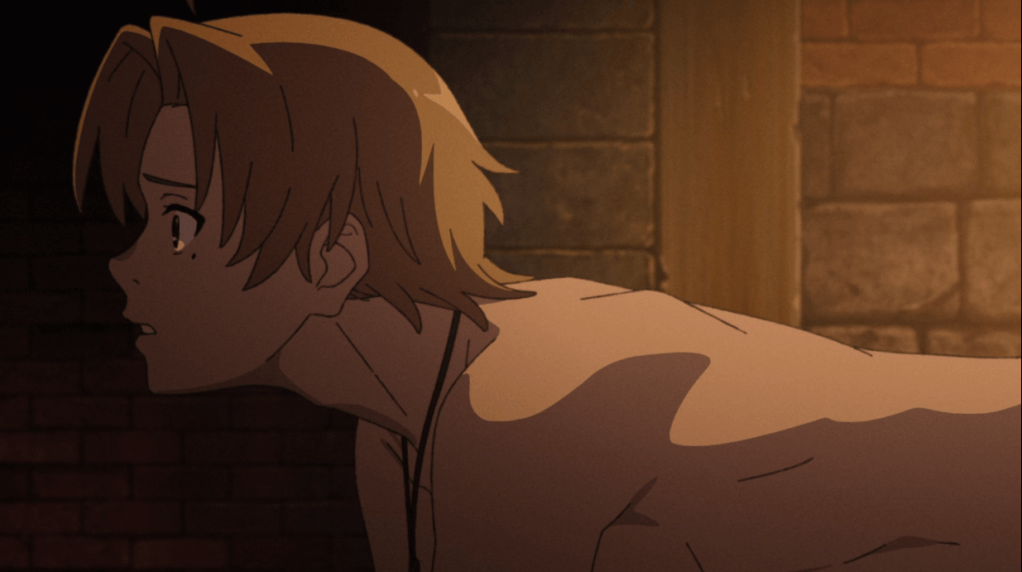
After spending episode 0 looking at Sylphie, the focus firmly returns to Rudeus for the season’s short first arc, and he’s not in a good place. He did hit the road with the intent of looking for his mother after Eris left him behind, but he’s still struggling with a strong sense of abandonment and isolation even as he tries to make a name for himself as an adventurer up north. That gets him involved with an established party of adventurers called Counter Arrow, and in particular with their youngest member, the archer Sara. She’s quite prickly towards him at first, but her disposition noticeably changes after Rudeus endangers himself to save her life. The problem is that she has unwittingly chosen the absolute worst time to get interested in Rudeus, who’s nowhere near as ready to move on (romantically or sexually) as he had convinced himself he was.
I have heard some complaints about an initial drop in animation quality compared to last season, but frankly, you have to watch very carefully to catch any of it, and episodes 2 and 3 seem like distinct improvements. Episode 1 and especially episode 2 do offer some nice action scenes which give both Rudeus and others chances to show off, but those scenes are practically afterthoughts compared to the bigger character development afoot. Rudeus is in a deeper emotional hole here than at any point since his reincarnation, and as episodes 1 and 2 plainly show, there’s only so much that he can do to climb out of it on his own. Association with Counter Arrow seems to be helping some, but it’s not enough. Unlike in most such situations in anime, though, a new girl in his life isn’t the answer; in fact, his abortive fling with Sara only makes things worse, not better.
That the series actually takes time to explore this fully is part of why episode 3 is such a stand-out. Anime series willing to tackle issues like sexual dysfunction are an extreme rarity, but Rudeus certainly has reason to have a hang-up, and Sara – who’s probably not much older than Eris – isn’t mature enough to be sensitive or understanding about it. Granted, Rudeus isn’t shown doing anything to reassure Sara that his inability to perform isn’t her fault, but Sara going all tsundere on him at that moment – when she was clearly interested in him and only using “obligation” as an excuse – was the worst thing she could have done. Rudeus’s later drunken, ill-timed counter-bashing certainly earned him the slap Sara gave him towards the end of the episode, but Sara was hardly blameless overall.
The interactions with Sara make for an interesting comparison/contrast to Rudeus’s later interactions with the prostitute. Beyond it being her job, she was also grateful to him for the free healing he gave to her sister (the random little girl early in episode 2), but she was far more mature than Sara in every respect. Perhaps because he had collected himself a bit by that point, Rudeus did make a point this time of assuring her that the problem was all his and not hers, which may have contributed to her giving him advice: he needs a woman he can feel safe with to get over this. Though he first thinks of Roxy, given the last episode of last season and the first episode of this one, Sylphie seems the more likely candidate at this point.
The other interesting facet of episode 3 is the adventurer Soldat. (Interesting name choice here, since that word also is the lowest enlisted rank in multiple European armies.) He was an outright prick during his appearances in episode 2, but he did at least have an angle: he couldn’t tolerate someone being a fake or a pushover. That makes his change of heart in this episode interesting and appreciable, as he seems to respect Rudeus more for venting (even if on him!) rather than just faking it and even seems sympathetic enough to hear Rudeus out about his Man Problems. As the episode progresses through the second half, it gradually becomes clear that Sol, as coarse as he is, is exactly the kind of friend Rudeus needs right now. Whether in this life or his previous one, Rudeus hasn’t ever really had a guy friend; Ruijerd was the closest, but he was a guardian figure, not a true friend. Sol can better see him eye-to-eye and talk frankly with him about sexual matters (again, something you hardly ever see in any other anime this side of Interspecies Reviewes) and won’t put up with Rudeus’s BS. I can see this being a positive influence long-term.
The appearance of a certain sex-crazed elf in the epilogue shows that a reunion on another front might not be far off, either, though the next episode title seems to point in a different direction. Regardless, the story seems ready to move on to the next stage after getting this largely satisfying character-development arc in.
Bonus Random Thought: This series has featured some excellent character designs, but I particularly liked Sara’s look. The short hair implies her tomboyish side, but without distracting from her emerging sex appeal.
Now that the seasonal Preview Guide is over, I’m planning to post a couple of reviews that I had been putting off. This is the first; expect Yakitori: Soldiers of Misfortune to be coming next week.
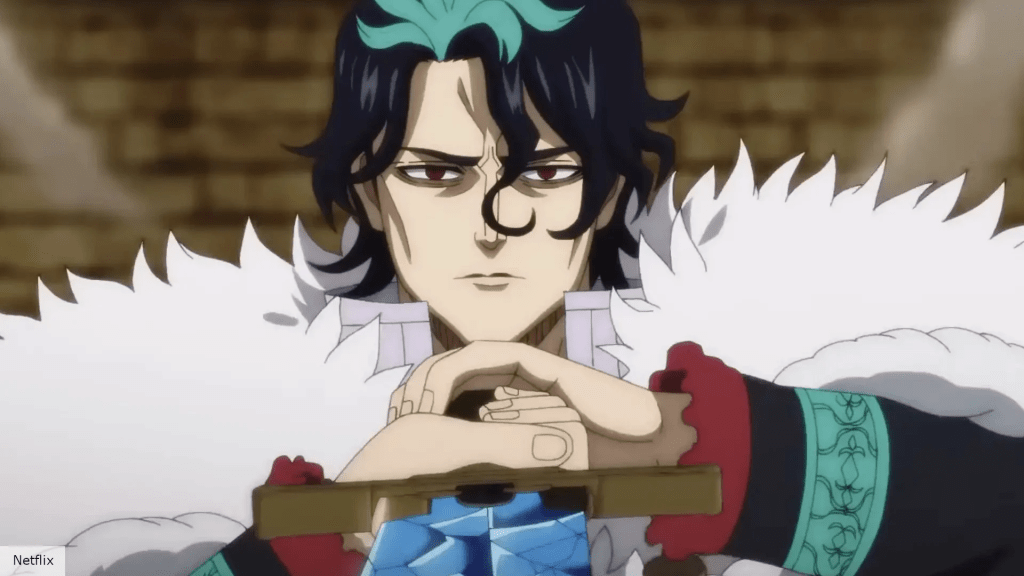
Movies connected to shonen action franchises are often non-canon affairs, designed to show off the cast and their abilities in lavish fashion but not intended to advance any meaningful plot or character developments. The recently-released Black Clover movie falls squarely into this category. Though chief antagonist Conrad Leto (pictured above) and his sympathizers are reportedly considered to be canon characters (original manga-ka Yuki Tabata consulted on the movie), the events of this movie are an original story which, at best, fits awkwardly into the existing timeline; based on the characters shown and their current statuses, this would have to happen in the six-month gap between episodes 129 and 158 (i.e., between manga chapters 228 and 229), but enough is going on during that time that retrofitting it in would severely camp the story. Hence it’s hardly necessary viewing for franchise fans, but if you are a franchise fan, why would you miss a chance to see favorite characters show off?
For movies like this to be considered successes, they must accomplish three tasks:
They must look flashier than the base series.
They must include as many characters from the base series as possible.
They must give as many characters as possible opportunities to show off what they can do in glorious fashion.
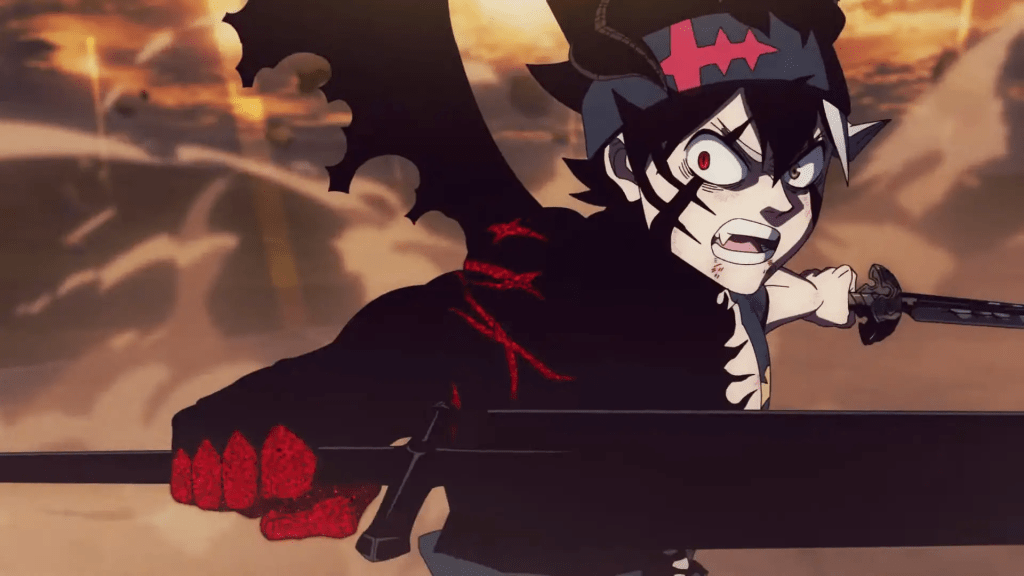
Sword of the Wizard King hits on all three of these points. The base series occasionally had some impressive animated sequences, but the opening flashback establishes immediately that the movie clearly had much more time and budget than normal. Elaborate, extended action sequences are a predominant feature – in fact, they make up more than half of the movie’s roughly 110 minute running time – and in general the franchise has never looked sharper in any visual aspect. In fact, what little there is for a plot is really just an excuse to string these feature action sequences together and allow a plethora of characters to get involved.
And boy, is the movie inclusive! Most of the named Clover kingdom residents who appeared prior to episode 130 have at least one or two cameos, whether Magic Knights or ordinary citizen that Asta encountered somewhere along the way. All of the Magic Knights – and in particular, the captains and Black Bulls – get plenty of opportunities to show what they can do as well; even Julius gets to shine in the flashback, though the fact that he is depowered (due to his resurrection) is a key plot point in the current time of the movie. Beyond the story’s main players, Mereoleona is the one who stands out the most, as she finally gets to show what she can do when she goes absolutely all-out against an opponent on her level in one of the wildest and most gleeful battle sequences. As expected, this requires characters to get innovative with their magic, and several combo moves (including some of a nature that I don’t think we ever saw in the main series) are present as well.
That’s good, because the plot here does not amount to much. It’s a familiar ploy for these types of movies: someone who was sealed away years ago gets free and causes kingdom-threatening trouble until he can be put back in his place again. In this case, it’s Conrad Leto, Julius’s immediate predecessor as Wizard King, who was deposed and sealed away a decade earlier after getting the idea in his head that the only way to correct the problems and inequities in the Clover Kingdom is to utterly destroy it and start over again with only chosen individuals. (In other words, villainy via taking the easy way out.) To this end, he obtains the titular sword, which stores the power of all past Wizard Kings, and recruits other past Wizard Kings, who sympathize with his cause, as minions. Naturally, most of them of them have unique magic specialties, including generating shields, creating armies of CG-animated golems, and creature magical keys which can open and close magical rifts (the other past Wizard King just has ordinary but high-end ice magic), and all operate on power levels that require opposition either from Magic Knight Captains, from entire squads, or from Asta. And that’s it. Villains get to be well-intentioned in their goals but misguided in their methods, while Asta (and sometimes others) get to espouse the franchise’s core values about persistence, acting for the people, etc.
In other words, if you’re expecting anything original or that requires brain cells to analyze or interpret then you won’t find it here. This is simple, direct fun, and if approach purely on that level, the movie won’t disappoint. It is currently legally available only on Netflix, with the normal array of dub and sub options available.
A fairly stacked spring season has finally come to a conclusion, so it’s time to take a look at how an assortment of titles turned out.
Title of The Season:Oshi no Ko
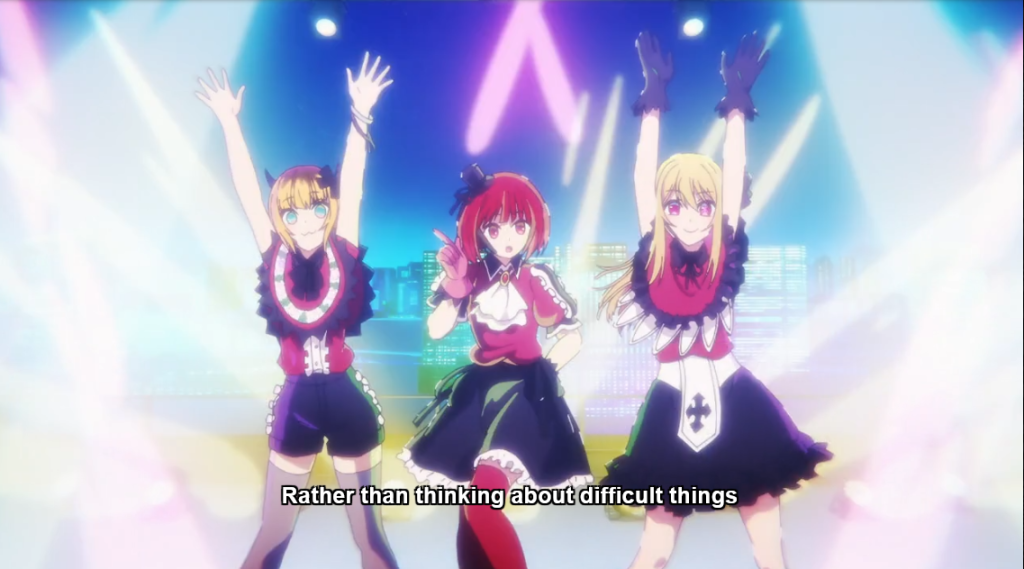
I have covered this series extensively in episode reviews, so the only additional commentary I’ll add here is that it is solidly my pick for the top title of the season. Its balance of humor and serious content was sometimes a little awkward, but no series this season was its equal in terms of depth of thematic development and it had only a couple of equals on character development fronts. Combined that with insightfully biting industry commentary, bold twists, strong direction, and terrific feature songs and you have a strong candidate for the year’s top series. A handful of other series were legitimate candidates for runner-up, and they will be noted in individual entries below.
Featured Title: The CaféTerrace and Its Goddesses
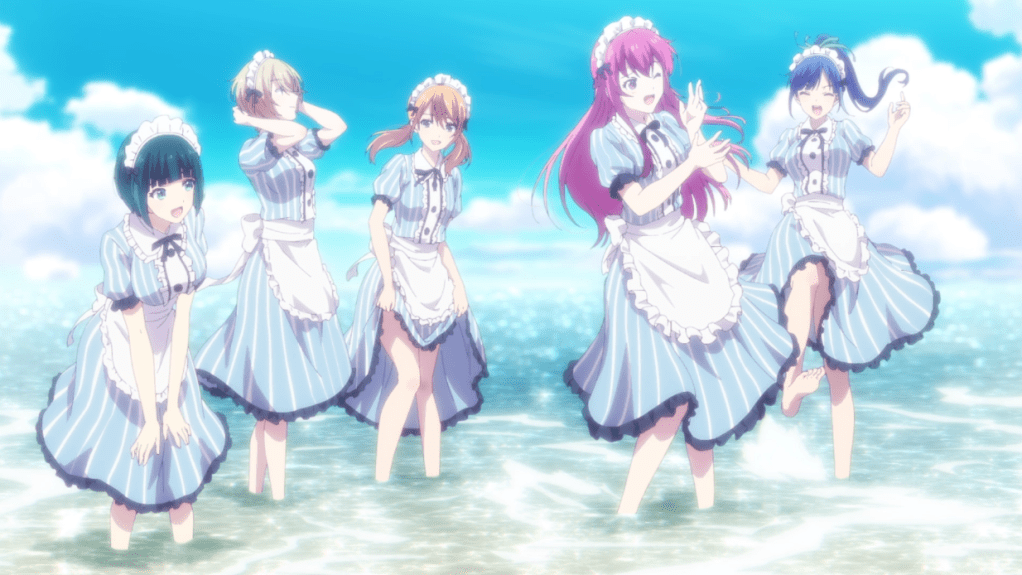
This title – which I marathoned most of during the season’s last week – was not one that I initially expected to give more than a blurb to, but in the end it was the one I felt I had the most to say about even though it clearly was not among the season’s best. The premise is fairly basic: a Tokyo University student returns home upon the death of his grandmother (his only living relative) with the intent of tearing down the house and adjoining café, but discovers five young women that his grandmother had been boarding living there. They eventually convince him to reopen Café Familia and serve part-time as its staff while attending high school (one), college (two), technical school (one), or job-hunting/band-leading (one). Though the relationship between the new owner and the girls is mostly prickly at first, both sides gradually learn to work with and even appreciate the other. And is love in the air, too?
While this series is classified by some as a romantic comedy, labeling it a romantic dramedy might be more accurate. It certainly has its humorous elements but takes itself seriously just as often, mostly through analyzing four of the five “goddesses” in detail; dumb, immature jock Ami is the only one left out, but unlike the others, she also gives no indication of any major complications in her backstory. Among the other four, two have different kinds of family issues that they are escaping from by living there, one is trying to dodge a past as a child actor (which she feels tore her family apart), and one is guarding a secret on behalf of the grandmother. Along the way, Hayato learns (sometimes the hard way!) how to not be a jerk as he gives his own brand of help to each girl in turn. Naturally, some of the girls gradually fall for him in the process, and a scene in the final episode reveals that he did eventually end up marrying and having a daughter with one of them – though that scene is, of course, coy about which one it was. After all, a second season has been green-lit for 2024, so you can’t spoil the fun this early, right?
If all of the above sounds like one of those old-school shows where the male protagonist goes around solving the problems of all of the girls, you wouldn’t be far off. Protagonist Hayato’s more acerbic personality sets him apart from the typical “male insert” feel of the such male protagonists, but the familiar structure is still there. A decided harem element does also gradually develop, with three of the girls openly expressing romantic interest by the final episode. (The idiot also declares love, but the feel is that her interest isn’t romantic.) The harem element is also supported by liberal doses of fan service; this is heaviest in the early going but never fully goes away and is occasionally even used deliberately by the girls to tease or otherwise distract Hayato.
While the series is graced with sexy designs, good artistry in general, and surprisingly solid animation, I found big portions of it to be a slog. The main problem is that the series is clear on what it is trying to accomplish but doesn’t achieve the emotional resonance necessary for its content to be fully effective. Some of this stems from using too little set-up and depending too much on stock gimmicks, and it doesn’t help that the series throws in some slapstick-style humor which would feel more at home in more purely comedic fare. And despite the camera being guided by a male eye, the girls at times get away with being outright mean to Hayato, while he gets blamed for much more than he’s responsible for. Even so, just enough of the humor, sexiness, and drama lands for the series to not feel like a total waste. I doubt I’ll be back for the continuation next year, though.
Overall Rating: C+
Other Titles I Finished
These are ordered by when they aired during the week. (Certain titles that I watch multiple episodes of but did not finish – like Kuma Kuma Kuma Bear Punch! – are not covered here.)
Mobile Suit Gundam: Witch From Mercury part 2 (Rating: B+) – This cour certainly wasn’t dull, with a ton of major reveals and twists to go along with respectable action scenes and some thematic depth. The course of events was very Gundam-esque, which in layman’s terms means that the story gets messy and political and not everyone survives, but I mean that as a positive here. The season was hampered some by the distance maintained between Miorine and Suletta (as the relationship between the two was an important factor in the first half), but I liked the character development course it offered for Suletta in particular and the way some other characters matured over the course of the story as well. Its strong (and complete!) ending isn’t entirely without flaws, but it should be very satisfying to most fans and helps elevate the series into Top 5 status for the season.
The Aristocrat’s Otherworldly Adventure (Rating: C-) – The rating for this one might be even lower if not for a handful of stronger scenes here and there, but the ridiculously over-the-top nature of the protagonist’s abilities overwhelmed what other few positives the season may have achieved. It’s not a series I can recommend even to dedicated isekai fans.
Demon Slayer: Swordsmith Village Arc (Rating: C+) – A lot has been said elsewhere about the flaws of this season, so I’ll only add I find most of the criticisms about it to be fair ones. It would get a lower score if not for Nezuko’s status at the end (and how this cleverly plays into the overall plot rather than just being a feel-good detail) and the fact that it still looked damned good even when tediously stretching things out.
Why Raeliana Ended Up At The Duke’s Mansion (Rating: B+) – I almost made this one my feature piece instead and would consider it for my Top 5 for the season. Certainly it was the pleasant surprise of the season for me, as through to the end I found it unexpectedly enthralling, to the point that I would look forward to more if a second season ever gets made. Though the second half of the series continued to suffer on the animation front, Raeliana was a delight to watch in action, character development was solid elsewhere, and it plays with intriguing notions, like what happens to a story when a character thrown into it completely disrupts its course? And did the intended protagonist of the story possibly have wholly different (and wholly less wholesome) motives than what was told in the story the protagonist knows? Accompanied by a stellar English dub, it gets a high recommendation from me.
Dead Mount Death Play (Rating: B) – This one’s weird balance of very dark and comedic elements remains fun through to the end, though I have to knock it a bit for the somewhat awkward and (comparatively) low-key way it shuffles into a seasonal break. (A second season is coming in October.) The dynamics of the setting that the reincarnated Corpse God finds himself in continue to be interesting as the series delves deeper into host body Polka’s family, police investigation into supercriminals, and (in one of the more surprising twists) one of those supercriminal’s own investigations into hints of a secret organization that may be connected to Corpse God’s original world. Will definitely be back for more in the fall.
I Got a Cheat Skill in Another World. . . (Rating: C+) – This one loses a bit of its early luster as its second half slides more towards typical harem tensions, and its limited animation in action scenes never improves, but the strengths that set it slightly above the bottom-feeding isekai of the season still remain: gorgeous character designs, a protagonist who’s more relatable due to his insecurities, and a lead love interest who was interested in Yuya before he became a stud (and seems a bit threatened by the broader interest he’s drawing now that he is one). The thing with the talking rabbit who trains Yuya in kick attacks is just weird, but some plot expansions late in the second half and the addition to the regular cast of the assassin girl liven things up further. If a second season gets made, I’ll probably be back for it.
KONOSUBA – An Explosion on This Wonderful World (Rating: C) – Kinda hate to give such a low grade to a spin-off of one of my favorite isekai franchises, but the magic that made KONOSUBA‘s main series work mostly doesn’t land here. Megumin may be a fan-favorite character, but this prequel shows that (unlike with Mikoto in the A Certain Magical Index franchise) she can’t carry a season alone; it was the zaniness of the interaction of the central quartet, as much as their individual quirks and personalities, which made the original the success that it was. Playing the concept too seriously also hurt the series overall, and Yunyun is better as a gag character than a primary supporting character. The alternate perspective it showed on the first couple of episodes of the original was neat, as was the explanation for where the Axis Church’s aggressive recruiting methods and Megumin’s fascination with Explosion magic come from, but that isn’t enough to balance out other weaknesses. I so lost interest during the season that I had to marathon the second half at the end to finish it, and it felt too much like a slog that way. Hopefully the next KONOSUBA project (a sequel to the main series recently announced as due sometime in 2024) will put the franchise back on more solid ground.
The Ancient Magus’s Bride, season 2 p1 (Rating: A-) – The first season and both OVA series focusing almost entirely on developing Chise and Elias created a very insular story, so this season season represents a paradigm shift, and a welcome one. Sending them to magic college greatly expands their exposure to other people in the magic community, which also greatly broadens the story possibilities. Chise and Elias also get to focus more on interacting with other people rather than just coming to understand themselves and each other, and the big cast of new regular bring all sorts of fascinating problems, idiosyncrasies, and personalities to the table, which collectively expand the magical world-building much further; this is not the standard collection of stock archetypes for a school series. An overall plotline which gradually starts to materialize as the season progresses also raises the stakes, as does Chise having to come to terms with how dangerously strong she may be. Along with G-Witch and Hell’s Paradise, it’s one of my top contenders for the #2 spot for the season.
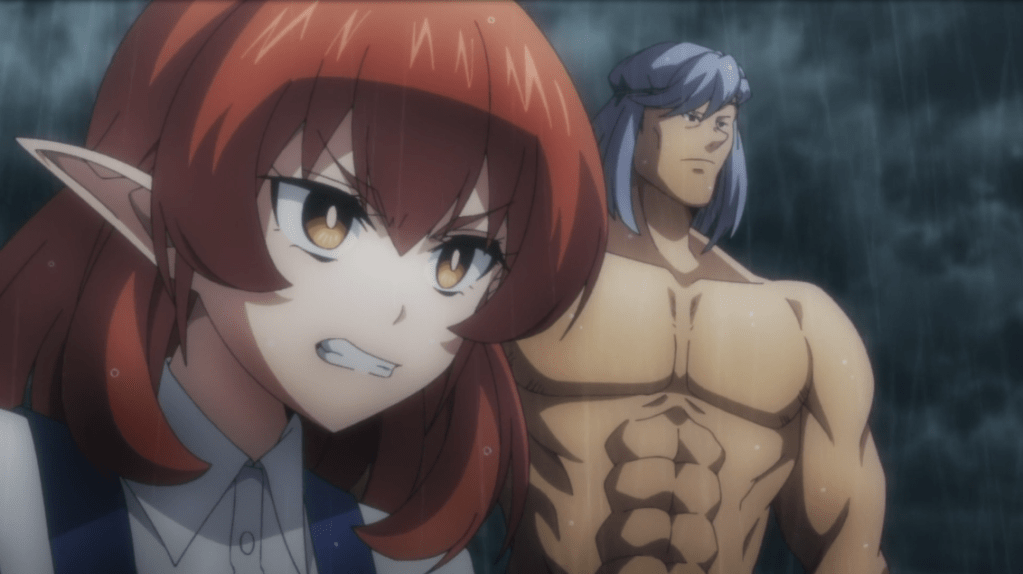
My One-Hit Kill Sister (Rating: C) – This one is being rated slightly above the season’s other bottomfeeding isekai only because it managed the most impressive-looking action and magical displays of the three. (And the dance routine in the ED – especially with its gender-reversal on the typical dance roles is still neat.) Asahi does see a little true growth by the series’ end, but any positive progress the series makes continues to be balanced out by Maya’s obnoxiously clingy, brocon behavior. Not a series I can recommend, unless you’re really into big sisters with incestuous interest in their little brothers.
Mashle: Magic and Muscles (Rating: B-) – This story about a magic-less musclehead pretending to be a mage at a magic academy has flaws rooted in its formula shonen action nature and flounders anytime it tries to get too serious. However, the stupefying feats of physical prowess that Mash pulls off every episode make up for that, turning this series into a mostly fun ride overall. More is coming next year, and I’ll probably watch it, too.
Tonikawa: Over the Moon for You s2 (Rating: B-) – The exploration into Tsukasa’s past that one might have hoped for here still remains at the the vaguely-hinted-at level, beyond providing further evidence that Tsukasa is centuries old. That raises the question of how Tsukasa apparently didn’t ever have the kind of intimate relationship she has with Nasa before modern day, but they make such a warm and appreciable couple that I’m willing to let that detail slide. The series isn’t doing anything special, but it doesn’t need to in order to continue providing the level of cutesy entertainment that it has provided so far. Not an exciting season, but I will be back for the short run this coming season.
Otaku Elf (Rating: B) – The concept here – that an elf was summoned to this world to be a shrine goddess 400 years ago but is now a hikkikomori-like recluse – had more play than I expected, turning this into a neat, enjoyable series that I can easily recommend. The addition of other summoned elves who each have their own issues helped some, but the series carries itself just fine on the foibles of Elda and her relationship with Koito. The “this was how it was done in the Edo Period” references that Elda regularly adds in are also neat touches for a history buff like me, the supporting cast is eminently-likable, and the role Elda plays in the community – and how she is appreciated and even loved for it despite her oddities – adds an occasional poignant note, too. Also has one of the more underrated OPs of the season. It would easily make my seasonal Top 5 (maybe even top 3) in most other seasons, but the competition this season is just too strong.
Heavenly Delusion (Rating: A-) – Complaints about it being on Hulu aside, this is easily one of the best-looking series of the season, as well as one of the weirdest. It goes into places that are occasionally very dark and graphic as it follows two gradually-converging storylines which, in all likelihood, are in generationally-disparate time frames: one at a research facility where some kind of bizarre experimentation with kids is going on and one in a post-apocalyptic setting where a young woman (who thinks she’s actually her brother in her sister’s body) and her charge (who has an ability which can destroy the man-eating monsters which roam about) are on a quest to find both the mysterious Heaven (which may be the aforementioned research facility, or may not) and the woman’s older brother figure. Love how the series mixes its weirdness with more grounded dramatic elements, which contributes heavily to being one of the season’s top titles. Will be back for the presumed continuation.
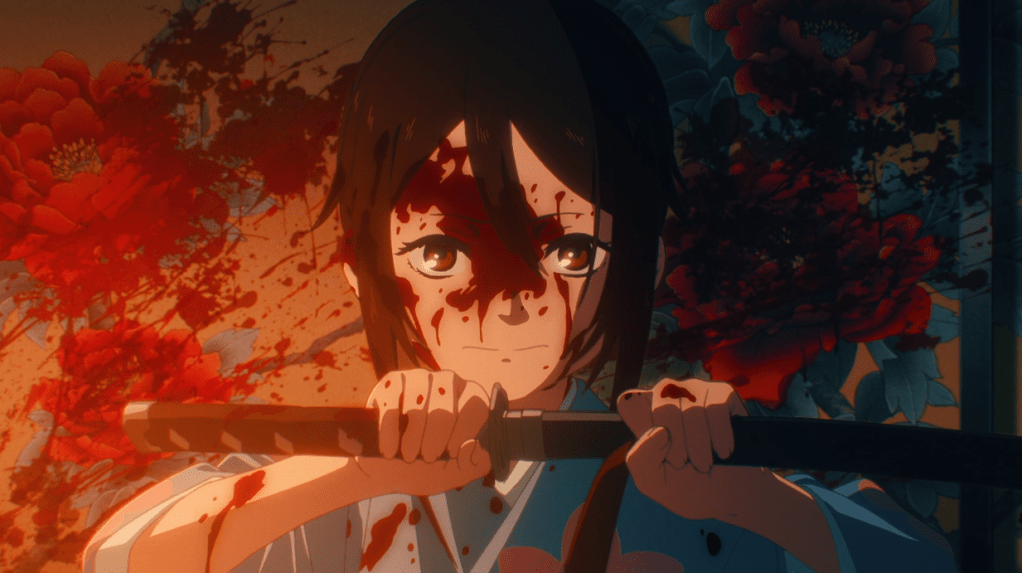
Hell’s Paradise (Rating: B+) – This one is another contender for the season’s best-looking series, though more for its striking use of color (especially in the visually spectacular opener). This was a solid actioner throughout, one which found a good balance between action scenes, character exploration, world-building, and mystery and mystery elements. A strong final episode caps the season out with both its most heartbreaking death scene to date, a major development for one of the lead characters, and a stunning suggestion that one of the foundational premises of the season may be a complete lie. Good – if also very graphic – stuff which easily earns a Top 5 ranking from me for the season, and I’ll certainly be back for its announced continuation.
A Galaxy Next Door (Rating: B-) – This series has been criticized for being too bland, but I found it to be a sweet, low-key look at two young adults who find that the connection between them which was forced by supernatural elements doesn’t define their growing (romantic) relationship; they would have fallen in love anyway. Ichiro and Shiori make for a lovely couple, and I appreciated how Ichiro’s younger siblings were a factor. Good character designs are also a strong point. It may not end up being a memorable series, but it made for a nice complement to TONIKAWA.
Summoned to Another World for a Second Time (Rating: D) – This one had a somewhat interesting premise – that one of the class of students summoned to another world is making the trip for a second time, with a five-year time lapse in the destination world between incidents – and mostly wastes it. This production was lackluster on all fronts, with some of the weakest fight scenes in an isekai series in recent memory being a particular problem spot, one of the most pathetic excuses for a Demon Lord you’ll see anywhere, and a series of eye-rolling plot developments which let no one but the protagonist earn any substantial victory. This is the bottom of the barrel for the season, and at least near the bottom for the genre as a whole.












 USA Anime