In Memoriam, Anime-Style

Though many countries have their own versions of holidays to celebrate the dearly departed, Memorial Day being on the last Monday of May is a uniquely American thing. In honor of 2023’s occurrence, I’m going to take a special look at several anime titles which are profoundly influenced (if not completely defined) by the death of a character early in their stories.

To qualify for this exercise, three conditions must be met:

  1. The death must happen within the series.
  2. After the death, the character in question is absent from the story as a separate entity (i.e., not lingering as an undead or reincarnate) after their death, except in flashbacks.
  3. The character must have a regular (if not pervasive) impact on events and/or character behaviors and motivations.

Since ranking these would be difficult, I am presenting them in chronological order by production date.

SPOILER NOTE: It probably goes without saying that all of these entries have early-series spoilers to some degree.

Martian Successor Nadesico

Martian Successor Nadesico – Anime Review | Nefarious Reviews

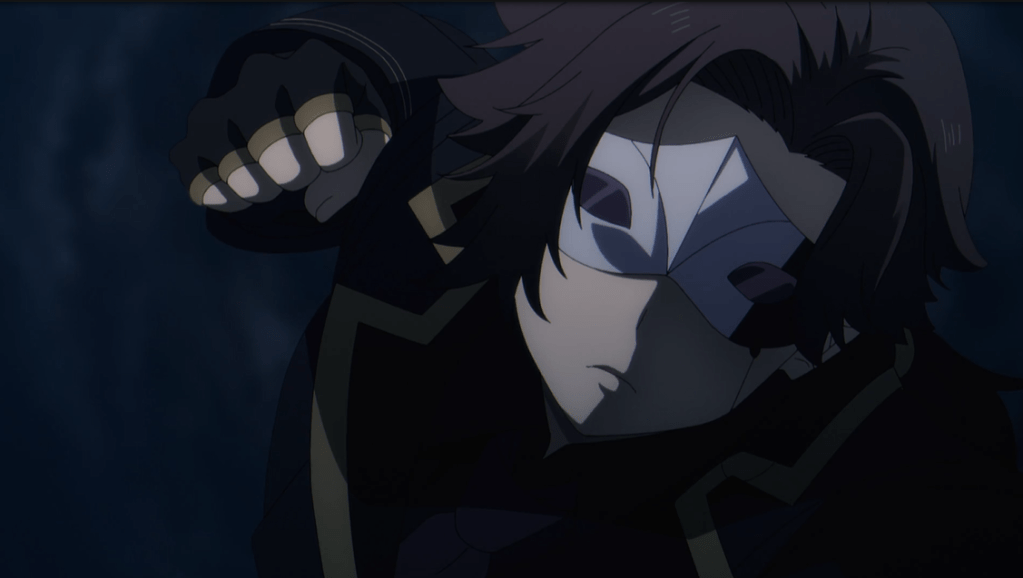
This 1996-97 series is one of the weaker entries here, but it still qualifies. Though mostly a zany sci fi adventure about humans fighting attacking Jovians using the special space battleship Nadesico, it takes a whipsaw turn when ace mecha pilot Gai Daigoji (top right corner in the picture) is unceremoniously and unheroically murdered by escaping officials at the end of episode 3. His death has a dramatic influence on co-protagonist Akito, who not only takes mecha piloting much more seriously in the wake of Gai’s passing but also becomes enamored of the mecha anime that Gai so loved. Gai’s death also becomes a major plot point in certain episodes later in the series and is the foundation of one of the series’ biggest ironies, which involves the exact identity of the invading Jovians.

Le Chevalier d’Eon

In mid-18th century France, Lia de Beaumont was secretly an elite spy for Louis XV when she died during a mission. (The series opens with a coffin containing her body being fished out of the Seine River.) This devastates younger brother d’Eon, whose investigation into her death leads him into a supernaturally-charged spy underworld. Before the first episode is over, d’Eon seems to become possessed by the vengeful spirit of Lia when he’s in a pinch against the preternatural forces connected to her death. This becomes a semi-regular occurrence throughout the series, to the point that d’Eon starts to question his own identity.

Or is that really what’s going on here? This 2006 series borrows loosely from the true story of famed French spy d’Eon de Beaumont, who went undercover as a woman in Russia, later insisted they were born as a woman, and lived the last 30 or so years of their life as a woman. (There was even a long-standing betting pool about d’Eon’s real gender.) In other words, d’Eon was either one of history’s most famous transgenders or else maintained a lie for decades as part of returning to France from exile. The anime heavily leans towards this being an actual case of possession but doesn’t completely discount the possibility that being possess by Lia was all in d’Eon’s head. Either way, most of d’Eon’s actions in the series are, to some degree, influenced by d’Eon’s loss of Lia.

Gurren Lagann

In this bombastic 2007 anime-original mecha series, co-protagonist Kamina was the cool guy who served as both role model and key motivator for Simon, the other co-protagonist. He took the lead in battle and became the leader of Team Dai-Gurren, a group of humans who used a giant mecha to fight against the aliens who had relegated humanity to living underground. His untimely death at the end of a pivotal battle about a third of the way into the series became the defining moment for Simon, who was left with no choice but to become a leader in his dear friend’s stead. Kamina continues to be the inspiration behind nearly everything that Simon does through the rest of the series, even to the point of Simon partly adapting Kamina’s style of dress, and his memory serves as a rallying point for other characters as well.

The Beast Player Erin

In this 2009 fantasy series, Erin starts as a young girl living in a village with mother Soyon, who is an expert veterinarian for the special reptiles that the village is known for raising. Soyon’s death early on (an execution related to perceived misdeeds) forces Erin to travel abroad to learn about and develop both the overt and secret skills her mother possessed, hence forming one of the 50-episode series’ main plot drivers. Soyon also appears in Erin’s memories numerous times to help guide Erin’s development involving animal breeding.

Cross Game

Cross Game: ambivalence isn't a good thing in my book | HOT CHOCOLATE IN A  BOWL

In this 2009-2010 series (which is based on the manga by Mitsuri Adachi, who also created Touch and Mix), 5th-grader Wakaba’s affection for neighbor/classmate Ko initially puts him at odds with Wakaba’s tomboyish younger sister Aoba, but Wakaba’s stunning drowning death changes everything. Four years later, her presence still vividly influences Ko, Aoba, and Akaishi (a one-time bully who also secretly loved Wakaba), and her passionate dream – that one day Ko would pitch to catcher Akaishi as Aoba looks on at Koshien, home to Japan’s National High School Baseball Championship – inspires characters, guides much of the series’ plot, and even affects Ko and Aoba’s gradually evolving relationship.

Despite her death near the end of the first episode, Wakaba was so transcendent a presence, and thus so impactful in the series, that barely any of the series’ 50 episodes go by without either a flashback of her or some reference to her, in addition to the life directions of both Ko and Akaishi being radically changed by her. A lookalike character even plays a big part in the series’ second half, too. Dealing with the lingering emotions of her passing is also such a big factor that I often describe this series as being about “love, loss, and baseball.” Even 14 years later, the series still has one of the strongest and most emotionally affecting first episodes of any anime series I’ve ever seen, has one of the all-time-great final episodes, and overall made my list of the top 10 titles of the 2000s.

to the abandoned Sacred Beasts

In this 2019 fantasy series, a civil war between North and South is ultimately decided by the North’s use of super-soldiers called Incarnates, who can transform into Sacred Beasts (monsters based on mythology). The end of the war leaves the Incarnates at loose ends, including several who cannot resume human form, and some go dangerously amuck. Co-protagonist Nancy Schaal Bancroft’s father is one such Incarnate, and she is enraged when Hank, the captain of the Incarnates, mercy-kills her father in the second episode. That sends her on a quest to pursue Hank and learn much more about the reality of the Incarnates.

In addition to the death of Schaal’s father being her prime motivator and a plot driver, this series also deserves its place here for its running commentary on the difficulties that soldiers have in readjusting to normal life after war, and in particular how some cannot do it.

Demon Slayer

This 2019-originating series does qualify based on a single character, but rather on an entire family. Tanjiro, the eldest son of a Taisho-era rural family who makes their livelihood with charcoal, loses his mother and four of his five siblings to a demon’s attack while in town one day selling charcoal. Their deaths and one surviving sister’s transformation into a demon push him to join the Demon Slayer Corps, which is the basis of the franchise’s whole plot. Either individually or as a group, his mother and deceased siblings pop up numerous times in his dreams and hallucinations through both completed anime series and the move Mugen Train, often at key points where Tanjiro needs an inspirational boost or refocus. They also, to a much more minor extent, impact surviving sister Nezuko, especially at one critical point where she must prove that she’s not a threat that the Demon Slayer Corps must exterminate.

86

This 2021 series is another case where the series qualifies more on collective deaths than the death of a single individual, though one individual does stand out a bit. The series is set in a future where autonomous war machine called Legion threaten to overrun humanity, having overwhelmed the Empire which originally created them and driven the Republic of San Magnolia into a defensive posture. The Republic claims to have developed its own autonomous war machines to fight casualty-free battles against the Legion, but in reality they are piloted by heavily-persecuted minorities (collectively called 86s, after the district they have been isolated in). The series splits its focus between sympathetic Alba (the oppressor race) Lena and the Spearhead Squadron of 86s led by Shin, whom Lena directs remotely as their Handler.

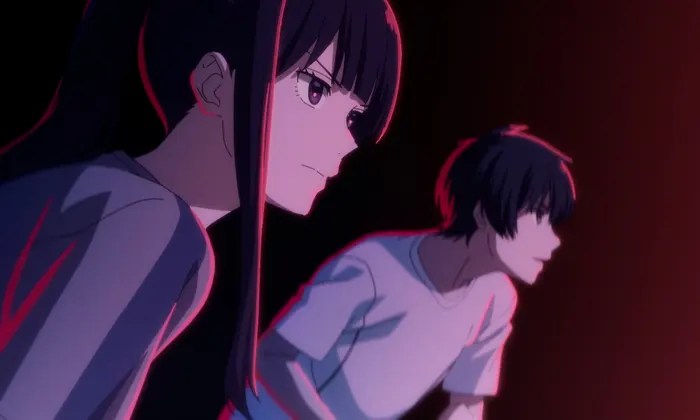
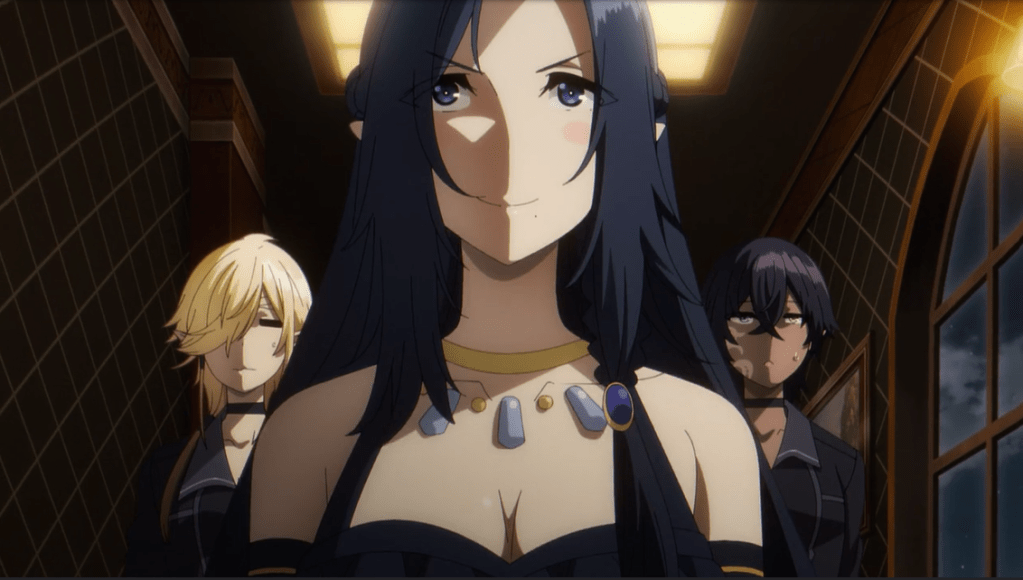
Over the course of the first half of the series, most of the 86s die in battle, with the most impactful individual one being the episode 3 death of Kaie (the short girl roughly in the center, above). Since 86s are not allowed to bury their dead, Shin has taken on the call name of Undertaker and carries scraps of each of their downed Juggernauts with the pilot’s name inscribed on them as mementos, with the intent of taking them with him to their final resting place. These dead (and one later non-86 death early in the second half) occasionally figure into plot elements and frequently appear in the thoughts and hallucinations of Lena and especially Shin, but this title deserves its place here equally for remembering and memorializing the dead being among the series’ most potent thematic elements. It is perhaps the most-suited title on this list to being brought up on Memorial Day.

Oshi no Ko

Though only seven episodes of this 2023 series have aired as of this writing, it is already among the strongest qualifiers on this list. In the series, a rural doctors winds up secretly helping his favorite idol, the immensely-talented 16-year-old Ai Hoshino, through a clandestine pregnancy, only to find himself murdered by one of Ai’s obsessive fans just as she’s going into labor. He then discovers that he has been reincarnated, with memories intact, as the boy of Ai’s twins. He watches adoringly as she moves forward with her career and ascends to the top, only to see her murdered right before him by the same obsessive fan who killed him nearly four years earlier.

The death of Ai at the end of the movie-length episode 1 sets the course of the rest of the series to date, as young Aqua embarks on a path to attempt to discover who their unknown father (whom he believes arranged Ai’ death) is, while sister Ruby dedicates herself to directly following in her mother’s footsteps by becoming an idol, even to the point of resurrecting the name of Ai’s long-defunct idol group. Essentially, nearly everything that both Aqua and Ruby do is in some way connected to their memories of Ai (who deeply impacted both of them in their previous lives). Other characters get drawn into her influence, too, when an actress decides to model her character on a dating show after Ai in order to become Aqua’s ideal girl.

Others

A number of other titles were considered for this exercise, but I ultimately decided these were either weaker candidates or else I just wasn’t familiar enough with them to write about them. The former cases include Claymore, Fullmetal Alchemist, Grimgar of Fantasy and Ash, K, Madoka Magica, Sword Art Online, and. . . while the latter include Major, Monster, and Touch. Titles that I felt were close but failed on technicalities include The Detective is Already Dead, Summer Time Rendering, and the movie King of Thorn.

Are there other worthy titles which should have been here? Mention them in Comments!

Oshi no Ko episode 7

Rating: A

After producing one hell of a hard-hitting ending last time around, the series faced a difficult assignment: find a way to follow through and resolve the problem without cheapening the circumstance which got the show there. Instead of just contenting itself with that, the writing went for the extra credit as well: take a predictable plot development (i.e., Akana falling for – or at least playing up to – the guy who saved and helped redeem her) and give it a somewhat unsettling, thoroughly jaw-dropping twist, and in the process redefine both one of the the established cast members and one of the underlying truths of the series.

The fallout from Akane’s suicide attempt last episode sets the stage for that. A conversation among Kana, Ruby, and Miyako lays out the background for this by discussing how coping with social media negativity can vary from person to person, but even the most well-adjusted aren’t immune to it; I especially liked how dark Kana’s eyes were as she strongly implied that she’s had her own difficult moments with it. (The only minor complaint here was the the comments about attempting suicide seemed a little too on-the-nose when they could not have known at that point that Akane had attempted it.) Seeing the rest of the cast of “Love Now” rally around Akane was gratifying; “Love Now” is not an inherently competitive format (a la The Bachelor) as dating shows go, so a cast of teenagers who are all performers getting chummy with each other off-camera, too, is hardly a stretch.

Just as importantly, all of the cast are savvy in one aspect of media or another, so they make the perfect team to attempt to redeem Akane’s reputation. One knows the music, one (rather literally!) knows the angles, one knows the timing and promotion, and one knows the editing and how to manipulate adults to get what they need. Everyone except the dancer is allowed to not only contribute but show how smart they are about it as well. I have no doubt that their campaign is probably an oversimplification, but the tactics nonetheless feel real.

As satisfying as that is, though, the most interesting part is actually the last quarter of the episode, after all that is done. The story has pitched all along about how lies are a shield to protect the performer, so Akane is pushed to create a role herself to potentially deflect future problems. Surprisingly for this kind of situation, she’s not the one who actually comes up with the idea of tailoring her performance to be Aqua’s ideal, but given how much Aqua has done for her, wanting to please Aqua is hardly strange. But that is also the exact point where the demon gets unleashed.

Viewers have been told that Akane was an actress, but not what type. The revelation that she’s a theatrical actress – and a renowned one at that – explains both how Kana knew her and why she had such trouble adapting to the format. Stage acting is very formalized and structured, so a free-form approach like a dating show, where nothing is set, is in utter contrast to her norm. Of course it threw her for a loop, and her diligent note-taking was all about trying to translate that environment into the structure she’s more familiar with. Given a character to play, she shines – and she’s chosen Ai as her model. The scene where she reveals not only her Ai-based personality but also Ai’s starry eyes is both electric and unnerving, especially given the preceding scenes showing how thoroughly and obsessively she studies Ai and how scarily close to the mark and revealing her analysis of, and insight into, Ai is. I am certain that I am far from alone in having woefully underestimated her over the last two episodes; in her own way, she’s every bit as clever as the other smart characters in the show. Ironically for Kana, she may be even more of a threat to Kana than the latter realized.

Akane’s analysis and copying of Ai also raises one other interesting point: that Ai’s trademark eyes are reflective of her self-confidence, rather than some trait of hers, and thus can be duplicated. That has interesting implications for the way Aqua’s star goes bright (as when he rescued Akane) or turns black. And what, if anything, does it mean that Akane’s stars are yellow rather than Ai’s white?

Sadly, looks like we’ll have to wait two weeks to see how Aqua (and eventually Ruby, too) both react to Akane’s performance, as HIDIVE has episode 8 scheduled for June 7th instead. Assuming that happens, that review may be delayed for a few days, as I will be on a trip where my access to HIDIVE will be uncertain.

Oshi no Ko episode 6

Rating: A-

“Egosurfing” (the apt title for this episode) is the act of looking one’s self up on social media to see what others are saying about you. While it can be a very gratifying experience when people are saying complimentary things about you, it can be crushing when they aren’t and positively toxic when people use the anonymity of the Internet to be cruel. Entertainers – whose very livelihoods can depend on tuning themselves to public whims – are probably among the most vulnerable classes of individuals for the more negative side, which requires any wannabe-star to either develop a thick skin or ignore it altogether. The first episode showed Ai getting caught up in that to some degree, while episode 4 showed Kana also having to deal with it. But both of them have/had their heads on straighter than Akane – the actress among the six dating show participants – or at least didn’t have the perceived external pressures that she did. Predictably, that leads to an epic meltdown, which is the focus of this episode.

After building the series around Ai, Ruby, Aqua and (later) Kana, shifting much of the episode’s focus to a character who had only barely been introduced before is a gutsy move, especially for this early in the series. However, the episode’s concept couldn’t have been done with any of the grounded, established characters. Akane is apparently a well-enough-known teen actress that Kana recognized her, but despite that, she’s decidedly lacking in charisma and presence compared to the others in the dating show. What’s shown here gives the impression that she has succeeded so far more by being hard-working and studious rather than a natural talent, which is fine when she’s part of a cast but not good enough when she’s in direct competition for viewer attention, as she is here. She’s completely out of her element and being overwhelmed by the circumstances, in addition to feeling pressure from her agency (even if it isn’t specifically directed at her), and that kind of thing can lead to mistakes. And the public can be very, very unforgiving of mistakes.

A telling scene here is that the much more savvy Yuki, who is the injured party in the accident, immediately picks up on what’s happening. She is very supportive and forgiving, and that doesn’t seem like an act; she may even realize that Akane is going in a desperate and dangerous direction and be trying to head it off. If so, she’s hamstrung by the restrictions on talking about behind-the-scenes publicly and cut off by the director deciding to use the scene anyway. (And why wouldn’t he?) Akane doesn’t handle it right to pitch it as a villain turn, and everything falls apart from there.

I had a sense of the ultimate direction this episode was going from early on, and that only became more certain as the episode progressed. Indeed, the heavy music in particular makes the intended destination obvious, despite the show’s typical levity about the topic earlier on. Thankfully, the writing does not go gimmicky with this; it makes a concerted effort to corner Akane emotionally, which allows the climactic scene to have real impact. I also especially liked the jarring shift between Akane’s serene face and the despairing one shown above, and how the episode showed that she hadn’t headed out with that goal; the attempt was a spontaneous moment of resignation, which is an all-too-common occurrence in suicide scenarios. This sequence was also beautifully-animated.

While the attempt was predictable, I actually wasn’t certain until the last moment if the show was going to allow her to go through with it or not. Aqua intervening makes sense in more than just dramatic flair, though. He’s both a former doctor (who doubtless saw a few suicide-related cases himself) and a more worldly individual than any of the others, and his experiences with social media concerning Ai could very reasonably have pushed him into action when Akane clearly seemed depressed and defeated. The bold actions on both their parts leaves me very eager to see how this plays out next episode.

Further Random Thoughts:

  • Kudos to HIDIVE for the Suicide Prevention notice as the end card for the episode.
  • Tucked in amongst the lighter content mid-episode are Kana’s insightful comments about how the changing nature of entertainment has made online marketing – and thus social media – impossible to ignore anymore if you want to get ahead in the industry.
  • Aqua also has some telling comments about how reality shows may not be as fake as he thought, which, ironically, makes a star who shields him/herself with lying unusually vulnerable. Given the way the episode climaxes, that seems prescient.
  • The opener make a point of featuring Akane in the rain, which now also looks more prescient than just a mood-setting device.

Oshi no Ko episode 5

Rating: 4 (of 5)

In a recently posted interview on ANN, the writer for the source manga, Aka Akasaka, explains how he came up with the idea for this series and the process he went through to gather sufficient insider details to make the effort feel realistic. I recommend it as a complementary read for anyone who’s become a big fan of the show.

That research definitely shows in this episode. It effectively splits into two parts, one which focuses on Aqua’s foray into a dating show and the second which focuses on Ruby and Kana and their steps towards forming a new idol group, a balance I’d love to see maintained going forward. The more serious part is Aqua’s participation as the actor member of a teen dating reality show featuring established media personalities; the others include a dancer, a band member, a YouTuber, a fashion model, and an actress. It works in various details about how reality shows work, such as them not being scripted but still subject to direction – a situation which should suit Aqua’s talents well once he gets used to it. Among the others on the show, the two who initially seem to be the ones to watch are the fashion model (who clearly has a better sense for how to manipulate situations than she lets on) and the YouTuber MEM-cho, who is very prominently-featured in the opener and looks to be the eventual third member of Ruby’s new idol trio. However, actress Akane is also featured significantly in the opener (while the fashion model isn’t), so she may become important later on.

On the other front, the early part of the episode devotes itself to reeling Kana into the idol group. Intellectually, Kana knows that taking the idol route is a risky play, and her thoughts on the matter are doubtless reflective of the actual experience of real-life predecessors, but ultimately she succumbs logically to the need for greater exposure and emotionally to her own evident attraction to Aqua. This part is decidedly more light-hearted while still having its serious aspects; Kana is savvy enough to recognize Ruby’s charisma and potential, for instance. The interesting aspect here is the point made about how the traditional way to gather attention to newbie idols – which is still shown in most idol-focused shows – may now be an outdated approach. The new wave is all about getting your names and faces out on the Internet, and as small an agency as Strawberry Productions is, that’s its strong point.

Which bring Pieyon, the masked strength-training YouTuber into the picture. The character is clearly partly a joke (and possibly a reference to two different long-established top YouTubers) but also partly a commentary on the gimmickry which can feed into being a popular and successful YouTuber. Pieyon’s claim to pull in the equivalent of a million U.S. dollars in one year is hardly unrealistic; he might not have even cracked the top 100 in 2022 with that number, and the cream of the crop are another decimal point up from that. As silly as both the character and his exercise dance are, he also shows a lot of savvy, and this is certainly a novel way (for anime) for idols to get started down their path. The bombshell at the end is, of course, the name which Ruby settles on for the idol group. Given who she is and what her goals are, it’s the only name which makes any sense, and it damn sure will catch attention. Wouldn’t be surprised if Aqua approves. The broader point, though, is that the series is mixing its humor with its show business insight in a way which doesn’t interfere with either.

As a closing thought this time around, I watched closer “Mephisto” with the English translation for the first time, and yeah, it certainly keenly hits the nose on the series’ content, too:

Come now, O children of the star, sleep well

The radiance will not dull, if it is you guys

And yes, this is Queen Bee, the performer who did the wonderful opener “MYSTERIOUS” for Raven of the Inner Palace last year. He’s a name and voice to watch for.

Spring ’23 Isekai Round-Up

Posted: Tuesday May 9, 2023

With some series hitting their sixth episodes this week, we’re now approaching the midway point of the Spring 2023 season. That means it’s time to take a look at this season’s crop of isekai series, most of which I am following this season to some degree. Which ones are more deserving of attention than they’re getting so far, and which ones can be relegated to the trash heap?

(NOTE: I never finished the first season of In Another World With My Smartphone, so I will not be including that one. Also, all episode counts are as of 5/8/23.)

The Aristocrat’s Otherworldly Adventure: Serving Gods Who Go Too Far

Episodes So Far: 6

Premise: A young man dies protecting two girls from a knife-wielding assailant. As he’s reincarnated into a fantasy world, he’s prodigiously blessed by that world’s seven gods. He find himself reincarnated as the young son of a Margrave and soon discovers that his abilities in all respects are on a scale vastly beyond anyone else in that world. But the gods also eventually expect big things of him.

Evaluation: For better or worse, Aristocrat seems determined to stake out ground as the ultimate example of isekai power fantasies. To the series’ credit, it does seem cognizant of how ridiculous it’s being and plays much of its antics in a light-hearted fashion, which softens the absurdity level a little. Even so, by the age of ten young Cain has already found himself betrothed to two princesses and a Duke’s daughter (including one who’s considerably older), earned a noble title on his own, introduced a new game popular among high nobles and even the gods, slain multiple dragons, and generally proven to be, by far, the strongest person anywhere. The one minor saving grace in all this eye-rolling excess is that not all of the characters are entirely numbskulls. They do notice that Cain’s not normal, and that leads to a scene in episode 6 where they confront him about it. Without that scene, this series would be utterly forgettable so far. Even so, the only other real merit is the bright, invitingly cutesy art style. Not devoid of entertainment value, but not a series I can recommend, either.

Rating So Far: C

I Got a Cheat Skill in Another World and Became Unrivaled in The Real World, Too

Episodes So Far: 6

Premise: Yuya Tenjo is an overweight, friendless loser who’s been subjected to severe bullying, in part from younger siblings upset that their grandfather (Yuya’s only positive link) left his house to Yuya on his death. One day, after getting his ass kicked for intervening when some thugs were intimidating a young woman, Yuya discovers the secret room in his worldly grandfather’s house, which has a door to a fantasy world. There he finds a trove of obscenely powerful items which help him become amazingly strong – and that strength even carries over to the real world, as high new stats reform his body into an ultimate hunk. But a radical outward change doesn’t necessarily mean a radical inward change, too.

Evaluation: With how fast Yuya gets incredibly strong and physically perfect, and how quickly he gathers a gaggle of knock-out girls around him, this isekai power fantasy should be every bit as eye-rolling as Aristocrat is. Surprisingly, though, it’s vastly more appreciable, even if its animation is frustratingly limited at times. The key to that is Yuya himself. He may be an ultra-talented Adonis now, one who turns heads everywhere and is mistaken for an actor or model in the real world, but thanks to his past experiences, he struggles to even accept that people would willingly be nice to him, much regard him as supremely cool. That very relatable vulnerability keeps him grounded even when he’s doing incredible feats of athleticism. Another huge plus is that Kaori, the real-world girl he protected at great cost to himself, regarded him as worthy before he transformed into a stud. Episode 6 also brings up The Sage, Yuya’s otherworld predecessor and the supplier of his broken-grade equipment, and his story about how his extreme power isolated him and how he doesn’t want that for his successor.

In other words, despite its occasional eye-rolling antics, this series takes its premise much more seriously and operates with a lot more heart than most series of this type do. It doesn’t hurt that its character designs – especially for Yuya’s potential love interests – are all gorgeous, either. In all, this is the isekai series this season that I feel is most being overlooked and has one of the better chances to achieve at least some degree of lasting popularity.

Rating So Far: B

Dead Mount Death Play

Episodes So Far: 5

Premise: A necromancer who became known as the Corpse God in his fantasy world, and who was defeated by a Hero, is reincarnated in modern Japan in the body of a recently-murdered teenager. Awed by his new world, he seeks to find the peaceful life here that he couldn’t in his previous world, but quickly getting caught up in the seedy underworld of Tokyo threatens to get in the way of that goal, as do members of a police task force.

Evaluation: This rare reverse-isekai variation certainly has its own quirky style that mostly works for it. Turns out that Corpse God wasn’t really a villain (even though his death theme certainly suggests otherwise!), and he’ll even use his necromantic powers to create skeletons that rescue orphans from a fire – as well as, of course, skewering the teenage girl out to kill him and turning her into a zombie. Despite sometimes-very-dark overtones and deadly action, the series leans at least as much in the humorous direction and has a somewhat playful side. Keeping those element in balance, so viewers don’t get tonal whiplash, has been tricky so far, but the series has managed it more often than not. Combine that with plenty of CG skeletons and some longer-term intrigue and you have an entertaining series.

Rating So Far: B+

Summoned to Another World for a Second Time

Episodes So Far: 5

Premise: Setsu and his whole class has been summoned to another world to be a band of heroes in an expected conflict against demons, but for Setsu, it’s his second trip to this particular fantasy world to be a hero! Last time he was an heroic figure who made peace between humans and demons and befriended many powerful individuals on both sides, and the passage of five years in that world hasn’t lessened their memories of him (even if he looks different now). But intrigue is afoot, as the threat to the human kingdom isn’t coming from the demons, who are being subjected to other schemes as well.

Evaluation: Although this one is also a power fantasy, and has Setsu owning everybody, it plays more as him hanging with the powerful, with somewhat of a side arc about his female childhood best friend also trying to get strong so she can stand alongside Setsu. This approach only works sporadically so far, though, with the biggest problem being that Setsu doesn’t have much of a personality. (One of the most pathetic Demon Queens to come along in fantasy anime in quite some time is another major problem spot, though a more limited one since she only prominently appears in one episode.) In fact, the best episode may be the one which focuses entirely on the childhood friend, and that episode is still remarkably stereotypical for its type. Unless it comes up with something better, this series is destined for the “Quickly Forgotten” stack where series like Isekai Cheat Magician reside.

Rating: C

Kuma Kuma Kuma Bear Punch!

Episodes So Far: 6

Premise: Yuna is still traipsing around the “game world come alive” setting she’s been trapped in and is still sporting the bear suits and hand puppets. People continue to not take her seriously until they see what she can do, and everything is still bear themed.

Evaluation: Unlike its first season (in Fall 2020), this one did not get picked up for episode reviews on Anime News Network, and that’s telling. It continues to be the cutest and mildest of all of the isekai power fantasies out there, but that’s all that the second season has going for it so far. The visual quality is still there, but the first four episodes were such a yawner that I have had trouble getting motivate to keep up with this one. The spark which made the first season work has faded.

Rating: C+

Why Raeliana Ended Up at the Duke’s Mansion

Episodes So Far: 5

Premise: Failed university student Rinko was pushed off a roof by someone, but instead of dying wakes up as Raeliana, a character in one of her favorite novels whose early death becomes a motivating factor for the novel’s heroine. She isn’t about to let that happen, so she uses her knowledge of the book to cut a blackmail-tinged deal with dashing, crafty Duke Noah Voltaire Wynknight to get out of her current engagement and become his pretend-fiancee. That starts a battle of wits between the two that the Duke seems to find charming (while Rinko find it aggravating), but there are other challenges and dangers which must be navigated as the story gradually starts to go off the rails.

Evaluation: Semantics about whether this “trapped in an otome game/romance novel” genre truly counts as isekai aside (I argue that it does), this one has proved to be surprisingly involving. A mediocre animation effort definitely hampers it, but Rinko/Raeliana has proved to be a delight in the way she privately shows off her frustration to viewers while using every trick she can think of to keep herself safe. She’s a strong, wily heroine with just the right touch of vulnerability, but Duke Noah is also a delight as the proper, smarmy noble who matches wits with Raeliana and may be falling for her more than he cares to admit. A superior-grade English dub (which is being simulcast) also is a plus here, especially Ian Sinclair performance as Noah – a role he was born to play. I haven’t watched enough of the rest of the genre to know how this one compares, but it’s a show I can get enthusiastic about each week.

Rating: B+

Oshi no Ko episode 4

Rating: B+

The writer for the source manga, Aka Akasaka, is probably even better-known as the creator of the acclaimed Kaguya-sama: Love is War source manga. That manga series got a live-action adaptation in 2019, prior to its highly-regarded anime form, and that first adaptation is widely-regarded as a bust, with an IMDb rating of only 5.6. Given that Akasaka started work on Oshi no Ko just a few months later, it’s impossible to watch the depiction of the live-action adaptation of “I’ll Go With Sweet Today” without positing that a large chunk of both last episode and this one is based on the creator’s bitter personal experience. That leaves me curious about whether Aqua’s effort to give the series-in-a-series here a strong finish is also based on personal experience or just the creator’s wishful thinking.

Regardless, the much stronger first half of episode 4 details Aqua’s efforts to elevate the source material’s famous climax, with a little but welcome segue into Kana’s viewpoint to show how frustrated she personally is about the production coming out crappy. This makes for an interesting contrast: she has the acting chops to pull off something better but not the angle, ability, or insight to force the production to get better through a bit of ad-libbing. Aqua, meanwhile, may not have the acting chops (or at least he doesn’t think that he does), but he does understand how to take advantage of circumstances and directorial intent. Because of that, he’s able to manipulate the tone and presentation, thereby getting the best out of the weakly-skilled male co-protagonist and giving Kana the opportunity that she’s been desperately seeking to really show what she can do. But I think it’s also pretty clear that Aqua is under-rating his own ability.

As interesting as seeing that sequence is, it is mere set-up for the more impactful scenes during the after-party. One is the manga-ka for “Sweet” being satisfied with the final episode and the other is Aqua’s conversation with the producer, whom he has now officially checked off his “father or not” list. A revelation this big – that the producer not only knew about Ai seeing a guy on the sly, but actively facilitated it – is a bit surprising to see come up this early, but it does show that the series is not going to drag its heels on Aqua’s Father Quest and establishes a hook for having Aqua move forward with his own media presence; the episode conspicuously cuts off that scene before Aqua replies to the producer’s proposal, but how could he turn something like that down? And given that the producer does know that Ai was secretly seeing a guy, and that Aqua has features which greatly resemble Ai’s, is he already putting two and two together on who Aqua might really be? (That he specifically brings up how much Aqua looks like Ai twice seems suspicious, especially in a series as astutely-written as this one.)

The rest of the episode is far more ordinary, even if it does catch the series up to the final scene of episode 1 and move past it. It also represents a decidedly more light-hearted shift as new recurring characters get introduced and the foundation gets laid for Ruby’s eventual turn as an idol herself, as well as a shift to focusing on Ruby after focusing on Aqua for the last episode and a half. Not sure why Kana being the redhead in the idol trio in the OP did not click before, but that does look like her (see the screenshot below) and she would be a natural fit for a number of reasons; even if singing isn’t her specialty, she’d certainly be able to act the part, and that would fit with the series’ ongoing theme about lies being at the core of the idol industry. Given that she’s showing inclinations of a romantic interest in Aqua, I cannot imagine her turning down the offer even if it wasn’t for the OP spoiler.

A few other random thoughts about the episode:

  • The use of music during the filming of the climax scene is especially sharp in driving the intensity and drama.
  • How much of Kana’s tears was pure acting and how much was relief that she was given a chance to do the scene justice?
  • The subtitles list Minami (the busty pink-haired girl) as a “pin-up girl,” which I suppose is a fair translation for “gravure” (what Ruby actually says), a class of female idols who model for pictures that are often provocative and suggestive, albeit in a more playful rather than aggressively sexual manner. Yeah, having a high school girl do this is a bit skeevy, but this can be seen even with preteens in Japan. Have to wonder how much Ruby’s fixation on Minami’s chest is meant for comedy vs. making a subtle poke at that side of the industry.
  • And is it just me, or does anyone else see Demon Slayer‘s Mitsuri when looking at Minami?
  • The OP and ED are now subtitled! Hurray! The OP carries so much more meaning when you have the lyrics.

Overall, the latter part of the episode drags the grade down a bit, but this is still solid entertainment fare.

Oshi no Ko episode 3

Rating: B+

Since episode 2 aired, news has broken that the first episode of Oshi no Ko was HIDIVE’s biggest debut ever, and also that opening theme “Idol” is topping multiple Japanese music charts. (It’s also currently the top-rated show for the Spring 2023 season on MAL, even over the new season of Demon Slayer.) That puts is on a hype track at least on par with a Spy x Family, which raises the very real concerns about whether or not the series can live up to the hype. Despite episode 3 being a less impactful episode than the previous two, it’s still does a solid job of carrying the weight of that hype.

Episode 3 picks up where episode 2 left off, carrying forward the reunion of Aqua with former child actor Kana Arima. Roles petering out for her as she got older (an all-too-common problem for real-life child actors) forced her to learn to hard lessons and revamp her thinking about acting if she wanted to resuscitate her career. Essentially, she had to learn the hard way what Aqua got taught at a young age: be more accommodating, make an effort to make connections, and play to what’s needed rather than always trying to be the best actor. That’s allowed her to resuscitate her career as an actor – specifically, in a live-action shojo manga adaptation – and she badly wants Aqua to join her by filling a recently-vacated villain role. Aqua’s not interested until he learns that the director is one of the people he’s seeking out as a possible candidate for being his and Ruby’s father, and he cannot pass up this chance to get a DNA sample.

While the plot keeps the story moving here, the details and characterizations are the much more interesting parts. Kana seemed almost like a joke character in her initial appearance, but the portrayal here is far more nuanced than expected. While her understanding of the business is not yet perfect (as Aqua discovers from overhearing the director talk about her), she has learned and grown as a person, to the point that she can offer some interesting insight about these kind of live-action productions. Specifically, the point here isn’t to make something that’s good, but rather to make something which showcases a lot of hot boys, and acting skills be damned. Her laments about having to act down to the level of her cast mates so the differences in skill aren’t too blatant is the most cynical take possible on Aqua’s “doing what’s needed, rather than what’s the best” lesson and raises the interesting question on how often something like this actually happens. (Fortunately, anime production largely dodge this in Japanese casting, though it isn’t unheard-of for idols to have roles in anime series as a gimmick.) Sadly, the way the original creator seemed disappointed with this subpar rendition of her work is probably a more common occurrence, one that has been alluded to in other anime (such as A Sister is All You Need), but all of this makes it perfectly plain why Kana is so keen on Aqua filling the vacated role: she at least knows that he’ll be competent, and she’s desperate to work with someone who is.

The big irony here is that Aqua winds up playing a hooded stalker, a character uncomfortably similar to the one who killed him in his previous life and Ai in this one. That irony is, of course, not lost on him, and so with his main task accomplished, the expectation that he is going to add some special flair to his performance makes for a nice episode-ending cliffhanger. You can tell that something special is coming up because this is one of the three times this episode that the star in his right eye goes black, and its always happens when his darkest ambitions come up; the other times were when he, a few years earlier, finally figured out the password to Ai’s old phone and gets a look at her contact list, on which he’s basing his hunt for his biological father, and later when he’s thinking about how he doesn’t have any ambitions beyond revenge.

There are other neat details to watch for here, too. I quite liked how Aqua and Ruby are shown in one scene wearing shirts emblazoned with “TWINS” in English, and the way Ai kept her life carefully segmented through the use of multiple phones was also a neat bit of posthumous character development; she may have been less flighty than she looked and acted. The details about how the shoot is normally handled on a TV show are also convincing. And will we now have a debate on whether password 45510 has some special significance? (It is the number shown in the opener, after all.)

If there’s a negative in the handling of this episode, it’s that it offers no opportunity for Ruby’s viewpoint, but since the content is more about what Aqua is doing, she will presumably get her turn. For now, the series is humming along quite nicely.

Oshi no Ko episode 2

Oshi no Ko delivered one of the best and most impactful opening episodes in years (though admittedly its extra-long length gave it an unfair advantage!), but because of the way it ended, episode 2 was the one which would really set the pace for its long-term direction. Seeing the latter convinced me that this series, more so even than personal favorite The Ancient Magus’ Bride, is deserving of weekly commentary, so expect me to be back every week for episode reviews.

One of the main reasons that the series continues to make a strong impression following a 10-year time skip is because it sticks true to one of its advertising points: that it will focus on the darker side of the idol industry. Indeed, maybe not since Key the Metal Idol in the mid-’90s has a series painted such a bleak picture of that scene. Ai literally lost her life to the darkest side of the industry (i.e., obsessive fans) while on the brink of conquering it; she was going to be the rare star to stand at the top while still (secretly) being a mother, after all. Even 10 years later, Aqua has not forgotten that one bit, which is why he’s determined to protect Ruby – who has a very real potential to break out as an idol herself – from the industry’s more exploitive side, even if that means crushing Ruby’s dreams. The end of the episode sees a compromise struck on this point, but as he and Ruby head for a performing arts-focused middle school, he seems certain to always be keeping watch over her.

The darker aspect shows up in other ways as well. Aqua’s investigation of an “underground” idol group that’s trying to scout Ruby digs up some ugly dirt, and Aqua and his adoptive mother (the wife of Ai’s manager, who now runs the business) aren’t exactly clean themselves for the underhanded way they get the current member of that group to talk and then judge her quickly over the fact that she talked. While there might be some vaguely villainous types in some idol series, this is not the kind of thing you would normally find in any normal idol show. (Of course, whether this could even properly be called an idol show is itself a matter for debate.) And of course, the passage of time has not swayed Goro/Aqua one bit from his quest to discover who his father was and kill him for (presumably) siccing that fan on his mother.

Significantly, the episode also gives some time to Ruby’s point of view. She knows that her brother has some plan that he won’t discuss with her, and seems to intuitively understand that her brother is, to some degree, looking out for her, but the passage of time has left her more inclined to try to reach out for her mother by following in her footsteps rather than drowning in a revenge scheme. The writing here expertly shows how her previous life as Sarina is influencing her in a couple of ways: becoming an idol is the ultimate expression of her ability to act in ways that she wasn’t able to do in her previous life, and a way to draw closer to a star who was both everything to her in the fading days of her previous life and her mother in the new one. She’s almost compelled to seek out becoming an idol despite the efforts of those around her to dissuade her. Hopefully, the series will continue to give at least some time to her viewpoints, because the stark contrast between how she see things and how Aqua sees things provides a richer narrative thread for the story.

There are a couple of other factors to consider here, too. On the plus side, Kana Arima – the child actor Aqua played beside in the movie in episode 1 – is back in middle school form. On the more mixed side, the lighter content sometimes seen in the first episode is also still around and sometimes effective, though the bits about the director’s mother interrupting at inconvenient times quickly outwore their welcome.

The music also deserves some mention here. Opening theme “Idol” by superduo YOASOBI, with an initial rap beat that flows into an up-tempo, electronica-fueled dance number, is a major winner on both musical and visual production fronts, but it packs much more impact if you actually understand the lyrics. (See here for an English translation.) Closer “Mephisto” comes from Japanese rock band Queen Bee, and its lyrics (see here for an English translation) also have some interesting parallels to the series’ themes and content.

As a final thought, Ai’s full name in Japanese order – Hoshino Ai – translates as “Star Love. Rather doubt that’s a coincidence, given her eyes.

Really looking forward to seeing how the rest of the series plays out, given how strong a start it’s off to.

Rating: A-

Review: Suzume

Suzume is the latest movie from acclaimed director Makoto Shinkai, and it would be unmistakable as one of his projects even if you didn’t know the director going into the movie. It has all of the hallmarks of a Shinkai project: stunning sunsets, fantastically detailed backgrounds, themes about making connections despite separations by time, space, and/or dimensions (and finding ways to cross those boundaries), melancholy longing which drives characters to action, and a special kind of easily-relatable, not-overly-schmaltzy sentiment that few other anime director have ever been able to deliver even half as effectively as Shinkai does. A complaint could be easily made that it feels too similar to his other recent works, but honestly, I don’t see that as a problem. Shinkai may not vary his formula much, but he has certainly mastered his particular style, and that shows beautifully in this film.

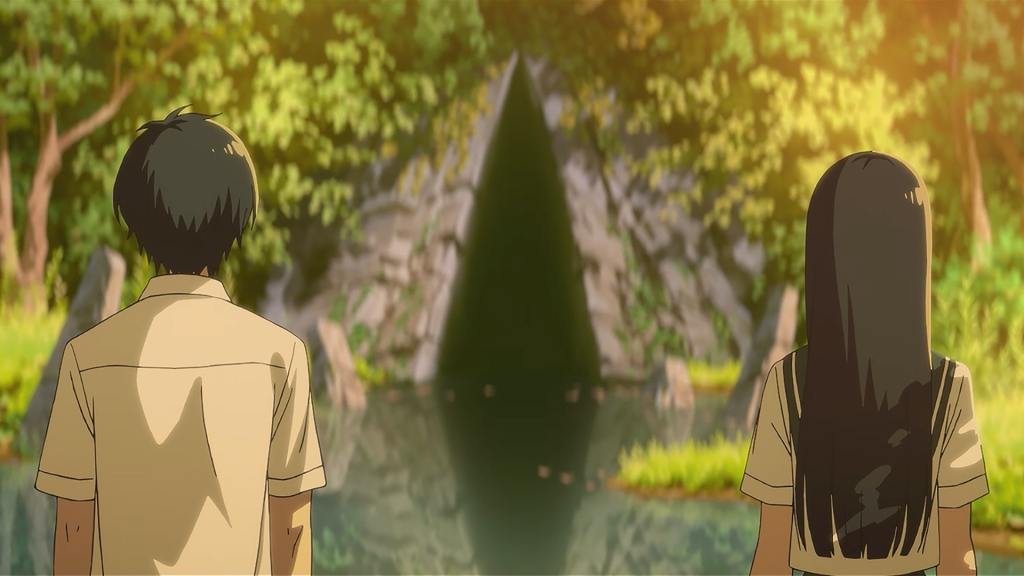
In this particular iteration, Suzume is a 16-year-old girl in Kyushu who gets caught up in a grand problem with interdimensional doors thanks to a chance encounter with a young man who’s preparing to become a teacher. . . while also, of course, fulfilling a long-standing family obligation to keep these mystical doors locked and sealed. Suzume’s unwitting encounter with one of those doors sets in motion a chain of events which could lead to earthquakes and widespread destruction if she and Souta (who soon gets turned into a three-legged kid’s chair!) cannot do something about it. But Suzume’s ability to interact with the doors and witness their effects (when most can’t) may have everything to do with an encounter with such a door during a great calamity she suffered through as a child, a calamity which, in many ways, defined both her life and her relationship with her aunt/adoptive mother. And certainly, going on a cross-country jaunt to deal with the doors (and a mysterious talking cat associated with them) without explaining anything puts a strain on that relationship, too, even as she’s clearly falling for Souta.

One of the more interesting and distinctive features of this particular project is the emphasis placed on abandoned places. This is a device that Shinkai has used before, but not to this degree, as the doors most commonly appear in places that have been abandoned. Whether this has particular meaning is unclear, though it does make a certain amount of supernatural sense that portals to a world for those who have passed on would be found in such places. It’s also entirely possible that Shinkai may have just gotten fascinated by the real-life abandoned facilities scattered across Japan and decided to highlight a few of them as a gimmick. The detail on these settings is just too phenomenal for them to not be based on real-life places. Coupled with this is the imagery of the remnants of catastrophe, both in real-life and in the otherworldly space. The effect of the Great Kanto Earthquake (whose 100th anniversary comes up later this year) is one, and the other, even though it is never specifically mentioned, is clearly the devastating Tohoku earthquake and tsunami of 2011; sharp-eyed viewers might also catch a reference to the Fukushima Daichi nuclear disaster associated with that event.

Another point of emphasis is the encounters that Suzume has along her journey, a device which which was also used heavily in immediately-previous project Weathering With You. By any reasonable analysis, the sojourn Suzume goes on is a dangerous one for a 16-year-old girl even without the supernatural element figured in, but as in Weathering, she meets and befriends a number of mostly good-natured people who help her along the way even if they don’t at all understand what she is actually doing and why. These are not complete charity cases, as Suzume does odd jobs and babysitting in some cases and is helped by someone who has his own reason for seeking out a missing Souta in another case. The strain Suzume puts on her aunt (whom she conspicuously refers to by name, rather than ever calling her mother) with these antics and her evasiveness about what she’s doing also gets dealt with. Suzume, by comparison, is a fairly standard Earnest Girl who unquestioningly follows her heart and instincts; as most girls her age are, she’s quite mature in some respects but spectacularly immature in others. However, even without there being much novel about her, she still makes for a fine heroine.

As we’ve come to expect from Shinkai films, the visuals are a thorough treat; this may even be his best-looking film to date. I have already elaborated on the sterling background detail work, but the animation effort is also quite sharp, character and critter designs are inviting without entirely being anime-typical, and special effects impress. A wonderful musical score also delivers throughout, helping to highlight a key late emotional point.

The movie is currently circulating in American theaters in both subbed and English dubbed forms; this review is based on the latter. This is the first significant anime dub for Nichole Sakura, who gives Suzume a somewhat deeper voice but still handles Suzume’s emotional aspects well. Josh Keaton (He is Thomas from Tiger & Bunny 2) also has limited anime credits but is a perfect fit as Souta, whether in human or chair form. Lesser roles are a mix of a few familiar anime voices with relative or complete newcomers, but nothing felt off the mark. In particular, voices that were supposed to be young kids sounded like genuine young kids.

After a slight downturn with Weathering With You, Shinkai is back to Your Name-level form with this one. Despite the familiarity of the story pattern and sentiment, this is still going to be one of the year’s top anime releases.

Overall Rating: A

Special Preview: Oshio no Ko

Streams: HIDIVE on Wednesdays

Debut Rating: 5 (of 5)

EDIT: Also see here for an official music video linked to the debut, though it should be watched after watching the debut since it is spoilery.

Wow. I read the first volume of the source manga a week before, so I knew all of the twists and turns that were coming in this movie-length debut and knew that the whole thing would adapt well to anime form. Even so, I wasn’t prepared for how much of a punch the content would have, or how effective and involved its themes would come across in this format. It gets my highest recommendation, though that comes with a caveat: if you decide to check it out, you must commit to watching the whole 82 minutes, and preferably in one sitting. Drop out early on this one based on any assumptions you might make and you are likely to completely misjudge what it actually is.

That’s because the first volume of the source manga (which this debut adapts in its entirety) is, in some senses, one of the biggest bait-and-switches TV series anime has ever seen, and it takes nearly all of that 82 minutes to accomplish that. All of the advertising for the series has promoted it as the story of up-and-coming idol Ai Hoshino (center above), and the first episode certainly is that. It shows how she rises from small-time to getting acting gigs to becoming a star big enough to earn her group a dome performance. . . all while secretly raising twins she gave birth to at age 16, while she was on medical leave. (She gets away with this by them being passed off as the children of her manager and his wife.) Meanwhile, a rural doctor who’s a fan of hers becomes her attending physician and vows to make sure she safely gives birth when she declares that she plans to keep the kids in the hope of experiencing the family she never had. But he gets stabbed to death by an obsessive fan of Ai’s as she goes into labor and then reincarnates as one of her twins. And he’s not the only one, either.

That’s the first massive twist, and it isn’t the last. I’m revealing it here because it’s crucial to understanding anything else going on here and because the first few minutes of the movie does everything it can to hint that the story is going in that direction. From that point on, Ai’s kids – Aquamarine and Ruby – mostly take center stage, though Ai still has her feature moments, too. This is also the point where the story irrevocably establishes that it isn’t actually an idol series even if it is about an idol. While there are some light-hearted moments, the underlying structure is a more serious, analytical look at the cold practicalities behind the entertainment industry. I don’t mean that in the seedy sense, either, although something seedy clearly happened at some point; Ai’s pregnancy was not a virgin conception, after all. It considers realities like how little most performers earn, how hard it can be for group idols to break out solo, what kinds of actors productions have and what purposes they play, the generally cynical attitudes at the foundation of it all, and so forth, all while offering salient points like how delivering what the director really wants ultimately trumps actually acting well.

But for all of the events that transpire in this content, and the emotion gut-punch that hits at one certain point, the thematic elements here strike just as strongly. The biting recurring theme of the show is that, at its core, the idol industry (and, by extrapolation, entertainment in general) is all about lies. The images that idols portray, and the pandering to fans, is all a lie, but most fans instinctively (if not necessarily consciously) accept that and play along with it. So an idol who does not know love is not a problem as long as she can project that she does and get the fans to buy into it. Smartly, the writing also acknowledges that this isn’t foolproof; fans will pick up on it when the image an idol projects, or her smile, does not feel genuine enough. And Ai is the biggest liar of them all, since she’s also lying to cover up the existence of her kids. She’s so wrapped up in lies that, as cheery as she is, she’s afraid to say “I love you” to her kids for fear that she will acknowledge that as being every bit as much of a lie as when she sings lyrics laced with that phrase. And then of course there are the obsessive fans, who become aberrations by being unable to accept the contract of lies on which all of the industry is predicated, and thus cannot be part of the true spirit of the fan/idol interaction.

And that’s why this debut is supremely ironic. The series is about lies, but the direction it initially seems to be going is a lie, too, and that reset hits more than once. Very little pitched about the series in advertisements is any more truthful than the images projected by the idols in it, and while hints about the big late plot twist are dropped much earlier, the real path will not show itself until only a couple of minutes before the credits roll. (But do stick around for a rather emotional epilogue!) Even after the big twist lands, there’s another awaiting about the motivational direction of one of the characters who will be the series’ co-protagonist going forward, and that puts a very, very different spin on a story which may still continue to be about breaking into the entertainment industry. I can safely guarantee that this protagonist’s motivation is quite different than that of any more stereotypical would-be performer.

Aside from its main themes and twists, this debut also did a lot of other thing well. As much as Ai comes across as a genki girl-type, she has distinct desires and motivations as a girl looking to find love in lies, and the nature of the second twin, while very gimmicky, also has its own deeper angles. The production also works the emotional elements well and packs in some sharp, symbolism-rich imagery, such as a recurring theme of a shining star in the sky being equated to Ai. The stars literally in Ai’s eyes may seem cheesy at first, but they also pack meaning as the story progresses and her backstory is explored a bit more. After using a silent soundtrack for much of the movie’s running time, the somber piano numbers deliver hard towards the end.

If there are any slight complaints here, it’s that one key scene runs on a little too long and some of the foundational logic is a bit shaky. But I will forgive that in light of how well the rest of this is done. The rest of the series may or may not hold up, but for my money, this is a superior adaptation of its equivalent source material and one of the strongest debuts in years.