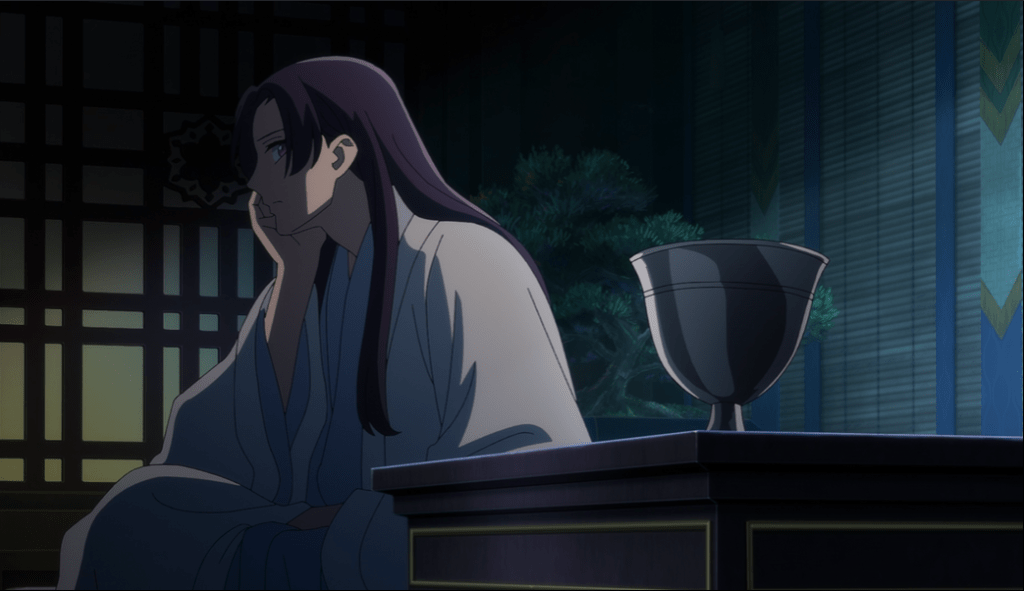
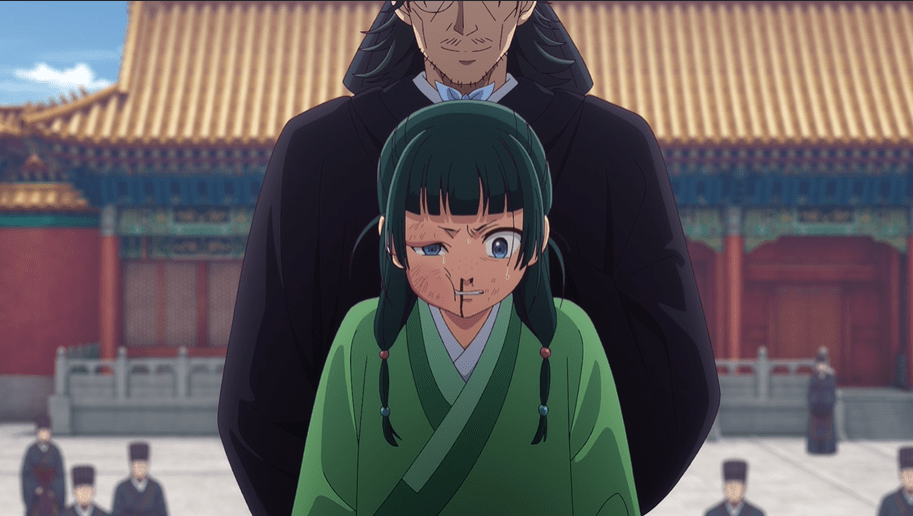
After the dramatic events, revelations, and symbolism of last episode, there was really only one final climax possible for this series, but that doesn’t make Lakan discovering and then picking Fengxian as the courtesan he’s going to buy out any less moving or satisfying. He’s intuitive enough to understand the message that Maomao sent him with the withered blue rose once Meimei put it in context for him during the selection process, and every bit of his actions here show how deeply he’s still in love with Fengxian. Seeing Fengxian’s idealized rather than disease-ravaged face is an old anime trick, but it works especially well, and carries special meaning, in this case given Lakan’s own face blindness. Most importantly, it’s the strongest indicator of how genuine Lakan’s feelings are.
The role Meimei played in all of this shouldn’t be overlooked, though. She mentioned to Maomao before about how courtesans don’t always get everything they want when being bought out (which can now be taken to refer as much to Fengxian as to herself), and her being bought out by Lakan wouldn’t have been a bad deal for her at all. He had plenty of money and prestige, could intellectually challenge her, and she’d known him since before she became one of Verdigris’s stars. But that meant she also knew who his heart really belonged to, and the way she looked after Fengxian a few episodes back showed how deeply she still cared about her “Big Sister.” This was her golden opportunity, but she also knew what the right thing to do was here. The manga version is clearer about showing Meimei lamenting the opportunity she was passing on here, but there are enough subtle hints that the impact of this scenario on Meimei still gets across if you’re paying close enough attention.
The explanations Maomao make to Jinshi later on clear up a few additional points, such as how Maomao really feels about Lakan and why: she doesn’t hate the guy, but has seen him as a creepy pest since she was very young and dislikes his tendency not to take action himself despite his keen intuition. (Her frank comment about how she wouldn’t be here if Lakan didn’t “land that shot” is very much like her, too.) For all that her biological parents weren’t in the picture, though, she clearly does not feel deprived. Loumen was a wonderful adoptive father, and the doting from the Three Princesses compensated for anything she might have missed from her mother. Perhaps her attitudes about love have been impacted by the situation with her parents, but she’s not damaged goods beyond her pinky fingertip.
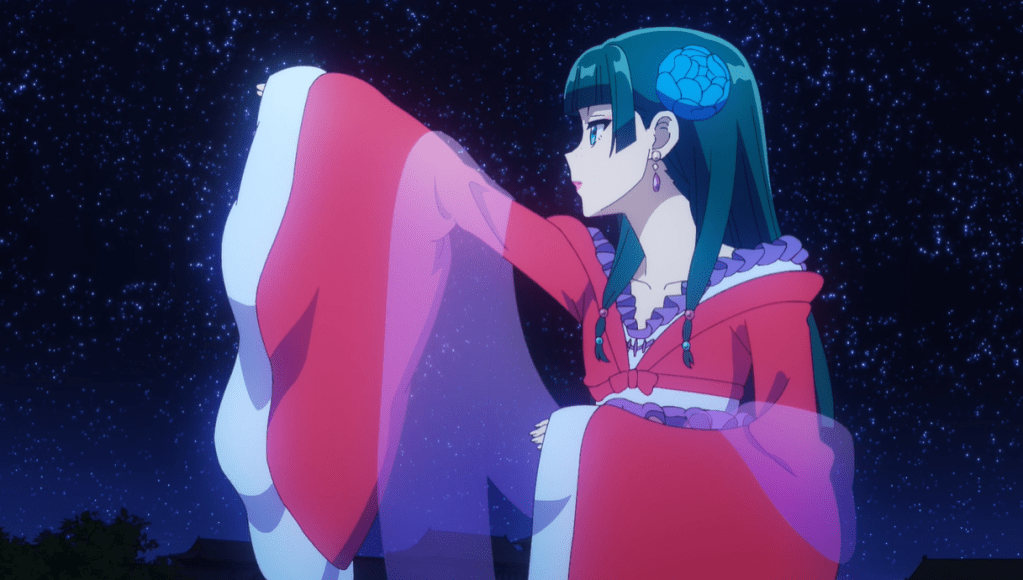
The way she chooses to close out this part of her life – with her dance atop the wall at night – is a great summative scene for the series as a whole as well. It harkens back to the case of the ghostly woman in episode 3, but instead of dancing for a man, she’s dancing to send off her parents for whatever time Fengxian has left, in the tradition of the pleasure district. (Meimei surely intended this by sending Maomao that veil, too – another point for Meimei!) Jinshi personally going up to investigate and carry the now-bleeding Maomao back down also reaffirms where he stands, even if Maomao doesn’t appreciate that.
And my, poor Jinshi. He actually thought for a moment that he might be getting through to Maomao romantically, didn’t he? Sorry, my friend; though she isn’t intentionally so, Maomao is much harder cat to tame than that.
The one seemingly-incongruous detail is the scene with Loulan meeting with her father. Perhaps that’s meant as a stark contrast to Maomao’s relationship with her own father, or perhaps it’s meant as a precursor to what comes next. We’ll have to wait until the second season debuts in 2025 (which was announced at the end of the episode!) to see.
As a side thought, the animation team cleverly slipped in another association between Maomao and woodsorrel. Look at the flower she’s picking as a toddler:
Overall, the consistent quality of this second half, and the number of big moments it lands, allows this series to edge out Frieren: Beyond Journey’s End as my pick for Best of Season.
With its 28th episode, Frieren: Beyond Journey’s End ends its initial run. By any reasonable metric, it has been a huge hit on both sides of the Pacific, to the degree that it not eventually getting further animation is inconceivable. (My guess is that we’ll see more late next year.)
I could write a full review to add to the masses singing the series’s praises, but given the tenor of the series, a different angle might be more interesting. One of the recurring themes of the series was the learning of valuable lessons, especially that even someone more than 1,000 years old still has as much to learn as she does to teach. So let’s look at eight lessons we can take away from the series.
Note: The following assumes that you have watched all of the anime series or are at least familiar with its equivalent source manga. There will be spoilers for those who haven’t!
Lesson 1: Heroes Can Be Self-Made
Of all the many flashbacks to Himmel in the series, the one that may have had the deepest impact on me was the one in episode 12, where Frieren recalled how Himmel failed to pull the Hero’s Sword from the stone in the Village of the Sword. That meant that Himmel was not predestined to be the Hero; he didn’t have a divine prophecy backing him, wasn’t plucked from another world by a goddess to fill that role, didn’t seem to have special powers or equipment, didn’t come from an OP village, and didn’t have Hero as a title from video game-like stats. But he, a boy from an ordinary village, went on to become a legitimate Hero anyway, not being deterred for a minute by the sword incident. He had the will to make it happen and the determination to see it through, and in so doing became arguably one of the greatest of all anime fantasy heroes. Too bad he fell hard for the girl who wouldn’t figure out how much he meant to her until after his death.
Lesson 2: Little “Good Deeds” Are As Important As Big Ones
While this is most directly addressed in the final episode, all throughout the series we are told about numerous small things that Himmel did (or led his party in doing) which served as complements to his great deeds. He wasn’t above simple, seemingly insignificant kindnesses like helping to carry items or protect a traveler because he believed in helping where he could, no matter how trivial that help may be. While this can be looked at as Himmel just being an inherently good person, such acts do serve a purpose. They are direct, tangible actions that make a common person’s life better (or at least easier), and people remember that. When those memories are passed on to following generations, they can inspire others just as assuredly as the grand deeds do.
Lesson 3: Vanity Can Serve A Purpose
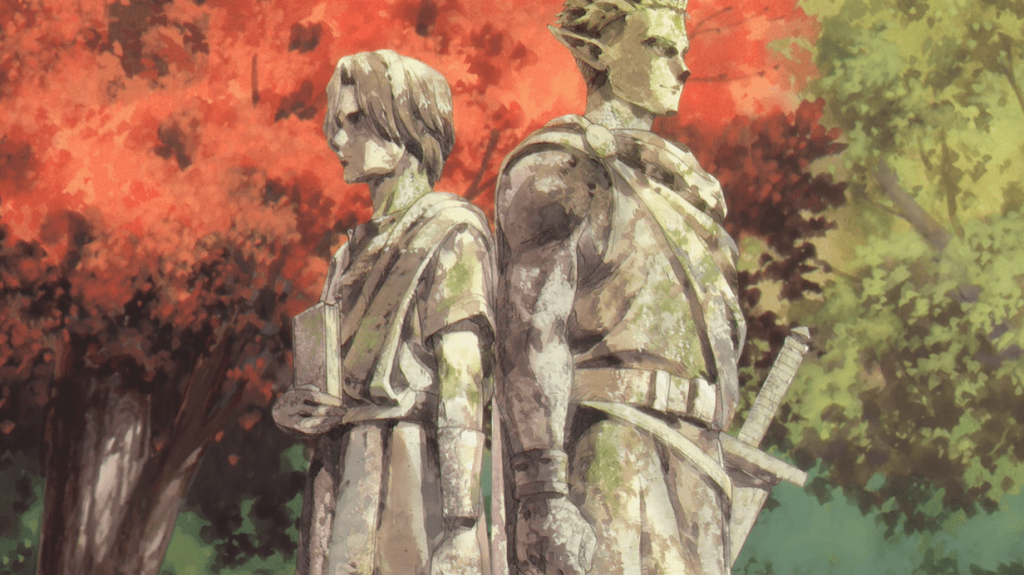
One of Himmel’s few genuine faults was that he was very conscious of his image, to the point of one time spending hours just determining the right pose for a statue to be made of him. However, Himmel was a lot more subtle and clever than Frieren ever gave him credit for. Himmel understood how important it was to leave behind inspiration for those who would follow (as would, much later, prove to be the case with Wirbel in particular). More personally, he also wanted to make sure that one certain person would never forget him, no matter how many years might pass or where her journeys might take her. Himmel passed it off as a joke when he said that he was having all the statues made so Frieren wouldn’t be lonely after he was gone, but many later scenes suggest that it wasn’t a joke at all.
Lesson 4: There’s No Age Limit on Being Childish
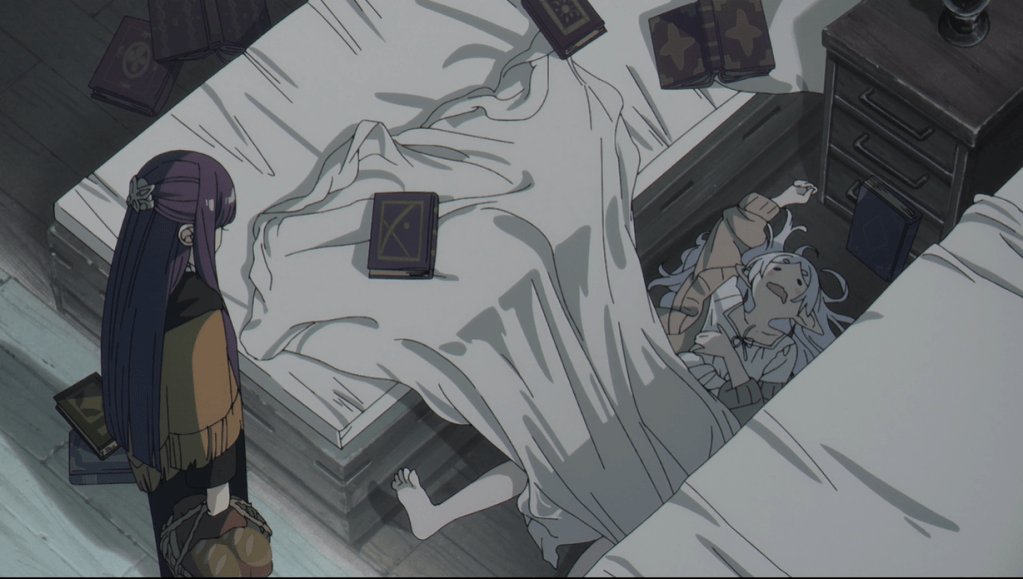
One recurring joke throughout the series is that, despite the immense age difference between Fern and Frieren, Fern sometimes comes off as the adult in their relationship. She’s certainly the more mature and responsible one when it comes to everyday activities or even something as simple as how one sleeps. Watching Frieren lie in bed, kicking her feet as she reads a book, in episode 12 also seemed very incongruous with her supposed maturity level. Serie, who’s even older, shows that she can be childishly petty in the late episodes, too. (This makes for an amusing contrast to Fern’s immature pouting at times or the constant squabbles between Lawine and Kanne which result in physical tussling.) Frieren also shows on a few occasions that she’s not above patting even full-grown adults on the head as if they were children.
Lesson 5:Magic Is What You Make of It
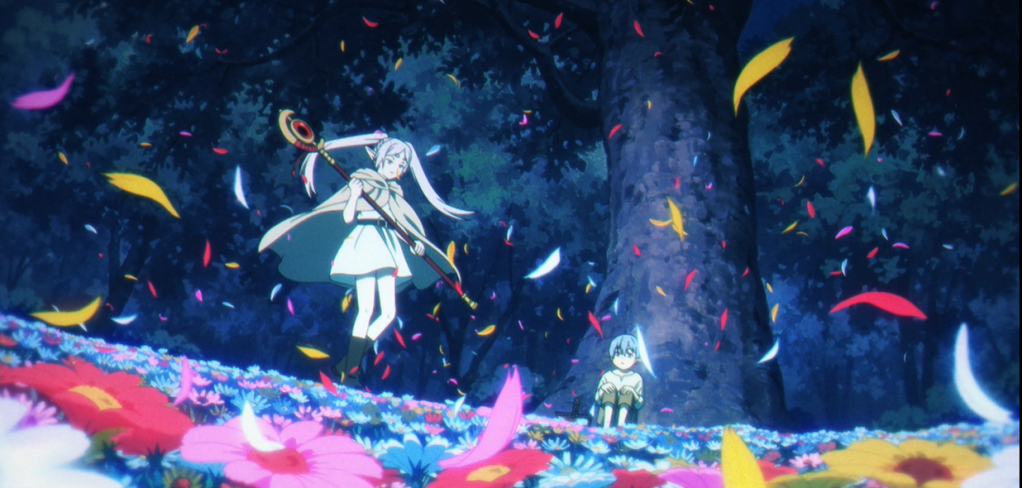
Although this comes through most strongly during the First-Class Mage Test, a recurring world-building aspect is that there’s no one right way to use magic (despite what Serie seems to think). It absolutely has its valid combat and defensive applications, but it also has plenty of peaceful applications, too, such as cleaning clothes, warming tea, waking someone up, or making a field of flowers. And as useless as some of those applications might seem in the big picture, they can play key roles in changing the world in unexpected ways.
Lesson 6: Questing to Save The World Doesn’t Mean You Can’t Have Fun Along The Way
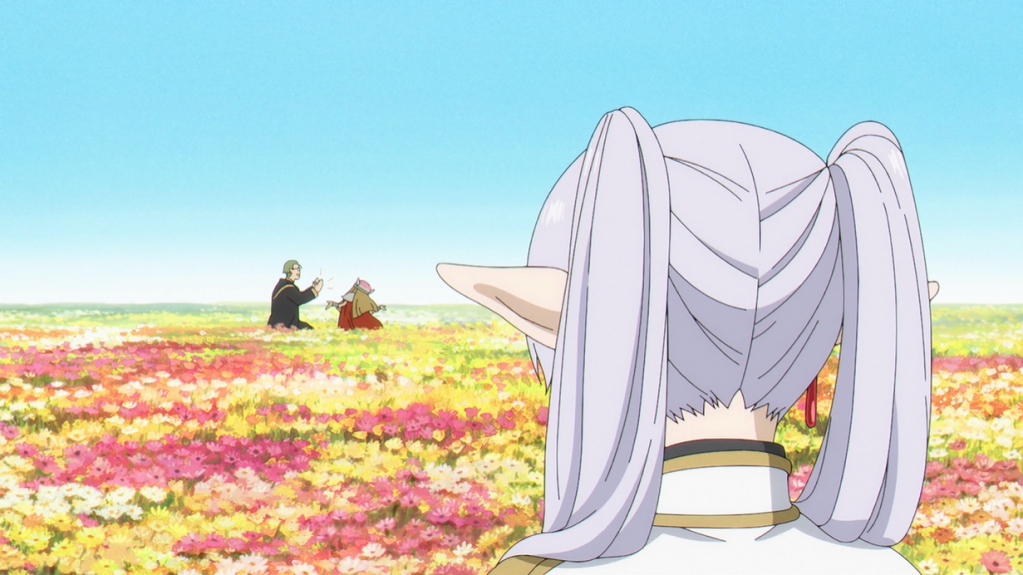
Though Himmel was passionate about becoming a Hero and defeating the Demon King, he also seemed to recognize that taking things too seriously – prioritizing efficiency too much – could also be detrimental. (Either that or he was just a very whimsical soul.) Sure, there was the the running joke about Heiter’s drinking (which, ironically, only got funnier as the series progressed), but this aspect showed more clearly in early incidents like the Hero’s Party members frolicking in the field of flowers in episode 2 or playing with orphans at an orphanage in episode 11. Later in the series, it also comes up in Himmel’s dedication to enjoying the process of clearing dungeons. Frieren’s fascination with magical junk could also be considered an aspect of this.
Lesson 7: Being Remembered (and Being Able to Remember) is Important
Of all the recurring themes in Frieren, none are more pervasive than the importance of remembering and being remembered. As early as episode 1, Himmel entrusts Frieren with remembering the Hero’s Party and what it accomplished because she was going to outlive everyone. Himmel had all of the statues made at least in part to make sure Frieren didn’t forget him. Frieren’s entire journey is about exploring her memories of her time with Himmel and crew, and on many, many occasions throughout the series we are exposed to people who have been influenced by their memories of what the heroes did. On the flip side, Voll is guided by his memory of his wife but troubled that he can’t remember her clearly. Serie also reveals in the final episode how she’s never forgotten about those she’s trained, even though, like Flamme, they didn’t succeed to the degree that she wanted. And Kraft sought religion because his great deeds have been forgotten; even when physical evidence remains, people don’t know what it means, but surely the Goddess will, right? The second closer is all about remembrance, too.
Lesson 8: Beware of Mimics!
That 1% chance it’s not a mimic isn’t worth it.
That’s it for now. Look for the Winter ’24 Wrap-Up coming in a few days.
The Apothecary Diaries is undeniably Maomao’s series, though Jinshi has increasingly had his viewpoint represented of late. That makes episode 23 a major aberration, since not once during the episode is Maomao’s perspective used. However, despite our adorable little freak being limited to what essentially amounts to a supporting role, and despite the episode primarily focusing on a character who’s certainly not a fan favorite, the writing and production still delivers a quality story, one which shows how badly Lakan has been (deliberately) misrepresented up to this point.
That’s not to say that Lakan comes off as a good or “merely misunderstood” character by the end of the episode. However, as the lengthy flashbacks following his Chinese chess matches with his daughter show, his situation is a lot more complicated, definitely more tragic, and at least a bit less seedy than what it originally appeared to be. The most important revelation is that Lakan’s interest in Fengxian (Maomao’s mother) was reciprocated. Despite her attitude as Lakan has remembered in earlier flashbacks, Lakan probably caught her interest for much the same reason that she caught his: he was an intellectual equal. She probably enjoyed her games with Lakan much more than she let on, and knowing that she wouldn’t get that kind of mental stimulation from her other suitors, was desperate enough to not be bought out by someone else that she was willing to do something very risky in order to make it possible for Lakan to do it; in other words, it was her scheme, not Lakan’s, to devalue herself. Unfortunately for everyone, the scheme didn’t work because of nothing more despicable than truly horrible timing.
In other words, Lakan’s only blame here is that he didn’t realize what Fengxian was doing. He had no power to resist effectively being exiled, and because he (most likely) didn’t have enough context to understand right away what Fengxian’s buyout failing meant, he didn’t send her a letter explaining his prolonged absence – assuming, of course, that he was even able to do so. (If he was abroad, that might not have been possible.) That means his exchange with Jinshi is based on things he learned after the fact, not that he did or considered doing himself, so he was pitching complete BS to Jinshi a few episodes back.
The reason he couldn’t come back quicker ultimately doesn’t matter, though. Fengxian’s failed gambit did result in Maomao being conceived but cost her everything else. Not knowing that Lakan wasn’t away by choice, she doubtless though Fengxian has just abandoned her. (There’s doubtless plenty of precedent for that in the pleasure district.) Hence, her trying to curse Lakan doesn’t sound strange at all, nor does taking off the tip of infant Maomao’s finger as part of it. The immense irony here is that it’s strongly implied that Lakan’s uncle – the one who taught him how to recognize people – was Luomen, which means that the man Maomao calls her father is actually her great-uncle. I’m betting she’s not aware of that, but I’m also betting that Luomen does know. In fact, him taking Maomao in may not have been an irony at all; he might have done it because he felt responsible for the situation. (Even though that really wasn’t his fault, either.)
Other little details deliver a boatload of world-building and explanations:
The beginning of Lakan’s flashback confirms that he really does have prosopagnosia (i.e., face blindness), and so seeing faces as Chinese chess pieces is a coping mechanism rather than an anime affectation.
Maomao once mentioned she didn’t have a mother. At the time, it seemed to be because she couldn’t think of Fengxian as her mother, but the flashback shows that courtesans aren’t allowed to be mothers, so being born in a brothel means you don’t have one (as Fengxian herself didn’t).
The reason why Meimei tolerates Lakan is now clear: he taught her games – and she was generally on good terms with him – when younger. She presumably doesn’t hold anything against Lakan over Fengxian because she’s probably heard or pieced together the whole story over time.
Madam may even to this day blame Lakan for what happened to Fengxian (even if it’s not fair), and she clearly did back then, hence why Lakan was never told the truth about Fengxian’s presence or condition. Very possible that she’s looked after Fengxian all this time because she blames herself for contributing to the mess by running up Fengixan’s price.
This explains why Maomao has conspicuously looked at her pinky finger on a few occasions over the course of the series, and what was going on in her dream about her mother hovering over her with the knife.
This also means that Maomao’s resolute insistence on calling herself a commoner takes on a much broader meaning. Even if she is illegitimate, she could make fair claim to being a noble, so she’s specifically rejecting Lakan by making that claim.
Most of the women in the series have a signature flower. Fengxian’s appears to be balsam, and we can now identify the little yellow flower that Maomao has been associated with in the past as woodsorrel (or perhaps more specifically, yellow woodsorrel). In one scene, Fengxian claims that it’s also known as cat’s foot, which does provide a thematic connection for Maomao, but doesn’t seem right; everything I’ve looked up says that cat’s foot is an entirely different plant.
Maybe the biggest question left by the episode is if Lakan understands and appreciates how completely he got played by Maomao. She knew he wouldn’t resist the game, she banked on him deliberately losing because he wouldn’t risk her killing herself with poison, and she knew that he was weak to alcohol. Making the “poison” just be extremely-high-proof spirits was a dirty trick but (mostly) not a lie, since it would, indeed, be a medicine in small doses but poisonous in bigger ones. Exactly who she expects him to buy out should be obvious, and I have no doubt that the withered rose Maomao left for him was meant to be a metaphor for Fengxian. Add in the business with the fingernail polish and it’s a scheme worthy of an evil mastermind. Jinshi should be careful to stay on her good side.
Certain visuals are also worthy of recognition here. The black rain that Lakan runs through (and later despairs in) is a brilliant touch. So is a shot of a garden at the 1:50 mark, where woorsorrel (Maomao) is shown in the background while unopened buds of why I presume is balsam (Fengxian) is shown in the background. The lullaby Fengxian sings here is also the same one she hummed back in episode 18.
Overall, this is another fantastic episode for a series on a terrifically-strong run.
Though he’s hardly one of the more likable characters in the series, Lakan is still an intriguing one. He’s ferociously smart and a superior judge of character and ability (last episode strongly implied that he is responsible for Lihaku being where he is, for instance), which allows him to maintain a high position despite a seeming lackadaisical attitude. Not much truly gets him interested beyond games (in both the literal and figurative sense), and for all his cunning, he doesn’t seem to operate with a bigger purpose; he annoys Jinshi just because it amuses him and, perhaps, gives him a convenient method to interact – however indirectly – with his daughter. As revealed at the end of this episode, he also has an odd way of looking at people, at he sees their faces only as game playing pieces; doubtless this contributes to his approach to people. However, Lakan is about to find out that he’s not the only one who still has her faculties intact who’s good at games. You can only prod a cat so much before she’ll scratch back.
This all arises because of some reminiscence Lakan has about blue roses being present at the palace, so he decided to challenge Jinshi to come up with some, knowing full well how difficult it would be to do. Blue roses don’t appear in nature, but in China they symbolize achieving the unobtainable. They are also connected to a folk tale about a princess who insists that she will only marry a man who can present her a blue rose. Ultimately she accepts a white rose as blue because it comes from the right person. (In some version of the story, it’s a gardener’s son that she’s long known; in others, it’s a wandering minstrel.) This seems to have some kind of connection to the matter with the courtesan who was Maomao’s mother, although exactly how hasn’t been revealed yet. Whether Maomao is aware of this or not, she clearly recognizes Lakan’s comments to Jinshi as a challenge. And we know well from past stories in this series that Maomao is relentless once she takes a challenge seriously.
For all that the procedure Maomao uses to try to coax roses to bloom out of season is interesting, as is the gimmickry she uses to temporarily turn white roses blue (infuse them with colored water!), that’s actually not the whole story here. She isn’t just trying to make blue roses; she’s trying to show Lakan up completely by playing a deeper and broader game at the same time. The whole business with spreading around the reddish nail polish – even including wearing some of it herself to entice others in the Rear Palace to start doing it – seems at first to be an odd choice of timing, but as the scenes with Lakan near the end show, it’s actually an elaborate scheme by Maomao to send a message to Lakan. She knows full well that a color similar to that was used by courtesans at Verdigris house, and a Lakan flashback strongly suggests that Maomao’s mother used it. Exactly what message she’s trying to send isn’t clear yet, but it clearly is throwing Lakan off.
And isn’t it interesting that, in Lakan’s view, the only people with faces which haven’t been playing pieces have been Maomao and her mother? That raises the question of whether Lakan’s stunned expression upon seeing Jinshi carrying the unconscious Maomao in episode 19 may have been because he realized he could see her face. (That was the first time he got an up-close look at her face.) That further raises the question of whether he can see her face because she’s important to him, or whether she’s important to him because he can see her face. I suspect we’ll find out more about that in what looks like a more direct game challenge next episode. Regardless, the Maomao/Lakan confrontation has been built towards all season, so I’m definitely looking forward to the upcoming payoff.
Though The Apothecary Diaries has been set up almost from the beginning to ship Maomao with Jinshi (and Jinshi is clearly starting to see her romantically even if Maomao is still repulsed), romance is not a major element in the series. It is not entirely devoid of romance, but those elements are located in the story’s fringes. One of those fringes is the recurring military officer Lihaku and how head-over-heels he is for Pairin, one of the three princesses of Verdigris House and a courtesan Maomao looks up to as a big sister.
Actually, calling it a romance at this point might be a stretch, as there’s little clear indication that this is anything more than a one-sided obsession on Lihaku’s part. However, Pairin does pointedly tell Maomao in a letter that she’s waiting for a prince to sweep her off her feet, and Lihaku clearly has both the kind of build she most prefers and the stamina to keep up with such an insatiable woman in bed. Lihaku is also a promising officer, fully in love with Pairin despite knowing exactly what her occupation is, and earnest in a straightforward, puppy dog-like way. All of that makes him credible as a favorable match, and Maomao – who, as Jinshi implies, wouldn’t hesitate to drive him off if he wasn’t fit for her “bis sis” – is clearly of the same mind. He even gets the Jinshi seal of approval (even if he doesn’t know it) by sticking to his convictions. Meimei ominously mentioned a few episodes back that a courtesan getting everything she wants in a buy-out is a rarity, so seeing Pairin leave Verdigris with Lihaku might be a scenario worth rooting for. However, given the Next Episode preview, that seems more like a long-term maneuver than one which will play out in the short term.
The humor for the episode comes mostly from the well-established bag of tricks: Maomao dispassionately doing and saying things that would be racy for anyone else and carelessly wording things in ways that can easily be misinterpreted. (Really, Jinshi should have learned by now to expect this kind of behavior from her, but it is still entertaining to see him regularly thrown off by her antics and thought processes.) The brief mystery aspect comes from a short opening scenario involving the eunuch doctor and problems with his family’s paper-making business; I had thought they might skip this bit, since it doesn’t seem connected to any bigger scenario. It does, at least, explain how someone from a wealthy background like the doctor ended up as a eunuch, and raise a slight possible mystery as to how the doctor was unable to meet the elder sister who preceded him to the Rear Palace. Very possible that this is a throwaway detail, but the series has been known to recycle seemingly-innocuous details before. . .
In all, this felt like the simplest and quickest episode in this half. Still some nice detail work (Lihaku was, I believe. looking up at the same kind of tree in one shot as the branch in Pairin’s hand in the scene where she’s reading Maomao’s letter) and looked great on technical merits, so it can hardly be called weak, and it does make for a more relaxing story than the more dramatic events of recent episodes.
In Part 1 last week, I covered series that have not been getting episode reviews at Anime News Network. In this installment, I will be offering my take on series that I am following that are getting week-to-week coverage. In most cases, these are the season’s more popular and/or noteworthy productions, so it’s not a coincidence that the average grades here are higher.
The Apothecary Diaries is, of course, not being covered here because I am episode-reviewing it. Some may notice that Gushing Over Magical Girls is not listed here, either. That’s because I have enough to say about that one for it to warrant its own separate review. Like Ishura, it’s another series that I am increasingly regretting not giving the weekly review treatment.
7th Time Loop: The Villainess Enjoys A Carefree Life Married to Her Worst Enemy!
Rating: B
The title on this one is partly misleading, as protagonist Rishe’s life as the fiancée of Prince Arnold (the man who directly killed her in one previous iteration of her life and was indirectly responsible for her demise in others) has been anything but carefree. As in other versions of stories where the protagonist is bounced back into a younger self, she uses the knowledge and skills gained in earlier iterations to take a wholly different approach this time, and in so doing she has partly-intentionally, partly-accidentally caught Arnold’s interest. He finds her strength of will and personality to be refreshing and intriguing, to the point that he’s willing to play her game even though he clearly doesn’t need to. There are hints that his frustrations with his circumstances and lack of an emotional anchor are what led him down the warpath in Rishe’s other iterations, and watching how he’s slowly changing is almost as interesting as watching Rishe do her thing. Not a spectacular series overall, but definitely an appreciable view featuring a strong, take-charge heroine.
Brave Bang Bravern
Rating So Far: B+
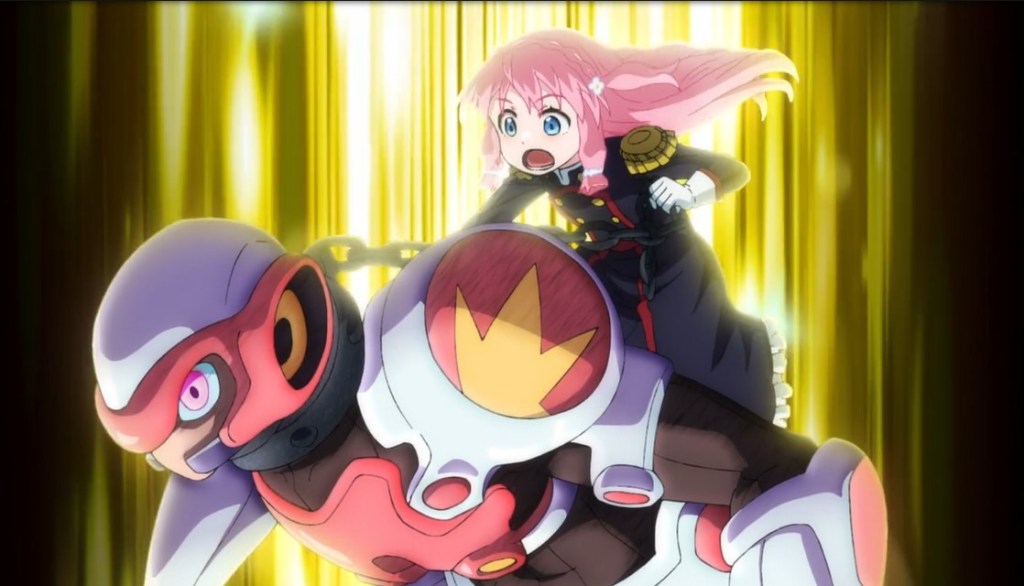
For the most part this is a fun, silly mecha series which ably captures the exuberant energy of classic giant robot anime (to the point of deliberate self-parody at times) while still allowing enough room for some real-mecha action alongside Bravern’s featured heroics. It certainly doesn’t hurt that Isami and Lewis make for a solid central duo, or that Bravern is a delightful character on his own. Much of what he spouts is cheesy as hell and laced with not-so-subtle innuendo, and he has all sorts of amusing gimmicks that give the humans around him pause, but he can certainly back up his words and does genuinely seem interested in helping out both humanity in general and Isami in particular. The most recent episode (#7) has veered into some very interesting world-building developments by showing that Bravern isn’t the only giant robot who can talk and Lulu (the seeming-alien girl who has become attached to Lewis) isn’t a unique individual after all. And we cannot forget the wonderfully gay closing theme; the series practically demands viewers to ship the two leads even though there are plenty of nice-looking women around. Technical merits are well above average, too. This will never be one of the most popular series of the season, but I’d bet that this one winds up having more long-term staying power than most others.
Chain Soldier
Rating So Far: C+
This is one of the boldest seasons in years for fan service-intensive titles, and this series is a significant contributor to that. It provides a middle ground between the extremes of Gushing Over Magical Girls and the more conventional light nudity of Tales of Wedding Rings, offering decidedly more kink than the latter but not to the almost overwhelming degree of the former. (And kudos to HIDIVE for securing the uncensored version!) The core premise – male protagonist Yuki can turn into a strong monster by becoming the slave of super-powered girls, with a payment that they’re compelled to do a sexy service for him – is twisted in all sorts of ways and becoming increasingly risqué as the series progresses, to the point that other girls beyond lead girl become his temporary master, too – and, most interestingly, he takes on a different appearance, physical capability, and power based on who his master is. (He gains lesser physical capabilities but keener senses and x-ray vision when the clairvoyant girl is his master, for instance.) This is a big help in keeping things interesting, since the overall plot, characterizations and couple of episodes spent on practice duels with another squad have been lackluster. Watchable, but not much to get excited about here outside of the fan service.
Delicious in Dungeon
Rating So Far: B+
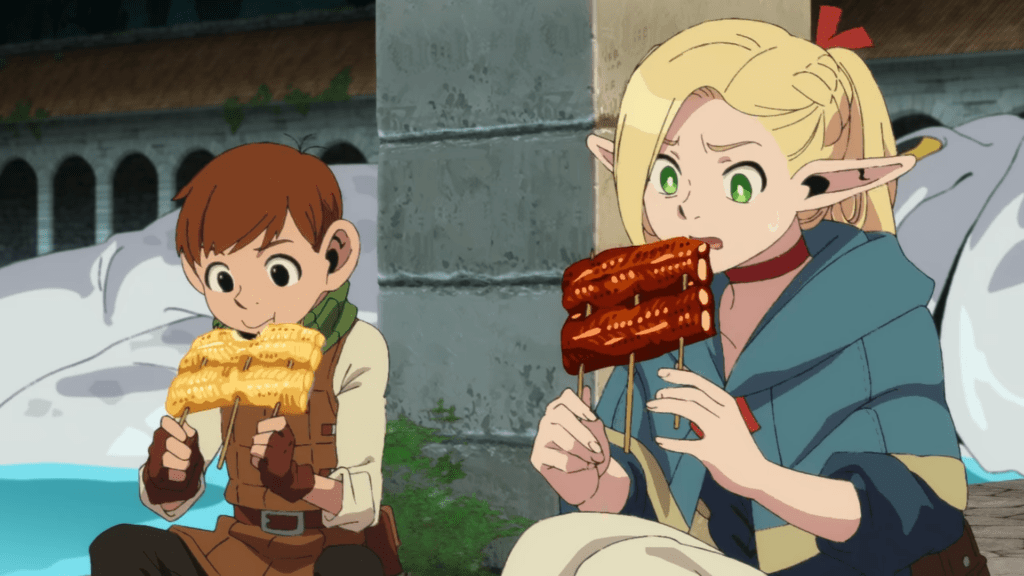
I’ve read the source manga on this one, and I am pleased to say that the series has been doing a quite capable job of capturing what made the manga such an enjoyable read. It is mixing adventuresome but also well-grounded cooking with dungeon delving in highly entertaining fashion; you don’t have to be a fan of cooking shows in order to appreciate this one. My personal favorite was how Senshi accidentally made a dessert while fending off some ghosts, but the series so far has taken all kinds of innovative looks on dungeon ecology, including using golems as walking gardens or discovering that there’s actually nothing magical about living armor. It hasn’t been shy about slipping in a good amount of character development, either, with all four of the core cast members being allowed chances to shine and having their own distinct attitudes about the whole “live off the land” venture. The vibrant, inviting use of color also helps give the series an extra visual appeal, too. I’m only limiting this one to a B+ grade simple because there are other series this season that are a distinct notch or two better still.
Frieren: Beyond Journey’s End
Rating So Far: A
The current First-Class Mage Examination arc isn’t quite as strong as the first cour of the series – and it definitely bows some to more typical contest/tournament arcs in shonen action series – but this is still one of the best series of the last couple of years for good reason. Its technical merits stand head and shoulders above most other series this season, which really shows in the usually-infrequent action sequences, but this arc still has a whole lot more going for it than that. The trials of the examination allow Frieren to interact more broadly with other characters, throw in a number of genuinely interesting new characters, and give Frieren ample chance to show off both her abilities and her quirks. It also allows for some fascinating exploration into the nature of magic in this setting, especially how much of it is based on imagination; you can’t beat a foe with magic that you cannot imagine yourself beating, for instance. As before, the strongest elements are in the little details, in the way the series smoothly tosses in humor, and of course in any flashback involving Himmel. The new version of original closer “Anytime Anywhere” is also devastating once you realize the story it’s telling between its lyrics and visuals. Only one other series this season even comes close to standing on this same qualitative level.
Metallic Rouge
Rating So Far: B
Yeah, don’t ask me to explain the plot on this one because I don’t get it, either. That’s the biggest negative in what is otherwise a very Blade Runner-esque take on artificial humanity, one which looks increasingly deeply at what Neans are, how they fit into society, and how much of their identities they can establish for themselves. Rouge’s raison d’etre has also increasingly come into play as her origins are getting explored. And oh, yeah, alien invaders are present, too – or at least some of their war machines are, anyway. Fortunately, the series has likable lead characters (especially Rouge) and a fair amount of good action scenes to carry the weight. Overall, the series feels like it’s underperforming, but it’s still a pretty good sci fi romp.
Shangri-La Frontier
Rating So Far: B+
The first half of the series carried itself on raw verve and spectacular action sequences, and not too much has changed going into the second half. The build-up to the epic battle against unique monster Wethermon the Tombguard, the execution of said battle, and the fall-out from it have take up the entire season so far, but as shonen action-style epic battles go, this one mostly delivers. Having an actual, heartfelt story behind the circumstances helps, and all three of the core trio get to show off flashy (and sometimes ridiculous) new tricks. The aftermath is nearly as interesting, though, as one character seeks to reset and the defeat of Wethermon at this stage has advanced the setting’s overall story in an unexpected way. The behind-the-scenes frets of the game developers was one of the great running jokes of BOFURI, so I am eager to see how much this twist affects the story going forward. Its new OP pales compared to the original one, but overall, the series is still one of the best game-playthrough series out there.
Solo Leveling
Rating So Far: B-
This is, by any measure, the most popular new series of the season, and in its last 3-4 episodes (or at least the ones that weren’t a recap), it’s finally started to show where its real appeal lays. Forget the weak attempt at a framing story, or the cheesy mechanics which make this a game-like structure for him but no one else; this one sells itself entirely on its action chops. Not all of its feature action sequences have been visual spectacles (the most recent one, where Jinwoo eliminates the party that was going to use him as a sacrificial lamb, uses a lot of typical anime action cuts), but the snake battle in particular was on a level with Shangri-La Frontier‘s best and the far darker, bloodier flare gives the series a very edgelord vibe. Hence, I don’t feel I can justify rating this series any lower even though I want to.
The Witch and the Beast
Rating So Far: B
After a standalone opening episode, this series has been operating in two-episode arcs, and not always with features duo Ashaf and Guideau at the center; one arc focused instead on a necromancer and her helper who dealt with very similar cases to what Ashaf and Guideau do. That offers some nice variety and a greater expansion of the setting and its mythos, though it comes as the expense of less screen time for the very likable central duo. Despite some occasional light-hearted moments, this one mostly dwells in the realm of dark, dangerous, and sometimes gruesome ambiance, making it one of the season’s most atmospheric titles. It looks pretty good, too. Taking a week off when it was already one of the season’s latest starters leaves it behind all of the others in terms of content to evaluate it on, but this more mature-leaning series is a definite keeper.
The Wrong Way to Use Healing Magic
Rating So Far: B
This one has been one of the surprise success stories of the season, a title that has turned out to be quite a bit more appreciable, and quite a bit less generic, than its premise suggested. It’s not like the series is doing anything dramatic different plot-wise, either; this is, at heart, a fairly typical story about a tag-along on an isekai summoning who turns out to be the real power among those forcibly recruited. However, a combination of fun twists, ridiculous antics, and, yes, some unconventional applications of healing magic (though not in the mean-spirited fashion of Redo of Healer) have compensated for so-so action and visual merits, and the series has a surprising amount of sincerity and depth beneath its surface. It will never be mistaken for a top-tier title but is still a blast to watch.
Villainess Level 99
Rating So Far: B
Speaking of series that are a blast to watch, that title also firmly applies to this mostly light-hearted take on the otome game villainess genre. Yumiella’s deadpan delivery is a delight to watch, but what truly keeps the series interesting are the ways that the overall story is continuing as she tries to stay out of it, but yet is also adjusting to the actions she’s taken. The way she’s also endlessly oblivious to the genuine efforts of one of her classmates to get closer to her romantically is also fun, and I have respect Patrick for sticking to his guns despite having all sorts of reasons to be driven away by Yumiella’s OP nature and personality quirks. (I’m rooting for you, Patrick!) Essentially, Yumiella is the kind of presence who’s a terror to have on your side but would be far worse to have against you, and the local king and queen earn points for recognizing that and quickly making sure Yumiella is welcomed rather than chased out. I look forward to seeing where this one goes next.
That’s it for this edition. One of the next two weeks I’ll have a feature piece on Gushing Over Magical Girls.
The Incident may be over, but the mysteries surrounding it aren’t, and as this great follow-up shows, they may not be for quite some time. Jinshi has always given the impression of having far more on his plate than Maomao was ever aware of, and this episode only codifies more clearly how broad and deep that plate is.
The most immediate concern is, of course, Maomao’s rescue of him from the falling beam. Having Maomao recuperate in his own bed certainly is a strong statement (though Maomao is either oblivious to that or deliberately avoiding it), but the real matter here is Maomao laying out the conspiracy she saw last episode which drove her to action. With all the details taken together, there’s no way it doesn’t look highly suspicious, but as I mentioned last time, only a person positioned exactly right, with direct exposure to all of those incidences, could have made the connection that each incident was related. Even the metalworker matter comes into play, with a crucial part (which was stolen under cover of the fire) having been recast with the special metal that melts at low temperatures – and because that part was directly over a ceremonial brazier, the opportunity for it to fail presented itself. Everything else was just to cover that crucial point up; even the metalworker’s death now looks suspicious, too.
All of this brings up one really big question: was Suirei really the mastermind here in the attempt on Jinshi’s life? If so, why? At the very least, she had accomplices and, we can presume, some degree of backing, but it’s quite possible the details were her orchestration. The comment she made to Maomao on the hill a couple of episodes back sounded a bit like a challenge at the time, and now it’s clear that it was intended to be a hint about her false-death trick – in other words, the same gimmick used by Juliet in Romeo and Juliet. That is a hallmark of a mastermind, as is her manipulation of the doctor. That she was adopted by the doctor’s former master because of her displayed talents further lends credence. Every proper detective needs a Moriarty, so this is likely not the last time Suirei will clash wits with Maomao, and the latter clearly wouldn’t have it any other way. At the very least, the extent of this conspiracy is far from being fully revealed.
The episode also does confirm two points that have long been suspected: Basen is, indeed, Gaoshun’s son (his youngest, in fact) and neither Jinshi nor Gaoshun is actually a eunuch. In fact, the name “Jinshi” is likely every bit as much artifice as the identity and persona he takes on during his work in the Rear Court. He’s even lying about his age by a few years. Whether or not he’s actually Ah-Duo’s son (and thus the current emperor’s son and true successor, rather than brother) remains nebulous, though Jinshi’s own reflections on the matter point towards that truth as much as Maomao’s own suppositions did back when Ah-Duo left the Rear Palace.
Things are afoot elsewhere, too. Maomao is returning the Rear Palace because Gyokuyou may be pregnant again (and it keeps Lakan firmly at a distance) and new courtesan Loulan is proving to be quite the oddball with her dramatic fashion changes; everything suggests that she’s doing it deliberately to discourage the Emperor from getting too close, though for political reasons, he can’t completely ignore her. The anime-original scene of someone whispering in her ear after the incident with Suirei also seems highly suspicious, but given what seems to be coming up next, we may not see anything more come of that for a while (if even at all this season).
In fact, based on the final scene with Lihaku and the Next Episode preview, it looks like the adaptation is going to skip a story where Maomao helps out the eunuch doctor in the Rear Palace with a family business problem. That chapter always felt like a side story to me anyway, and upcoming the story involving Lihaku and Pai Lin is a much juicier affair anyway. Should be good fun!
Really, this should have been started last week, when the earliest-starting series were first hitting episode 7s, but sometimes real life intrudes. Anyway, I have plenty of time this week and next for some extra writing, so let’s take a look at how a bevy of series this season that I’m not actively episode-reviewing are doing.
In all, I have somehow wound up staying mostly current with 23 series this season. A handful of others that I watched more than one episode of have fallen by the wayside; I likely won’t continue with Mashle: Magic and Muscle (mostly because I have just lost interest with its oddball gimmick) or My Instant Death Ability is Overpowered (because it’s just bad and seems to be poorly-adapted), but I am not ruling out watching more of The Weakest Tamer Began a Journey to Pick Up Trash or The Strongest Tank’s Labyrinth Raid at some point, as both had potentially endearing qualities but simply lost out to volume overload. Because trying to cover them all at once would be burdensome, I am dividing them into two groups. This group are titles that are not getting episode reviews on Anime News Network, and the second group (which will constitute next week’s installment) will deal with my take on titles that are getting coverage.
Banished from The Hero’s Party s2
Rating So Far: B
The first season was an unexpectedly solid performer which tossed out some intriguing ideas about how the Blessing bestowed on everyone (and even monsters) could influence the individual, especially how it can be difficult to ignore the Blessing in some cases. This season continues to explore that, both by looking at how Ruti’s new Blessing checks her Hero Blessing, thus allowing her to choose her own path, and how the new Hero fanatically embraces Blessings and preaches a worrying level of determinism about them. The notion that someone may be going around artificially giving monsters extra Blessings also comes up. The series still has plenty of low-key charm and sexiness, and seeing Ruti acting more and more like a regular human being is welcome, but it’s building a good balance between plot and fantasy world slice-of-life. Animation limitations prevent it from being a top-tier performer (the most recent episode in particular had significant quality control issues), but it’s still among the better series this season.
Doctor Elise: The Royal Lady with the Lamp
Rating So Far: B-
I’d really like to rate this one higher, as its combination of double-isekai and time travel gimmicks provides for some interestingly different possibilities. Also, rather than having an OP ability, Elise simply has the medical knowledge of a trained 21st century physician, knowledge that’s a century and a half more advanced than what exists in the setting where she’s a potential future Empress. (But it might as well be an OP ability, since she can perform medical procedures that flabbergast the current medical community.). There’s also something very satisfying about seeing her struggle to avoid her fate by pursuing the new calling she discovered in her second life in modern Japan, rather than by just being a better future Empress. However, the series isn’t even trying to avoid over-dramatizing its medical procedures and is taking a very by-the-numbers approach to having Elise unwittingly win over the prince/future husband that she never really connected with the first time around. As a result, certain aspects of the series feel redundant in a season that also has the conceptually-similar 7th Time Loop. Mediocre technical merits also hamper the series some, but not to the point of denying the appeal of Elise as a strong female protagonist.
Fluffy Paradise
Rating So Far: C+
If I had to describe this series in one word, it would be “saccharine.” But what else would you expect from a series where the protagonist is an adult woman on the inside mostly embracing her little-girl-on-the-outside to spend her days hanging out with floofy animals and monsters – and if some of them happen to be Holy Beasts, dragons, or even goblins, so what? This is a much more cutesy, relaxing series than most other isekai, and it has to be accepted at that level in order to be tolerable. For those wanting more from a series, there are hints of bigger machinations and broader realities in the setting (and the underlying current of God seeking an evaluation of how humans treat non-humans still lingers in the background) and the series isn’t entirely ignoring how potentially strategic Nema’s capabilities are; it would definitely be more involving if it stressed the latter aspect more, though. Still, the series functions well enough as the kind of thing you might watch while eating breakfast to get your day started off right.
Hokkaido Girls are Super-Adorable!
Rating So Far: C+
Honestly, there’s not a lot to this one; it’s just a basic, slice-of-life harem series. The only distinguishing features so far are that it’s set in winter in Hokkaido and all of the girls are gyaru to some degree. The most recent episodes have introduced the third, slightly older girl, so we now have a busty blonde genki girl, a more subdued brunette who’s secretly a gamer, and the senpai with short, pale hair and possibly mixed blood. All are, of course, beautiful and have befriended protagonist Tsubasa. Each may also already have feelings for him to some degree, though there’s no full-blown romance yet. The series annoys some by having Tsubasa spend too much of his time being utterly flustered (but what boy his age wouldn’t be, with girls like these three around?), but the most recent episodes have shown that he has some tensions at home that are already causing conflict. The trio of ladies also have no shortage of sex appeal, though the series has largely avoided full-blown fan service so far. Worthwhile if you appreciate the genre, but unlikely to win over outsiders.
Ishura
Rating So Far: B+
If any series in this group is strongly crying out to be reviewed episode-by-episode, it’s this one. (I almost considered doing it myself.) The series took a big risk with an approach that could easily discourage many viewers: its first five episodes are a collection of mostly-disparate stories which each focus on one or two characters who are each going to play roles in a grand power struggle between an empire and an offshoot city-state. Each of these episodes gradually moves the overall timeline forward as characters start to converge, with paths finally crossing – and featured characters coming into open conflict with each other – starting with episode 6. (And episode 7 even provides the first death of a featured character.) The technical merits here are by far the strongest of any title in this group, the graphic content can occasionally be intense, and the plotting is as dense and intricate as any series airing this season. The wealth of angles it takes on the story can be both a blessing and a hindrance (in the sense that significant effort is required to keep track of all the moving pieces), but it certainly isn’t boring. This could wind up being the most under-appreciated title of the season.
Synduality: Noirs2
Rating So Far: B
The first season proved to be a competent mecha-like series with hints of a bigger picture, and the second half definitely explores that bigger picture further. We now have a more concrete idea about what Histoire is, what other forces are moving in this setting, and who’s really affiliated with what group, including one significant surprise reveal. Most importantly, these episodes spend considerable time exploring who and what Mystere is, how she’s related to Noir, and how both play crucial roles in this setting. All the familiar faces are also back from last season, and both of the last two episodes have ended with startling, game-changing developments. I still have some mixed feelings about the mecha action elements, but this series looks better than most and is certainly keeping things interesting.
Tales of Wedding Rings
Rating So Far: C
Some male protagonists wind up with harems by happenstance. In the case of protagonist Satou, though, the harem is by design, since he’s supposed to form a marriage-like bond with five Ring Princesses in order to access assorted elemental and light powers as the Ring King to fight off the encroaching baddies. By the time of this writing he’s added an elf, a beastwoman, and now a dragonoid to the human girl (and longtime childhood friend) that he started with, and one more is still to come. The problem is that Satou comes across as too pathetic to warrant all of these feminine beauties or be a threat to be feared; granted, this isn’t unusual for the genre, but in a fantasy setting where he has to do direct battle, it’s more damning. Let’s not even get started about how basic the plot is, how limp the writing is, or how weak the action animation and choreography are. The only things keeping the series afloat are that the female character designs are sufficiently sexy and the fan service does include some nudity. (It’s decidedly less prevalent than in Gushing Over Magical Girls but still present.)
The Foolish Angel Dances with the Devil
Rating: B-
I’m a little behind on this one, so this evaluation only covers through episode 6 (of 7). So far it’s combined traits of a supernatural romcom and an initially-antagonistic romcom, with the main variation being that the male and female leads are both supernatural entities, rather than one of them being an ordinary human dragged into a bigger world. We’re also seeing the story about equally from the perspectives of both Lily and Masatora, which is definitely more unusual but very welcome. The story takes a more serious turn in episode 6, but to that point it’s been a sometimes-funny, mostly-enjoyable exercise in them being catty towards each other while trying to deny that they are attracted to each other, all while occasionally sprinkling in bits of supernatural action. (It has some mild fan service elements, too, but this is, on the whole, a tame series.) The technical merits are actually decent, so the grade is more a reflection of how I’ve had trouble getting enthusiastic about this one despite continuing to follow it.
The Undead Unwanted Adventurer
Rating So Far: B-
This is another series that I find interesting enough that I want to rate it higher, but its workmanlike approach and CG skeletons just don’t inspire a lot of excitement. Still, it works to a degree with an interesting twist on the reincarnation concept: an adventurer who dies in a dungeon is animated as an undead, but with his mental faculties completely intact. As the story progresses, he’s able to evolve into higher undead forms by leveling up, to the point that he can somewhat pass for human as long as he keeps his face and skin hidden, and now he’s easily passed the plateau that he was stuck at for years as a human adventurer. There are vague hints of a bigger plot and a couple of mildly tantalizing mysteries afloat, but the series is also increasingly struggling with staying on-model on the artistic front. Not one of the season’s most thrilling fantasy series, but still worth a look.
Tsukimichi -Moonlit Fantasy s2
Rating So Far: B-
This first season of Tsukimichi was the pleasantly fun surprise of the Summer 2021 season. While its second season still has some crazy antics, it has shifted to a more story and setting-developed focus, including episodes spent focusing on the two isekai’d students from Makoto’s world that do have the Goddess’s stamp of approval and how Makoto’s actions have indirectly affected them. That does allow for some interesting developments, such as the first instance I can recall of a summoned high school student literally being seduced into his Hero role, and some new intrigues do come up as Makoto goes to a magic school and winds up being an instructor. However, that has come at the expense of some of the craziness. It’s still an entertaining series, just not as sharp as it was before.
That’s it for now. Come back next week for part 2!
This episode represents the biggest dramatic peak in this part of the story. It is the culmination of everything that has happened so far this season and some details going back to last season, too, all bound together into one grand scheme, one greater even than the schemers who are active parts of the story. I knew this was coming from the source material, and anticipated that it would be one of the season’s highlights, but the adaptation effort here exceeds even those expectations. This is, easily, the best episode of any series that I have seen so far in the Winter ’24 season.
There are so many little details to parse here, but let’s start with the grand scenario at hand. Since the early stages of the series, there’s been a sense that someone is plotting something big in a very subtle fashion, and that sense has only increased since Maomao moved to working in the outer court. Given that the ultimate target seems to have been Jinshi (i.e., the Emperor’s younger brother), the plan had to operate by making all the steps look as coincidental as possible. Or perhaps, as Maomao postulated herself, a truly linear plot never existed, and instead, a net of incidents was thrown out that could conglomerate into something big in multiple different ways, depending on what worked and what didn’t. That seems to be the more likely scenario. The removal of an official a year ago set one possible direction for the plan in motion, and steps were then taken to reinforce that path as it became clear that a scheme to use a less sturdy part for the suspended banner rod in the ceremonial hall could be used. The only chance that anyone would link some food poisoning cases to a fire started by a careless smoker to a mystery about a metalworking formula would be if the same person were deeply involved in all of those incidents. Even so, even Maomao only ferreted out the scheme with the help of a coincidental encounter with someone who had formerly studied safety concerns in that very hall. In other words, the plan should have worked, and it took a truly extraordinary effort by one individual to thwart it.
The mystery effort provides a strong thrill factor, as does Maomao’s dramatic efforts to get into the ceremonial hall – something she only accomplishes with help from the least desirable figure imaginable to her. But it’s also interesting how Lakan fits into this. If he wasn’t present already in some official capacity then he may simply have seen Maomao running (she was definitely shown as being conspicuous in that act) and decided to follow here. While it might be logical to assume that he’s behind this, that doesn’t seem to be the case. Given that he examined some of the same cases that Maomao did, he must have had his own suspicions about an overarching plot, and since he had set Maomao on at least one of the key incidents, he reasonably could have suspected that Maomao had figured something out. Hence him stepping up was probably as much about him being curious to see what played out as it was about helping his daughter and being displeased with the one guard Maomao goaded. (That was quite the dark expression from a character otherwise seen always smiling.) And his expression at the end – as Jinshi was walking out with the unconscious Maomao – was quite telling. He was shocked, clearly the most thrown-off his game that we’ve yet seen him, so he wasn’t at all expecting either Maomao’s state or Jinshi to be carrying her or both.
In fact, the expression work in the episode is at least as much of a highlight as anything else here. It wasn’t just Lakan; Maomao also had her share of great expressions, too. The real champion on that, though, is Jinshi. The stunned expression he had at first after she saved him, the deeply concerned expression as she was passing out, and the severe, determined expression he wore as he carried Maomao out collectively makes for a great expressive range. Kudos also go to Aoi Yuki and Takeo Otsuka for some fantastic voice work as Maomao and Jinshi; they’ve been great all throughout the series so far, but haven’t shined more brightly than they do here. Strong scene-staging, good supporting animation, and on-point music also contribute.
The fallout from this will be big, and we still have yet to see how deeply Suirei is actually involved in all of this. (I’ll also be interested to see if next episode goes into more detail about how the metal buckles failed; the artistry gave a hint on that, and it does have something to do with things shown in the metalworker’s will incident, but narratively speaking, the story could get by without it.) However, this is a grand moment on the level of the “this is poison” incident, and the episode achieved here is one that I expect to rewatch many times to appreciate its excellence.
I was going to skip reviewing this one separately and just combine it with episode 19, rather than post a review this late. However, episode 18 turned out to be loaded, the culmination of many hints and mysteries presented to date, and the previews suggest that next episode will be even more loaded. (Okay, I’m not going to be coy here. I know what has to be coming next, and as big as this episode’s revelations are, next episode should be the most pivotal one of this season’s half of the series.) So let’s take a somewhat delayed look at what transpired.
Last episode ended – and this episode starts – with Maomao answering a stunned Jinshi’s question about what it means to “devalue” a high-ranking courtesan. Maomao commenting about how she managed to avoid showing emotion as she walks away suggests that this is a very personal matter for her, and much of the rest of the episode lays out why. Though never said bluntly or directly, the inescapable conclusion is that the woman laying in the annex, wasting away from an advanced case of syphilis, is the courtesan that Lakan was talking about to Jinshi in previous episodes, as well as Maomao’s biological mother. In other words, that means that Lakan is her father, and she is very probably the result of Lakan’s attempt to “devalue” said courtesan.
What the revelations here do not make clear is how much consent was involving in this event. Did Lakan taken Maomao’s mother forcibly, or was she fully complicit in the devaluation? The exact way Lakan worded things back in episode 16 suggests the latter; he’s a canny man who words things carefully, so I can’t imagine that he actually did force her after lamenting that he was tempted to do it but implied that he didn’t. If that is the case, though, then something else went horribly wrong, to the degree that Maomao’s mother may have tried to kill her when Maomao was just a toddler. Maomao’s narrative strongly implies that her mother was left with no choice but to start sleeping with customers regularly after having her, and somewhere in that process she contracted syphilis. Overwhelmed by how her life was collapsing, she took her frustrations out on a young Maomao. Though the episode doesn’t specify this, I’m guessing that Luomon – who arrived on the scene after the devaluation incident but before Maomao’s mother went full-blown into her affliction – probably adopted her in the wake of that incident.
All of this explains and links together a lot about Maomao’s circumstances: how she came to be an apothecary’s daughter, why she was practically raised in a brothel, how she came to be so beloved by Verdigris House’s stars, and why Lakan is so keenly interested in her. It explains why Maomao so glumly visited the annex in an earlier episode and why the disease-addled woman might not want to see Maomao. Assuming Maomao knows Lakan is her father (and based on her reaction to Jinshi when he mentioned that Lakan wants to meet her, I think it’s safe to say that she does), it also explains, to a degree, why she’s been so particular about asserting that she’s a commoner; it’s not just a way to keep Jinshi at a distance, but also a way to distance herself from the noble-born Lakan. This also explains why Maomao claimed in an earlier episode that she doesn’t have a mother. Who wouldn’t be emotionally detached from their parents under circumstances like these? I also do like the implication that Maomao is who she is because of her pedigree; she gets her hair color, respectable looks, and disposition from her mother, her eccentric way of approaching things from her father, and her intelligence from both.
The one big question not answered by this episode is why Maomao’s mother is still at Verdigris House rather than cast out on the street, as would seem to be the normal fate of a courtesan who can’t work anymore. Obviously she’s confined because of her advanced condition, but why keep her? That Meimei refers to her as “big Sis” suggests that she was one of Verdigris’s top courtesans in her time, but there has to be more to it. Does the old matron feel partly responsible, perhaps?
Artistically, the episode is definitely pulling some punches here compared to the manga version. The artistry conspicuously hides her nose behind thick strands of hair in every shot, because – as the manga version of those scenes shows – it has collapsed in a condition known as “saddle nose,” which is a known possible effect of tertiary-stage syphilis. Also artistically striking was one sequence around the 6:40 mark, which showed the mother with her fingernails, eye make-up, and sores highlighted in red before showing a tree outside also blooming red.
Maomao’s parentage is hardly the only thing going on this episode, however. Her conversations with Meimei and Pairin are also telling. The latter is apparently getting offers (but why would she leave when she can get all the sex she wants here?), and Meimei seems to be waiting for something herself. Based on her comments to Maomao while walking to the bath house, is she, perhaps, waiting for someone special to make her an offer, somewhat like the courtesan who left the Rear Palace back in episode 3? Jinshi is also shaken further both by guessing that Lakan is Maomao’s biological father and having to deal with Lakan seeming to know his real identity.
The latter part of the episode is also laying further groundwork for other plot lines, including one which seems to be centered around Suirei, the tall woman Maomao first met back in episode 14. Her cryptic comments here further suggest that she’s up to something – and based on the ominous music at the end of the episode, quite possibly something dastardly – and perhaps challenging Maomao to figure out what that is. The detail about the upcoming vegetarian meal isn’t an idle one, either; the importance of that will come up more immediately, though.
While this episode isn’t totally devoid of humor (or, for that matter, fan service), this is one of the more purely and heavily dramatic portions of the series likely to be adapted this season. This strong episode should be followed by another strong one if the adaptation teams sticks to form.
NOTE: The review for next week’s episode may also be later than normal due to a convention. After that, I don’t expect other delays through the end of the season.