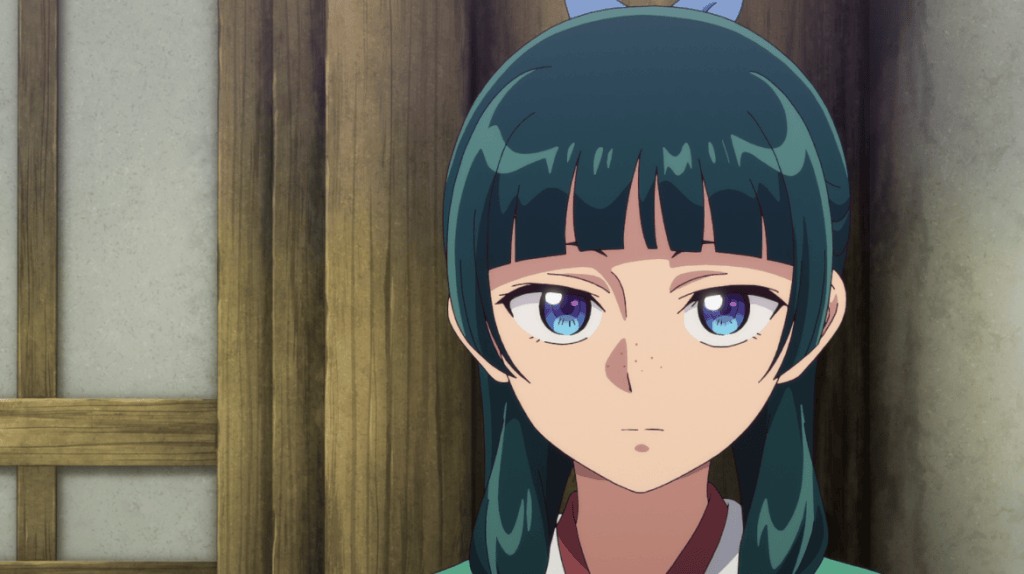
Episode Rating: A
Looking good at being convincingly ugly is, in my opinion, one of the hardest artistic feats for an anime title to pull off, and in that realm, this series has few equals. That this episode pulls that off well without making a spectacle of it is far from the only reason I’m giving this episode a top rating, too.
Unlike last episode, this one remains almost purely serious as it examines several grim circumstances related to one destitute family. The biggest plot point is that the youngest daughter is deathly ill after eating some of that curious food bar we saw the cloaked woman distributing in each of the last two episodes, and it’s highly likely that the mother who died during an earlier miscarriage was affected by it, too. The problem with the bars is that they contain ergot, a group of parasitic fungi found on grains like rye, wheat, and barley. Those who eat it are affected by ergotism (also colloquially called St. Anthony’s Fire), and the common symptoms of it are well on display here: gangrenous extremities, convulsions, and spontaneous abortions for pregnant women (which is doubtless what the “miscarriage” actually was). It’s believed that some historical plagues were actually outbreaks of ergotism and that it was the cause for some bizarre behavioral incidents, like dancing diseases or even some of the accusations thrown out in witch trials. (That’s much less surprising when you consider that LSD is a derivative of ergot.) Fortunately for this unnamed girl, most ergotism victims can fully recover if it’s caught before tissue death sets in and exposure to the source is ended.
But that raises two whopping big questions: is the cloaked woman (Jinshi gets reports calling her the “White Lady”) knowingly distributing ergot-contaminated food, and if so, why? The inclusion of sugar in the bars – likely to mask the nasty taste of ergot – strongly suggests that this is deliberate, and, well, we do have those evil-seeming grins of hers, too. The only explanation which makes sense here is that this is a form of biological warfare, or perhaps more accurately, biological destabilization tactics. Unsettle the population and distract the government with having to deal with the problem and that could allow other moves to be more easily made. But what’s the bigger goal here? We’re still in the early stages of this particular mystery, and the series has a well-earned reputation for being very deliberate in how it plays out, so no doubt we’ll find out eventually.
The other matter hers is the destitute family. The father’s a gambling addict rather than a drunkard, and apparently not above beating his elder daughter, but otherwise it’s an all-too-familiar story. It’s sad but all-too-realistic that the only escape for the girls is the path of the courtesan, but it is probably their best option for avoiding even uglier circumstances, and the daughter knows it. (And the less we dwell on Maomao’s “she can be trained” line and what that means concerning the younger daughter, the better.) Maomao has been known to push people to get them to act certain ways before, so her harsh words on the matter could have been her style of manipulation, but regardless of that, it made for a compelling scene. The later follow-up involving the father coming to Verdigris House seeking his daughters handles the follow-up well without going overboard.
The episode doesn’t forget about the matter of the insect journal, either. Certainly makes one wonder if Maomao’s apothecary predecessor may have pulled a fast one, doesn’t it? It provides a good excuse to bring Suirei (Rei now, I guess) back into the picture, and that should make her meeting with Maomao next episode very interesting.
In all, this is an extremely well-constructed and well-executed episode, one that even finds a little time amongst its heavy topics for a little humor without that at all being a detriment to the rest of the content. (Apparently Pairin’s lustiness wasn’t exaggerated!)

