Episode 2 Rating: B
Episode 3 Rating: B+
Episode 4 Rating: B
I hadn’t originally intended to do episode reviews for this series, and this is one that I may only do every 2-3 weeks instead of weekly. However, a number of developments – not the least of which is the surprisingly quality of this adaptation – have convinced me that I can’t just let this one go with a mere mid-season report consisting of only a paragraph or two.
Before getting into the content of the episodes, let’s get a bit of terminology established first. While the series has some structural similarities to isekai reincarnation stories (like Saga of Tanya the Evil or this season’s Reincarnated as a Sword), I instead classify it as a linear reincarnation series, which is a designation I use for stories where a character is reincarnated at a much later time – typically centuries or even millennia later – in the same world. (Series like The Misfit of Demon King Academy, Reborn to Master the Blade, From Overshadowed to Overpowered, and The Demon Sword Master of Excalibur Academy fall into this category as well.) Fantasy linear reincarnation stories commonly feature cases where the reincarnate is coming from an historical period of peak magic into one where magic as the protagonist knows it has degraded and/or changed dramatically, so the powers the protagonists have inherited from their previous lives far outstrip anything existing in the current day and thus make the protagonist very OP. Why this change has happened commonly (but not always) becomes a significant plot point. For this iteration on the concept, the former point is absolutely in play, while the latter point has been vaguely alluded to so far in the anime version but has yet to be delved into with any depth. Speaking as someone familiar with the first few volumes of the source material, the latter is a point which always lingers in the background of A Tale of the Secret Saint and occasionally gets touched on but isn’t likely to be heavily emphasized within the scope of this season.
Episodes 2-3
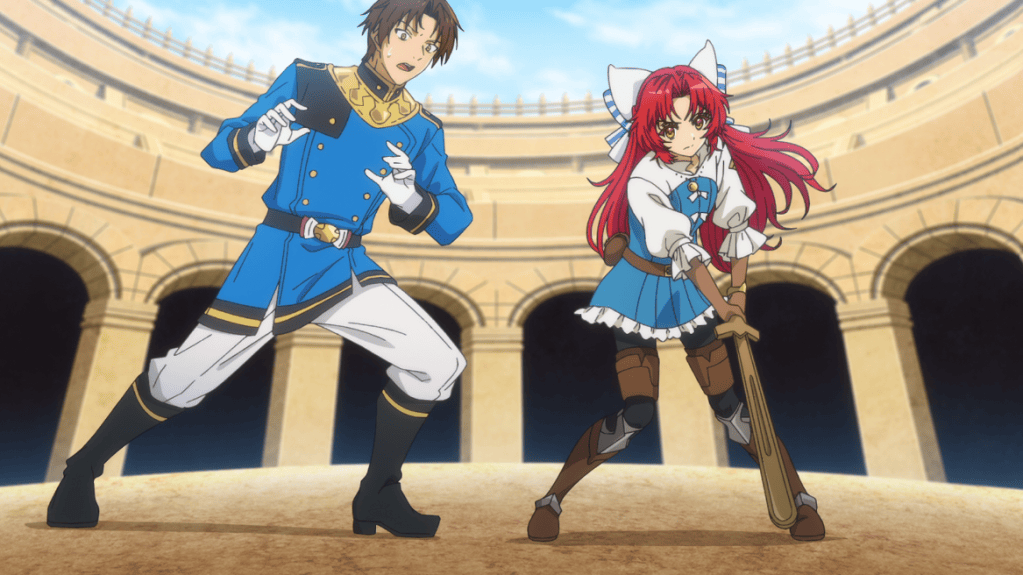
The story progression at first is pretty ordinary here: Fia seeks to follow the family tradition of becoming a knight while also concealing her status as the reincarnation of the Great Saint (for understandable reasons), so she goes into the knight trials with an ordinary sword that she’s secretly enhanced and covertly using self-buffing spells; the latter is virtually unheard-of in this era, so that deception, at least, she can easily pull off because her spells would just look like she’s mumbling under her breath. (Like her ability to read Captain Saviz’s aura, I assume that the spell effects the audience sees aren’t perceivable to other characters.) That’s not true for the sword she enhanced with apparently-permanent enchantments, which does become a bit of a plot point. Fortunately for her, that her father might have unknowingly given her a legendary-grade magic sword is a perfectly plausible explanation for why Fia had it, since a Saint being able to do that is also unheard-of in this era.
But episode two also provides Fia’s first slip on her true nature. Her ability to matter-of-factly identify Saviz’s old injury and how it’s still slightly affecting him by mere observation is not something that even most veteran knights could do, much less a 15-year-old newbie. Further slips come during the monster hunt in episode 3, where she demonstrates monster knowledge beyond what she should have and a monster quantification ability that no one else can muster. At this point what she’s done so far can still mostly be played off as her being exceptionally observant and her ability to remain collected and take charge when needs can be passed off as inborn leadership skills (something Zavidz recognizes), but Fia’s difficulty at remaining as inconspicuous as she would prefer to be certainly looks to be a recurring plot point, and that mystery is only going to start growing in the eyes of the Knight Brigade captains after the scene at the end of episode 3.
And that brings up one of the setting’s most interesting world-building points: that the power of Saints have degraded dramatically over time. Saint abilities are still regarded practically with reverence even though, by the standards of Serafina’s era, they are apprentice-level weak, but how did this dramatic decrease happen? Was it just a result of losing their connections with their spirits, and thus relying more and more on gradually-thinning inherited powers (which is what’s been most implied so far), or was there an actor behind it? Fia’s comment about corruption in her drunken ramblings could refer to that, or it could be a reference to how people allow Saints to cling to privilege and reverence even though they’re gradually decreasing in capability over time. Her comment about how Saints should be the shields for the Knights every bit as much as they’re protected by the knights is also a radical departure from the perception of Saints in the current era. In all, it’s a pretty sobering set of observations from a character who’s sloshed and participated in all manner of silliness involving the “meat festival” earlier in the episode. How seriously and elegantly the adaptation handled this key scene is the sharpest evidence so far that this series might be more than just a fun little tale, and Fia highlighted against the moon is one of the series’ prettiest scenes so far:

(Also, her comment about how the moon is pretty should be remembered. I’m not sure if the anime series will delve into this point, since it’s mostly covered in side stories, but the source novels clarify that it’s a phrase which has long held a particular meaning in this setting.)
Fia’s reaction to the healing potion is also worth noting. While everyone has endure through pain when using a modern healing potion, the anime doesn’t clarify that Fia’s reaction is worse than normal. There is a reason for that, but since it may still be clarified in an upcoming episode, I won’t get into it now.
It’s also worth noting here that the epilogue to episode 2 actually comes from a side story included with (IIRC) novel 1. That suggests that some of the side stories from other volumes might get included as well.
Episode 4
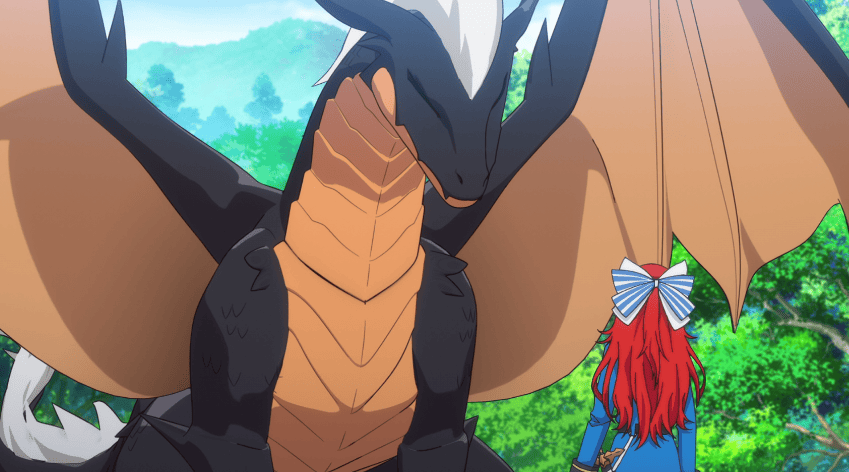
This one, the first of a likely 2-3 episode arc, focuses on Fia taking a temporary assignment to the monster tamers of the Fourth Knight Brigade in order to see if she can judge the strength of familiars like she could the monster in episode 2 or the Knight Captains in episode 3. It greatly expands on what it means to get and work with a familiar, including the interesting notions that familiars generally don’t allow anyone but their masters to call them by their names and that the type of band that a master has on his/her arm is often an indicator of how strong the familiar is. Since Fia’s bond with Zavilia is a special case, the normal appraisal method naturally isn’t going to work for her. The episode also offers a good excuse to bring the now-much-bigger Zavilia back into the picture for the first time since episode 4 and show off his pint-size form.
Although there are a couple of moments of sincerity here, such as the scene where Fia reminisces about how healing potions used to be made vs. the way that’s done in modern day or where Zavilia asks, in complete seriousness, if Fia wants him to become a king, this episode more purely plays to the lighter side of the series’ content. The ridiculous bird costume for Zavilia is pretty much Fia being Fia, but Zavilia gets in a good crack or two as well with his insults towards Quentin, Vice-Commander of the Fourth Knight Brigade, disguised as “bird calls.” Zavilia’s voice still being very young-sounding even in his larger form is also an interesting production choice.
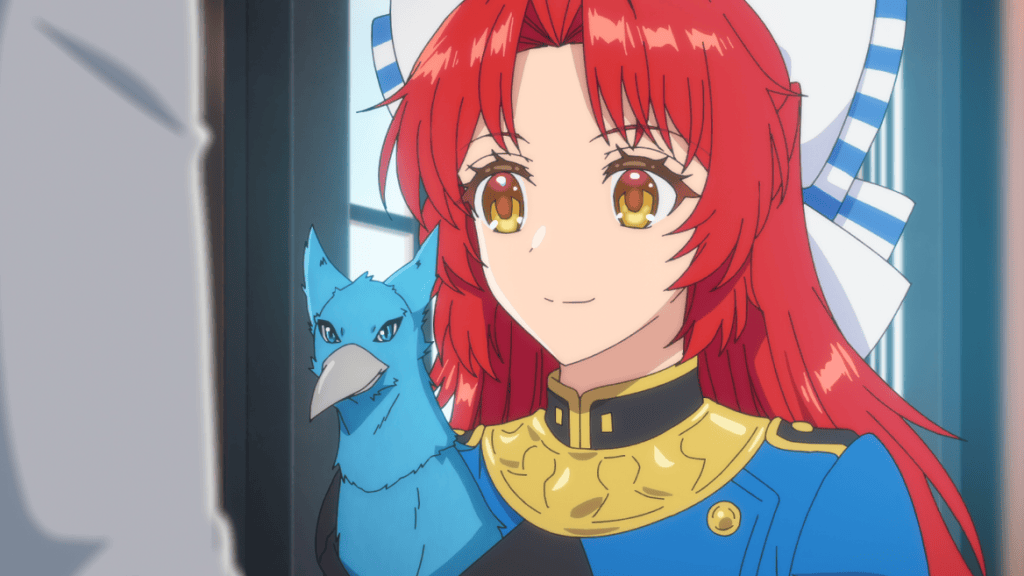
Overall, these three episodes have done a remarkably good job with mixing lighter and more serious content with assorted world-building tidbits, all while presenting a highly likable heroine with an amusing mix of stunning competence and an equally stunning lack of common sense. The artistic effort here is also sharper than expected, especially in the use of color; Fia’s red hair and golden eyes are commonly described in the novels as quite striking, and the artistic effort by studio Felix Film (Reincarnated as a Dragon Hatchling, You are ms. Servant) certainly brings that out. Zavilia is also such a sharp and smooth execution that I’m not even sure if CG was used for him. The animation effort, while not top-tier, is also better than expected, especially in Fia’s battles in episode 2, which feature brief bursts of genuine battle choreography. This is never going to be a prize-winning actioner, but it’s still heartening to see a series which would normally get a bottom-feeder technical/artistic effort get a treatment that might even be above mid-grade. Overall, this is a highly satisfying adaptation so far.
Next episode should feature Fia getting to interact directly with a modern Saint for the first time. That should prove interesting indeed.

