Rating: A-
NOTE: For the review of episode 1, see its Preview Guide entry.
Nine years ago, when I was still writing for Anime News Network, I did episode reviews for the first season of Saga of Tanya the Evil, so continuing them for this new season only felt natural. And it’s a thorough delight to have the franchise back in series animation, too, as the first two episodes remind me quite well why I fell in love with this franchise.
Even at the time it first aired, Saga of Tanya stood distinctly apart from other isekai reincarnation fare in three important ways: it used a variant of early 20th century Europe for its setting rather than a pure fantasy setting, its reincarnator was a middle-aged businessman with a distinct philosophy rather than an otaku and/or younger individual who was mostly an audience insert, and it focused primarily on a military setting in a modern-style war. In the nine years that have passed since the first season aired, those distinctions have only become even starker, allowing the series to continue to easily stand out in the crowd; hardly any isekai title in the intervening years has even come close to imitating Saga‘s approach. And that’s only a small part of what makes the first two episodes of this new season so impressive.
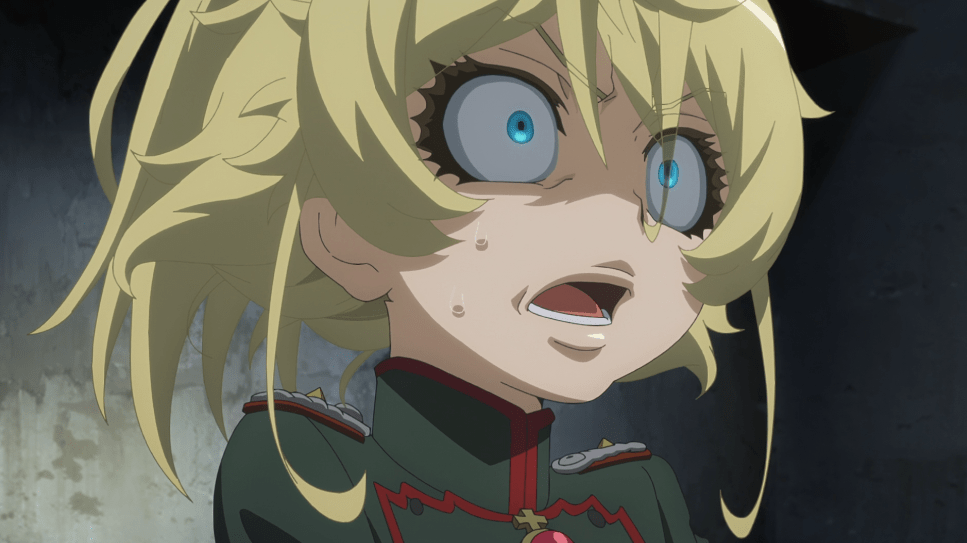
Animation studio NUT has gone on to headline several other anime since Saga, but Saga is the title which built its reputation, and the studio is gloriously back for the second time around. If anything, these first two episodes look even sharper than the original. Episode 2 doesn’t provide any opportunity to show off the series’ animation quality, but the detail work on the settings and uniforms, instances of background animation, and the expressiveness of various characters (especially Tanya, of course) all still stand out, and new-to-the-franchise director Takayuki Yamamoto doesn’t miss a beat on retaining the franchise’s signature visual style and rich but still earthy color schemes. (It probably helps the most of the rest of the principle staff from the previous season, including – most importantly – scripter Kenta Ihara have returned.)
MYTH & ROID is also back doing the opener. Original OP “Jingo Jungle” is a hard act to follow, but the new “Why? RED induction” is a fair effort to replace it, especially on the visual front, with imagery that conveys the dark, ugly business that Tanya finds herself stuck dealing with. However, the new closer, the techno-styled “Weiter! Weiter!” (“Further, Further” in German) is the real stand-out this time. It’s sung in-character by Aoi Yuki (the voice of Tanya), which is quite a feat considering the soaring vocals it achieves, but it also looks fantastic. It’s likely to be on the short list when it comes to the year’s best OPs.
Content-wise, so much is going on in episode 2 that I’m amazed that they were able to stuff it all into one episode without it feeling rushed. (That’s a true sign that they chose the right person to be the director for this installment.) On the home front, Generals Zettour and Rudersdorf confirm something that’s long been implied: that they are lifelong best buds. Both are also clearly aware of how strained the Empire’s position is, though they differ in Rudersdorf leaning towards a “we have no choice but to move forward” philosophy, while Zettour ever remains the absolute pragmatist. What the episode doesn’t make clear – and which may confuse anime-only viewers – is that Zettour is now more directly involved in the administration of the Eastern Front, which is why Tanya is able to go see him later in the episode. The one writing flaw in the first two episodes is that this point isn’t made clearer.
The episode also takes a peek at what various other involved parties are doing. In the Great Britain stand-in Allied Kingdom, leadership is scheming to use the Federation (Russia stand-in) against the Empire (Germany stand-in), while the Federation is seeking to use the Allied Kingdom against the Empire, a relationship more similar to the grudging alliance of the two countries in World War II. That’s not the only place where the series is fudging on comparing its timeline to actual history, either, as NKVD director Loria (who was first introduced in the movie) is clearly modeled on Lavrentiy Pavlovich Beria, Stalin’s longest-serving secret police chief, who was sometimes described as a “Russian Himmler,” but in our history he didn’t come into that role until the lat 1930s. The anime depiction isn’t exaggerating at all here; Beria was reportedly every bit as ruthless and as much of a disgusting creep as Loria’s is shown to be here (his rape victims may have numbered into the hundreds, and the remains of young women he killed when they resisted him were still being found decades later), down even to the way he scouted out his female victims (as depicted in the movie).
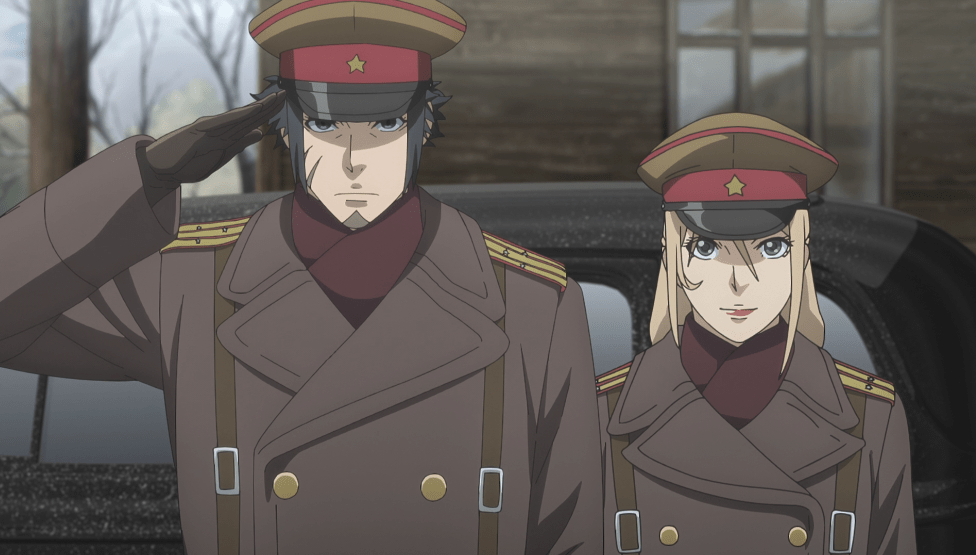
But he’s not the only significant figure on the Eastern Front. This episode introduces two characters who will be regulars for probably all of this season: Political Commissar Liliya Tanechka and Colonel Mikel, a Federation mage called back from the Gulag when Loria convince Stalin that they couldn’t do without mages after all. Lt. Colonel Drake, who was seen extensively in the movie, is also back and will have a big role this season, and Mary Sioux (now being spelled Mary Sue in the subtitles – guess they stopped pretending and decided to be literal?) is also back, though how big a role she’ll have depends on how much liberties this season takes with the novels.
But the bigger, more immediate development is on the Empire’s front lines. Tanya has been so wrapped up in fighting Commies that she failed to realize that many of the troops the Federation is throwing at them aren’t actually Commies; they’re nationalists, locals subsumed by the Russy Federation who are fiercely loyal to their local territories instead of party dogma. And anyone who’s studied any degree of military history (as the man who became Tanya clearly had) knows that the best way to deal with nationalists resorting to guerilla tactics to defend their homes is to win them over rather than try to wipe them out. Assuming that the Russy Federation is fully based on a mix of Russia and the Soviet Union, that probably means that there are numerous ethnic groups who have suffered under Communist purges who wouldn’t need a hard nudge to rebel if befriended and given a degree of autonomy. Zettour’s pitch to the leadership of the territories the Empire has already conquered may well prove to be the key to the Empire stabilizing its situation going into the winter.
(As a sidebar, the “Horatius at the Bridge” reference that Zettour makes during his speech refers to a famous event from early Roman history, where a Roman officer named Horatius single-handedly holds a choke point on a bridge as it’s being dismantled behind him, thus preventing an invading army access to Rome. Serebryakov’s later description of coffee is also a famous quote.)
Not all of the episode is grim and serious, though. This series wouldn’t be what it is without occasional lighter moments, and this time around they’re at the end of the episode, including another post-credit scene.
Looks like Ildoa (the Italy stand-in for this setting) may finally soon be coming into the picture as well. That provides another potential plot angle going forward, and we’d expect nothing less. This is a strong start to the new season, and while I personally feel that the novel eventually descend into drudgery, we’ve got a while before we get to that point.

