These two episodes are getting reviewed together entirely because of an oversight on my part: I somehow forgot that I had not finished and posted episode 10’s review and did not realize my error until Thursday this past week. With only a couple of days left until the next episode aired, I just decided to delay it further and do these two together. My apologies to any who were following along weekly!
In the end, looking at these two episodes together may have been fortuitous, as they sharply contrast with each other even while being intrinsically linked thematically. Episode 10, which is the slower of the two (to the point of having no action at all), is the set-up side of the pair and arguably the stronger episode. It primarily involves Will formally becoming a paladin, which in this setting refers to not a holy warrior of the church, but rather a knight who has the backing of both the local lord and the church and answers equally to both. This is an atypical and very interesting arrangement for a fantasy setting, one that I hope to see explored more. At the very least, it does formalize Will’s status as a paladin and given Robin the impetus to name him The Faraway Paladin in song. The episode’s other main task is the assemblage of the team who will accompany Will on his quest to deal with the demon boss of the Demon Forest, and that finally brings into the picture Reystov, the scruffy, dark-haired warrior who has been prominently-featured in the opener from the beginning. That gives Will another front-liner of his caliber, which should be quite useful in the battles to come.
The other interesting feature of episode 10 is the greater exploration of Bishop Bagley. Some parts of episode 9 suggested that he was not just the standard, pompous church leader, nor is he a charlatan. No, he is a main of genuine, powerful faith, one who is so conscientious that he deliberately distances his diving blessing from the more earthy tasks he must undertake. His faith and divine power are not meant to be shown off; they are strictly for furthering the cause of his god, and he will not allow that to be corrupted. A case could be argued that his behavior is rather selfish, in that he is foisting duties on others so he can maintain his own private piety, but he is one of the most genuine-seeming of all religious figures I’ve ever encountered. As a non-religious person, I can respect that and find him to be a surprisingly likable character.
Episode 10 also features a couple of different scenes where both of Will’s superiors-to-be caution him that the path he is choosing can only lead to despair. Will has rather flippant answers in both cases, but that comes back to bite him in episode 11. Things work so well in the early going of the mission that the episode does not bother to animate it much, despair does come, just not in the way he at all expected. It happens in the form of an ambush of demon beasts led by a chimera, one where Will loses it after Menel is badly-injured trying to hold his ground against the chimera. The incident was not at all Will’s fault; any veteran adventurer would be much more likely to lament their own inadequacy while thanking Will for saving their life by healing them, and Menel is probably no different. However, Will not only blames himself but also spins that blame in a troublesome direction: by somehow twisting it into the belief that he was wrong because he expected someone who wasn’t on his power level to operate on that level. Menel would probably be insulted by that, so I can see a good talking-to in Will’s future from both him and Reystov. This showcases Will’s greatest current weakness: as powerful as he is, he still does not have much experience working with a group or relying on others.
Sadly, these episodes still show the technical limitations of the series. While the artistry still usually looks good, the animation shortcuts are way too prevalent, especially when compared to the brilliance that 86 achieved in its episode on the same day. While I still think the series is doing some good things overall, that is still a big limiting factor.
Episodes 22 and 23 may be delayed until March, but that still leaves one more episode to deliver within the confines of the Fall 2021 season, and it’s one hell of an episode to watch play out. By the cliffhanger ending, nearly every major character’s fate is in question, leaving an agonizing wait of 11 weeks for those who are anime-only viewers.
What’s not in question is the fate of Kiriya and the Morpho. I knew how this was going to play out according to the novels, but the head-to-head battle between Shin and Kiriya was still a thrilling affair nonetheless, and one which I felt had even more impact because we could see Frederica in this version. That she would somehow be involved in this final conflict was a narrative given, as in many ways she is much more the key to Kiriya’s defeat than Shin is. As the presence that Kiriya cannot ignore or deny, she is the ultimate distraction, and the one who can pinpoint the exact location of Kiriya’s brain. That she had enough savvy and determination to use what she could do to the ultimate extent – even if it meant turning a gun on herself (which was easily one of the series’ most chilling scenes) – just impresses all the more.
Of course, Shin had other help, too. The other four 86s all took “I’ll take care of this, you move on” roles to set the stage, and Raiden even managed to get back in the action to be a distraction again at a key point. Then there’s the mysterious, mostly-muddled voice which came over the Para-RAID and seemed to be heralding the arrival of the artillery fire and flammables, which were also key to limiting the Morpho long enough to Shin to get his shot. Given the way the camera briefly focused on where Shin used to wear the Republic’s Para-RAID on his ear during one of those call-outs, there’s only one realistic possibility for who that could be. The Republic may not be as dead and defeated as everyone had feared. . .
While the fantastic battle sequence is certainly the featured content here, the episode adds in so many other neat little touches, too. Anju silently mouthing something as she went into action is a clear callback to the way her would-be paramour Daiya did the same thing right before his death, and guessing what she was saying does not require any great feat of mental gymnastics. The field of grounded blue flyers around the Morpho made for a pretty visual, but they may also have been the key to the mysterious support artillery being able to target the Morpho, since those blue fliers were what would normally provide a defense against radar. The scene where Frederica witnesses Shin, Kiriya, and Rei all together in a classic “what might have been” moment was a worthy addition, and this also marks the second time that a Shepherd has been undone in part by the memory of a little girl. (For Rei it was a young Lena, if you recall.)
But as much as the storytelling did well here, this was the technical side’s time to shine. This episode absolutely shows where all that extra production effort was going, and the musical support was phenomenal, too. Those efforts contribute towards yet another impressive episode for this series.
The Tale of the Heiki is a 12-chapter epic assembled no later than the early 14th century from a collection of oral traditions. It chronicles the rise and fall of the Taira (aka Heiki) warrior clan in 12th century Japan, events which brought the Heian Period to an end and directly contributed to the foundation of Japan’s first shogunate. It has been published in several forms over the years, including a 2016 novelization called The Heiki Story. This 11-episode ONA series is directly adapted from that novel.
Though some elements in the story are no doubt dramatized, this is a hard-history story with only a bare thread of supernatural elements woven within and underneath it. Those elements mostly show up in the form of Biwa, a heterochromatic girl who can initially see the future (and later also inherits the ability to see the dead) but is consistently unable to do anything about it. She also, oddly, does not age at all, despite a story which covers roughly 20 years. Exactly what’s going on with that is never explained, but ultimately that is not an important detail; with one exception, she is not an actor in the story but rather an observer, occasionally even an innocent confidant who allows characters to sound out their innermost concerns. In fact, she may well be the embodiment of the story itself, as an alternate version of her is shown strumming the biwa while reciting poetic lines (presumably the original lines of the story) as major events happen, and later in the story she finds her purpose in resolving to recount what she has witnessed of the Heiki clan. While an interesting approach, the downside to this gimmickry is that her thinly-used side story about trying to find her long-absent mother ultimately has little impact when it does finally resolve.
The story told here is a messy one, filled with multi-angled power struggles and the way people can get chewed up and spit out by the relentless ebb and flow of events. Good-hearted souls inevitably get overwhelmed by the deeds they must do in furthering their clan’s cause, the weak get ignored if they’re lucky, and any who even slightly defy the powers that be do not live long enough to brag about it. While the story shows that those who get ahead are the most cold-hearted, practical, and cynical souls, the underlying them of the story is actually the impermanence of power and how even the mighty can fall low. To call this a morality play would be a stretch, however. This is a story designed to inform, and the only judgment cast is the suggestion that Kiyomori, the leader of the Heike clan and one of the two key power brokers in the story, may have been divinely punished for his actions.
That being said, the story does have at least some human element to it, which can be found in a few key characters. Shigemori, Kiyomori’s eldest son and most honest and trusted adviser, is the focus of this early on. He is the one who takes Biwa in when she is about to be killed by Heike underlings, and is the first shown to struggle with the amorality of what his clan is doing. Watching him try to do his duty while also trying to keep his uncle from doing anything too extreme can be compelling, and that role falls to one of his sons after he passes on. That role also falls to Tokuko, Kiyomori’s daughter, who befriends Biwa and is the one to most use her as a confidant as she gets married to the son of the current emperor and gives birth to a son who will, for a time while and infant, technically be the emperor. She is arguably the most durable and adaptable of all the major characters, as she finds ways to adjust to her circumstances in each stage of the story and maintain her loyalties even when others are not loyal to her. Watching how other characters get destroyed by being forced into roles that they are ill-suited for can also be morbidly fascinating.
Because the story focuses only on major events, the writing can feel choppy at times, with major events often being glossed over. However, doing so prevents the story from ever getting bogged down. It also allows more breathing room for characters to develop and show how they come to the decisions about their fates that they ultimately make. Doing the story this way also occasionally results in some goofy behavior; curiously, Minamoto no Yoritomo, who would later become the first Shogun, gets the most consistent treatment in this respect, coming off as a caricature of a man who barely seems to understand what’s going on around him rather than a shrewd man able to position himself to effectively rule Japan. Have to wonder if someone didn’t have an agenda there.
The animation production by studio Science SARU takes a stylized approach seen in many other works that they have animated (Devilman Crybaby, Night is Short, Walk on Girl, Keep Your Hands off Eizouken!), in this case favoring designs more in line with classical period drawings. It offers some excellent and likely well-researched renditions of locations, boats, and especially modes of dress, and on the rare times it shows action scenes the animation holds up well. Some of the strongest visuals involves the alternate forms of Biwa playing the biwa for key events. Overall, the look is definitely not a traditional one for anime, but it has its own appeal. A musical score regularly punctuated by biwa music quite effectively supports the story, lending a suitably dramatic feel to the biggest events and providing a quality opening song. The one exception is closer “unified perspective,” a weird mix of rap and electronica that never set right with me.
The Heike Story is, on the whole, a strong production which lies off the normal beaten anime path but is sure to appeal to history buffs. I can easily see it making both Best of Season and Best of Year lists and will be considering it for the latter myself.
After yet another week off, 86 is back to remind us once again why it is, at worst, one of the year’s best series. And it does so despite dodging the one opportunity it had for an action scene by only showing the aftermath.
Avoiding animating the skirmish was not a cost-cutting measure, however. The writing had enough other territory to cover here, so it does not need what would have amounted to a filler battle at this point. (Still, seeing a little more action here would have been cool.) Besides, this episode is a very direct adaptation of pages 131-164 of the third novel, down even to exactly duplicating a lot of the dialog, and a description of the skirmish was skipped in the novel, too. Really, a more faithful adaptation of the source material could not possibly be expected at this point.
And it’s not like the episode is just killing time. Shin’s behavior has been reckless in battle of late, and he absolutely needs to be called out for it. Raiden – who is his longest-standing companion – gets the first opportunity, but his “we’re in this together” tack is simply not resonating with Shin at this point. Though he leads the 86s, and though they look to him as a companion and put their faith in him as their personal Reaper, he is not on the same mental track at them, a reality that the visuals reinforce with the background images first of a track behind Shin which curves away from the straight track behind Raiden and then with an image of parallel straight tracks when Raiden tries to insist that they should not separate. The visuals further the metaphor by showing a track behind Shin with a stop marker on it, while Raiden’s track doesn’t have one; this is a not-so-subtle indicator of what each sees as possibilities ahead of them. The way the focus on the tracks shifts in and out also serves to emphasize these metaphors.
The person who can most get through to Shin is, perhaps not surprisingly, Frederica, and she gets her chance during a night camp towards the end of the episode. Her special vision has given her an understanding of things far beyond her years, enough to know that her sense of not having a future – of the world probably being better off without her (and that isn’t just depression talking, given the potential her existence offers as a rallying point for remaining imperialists) – is closer to Shin’s own lack of purpose than any of the others can manage. Each of the other 86s would probably function fine in civilian life if they had to, but what place is there for Shin? What goal does he have to pursue? Even dealing with Kiriya is just a substitute, as he admits himself. He can get manic in battle because he has nothing else, and as Frederica so indelicately puts it in the episode’s one light-hearted sequence, even romantic interest from a comrade like Kurena isn’t enough since he doesn’t see her that way. In another stark visual metaphor, he is even shown standing apart from the others as they all look out over the “sea.” Unlike the others, Frederica fully understands this, both from her own circumstances and from what she saw happen to Kiriya, and her presence in the story allows him to articulate it.
But even though Frederica understands Shin and can get him to talk about the heart of the matter, she cannot save him. Only one person can do that, and all signs are pointing to that person not being alive anymore, a reality that the 86s themselves are well aware of.
The characters in the backfield have not been entirely forgotten about in all of this. They get enough screen time to explain the strategy being used to set up the 86s’ final push at the Morpho and the back-up that will be in place for them should the opportunity for support arrive. In other words, those scenes are a reinforcement of something that Raiden later points out: as dire a situation as they are heading into, at least this time they do have people working with them, instead of just wanting to see them disposed of. The visual metaphor of the downed butterfly being swarmed by ants is also an interesting choice here; if the butterfly is meant to be a reference to the Morpho, then the ants are the Reginleifs, perhaps?
With more stable and consistent visuals supporting the writing and the full array of symbolism at hand, this episode serves well as the final downtime before the season’s climax. I am very interested to see where the penultimate episode ends, as I feel that what’s left would play out best as a double-episode. Regardless of how that’s handled, however, I cannot imagine anime-only viewers being disappointed by their upcoming Christmas treat.
NOTE: I was going to just let this pass without full comment, but on request of a reader, I have decided to go ahead and post this, late to the game as it is.
While I always liked and respected the quality of the original Cowboy Bebop series – and, in fact, do currently rate it as a Masterpiece – I have never regarded it as the inviolable classic that many long-time anime fans apparently do. I am also more tolerant than most when it comes to major changes in transitioning a title between wholly different media formats; I fully appreciate that a presentation which works well in animated form does not necessarily work as well in live-action form, and updates for changing times are sometimes needed when 20+ years pass from the original. Most attempts to be utterly faithful end up feeling awkward at best. (The live-action version of Disney’s Beauty and the Beast probably came closest to pulling it off.) Both factors contribute heavily to why I do not accept the common argument in the anime community that the live-action version of Cowboy Bebop is a vile disaster. (Well, with one exception, which I’ll get back to later.)
The one place where even the harshest critics generally give the LA version at least some credit is in its casting choices, and I generally agree that this is one of the LA version’s strongest aspects. Some have quibbled about Jet actually being black instead of just sounding black (thanks to the great English dub work by Beau Billingsley), but Mustafa Shakir makes an ideal Jet, and I don’t see how him being black here makes one bit of difference in the story. John Cho makes a suitable, if somewhat different, Spike, too, and Elena Satine makes a suitable femme fatale as Julia. My feelings are more mixed about Alex Hassell’s Vicious (who is probably the most changed character), but I didn’t have a problem with turning him into a more over-the-top character who’s dangerous because he has killer skills coupled with a childishly immature mentality. Daniella Pineda’s Faye has also been very controversial, and I do have to agree with criticisms that the writing went a bit too far in trying to push her in a more openly strong, foul-mouthed direction. However, I still found her fun enough to watch. Among lesser roles, Tamara Tunie works well as Ana, while Josh Randall’s Pierrot was the weakest performance, though at least as much for the way he was written; this transition just didn’t work.
And Radical Edward at the end? Yeah, who actually thought that was a good idea?
I have not watched the original series in years, so I will not comment on how directly the story content carries over or compares. However, the LA version seems to be aiming for a much more overtly campy feel than the original series did. Yes, that element was often there in the original version, but that version often felt more like it was trying to make statements as much as entertain, whereas this version goes more purely for the entertainment value. That results in the dialog being much snappier here, and tastes will certainly vary on that. It has been referred to as “Whedonesque” (or something to that effect) in a pejorative sense, but frankly, that criticism holds no water with me; I have long been a fan of the Joss Whedon dialog style, so it did not bother me at all. And the series does just fine when it sticks to focusing on entertainment value; it tends to stumble when it aims for anything more involved than that.
I also found the production values to be acceptable for what is essentially a straight-to-video series. It did generally succeed at capturing the appropriate ambiance for its settings, certainly didn’t look like cheap trash, and put serious effort into staging its action scenes. No, it isn’t stellar in any of these regards, but anyone calling it a miserable failure is setting too high a bar for success.
In general, that’s how I feel about the series as a whole: fans set too high a bar for what was to be deemed “acceptable,” to the point that the series really had little chance to succeed. No, it is not the masterpiece that the original was, but I was hardly expecting that. I was entertained enough by it that I would have watched more if it hadn’t been cancelled, and that’s good enough for me in this case.
Other Titles That I Am Following:
The Ancient Magus’s Bride – The Boy from the West and the Knight of the Blue Storm episode 1 – If you’ve seen the main anime series or its prequel OVA, this is more of the same, and that’s definitely a Good Thing. It takes place in the interim between resolving the events with Joseph (as shown at the end of the series) and the upcoming Magic College arc, and the guiding hand of creator Kore Yamazaki is quite clear in the presentation. It spins a tale about a new, asthmatic boy who is getting wrapped up in affairs involving the Wild Hunt of Celtic lore running amok, but Chise gets plenty of screen time, too. Only one episode is out so far on Crunchyroll (the second isn’t due until March, I believe), but I do highly recommend it for franchise fans.
The aquatope on white sand episode 24 – And so the series wraps with both a departure and a return after a two-year time skip. While at one point I felt this series was just meandering along this season, it came together remarkably well in the end, to the point that the series is a strong contender to be in my Top 5 for the year.
Banished from the Hero’s Party episode 11 – I can see complaints about the series rushing things along, but I have quite enjoyed seeing how the series has delved deeper into Blessings and the influence they have over recipients.
Irina the Vampire Cosmonaut episode 11 – As expected, Lev now gets his opportunity in space, but an even bigger task awaits him at the end: Trying to reunite with Irina before she gets disposed of as inconvenient. Fortunately for both, looks like Anya is whole-heartedly bought into this, and Lev may have some high-level help, too. I look forward to seeing how this series concludes.
Mushoku Tensei episode 22 – Honestly, I’d stack the last few episodes of this series up against nearly any other title this year in a qualitative sense. The previous episode may have been “Turning Point 2,” but this episode is the real game-changer – or perhaps the fallout from it.
Taisho Otome Fairy Tale episodes 10-11: I was going to write about this series sometime in the past couple of weeks, but I have decided to let it play out and give it a summative review at the end of the season. (It will certainly be my pick for the Surprise of the Season.) I don’t think it qualifies as a spoiler to say that these episodes bring into play the Great Kanto Earthquake, as any anime series set in Japan in 1923 cannot avoid dealing with such a devastating event. Despite the tragedy all around, Tamahiko is at his finest here in his unwavering determination to reunite with Yuzuki, and seeing how much stronger he is now is a joy to watch. Both before and after the earthquake, this series has consistently hit its emotional beats, and it even filters in historical detail, too, such as the brief shot of the “fire whirlwinds” alleged to have contributed even more to the death total than the earthquake itself did. I am expecting a potent season (series?) finale next week.
Yuki Yuna is a Hero – The Great Mankai Chapter episode 12 – With this episode the series (and perhaps the franchise?) wraps. After episode 11 mostly consisted of the finale of the previous series, episode 12 steps beyond and goes into much greater detail about What Happens After; since short-changing this was the one minor flaw in the finale of the last series, I quite enjoyed what this episode detailed, especially including the time skip at the end. (Though I find it a bit hard to believe that four years passed before they got to doing what they are doing.) Overall, this was a strong way to wrap the series.
Apparently, I have been doing it wrong all these years in fantasy RPGs. The correct way to bring down a wyvern is not to use arrows or a sword or attack spells; it’s to wrestle it to the ground and break its neck bare-handed.
Granted, that’s not a feat that a typical fantasy RPG paladin can even pull off, even if I have seen something like this done once. (Many years ago, I participated in a game where a high-level fighter managed to successfully grapple a red dragon thanks to magical buffs and an insanely customized skill set.) That William does not seem to appreciate how awed everyone else is by him being able to pull off this feat is rather amusing, but basking in the limelight was clearly not his style in his previous life and that has not changed here. Or is part of it that he just does not realize how extraordinary his abilities are? Yes, this is a common feature of isekai power fantasies, but it feels less eye-rolling here. Also, seeing Will team up with Menel to take the wyvern down was a real treat.
Up to that point, the episode was mostly just about William’s first encounter with large-scale civilization and the appreciation that he quickly develops for it as he goes around with Robin, Tonio, and Menel. That further entrenches his motivation for stepping up to defend the civilization he cherishes against the wyvern (not that he probably needed any additional motivation), but it also allows the series to showcase how deeply entrenched magic is in supporting day-to-day life in more developed areas, whether it be the magical streetlights or the magical baths/saunas. The use of a test to determine is someone is a charlatan or has a legitimate divine Blessing is an entirely reasonable practice in a setting where divine power is real, though I did find it very interesting that the stuffy head priest took William’s words as proof of his legitimacy; perhaps the way William said it is a callback to old knowledge that an untrained person would not have?
The other interesting aspect is William’s meeting with Ethelbald, the leader of Southmark. This was fully expected based on his name being brought up last episode and his presence in the opener, but it was still interesting to watch how Menel automatically positioned himself like Will’s escort upon seeing Ethelbald being with soldiers doing the same. I always appreciate in series when effective leaders are shown being quick-witted and cagey, and the production does a good job with that here. Ethelbald has every reason to be wary of someone of Will’s talents appearing on the scene and whether Will’s very real modesty is disingenuous, so the probing seemed fitting. The real question here is whether Will fully appreciates the implication of what he proposed to Ethelbald: a leader could easily take that request as an aspiration to make the fringe lands a veritable fiefdom. In that vein, Ethelbald’s statement at the end of the episode comes off more as another probe – to see how Will reacts – rather than an actual threat. (Especially since it may not be within his capability to kill Will anyway.) I suspect that Will will understand that, but will Menel as well?
The one thing which bother me a bit about this episode is the scaling of Robin in some perspective shots. They are making her look like she is well less than 3 feet tall – IOW, short even by widely-accepted halfling standards. Otherwise this was another solid, if unspectacular, episode.
In 2012, the anime series Sword Art Online debuted. Despite nitpicking about its shaky logical foundations, the compelling dual gimmicks of its premise – players trapped in a VR MMO game, actions taken there have real-life life-or-death consequences – won out and turned the series into an immediate smash hit. That began one of the most enduringly popular franchises of the 2010s, despite the flawed nature of the source novel: it had big story gaps, was too much of a raw power fantasy for some tastes, and regularly violated its setting’s own rules for purpose of dramatic license. The anime series improved the story gap problem by including side stories from a second novel which greatly filled out the initial Aincrad arc, but even then, the story was not as robust as it could be. Writer Reki Kawahara recognized that, and so produced the Sword Art Online Progressive novelseries, a revision from the very beginning specifically designed to flesh the story out a lot more. This movie adapts the entirety of the first Progressive novel while also revising and updating the story even further. The result is a triumph which thoroughly satisfied this franchise fan, even if I didn’t feel that everything it tried completely worked.
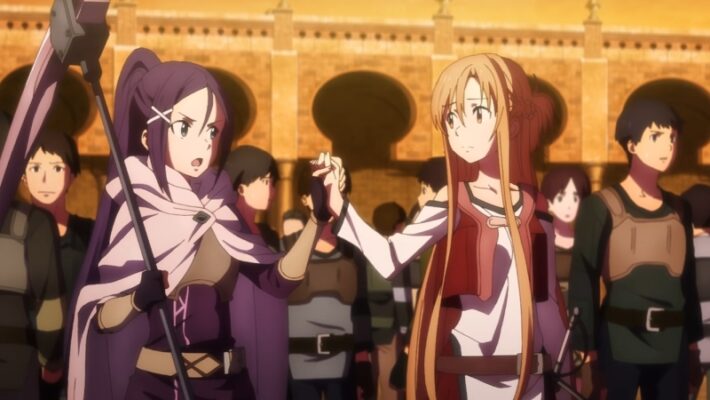
The original Aincrad arc was told mostly from the point of view of Kirito, which too often resulted in Asuna’s potential strength as a character getting downplayed. Though advertised as a veritable co-lead, she rarely got to show what she could do without Kirito at her side; in fact, she appeared in only maybe one scene in the entire Aincrad arc where Kirito was not also present, and she was not even the focus character in that scene. (Both Silica and Lizbeth got more feature solo treatment than she did, and they only appeared briefly outside of their feature episodes.) The first Progressive novel partially remedies this by telling some scenes from Asuna’s viewpoint, but the movie takes that a step further by making Asuna the nearly exclusive viewpoint character. This is a wonderful development for dedicated Asuna fans like me, and she once again proves how well she can hold her own in the spotlight.
Peeks into Asuna’s background (which come in the later Mother’s Rosario arc) showed that Asuna was a girl who seemed perfect on the outside but was not in the slightest in control of her life. In fact, trying out her brother’s NerveGear was one of the rare impulsive acts she made entirely of her own will. Sadly, the fateful irony of that is not explored here, but even in SAO she still starts out being led around, protected, and coached by a friend from school. The movie shows how it took a combination of a betrayal by that friend and initial encounters with Kirito for her to find her inner strength – first to die on her own terms and, later, to stand and fight for survival. In the TV series, Asuna dazzled visually when her cloak comes off during the battle against Illfang, but in this version of the scene she dazzles just as much with her commanding presence and spirit, in addition to playing a bigger role in the battle. That she would eventually become the subleader of Aincrad’s leading guild and a driving force behind the effort to clear the game is far more credible after seeing her here. Perhaps most importantly, this also shows that her decision to stick with Kirito even after he declared himself a “beater” (a major change from both the original novel and TV series) is in character for her without any “protagonist gets the girl” contrivances, as she is finally deciding something for herself. This and other scenes here (some from the second episode of the TV series, some not) also lay a much firmer and more convincing foundation for her later romance with Kirito.
The biggest addition is the introduction of Misumi/Mito, a girl in Aincrad who was Asuna’s classmate, chief academic rival, and closet friend in the real world. (“Closet” in the sense that the two conspicuously only hung around together when Asuna’s other classmates were not around.) In the novel and manga versions, Asuna learned about the game through diligent study after holing up in a room for a few days after Kayaba’s announcement, but here Mito serves that purpose. Mito is both a gamer in general – something which distances her from other girls – and an SAO beta tester specifically, and I did appreciate the beta tester aspect being more than just window dressing. The story does not necessarily need her, and at times tries too hard to force her into established scenes, but she is used effectively, including offering some yuri baiting (many signs point to her being interested in Asuna) and getting some of the most difficult emotional scenes as she must deal with the circumstances that eventually split her from Asuna. Kirito, on the other hand, is relegated to a major supporting role, but seeing him from an outside view is interesting, especially the way he acts towards Asuna during their first meeting. Many other important characters get at least brief cameos, including Argo and one other who eventually becomes one of the franchise’s main villains.
The technical merits certainly show off the advance of nearly a decade and a movie-level budget, with recreated scenes looking distinctly sharper this time around; the battle against Illfang in particular shines anew, but the depiction of sword skills in action also looks crisper. Base animation quality in general is also much stronger, and the scenery is as sharp as ever. The musical score leans heavily on themes from the TV series, with a few new additions and a solid closer by LiSa. Only a subtitled version was available at this time; I will update this entry when a dubbed version becomes available.
While established fans will probably get more out of this movie, Aria on a Starless Night is a reasonable entry point to the franchise, as it does start the story from the very beginning. For established fans, it makes an excellent complement to the first two episodes of the first series, and one that I look forward to watching again in dubbed form.
Update: (12/9/22): The English dubbed version is now available on Crunchyroll. All the familiar voices from other franchise installments are back, with Anairis Quinones proving a fine fit as Mito and carrying the character’s emotional burden well. Overall, it’s an excellent English dub, with the only minor flaw being that the performance of Diabel is a bit less crisp this time around.
NOTE: This review has received a couple of other updates, including correcting the name Rit to Mito.
As Will has begun his journey, his knowledge of the world has steadily expanded. With the meeting of additional traveling companions, it jumps forward in leaps and bounds. In a meta sense, this is the most important development in this episode, though if you were to ask Will, another discovery is far more valuable to him.
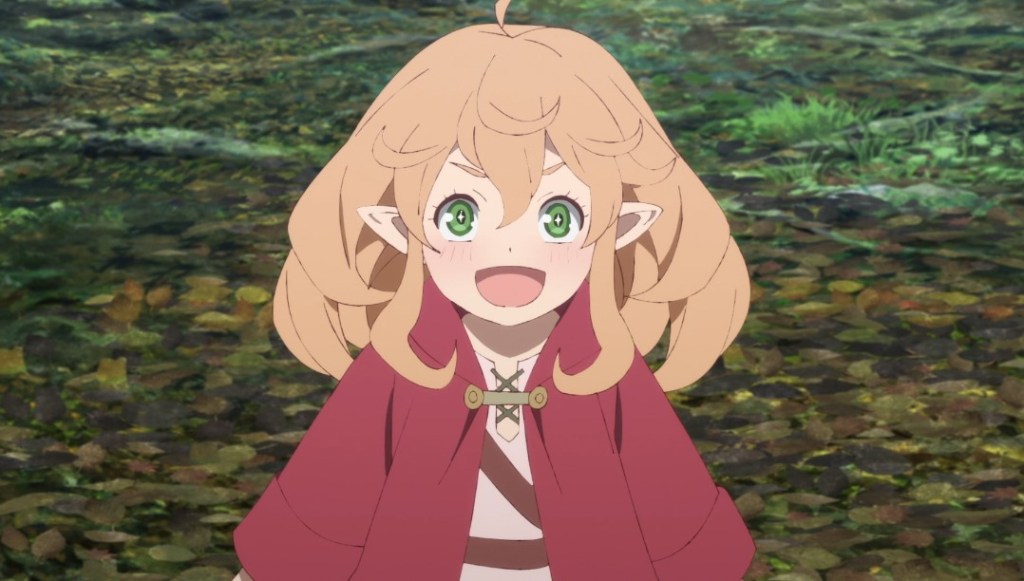
But first, the two characters most prominently featured in the opener who have not appeared yet make their introductions. Robina Goodfellow – aka “Bee” – is a shining ball of raw energy who embodies the very essence of what a halfing bard should be in an RPG-grounded fantasy tale. Her enthusiasm is infectious, and she will be a welcome regular addition to a cast that is otherwise much more mild-mannered. Tonio, on the other hand, represents a more stable maturity as a merchant. The slickness with which he takes advantage of Bee’s performances to do business shows a synergy between the two, and his more worldly ways and knowledge will be an invaluable resource to Will. One does not normally think as a merchant as part of an adventuring party, but he fits here just fine.
The details Menel and Tonio provide are not anything excitingly different for fantasy literature, but they do expand on what has already been established. Southmark is the southernmost of the continents known in this world, and it was entirely abandoned by humans during the demonic invasion of two centuries past. After many decades, humanity has finally begun reestablishing itself, with the fertile grasslands on the continent’s northern side being the foothold and the port of Whitesails (a fitting name for a port!) being the hub. Worship of Gracefeel was once prominent on the continent, but now it barely hangs on; Will’s supposition that Gracefeel intends for him to correct that is probably accurate. For Will, though, the way Bee’s song reveals some of the past exploits of Gus, Mary, and Blood, is probably more valuable, as it is a reaffirmation that their heroism is remembered.
The most disappointing aspect of the episode is how limited the animation is. Bee is shown with her mouth moving as she performs but not her hands, which makes for an incongruous impression. The episode also gives the feel that the story is being hurried along at this stage, with us being told rather than shown much about how Bee and Tonio operate as the quartet passes through numerous villages on their way to Whitesails. (Really, I’d be curious to see what novel readers might say about this.) Still, at least the story is moving along after a week off, and some juicy potential story hooks have been set up. I am interested to see what will happen when Will makes it to the major port next week.
After watching this episode completely twice, I cannot help but wonder if it might have looked a bit different if the series had not run into production issues big enough to necessitate two off weeks out of the previous three. It makes more animation conservation moves than normal, plays atypically vague on its shot selection, and has occasional scenes that are outright incomprehensible; the platform drop scene at the 1:10 mark especially sticks out as a weak point. The episode is also suspiciously dodgy on ever giving viewers a good, full look at either the real or fake Morpho; yes, it is so huge that it would not fully fit into a camera shot except at distance, but the only real sense we get of its overall shape is from a very brief computer display from the viewpoint of the Morpho’s controller. I have seen speculation that the animation of the Morpho was the primary sticking point in the delays, but that seems unlikely to have been the whole problem.
At least the episode does return the series to its full-on action component, and the animation of the Reingleifs seems as crisp as ever. Even so, the staging of the action scenes feels more limited. Earlier battle scenes were much more dynamic in their choreography, with the ones here more commonly using representative actions than full-out action stunts. The only scene that fully impressed was the overhead shot of the Morpho firing, which allowed viewers for the first time to see a real-time display of the firing and impact sequences in action. Good use of the musical score to promote tension, and effective use of the chatter of the Black Sheep, help keep the tension level up, but this episode will not be remembered as one of the series’ action high points.
The episode does better on other points, as various scenes throw out all kinds of background tidbits. Kiriya’s memories of Frederica show how her memories of her time with Kiriya, and the affection between them, was not a one-sided interpretation. His comment about how the headless skeleton with shovel insignia used by Shin is specifically a “Nouzen family crest,” rather than just the crest he copied from his brother, is also an interesting bit; that the Nouzen family lived next door to Annette suggested that they were a family of some status, and this confirms that its origins in the Empire must have been of very high status. The exchanges between No Face and Kiriya also reveal that Shin has been identified as a person of interest by the Legion, to the point of being given the code name Baleygr (an alternate name for Odin, which is fitting for one who is regarded as all-seeing when it comes to the Legion), and that the Legion specifically wants him – or, probably more specifically, his brain – intact. On other fronts, the conversation between Grethe and Willem fleshes both out a little more and reveal that the “spider-woman” comment another officer made towards Grethe back in episode 12 was not an idle one.
Contrarily, Ernst’s statements to those assembled in the command center have less impact. His assertion that humanity is not worth saving if it will not maintain certain standards is becoming repetitive at this point, with the only slightly new twist here being the “you elected me, so you have to deal with what you chose” comment thrown in. His statement there does at least affirm that he has no intentions on backing down on that assertion even when things look bleak. The scene where the 86 discover that Frederica has tagged along by hiding in Fido plays out more naturally and confirms that she did, indeed, accompany the 86s even if they were not aware of it. (Really, who expected her to remain behind?) Shin’s tendency to lose himself in battle – as reinforced here by the switches back-and-forth between his profile and Kiriya’s – makes her worry over the 86s having a death wish, and her desire to use herself as a hostage to ensure their safe return, completely understandable, and it’s not like everyone else from the Federacy doesn’t have that same impression about them. The series is fully beating into the ground the point about how no one properly understands the mentality of the 86s, but it is, at least, being consistent about it.
That repetitiveness also, in a way, brings up just how impactful Lena’s minimal presence in this cour is on the story. When I originally read novels 2 and 3, I felt that her greatly reduced role was the story’s weakest point, and unfortunately the anime adaptation has not been able to overcome that flaw. Frederica is a fine character on her own, but she is not a sufficient replacement because she does not provide enough of a different world and situational view, and that lack of screen time forces the story to focus exclusively on the 86s. That is, I feel, a big factor in the story overly dwelling on the point about how no one except the 86s wants to see them in battle.
Despite my criticisms here, this isn’t actually a bad episode; it still looks good overall and does a lot of things at least acceptably well. The series has just set such a high quality standard that any episode which is not a home run (and this one certainly isn’t) looks bad by comparison.
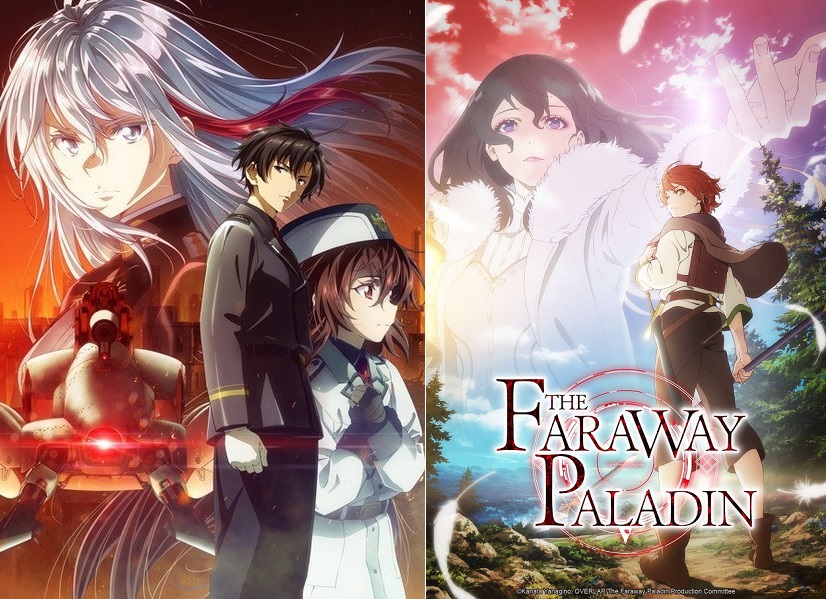
The 9th weekend of the season features an unusual coincidence: both of the series I was episode-reviewing are resorting to recap episodes, and in both cases production issues can be presumed to be the cause. (However, this was not a sudden change in either cases, as the “Special Edition” nature of this week’s episode was announced last week in both cases.) For 86, this is counting as episode 18.5 and focuses exclusively on recapping the second cour episodes, with the only new content being some narration by Frederica. For The Faraway Paladin, this is counting as episode 7.5 and covers the entire series to this point, though with only light treatment of the first three episodes. In this case, some narration by Will is the only new content. Of the two, 86‘s recap is by far the smoother one, with the one for The Faraway Paladin feeling like it was thrown together at the last minute; that the one for 86 was a planned recap that just got moved forward a couple of weeks may have something to do with that.
In short, neither adds anything of consequence to their respective series, so they are both eminently skippable. If you’re going to watch one of them, though, watch the one for 86.
Now for this week’s special highlight. Next week will probably be the Cowboy Bebop live-action series, as I feel a need to make a partial rebuttal to Steve Jones’ drubbing of it on ANN, but I don’t intend to make comment until I have finished it. (I am halfway through it as I write this.)
Overlooked Gem: Taisho Otome Fairy Tale episodes 1-8
With no significant pedigree, art and animation quality which do it no favors, no thrilling hook, little lead-in advertisement, and only tepid first-episode reviews, this adaptation of a shonen manga faced an uphill battle to get much attention. Indeed, it did not qualify for episode reviews on Anime News Network despite a respectable community score. (Series rated lower than Taisho Otome‘s 3.6 score get picked up every season.) However, certain qualities in its first episode caught my attention, and by the end of episode 2 I was committed to watching it out. This is a far better and more emotionally involved series than I was expecting, which makes it easily my biggest surprise title of the season and maybe second only to Idoly Pride as my most pleasant surprise of the year.
In the series, which is set in early 1920s Japan (aka the Taisho Era), protagonist Tamahiko is a scion of the prestigious Shima family, one noteworthy to many both for producing unusually tall family members and for behaviors that common folk find vile. However, an auto accident which killed his mother and rendered his right hand useless has left him on the outs with his father, who sends him to seclusion in a countryside home and has him treated as if dead. Tamahiko was already a bit of an outsider because of his family and introverted personality, and his injury and lack of compassion from his father left him so depressed and without purpose that he wanted to just wither away and die. But one great obstruction to that intent enters his life: Yuzuki, a short, initially 14-year-old girl whom his father “purchased” (in the sense of buying out her family’s debt) to be Tamahiko’s current caretaker and future bride. (15 is marriage age for girls at this point in time.) Yuzuki is firmly committed to making the best of a potentially very bad situation, but in Tamahiko she finds a young man far kinder than his family’s reputation suggested and far more in need of the kind of nurturing care that is in her nature than she could have anticipated.
In other words, this is a story about a young man’s struggle with clinical depression and the girl who gradually helps pull him out of it. One of the best aspects of the storytelling is that Tamahiko does not experience a sudden turn-around due to Yuzuki’s attention; his steps to climbing out of the pit of despair that he has sunken into are small ones, and he suffers frequent relapses of doubt, moments where he wonders if someone as pathetic as him can be worthy of a fine girl like Yuzuki. He sees everything he does as worthless, and has difficulty appreciating that some of the small things he does do genuinely make Yuzuki happy. Through interacting with Yuzuki (and to an extent others), he starts to understand that the way he is now is unacceptable; he has to be better, for Yuzuki’s sake if not for his own. By the end of this run of episodes, that has led to him letting himself get roped into tutoring local kids (which he turns out to be quite good at – one crippled hand does not affect one’s ability to teach, after all) and even seeking to return to school.
The weak point of the character development is that nearly all of the story is from Tamahiko’s perspective, so Yuzuki’s potential depths as a character are not explored anywhere near as much. Outside of the early parts of the story, where flashbacks showed that she was always the nurturing type and was apprehensive about this arrangement even as she tries to remain positive, we barely see her inner thoughts at all. Early on she makes a worrisome comment about finding a way to fall in love with Tamahiko, but her actions suggest that she has found true happiness in being needed by Tamahiko (whether he admits it or not). Does that make the two codependent? Maybe, though this doesn’t feel like the intent. It’s also possible that the original writer did not think her character through that much and she is merely meant to be a standard yamato nadeshiko type, an impression reinforced by the episode prologue used at the front of several episodes. However, given the emotional resonance of the series, that seems too shallow an interpretation to purely be the case.
Any weakness in Yuzuki’s development is made up by other characters entering into the story. The first is Tamahiko’s younger sister Tamako, a ferociously intelligent and devious young woman, who initially looks a like a standard troublemaker character but shows that she had her own problems fitting in. She, too, finds herself on a satisfyingly stronger trajectory as her experiences with Tamahiko and Yuzuki give her new purpose. Next up is the thief Ryo, who presents herself as a classic extroverted troublemaker character but is also shown having much more on her plate than she lets on; the story doesn’t dwell on her troubles but clearly shows that her situation is not as smooth as she lets on, either. At the end of this run of episodes, the last of the characters featured in the opener – the singer Kotori and her twin brother Hakaru – get introduced. Hakaru befriending Tamahiko as a fellow new transfer student makes it clear how he fits in, but what role Kotori will play is less clear.
While the series has plenty of comedic elements to it, the extent of its weightier side casts the series more as a true dramedy. Common people are all too willing to see the Shima family as villains, and that is something which Tamahiko and Tamako must both bear; the most complicated part of this is that the scorn is justified in general even as it is not entirely deserved in this specific case. Tamahiko’s condition and the growing love between Tamahiko and Yuzuki are also not jokes, even if the tentativeness of the two in addressing their feelings is typical anime-cutesy. Most importantly, the series can regularly hit substantial emotional beats, thanks in part to delicate use of a musical score grounded in traditional Japanese instrumentation. The series also extensively uses the song known in Japan as “Merciful” or (in its Japanese lyrics version, which seems to be used here) “World of Stars” and in Christian countries as “What a Friend We Have in Jesus.”
The other weak point of the series is, sadly, its visuals. The artistic effort is not entirely without merit; it excels in its fabulous yukata and kimono designs, does fine with period detail, and shows capable use of color and lighting in shifting the tone of various scenes. (Tamahiko’s greatest inner turmoil tends to happen in darker spaces, for instance.) However, the lackluster artistic and animation quality overall could be a major barrier to enjoying the series. Even the character designs leave something to be desired in places, especially the way Tamahiko’s eyes are drawn, and quality control slips frequently.
Despite that, the series does enough else right that it can be plenty engaging enough if given a chance. It gets a solid recommendation from me.
Thoughts onOther Series That I Am Following:
Banished From the Hero’s Party episode 8 – Still liking this series a lot, but the last couple of episodes have been rough around the edges. The plot twist at the end of the episode is a potentially loaded one.
Selection Project episodes 8-9 – Yep, as expected, they carried through on the gimmick borrowed from Idoly Pride earlier this year, and wth characters in the same hair color, relationship, and personality configurations, too. (And no, I don’t mean the one about the ghost.) How the emotions involved in it play out is handled pretty well, and in a way markedly different from how Idoly Pride used it, to the point that it would be fine drama if it was fresh. However, it cannot fully escape the eye-rolling “been there, done that” feel of this being the second time this year that this particular major gimmick has been a major story point in an idol show.