In last week’s review, I underestimated how much content from the second novel was still left to adapt. A full episode will probably be needed to do what remains justice, but that also sets the series up perfectly for the next episode to end with the final scene of the second novel. Assuming that this season also has 11 episodes, that leaves six episodes to adapt novel 3, which feels about right.
For anime-only viewers, that all means that this is the most low-key episode of the series to date – in fact, probably the series as a whole. It is the peaceful interlude before the shit hits the fan. That does not, however, mean that nothing of consequence happens, or that the story has in any way forgotten to be compelling.
Most of the first half of the episode focuses on military preparations for the anticipated large-scale offensive by the Legion, including how the 86s will fit into that picture. The big revelation here is that the Federacy has made contact with two other surviving nations – the Alliance of Wald (to the south) and the United Kingdom of Roa Gracia (to the north) – and will start coordinating with them; don’t expect to see much further about either of those within the confines of this adaptation, however. The other key points in this half are that the rest of the 86s are back involved again after being almost entirely sidelined last episode and that we get a much clearer idea of where Colonel Wenzel is coming from. She’s not the stereotypical amoral science/tech experimenter; she has very specific reasons for her experimental designs being the way they are, ones that are grounded in practical experience.
The real star of the episode, though, is Frederica. At times she has acted her age (around 10), and that continues this episode, but at other times she has acted far older, and her conversation in Shin’s room shows part of the reason for that. No reasonable person would assign the blame to her that she assigns to herself over what happened to her “knight,” but how a child’s logic could lead to that is easy to understand, and the truth that people were killed to protect her is inescapable. That’s a heavy weight to lay on anyone, much less a girl who was only 5 or 6 years old at the time. Credit goes to Misaki Kuno (Hawk in The Seven Deadly Sins franchise for some fine voice acting here, but I also have to respect how this story is used to draw parallels to Shin’s situation. Shin was certainly headed down a destructive path similar to Kiriya before Lena snapped him out of it.
As always, the episode’s use of visuals and symbolism is sharp, though it did also seem like the episode was pulling more tricks than normal to minimize the animation need. The two birds on the wire as Shin and Raiden were talking near the end, followed by only one bird left as contemplating what Lena was doing, was a nice touch, as was the moth caught in the spider web as Frederica got to the deepest part of her conversation. The visual expressiveness of Frederica also continues to make a nice counterpoint to the limited – but still telltale – reactions of Shin; the artistry really is accomplishing a lot there with his minimalist reactions to things. Lena getting at least a brief appearance at the end was also welcome.
The downtime is now over. Get ready to a return to the action with next episode.
After much consideration (including looking at the response made to my query about the matter a few days ago), I have made a few decisions about how I will do reviews this season.
86 episode reviews will continue.
This was probably a given.
I will notcontinue with Mushoku Tensei reviews.
While I did enjoy reviewing the first season for Anime News Network, I originally volunteered for the series primarily because, based on the Preview Guide entries that season, I was very concerned about whether or not anyone else on staff at the time would give the series fair consideration. After reading Kim Morrissy’s first episode review for this season, I no longer have that concern. I think she’ll do a great job with the series, so I will fall back to just making short comments about it in the “Other Shows I Am Following” section.
I will review The Faraway Paladin weekly, starting with episode 3.
I was interested in doing this title anyway, and it being the most frequent name to come up in responses to my query sealed the deal. Because that title airs on the same day as 86, it will be posted on a couple of days of delay on most weeks.
Time allowing, I will do a rotating feature on other titles.
Basically, I’ll choose 1-3 other titles a week to make more substantial commentary on, to an overall writing total about equal to one full review. Expect Irina, The Vampire Cosmonaut, Banished From The Hero’s Party, Mushoku Tensei, Yuki Yuna Mankai Chapter, and Taisho Otome Fairy Tale to be in this rotation, but others are possible. And yeah, I’ll probably have to say something about Fena: Pirate Princess after its last episode airs. To get things rolling on that. . .
Muv-Luv Alternative: episodes 2 and 3
I can see now why the series debuted with a sort of prequel episode detailing a minor (in a storytelling sense) incident from the backstory of the game: the series was trying to draw in newcomers with something more approachable than what episodes 2 and 3 turn out to be. I am dubious that the series will be successful on this, for a number of reasons.
The biggest problem is that episode 2 begins by clearly dropping viewers into the third stage of an established parallel world-jumping plot line. (This makes sense, given that Alternative is a sequel to the original game.) To its credit, the storytelling does at least make a serious effort to establish enough context for newcomers to be able to follow along, but it cannot in the slightest escape the impression that newcomers are lacking important context to sufficiently appreciate everything that has transpired. These two episodes regularly short-cutting events to get to the main points doesn’t help on that. Maybe this “something’s missing” impression will fade as the story progresses more into events that Takeru hasn’t experienced before, but how long will that take?
The other big problem is the technical merits. The mecha look fine, but holy hell, the character designs and animation are weak! The base character designs are not all that appealing to begin with (I especially am not a fan of the way breasts are portrayed for the young women when they are in combat suits), and on top of that, episodes 2 and 3 in particular have more trouble staying on-model than just about any series that I have seen recently. The normal visual factor which might keep the series afloat just aren’t there.
I might give this one one more episode to impress me, but so far it looks like one of the weakest of the mecha offerings this season.
With this episode, the interlude from the battle scenarios ends, but that shouldn’t be any surprise; even if it wasn’t written into the characters, the story was not going to stray away from one of its core elements for long. At least nothing felt forced about the return of the 86s to the battlefield; they have almost literally grown up on the battlefields, so it is what they know and what they are comfortable with. Most of them also do not have any conception of what life after the war might be, which is what Ernst was almost desperately trying to instill in them over the past two episodes. (This is the very long game in the novels, though, so any sense of resolution on this point should not be expected by the end of the season.) So a return to the battlefield is the only logical path for the story.
One of the interesting aspects of this is how the 86s still face some prejudice, but for utterly different reasons than before. This time around they are not regarded dubiously because of race, but rather because their experience and attitude make them different. Despite their youth, they are hardened veterans around new trainees, ones capable of feats that seem almost unearthly, and Shin’s normal disposition certainly does not help. Other recruits not wanting to keep their distance would have been more unnatural, which is why Eugene making at least somewhat of a connection to Shin is so important. He is the bridge to normal relationships for Shin in the absence of Lena. . . which is, of course, why he has to die.
Eugene’s death is important to the story, since it signals Shin’s return to his old role as mercy-killer and Undertaker but also is the first death not of his own cadre or family to shake him up. It is also the most harrowing and graphic scene in the series to date, and fully retains that despite being toned down from the original novel. (In the novel, it was the lower part of his body that got blown off rather than one of his hands.) Although statements had been made before in the episode about the losses that the Federation was taking, and how the battle overall was not going well despite the Federation having gained back some territory since the 86s’ arrival, that scene drives home the severity of the situation. The blood from Shin’s mercy-killing splattering specifically onto a daisy is also an interesting symbolic choice; since the white daisy typically represents innocence and purity, the blood staining can be taken to mean the brutal shattering of that innocence. Shin stepping into shadows as the red-haired soldier complained about Shin not saving Eugene packs some obvious specific symbolism as well.
Though much of the episode sets up for Eugene’s death and the fallout from it, the episode has other important things going on as well. What Frederica’s role is going to be is firmly-established: she is literally her unit’s “mascot,” which in Giad is a long-established position firmly entrenched in psychological manipulation. A young girl is assigned to live with a unit with the intent of fostering a familial connection. Soldiers who feel they have a younger sister or daughter immediately at hand to protect are going to be more likely to fight to protect her and less likely to desert. In other words, Frederica is gaming the system by taking advantage of an odious custom to be out near the battlefield, and thus furthering her quest for her previous knight. It is a slick storytelling gimmick for keeping her involved, but an effective one.
Frederica is also, in some respects, filling the role of the absent Lena. Nearly all of what little humor the first half had was associated with Lena’s reactions to eating things, and now we have Frederica’s comical struggle with eating mushrooms. Fido got most of the rest of the levity, and now he’s back in a new body to resume that role. Combined with the memorial made to the fallen Juggernauts, the chest of name plates, and Shin’s handgun being returned to him, it makes for both a touching sequence and a further acknowledgement by the Federation of the importance of what the 86s accomplished. (Interesting, though, that the 86s react more strongly to Fido and Shin getting his gun back than the memorial, isn’t it?) Sadly, that gun being returned to Shin was also one of Eugene’s earlier death flags.
The other important thing which happens in this busy, packed episode is the formal introduction of Lt. Colonel Grethe Wenzel, who looks exactly like she was described in the novel. She has made some cameos over the previous couple of episode but will now be the 86s’ direct commander for the rest of this season, so expect to see a lot more of her if you’re an anime-only viewer. This episode also features the formal debut of the Reginleifs, the upgraded replacements for the Juggernauts the 86s used to use, and the return of the slick CG-animated battle scenes.
In terms of the adaptation, this episode is jumping all around in the second novel, but that’s not a problem because the second novel was not linearly ordered in the first place. Several small details are being skipped over, but the adaptation is, on the whole, still doing an excellent job, in this case covering a lot of ground while still mostly maintaining its quality standards. Given current pacing, I suspect that the adaptation of the relatively short second novel may conclude with next episode.
Other Series That I Am Following:
Thanks to a trip followed immediately by multiple visitors at home, I am somewhat behind on recent episodes. Hence I will save commenting on other recent episodes until I get caught up.
I am also taking suggestions for which title to make my second to cover for the season. The most likely candidates are Mushoku Tensei, Irina the Vampire Cosmonaut, the new Yuki Yuna installment, or The Faraway Paladin. If you have a preference for what you’d like to see from among these, respond to this post within the next couple of days, as I will make my choice before the end of the week.
Last season ended with Shin’s squadron in mortal peril. Killing them all off at the point and moving forward with a new group of 86s would have been a hard-hitting and interestingly daring movie, but even a series as bold in its themes as this one was not about to waste the time invested in establishing these characters and how they fit into the overall storyline. Hence, that all of them were rescued should come as no surprise.
I’m giving this episode a maximum grade because, honestly, I cannot imagine how adapting these parts of the second novel could have been done any better. And in some senses, the adaptation is even an improvement. The second novel features the early scene with Lena – now with a streak of red in her hair (which could represent both the blood of the 86s who are dying and her defiance of white purity) – dealing with the Lieutenant Colonel over her, but that’s basically all we hear about Lena for the rest of the novel. The adaptation has added some extra content here, suggesting that it intends to keep giving Lena at least partial screen time. I heartily approve of that decision.
The Lena we see here is one strengthened and sharpened by her experiences with Spearhead Squadron. She knows that her superior won’t dare do anything about her clear bending of the rules because she’s getting results that will help him get promoted, and she’s ruthlessly taking advantage of that. Meanwhile, she’s covertly planning for the massive Legion offensive that Shin suggested could be on the horizon (since she knows now that it’s pointless to bring this to the upper command), and she’s apparently got some other young, probably idealistic officers gathering around her cause. (This was not in the novel.) The look that her uncle gives her makes me wonder if he suspects that she’s up to something; if so, will he just let it slide because now she’s learned to play the game?
The Republic side of the story is also significant for introducing Cyclops, aka Shinden Iida. In the novels she is only a minor character at this point in the story, but she plays a bigger and more involved role later, so I am curious to see if this early introduction is a sign that she will have some added appearances here. Her bolder and more naturally expressive demeanor makes for a good contrast to Shin. That Lena was only demoted to Captain, rather than Lieutenant, is also an interesting change, as is her being called “Bloody Regina” instead of “Bloody Reina.” The latter is closer to her name, but given that Lena is also referred to as “the bloody Queen” in the novel, the former also makes sense. For symbolism in this part, the absence of flowers in the vase in her bedroom is an indicator that she’s keeping her current crew of 86s alive, but her unwillingness to be less than formal with them is also a telling sign. I also liked the pool ball symbolism: the white ball breaking up the formation of colored, then hanging on the edge of the pocket. Assuming Lena is the white ball and the 86s are the colored balls, it’s certainly not subtle in its meaning.
Of course, the more eagerly-anticipated half involves the fate of Shin and crew. They did make it to the realm of one of the other surviving countries after all, and every hint dropped in the episode suggests that the ghost of Rei took over a Dinosauria just long enough to transport them to where they could be found. This side finds a more ready mix of serious and lighter-hearted moments and introduces several important long-term characters, especially Ernst, the provisional president of the new Federacy of Giad. His character design was not what I expected, but the portrayal is nonetheless on the money; he clearly comes across as a man of high ideals, but nestled underneath his foppish behavior is a coldly pragmatic streak, too. He probably really does believe that killing off or otherwise doing anything but right by these “children” (note the teddy bear in the room where they are being collectively kept?) would be a sign that humanity has completely lost its way, but his actions are also calculated. The appearance of Shin’s squadron is a monumentally important event, as it is the first clear signal that another country still exists and they carry a revolutionary communications technology, but even beyond that, Ernst seems determined to use their treatment as an example of how humanity must be better, or else the struggle to survive is pointless. But how will he react if the 86s quite literally stick to their guns, as they have already indicated they want to do?
Some of the officers in the one meeting with Ernst will also become named characters going forward, but the other important introduction here is little Frederica. Her display of childish arrogance is both impressive and amusing, but not comically outlandish and perhaps not without legitimate origin. This is the same girl that Shin saw a brief flash of in episode 11, after all, the one who was shown wearing a royal-looking robe and being referred to as “princess.” That makes Ernst’s reference to her as “Empress” here a lot more suspicious, as it doesn’t at all come across as a pet name. Add to that Ernst’s comments about he’s taken her in – but not as a daughter! – due to “special circumstances” and everything points to her being a surviving member of the former Empire’s ruling family. She’s also clearly sharper than the norm for her age; the way she glances at Ernst when he calls her Empress was not the reaction of a child. She is featured prominently in advertising copy for the second season, so she will have a major role going forward, and I am curious to see how anime-only viewers react to the way she gets used.
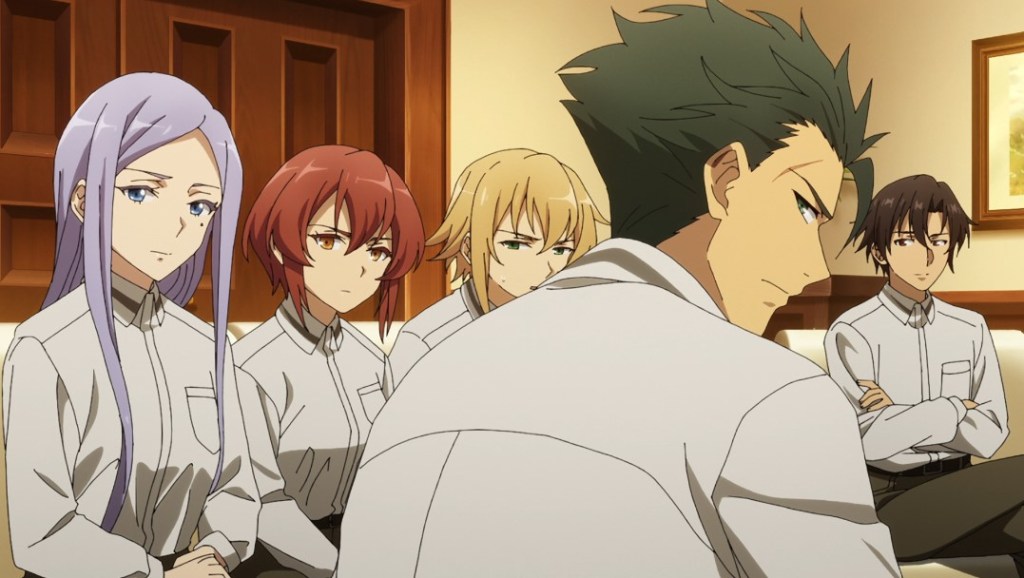
On the technical front, the series remains well-animated and well-constructed, featuring plenty of superb musical support and symbolism beyond what I have mentioned so far. Impactful scenes on the Federacy side include the way the 86s’ reaction to what Ernst is doing shows in their body language in the screenshot at the top of this review and the way faces look through the hazmat suits. The closer (which will presumably be the regular new opener) was not as strong a song but featured some quite impactful visuals, especially the shot where the bodies are holding their severed heads while flowers sprout where the heads should be and another which cycles through all five pilots screaming in their cockpits.
Other than the unusually-scheduled Fena: Pirate Princess, nearly every Summer 2021 series has either concluded or hit its seasonal break, so it’s time to do a wrap-up before the (very packed!) new season gets underway.
Biggest Disappointment: The Detective is Already Dead
Rating: 2.5
This series started out with such a neat female lead and intriguing concept, so how did it become such a mess?
At least part of the problem is the series’ concerted effort to revel in snarky banter, a la Rascal Does Not Dream of Bunny Girl Senpai. The writing too often struggled to get the timing down right on this, which resulted in lame attempts to do it when a sense of urgency was more called for. Even beyond the banter, conversations that were too long and/or too casual repeatedly bogged the series down to a frustrating degree. A thorough edit job to tighten up the pacing would have helped immensely.
Trying to tell the story out of order after the double-length first episode also didn’t help. Other series have proved that this can be done successfully, but the way this series did it made the overall story hard to follow and left several gaps; how does the blonde come into the picture, for instance? This never was explained in more than a vague, off-handed way. The coherence of the storyline does improve at the end, when the plot finally shows what all of the scattered events past the first episode were working towards, but the payoff is not enough to balance out the irritation in getting there and leaves a few too many questions unanswered.
The series wasn’t without its merits. It certainly featured pretty character designs, Siesta was generally a delight, and the scene where she was drunk was one of the season’s most adorably sexy moments. I have to think that there was a better series to be had here, however.
Top Performer:The aquatope on white sand
Rating: 4.5
With the series featuring the same studio and much of the same main staff as 2018’s Iroduku: The World in Colors (and even partly ripping off that series’ opener), there was a high probability that I was going to like this one, and it didn’t disappoint. While maybe not an overwhelming success, this was certainly one of the better-animated and generally prettiest series of the season, and it featured an interestingly different angle on its storytelling: one girl’s effort to find herself after life as an idol didn’t pan out, and another girl’s desperate effort to keep the family aquarium operating despite imminent closure, for the aquarium almost literally means everything to her. In their broken dreams, the two girls meet, form a comfortable (if not necessarily yuri) chemistry, and support and strengthen each other through trials both ordinary and dramatic. (A typhoon is a pivotal event late in the season.
What most makes the series work is its fine character writing; these are easily understandable and wholly believable and likable characters, and they interact in natural ways. If there’s a flaw here, it’s that former idol Fuuka gets underused as the writing focuses more on aquarium girl Kukuru’s story, but the series occasionally pulls off some touching moments and mixes in a light but wonderful touch of magic in the odd experiences that some have at the aquarium. Though the series meandered a bit in the middle, its first half finished with a strong final two episodes. I will definitely be continuing with it.
Thoughts on Other Series:
Battle Game in 5 Seconds (2.5/5 overall): I’m sure that I’m not the only one left scratching my head over that ending. I like Yuri just enough that I might watch more, but the limited animation, unlikable lead villain Mion, the largely-unsympathetic protagonist Akira, and a host of other smaller factors leave this one near the bottom of death game-type series rankings for the past few years. Might have still been at least passable with better animation.
Fena: Pirate Princess(3.5/5 overall): The series is not done, and it has the feel of some basic driving plot structure, but I am taking more of a liking to it the more I watch it. (A strong opening theme doesn’t hurt on this.) It is easily one of the season’s best-animated titles, and it has certainly not lacked for cool, exotic settings, flashy action, and an almost laughable collection of mythical and historical tidbits being thrown together. Would like to see Fena be a bit stronger and more capable character, and despite a pretty character design, she lacks the winning charm of a Pacifica Casull (from Scrapped Princess, who is the character she probably most resembles situationally). But the series feels like it’s starting to get on a roll, so I look forward to seeing how it plays out.
How a Realist Hero Rebuilt The Kingdom (3.5 overall): I have shared my thoughts on this one extensively in the episode reviews, so I won’t go into detail here. While I often felt that the series could have been doing a bit more (or at least in a bit less corny way), the world-building has nevertheless proven plenty intriguing enough to hold my interest. Next season needs more of Liscia, though!
I’m Standing on 1,000,000 Lives (3.5/5 overall): This is the one series that might top Battle Game in 5 Seconds for the season’s worst action animation, but it is at least operating from a much stronger base and more compelling character set. Both new core character additions this season are solid ones, and both story arcs ultimately came together well even if they seemed shaky at times along the way. It also featured some solid character development for its longest-term cast members. I’ll watch more if more gets animated, but I don’t have high hopes for that.
Miss Kobayashi’s Dragon Maid S (4.5/5 overall): At the mid-season point I certainly wouldn’t have placed this series near the top of the heap for the season, but its last few episodes have shown that the series can be entertaining and compelling even when not depending on its comedy chops. The expanded backstory about the dragons has fleshed out several characters more, leading to some scenes that were even a bit touching. And of course, the animation of the occasional action scene was fantastic, easily the best of the season. Still not a big fan of the series, but it is one that I have to respect.
Night Head 2041 (3.5/5 overall): Yeah, it’s an all-CG series, but don’t hold that against it! Despite a highly generic feel, it still managed some interesting twists in a story about a world where supernaturally-powered brothers have emerged into a modern culture which has outlawed anything spiritual or supernatural. Not a great series, but it is a better one than any initial impression it may give.
Remake Our Life! (4/5 overall): The twist at the 2/3 mark did not bother me as much as it did some others, though I find the ending more ambiguous in its propriety given what Kyoya is sacrificing to make that happen. Still, I have enjoyed this series overall and found it well-animated and supported by thoughtful developments and twists. I will be back for more.
Scarlet Nexus (3/5 overall): Honestly not sure why I stuck with this one, and it was one of the titles that I was most prone to falling behind on. Still, I did finish its first half and found it to be a mostly-mediocre tale about psychics descending into a sort of civil war scenario, with (apparently) a lot of forgotten history behind it. The Others are visually interesting, but nothing much else sticks out about it. I can see myself letting this one go given how packed the upcoming season is.
Seirei Gensouki: Spirit Chronicles (3/5 overall): Where this season cuts off is just criminal. If more doesn’t get made then this one will rank high on the “leave the viewer hanging” rankings for recent years. Feel like the story could have done more, and I could do without the Kirito clone (heck, he was even voiced by Yositsugu Matsuoka, the Japanese voice of Kirito), but despite the series being underwhelming in a lot of respects, it never bored me.
That Time I Got Reincarnated as a Slime (3/5 overall): Though this one finished pretty strong, it had such an agonizingly slow burn getting to that point that I have to penalize it on the grade. Still, Guy Crimson is a neat addition to the case, and if more gets animated then I look forward to seeing how he figures into future events.
Tsukimichi – Moonlit Fantasy- (3.5/5 overall): Yes, it’s loaded with some silly harem hijinks and features an OP protagonist, but I found the series to be quite a fun view more often than not, and the appearance of a duo near the end who could pose a threat to the protagonist was a welcome development. While it would never be a high-priority title, I would likely watch more.
Given what transpires in this understated season finale, its title – “To Fight and Conquer in All Your Battles is Not Supreme Excellence” – is a rather amusing but still apt choice. It is part of a quote from Sun Tzu which continues with “supreme excellence consists in breaking the enemy’s resistance without fighting.” If that is interpreted figuratively rather than literally, then it mostly applies to Kazuya’s efforts to further secure the favor, loyalty and love of the veritable harem developing around him. Not that he necessarily had such a self-serving goal; he’s clearly just trying to do nice things for people he already (by his own admission) considers family. But how that would be perceived by others is what matters here. Really, how could any outsider look at what is going on around Kazuya and not interpret it as him collecting a harem?
The prominent opening presence of the leadership of the Gran Chaos Empire also marks their formal entrance into story participation, but the quote could also apply to them as well. Kazuya has apparently made a favorable initial impression on both Empress Maria Euphoria and her young sister, the warrior-envoy Jeanne. (If the names were chosen deliberately, rather than just because they sounded appropriate, then the potential references here are interesting. A whole host of Marias – including Maria Theresa, Maria Louisa, and Maria Josepha – were Empress at various points in the later stages of the Holy Roman Empire, and a Jeanne in plate armor could be a reference to Jeanne d’Arc.) That she is deemed an idealist, and thus contrasted to Kazuya’s realist nature, makes for an interesting comparison, especially since their views on many things probably are not so far apart.
I do have to wonder, though, about the practicality of it all. Doubtless Maria Euphoria being regarded as a saint has something to do with her maintaining authority, but both her and her idealism seem too soft for a period when such a great threat exists to both their kingdom and human/demi-humankind in general. And really, a skirt under plate mail? Talk about impracticality there. . . but I digress. They also seem a little too soft and apologetic towards Kazuya, even for being partly responsible for him having been pulled here. Still, bringing another major power into the mix is a good move for the story, as the setting will need to expand now that Kazuya has largely settled matters at home.
Sadly, the announcement that negotiations about Amidonia will take place essentially marks the seasonal break point for the series. It will return in January, and initial advertising art suggests that Liscia may have a more prominent role then. Let’s hope so, because she has been underused so far. In all, this season has not done anything spectacular, and I still find certain aspects of it to be a little too silly, but Realist Hero still has solid enough world-building that I will be back for more.
Other Titles That I Am Following:
I am hoping to have a Summer 2021 wrap-up post up on Wednesday 9/29, so I will reserve any further thoughts on series that I have completed (or will be completing by then) for that.
With this episode, the series wraps up the Amidonian subplot (at least for now) by having King Gaius die gloriously in battle – so much so that even Kazuya has to acknowledge it. However, while the battles in the first half form the episode’s action content, the more interesting parts – and the ones with the longer-term consequences come after.
Honestly, the battle portion was not all that impressive. The animation chops just aren’t there to make for truly dynamic fight scenes. Gaius’s duel with Carla at least tried, and did succeed in portraying Gaius as a formidable warrior, but even then the artistry seemed a little off, an impression that persisted throughout the episode; everyonea looked a little more cartoonish than normal, I guess? The battle tactics seemed standard, but I was less than impressed how – once again! – one of this setting’s major powers just admits ultimate defeat before Kazuya’s greatness but goes through the motions of resisting anyway. Granted, Gaius’s case is a more extreme one; unlike with his rebellious dukes, Kazuya has no practical “out” for leaving Gaius alive, and Gaius seems to understand that even if Kazuya does not himself. Even so, I cannot shake the feeling that the story is going easy on Kazuya
And speaking of Carla, why she his bodyguard now, instead of Aisha? Yes, she does have a reason now to be loyal to Kazuya (for Liscia’s benefit, if nothing else) and is wearing a slave collar, but having a recent enemy suddenly be a bodyguard does not seem like it has the best optics.
In any case, the second half plays out with Kazuya wisely being cautious about the fate of Amidonia; taking over its capital, even in retaliation for being invaded, was a big move, and I’m sure he’s right to be leery of how the Empire is going to react. His plan to use cultural programming to influence the people of Amidonia is an interesting one, especially mixing in the Amidonian officer to sing Amidonia’s (rather bloody) national anthem. That could be considered a bit anachronistic, as the formal adoption of national anthems is a product of the 19th century (there were some more informal cases dating back as far as the 17th century), but I can excuse that. More importantly, it stands as a clear symbol to the people of Amidonia that Kazuya does not intend to subsume Amidonia’s identity into Elfrieden. Despite this, I cannot shake the feeling that the series just wanted to have another opportunity to conduct a variety show. . .
Overall, I can see the ideas that the episode is trying to move forward with, but the execution is too lackluster for me to give the episode a higher rating.
Other Series That I Am Following (or at least checking out):
Fena: Pirate Princess episode 7 – Daaaaamn. The havoc wreaked by that uber-cannon is one hell of an eye-popping scene. Also have a bit more respect for Makabe after his speech earlier in the episode.
Ganbare Douki-chan – This 6 minute OVA is a bit fan servicey and features a young office lady who may be trying to seduce a coworker, but he’s too decent a guy to pick up on the signals.
I’m Standing on 1,000,000 Lives episode 23 – Yes, Yuka, you really are into hot older guys. Don’t try to deny it; just run with it.
Tawawa On Monday – This is apparently a series of 6-minute-long ONA shorts, and it is nearly 100% about large, bouncing bosoms – specifically, a well-endowed teenage girl who helps a salaryman to “recharge” on the train on Monday mornings. Really
That Time I Got Reincarnated as a Slime episode 47 – Yep, Milim was faking it after all, and clearly Rimiru was not the only Demon Lord who couldn’t tell. Very pleased that Raphael is thoroughly disgusted with him at this point; he deserves it. The offhand revelation about how Milim is related to Veldora was an eye-opener, and their “playing” was fun to watch. With Clayman also getting the crap kicked out of him and the revelation of who was pulling his strings, this may be my favorite episode yet this season for this series.
The aquatope on white sand episode 11 – Maybe the best episode yet of the series. Still not sure if I totally buy an actual romantic connection between Kukuru and Fuuka, but I love the way the episode both reflected and summarized the central struggles for Kukuru. But where can the series go next?
The first few episodes of this series may have taken a much slower, more carefully developmental pace, but that’s all different now. Elfrieden is facing not only a civil war but also an attempted land-grab by a neighbor, and both issues need to be dealt with decisively for the kingdom to move forward. Since the series is already up to episode 11, that means that things need to be dealt with quickly. But was this too quickly to be credible?
Events can move along this quickly partly because Kazuya did an enormous amount of planning and prep in the background, but also partly because even less was what it seemed in the confrontation with the dukes two episodes ago than was apparent at the time. The conversation from a few episodes earlier involving the shocking thing that Count Magna told Kazuya in private finally resurfaces, and turns out to be the revelation that Duke Carmine’s “rebellion” was just an act to draw out corrupt nobles and their connections, which otherwise would have gone into hiding and continued to fester under Kazuya’s rule. Essentially, it’s Duke Carmine’s play to both provide the greatest service he could to Elfrieden by finishing the job of “cleaning house” that Kazuya had begun and to pass the torch onto the next generation, and if that puts his career and possibly even his life at stake, well, he readily accepts that cost. Turns out revealing that to Liscia is what their private conversation right before the meeting with the dukes in episode 9 was all about, and she’s the only other person outside of Count Magna and Duke Carmine (and presumably his chief subordinate, the dog-headed guy) who knew about that.
Since things had already been arranged with Duchess Walter beforehand, that left only Duke Vargas hanging – possibly literally. He has always felt like he was more boxed in by his warrior pride than truly passionate about this rebellion; perhaps he was motivated more by an understandable lack of trust in the newcomer and being thrown by the rapidity and thoroughness of the changes Kazuya was instituting. Or perhaps he couldn’t just accept working under someone who could not beat him in a fight. While he does prove a match for Aisha, Kazuya has more cleverness and people on his side than to lose in this situation (and, pointedly, neither he nor the people on his side ever agreed to a one-on-one duel); the simple fact that he won over Liscia, the person put in the most uncomfortable position by this change of power, should have been a glaring indicator to Duke Castor the he was on the wrong side. He seems to know that at the end, as does his daughter. I cannot see Kazuya having them both executed for treason (even though neither would object and Kazuya would be within his right to do so, as Liscia seems to well understand), so it will be interesting to see how their fates play out.
Things are looking much worse for Amidonia. This is the part where I most feel the episode moves much too fast, but the point that Gaius is outmaneuvered on every front is sufficiently made. I don’t see that ending well for Gaius, but at least his daughter was smart enough to ditch the old man. Will she wind up taking over once daddy is out of the way?
Sadly, the animation shortcuts here are still quite evident, even if the series is doing far better than certain others I could name. (I’m looking at you, I’m Standing On 1,000,000 Lives and Battle Game in 5 Seconds. . .) But hey, at least the character designs are still solid. And yes, I agree with Carmine that I would like to see Liscia in a wedding dress, too; we really haven’t seen her in anything much other than her military uniform and that school uniform, and neither is very flattering.
Other Titles I am Following:
Remake Our Life! Episodes 8-10 – I fell a couple of episodes behind on this one, but after hearing talk about some controversy concerning episode 9, I made a point to get caught up this weekend. What happens at the end of episode 8 and throughout episodes 9 and 10 is a very interesting and highly unusual twist on the more standard “accidentally changed the future for the worse” scenario, and I am loving the moral ambiguity of it all. I also like how the scenario was so carefully foreshadowed, especially in episode 8 but to a lesser extent in the entire series up to that point. This is now a higher-priority title for me.
I’m Standing on 1,000,000 Lives episode 22 – Still like the plot, still find the visuals to be crap. Once again, I have to wonder if this wouldn’t be one of the better series of the season with a decent animation effort backing it, as it raises some good points and character development.
That Time I Got Reincarnated as a Slime episode 46 – Wow, there’s a lot to parse here as the action gets heavy and Rimiru gets so pissed that he uncharacteristically stops listening to Raphael. The highlight is unquestionably Shion briefly beating the shit out of Clayman, but that’s far from the only important scene. What Guy is doing – or, just as much, not doing – is just as interesting, and we get the strongest indicators yet that Milim isn’t really mind-controlled; she’s just going along with what Clayman is doing for her own reasons. Frankly, I thought she was too simple-minded to pull such a deception off, but that smile she gives Rimiru as he’s preparing to flip her seems to indicate that getting to fight her “bestie” for serious may have been one of her goals. (Of course, she also just likes fighting, as the fight against Carrion showed.) And now Veldora’s on the scene, too! Next episode should be extra-juicy, since most or all of the Demon Lords are quite well aware of who Veldora is.
I first saw The End of Evangelion in a packed convention viewing room at some point early in 2002, when it was circulating as a promo for the inaugural English-language DVD/VHS release later that year. It was my most mind-blowing experience with anime (and maybe animation in general) then, and even 19 years later that assertion still remains mostly true. It was bold, brutal, utterly uncompromising in its vision of humanity, and awash with more symbolism that could be adequately digested in a single viewing, including some rather bluntly directed at petulant fans of the franchise. It told a story on the grandest of scales, but its ultimate resolution came down to the most basic of human foibles and desires.
Thrice Upon A Time feels like a deliberate effort to recapture the magic of that creation, except with a more thoughtful and accommodating approach about how it wants to speak to the fanbase. Whereas the the original version of the franchise’s conclusion has sometime been referred to as director Hideaki Anno giving a middle finger to audiences who complained about the end of the TV series Neon Genesis Evangelion, this is a more focused effort on truly bringing the overall story to a conclusion and more thoroughly (if not necessarily completely) examining the underlying issues of characters beyond just Shinji. It also proves that, this time, Misato’s comments at the end of the third movie about “more fan service” were not just a tease.
While the way things play out is quite complicated, the plot is relatively simple to describe: Shinji sulks for about an hour of movie time while a Rei clone gets a chance at a normal life in a village of Third Impact survivors and Asuka hangs around at loose ends. Meanwhile, both NERV and Wille prepare for the final confrontation over Evangelion Unit 13, which is to be the trigger for the Fourth Impact, which will finalize the Human Instrumentality Project. The entire second half of the movie is then the attempted implementation of the Fourth Impact. Altogether, that makes for a 155 minute runtime, which clocks in as the sixth-longest animated movie ever. (See here for a list of the titles which beat it out.)
Although the first half is certainly the slower of the two, it has its own merits. It allows the grown-up versions of a few familiar faces to show up and the offspring of some characters from the original series to appear. On the larger story front, it delves a bit more into why the Eva pilots haven’t aged (though a full explanation on that should not be expected) and shows the extent of the damage wrought by the aborted Third Impact, but the focus is more on a personal level. Each of the original trio of pilots gets a different experience: for the Rei clone, it’s a chance at a completely normal life (or as normal as one in a post-apocalyptic setting can be, anyway), away from anything to do with NERV, even if she cannot ultimately escape that connection. For Asuka, it’s a partly-self-imposed separation from the normal humanity she’s dedicated to protecting. For Shinji, it’s a chance to work through all of the mental and emotional trauma he has been subjected to. He needs time away from the insanity of NERV and Wille to come to terms with what’s happened. While his near-catatonia can get annoying after a certain point, could you really expected even a well-adjusted adult to be coping any better, much less a teenager?
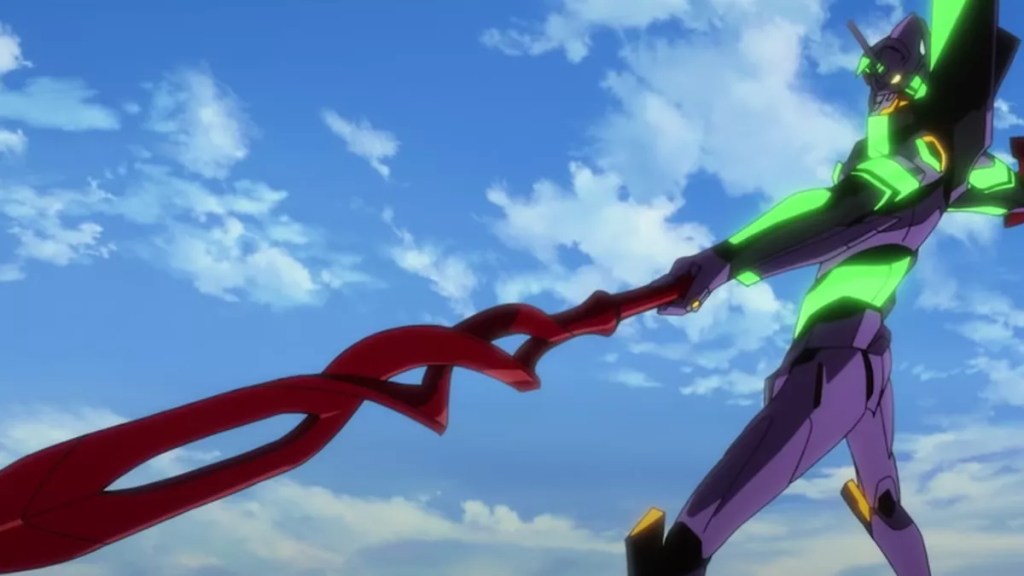
Once the climactic battle against NERV begins, though, all bets are off. The rest of the movie is as much pure, sometimes nonsensical spectacle as End of Evangelion was, to the point that I’m not even going to begin to try to explain it; I’ll only add that a new class of technobabble might have been created here. This is mecha action and symbolism the way only Hideaki Anno can envision and execute it and an Evangelion title can produce it. While the exact details may be different, it follows the same general plan as End of Evangelion: giant Reis, oddly disturbing insert songs, and alternate-art interludes from the intense visual action. The main difference is that, this time, Gendoh is the one getting the most intensive introspection. The original never fully showed where he was coming from; there were hints, and he was clearly obsessed with Yui, but not a full rundown on why he was the way he was. In fact, that is the biggest new contribution that this movie makes to the franchise: showing how Gendoh came to be who he was and how he interacted with others, and how everything he does is derived from that. And if all of that makes him come off like a school/workplace shooter candidate, well, that was likely intentional.
The ending will doubtlessly be talked about for years to come, in part because it seems a bit too simple and clean. (Do watch that scene very closely, though, or you will miss background details.) Another reason will certainly be the role Mari plays in it. If I have one major complaint about the movie, it is the handling of Mari – or, rather, the lack thereof. Who she is, how she came to be involved in this, and why she seems more well-adjusted than the other Eva pilots is not explained in the slightest, nor is her strong connection to any of the others except maybe Asuka – and even that does not get much attention. A name drop late in the movie suggests a Biblical connection, but her role here does not fit well with that. She seems merely to exist to fill action slots that the other pilots cannot, and so her prominence presence at the end makes little sense.
The movie is strong in a technical sense as well. The visuals in the action scenes do lean heavily on CG, sometimes to the movie’s benefit (it emphasizes the artificiality of what’s transpiring) and sometimes not (it’s too artificial at times). Even so, this allows for some glorious action scenes in the latter half and a wealth of small visual details in the first half. Both Eva and character designs are as sharp and iconic as ever and the musical score is well-used. Oh, and let’s not forget plenty of sexy Asuka fan service and a lesser amount for Rei.
I watched the movie in English on Amazon Prime, which means that it reuses the cast that Amazon Prime used on its redubs of the first three movies. That means that Amanda Winn Lee is back as Rei, although even fans of the original English dub of the TV series will have to listen closely to tell the difference from Brina Palencia’s performances in earlier dubs of the movies. That and other carry-overs from the redubs at least assures that there will be no vocal inconsistency if you watch the movies straight through.
Ultimately, the biggest difference between this and previous franchise entries is the message sent at the end. I have always felt that the essential message of the TV series was about learning to like one’s self and accepting one’s own identity, while the essential message of End of Evangelion is that individual identity should not be subsumed to group identity. Both of those elements are present in the earlier movies of this tetralogy, but this one seems to boil down to a different truth: no matter what happens, life moves on. Staying mired in the past is very human but also counter-productive, to the point that dwelling there too long damages everything. Nearly every character in the movie who cannot do this is unhappy, while those who have done it seem well-adjusted despite difficult circumstances, and the movie’s climax basically hinges on this point.
While I am still somewhat ambivalent about the ending, this should be the final installment in the franchise, as nothing much of consequence is left to say. It is a movie that everyone who has followed the franchise to this point should see, though I do recommend rewatching the third movie first.






 USA Anime