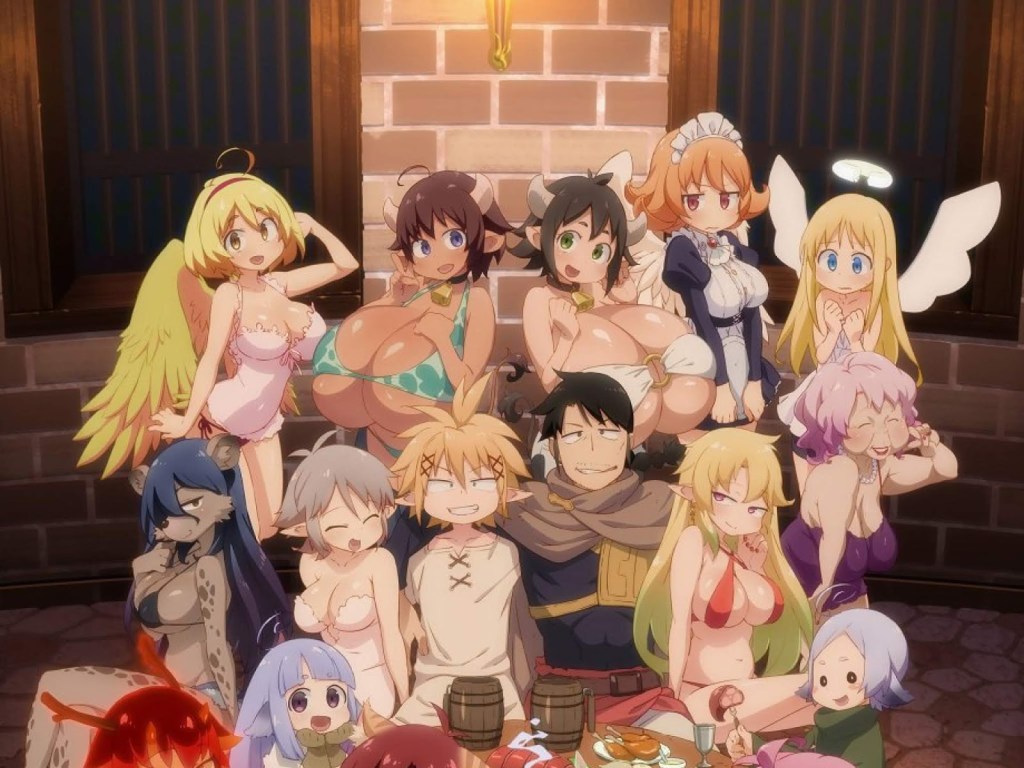
With this episode, the series ties up the final bit of loose ends from the Elfreiden revolt, while also making official that Kazuya has a harem.
But before we get to the latter, let’s look at the final clean-up effort, as that had some minor surprises of its own. Last episode ended with the implication that there were still discontent elements among the nobles of Elfreiden who were still plotting against Kazuya. Not a problem; Kazuya and Hakuya seemed to be well aware of them, which spurred Kazuya to classic Machiavellian tactics. While the episode tried to class this part up by couching Kazuya’s approach here with direct quotes from The Prince as framing devices, the resolution of killing off the other nobles comes off as a bit to simple, sudden, and perhaps even bloodthirsty, though Kazuya did make clear last episode that even purges of nobles was considered necessary even if it wasn’t desirable. Even so, using the trial of Duke Vargas and his daughter to draw them out was a slick move, and yeah, who really thought Duke Carmine was actually dead? (Okay, I’ll admit, for a bit there between episodes I thought the series might actually have the balls to do it.) In retrospect, having him officially dead but serving as the king’s secret enforcer does seem like a fitting resolution.
I am also glad that a way was found to salvage a role (if a greatly diminished one) for Duke Vargas, since even though he was fully guilty of participating in the revolt, he was suckered into it. That Carla was going to be spared was expected. Within the context of the setting, her being stripped of status and becoming a slave to the Royal Family (and thus under the direct authority of Kazuya and Liscia, who wouldn’t mistreat her) may have been the best possible scenario. Since Kazuya wants to keep her close for the special task he’s assigned her (and he’s right that neither Liscia nor Aisha could probably strike him down if needed), and to keep her accessible to Liscia, she’ll probably be impressed into service as a maid.
Finally, there’s the harem part. Something like this was going to be coming at some point, and Kazuya could not remain standoffish about this forever. In Liscia’s case, the series has done enough to establish that she has genuinely grown to feel that way about Kazuya, and while it may be stretching a little more in the case of Aisha, it’s not out of character for her, either. While the way it plays out still carries a whiff of standard harem hijinks, the motivations of Liscia and Aisha for doing it at this particular moment also seem sincere, and that prevents the bed scene from being eye-rollingly tawdry. This has never been a series prone to fan service, so the scene remains visually tame for what’s going on. This isn’t at all a surprise, and fits with the tenor of the series so far, but is still slightly disappointing.
So what plot threads are left to work with here? I am a bit curious about what scheme Roroa has in mind here, but otherwise the series is at a transition point. What direction will it go in next?
Other Series:
While I probably won’t make this a regular feature with this series’ reviews, I thought I’d add in a few observations since this is getting posted so late.
The Genius Prince’s Guide to Raising a Nation Out of Debt – This one makes a nice complement to Realist Hero rather than competition, as it approaches the “reform the kingdom from the top down” attitude from an entirely different, non-isekai angle. Wein is a delight and his relationship with Ninym is special.
Life With an Ordinary Guy Who Reincarnated Into a Total Fantasy Knockout – Speaking of series that are lots of fun, this one has proven to be a blast so far, even though it’s far from being one of the season’s top series on technical merits. In fact, it’s probably my most-anticipated non-Sunday title each week. Yes, a lot of it may be stupid, but the production shows a keen sense of comic timing and the writing is adept at milking meta humor. I recommend checking this one out if the name chased you off at first.
In the Land of Leadale – It’s a straight-up power fantasy with just enough of a humor aspect to it not to feel entirely stale. I am concerned that it’s missing opportunities to explore the circumstances of its setting more.
Attack on Titan – It’s not often that I can say that watching each episode of a series is an experience. 86 came pretty close to that during its run last year, but the recent episodes of Attack on Titan have achieved that at least as well as any other series I can think of. James Beckett’s review of episode 20 is one of his best, and I don’t feel that I can add any more insight to what transpires than he does. This is potent stuff.
Demon Slayer – Entertainment District Arc episode 10: The first 10 minutes or so may have been a bit slow, but after that – hot damn. This is an episode that people will point back to for years to come for both its visuals and action content. Can’t wait to see how things play out in next week’s double-length finale.
These are not the only series I’m following this season, so more thoughts next week.
Note: To see episode-by-episode commentary that I did as the series was airing, go here. This review offers more of an overview instead.
Any adult who has ever played tabletop and/or electronic fantasy RPGs has probably wondered at some point where the sex is in the setting. After all, a diverse array of sentient races also makes for a diverse array of sexual possibilities! This Winter 2020 series, which adapts a manga, goes all-out to answer that question. The result is a light-hearted, surprisingly entertaining series so notorious for its explicit content that Funimation dropped the stream of it after only three episodes. (Only Australian streaming service Anime Lab continued with it, albeit in censored form.) Now it is finally available in the U.S. in fully-uncensored form, and it is an absolute delight to revisit.
The premise used here assumes that a fantasy world with numerous different sentient species peacefully intermingling would also have a vibrant and diverse legal prostitution scene, especially when the government’s ruling party (currently composed of orcs) includes fornication as a right in its platform. The series then further postulates that this reality, combined with the presence of magic, would result both in racially-themed brothels and some other creative takes on the concept, such as a golem brothel where you can essentially custom-design your own girl or even a temporary-sex-change brothel. Since succubi are a real thing in this setting, all prostitutes are generically known as “succu-girls” (under the idea that most sentients in the setting have at least traces of succubus blood in their ancestry if one goes back far enough), and of course magic helps prevent diseases and unwanted pregnancies.
The story – such as it is – follows human adventurer Stunk and his elf partner Zel, who are frequently joined by the angel Crim (who is stuck in the mortal realm for a while due to a damaged halo) and a fourth member who rotates primarily among a halfling, a beastman, and a lamia. Stunk and Zel get into an argument one night about which type of succu-girl is best and why (Stunk tends to favor appearances, while Zel favors mana quality), so they decided to start writing reviews of the brothels they had visited to formally compare opinions. When they discover that they can make extra money that way, Stunk and Zel make a goal of going around sampling all the different brothel possibilities and writing about their experiences, much to the dismay of Meidri, the bird maiden waitress at their local watering hole, who worries that they are corrupting Crim (who is earning his keep by also waiting tables there).
Each of the twelve episodes features the group’s experiences visiting either one or two brothels. The episodes are not entirely standalone, as characters and circumstances in earlier episodes can pop up in later ones; a brothel recommendation pass that the guys get in episode 2 does not end up getting used until episode 12, for instance. However, any sense of overarching plot is incidental. In fact, the lack of a plot even becomes a gag at one point, as an off-handed reference is made about how Stunk and Zel just happen to save the world from destruction while out recouping their funds from a drinking binge at a brothel which features alcohol fairies. This is not a story with any antagonist, either; a vampire lord that the group encounters (naturally!) winds up going to an undead brothel with the gang, and the Demon Lord – who looks like a 13-year-old girl but is around 10 feet tall – is just campaigning in an election and trying to raise the image of demons, who are notoriously regarded as one of the least-marriageable races. (Exactly what the problem is here is revealed in the last episode, and the reasons behind it are rather amusing.)
Nope, this series is all about the sex, and it is very up-front about it; hell, the first line of the opener song is “I love being a horny bastard!” Expect plenty of nudity, orgasmic moaning, intense sexual situations, and all manner of fetishes, including some you’re probably best off not thinking about much; arguably the most outrageous episode features sexualized egg-laying, including commentary on which races really get into it (including buying the unfertilized eggs at auction), though the scene where one character tries to figure out how to fuck a literal animated skeleton is also an eyebrow-raiser. On a couple of occasions, the series even self-censors, but even then. the production team makes jokes out of it; maybe the single funniest moment in the entire series is a sexual sequence where a mayonnaise jar represents the experiences of one of the characters, and it is arguably far more lewd that way. (I believe someone has made a T-shirt of “Angel Mayo,” and I really, really want it.
Perhaps the most remarkable aspect of all of this is that the content is vastly less seedy than it sounds like it is. That is attributable to two key characteristics, one of which is how enormously creative the series is. This is an extremely well-thought-out concept, one which even considers factors like how patrons at the gender-swap establishment are restricted to the premises until the gender-swap wears off (there’s just too much opportunity for mischief), or how a sexy archmage is using duplicates of herself to surreptitiously collect semen samples for her research while using the payments provided by customers to fund that research. Want to combine a nyotaimori establishment (where food is served on a woman’s body) with sexy fun in a fantasy setting? Have the food cooked on the naked body of a fire salamander succu-girl! The degree to which the series makes female characters who might not normally be considered sexy seem quite sexy is also quite remarkable.
The other key characteristic is how shockingly sex-positive the series is. Yes, many of the characters in the series are prostitutes, but nothing is exploitative about it. The succu-girls never give any indication that any of them are doing this unwillingly, and they are universally shown enjoying the experience. Even one brothel where the characters seem to be taking advantage of imprisoned girls is revealed to actually be a role-play-focused brothel, with the staff shown collectively deciding on what theme to use next in an after-hours scene. In fact, the only ones ever shown having unpleasant experiences are the guys, when they either get in over their heads or get in situations which do not align with their tastes. The closest the series gets to unpleasant sexual content is that the guys do harass Meidri a bit, but they always violently pay for it, too. While doing the episode reviews of the series for ANN, I head from numerous people who said that they didn’t normally like fan service series but liked this one because of that sex-positive aspect, and I understand that it was fairly popular with couples viewing for that same reason. Sure, an argument could be made that this is all glossing over the unfortunately-very-real problems with sex trafficking which still exist in the world, but this is a comedy at heart so it’s not striving for any deep social commentary.
The production effort by studio Passione offers a vividly colorful presentation, one where brothel and character designs get equally creative. One of the most frequently-recurring succu-girls is a 50-something human who may look baggy but has lost none of her verve (and occasionally hosts epilogue pieces ), while others are part-octopus, part-hyena, demonic lust machines, or any number of other wonderfully-conceived designs. The underlying attitude presented here is that the world of sex has something for everyone, no matter your kink or taste in women. One episode even has an incubus come on the scene to stir up trouble. Strong animation and music support also goes a long way towards make numerous scenes remarkably erotic, and the opener (which I think sounds like a Village People rip-off) are both fun and memorable as well.
The steelbox release is, I believe, being offered exclusively by Right Stuf under their adult Critical Mass label, and has warning notices similar to those seen on hentai titles. It is subtitled-only and includes typical on-disk extras like commercials, promos, and separated Next Episode bits, but it does also have a separate disk with the OST and a bundled artbook, which includes storyboards for the opener, episode 1, and episode 12, and a beautiful collection of background art. The most fun extra feature is a trio of short bonus manga, the most interesting of which explains why elves become succu-girls. (The logic is more sensible than you might imagine.) The one about elves could safely be read after the first episode, while the others are best read after completing most of the series.
Ultimately, this series is strictly for adults, but if you are an adult who can appreciate a healthy dose of sex in your anime content, then I highly recommend checking this title out.
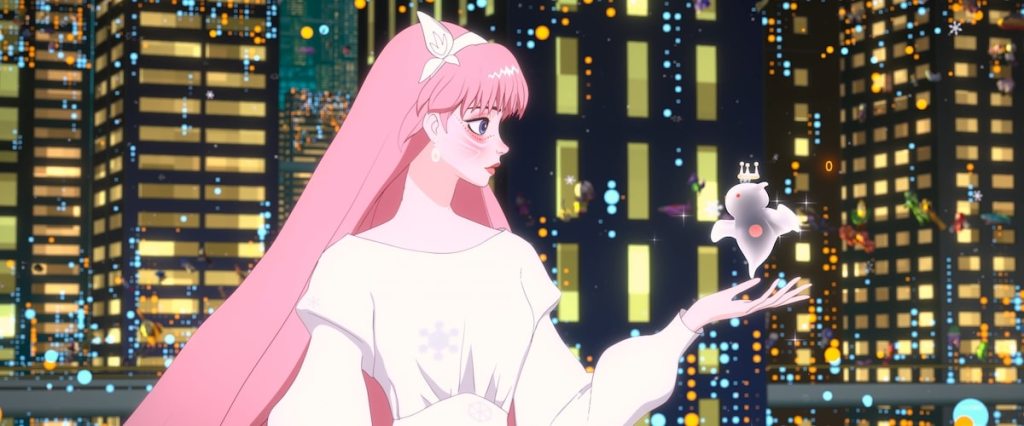
Mamoru Hosoda is a director whose works I have had somewhat mixed reactions to. While I very much liked his Summer Wars, I found his Wolf Children to be too much a paean to an impossibly perfect mother. (I have never gotten around to seeing The Boy and the Beast or Mirai.) Hence I was a little apprehensive about a work which was essentially transplanting the classic Beauty and the Beast story into an online environment. After seeing it in the theater, I am pleased to say that I was concerned for nothing. Belle is not a flawless movie, but it delivers on what counts, and it will be an emotional experience for many.
Much like Summer Wars, the movie imagines a global virtual environment where all people will gather, and posits some interesting (if also, in a technical sense, fantastical) notions about it: the automatically-generated avatars are reflections of a person’s true self, for instance. Exactly how the interface works is hazy, as it doesn’t seem to use a NerveGear/Amusphere-like rig like what the SAO franchise does, but that is ultimately a picky detail which can easily be ignored for convenience’s sake. The more important point is that the environment – called U – pitches itself as a way to remake one’s self and become something different in the virtual setting. That’s a fascinating concept with a broad range of possible impacts, but the story is not interested in exploring that beyond what is necessary for the story.
Though the main body of the story borrows heavily from Beauty and the Beast (and in particular the animated Disney version), this is not a romantic story at heart. That doesn’t mean that there aren’t any romantic elements to it, but the fledgling romances are entirely sidelights rather than the main focus. This is instead a story about identity and how it can be shaped by trauma. Heroine Suzu is so thoroughly shaped by the loss of her mother at an early age (and in a way that some call selfish and senseless) that she has lost her ability to sing and struggles morosely through life, until U gives her the chance to be reborn as Bell (no, that’s not a misspelling). In the virtual realm, she finds her voice, and the quality of her songs speaks to many. But there is another individual, a bestial creature who seems bruised and filled with rage, who also captures people’s attention, and Bell finds herself drawn to him, perhaps because she can sense that he is suffering as well. Hence she undertakes a quest to find out who he really is. Meanwhile, a very justice-minded individual in U plays the Gaston role by seeking to unveil the identity of the Beast, whom he sees as a troublemaker, and Bell gets dragged into his quest.
Despite some occasional distractions where Suzu must deal with the romantic entanglements of school mates, the story stays firmly focused on the way its core themes intertwine. It also mixes in some subthemes about the fickle nature of social media, but that is another element which never gets fully explored. By keeping the focus tighter, its late scenes carry more emotional impact. And if the final resolution of the Beast element seems oversimplified, well, it’s easy to forgive that in light of how much of an impression it makes.
The visual style of the movie is very reminiscent of Hosoda’s earlier works, including letting character details slide in real-life group shots. Real-life location detail is quite strong, but nothing seems overly special about the U environment beyond the eye-catching appearance of Bell. I was, frankly, much more impressed with the detail given to Suzu, and in particular how thoughtfully the movie animates her body language.
The real production star of the movie is the music. That may seem strange given how much of the film plays out without any backing music, but the wonderful insert songs just make that much of an impact. I saw this movie in English dubbed form, and dearly appreciated that all of the songs were not only translated, but also done so beautifully that they almost perfectly fit the animation of Bell singing. The translation part is particularly important in this case, as the lyrics speak more deeply to the heart of the movie than just about any other animated film that I can think of, and I have to applaud the wonderful discovery of Kylie McNeill, who both voices Suzu/Bell and sings all of the songs. Quite simply, the whole movie works in English because of her, and anyone who skips watching the movie in English in favor of the Japanese dub is missing one of the truly epic singing performances in an anime title. It’s not so much that she’s the Greatest Singer Ever (though she is clearly very talented), but rather the perfect voice and delivery for the role. See this article for more detail about how she came to be the movie’s star.
Ultimately, the flaws in the movie mostly involve ideas that the movie tosses out but never much pursues and some romantic elements that, ironically, add little to the movie. The final resolution also feels like it did not really solve the problem even though it was suitably dramatic and satisfying. Those are generally minor negative factors, however. This is a movie well worth seeing, and definitely see it in theater if you can.
Note: Since this title is coming in so much later than the rest of the Winter 2022 Preview Guide, I am making it a separate entry.
Streams: Crunchyroll on Saturdays
Rating: 4 (of 5)
The title on this one can be a little misleading, as while all of the main cast members are, indeed, salarymen, this is actually a series about badminton – or, more specifically, salarymen who are members of corporate badminton teams and play in competition against teams from other corporations, to the extent that an employee might be recruited specifically for his badminton skills. Not having this in a high school setting puts a somewhat different spin on the the first episode, though the differences only go so far; the structure still feels very much like a typical school-based sports series.
The general story beats are also familiar. A talented player who’s washed out in part due to past trauma gets another chance in a new venue, but is being very standoffish about it, while a gregarious new teammate tries to break through the protagonist’s shell. Naturally the protagonist has to be challenged to a one-on-one match and lose in order to take the chip off his shoulder and be forced to be a team player, and naturally the protagonist is stuck with his new partner much more than he’d like, both in job and badminton settings.
For all that familiar feel, however, the first episode is executed very well. The animation production effort by LIDEN FILMS shines, especially in the very detailed badminton play scenes, and makes effective use of cuts and scene transitions. Other scenes also feel natural, and I appreciated that the character designs for the guys are not just pure bishonen; Miyazumi (the blondish-haired one) is actually quite muscular, and that is certainly emphasized. On the whole, the episode achieves a good balance of lighter and more serious moments, too.
I don’t like sports anime in general, and this is clearly a series aimed at female audiences, but I still have to respect the quality at work here. This is the first title that director Aimi Yamauchi has helmed, and if this episode is an indicator of what she is capable of, then hers could be a name to keep track of down the road.
This episode is a tale of two parts: a part about death and a part about life going forward. For many reasons, it feels right to put them together in the same episode.
The death part concerns the greatest lingering consequence of the internal strife within Elfreiden: the fate of the lionel, Duke Carmine. That Kazuya regards him as an upstanding figure important to the country has always been clear, and Kazuya has been equally clear about not liking killing people, especially ones that still have great value to the kingdom. Purges of the kind that must be done here – indeed, of the kind that Duke Carmine was specifically trying to force – are a fact of practicality in this world, much as they were throughout the centuries in many places in our own world, but they do fly in the face of modern sensibilities in First-World countries. Indeed, Kazuya is the only one who seems to have a big problem with it, since even Liscia – whom Carmine was close to – only barely flinches on the report of his death. Perhaps because of what she’s said about her own family’s history, she was clearly fully prepared for this eventuality.
But as much as Kazuya has proven to be an innovator on other fronts, he’s completely trapped by circumstances and practicality here. Not carrying out executions is only courting trouble, and Duke Carmine clearly knows that; in fact, he was probably counting on it. He sees his own death as both a noble way for an aging warrior to go out and a way to protect the kingdom’s future even in death – and as a bonus, it conceals the truth of whatever the heck is the grander scheme in play. Based on the prison scene and other scattered comments, the vague implication here is that Liscia’s mother, the former queen, is the ultimate mastermind, but if so, the scope of this scheme must be enormous if it involves cleaning house on a kingdom level and installing a new king as a means to an end. There’s also the matter of Duke Vargas and his daughter to be settled, though I cannot imagine Carla being killed off.
For the most part, the Kazuya-Carmine scene was handled well, with both ably expressing their viewpoints even though it ultimately changed nothing. The one knock on this part is that the music a bit overenthusiastic about trying to play up the tension.
The second part involves life going forward. Roroa is still waiting for her opportunity to act, while Hakuya is chatting up Jeanne remotely, and reveals his ambitious – if also mundane – life plan. The other part is one we knew had to be coming at some point: Kazuya formally getting a harem. While there are, admittedly, practical considerations in play here, and while this is another case of culture clash for Kazuya, Liscia seems a little too comfortable with this all to be fully credible. She’s not concerned with how many other wives Kazuya eventually has, as long as she’s #1, and she welcomes both Aisha immediately and eventually Juna as other in Kazuya’s harem. This is the one part which feels like pure wish fulfillment, but hey, Kazuya has at least both proved his merits and is in a position to warrant it. I’ll roll with it, especially since it balances out the weak, entirely too vague epilogue scene.
In all, it makes for another solid but unspectacular episode.
With this episode, the final resolution of the conflict over Amidonia seems to be done – at least for now, anyway. Julius isn’t happy about it, but there was no reasonable outcome where he was going to be happy, as the negotiations between Jeanne and Kazuya completely boxed him in (as they were designed to). He at least gets his capital back, at the cost of war reparations designed to eat into his country’s military costs and ransoms for captured nobles, and that at least allows him to salvage some outward dignity even if he’s seething on the inside. Somehow I rather doubt he’ll heed Kazuya’s (literally) Machiavellian warnings, though given how disappointed the populace was to see him leave, the people of Amidonia likely won’t put up with much from him.
In doing so, the story covered its bases quite thoroughly. The geopolitical situation is fully considered, the matter of Julius’s sister (the mercantile princess we’ve seen a few times) is brought up in a context where the reason why Julius cares at all about her is explained, and even the fate of General Margarita (the woman who sang the Amidonian national anthem at the end of episode 12) is addressed. We even get a significant segment showing Jeanne reporting back to Maria, and a party later on to celebrate the role adventurers played in bringing things to this point – one where we learn that Kazuya’s major weakness is, unsurprisingly, alcohol.
I do get the feeling that the series is being a little too thorough and methodical, though. Sure, the Jeanne/Maria scene better clarifies the kind of person Maria is and brings up the matter that Kazuya may well be fulfilling prophecy on a hero even without directly confronting the Demon Lord, so I can largely excuse that scene, but it definitely feels like the story has been moving at a snail’s pace. At least the story has now cleared nearly all of its initial plot threads, so I am curious to see where it will go next. Perhaps return to Tomoe’s revelation that she can talk to the demons and the significance of that? (Kazuya did vaguely probe about this in his dealings with Jeanne in the previous two episodes, but the matter has not been explored beyond that.) As long as the next episode does better than the weak party scene it ended on, things should go fine.
Additional Note: Since hardly anything else this season is looking consistently comment-worthy after two episodes, this will likely be my only full, weekly episode review for the season. Instead, I will do one additional post per week (probably on a Tuesday or Wednesday night) which summarizes reactions to other titles and highlights the one I feel is most doing something interesting.
Jeanne, Hakuya, and Liscia are all surprised by Kazuya’s off-the-record claim.
Rating: 4 (of 5)
Even for a series which is firmly focused on strategic thinking, devoting nearly an entire episode just to one long conversation is a bold move. It requires a special kind of dynamic to be able to pull that off without it getting boring, and few shows that have tried it in the past have been up to the challenge. (The one shining success story that I can think of is the second episode of Spice and Wolf, and even that may not work if you don’t find the interplay between Lawrence and Holo to be involving.) Episode 15 pulls this off better than most.
This happens primarily because nearly everything discussed is directly relevant to what’s going on in the series. The negotiation between Kazuta and Jeanne carefully lays out what’s at stake for both parties and how the resolution of the matter can affect not just the parties immediately involved but also the whole region. The Gran Chaos Empire cannot afford to ignore Elfreiden’s invasion of Amidonia (even if it is punitive) if it wants to maintain the greater treaty, while Elfreiden needs assurances that returning Julius to power won’t just result in him trying the same stunt as his father down the road. There’s also the matter of Elfreiden (who has yet to sign the treaty) working covertly rather than overtly with the Gran Chaos Empire in the future and how that can benefit both sides. How other surrounding countries might respond also has to be considered.
The resolution of the Amidonia matter does not require the full time, however, hence allowing some other points to be explored. Jeanne once again shows how remarkably practical she can be with the discussion about eating monsters, but that light-hearted moment leads to the more interesting discussion about how the relationship between monsters and demons may be thought of as akin to the relationship between people and animals, and further, how demons don’t seem to differ much from the other demi-human races. I have to respect how thoroughly the writing it thinking through the consequences of such an observation should it be disseminated to the public. This whole matter may not be the main point here, but it is an observation that I expect will be of great significance to the story down the line.
Ultimately, the resolution of the matter is the kind of thing that can only happen when all parties involved are sensible one. Jeanne continues to impress with her composure, only really losing it briefly with her wildly-reaching proposal about Kazuya joining the Gran Chaos Empire instead. The visual effort here also deserves at least some credit for preventing the main scene from ever feeling too static, despite the fact that all but the last couple of minutes of the episode take place in the same room. In fact, that may be the most impressive part of the episode.
As good as this was, I look forward to seeing the series move on to something else next episode. Perhaps exploring why the name “Divalroi” seems so familiar to Kazuya? (Actually, I’ve heard from novel readers that this is a detail which shouldn’t be expected to come up again anytime soon.)
Jeanne, talking to Kazuya in a formal diplomatic matter
Rating: 4
The series is back for its second half, and picking up right where it left off: arranging to deal with the Gran Chaos Empire as it arrives in Amidonia with a large army, all to advocate on behalf of Julius in his attempt to regain control of Amidonia and the capital city of Van in particular – something that he claims Kazuya unlawfully seized. That sets the stage for an episode which entirely involves characters talking but is hardly without conflict.
Saying that a battle is taking place here despite no blows being struck would hardly be an exaggeration. The first part of the episode involves Kazuya adjudicating infrastructure within Amidonia, though with goals that are not just purely practical; he’s choosing bridges and then having them named after Elfreiden officials, with the goal of goading Julius into destroying them upon a return to power and thus riling up the locals against him. This is just the long-term aspect of going on the (verbal) offensive in the upcoming meeting with Julius and the Empire, represented by Jeanne. There he pulls no punches in poking at Julius while also arguing, with documentation, that Amidonia did well more than just invade in trying to destabilize Elfreiden. Jeanne seems to realize what he’s doing, as she never loses her composure as Kazuya systematically maneuvers Julius out of the negotiating picture. In fact, the only times Kazuya seems out of his element is when he briefly has to make small talk and does not correctly understand the full extent of a summoned maid’s inclination to mess with Julius while keeping him occupied.
The more I see of her, the more I like Jeanne as a character. She’s caught in the middle of the situation here but doesn’t flinch or hesitate in keeping Julius on a short leash and never loses her composure. (She also looks more convincing than most in her heavy armor.) Empress Maria is well-represented by Jeanne. Kazuya isn’t going to be able to manipulate her with practicalities as he has so many others, so I look forward to seeing the conclusion of their negotiations next episode. Juna also looks good in her navy uniform (with pants!), too.
On another note, who or what exactly is Albert and his queen talking about at the beginning of the episode? They’re certainly suggesting that something like this has happened before, only this time it’s more successful? More seems to be going on here than was originally apparent. . .
Welcome to my version of the Winter 2022 Preview Guide! I expect to be covering nearly every full-episode series that will be debuting or returning this season which has an official English-subtitled stream. (The exceptions will be the second season of The Case Study of Vanitas and the third season of Teasing Master Takagi-san, as I am not caught up on either.) These will be listed in newest to oldest order, and this post will be updated multiple times per day on busier days.
Note #1: All titles for the Winter 2022 season have now been posted, with Salaryman’s Clubgetting a separate entry due to its lateness.
Note #2 (updated):How a Realist Hero Rebuilt the Kingdom s2 will go directly to episode reviews, since I did those for the first season. I am also taking requests for what to do for a second series this season.
So without further ado. . .
Arifureta 2
Streams: Funimation on Thursdays
Rating: 3 (of 5)
I’ll be frank: I always thought the first season of Arifureta was a bad show for any number of reasons, but I still watched it anyway because it was so serious about its badness that it came off as corny, and I enjoyed it at that level. The second season’s opener suggests that things won’t be too much different, aside perhaps from the change of animation studio resulting in slightly better CG monsters. Hajime’s still the edgelord traveling with a bunch of girls all keen about jumping his bones and a little girl who calls him “Poppa,” and he’s leaving most of his classmates in the dust, to the chagrin of at least one in particular. The main difference this season is that Kaori is also along for the ride and in full competition.
The first episode is mostly just about re-establishing everyone’s relative position and providing the hook for the next big arc (including who the next enemy to get utterly butt-kicked by Hajime will be), so nothing much special is going on there. And while all of the cattiness in the military vehicle was annoying, it was saved by a few choice lines. One was Yue’s pointed assertion that while the other girls just want to bed Hajime, she’s actually done it. The other is Kaori’s very pointed (and true!) observation about Hajime’s current status, as shown in the screencap above. Rarely has the “slam head into table” (or in this case, steering wheel), which immediately follows this shot, felt more warranted. Keep popping off a bit more like this and the second season might hold my interest just like the first did.
Love of Kill
Streams: Crunchyroll on Wednesdays
Rating: 3.5 (of 5)
In this manga adaptation, Ryang-ha Son is a veteran hitman so notorious that everyone in the Underworld has a bounty out on him, but for reasons even he doesn’t fully understand, he’s taken an interest in young, relatively new female bounty hunter Chateau. Actually, “stalking” might be the appropriate word here, as she cannot seem to shake his attention or dissuade him and he even helps her out by killing some of her targets for her and allowing her to take credit. Maybe his interest is romantic, or maybe he just wants a connection that doesn’t seem rotten to him. But she has her own baggage to deal with and Ryang-ha as a potential target.
How well this goes over with viewers may come down to how much they can tolerate Ryang-ha’s very stalkerish behavior. Though he never gets physical except in self-defense, he can clearly manhandle her if needed, so this isn’t an even pairing at all; the power dynamic is all in his favor. This isn’t quite as creepy as it could be, though, because the only real menace present here is that he is a legitimate cold-blooded killer; this seems more a case of him trying to feel out a potential relationship he’s never really had. Meanwhile, Chateau seems very deadened emotionally beyond her obvious frustration with Ryang-ha. I suspect the plan here is to see them gradually coming to understand each other as more of their sordid pasts are revealed, and I can see that working if it’s handled carefully. It’s walking a thin line so far, but I am cautiously optimistic.
The Genius Prince’s Guide to Raising a Kingdom out of Debt
Streams: Funimation on Tuesdays
Rating: 4 (of 5)
Well, this was a lot more than I was expecting. Rather than being a carbon-copy of How a Realist Hero Rebuild The Kingdom, this one goes at the “rebuild a fantasy kingdom” gimmick from a wholly different angle: the prince is trying to fail, without looking looking like he’s doing it deliberately, in order to secure himself an easier life. Unfortunately for him, failing is the one thing he’s not good at. His unwanted successes are starting to compound into a reality that’s going to require a lot more work for him.
The first episode sells this concept remarkably well. It lets us see quite clearly how much of an ass Prince Wein is internally, but much like Tanya in Saga of Tanya the Evil, he knows that he has to at least keep looking good to secure his desired easy life. Like with that show, the great and amusing irony here is that his attempts to maintain a facade are too good and bought into too fully by everyone around him – well, everyone but close advisor Ninym (who is a different race, I guess?) anyway. This results in some surprisingly effective comedy, though the series isn’t entirely light-hearted, even with jaunty music playing during a major battle scene; Ninym’s encounter with a defeated enemy general is decidedly more serious, for instance. I like that balance so far, and also the rapport that exists between Wein and Ninym. Not sure how well the series maintain the premise, but it is off to a rousing start.
She Professed Herself Pupil of the Wise Man
Streams: Funimation on Tuesdays
Rating: 2 (of 5)
To be clear, the low rating for this one should be taken less as an indication that the concept or series as a whole is bad and more as in indication of how unsatisfactorily the first episode is executed. The basic premise is the Danblf is one of the top wizards (aka Wise Men) in a wizard-focused kingdom of an open-format online game, and entirely too much of the first episode is spent establishing that. I don’t mind a bit of exposition as a stage-setting technique, but this series then rambles on showing an utterly run-of-the-mill big battle scene and partly introducing numerous characters who won’t be important immediately, before finally getting to the big twist near the end of the episode: that somehow the classic white-bearded wizard has become a cute white-haired girl. Maybe the episode could have explained a bit more here – did the character just change, or is the player now stuck inside the game in this form – but instead it shows a wordless montage of here wandering around, giving cameos to various characters already introduced and/or important later, before declaring herself cute. In other words, the first episode does not even fully complete the basic premise.
I have to think that there’s a better series afoot here, as there are some interesting concepts shown concerning fantasy RPG play, but this first episode does nothing to promote the series. I will probably give it at least one more episode to prove itself, but it faces a lot of genre competition this season, so it cannot afford too slow a start.
Life With an Ordinary Guy Who Turned into a Total Fantasy Knock-Out
Streams: Crunchyroll on Tuesdays
Rating: 3.5 (of 5)
A 32-year-old stud who’s never had any problem attracting women but is more comfortable around guys and his longtime friend, who’s so average that he drunkenly wishes to be a petite hottie, get transported to a fantasy world by a goddess of beauty, who grants the second man’s apparent wish and reincarnates him as a petite blonde girl, all as part of a scheme for them to become heroes and defeat the Demon Lord. Uncomfortably, they both immediately start to find themselves attracted to each other, but whether that’s the result of the curse of the Goddess of Beauty (whom they managed to tick off) or a pre-existing attraction is unclear. What is clear is that both have special abilities: he has a high starting level, she has a plethora of skill that make her irresistible.
I was expecting something at least a little crazy and very trashy out of this, but I was surprised by how fun and well-thought-out it turned out to be. Each of the two leads is well-established and gets a lot of play out of adjusting to the other one now being the opposite gender and trying to sort out how that changes his/her feelings about the other. The irony here, of course, is that both see the other as ideal now that they are opposite genders, and I hope the series goes a long time before clarifying if the goddess’s curse is responsible for that or not. The series even proclaims itself as a “romantic comedy” rather than an isekai title, and it should be entertaining if it keeps that up.
Princess Connect! Re:Dive s2
Streams: Crunchyroll on Mondays
Rating: 4 (of 5)
While Spring 2020’s edition of this mobile game-related title was never a favorite, it was always a series that I enjoyed and appreciated for its goofy fun mixed with occasional touches of strong sentimentality. No doubt this had a lot to do with being directed by Takaomi Kanasaki, the same person behind the anime sides of the Is This a Zombie? and KONOSUBA franchises, and with it just focusing on side stories for its affiliated game rather than trying to shoehorn in too much of the game’s main plot. The first episode of this season beautifully reminded me of why I liked the first.
There’s nothing extraordinary about any of the characters or what they’re doing here, but they make for a cute, fun mix and look like they are genuinely having fun together while out on a silly quest for a legendary ingredient. The series’ trademark humor style is well in evidence, but it also finds a surprisingly affecting place for a story about an old man and his former adventuring party before finishing the episode with a devious twist. It still looks pretty good, too, even if it does tend to have a KONOSUBA-like affinity for not staying tightly on model. I thoroughly enjoyed this episode and will absolutely be following it again.
Sabikui Bisco
Streams: Funimation on Mondays
Rating: 3.5
In a post-apocalyptic Japan, a condition called the Rusting is ravaging metal and people alike and turning the land outside of cities into desert wastelands. While young doctor Milo does his best to make his home city a better place (and find a cure for his elder sister’s advanced Rusting condition), including using illegal mushrooms to try to concoct new medicines, an archer is on his own mission, one which causes mushrooms to sprout everywhere and gets him regarded as a terrorist.
This light novel adaptation was widely-considered one of the most anticipated new titles of the season, but its first episode feels like it’s not quite living up to the series’ full potential. Much of this is because too little that has been shown so far makes much sense, but it also suffers from some minor pacing problems; conversations often go on just a little too long, apparently intent on stuffing little extra background tidbits into the story in a not-too-graceful fashion. Honestly, a lot of the problems could have been alleviated by just making this an extra-length premiere. Even so, it has enough style points and neat ideas to feel like the series is capable of quite a bit more than it has shown so far. The score I am giving this episode indicates cautious optimism, as this could eventually be one of the big shows to watch this season. I will definitely give it at least a couple more episodes.
Fantasia Sango – Realm of Legends
Streams: Funimation on Mondays
Rating: 3 (of 5)
This one has a somewhat unusual pedigree, in that it’s based on a Taiwanese RPG which adds supernatural elements to the classic Chinese novel Romance of the Three Kingdoms. Hence it uses Chinese naming conventions even though it is fully a Japanese production. (The title was originally advertised with Japanese character names, but the subtitles use the Chinese equivalents.) The set-up is a fairly standard “gather a team of unique individuals to fight the miasma causing humans to turn monstrously evil” scenario, only with the godlike sponsors seemingly more directly involved here.
Don’t expect any more from the series than that and it actually works pretty well. The character designs are decent (if a little generic and obsessed with buxom figures for adult women) and the content delivers better-than-average action execution and battle flow, with solid musical and at least competent animation support. I cannot see this getting too deep, but it should be at least passable as a pure actioner.
Tribe Nine
Streams: Funimation on Mondays
Rating: 2 (of 5)
Baseball gets taken to ridiculous extremes? Okay, I can buy that, as this is hardly the only title over the years to pull that stunt. Sports used as a matter of settling conflicts is also a time-honored tradition, one that is known to date back several hundred (if not several thousand) years in certain parts of the world. Youths in Japan becoming so uncontrollable that they break down into tribalism is also an idea that’s been used to some degree in many other series. However, combining all three just creates an excuse for a shonen action series that is over-the-top ridiculous, and not in a good way.
I will give the series credit for trying hard to promote its cool factor with a funky musical score and outlandish visuals. However, I have to give this a low score for two reasons: the very disconcerting eyes of characters in the protagonist group and hair styles which suggest that the characters either never wash their hair or use way, way too much product on horrible notions of what good hair looks like. The series does have some energy going for it, but that isn’t enough.
Futsal Boys!!!!!
Streams: Funimation on Sundays
Rating: 2.5 (of 5)
Futsal is an actual sport which has an international following, though it’s practically unknown in the States. It is played in teams of five and uses rules similar to indoor soccer, which makes it ideal for adaptation into anime form. The first episode here makes the wise decision to move along quickly, only briefly introducing its core cast as two impromptu matches get played out. The personality mix so far seems typical for series about boys’ sports teams, as do the problems the team faces (attitudes not conducive to teamwork, etc), so this is a run-of-the-mill sports series in most regards.
The problem – and the reason why I’m rating this below average – is that it’s really stretching to create some antagonism here. Delinquents who settle things with futsal? Really? The series lost all credibility with me over that, and the animation isn’t and choreographer are not that great, either. Don’t see much promise here.
Sasaki and Miyano
Streams: Funimation on Sundays
Rating: 3.5
I’ll be frank: BL is absolutely not my thing, and I don’t care for the heavily shoujo-influenced character design style here on on top of that. Even so, I have to acknowledge that this is a pretty solid start for a light, fluffy romantic comedy that will no doubt charm audiences less averse to BL. The series is refreshingly not coy at all about whether Sasaki’s genuinely attracted to Miyano, and while Miyano does not seem to reciprocate (yet), it’s not hard to see that developing. I might quibble about the somewhat confusing way that the episode bounces around its timeline with little to no hints of transitions, but the series’ easy flow and gentle humor more than make up for that. In other words, this is shaping up more and more to be one of the better seasons for romcoms in quite some time.
Attack on Titan Final Season (ep 76 overall)
Streams: Crunchyroll and Funimation on Fridays
Rating: 4.5 (of 5)
Nine months ago, the first half of the final season left viewers on a major cliffhanger. So what do we get for the wait?
One hell of a spectacle, but also one of the franchise’s more graphic episodes.
Oh, and Levi is maybe dead, but maybe not, and Zeke is still alive but with a weird experience, and Yelena’s plans are falling apart in the face of the Marley attack (which Eren thinks is risky, based on Marley’s “limited knowledge” of something, and not everyone from Yelena’s faction is on board with the sterilization plan, and Eren may be up to something beyond what the others are. . . Yeah, there’s a lot going on here to sort out, but what’s most important is the return to good ol’-fashioned Titan-on-Titan bashing, including Eren using the War Hammer Titan’s abilities. It’s messy, and Yelena’s people are getting their butts kicked, but too much time is left in the series for a major reversal to not be coming.
Yeah, Attack on Titan is back, and it’s great. This should be a fun run to the finish.
Rusted Armors
Streams: Crunchyroll on Sundays
Rating: 1 (of 5)
This is the anime branch of a mixed media project with an unusual progression: it started out as a stage play first, then got animated.
Or perhaps I should say it got the semblance of animation? This is an all-CG production that, frankly, features the weakest artistic and animation efforts at least since last year’s epically bad EX-ARM. The story isn’t much better; it features an array of colorful guys using special Armors (some of which feature tech way beyond the time period) to defend their home village of Saika during the Warring States era. This involves fighting off faceless enemy forces wearing full plate armor of a style never seen in Japan (or anywhere else, for that matter) and using all sorts of annoying verbal quirks. There’s an amnesiac member to provide a semblance of mystery, too, but in general this is the most half-baked production I’ve seen since EX-ARM. The live-action bit at the end, where two of the actors visit actual sites which correspond to the series, is actually the most interesting part, and that should never happen.
Requiem of the Rose King
Streams: Funimation on Sundays
Rating: 2.5 (of 5)
This series adapts a manga, which itself was inspired by Shakespeare’s historical plays, in particular the Henry VI trilogy and Richard III. It does not seem to begin at the start of the manga (Richard III’s birth), but rather at some later point, and depicts events and characters involved in the War of the Roses, the period of on-and-off civil war in England from 1455 to 1487. While the first episode does depict some actual historical events, to say that it is a fantastical interpretation might be a bit of an understatement. Richard III generally doesn’t come off well in historical accounts, with various minor deformities attributed to him, but the only one retained in this case is that he was slight of stature. Here, instead, he’s both hetorochromatic and not fully a “he” – in other words, intersex. This is used to reinforce in Richard’s mind that he is a demon child, and significantly, he is always depicted wearing black and whispering into his father’s ear to push him to take the English crown. The scene shown in the screen cap, which involves the all-white Henry VI (though Richard doesn’t know that), also carries homoerotic undertones. (The story is at least consistent on the point that Henry VI was not regarded as a mentally strong individual.)
As much of a history buff as I am, that angle doesn’t work for me. I will acknowledge that the very limited animation uses some very interesting visual styles, so I could see it finding an audience, and the actual story of Richard III has no shortage of twists and turns beyond that. The depiction of Richard III as a generally tortured soul is also somewhat interesting, but I doubt I’ll watch the series further. Pass here.
Miss Kuroitsu From the Monster Development Department
Streams: Crunchyroll on Saturdays
Rating: 4 (of 5)
Kuroitsu works for the Monster Development Department of secret organization Agatsya, whose ultimate goal is world domination. The barrier to this is assorted Super Sentai heroes, including local hero Divine Swordsman Blader. Hers is a taxing job, which can include making proposal on the fly before the organization’s leadership, dealing with the whims of its absolute leader, and managing the situation when new ace monster Wolf Bete doesn’t turn out quite like the monster’s mind expects.
This manga adaptation was one of my most-anticipated titles based on its premises, and despite an unpromising start, it winds up shining as a silly mix of workplace comedy and Super Sentai parody. It deftly recovers from its weaker initial gag about a mascot-like monster which Kuroitsu has to pitch as a real threat due to a slapdash presentation her boss provides her, with the pivot point being the chief strategist’s unexpectedly accommodating attitude. From there, it presents a much more inspired bit about a wolf warrior who winds up female instead of male, much to his dismay, and how that ironically proves to make him much more effective against the hero. I laughed at the episode several times, and even the way fan service and censoring is handled is both funnier and sexier than in World End Harem (whose rating I might drop further after seeing this). The lengthy episode titles are a hoot, too, and the regional Sentai heroes shown early in the episode are apparently actual regional mascots – another clever twist.
This is one that I’ll definitely be watching and specifically recommend checking out, though you have to stay for the whole episode if you do.
Akebi’s Sailor Uniform
Streams: Crunchyroll on Saturdays
Rating: 3 (of 5)
In this manga adaptation from CloverWorks, Komichi Akebi is a junior high girl eagerly looking forward to attending the same school as her mother and wearing a sailor uniform, just like her mother did. However, they somehow both fail to notice that the school has moved on to wearing blazers in the time since the elder Akebi attended. (Really, how could they not notice this?) The sailor uniform is allowed since it is part of the school’s history, but that still leaves Akebi nervous about sticking out in a bad way.
I can see this series going over well, but the first episode did not work for me for one superficial reason: I do not care for the character design aesthetic. There’s just something about the shape of the heads and neck that I find distracting, and after looking at some of the manga art, the blame at least partly goes to the source material. Otherwise this looks like a sweet little story about an athletic girl from the countryside being herself around peers that don’t share her background as she navigates high school life. Fair warning that the first episode at least is a bit more fan service-y than might be expected, and I could maybe see that making some people uncomfortable.
My Dress-Up Darling
Streams: Crunchyroll on Saturdays
Rating: 3.5 (of 5)
In this manga adaptation, Wakana is a social recluse because he find himself unable to find common ground with other students, given his passion for (obsession with?) traditional Japanese hina dolls. That may be starting to change due to fateful encounters with class popular girl Marin, who, upon discovering that Wakana can sew, practically begs him to help her with her effort to make a cosplay outfit for a favorite character.
This was maybe the most widely-anticipated non-sequel of the season, and after the first episode, I can sort of understand why. It is, at heart, a classic story about the Social Outcast finding common ground with the Popular Girl, and naturally the Popular Girl seems to have some hidden otaku-friendly hobbies. However, this one feels like it might show at least a little more depth. Marin is a more genuine character than normal for this role, one who does not let her image get in the way of her convictions. (She detests people who don’t respect another person’s interests, and I’m presuming that’s because she will be revealed to have had problems with that in her past.) And the twist at the end about who, exactly, she wants to cosplay was pretty funny. The series looks pretty sharp and has a scattering of mild doses of fan service, but I’m a little hesitant to fully commit until I see if the series avoids common genre traps. Will certainly check out more of it, though.
The Strongest Sage With the Weakest Crest
Streams: Crunchyroll on Saturdays
Rating: 2 (of 5)
In this light novel adaptation, Gaius the Sage was a menace against demons in his time, but he felt that he had maxed out his power with his first of the four Crests granted by the gods. Hence he apparently chose to reincarnate in a later age with a different Crest that wasn’t as strong but had more growth potential. (I say “apparently” because a sizable time gap is implied rather than spelled out.) That just means that, as an incoming student at Second Academy, he’s vastly stronger than anyone else, and his familiarity with older magical means allows him to ferret out a plot by demons to weaken the magical strength of humans overall. Oh, and he’s getting a girlfriend this time, too, which he apparently didn’t have the first time.
This series isn’t going to avoid comparisons to The Misfit of Demon King Academy even though the story circumstances are significantly different, and the comparisons won’t be favorable ones. The thing about the potential girlfriend has some cute potential, but Matthius is not that interesting a character and events in the first episode feel like they’re moving way too fast. (I would be interested to see commentary on this from someone who has read the first novel.) The plot about demons infiltrating to sabotage human power by promoting inefficient spellcasting styles is a little interesting, but this is too much of a naked power fantasy with not enough other attracting factors to compensate.
Cue!
Streams: Crunchyroll on Fridays
Rating: 3
15 girls/young women join new agency AiRBLUE with the aim of becoming seiyuu (i.e., Japanese voice actresses). As a first exercise, they must read a famous scene from Shakespeare’s Hamlet.
And that’s the entirety of the plot so far from this mobile game adaptation. It briefly introduces a whopping 15 girls (not counting the agency staff), with the greatest focus on Haruna (the one on the right in the screenshot). The only real gimmick here is the way that the voice acting can cause characters to visualize the scene, and frankly, that didn’t work so well in this case; much of the problem, I think, is that Shakespeare doesn’t sound right to my ear in Japanese, no matter how it’s interpreted. The cast seems like it’s going to offer just about every standard body and personality type from idol shows, but overall, it’s a pretty bland start, hence the middling grade.
World’s End Harem
Streams: Crunchyroll on Fridays
Rating: 3 as a fan service title, 2 otherwise
In anime and its associated works, going into cold sleep for whatever reason inevitably results in the subject being ensnared in the after-effects of calamities which happen while the subject is sleeping. That’s exactly the case here, with nearly all of the men in the world dying off to the MK (Male Killer) Virus while protagonist Reito is sleeping until AIs come up with a cure for his disease – which, ironically, is likely the reason why he comes out immune. As one of only a handful of men left, he’s faced with an intimidating responsibility: impregnate as many women as possible in an effort to pass his immunity on to male children. And it has to be done the natural way, too! The problem is that Reito is still completely hung up on long-time girlfriend Erisa, who has since disappeared. How tolerant can The Powers That Be afford to be with him?
Okay, so the premise is sleazy as hell, and clearly tricked out to force a harem situation. Even so, the premise raises some interesting ideas: could society survive (and maintain its existing technical level) if half its population quickly died off? And while Reito’s devotion would be commendable in other circumstances, does his obligation to humanity as whole override what he wants? Somehow, I don’t think this series cares too much about exploring these details, as the sex potential here is far greater. The first episode doesn’t have any sex scenes, but they are likely coming, and (as the screen shot shows) it certainly has select censoring. Artistry isn’t bad, either, though it does appear that very large-breasted women will be favored.
I’m giving this episode the rating I am because this is an okay set-up for a fan service scenario, but this series has the very real potential to be one of the season’s worst.
Girls’ Frontline
Streams: Funimation on Fridays
Rating: 2.5 (of 5)
This series is based on a mobile game, so contemplating the foundational logic in anything beyond a meta sense is probably pointless. Even so, I have to ask: if you’re going to make AI-driven combat androids, why make the generic ones look like female S&M enthusiasts, the elite ones look like maids, and the rest look like Japanese school girls, complete with mini-skirts? I also have to question the stability of a unit firing four auto-fire weapons attached to their legs in continuous barrages, but whatever. Logic clearly isn’t a core element of this one, no matter how much it tries to play up its technical side.
The actual episode here – which involves “T-Dolls” fighting each other post-WWIII – feels more like a prelude than an actual first episode, with the woman who will presumably be the Commander arriving at the end of the episode. Hence it’s hard to see how this might play out at this point. The visuals look decent, but this does not feel like a title that is going to be plot-heavy. The series should work for Girls With Guns fans, but I question its staying power otherwise.
Slow Loop
Streams: Funimation on Fridays
Rating: 4
Introverted, boyish Hiyori learned fly fishing from her father, and still does it even though he passed away three years ago. Her soon-to-be high school life gets upended when bubbly, ditzy Koharu arrives on the scene and immediately expresses enthusiasm for fishing, since she’s never gotten to do it for real before. Oh, and Koharu is also to be Hiyori’s new stepsister, too.
I wasn’t expecting anything more than “cute girls do fishing” out of this, and that looks like it will, indeed, be a major component of this light-hearted series. However, the first episode impressed by adding in the context of having to adjust to a new family situation, and how she’s not the only one who needs to adjust. There also looks to be a cooking component as well, though whether or not that will be a regular thing remains to be seen. This isn’t quite as laid back as Laid-Back Camp, but it has some legitimate charm in that vein. I might actually watch more.
Tokyo 24th Ward
Streams: Crunchyroll and Funi on Wed.
Rating: 3.5, I guess?
A year ago, friends Ran, Koki, and Shuta attempted and failed to save mutual friend (and Koki’s sister) Asumi during a fire. A year later, they are drifting apart when a memorial for that fire is held. Shortly thereafter, all three get a mysterious phone call which seems to be from Asumi and experience some kind of brain hacking which gives them abilities beyond what they had before – abilities which might be used to stop an impending calamity in Tokyo’s 24th ward.
And that is all that really makes sense about the double-length debut of this original anime series, which comes from the director of planetarian, Inu X Boku Secret Service, and most of the 2010s Jojo’s Bizarre Adventure titles. I’m giving this an above-average rating because it is animated well and the climactic scene involving the train is suitably thrilling, but so much else is going on here that another episode or two may be necessary for everything to settle in. Certainly this is an ambitious-looking series, with the first episode dangling all kinds of potential plot threads and character developments in addition to the central mystery about Asumi and the boys’ new abilities, and I can appreciate how the character development is already firming up, but I’m cautious in my optimism here for now.
Police in a Pod
Streams: Crunchyroll on Wednesdays
Ranking: 3 (out of 5)
This new series is based on a comedy manga, and comedy is, indeed, an element present throughout the first episode. The premise features a rookie female cop (the one on the right in the picture) who is being discouraged to the point of considering quitting by the abuse heaped upon her while doing her her job, but a beautiful new trainer (the woman on the left) convinces her to give the job a second chance. While this can result in some somewhat serious parts – such as a career burglar’s commentary on what signs he looks for in good targets – and some sincere moments, more often than not the encounters are a vehicle for light humor.
Whether that humor works sufficiently enough to drive the series is another story. I did get a couple of chuckles out of the swearing the more experienced female officer does under her breath in response to angry traffic stops, and the funniest moment involves her reaction to realizing that she had just posed like a poster she hates. However, this is by no means a slapstick series, and I just didn’t find enough going on here – or things coming together well enough – to sustain the episode. Still, it might be worth watching just for the gorgeous character designs. (And, notably, its lack of fan service despite that.) The manga it’s based on is an award-winner, so I will probably give it another episode or two to prove itself.
In the Land of Leadale
Streams: Crunchyroll on Wednesdays
Rating: 3.5 (of 5)
The first episode only hints at the background involved (so it may be elaborated on more in ep 2), but the basic premise is that a young woman was critically injured in an auto accident, to the point of being perpetually dependent on life support. While in that state she became a top player in a VR game called Leadale, presumably in part because it allowed her the semblance of physical activity that she was unable to do in the real world. After a power outage knocks out her life support, she wakes up in a setting resembling Leadale, complete with her stats, equipment, and even menu controls all intact. However, 200 years seems to have passed since the time of the game. Her early encounters in a border village she once visited and at her former tower indicate that what happened in the game seems to be part of the lore of this setting, but also that a lot has changed over time, including her (self-admittedly) OP abilities and resources being even more out of whack with the current power scale.
In other words, this is a set-up somewhat like Overlord, where a lot of uncertainty exists about both whether this is more a “transported to another world” or a “trapped in a game” scenario and whether other former players are present or not. The added mystery in this case is the time gap, and presumably that will be an underlying plot thread for the duration of the series. Beyond that, this is setting up as a typical power fantasy, albeit with a female instead of male protagonist, but it does have one saving grace: the production team made the wise choice to play up the cheesier aspects of the source novel by using a goofy tone. That helps compensate for mediocre technical merits and turns the way the episode plays out into a lot of fun. I wasn’t impressed by the first novel, but I like the approach taken here well enough that I may follow this one.
Orient
Streams: Crunchyroll on Wednesdays
Rating: 3 (of 5)
The arrival of oni put an early end to the Warring States era in this shonen action series set-up. 150 years later, the oni control everything, with only the Bushi (i.e. descendants of samurai) remaining to resist them, and those that do remain are mocked and looked down upon for it. The hot-headed redhead naturally cannot accept the order of things, so he plans for a rebellion at the right time, while his childhood friend/sparring partner becomes disillusioned over time. That is, until push comes to shove.
As shonen action series go, this one is as formulaic as they come, with only the time period differentiating it at all. (And yet motorcycles exist in a time period that should be equivalent to the mid-1700s?) For all of its generic procedurals and uninspired action scenes, though, it does come together pretty well near the end of the episode, enough so to have at least some hope that the series might amount to something.
The season finale for The Faraway Paladin splits itself into three major components: Will’s Struggle, The Climactic Battle, and What Comes Next. (These are my names for the components, not official ones.) While the finale would be lacking with any one of these components missing, and some elements do carry over from one part to another, the components do not come together to form a smooth, integrated whole. Even so, the episode makes for a passable climax and stopping point overall.
The first part – Will’s Struggle – feeds directly off of how episode 11 ended, with Will being plagued by doubt over expecting too much of people who clearly are not on his level. I like how Reystov later coins this “the illness of the strong,” because he’s absolutely correct that you have to be one of the strong ones to even have concerns like this. Will finds himself falling into depression, and thinking he has to do everything on his own, because he does not understand that everyone in a party has to be equally strong in order for the party to function effectively. Any veteran RPG gamer can affirm that lower-level characters can still ably support and work with higher-level characters in a fight, and thankfully Meneldor is tough enough and determined enough to shake Will out of that funk. Really, it’s just Menel returning the favor for Will giving Menel new direction when the latter was unsure of his path, but I liked how Menel stubbornly insisted that friendship was the true, pure motivating factor here. In general, this part works passably well, though it fell short of achieving the emotional impact it was aiming for.
The second part, the Climactic Battle, is arguably the weakest. It does show well how the overall battle force comes together to give the demon beasts a proper fight the second time around, and the action scene involving Will and Menel dueling with the chimera attains at least some thrill factor as Will methodically fights with Menel’s arrow and magic backing – in other words, exactly how their team-up should work. However, despite the most involved fight animation since the early episodes, the action never achieves a fully satisfying zing. It’s going on and it’s cool, but it does not have much impact, and Reystov further makes it anticlimactic. Not a bad fight overall, but not a memorable one, either.
The last and shortest part, What Comes After (which follows after he credits), was my favorite. Few anime protagonists have more completely but also cluelessly stumbled into the role of establishing themselves as a Lord than Will does here, and I very much liked how Menel laid that out to Will. That was clearly what Ethelbald thought Will’s intent was, and Will did, indeed, accomplish it without even realizing that he was doing it. But he does meet all of the criteria, and becoming the Lord of the Beast Forest would, indeed, position himself well for later objectives. Hence this part is a success.
And that’s it for now. A second season has been green-lit since last episode, one which will likely adapt the remaining 2.5 or so novels. No details yet on when that might happen, so for now, the series wraps as an overall decent fantasy isekai highlight by occasional stronger elements.
And with this, the episode review coverage for the Fall 2021 season wraps. Looks for episode reviews for the Winter 2022 season to begin during the third week of January.