How a Realist Hero Rebuilt the Kingdom episode 25

Rating: 3.5 (of 5)

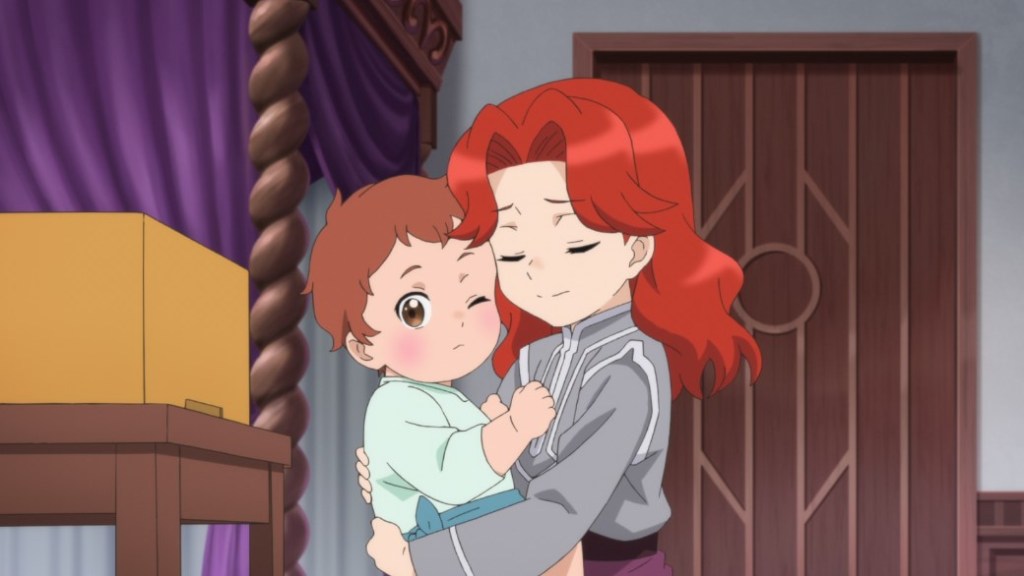
Duchess Excel Walter always came across as the sharpest and most potentially devious of Elfrieden’s Dukes, and she was the only one to fully scout out Kazuya when he first arrived. After seeing this episode, though, we may have been underestimating her. Saying that she was the single most important person in the kingdom for Kazuya to have on his side (even over Hakuya) would probably not be an exaggeration; I shudder to think what kind of machinations she could have gotten up to had she regarded Kazuya as unsuitable to rule.

And yes, having numerous lovers over 500 years, having children by many of them, and loyally staying with all of them until they died does legitimately make her an authority on love and so the perfect person to tutor Kazuya’s prospective brides. (It also raises some interesting questions, such as how long the fertility cycle is for her race, but that’s academic here.) This training has a lot of practical value and justification: it will keep the royal household peaceful, limit the potential for conniving individuals to make inroads, and help head off potential succession issues, like what tore the kingdom apart in the previous generation – no doubt something that Excel is keenly concerned about not seeing repeat. Having codified how Kazuya genuinely feels about each of the brides is also nice, though also a little unfair since Kazuya is not getting the same consideration from them. (And how that information was gathered was very underhanded.) However, there’s no avoiding how much of a harem dream scenario this long scene comes off as being. Other harem leads can only lament that their harems aren’t so harmonious.

Of course, all of that is kept light-hearted, as is most of the rest of the episode. Poncho reappears again just long enough to show that he has successfully produced a Japanese-style sauce. (I want to say that’s tonkatsu sauce, but I may be mistaken.) This is going to lead to further introduction of Japanese dishes, which seems to be a staple of isekai series these days; honestly, I’d love to see one of these where the protagonist learns to adapt to the food of his new world rather than try to recreate food from his old one. How that discovery seems to solve a problem is, once again, all too convenient. Maria’s conversation with Jeanne is also pleasant, though important for one thing: it shows that Maria, while she admires Kazuya, seems to have no marital intent towards him.

The one thing which doesn’t set well with me about this episode – aside from the erratic artistic quality control, of course – is the revelation that only eight months have passed since Kazuya took the throne. That everything Kazuya has done could be accomplished in a mere eight months (even if they may be a bit longer than eight months in our world – an interesting little detail) is absurd on a credibility-shattering level. Unless magic on the level of Cayna in In the Land of Leadale was somehow involved, there’s just no way all of this construction, planning, and social reorganizing could be done that quickly.

The saving grace here is the summons by Albert at the end. The series has always dangled some suggestion that much more may be going on with Albert and his queen than what has been shown so far, and revealing what that is seems like a fitting season-ender for a series which has not had substantial plot movement in a while.

ESTAB LIFE: Great Escape Preview

Streams: Crunchyroll on (normal day uncertain)

Rating: 2 (of 5)

Technically this is a Spring 2022 season title, but its first two episodes debuted more than a week early, so let’s take a first look.

Though he has directed a number of other notable anime titles (Infinite Ryvius, s-CRY-ed, Planetes, Maria the Virgin Witch), Goro Taniguchi may be best-known as the creator of the Code Geass franchise and last year’s Back Arrow. This new creative effort, which is being directed instead by Hiroyuki Hashimoto (Is the order a rabbit?, Magical Girl Raising Project, Classroom of the Elite), takes things in a different direction than his previous two efforts and represents his first partnership with Polygon Pictures, the studio behind Knights of Sidonia, Ajin: Demi-Human, and Drifting Dragons. So yeah, that means that this is an all-3DCG title. While the animation effort here is smoother than most, anyone who normally has a low tolerance for 3DCG in anime probably will not find the look of this one to be any more palatable.

That’s not the only barrier this title faces, either. Make sure you look up the premise on this one in advance, because nothing in the first two episodes explains why wards of Tokyo seem to be separated into walled compounds, why transit between them seems to be so forbidden that being an Extractor (i.e., someone who shuttles people between compounds on the sly) is a thing, or why things like a dog-human hybrid, a slime girl, or a magic-using former yakuza girl exist. Why a bunch of high school girls – accompanied by an AI robot and said dog-human hybrid, who seems intelligent but only speaks in “woofs” – are said Extractors or wear such cutesy outfits while doing their extracting can be chalked up to just “anime logic,” so let’s not dwell on that. Way too little of what transpires in these first two episodes makes sense as it is.

In fact, the whole production seems to be relying entirely on “Rule of Cute/Cool” to get by. Its bloodless action scenes do have some zing but are nothing special overall, the interactions between the girls is about as anime-generic as they come, and some of what transpires is just outright silly, and not in a good way. The story also conveniently overlooks how the Extractors get out of the messes they get themselves into; sure, they get their clients out through some ludicrous methods (a zipline from one of those grappler guns which seems to extend for a mile or more?), but how do they get themselves off the top of a high-rise that they have climbed up to through hostile security measures? For that matter, how do they so freely move from compound to compound when travel seems to be restricted? Yes, some things can be overlooked in the spirit of cool, but this series gets away with way too much.

Overall, this isn’t one that I can recommend on any basis.

Winter ’22 in Review part 1: In the Land of Leadale

The past three seasons I have done season-ending summaries for titles that I watched out. This season I am doing that in two (possibly three) parts between now and the start of the Spring ’22 Preview Guide on 4/1, as there are a few titles I want to talk about in at least a little more depth than a single paragraph reaction. This is the first installment, for one of the titles that have already concluded.

From the beginning, In the Land of Leadale was primarily – if not exclusively – distinguished by being a power fantasy isekai which featured a rare female protagonist. That never really changed, as even up until the last episode (#12), Cayna is still performing feats of magic that are jaw-dropping by any sense of scale in her new world. In fact, the power shenanigans going on here are so ordinary that this would fall in nondescript fashion into the ranks of the most generic power fantasies if Cayna was male. Nothing (beyond alcohol!) is even a slight threat to her, and nearly everyone she meets that is not a blatant bad guy quickly gets won over by her; despite her immensely out-of-scale power, no one seems even mildly threatened by her presence (excepting her “kids” when they have done something to piss her off, of course).

The one thing that saves the series from complete mediocrity is that it usually does not take itself seriously. I only read one novel of the source material, but the anime version of those parts of the story is distinctly more comical, and it gets just enough mileage out of the generally-light-hearted interpretations of Cayna’s antics to keep the series afloat. Much like the other major isekai power fantasy with a female protagonist – I’ve Been Killing Slimes for 300 Years and Maxed Out My Level – the series also usually has a laid-back feel to it, with an emphasis more on fun and familial relations than conflict. The only parts that ever truly gets heavy are the ones about the former player leading bandits and the zombified village, and while the latter incident does have long-term consequences, the writing barely dwells on the darker elements.

That aspect of the series is both good and bad, however, for it results in the series seeming directionless for most of its run. The only thing in the story even approaching an overarching plot is the mystery about how Leadale came be to be a “real-world” setting instead of just a game, but Cayna hardly dwells on that beyond trying to find and reactivate the towers of the other Skill Masters, which were abandoned when the game shut down. Even meeting other former players, and discovering that they ended up here at different times without dying, does not spark her curiosity to further investigate what happened, and deciding to adopt an orphan girl late in the season seems to put a limit on how much further she might bother to pursue the matter.

That sense of aimlessness continues until the very final scene of episode 12, where Cayna makes some comments which initially sound like standard fare for wrapping up a series. However, upon further reflection, those comments speak to the true purpose of the series. This story is not about Cayna going on grand adventures or trying to solve some big mystery; it is, instead, just about her getting to live a new life, one which she can actually enjoy. Getting a chance for a better life in a new setting is a common theme of isekai titles even beyond the anime/LN/manga sphere, but the real-world situation of Cayna’s never-named player is the grimmest of any isekai character you’ll find anywhere. Her life literally was the game, so getting to experience the game setting for real was the best possible outcome for her. As long as she’s doing what she wants and experiencing what this world has to offer, that’s all that matters to her, and that’s what the story is about.

Understanding that does not detract from the flaws the series has. The series will never be remembered for its artistic merits, Cayna is effectively a bully when it comes to her adult “kids,” Skargo is stupidly over-the-top, and the catty behavior of the werecat butler and maid towards each other gets annoying quick. However, the series does ultimately achieve its goal, so I can give it slightly positive marks overall.

Overall Rating: 3.5 (of 5)

How a Realist Hero Rebuilt the Kingdom episode 24

Rating: 3 (of 5)

So the Native Americans long shown in the opener have finally appeared. Only it turns out that they are not associated with the dragons after all, but rather are refugees.

In many respects, patterning refugees after a generic Native American motif is loaded with an irony that may or may not be intended. Assuming that the adaptation is sticking reasonably close to the novels, original writer Dojyomaru has shown before at least some familiarity with American history, so it is entirely possible that Dojyomaru knew just enough to recognize that Native Americans would be a fitting representation of displaced people. (The writer certainly didn’t put any effort into giving them Native American-sounding names, though!) The additional irony, if that is true, is that it makes Kazuya’s proposal to Jirukoma and Komain come across all the more harshly, and that, I suspect, was not intended. Granted, the circumstances here are fundamentally different; they were forced out of their homeland by the Demon Army, not the country Kazuya represents. Even so, I cannot imagine an American writer having the gall to present a scenario like this.

The proposal Kazuya puts forward to them is loaded with all sorts of implications independent of the cultural identity being borrowed here. (And to be clear, the borrowing only extends to general appearance and them praying to nature spirits. No other negative stereotypes of Native Americans are portrayed.) Refugees have been a problem throughout history and remain a thorny issue even to this day, as the opening narration dutifully points out; in fact, the timing of this is quite ironic as well, given the current mass surge of Ukrainian refugees resulting from Russia’s invasion of Ukraine. Perhaps because he is basing his decision on real-world refugee cases from the past several decades in his home world, his solution to the problem is direct and blunt: the refugees must either formally join the country or leave. Allowing them to exist within Fredonia’s borders while they still maintain intent to eventually return just leads to problems which can last for decades, problems only exacerbated when new generations appear with no direct ties to their parents’ homelands. Essentially, he’s telling the refugees that that there’s no place for them if they will not integrate.

Of all of the decisions that Kazuya has made so far, this is the one that I can most see having long-term negative consequences. Jirukoma leading those unlikely to integrate off to fight against the Demon Army seems like an unrealistically convenient simplification of the situation, one seemingly-designed to eliminate problem cases before they happen, but that feels like too simple a solution. And the series is not subtle about driving home its point with the difficult birth of a refugee child, an incident which itself might intended as symbolic.

About that problem birthing, the stats used here are essentially correct. Some form of caesarean section has existed for millennia, but prior to the late 1800s the mortality rate for the mother was so high (as much as 85% by some estimates) that it was typically only done in desperate circumstances, such as when the mother was dead or would likely die in childbirth. Some of the steps described here are considered key ones in reducing the mortality rate, and real-world attempts certainly don’t have the benefit of light magic as an assist. (I do have to wonder, though, how familiar the people of this would be with blood transfusions, as this has not been brought up before.) In addition to (somewhat awkwardly) hammering home Kazuya’s point about refugees, the birthing also provides a convenient opening for Liscia to get on Kazuya’s case about working towards a baby of their own. Really, why is he so reluctant about this, other than the meta logic of being the “good guy”?

Overall, like the last episode, this one plays out much too unrealistically conveniently to be fully appreciable, and the artistic effort only seems to be getting more unstable. At least there are still two episodes remaining (this one is set to run through April 3rd), so hopefully the series can manage a stronger seasonal finish.

86 episode 23 (finale)

Rating: 5

With episode 21 having provided the action climax and episode 22 providing the dramatic climax, all that’s left for episode 23 to do is provide the epilogue. But as with any grand story, a proper epilogue is an absolutely essential element. It may not have the drama or intensity of earlier content, but it must bring together and finalize the story threads to that point. Episode 23 isn’t completely perfect on that front, but it comes so tantalizingly close, and has so many wonderful little touches, that it makes for quite the satisfying finish nonetheless. I am left with no regrets about naming this my #1 series of 2021.

None of that quality comes from any big surprises for the viewer, because there aren’t any. Even if a meta take on the series did not dictate it, that Lena would comes to the Giad Federacy and be reunited with Spearhead Squadron was all but outright said from the early stages of the episode. However, the way that gets handled matters, which is why “Handler One” is the perfect title for the episode. (In fact, it is the only reasonable choice for the title.) On the surface, that title refers to Lena actively returning to the picture, but it means so much more in execution. Despite Shin’s talents, the surviving Spearhead Squadron members would not have gotten out of the Republic alive without her as their Handler, and the fact that they do not hesitate to agree to work under her again is a tacit acknowledgement of their respect for both what she did then and how she survived since then. Her title as Handler One also becomes irrefutable proof of their identities when they finally meet face-to-face.

If the structure of the episode seems a little odd – with essentially two separate end credits scenes – that’s because the production team opted to adapt both the novel 1 and novel 3 epilogues mostly independently rather than fully merging them. The first part is a fleshed-out adaptation of the novel 3 epilogue, which was originally done from the viewpoint of the 86s. The Christmas scene, those of the other 86s doing various normal things, and the scene about Shin retaining his mark are anime-original, but the scene in Ernst’s office and the graveyard scene are straight from the novel; it carries decidedly more weight in this version, though.

As well-handled as the 86 side was, the part I was more waiting for was Lena’s side of the same time frame, which adapts the novel 1 epilogue. In showing the state of the Republic in the wake of the Federacy’s rescue operation, it carries a lot more impact. It reveals that the Republic got crushed in just a week’s time, and only barely hung on thanks to the efforts of Lena rallying the 86s and like-minded Alba officers. The strong implication pitched by the visuals is that it took devastation on a massive scale to break the genocidal ways of San Magnolia, but as the soup kitchen scene shows, even that is not going to bury deeply-ingrained racist tendencies; one needs look no farther than the U.S.’s messy (and some would argue ongoing) history with racism to see how painfully realistic that is. The imagery used to show this – from the ruined monuments to the altered slogans and graffiti to very-ironic wreckage of Juggernauts on the damaged war memorial way, to even the open presence of 86s everywhere in District 1 – is beautifully-chosen, though the wreckage of Lena’s bedroom had the most impact for me. It symbolizes what she is leaving behind, with her carrying forward the one thing which is truly important to her. The pictures of her superior posing with uncomfortable-looking 86s, and the way they are blatantly placed to convince any visitors that he’s changed his thinking, also was a biting touch; even the cat seemed to recognize how disingenuous he was.

What struck me most while watching the scenes leading up to the climactic reunion was the sense of parallelism the story displays. Each side has a scene of characters coming home, having lighter and more casual moments with friends, and a more serious office scene about what’s to come in the future concerning the planned independent mobile force. Each has the featured co-protagonist visiting a grave in a graveyard, then later visiting the memorial for Spearhead Squadron’s Juggernauts, and in the latter case, each scene showed the featured character stepping away – and thus stepping forward – from the same floor-level angle. Each also very deliberately shows how the protagonists have changed. Despite her soft look, Lena has a hardened and more determined core, while Shin can actually smile and enjoy things for a change; that he can now cook was a neat symbol of that, even if it was played more for humor.

All of that beautifully sets up the epilogue of the epilogue, where the 86s and Lena finally meet face-to-face. That they are able to meet like this is the full culmination of the story to this point, and it was every bit as satisfying in execution as I had hoped. My one slight complaint might be that they gave the scene a little too much play, but again, the details more than make up for that: the signs on both Lena and Kurena’s faces that they had been crying, for instance, or the way that Fido’s recording called back to a similar sequence back in episode 10. The way the video did the montage of Shin running forward at three distinct ages, or how the very brief upside-down shot of Lena walking towards Shin’s damaged Reginleif in episode 22 is transposed with her walking to meet them in the final scene. The way the other 86s giggle when Lena clearly doesn’t recognize them, and the way the expressions of both Lena and Shin change.

The details and symbolism shown in other ways as well. Railways have been used throughout the series as symbolism for what direction the characters are going, and now the railway leads directly to the six standing together. Even the shots of the birds flying away carry extra meaning; the end of episode 11 showed five flying together, but now there are six. Lighting tricks are also use quite effectively throughout, and Willem beeping back at Fido while the other two Federacy officers give him funny looks makes for a neat humor touch. The only other complaint about this episode is that the artistry is a little shaky in certain scenes (especially early on), but again, the does so well on so many other fronts that that can be overlooked.

This episode concludes the adaptation of what I consider the strongest part of the franchise, so where will the story go next? Various scenes here give at least some indication on that. Lena, now reunited with Spearhead Squadron, is going to work with them as a special unit to deal with special threats posed by the Legion, who have taken substantial losses but are hardly defeated. Currently six more novels are available in English, with two more available in Japanese. At the slow adaptation paces used so far, that means several more seasons could be done. No break point as significant as the end of novel 3 exists past this, though (at least not through novel 8 – I’m reading 9 now), so any future seasonal conclusion won’t be as satisfying. Still, this series already stands as a model for how a light novel adaptation can do its series justice, so I will eagerly welcome any future continuation.

How a Realist Hero Rebuilt the Kingdom episode 23

Rating: 2.5 (of 5)

To a certain extent, oversimplifying how characters deal with certain problems is a practical issue necessary for anime series (especially fantasy series which work on an epic scale) to function. They simply do not have time to deal with all the minutiae of how grand processes and big story movements work (excepting stories like Ascendance of a Bookworm, where the minutiae is the whole point); otherwise they just get bogged down in the little details and become boring. Because of this, Realist Hero has always gotten a certain amount of leeway from me on how it accomplishes some of its reforms. This episode, however, is where the series finally stretches practical credibility beyond the breaking point. That’s why I am rating this episode lower than most.

To be sure, the goal here was a noble and worthy one, especially after the Machiavellian tactics Kazuya had been recently resorting to on other fronts: clean up the slums and reform them so that the poor in general (and not just slaves) have more opportunity. And as the sojourn of Kazuya’s party into the slums shows, he has certainly accomplished that. Things have been cleaned up, decrepit buildings have been torn down and replaced with small but free housing, locals have been put in charge of keeping the slums clean, and programs have been instituted to promote healthy habits. In fact, the whole situation is practically an ideal. We are not given any sense of time frame here, but the implications is that all of this was accomplished within a relatively short period of time.

And that’s a big part of why none of this is even slightly credible. If cleaning up the slums was this easy or could be done this quickly, it would have been done by all rulers that care a bit about their populations. Also, where did the financing for this grand plan come from, especially in light of having to deal with absorbing Amidonia? Even if the benefit is ultimately a big one, it had to be a very expensive plan to institute. At least the story covers the “buy-in” part of it by used a three-eyed race who can see pathogens to convince people of the existence of germs and bacteria, but even that comes off as and all-too-convenient work-around. Yes, there is a refugee camp that is causing Kazuya some consternation, but even the problems there are coming from the outside.

In fact, the only part that was at all realistic was his progression on combat skills. Yes, he has been doing some training, but even if it’s for months, he could hardly be realistically expected to be competent at swordplay yet, especially since he cannot be spending so much time at it. Here he looks like the classic beginner, so proud of accomplishing one basic move that he is unprepared for follow-up attacks. At least this is the one thing whether others can put him in his place on (his scolding from Liscia was well-deserved), and that scene saved the episode from being a total letdown. Still, with the continued shakiness on its visual quality control, this series has some work to do to shine again.

86 episode 22

Rating: 5 (of 5)

86 is finally back for its final two episodes, after its nearly three-month hiatus. Perhaps partly as an apology for the wait, the series delivers the finest and most emotionally potent episode of its second half. And a lot of that has to do with Lena finally being back in the picture, to the extent that this episode shows why the series works best when both are involved.

The episode is titled “Shin,” which is fitting because it serves as the climax to Shin’s personal journey through the second half – and really, the series as a whole as well. While the other 86s seemed to adjust relatively well to life in the Giad Federacy (even if they did ultimately opt to return to the battlefield), Shin never did. The combination of his ability, experiences, and personality have left him haunted and directionless. He can try to deny that the dead have no place and no voice among the living, but he cannot move past them himself. When he tries, he see nothing ahead of him – no point or meaning to moving forward. He is the Undertaker, the one who made sure that those who had died were not forgotten, but even his fellow surviving 86s – even Frederika, who understands him better than anyone else in the Giad Federacy – could not ease that burden or give him purpose, and it weighs even more because, as far as he knows, the few who had stayed with him are now dead. How could he not mock himself?

But as the first half showed, and the second half occasionally reminded us, there was one person he seemingly made a deeper connection to, even if he didn’t acknowledge it: Lena. Unlike with the 86s, he inspired her not to be comfortable with dying, but to live, and that was something he never appreciated before. She also was someone who would remember him. Shin desperately needed to understand both, which is why the scenes where he first recognizes her voice and then gets a verbal confirmation directly from her about the impact he had on her carry such an emotional punch. Lena isn’t dead after all, but rather a much stronger person for her efforts to pursue the 86s formerly under her command and reach the place that they reached, even if she also believes them to be dead. That admission – that acknowledgement – is what he needed to hear, and who he needed to hear it from, to finally be able to move on, as symbolized by the fragment from his brother’s Legion falling out of sight as the music hits its crescendo.

As dramatic execution and symbolism goes, this scene was everything that I had hoped it could be. The two seemingly-permanently parted ways with Lena in the midst of blossoming red spider lillies, which can symbolize death and separation. However, they can also symbolize both rebirth and star-crossed lovers, and having their reunion (such as it is) in a field of such flowers packs both meanings here. Lena first speaking silently, with Shin getting only subtitles (presumably because of a bust external mic) was a neat touch, as it allowed her instantly-recognizable voice coming over the Para-RAID to have much more impact, and using the white filter bars at the top and bottom of the screen gave the scene a greater feeling of intimacy. The sun emerging from behind the corner of the Reginleif as the scene builds to a crescendo was also a fitting, subtle bit of symbolism.

But the best part, unquestionably, was Shin’s changing expressions throughout the scene. He’s never been an emotive character, and while his stoicism has, at times, been a negative, it gives the flood of emotions he shows here all the more impact. The animation quality shown throughout demonstrates that the issues the series occasionally had back in November and December are now a thing of the past, too, and the musical choice for the crucial scene was outstanding. (And yes, the fact that Shin did not recognize Lena on sight is consistent. Just like Lena never actually saw his Undertaker logo, no one but Raiden among the 86s ever saw her face.)

The way the anime episode handled this content is a bit different in places than in the novel, and the first third or so of the episode was definitely padded out. However, nearly all of the choices here – including adding a scene from early in novel 4 as the credits scene here – were good ones. The only move I slightly disagree with is adding the last Legion that Lena (or, more likely Cyclops) blew away as it approached Shin’s damaged Reginleif. That felt like an unnecessary bit of extra drama. I did also like some of the little background touches, like the way Cyclops reacted when Lena handed over her gun to the Giad forces. The one other minor complaint on details is how Lena’s seemingly-smudged face seemed to clean up as the episode progressed. Whether Shin’s decision not to press the point on identifying himself to Lena was correct is more debatable, but in a storytelling sense his logic – that the proper reunion should happen when she’s reached their final destination, not on this battlefield – makes sense.

The stopping point of the episode is at the end of novel 3’s last chapter. All that is left is the epilogues to novels 1 and 3. The next episode’s title – “Handler One” – suggests that the finale will focus more on Lena’s viewpoint (i.e., novel 1’s take) on the common ending of both novels, but that’s perfectly fine, since it should also fill in some on what’s been happening in the Republic up to this point and what comes next for the Republic. That should make for a highly satisfying conclusion to this series, and I heartily look forward to it.

86 special: Episode 21.5

Frederika, observing Kiriya’s final moments

After more than two months off, 86 is finally returning this Saturday (March 12th) and next Saturday (March 19th) for its two-episode finale. So, naturally, that means yet another recap episode precedes it.

This time, though, I will begrudge the production team this recap. It does not provide any new content beyond somewhat in-character narration by Seiichiro Yamashita (the voice of Raiden), instead being just a collection of scenes from episodes 18-21, with the heaviest lean on episode 21. However, as recap episodes go, it’s done pretty well, concisely summarizing the moves and emotions which brought the series to its cliffhanger ending in episode 21. It provides a good primer to refresh your memory on important details before watching episode 22, should you not have time to go back and watch the individual episodes as a lead-in.

Naturally, I will be commenting on episode 22; it will, in fact, be my priority for the day, which may delay Realist Hero a bit more than normal in getting posted. Look forward to it!

Other Series I Am Following:

Have not done this commentary for a few weeks, so this short write-up seems like the ideal place to update on a few titles. They are in order by when they air during the week.

Demon Slayer: Entertainment District Arc – Damn, those were some impressive battle scenes. The overall story could be stronger, but at least Nezuko got some opportunities to shine. Now we get to take a breather for a year or two to wait for the next arc to get animated.

Attack on Titan Final Season – At this point the series is up through episode 84, and the last few episodes have been one hell of a ride. Aside from the occasional odd tonal blips (dammit, I liked the scene where Conny’s first reaction to seeing post-thaw Annie is to laugh at her stuffing her face), this has been heavy stuff thematically, but the series is better for it. Characters on both sides have committed atrocities (an all-too-common occurrence in warfare, unfortunately) and the series is neither trivializing it nor allowing easy justifications as ways out. The survivors of the original cadet corps (minus Eren, naturally), the Marleyans, and even some of the former Jaegerists all have to find a way to work together to stop Eren’s mass genocide, each for his own reasons, and that won’t come easily. The big revelation here was how Marco ended up getting eaten, and that was just the capstone of a beautifully tense episode. Really, unless this series miserably fails its finale, I don’t see how it cannot be the series to beat for 2022’s Series of the Year.

Princess Connect Re:Dive Not every light-hearted series can pull off the kind of serious turn that this one is trying to do in recent episodes, but I like the approach this one is taking. Finally the bigger story – i.e., multiple recyclings through similar settings and events, though to what ultimate end is still unclear – is starting to coalesce, and even Pecorine is mustering up the courage to be frank about her real identity. This series has always looked good, with some surprisingly fantastic action scenes in recent episodes, but now it’s becoming genuinely compelling, too.

Sabuki Bisco – On the other hand, this series is going in the opposite direction. Frankly, I have de-prioritized it so much that I have come close to dropping it. It’s not that the series is necessarily doing anything wrong, but nothing about its plot or characters is grabbing me. Unless it finds some kind of better spark, I will be coasting on it into the end of the season.

The Genius Prince’s Guide to Rising a Nation Out of Debt – Still finding this one quite enjoyable, and seeing Falanya getting more actively involved in the most recent episode – to the point of becoming the focal point character – was a pleasant surprise. This one I can get enthusiastic about, although it’s still not the most fun series even on its release day.

Life With an Ordinary Guy Who Turned Into a Total Fantasy Knockout – Yeah, this one is still easily the most enjoyable series of this season. Every episode had been a lot of fun, and it’s still a priority view. The recent notion that Jinguji is Tachibana’s “special weapon” is terribly amusing, and that was far from the only bright point in the last couple of episodes.

In the Land of Leadale – Recent efforts to introduce other former players and delve at least a little into the backstory of how Leadale came to be this way have piqued my enthusiasm for a series that I was only largely coasting through before. Hopefully this will be the start of a trend, but I can also easily see the series just reverting to Cayna’s OP antics.

Arifureta 2 – It is what it is. The MC still annoys me, but I am finding the series just entertaining enough to maintain interest. The prospect of a bigger plot playing out and Hajime finally running into a tough-looking foe have gotten me a bit enthusiastic, and the production effort is a distinct upgrade from the first season. Will almost certainly finish this one out.

World’s End Harem – Been a while since I’ve seen a series glory so much in being trashy as this one does. . . Oh, wait, I only have to go back to last winter’s Redo of Healer, don’t I? Frankly, the series is not worth watching censored, so this is the rare case where I recommend hunting down an uncensored version if you’re going to watch it. And damn, Doi has turned into quite the little monster, hasn’t he? The recent plot twist has gotten me a little more interested, and I am still curious to see what is really going on behind the scenes, but this is still trash. . . and I will continue to watch it nonetheless!

Yashahime – Too bad the weekly episode reviews on ANN ended, as I feel that this half of the current season has generally been stronger. Nothing glorious here, and Kirin turning into a quasi-villain is disappointing, but the cast is still plenty likable enough.

My Dress-Up Darling – This one came into the season with a lot of fanfare, but even so, how much I’m appreciating it is still the surprise of the season for me. Marin is adorable as she deals with the prospect of being in love with Wakana, and I am even appreciating the regular fan service moments, but the scene of deeper meaning and subtle commentary about cosplaying are appealing to me more and more. This is one of the season’s better-constructed series overall.

How a Realist Hero Rebuilt the Kingdom episode 22

This series has always been deliberate and thorough at examining economic issues for its fantasy setting, so I suppose that it eventually getting around to dealing with a thornier issue like slavery shouldn’t be a surprise. What I did not expect was that the series would take a mostly bottom-up angle on the matter.

To be clear, I generally don’t have a problem with fantasy anime series using slavery, especially where contextually appropriate. Throughout the history of human civilization, slavery or its approximate equivalents (i.e., serfdom in some feudal settings, helots in ancient Sparta, and others) has been a widespread institution, with cultures across the globe using it to some degree or another; not until the 1800s did it fall out of favor world-wide. In most cases where it appeared, slavery had a substantial or even critical impact on both the economy and social structures, as well as providing a convenient way to deal with convicts and prisoners of war. Even more advanced civilizations (like the Roman Empire) used it widely and depended on it heavily, to the point that over a third of the population of Italy around the end of the first century BC was estimated to be slaves. (Also notably, early Christianity opposed the ill treatment of slaves, but not the institution itself.) Hence slavery not being present to some degree in this world’s setting would have been odd. I really only have a problem with slavery depictions in anime if they are being used in a fetishistic fashion outside of S&M scenarios.

Up to this point, though, the series has largely danced around the matter, aside from Carla being relegated to slave status as part of her punishment; I think it was mentioned once or twice in the first half, but the series has done little to actually depict it prior to this episode. Here the writing clarifies that slaves in Fredonia nominally have some rights and protections, though in practice they can still be mistreated quite a lot. (Even so, that’s still on the enlightened side as slavery goes throughout history.) Rather than focus on Kazuya’s efforts to reform the system, the story features a young man who has inherited a slave trading business but decides to shut it down in humane fashion since he doesn’t have the temperament to run it. He comes up with the idea of treating the slaves he inherited well and educating them, both to make them more attractive for purchase in general and to assure the likelihood that they will be picked up by more responsible new masters. The irony is that this coincidentally dovetails exactly into Kazuya’s efforts to reform promotions of knights and nobles by connecting it to governance, which hence requires more educated staff – which thus makes educated slaves much more valuable.

The story perhaps softens and oversimplifies the realities of the situation, but I did like how Ginger Camus’s actions were shown to start a trend, and how that brought him to Kazuya’s attention (through Roroa) as the kind of person he would want to have working for him. It almost turns the whole scenario into a moral lesson, but the series can be forgiven for that because sometimes actions like this are all it takes to start a trend of common decency. I can also appreciate Kazuya being cautious about how he goes about getting rid of slavery. He uses the example of the American Civil War to explain how directly abolishing an institution deeply-ingrained to local economics can have violent consequences (even if that may be the more moral thing to do), so he opts for a path towards gradually phasing it out instead.

There are a number of potential problems with this approach that Kazuya’s plan is still glossing over, however. Educating slaves so they can get proper jobs is all well and good, but the economics of paying for labor, rather than just purchasing it up front, also has to be worked out, as will situations like how San got sold into slavery (i.e., by being sold off by family to cover a debt – an altogether common occurrence in many societies which have used slavery in the past), and the economy will have to adapt. Also, can such resources be devoted to slaves if underlying problems like poverty are not dealt with first? (In other words, are the poor also going to get educated to this degree?) Finally, changing attitudes about slaves will not be so easy; granted, this is not a situation like the American South, where slaves were all the same race and thus visually distinct from the regular population, but even so, changing the attitudes of some towards slavery may take generations. But at least the series’ heart is in the right place.

The one production criticism here is that the series is, once again, seriously skimping on animation. Quality control is rough in numerous scenes, and the episode uses just about every animation shortcut imaginable without being too obvious about it. In general, though, the episode handles the whole matter about as well as possible, and I do hope that Ginger and San are shown together in future content.

How a Realist Hero Rebuilt the Kingdom episode 21

Rating: 3.5

Last week I made a number of suppositions about why Roroa appeared before Kazuya and offered to become his wife and why he would probably accept the offer. This episode proved virtually all of those suppositions to be correct, even the ones about how Roroa still planned to continue her mercantile practices as a (sub-)Queen, just behind the scenes. Even though I have not read the novels or seen spoilers concerning Roroa, though, I cannot take any credit for prescience here. This series has always unfolded in a very methodical way, so none of those reasoning by Roroa were hard to predict.

If there’s even a slight surprise to Roroa’s actions, it’s that she seems more enthusiastically lovely-dovey with Kazuya than expected. This is the one place where the scenario feels like a pure nod to standard harem anime tropes: she is the Aggressive Newcomer, the one who shakes up the staid status quo of the existing love interests by coming on hard rather than just passively waiting for the protagonist. No, she has no chance of supplanting Liscia as #1, and she is clear that she is not interested in that, but that gives a prod to Liscia in particular to get more motivated about actually pushing Kazuya to fulfill the part of his kingly duties that he has been neglecting so far. (Apparently they did not ultimately have sex in the previous bed scene.) I also do find it slightly amusing that the one place where Kazuya defers to anyone else on decision-making – on choosing whether or not to take on additional wives – is the one place where he probably shouldn’t. Sure, it could be called considerate to Liscia, but it also forces Liscia into the role of Harem Manager. (Actually, the first wife managing the others isn’t at all an uncommon arrangement in polygamist households in other cultures.) Kazuya is just lucky that Liscia is so practical-minded about it.

The conversation with Roroa goes on too long, but that’s par for the course for this series. The extra length does at least bring up a future potential problem spot: the Orthodox Papal State. This group has been mentioned before, and the discussion about how they would take advantage of the collapse of Amidonia – and how they could continue to be a thorn in Kazuya’s side even with the annexation of Amidonia being recognized – is interesting. That almost offsets how awkward the static positioning of Liscia is throughout that whole scene.

Most of the rest of the episode is more talking, this time the long-awaited magical Zoom call between Kazuya and Empress Maria (via Gemstone broadcast). The annexation of Amidonia into Elfrieden to create a new state – the Kingdom of Friedonia – certainly necessitated this, since it does, on the surface, seem to fly in the face of both the treaty and all of the earlier diplomatic efforts by Jeanne. However, Kazuya correctly points out the flaw in the treaty: a situation like this, where the people push for a new political situation despite the treaty. Kazuya is clearly using the Cold War between the capitalist Western countries and the communist Eastern countries during the mid-to-late 1900s to illustrate his point, and I believe he may be referring to Yugoslavia, and how it fell apart in the 1990s, as the problem case which illustrates his point about Amidonia exercising self-determinism.

Sadly, the episode falls back on more typical harem hijinks at the end; the series seems unable or unwilling to fully step away from this, even though the story does not need it. Stunts like this are the main reason why I am not giving this series higher grades, even though I like what it is doing otherwise. (Well, that, and the shaky artistic quality control in several scenes.) And yeah, Kazuya, best not keep Liscia at arm’s reach for too long, even though your reasons for doing so are somewhat understandable. If you’re accepting the role fully now, every part of the role needs to be accepted.