Back in March I did a look at non-Japanese isekai stories based on their audiobook versions. Audiobook listening has since become an almost daily activity for me (and a staple on lengthy drives), and I have continued to mix a fair number of non-Japanese isekai series in among audiobooks of light novel series. Hence it’s time for a second round of looks at assorted isekai options on audiobook, though this time with some Japanese-originating material mixed in.
Concerning Readers: One thing I have increasingly noticed is that reading an audiobook is its own kind of art form. Not every voice actor can pull it off, but the ones who are good at it can really enhance the source material, even to the point of making it more engaging than it would be to read. AI read-alouds are becoming a thing, and I could see them being a boon for vision-impaired individuals, but at this stage AI readers are not even close to being dynamic enough to enhance the experience the way a good human reader can. (A few years down the road, though, this may no longer be true.) All of the ones I am reviewing here did have human readers, so each title will get both a Content and a Reader grade.
Fallen Lands
Author: C Peinhopf
Reader: Charlie Keegan James
Volumes: 3 (so far)
Series Rating: B
Narration Rating: A
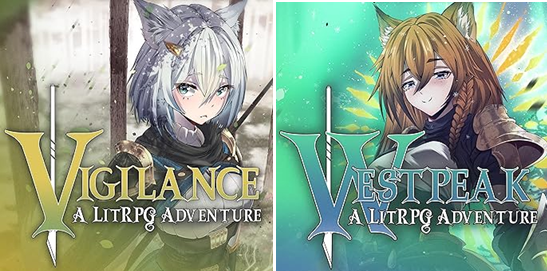
At the time of this writing, this independently-published series consists of three progressively longer novels in print form, though only the first two are yet available in audiobook form. (The third novel was released in print/eBook form on 11/11/25, so it should be just a matter of time for the audiobook.) That makes for roughly 34½ hours of audiobook for the first two. The artwork shown above is for the audiobooks; the covers for the print/eBook versions are dramatically different and decidedly darker in tone.
In the story, Evelyn was a young woman from Colorado who was in the process of moving to California to attend college when she was stolen away to another world in very traumatic fashion. She finds herself in a new body that’s chained to a sacrificial altar, along with several others. He new body isn’t human, either; she’s a kitsune, which she later learns is a near-mythical spirit race in this world, but more immediately relevant is that she can turn into a fox, which is instrumental in her escape from a chaotic and bloody situation as whatever ceremony the demon cultists were trying to conduct goes amok. She soon discovers that she is deep in the hinterlands of a world where demon invasions have pushed humans and human-like races back and that the process which brought her to this world has (entirely unintentionally, she later learns) made her a hero that the world has been praying for. She eventually meets up with a female ranger who takes Evelyn under her wing, shows her how to be an adventurer, and helps her find the twin she remembers seeing in the room with the altars, whom she discovers was also originally from Earth and is a hero, too. Though she and Amelie (her red-haired/furred twin) eventually are taken in by a noble elvish family whose elderly leaders recognize them for what they are, both find themselves driven to be stronger and are not at all content to just be young noble ladies. Not that circumstances will allow them so simple a life when devils who still have a purpose for them come calling.
In most respects this is a standard LitRPG set-up, one which leans heavily on a game mechanics-like System (which we later learn was set up eons ago by the gods of this world to bolster humanity against inhuman threats) which duplicates various features of fantasy RPG play; the differences between this and some other similar settings are that not everyone in this world is a “classer” and that Evelyn initially has difficulty learning about how all of this works, since this System is far less user-friendly than most. (And when she does eventually gain a spell which allows her too look up information on System topics, the results are delivered in a curiously idiosyncratic fashion rather than the dry, mechanical reads normally seen with System voices.) Both novels are heavy on action and exploration elements, and battle scenes can turn very messy and even decidedly gruesome at times, though they are well-executed and vibrantly-described. The latter part of the first novel does also include some content on Evelyn and Amelie getting integrated into noble society (with their identities as heroes being hidden). That gets swept aside by the circumstances which set up the second novel, though the advertising blurb for the third novel suggests that it will return.
Little about the setting is strikingly distinctive outside of certain exotic monster designs, and one of the bigger negatives about the novels so far is that the world-building is a slow, drawn-out process. It’s almost frustrating at times how long the novels take to get around to explaining some important points, and there are some events which happen early on which only make sense much later, when the reader has much better context for what was being described. This wouldn’t be so much of a concern if the writing had put more effort into showing Evelyn thinking that through, but it tends to jump from Evelyn not understanding at all to having it figured out completely. On the upside, the nature of kitsune in this setting is rather interesting, as are the way spiritual elements are handled and some later revelations on why some things in the world are the way they are.
Despite the novels’ flaws, the story is more than carried by its protagonist. Evelyn is a fun and fully engaging character as she struggles to survive, come to terms with her new life, grow, and do what she feels needs to be done; she doesn’t specifically strive to be a hero (unlike Amelie), but her actions wind up being heroic nonetheless, and some of her most important triumphs are sheer exercises of will and determination rather than battles. She can be a berserker in a fight but also playful and sarcastic, too, especially once Amelie comes into the picture. The addition of Amelie provides the series by far its strongest character interactions, as both girls quickly come to see the other as sisters even though they come from different backgrounds and circumstances and look at their current situation differently. Another girl also becomes a close friend of Evelyn’s in the second novel when Evelyn and Amelie are separated for a while, but the bond is nowhere near as strong. The story is definitely at its best when the twins (actually part of a set of triplets, we later learn) are together.
That being said, the series’ strongest merit in audiobook form is the outstanding performance by its reader, to the degree that audiobook form is the recommended way to experience this story. Ms. James vividly brings Evelyn and Amelie to life and capably uses an array of different accents (Amelie was French on Earth, elves are British, other characters have Scottish, Australian, or even Russian accents) to help distinctly differentiate characters, and she convincingly wrings out every bit of emotion in the story without ever crossing the line into camp or exaggeration. She even manages well with male voices, too. This is easily one of the best audiobook performances I’ve heard to date, and this story might only be half as entertaining without it.
While the first novel ends on a cliffhanger, the second ends with the very dramatic conclusion of both a major goal for the setting and the conclusion of a story arc, but also indicators that even bigger forces have been set in motion by those actions. That leaves plenty of hooks for going into the third novel, and I’ll definitely be back once it makes it into audiobook form.
Summary – Strengths: Reader, protagonist, descriptions of action scenes and other dramatic confrontations.
Summary – Weaknesses: Erratic and slow on world-building, leans heavily on RPG-like elements, doesn’t describe well how the protagonist figures some things out.
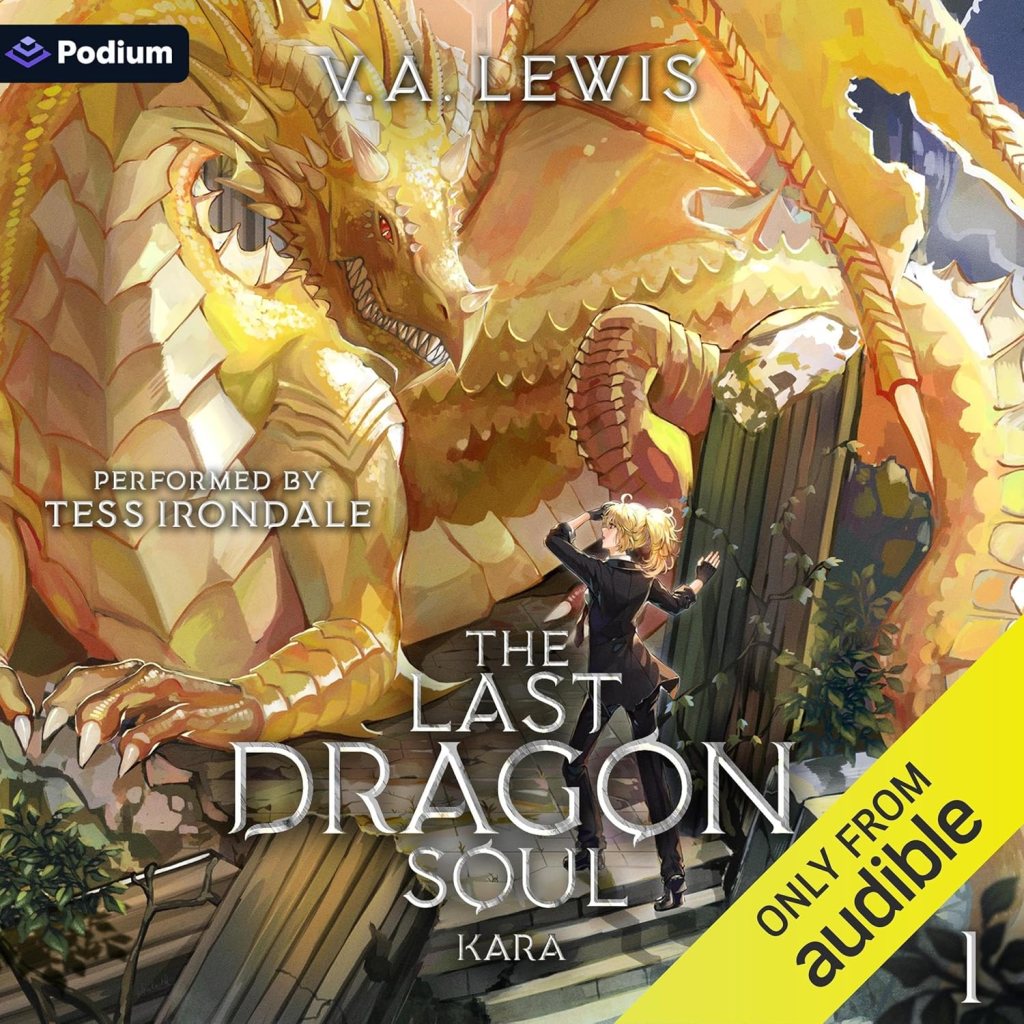
The Last Dragonsoul: Kara, Book 1
Author: V.A. Lewis
Reader: Tess Irondale
Volumes: 1
Novel Rating: B
Reader Rating: B+
This self-published novel (apparently only available in audiobook or eBook form) appears to be the first in a new series for prolific author V.A. Lewis, who’s done a number of other series in the isekai LitRPG vein. While it’s advertised as “Book 1” and was clearly not written to be a standalone, a follow-up has not even been advertised (much less released yet in any form) as of December ’25.
The novel on its own does sufficiently establish its premise, setting, and titular character, however. Kara was a young woman from Earth preparing for her first day in a corporate job when she suddenly found herself in a monster-infested set of ancient ruins high atop a mountain range. She shortly encounters the entity who summoned her there: an ancient dragon, possibly the last of his kind, who wished to pass on his power to someone before he expires and doesn’t trust the humans of this world (who are partly responsible for him being on Death’s door). Kara needs that power to survive in this world, so she reluctantly agrees to take on his dragon soul, which will give her increasing abilities as she evolves it. She then sets off through the vast mountain range on a quest for civilization, dealing with assorted threats along the way that include monsters, golems, dangerous flora, magical storms, and even a robotic entity who seems to know about her and is curiously insistent on having her meet the mysterious Soul Master – whether she wants to or not. She also picks up a traveling companion in the form of a young, sentient bear. (The bear doesn’t talk, but is clearly intelligent and even eventually becomes able to use magic as well.) There are also unsettling signs that some force has been going around wiping out any bastions of civilization in the mountains.
Eventually Kara and the bear Angel find their way to one of the last remaining “sanctuary cities” in the mountains: a dark elf metropolis that’s mostly underground. There they make new friends – a dwarf smith/innkeeper, a dark elf prostitute, an elf archer, a female troll food stand operator, and a minotaur tailor (the latter two of which turn out to be former lovers!) – and tenuous allies and enemies in a city that’s full of refugees but has only one other human besides Kara present, and he’s a villain. Trouble eventually finds Kara even there, though, as the force responsible for wiping out the other towns and settlements she found comes calling. Fortunately she’s quickly learned to always be ready for a fight, and her unique status as a dragon soul possessor makes her one of the most powerful beings around.
If you favor settings where the world’s ground rules are firmly established early on rather than gradually metered out, this one may be more to your liking than The Fallen Lands. The most interesting aspect here is a major twist on the standard “fantasy world with a governing System” gimmick: the System does exist, but only for humans (other than Kara), and specifically as a mechanism to allow humans to use magic. There’s even backstory up front about how that came to be, so that’s not treated as a core mystery in this case. That sets up an intriguing potential conflict between different fantasy world mechanics, since the evolution approach that monsters and dragons undergo is utterly different and demi-humans like elves, dark elves, orcs, and trolls advance by improving their cores through a leveling-like method that isn’t part of the human’s System. And then there’s the Soul Master and his robotic minions, too, which may represent a fourth set of rules. The minimal presence of humans in the first novel unfortunately limits the opportunities for these system to clash, but this offers vast possibilities for future novels.
While Kara isn’t as distinctive a protagonist as Evelyn from The Fallen Lands, she does well enough as a confident but also compassionate young woman, one who won’t hesitate to take action and can act quite boldly when needed. While Angel is her longest-term companion and can generally get his point across well enough without talking, that does limit his personality development. The writing somewhat makes up for this by more fully developing the talkative, congenial elf archer and especially the dark elf prostitute, whose progression into learning self-worth and self-confidence from associating with Kara is one of the novel’s highlights. Other recurring characters impress less but still contribute to an overall well-rounded cast.
The novel also excels at staging and executing a diverse variety of action scenes – and, importantly, Kara’s not the only one who gets to show off in them (even if she does get the lion’s share of attention). The writing also does a reasonable job of providing her escalating challenges and forcing her to get creative rather than just power through everything. On the downside, the mechanics of the setting do still lean on RPG influences, even if it’s not done as heavily as many other LitRPG titles, and parts of this very lengthy (over 22 hours of play time) novel drag a bit, primarily because the writing keeps too many things going on at the same time.
No complaint about the reading job, though! Ms. Irondale capably handles all of the different voices and personalities, including the slow and ponderous speaking style of the minotaur tailor (actually this seems to be the speaking style of minotaurs in general, not this character) and generally paces the reading well. Her reading isn’t as emotive as the job done in The Fallen Lands, but that may partially be the fault of less emotive base writing. It’s still an above-average job, though!
Plenty of loose ends are afloat at the end of the novel, and humans are starting to come into the picture in bigger numbers, so there’s lots of room for a continuation here, and I will likely be back for it if it comes.
Summary – Strengths: Up-front world-building, varied action scenes, generally strong supporting cast.
Summary – Weaknesses: Pacing can sometimes drag, not being able to speak distinctly limits one key supporting character.
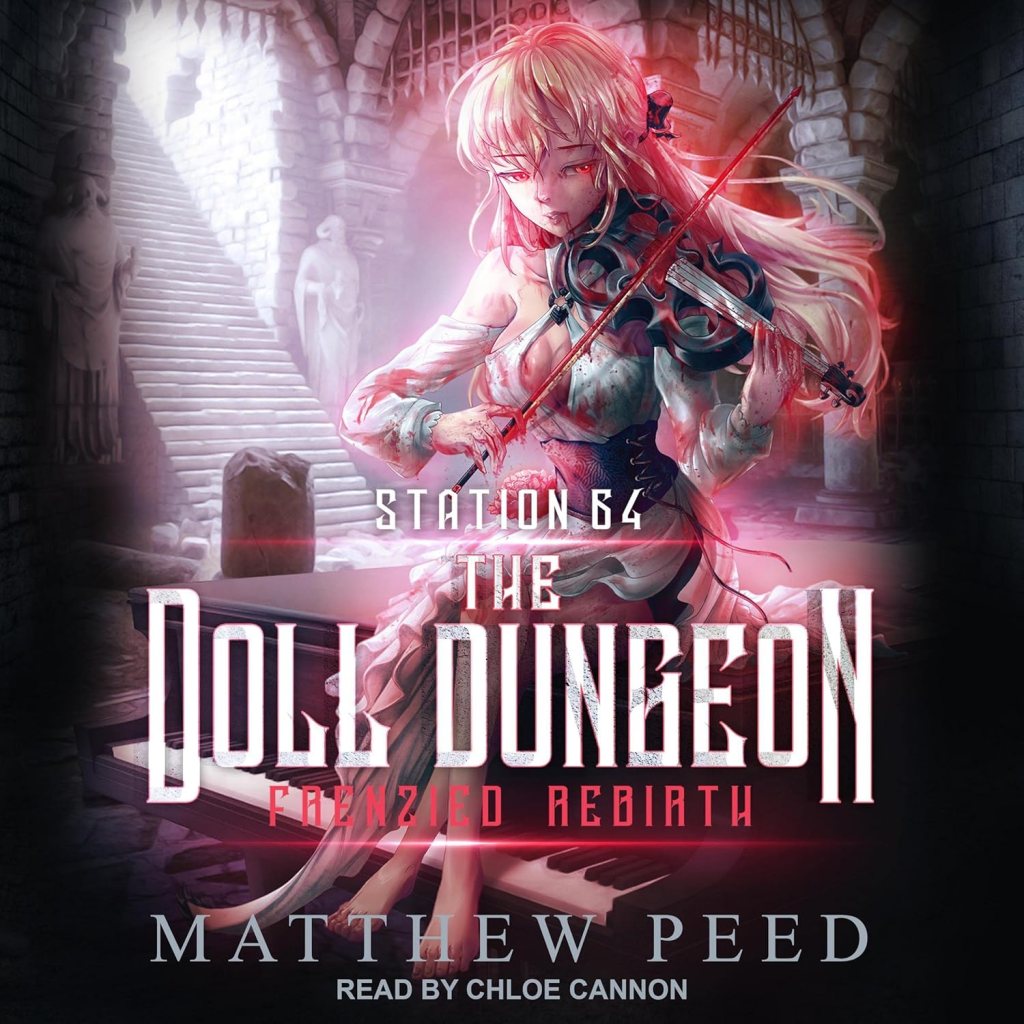
Station 64: The Doll Dungeon
Author: Matthew Peed
Reader: Chloe Cannon
Volumes: 4
Novel Rating: B-
Reader Rating: B-
This four novel series from Tantor Media was published over 2021 and 2022 and appears to be complete. This review is based on the first three novels only, as I am currently ambivalent on finishing it. The novels have an average audio time of around 7 hours each, which puts them in line with the typical Japanese LN.
While this series probably technically falls under the LitRPG umbrella, it has some eccentricities that somewhat set it apart from the crowd. It’s a reincarnation story (sort of) but not an isekai, uses a System with game-like levels, abilities, and stats but in a setting that’s modern-day (and later sci-fi) with fantasy elements overlaid, and essentially flips the basic concept of Solo Leveling – i.e., dungeons appear all over the world that must be dealt with by adventurers who have gained classes and abilities. That happens here as part of an apocalyptic event called the Aether Shift, but the effect here is more drastic: major cities have become isolated city-states ruled by the strongest adventurers and separated by difficult-to-traverse rural wastelands teeming with very powerful monsters, while the dungeons pop up in those cities. Also like in Solo Leveling (and numerous other game mechanic-like settings), the economies of these cities have largely become dependent on materials and valuables collected from the dungeon, so being an adventurer is a dangerous but also rewarding job.
The “flip” comes in the nature of the protagonist. Azaria was the sheltered teenage daughter of one of Chicago’s power couples, but she happened to be on a train when the Aether Shift struck and so got caught up in the remaking of the world. Instead of becoming an adventurer, though, she winds up becoming the disembodied Core of a new dungeon springing up where her train was at the time it happened (i.e., Station 64). She later learns that she’s not the only one this happened to, and that most who suffer this fate lose their self-awareness in the process. Some unusual circumstances and her delayed (by a year) start as a dungeon have allowed her to fully retain her identity, though. She opts to take an atypical approach by designing her dungeon around the concept of automatons which typically look like dolls or stuffed animals, which eventually earns her dungeon the moniker of Doll Dungeon. She also soon learns to her dismay that killing adventurers within her dungeon gives her power which helps her to level up just like the adventurers do, and she feels a compelling push to do so.
Fortunately for her, she’s not alone. As Azaria is preparing to open her dungeon she encounters Lance, a down-on-her luck female adventurer who’s gotten herself into trouble with more powerful adventurers. Lance’s attempt to actually communicate with the essence of this new dungeon leads the two into a working relationship which helps strengthen and stabilize both. While Lance works on expanding her power and limiting her trouble with other adventurers, she eventually discovers that the biggest threat to her may be from her own family. Azaria also soon faces bigger problems: agents of the godlike beings who engineered the new status quo are around and they don’t take kindly to dungeons or worlds which prove too uncooperative. Their motives in all of this also prove to be more sinister than any human realizes. A time may come when humans and dungeons have to work together against a common threat.
The dual protagonists split works well for the series, since it allows readers to see both internal and external viewpoints concerning the dungeons and the new state of the world and thus quickly get a much more complete picture of what’s going on in this altered reality. Lance’s efforts to claw up (sometimes literally!) from rock-bottom are fairly typical for the genre (and may remind some readers of Jinwoo from Solo Leveling), while Azaria’s path may seem fresher but actually fully lines up with the much rarer dungeon-building stories out there. The parts about her building her dungeon and learning to interact with other sentient dungeons are still interesting, as is how she integrates her musical background into running her dungeon. However, the story doesn’t truly start to distinguish itself until the dimension-hopping elements come into play in the second and especially third novels and the greater purpose behind the Aether Shift becomes apparent.
Of all the entries in this article, this is the one which is carried least by its protagonists. There’s nothing exactly wrong with Azaria or Lance in those roles; they just aren’t especially dynamic characters and don’t stand out personality-wise, although tracking Azaria’s gradual shift towards ruthlessness does hold some interest. The same can be said for the supporting casts for both, although you’d have to actively try to craft a less interesting leader for Neo-Chicago than the supremely powerful Neo, whom I’m certain was patterned off his namesake from The Matrix. The writing places roughly equal emphasis on action and developmental elements, with a little splash of intrigue and even hints of romance here and there; this is not a sign that the story ever gets complicated, however. The series also does suffer some from its heavy dependence on stat screens, though this lessens some as the series progresses.
Of the entries in this article, this one benefits the least from its reader. Deeper-voiced Chloe Cannon is competent overall and handles the heavier voices (especially Lance and Azaria’s chief underling) well, but she doesn’t have the range that some of the other readers do for alternate vocal styles, pitches, and accents and uses a slower, more deliberate reading style. That works fine when trying to reinforce the creepy ambiance of some of the dungeons but less so with lighter-hearted or more emotional parts. Overall, her read of the novel isn’t a negative but it’s not a plus, either.
Overall, this is a competent but unexceptional story which carries itself more on some interesting ideas than its execution.
Summary – Strengths: Variation on basic concept, does eventually explore the structure and reasons behind the dungeons and the transformative Aether Shift, dual protagonists facilitates a quicker exploration of the setting.
Summary – Weaknesses: Unexciting protagonists, comparatively short length of each novel, some aspects of the setting seem impractical given the time frame.
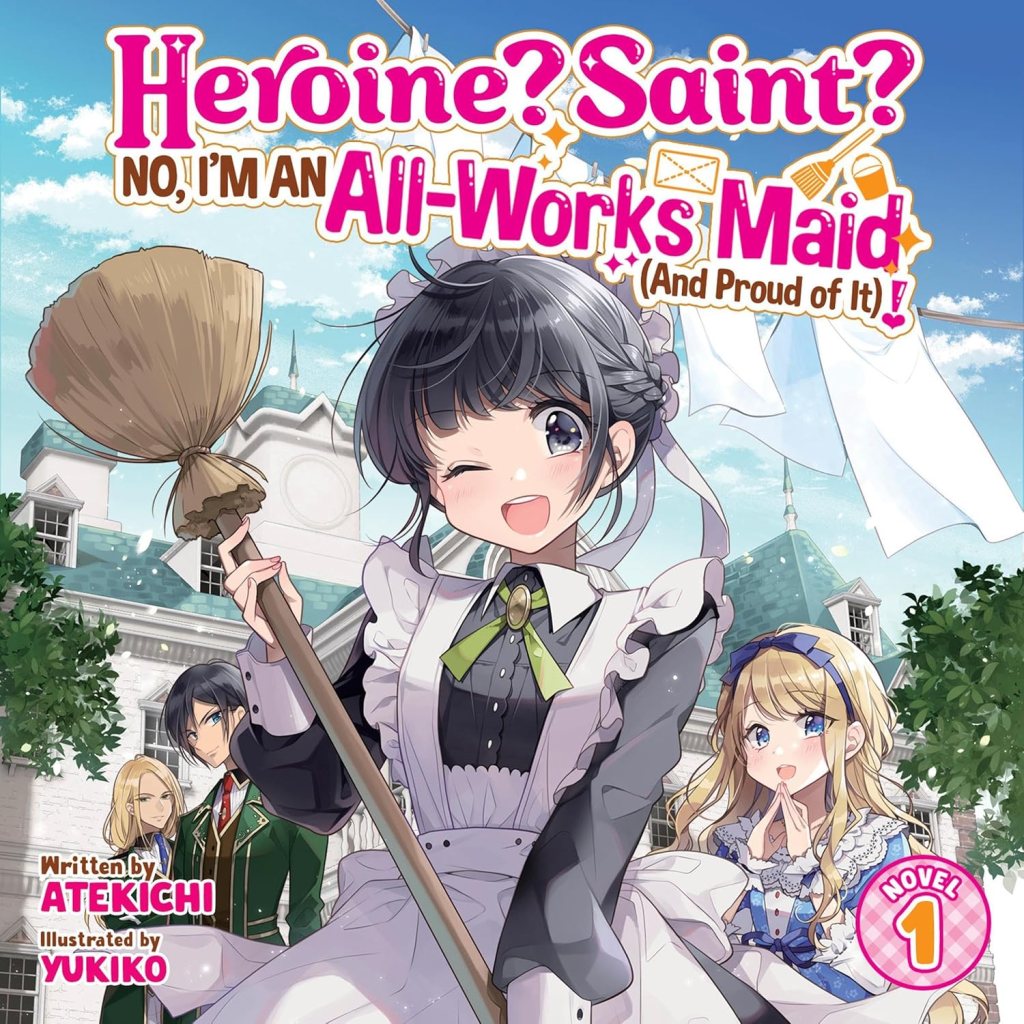
Heroine? Saint? No, I’m an All-Works Maid and Proud of It!
Author: Atekichi
Reader: Courtney Lin
Volumes: 3 (audiobook), 4 (English print), 8 (Japanese print)
Novel Rating: B+
Reader Rating: A
The one genuine Japanese light novel on this list, Heroine? Saint? has three novels available on audiobook at the time of this writing, with a total audio time of around 25 hours. The fourth novel is available in English but has not yet received an audiobook.
This series answers one salient question about isekai stories involving being reincarnated into an otome game: what if the modern Japanese person who is reincarnated as the heroine not only isn’t aware that she’s in an otome game but also decides to do something utterly different? That’s case here with Ritsuko Mizunami, who was a peerless genius growing up in Japan but found nothing satisfying until she became enamored with an idealized image of maids. When she dies in a plane crash and is reborn as the daughter of a former maid (And the bastard daughter of a noble, though she’s never aware of this), she vows to pursue the path of ultimate maid-dom upon her mother’s death. Because someone seems to be looking for her, she uses her enormous magic potential to alter her appearance and pursue maid-related application for her spells, then travels to the capital to become a maid under the name pseudonym Melody Wade. She quickly finds herself in the service of Luciana Rutleberg, the heiress of a poorly-regarded noble family (they’re nicknamed “the Ignobles”), who’s in desperate need of support since her one servant just retired. Melody quickly whips both the rundown capital estate of the Rutlebergs and Luciana into shape, hence turning the girl who’s supposed to descend into jealousy and become the game’s first mid-boss into a girl nicknamed the Fairy Princess during her debut. And that’s far from the last time that Melody unwittingly completely upends the story by applying the powers of a Saint to her maidly duties.
But Ritsuko/Melody isn’t the only reincarnate present in the story. Two others who died in the same plane crash and found themselves reborn as the country’s prince and the daughter of a duke, respectively, do know the source game Five Oaths of the Saint and are desperately trying to figure out why the girl who’s supposed to be the Saint hasn’t shown up on schedule and how they can handle game’s challenges without her. Though one of them does meet Melody, as of the end of novel 3 they haven’t recognized her for who she is and haven’t yet been able to track the story’s irregularities back to her. The one person who has figured out that Melody is actually the missing illegitimate daughter of the count isn’t aware that that daughter is supposed to be the Saint and is torn over whether to reveal her identity or not since Melody is clearly happy being a maid. Later on a fourth reincarnate shows up who seems to come from much later in modern Japan and is connected to the second and third ones, and there are vague suggestions that a fifth character (whose viewpoint we never see from) is also a reincarnate. Oh, and the Big Bad Evil of the story gets turned into a puppy along the way. Novel 3 also drops some hints that the entire setting may be artificially-induced and is being actively manipulated to force certain story beats to still happen.
In essence, this series is a complete, playful subversion of “reincarnated into an otome game” stories while also lightly parodying isekai OP protagonist stories in general. Melody is unaware of how monstrously out of scale her magic is (in essence, she has end-of-story-level magic at the story’s beginning) because she only using it for her weird, one-track extrapolation of what maids should be doing – like duplicating herself to do cleaning tasks, fashioning a dress for her mistress as impregnable as the strongest armor, or teleporting through a protective barrier into the land’s most dangerous forest to gather ingredients for dinner. Part of the charm of the story is seeing what stupefying feats she comes up with that she passes off as nothing special, and watching how she unintentionally interferes with the storyline is a delight, much to the dismay of the other two reincarnates who don’t know what’s going on. The fourth reincarnate, who also knows the source game, does eventually realize who Melody is but doesn’t understand why she’s acting the way she does and doesn’t have a clue about the other two. Add in a couple hunky guys who only look at this all from an outside perspective but have become potential love interests for Luciana and Melody and a mistress for Melody who’s literally alive because of her but struggles to get a handle on Melody’s mix of utter brilliance and infathomable cluelessness and you have a lively cast indeed. The story also moves along at a good clip.
If there’s one negative about the story’s content, it’s that the setting offers nothing special; in fact, that it’s utterly generic may be intentional. Throughout the third novel there are some growing hints that this may be a wholly manufactured/manipulated world rather than on which just resembles the game setting, so that view could change as the story progresses further.
The best thing about the novel in audiobook form, though, is the reading job by anime voice actress Courtney Lin. (She’s probably best-known as the English voice of Black Rock Shooter, Panty in New PANTY & STOCKING with GARTERBELT, and Kana in Magilumiere Magical Girls Inc.) She is an utter delight as the acerbic, sarcastic narrator of the story, but also maintains the pace and flow of the material well. She also very convincingly handles the voices of all of the important female characters, easily distinguishing each one without relying much on accents or affectations, and doesn’t do badly with the male voices, either. I presume she’ll take on at least one of the major roles when an English dub is made for the upcoming anime version; any of the narrator, Melody, or Luciana would be an ideal fit.
In short, this one is a lot of fun, and I highly recommend it even for those who aren’t normally fans of otome game-based content.
Summary-Strengths: Reader, narration, playful twists on standard genre conventions, does not use stat screens.
Summary-Weaknesses: Setting is very bland (though perhaps intentionally so).
That’s it for this installment! I expect to do this again in a few months.






 USA Anime