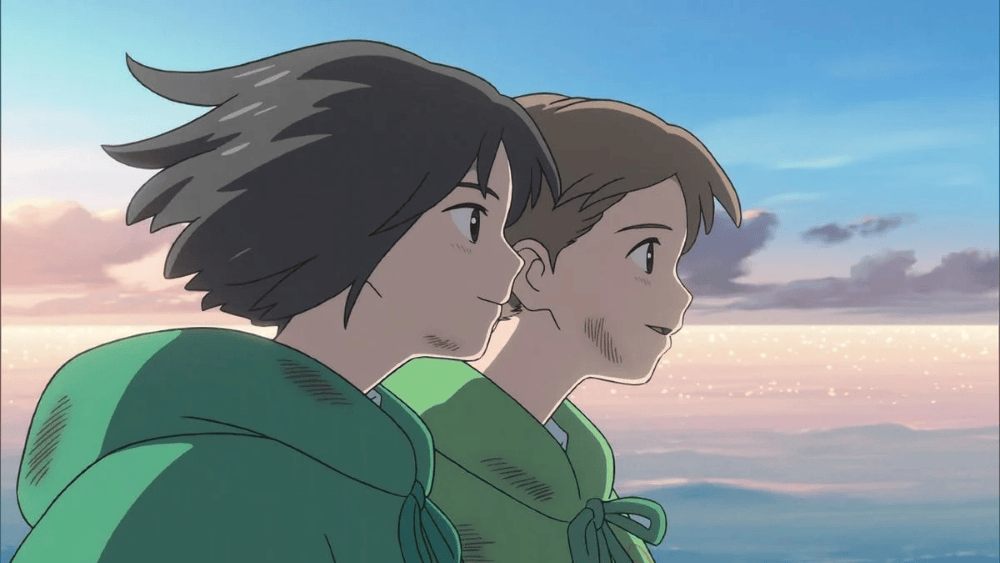
The movie version of Machiko Kyo’s incredibly harsh source manga opens with a disclaimer that this is a fictionalized account, though it is based on true events. In the documentary which follows the movie (which is only a bit over an hour long) in its theatrical run, director Toko Ina mentions that the intent of the anime adaptation is to make it a more timeless story, and thus more accessible even to modern teenagers, by toning down period-specific elements. While the movie does, in a way, succeed at that, even a viewer who isn’t well-versed in history is going to recognize this as probably being set during World War 2. Those who are versed in the Battle of Okinawa during that war are going to recognize that this is clearly about the infamous Himeyuri students, a group of 240 female students and teachers essentially conscripted to work in field hospitals and munitions transportation in support of the Japanese defense of the island; they were left to fend for themselves when the defense effort turned dire, resulting in only 11 students and two teachers surviving the battle. Whether dodging the direct reference is a deliberate cop-out to avoid confronting this dark episode in Japanese history or merely a side effect of the director’s choice to focus on characters and themes instead is debatable.
The events in the movie closely mirror much of what happened with the Himeyuri students, but that’s the framing device rather than the focus of the story. That instead falls on San, a somewhat timid and very empathetic girl who, along with close friend Mayu and her classmates, finds herself building fortifications rather than studying. There are dangers to be watched for – they have to be constantly vigilant for air raids – but their lives are are initially still casual enough to even do things like celebrates birthdays. And while they’re not thrilled about helping with soldiers in a hospital, they’re not too concerned about it, either. Then they discover that the field hospital is in a cave, and not long after that the bomb drops – literally.
The incident which transitions the story from its more relaxed first third into its more intense second third is jarring in both dramatic and tonal shift senses, and that’s far from the last time the movie can make you shift uncomfortably in your seat. The extreme graphic content of the source manga (especially in portraying the injuries of the soldiers and the kinds of things the girls are assisting with in the field hospital) is dramatically softened, and that the girls may have been subjected to sexual assaults by their own soldiers is only vaguely implied. Toning both elements down so much is going to be controversial, as it is a disservice to the historical figures this story is based on, but it does at least support the director’s “accessibility” goal (for better or worse). Besides, intuiting what those scenes were meant to suggest isn’t hard; I wasn’t aware of the Himeyuri girls before seeing the movie and I still had little doubt about what two certain scenes meant even if they weren’t framed in a sexual fashion.
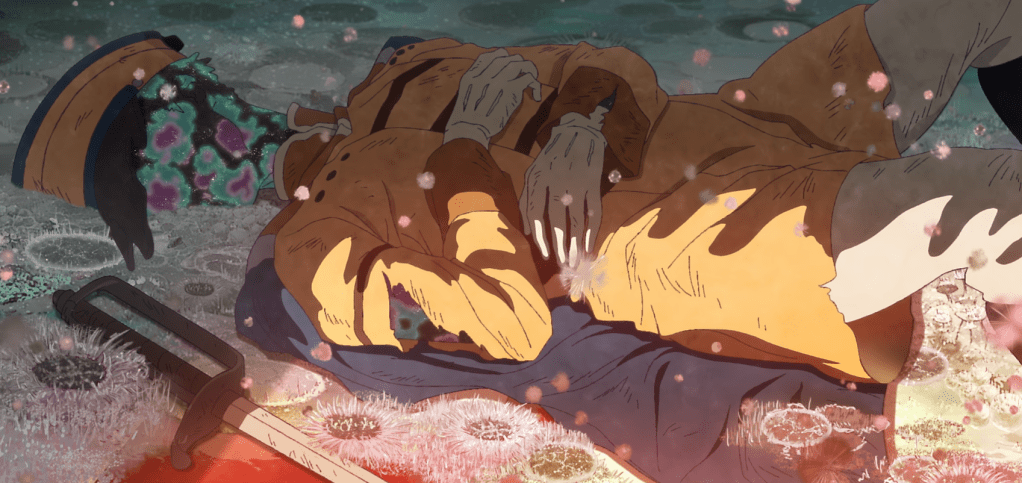
The most devastating part of the movie is its third act, however, where San, Mayu, and most of their classmates are released to fend for themselves. This is also where the movie’s most interesting visual choices land. When the girls come under fire (here it feels like they’re being specifically targeted, whereas in the actual history they were commonly caught in crossfires), we don’t even see the soldiers doing the shooting until near the very end. Ultimately, who the shooters are doesn’t matter because the girls are still getting gunned down, but whereas blood was shown earlier on, here the blood and viscera manifest in the form of flower petals (much like the fluff in SHIBOYUGI) because of a “spell” Mayu put on San to shield her from the worst of what was going on. This makes for a stunning visual impression which loses almost nothing for impact against seeing actual blood. And the circumstance under which San does start seeing actual blood again carries considerable weight because of what it means. Other incidents, like the group of girls seeking to blow themselves up with a grenade because they fear what the enemy troops might do (based on what their soldiers said), are also based on actual history.
But for all of the harshness even of this late content, the movie never loses track of the theme embodied in its title. San is fascinated by the life cycle of silkworms even as she’s horrified that the silk is gained by boiling the cocooned worms alive, and especially by how they can’t fly even though they have wings because the ability to fly has been bred out of them by humans. This becomes a metaphor for her progression throughout the movie. She is the silkworm, and if she’s going to survive then she’s going to have to burst out of her cocoon. The moment where that happens comes with little fanfare but still delivers a wallop, as like the silkworm, she’s completely different when she finally bursts out. It’s easily the movie’s most compelling character moment. The situation with Mayu’s real identity – which is more implied than fully revealed – isn’t handled as smoothly (viewers may have suspicions about it from early on) and isn’t as satisfying on its reveal, but it still carries some dramatic weight.
The visual effort is suffused with some clear Studio Ghibli influences, especially in the lovely way it depicts background art. The limitations of having originally been a made-for-TV movie show more in the characters, which are hampered by simpler designs and less-than-perfect consistency on modeling (though they are nowhere near as simple as in the original manga). The sense of movement provided by the animation is still much more evident than in a typical TV series, though, though, and the impression made by the aforementioned highlight visuals still lands. Kensuke Ushio (Chainsaw Man, DAN DA DAN, Journal with Witch) provides a musical score which may be the movie’s strongest production element, as the care and thought he put into why each scene needs to sound the way it does is evident even if you don’t watch the accompanying documentary footage (which focuses on him).
While the end of the movie suitably completes the theme (San may not have been able to fly away, but she did survive), I also felt it was a missed opportunity to make an even stronger statement; it’s my understanding that the manga version ended with San in a POW camp rather than in what looks like a post-war village, and keeping that would have made more impact because of the irony that she was treated better there than she was by her own countrymen. But, admittedly, that irony also would have distracted from the thematic focus.
Overall, you should not let the movie’s first third lull you, as it almost did with me; even in its toned down version, the movie isn’t at all a light view in the end. Even if it being a consequential look at a dark corner of history wasn’t its focus, the thematic emphasis doesn’t prevent it from accomplishing that.
Few anime series can pull off drastic tonal shifts as smoothly as this one can, and the episode “Sightseeing Tour” is just the latest proof on that. Even while engaging in elements of a light, playful foodie experience, the sense of the much more serious undertones is never far away, and the end of the episode (discounting the typical humorous epilogue) is far grimmer indeed.
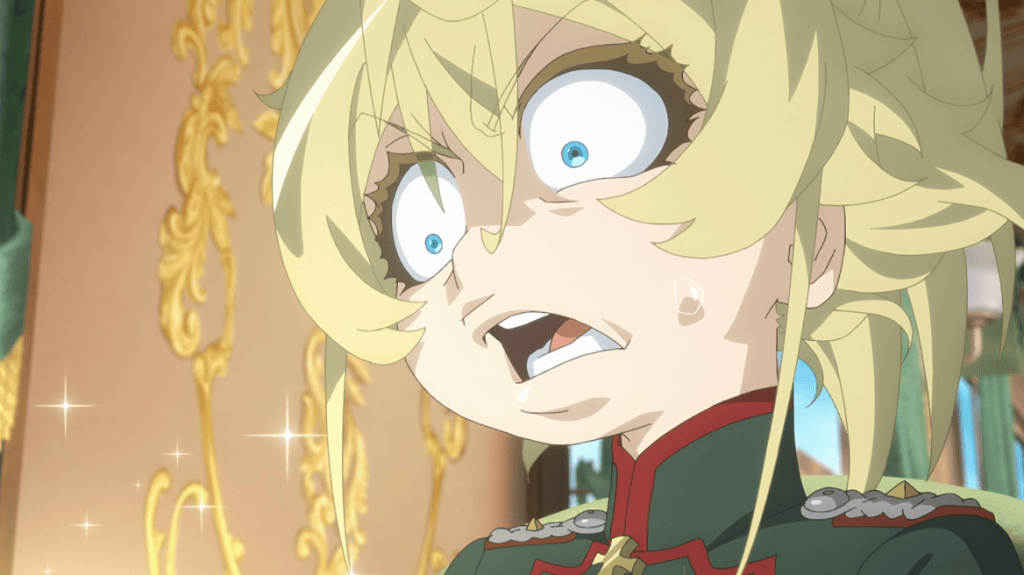
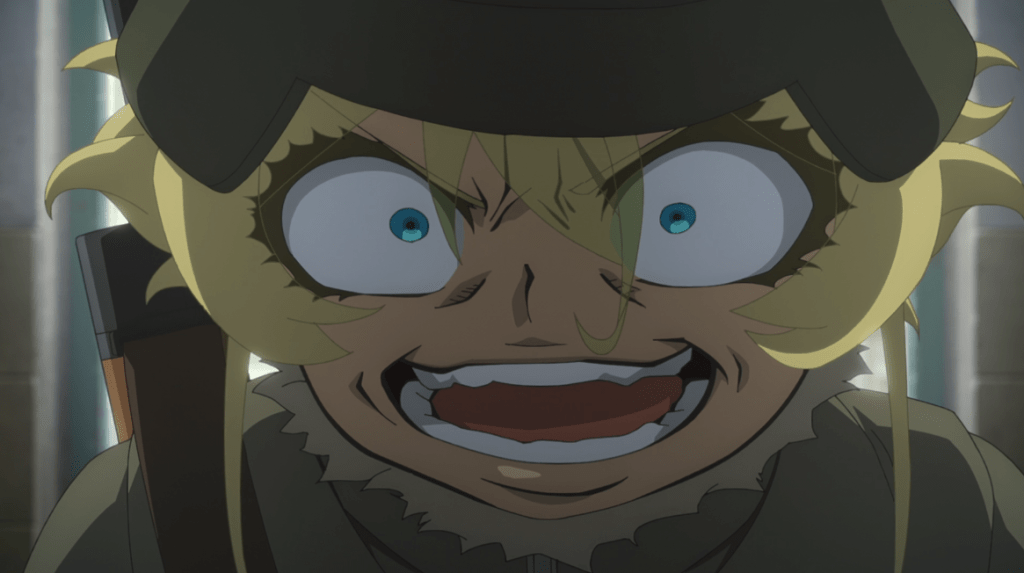
Although gushing over food like the cast of The Forsaken Saintess and Her Foodie Roadtrip in Another World is a new level for this franchise, commentary on food has actually long been a regular feature. Food was the main focus of the OVA Operation Pasta, but the series has also made regular observations about the quality (or more typically, lack thereof) of food on both the front lines and the home front going as far back as the beginning of the first season, with the most stark example being a scene from episode 7 of this season that’s referenced here. Beyond giving Tanya ample chance to make all kinds of interesting faces and visual interpretations of her dining experience, the scene also serves as a stark contrast to the reality of the Empire, and that’s certainly not lost on Tanya. How deep the Ildoan motives run here is more in question. They’re certainly trying to make a good impression on their “guests” to show that they’re on peaceful terms with the Empire, and Colonel Gassman’s gushing over his country’s offerings could just be as simple as national pride. But are they trying to send a message as well? Something like “this is what peace can bring you” or “this is what we can offer if you stay on good terms with us” very well could be intended, and even the fresh bread isn’t making Tanya oblivious to that, either.
Other tidbits show the contrasting priorities the Ildoans have here: they are distrusting enough to have guns aimed at the submarine bringing Tanya and her subordinates into port, but they’re also generous in providing travel funds. That may be a big part of why the whole experience leaves Tanya uneasy. The possible cause for that unease gets suggested in her meeting with Rudersdorf when she’s back on home turf: as nice as everything looks in Ildoa, they’re also exceedingly vulnerable. The scenes with Rerugen doing an inspection a few episodes back show that they’re not being completely careless, but when Rudersdorf mentions that attacking Ildoa is at least a consideration, Tanya realizes that, based on what she saw, it’s actually quite feasible; Ildoa’s peace dividends also leave it soft. She also quite probably has no intention of mentioning that, since she wants this conflict to end sooner rather than later, but if Tanya noticed it, then someone reading the reports from her and Rerugen likely will as well, and she knows that, too.
But all of the scenes in the Empire – even the lighter-hearted ones – reinforce another truth, too: Tanya has always had an exit strategy for the war in the back of her mind, but now she’s trying to bring a personal exit strategy to the forefront. And as suggested by various encounters hers and in episode 7, she’s far from the only one. In fact, many of the military’s key players look like they’re seeking a way out, but that may not even be possible anymore. Since we’re nearly at the limit of what I have read in the novels, it makes me wonder where this story’s going to be at season’s end. But that’s not a bad thing, either.
I also have to mentioned the caliber of the background art, especially in the train scenes. Someone put quite a lot of effort into the meticulous detail of those fancy train cars. The visual shift in lighting as the train moved into Empire territory was also an effective touch.
As a final note, I am pleased to point out that the aforementioned OVA Operation Desert Pasta finally has an English dub as of 9/2/26. Some sources are claiming that the movie has been dubbed, too, but just not released yet, so look forward to upcoming announcements about that.
Throughout the anime adaptation, Tanya has appeared on nearly every front that Germany directed engaged in during World War I or World War II. (The sole front that has not been represented is the battles in the eastern and southern German colonies in Africa during WW1.) The one she’s spent the least amount of time on in anime form has been the Northern Africa front, though. Aside from the epilogue for episode 12 of the first season and the first few minutes of the movie, the only focus on it was the OVA episode “Operation Desert Pasta,” and that was more a facetious side story than an actual representation of the front. While this episode’s mission doesn’t represent a full-blown return to that front, it at least touches on that direction and allows for a brief cameo by General Romel, this world’s stand-in for Edwin “The Desert Fox” Rommel.
To be specific, the episode involves the Empire pulling back its North African forces in light of Operation Andromeda grinding to a halt in a stalemate. Since the Allies control the seas (as they did in WW2), such a crossing would be a perilous one, so the 203rd is assigned out of their break to help make that happen. Making matters worse is that Ildoa, while not being completely obstructionist, isn’t cooperating, either, by not allowing the Empire forces to land travel through their territory, thus making the sea transport longer and thus more vulnerable. (Apparently they didn’t take well to basically being told to “stuff it” over their peace proposal a couple of episodes back.) And the one thing the Empire does have going for it on the seas – its submarines – don’t have accurate enough torpedoes to deal with the Allied fleet. So of course this is the perfect time for a certain mad scientist to show up.
Frankly, making this world’s version of the V-2 rocket be a mage-guided torpedo feels a bit repetitive, as the challenge and threat to Tanya’s safety here isn’t much different than the V-1 headhunting mission done in the first season. Granted, we do get some nicely-animated shots of naval ships being blown up this time and a good ending joke about how Neumann was too chubby to participate in this operation, but this winds up not being one of the series’ fresher episodes as a result. It also mostly lacks the insightful social commentary of the previous episode or the high drama of some other recent episodes.
There are some definite historical allusions present in this, though. The Hood and the Ark Royal were a British cruiser and aircraft carrier, respectively, which played significant roles in World War 2 naval actions. The former was famously sunk by the German battleship Bismarck, while the latter was involved in hunting down the Bismarck and was later sunk by a U-boat while escorting convoys. Since the battleship Bismarck has not appeared in this setting, the 203rd Aerial Battalion and the mission to evacuate North Africa were probably chosen to explain their destruction. The submarine Tanya goes to afterwards, the U-091, was an actual submarine which did fight in WW2, but it fought entirely in the North Atlantic and was not in service until after both of the other ships sank, so it’s possible that numbering that ship 91 could also be a reference to the HMS Ark Royal‘s pennant number.
On the upside, the “visit” to Ildoa should prove interesting, since neither Rerugen nor Tanya seem at all content with Ildoa’s behavior here. A passive, unobtrusive visit is certainly what the Ildoans want: a token visit to prove that they’re not hostile to the Empire, while at the same time showing that they’re still effectively neutral to everyone else. Given Tanya’s track record, I have to think she was deliberately assigned to this duty with the expectation that she was going to cause some kind of problem, and sailing in with flags openly displayed and calling out greetings is certainly not the level of conspicuousness that the Ildoans wanted. (Rerugen is shown getting a stomach ache from this, but he had to expect something like this from Tanya.) Should be very entertaining next episode to see how the Ildoans deal with her when she’s in their own country.
Continuing from part 1, this part features series which hit episode 7 on or after 8/15. I had originally intended to also include a look at the resumption of Re:Zero‘s season 4, but this has taken long enough to prepare, so I will wait and do that at the end of the season.
A Livid Lady’s Guide to Getting Even
Rating So Far: C+
While I don’t mind a good revenge tale, I’ve continued to have the same issue with this one from the beginning: the extremity of Elizabeth’s quest for revenge seems incongruous with her personality. While using economic manipulation to harass her former country seems an entirely natural fit, the most recent episodes show that she can be gruesomely bloodthirsty, too, to the point of not being above killing soldiers who haven’t directly wronged her just because they were with someone who did. (The series is also capable of delivering some shockingly graphic violence – shocking in the sense that the series had shown no hint of being that graphic before.) She’s shading more towards being a true villain than just a woman out for revenge, and how intentional that is isn’t clear. The two details I do like is that one group of mercenaries she goes up against shows that they actually have functioning brain cells when matched up against her (they use coordinated group tactics and retreat when it’s clear that there’s no advantage anymore to them sticking around, rather than after she’s pummeled them) and that she actually wears sensible adventuring clothes (including both pants and a leather cuirass) when out in Adventure Mode, something you see remarkably little of in fantasy anime. Basically, the main problem is that the series can’t seem to settle on exactly how dark it wants to be. Still, I intend to stick with the series to see if it ever sorts that aspect out.
Ascendance of a Bookworm s4
Rating So Far: B+
While I continue to see complaints from novel readers about how the anime version is condensing things, I’ve had no trouble following along with this one and have been impressed both by the more expansive world-building (the thing with the volcano in episode 7 is particularly interesting) and how this season’s episodes have gradually infused more political elements into the story while continuing both Rosemyne’s progression into the world of nobles and the advancement of her business ventures (which now include a hand water pump). The series has even made a bit of room for some romance, too; seeing Damuel and Brigitte potentially becoming an eventual couple has been a treat. The whole “gather the materials” arc does feel a little cumbersome, but at least that’s diffused amongst all the other events going on. Overall, the series isn’t doing anything spectacular, but it’s still performing solidly on all fronts.
Clevatess II
Rating So Far: B+
While this season isn’t quite as strong so far as the first one, it’s lost surprisingly little as it enters its magic school arc. That’s partly because this is far from a typical execution for such an arc; instead of being about day-to-day life at the school, everything which happens here is loaded with intrigue as the school becomes the focal point for the agents of numerous great powers, including all of the Dark Beast Lords and human factions as well. the exact nature of magic, and what Drell was doing there, also come into play, and if Alicia is cute as a button as a Heiden teenager, she’s arguably even cuter when she ends up in a rat-like dark beast form. The Otherworld she sees, which looks like a distorted version of the real world to her, is also an interesting concept. Th one downside here is that the expansive addition of new characters can make it hard to keep track of everyone and tends to spread the story a little too thin, but those are only minor detriments. It’s still a strong performer on technical and artistic fronts, still has the season’s best English simuldub, and is grace with arguably the season’s best closer, too. Though it’s not #1 this time, I’d still put it among the top five for the season.
From Old Country Bumpkin to Master Swordsmans2
Rating So Far: B-
While there are other significant developments this season, arguably the most important one is the proof that Beryl has been selling himself short for some time now: his father let him take over the dojo because he was convinced that Beryl had finally surpassed him in swordsmanship, and a duel between the two proves the father right. Of course, this is just forcing Beryl to recognize what everyone around him has known for some time now (i.e., that no one is more deserving of the title of “master swordsman” than him), but it’s still a big step for such an unfailingly humble and self-deprecating man. Helping Ficelle establish magic swordsman training has also been a big part of this season, as was an attack on the academy by magical monsters and a wild beast culling while visiting his father. Aside from the academy attack, it’s generally been a more low-key season, but advertisements about the arc which started with episode 7 suggests that’s about to change. Sadly, it’s also still saddled with one of the season’s weakest English simuldubs (Cory Yee is perfect as Beryl, but many other roles are either more awkward fits or occasionally stilted in delivery) and potential for romance still lingers, but it’s still watchable enough.
Goodbye, Lara
Rating So Far: A-
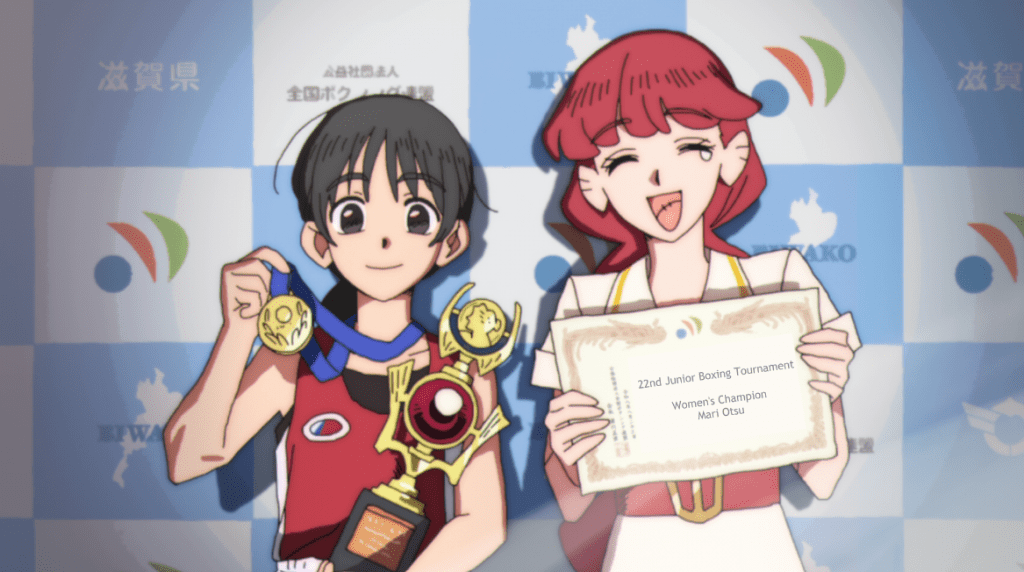
While I’m not a fan of the old-school artistic style or many of the character designs, that detracts very little from the quality storytelling we’re seeing here. Lara’s real struggle here is not to find love but to figure out what “true love” is, and there’s an increasing suggestion that pursuing that through romantic love may be leading her astray. A casual, almost off-handed reveal in the most recent episode – that it’s the “love of the sea” from a princess that has traditionally helped sustain the mermaid race – supports this, and so does the timing of the starry flashes and the activity of that giant fish-sword. I’ve seen discussion that Mari might be her actual “true love” and Lara just hasn’t realized her yuri heart yet, but I’m not convinced that’s an accurate read on the situation, either. Lara has been struggling to find love because of her fears, and it’s when her feelings overpower those fears that we see a reaction. It might not be loving Mari or this new prince stand-in specifically that’s the key to saving the mermaids, but humans in general. Perhaps that was the intent of the witch all along? If so, then Lara’s sister is utterly misguided in her actions – though given what she’s experienced, that’s understandable. The production also deserves credit for its excellently-animated boxing sequences, but the strongest draw for me is how wide-open the possibilities are for how the crisis will resolve itself. Overall, this series easily belongs in the discussion for the season’s best titles.
I Want to Love You Till Your Dying Day
Rating So Far: B+
Darkly-shaded yuri series are hardly unknown in anime, but I’m hard-pressed to think of another one which can gut-punch its viewers as hard or effectively as this one can. As much of a combat terror as Mimi is, she’s not indomitable, and her immortality doesn’t prevent her from sometimes ending up as a mangled corpse; unlike the other girls sent out to fight and die, though, she can come back from it thanks to (tragically) forbidden magic. That doesn’t make seeing her like that any less jarring, however. Nor does the harshest punch to date – the death of a major character in episode 7 – being wholly telegraphed with all sorts of death flags (including the series’ title!) lessen its impact or the desire to see how devastating it is next episode to the main cast. With the war effort only getting worse, I can’t see this one having a happy ending, but it is setting itself up well for a tragic conclusion.
Oh, Boy, Was I Wrong About Her
Rating So Far: B-
This one is merely the latest in a long line of “the friend I thought was a boy as a little kid turned out to be a girl” series, but unlike the previous entry with this gimmick (the Winter ’26 season’s Ren Arisugawa is Actually a Girl), this one isn’t hentai or even ecchi; in fact, it’s been remarkably tame on the fan service front so far, instead focusing on how Hayato and Haruki falling back into familiar patterns around each other (and Hayato’s sister, who also knew Haruki well). But while Hayato clearly still sees Haruki as a friend, she’s clearly upgraded her feelings about him (or maybe always liked him that way). This is all pretty typical, and of course there’s another girl Hayato has been getting friendly with much to Haruki’s consternation, but the series keeps things interesting by examining how Haruki seems to feel the need to put up a front at school and being dodgy about how both Hayato and Haruki have special circumstances which have led to their unexpected reunion. (Hayato’s involve the health of his mother and have mostly been revealed by the time of this writing, but Haruki’s have only barely been hinted at.) The way Haruki’s body language is distinctively different when only Hayato’s around – distinctly more boyish, in fact – is also interesting to watch and something rarely seen in these kind of set-ups, and there are a few good jokes about adapting to city life after being raised in the country. The series hasn’t been a world-beater, but it doesn’t look bad and has kept the character dynamics interesting enough to hold my attention.
Skeleton Knight in Another World 2
Rating So Far: B-
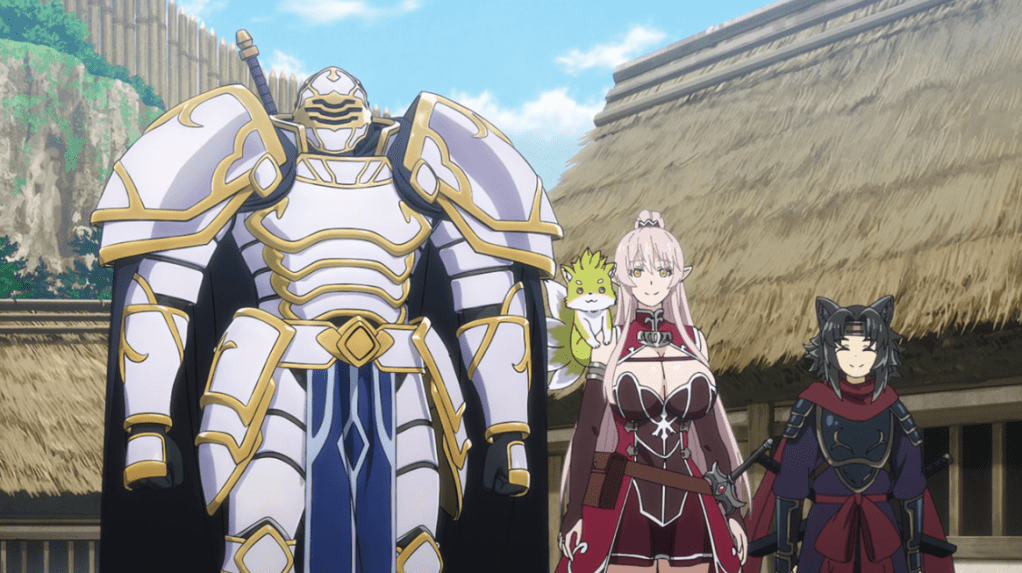
With a character like Arc around, the series will never be dull, but much of what has transpired this season feels less fresh. Chiyome having limited appearances until the last couple of episodes also has hurt some; the series does seem to work best when the full trio of her, Arc, and Ariane are together, and the presence of Ponta isn’t enough to make up for that. And while there definitely are some bigger political wranglings going on, they too often feel too disconnected from what the main cast is doing (even if that isn’t exactly true). Still, learning that Arc’s skeletal status in this setting is more than just an ordinary curse is interesting, and watching Ariane try to deny that she’s falling for Arc is rather cute. The series isn’t currently a high-priority view but it is still a solid keeper. So is the English simuldub.
That Time I Got Reincarnated as a Slime s4
Rating So Far: B
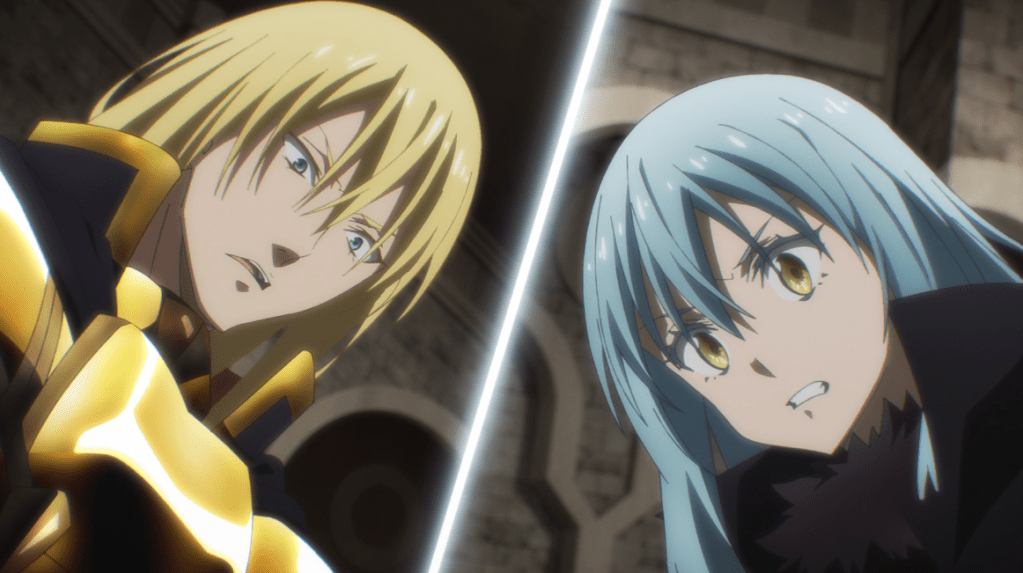
This one certainly took its sweet time getting to major developments, but after a lengthy set-up and an underwhelming foe in the series’ first half, it’s finally gotten interesting again. All it took for that to happen is for Granville – a true Hero, albeit from centuries earlier – to finally make his big, direct play in the wake of Mirabell’s defeat and death. And this time it’s a big enough scheme to not only make Rimuru seem threatened but also bring other Demon Lords and Primordials into play in potential conflict – easily one of the franchise’s most dramatic power escalations. It’s even gone as far as apparently killing off a major character, too. Granted, the franchise has done this before only to bring those characters back later, but this time may be different, and I’m actually a bit surprised at who was chosen to be eliminated. The hints which have been dropped practically since her first appearance that there’s something more special about Chloe than just her being brought here from another world are also finally starting to coalesce into a major twist, too. For the one of the rare times in the last couple of series from this franchise, I’m actually eagerly looking forward to how things are going to play out next.
The Duke’s Son Claims He Won’t Love Me, Yet Showers Me with Adoration
Rating So Far: C
Of all of the series that I’m still actively following, this one is probably my lowest-priority view on any given week. Part of that is some of the season’s weakest visuals (especially in character designs) and a very ordinary animation effort, but the content is also so very banal that I’m not quite sure why I’m still bothering to keep up with it, especially given that it comes out on the season’s busiest day (Saturday). The only real difference between this one and a number of other period romances where the female lead must gradually win over the emotionally distant high noble marriage prospect is that Elsa and Julius are married before the end of episode 1, which does create some slightly different dynamics in various situations. The most recent episodes have even shown wholly-predictable hints of potential building intrigue involving another handsome noble and his sister, who had been fixated on winning Julius over. It is a sweet little series with some effective light humor, so it’s mildly watchable, but one I doubt I’ll remember well once the season is over.
The Forsaken Saintess and Her Foodie Road Trip in Another World
Rating So Far: C+
Is foodie fantasy titles becoming its own subgenre? While there is an RPG-style adventure aspect to the series, that’s practically an afterthought compared to the emphasis placed on the “foodie” side of the title. I do get a good chuckle out of how the adventuring group Rin joins is called Smorgasbord because all the members love to eat (even though all of them are completely incompetent at cooking) and how stupidly specific Rin’s camper-summoning power is, but also appreciable is how the entire group realizes the value of what Rin can do in a strategic sense and how they quickly come to consider her an indispensable and beloved member even though she can’t contribute in fights. (Heck, her curiously-slanted Survival skill – which always mentions how tasty a monster is – alone would almost be enough of a contribution.) On the downside, the game-like item drops of monster meat detract some compared to other shows with overlapping gimmicks (like Delicious in Dungeon or Pass the Monster Meat, Milady!), and the the overall plot beyond the foodie aspect is both thin and not particularly compelling. However, Rin’s cheery personality (and possible bi leaning?) and the lovable members of Smorgasbord help maintain the series’ mild appeal regardless.
The Ogre’s Bride
Rating So Far: C+
Frankly, I’m at a loss for how I let this knock-off version of My Happy Marriage suck me in enough that I’ve actually bothered to watch it week-to-week. Though it shares a similar structure and story beats to MHM, it’s nowhere near on the same level in writing, characterization, or especially technical and artistic merits, and it doesn’t take full advantage of the peculiarities that make it different; it only barely touches on what happens if the chosen bride isn’t interested, for instance. (One episode uses flashbacks to show that Yuzu’s friend Touko wasn’t immediately or easily won over by Nyankichi, though she did eventually accept that she loved him back.) The series does at least earn some credit for exploring how having a bride can be both a blessing and a curse for a demon: it’s a blessing in the sense that a demon with a bride will get perceptibly stronger, but it’s a curse in the sense that the demon can become so obsessed with his bride that he can lose all common sense around her and capitulate even to requests from his bride that he knows are dangerous.
The other problem here is that the series still seems to want to use some stock elements even though they don’t fit well with the particulars of this scenario. For instance, how Yuzu is a commoner being married into the effective equivalent of a noble house is stereotypically a matter of consternation for the clan, but that’s at odds with the fact that the clan leader becomes stronger for having found his bride, which seems like it should be a big enough deal to override such concerns. That brides can be chosen as teenagers (or even younger!) is also a little messy, and the age gap between Reiya and Yuzu wouldn’t be overlooked in most other situations. And at the end of the day, this scenario hasn’t strayed far from being pure wish fulfillment. Despite its flaws and average (at best) visuals, it’s just compelling enough in its dramatic presentation to keep me watching.
Though I Am an Inept Villainess
Rating So Far: A-
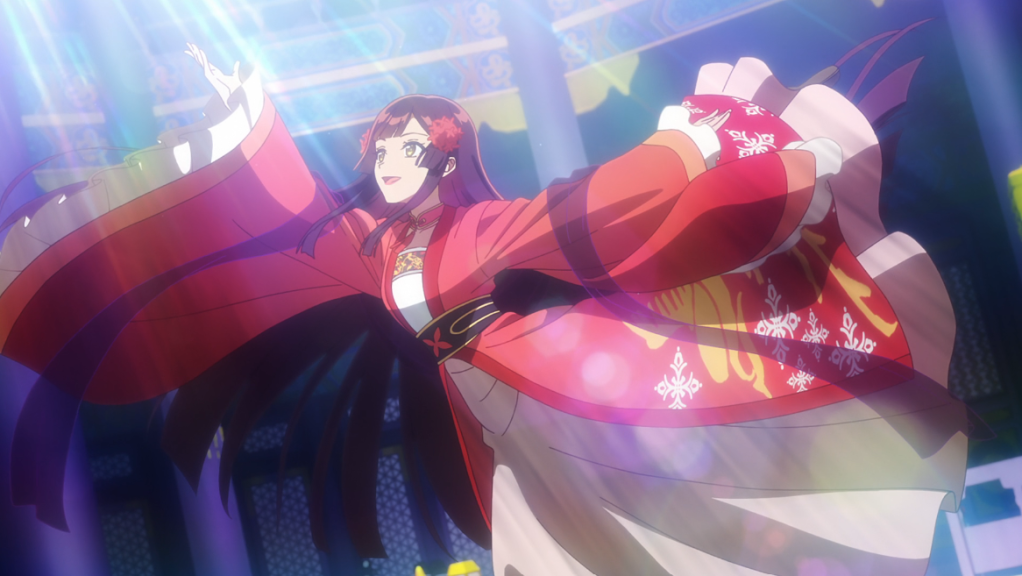
If I was just rating this series on its first 3-4 episodes then I might grade it a notch lower, but it has been on an absolute tear since the dance sequence that was the highlight of episode 5 (and, frankly, one of the great individual scenes of the year so far). The irony the Reirin is actually enjoying the body swap dominated the series early on, but that is gradually being replaced by the irony that the body swap may be providing a window to a much greater level of dangerous intrigue within the court, intrigue that may well have its roots more than two decades in the past. The big question now is whether the intrigue is playing out because of the body swap, or is the body swap just revealing a scheme that already existed? Certainly the switched souls are having an impact here, as the real Reirin wouldn’t have been able to recognize the curse that Keigetsu does, while Keigetsu’s body allows Rin to act more freely than she would have been able to otherwise. Connect that with a good animation effort and some of the season’s best visuals and you have a title that’s become a strong contender for my #2 position this season.
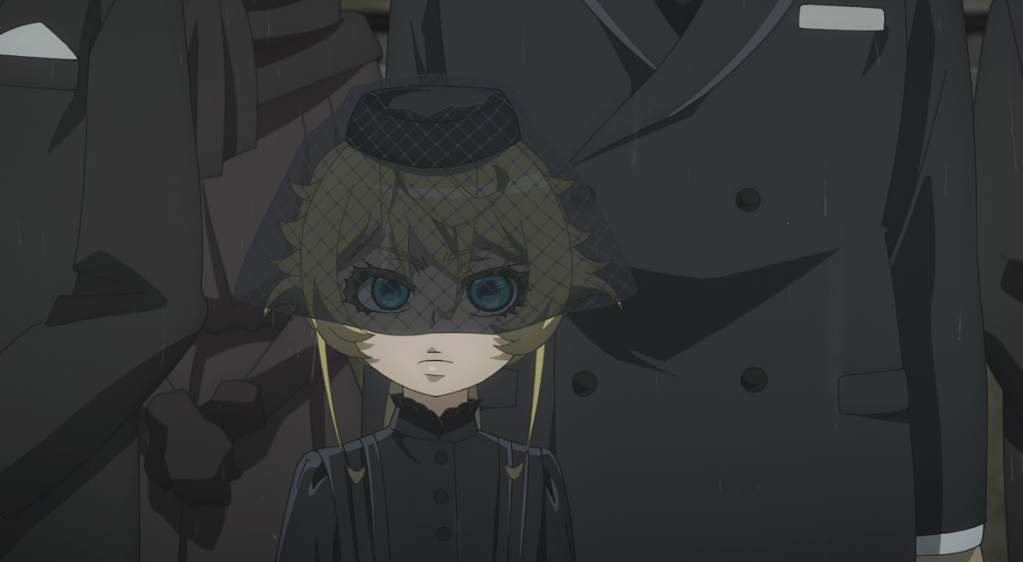
Even if you discount Tanya’s size, age, gender, association with Being X, and status as a cross-gender reincarnation, she’s still an aberration on other fronts. Some of that is a dramatic lack of empathy that she carried over from her previous life, which only reinforces her very studious pragmatism, but it’s also her lack of perspective. In her current life, she’s only really known the orphanage and the military, and so has spent little to no time in a genuine civilian capacity. Hence she doesn’t truly appreciate how the public thinks, and thus why that’s at the core of the disconnect between the country’s leadership and its military.
In Tanya’s understanding, the military is struggling because they don’t have clear criteria for what “victory” means; the goalpost for what constitutes enough to win the best possible concessions keeps getting moved back without additional support for the advancing goals, hence making a situation like the ultimate failure of Operation Andromeda (due to a lack of sufficient supplies) practically inevitable. None of Zettour, Rudersdorf, or Rerugen disagree with her on this point, but the two generals in particular understand what Tanya doesn’t: that the root cause of this isn’t politicians with unrealistic expectations (although they are part of the problem), but instead the public that they are, to some degree, beholden to. Though the soldiers lose their lives on the battlefield, the public has suffered, too. They’ve watched funeral processions of empty caskets carried by wounded soldiers become commonplace, they’ve dealt with the deprivations of a wartime economy, and they’ve become drunk on the propaganda used to bolster national spirit. They can endure if there’s something concrete to be gained from it all, which is why a return to the status quo simply isn’t enough. They must believe that they’ve won, that they’ve achieved “victory,” even if what that actually entails in this situation is a nebulous concept. That’s a very dangerous position for any country – but especially a military power like the Empire – to be in, especially with morale being pushed to the limit, as is shown in Tanya’s encounter with Col. Ulger.
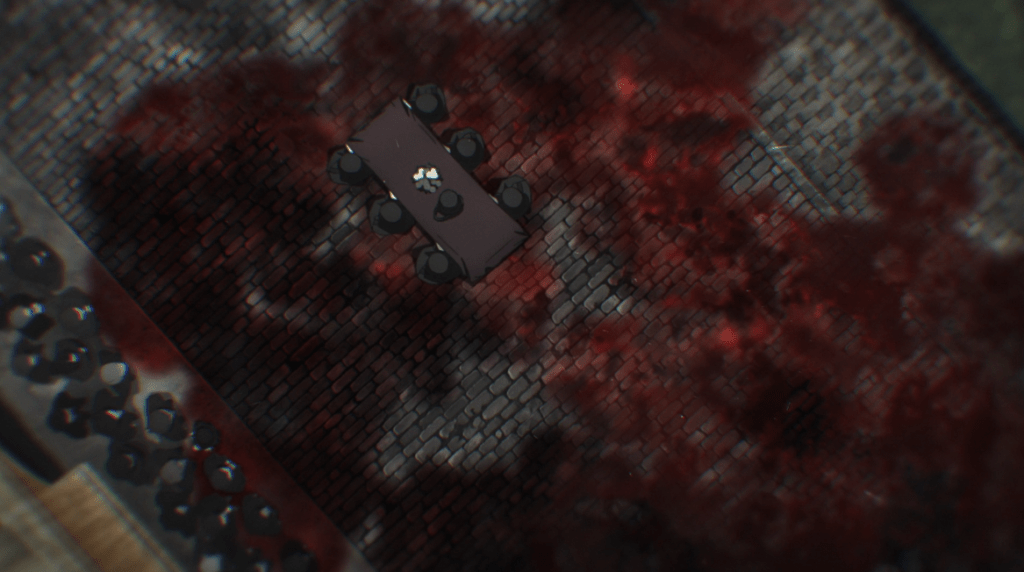
How devastatingly this situation get revealed to Tanya, through her encounters with various familiar military leaders, is what makes this episode so incredible and a big part of why I’m giving it such a high rating. The storytelling isn’t carrying all the weight, either; the scenes with the blood rain over the funeral, where Being X steps in to do some commentary, make a sharp visual impression with a stark contrast between the blood and the gray backgrounds. In the face of such stress, such madness, how many would naturally reach out for religion even if they were otherwise rational, modern men?
That’s not the only thing going on in this episode, either. To this point, the military leaders featured in this series have all been stalwarts dedicated to service to the Empire, but even they are starting to accept how untenable the situation is becoming. Tanya is quick to notice that Zettour’s line of questioning is heading in a potentially dangerous direction and politely heads it off, but I don’t buy at all that Zettour was merely conducting a kind of loyalty test there. She seems to less well pick up on Rerugen’s vague intimations in the same direction at the train station; if the military were to attempt some kind of coup, Tanya’s 203rd Aerial Battallion would undoubtedly be intended to be a key player. Those vague suggestions add an additional chilling undertone to the situation, and I can’t think that Tanya’s comment at the end of the episode – about how she can’t meet her ultimate goal here, in the rear – is an idle one. (And to be clear, I haven’t read much beyond this point in the novels, so this should be treated as pure supposition rather than any kind of hint.)
Despite the lack of action, and despite the usual supporting cast not being present at all, this is still the best episode yet in what’s already proven to be a strong season for this franchise. Admittedly, the series doesn’t take itself entirely seriously (as the epilogue scene shows!), but it wisely sections off its humor so it doesn’t interfere at ll with the powerful thematic points it’s making. Few anime series ever made have done this effective a job at portraying how a war effort can consume not just the soldiers on the front line but the home front as well.
We’re at the midpoint of the Summer season, with earlier-starting series hitting episode 7 (or in a couple of cases, even episode 8!) this week, so it’s time to get the ball rolling on what a wide swath of series have been doing so far this season.
With the return of Re:Zeroto action this week, I am now attempting to fully keep up with a whopping 26 series this season – maybe the most I’ve ever done. And that doesn’t include The Ghost in the Shell (despite having seen all previous iterations of the franchise, I bounced off of this new one hard) or the return of Bleach (I’ve seen all the previous episodes and movies, but just can’t muster enough enthusiasm to engage with this supposedly-last chapter). It also doesn’t include two series which are continuing from last season which I was following: MAO and The Classroom of a Witch and a Black Cat. The former is a simple time crunch, and I won’t rule out eventually going back and getting caught up on it, but I was losing interest in the latter towards the end of last season anyway, so it was an easy drop. I also didn’t end up engaging with a few titles that I rated highly in the Preview Guide, including The World is Dancing, Kaiju Girl Carmelise, and (most surprisingly to me, given the historical context) Jaadugar: A Witch from Mongolia. I did end up following a handful of titles that I didn’t rate highly at the start, and not because they got better; as you may have noticed if you’ve been following this blog for a while, mindless trash tends to make up about a quarter to a third of my viewing list in any given season, and this one is no different. I make no apologies for that, as those titles are my de-stressing fare.
One additional point on this front: I did watch multiple episodes of Red River, but I dropped off on this one after episode 4 and don’t feel inclined to get caught up. It may be based on a classic, but it’s just not a good adaptation in any sense.
This first part entirely covers shows which have aired seven or more episodes as of 8/15/26. Not all shows which I’m following which hit episode 7 on 8/15 are included here.
Black Torch
Rating So Far: B-
No title this season more purely falls into the shonen action stereotype, complete with a secret anti-mononoke organization and a mononoke faction mustering to fight against them, but at least this is a respectable execution of the concept. It helps a lot that the cynical Jiro and crabby Rago make a great pair in the central duo, while Ichika serves well enough as a probable tsundere type and Reiji is staking out territory as a traditionalist who’s a bit arrogant. Although Ichika never wears skimpy outfits and rarely shows much skin, the camera still takes every opportunity to ogle her body (especially her butt), which I only mention because it’s done to a purposeful and nearly distracting degree. That aside, the action scenes and plot development are good enough to maintain this one as a weekly but not priority watch. The English simuldub is also one of the better ones this season.
Daemons of the Shadow Realm
Rating So Far This Season: B
While I like this series quite a lot (and especially Yuru as the lead protagonist), I have to mark the series down a bit for way under-utilizing Asa, even if she does get distinctly more screen time in the last couple of episodes. Seeing Yuru start to come to a reckoning with some of the people responsible for tricking him back in the village is also good to see, as is the way that the traitor in the Kazemori clan was foreshadowed in a much earlier episode if you knew what to look for. The timing of its humor could still use a little work, but overall it’s still a solid-performing shonen action scenes with a couple of interesting angles to play.
From Overshadowed to Overpowered
Rating: C
The one thing this series has going for it is some pretty good character designs. Otherwise this is a very rote play on the “I’ve been reincarnated centuries later to a time when magic is weaker, so now I’m super-OP” concept. It even has a former apprentice who’s still around centuries later, and yeah, let’s not forget the sexy teenage sex slave. (Though to the show’s credit, the series is working on building her up to be something more and putting a couple of interesting spins on things like slave crests and generational curses.) It’s been watchable and mildly entertaining, and even offers a bit of fan service at times, but that’s about it.
Heroine? Saint? No, I’m an All-Works Maid (And Proud of it!)
Rating So Far: B-
How do you put a big twist on the standard “reincarnated into an otome game” concept? Have the protagonist be oblivious to the fact that she’s in an otome game (much less its intended heroine!), have her channel her OP magic into her obsession with maids from her previous life and resolutely pursue the path of a maid rather than a heroine, in the process inadvertently wreaking havoc on the storyline both directly and indirectly, such as by reforming a girl who’s meant to be a tragic boss figure into being the “Fae Princess,” giving her a dress capable of sustaining a blow from the main antagonist, or unwittingly putting the whole city to sleep in an effort to tame the spirit of the main antagonist, who’s become trapped within a puppy (but she’s not aware of that, either). And that’s just for starters. On top of that, there are two major characters who are also reincarnates and do know the otome game inside and out, and a newly-introduced character is strongly-implied to not only be another reincarnate but also one from a much later real-world time period than the previous three. (Or is it just three?) And that’s just the tip of the iceberg for all the odd, sometimes very silly twists this story can deliver.
On the downside, the first few episodes of this adaptation are fairly weak, and the sharp-witted narration which was a major feature of the original novels is being downplayed a lot here. The series distinctly improves with episode 5, though, and is better from that point on, so the rating here leans more towards episodes 5-8 than 1-4. While I don’t feel this is the source material’s best possible adaptation, and the humor isn’t quite as sharp in its absurdity as might be hoped, it’s still doing enough interesting things to be worth a dedicated watch.
I Became a Legend After My 10-Year Long Last Stand
Rating So Far: C
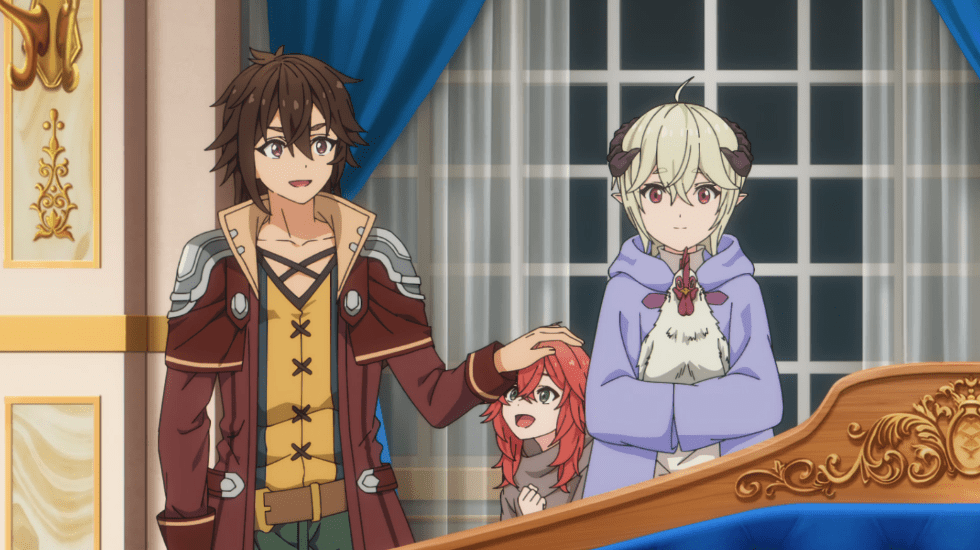
Yes, one of the characters is a (non-verbal) chicken called Exalted Gerbera, whose clucking has the power to destroy vampires in mid-transformation. That’s not the only slightly weird element in this series about a venerated hero who is now wandering around pretending to be a low-ranked adventurer because he got de-aged (another character is an also-non-verbal spirit dog), but it doesn’t help enough to make this one stand out. It’s still running hard with the “protagonist builds a makeshift family” approach, one that currently includes the dog, the chicken, the chicken’s demon handler, the daughter of one of Luck’s adventuring companions, a beast girl, and a new orphan girl who just turned up with the last episode, and it still fully embraces the “I’m super-powerful though I don’t look it” line. With ordinary visual and action elements, it’s not doing anywhere near enough at this point to be memorable.
As it turns out, very little familiarity with the Nanoha franchise is needed to keep up with this one, as Nanoha, Fate, and especially Hayate are all supporting characters rather than lead plot drivers here. (I currently suspect that this may be a case where they’ve hopped into this world for a long-term mission and are pretending to be natives rather than an alternate timeline story.) That’s fine because Shiina and Towa are carrying the story well enough on their own. They’re following a fairly typical progression of becoming friends without each realizing that the other is actually a Diaboli from a not-yet-aligned organization, down even to them finally meeting in battle forms at the end of the most recent episode, and naturally there’s a complication which is going to put them at odds even though EXCEEDS and the Diaboli Slayers are both working towards the same end goals (albeit from different angles). So the series gets docked a bit for lack of originality, but it makes up for that with cool action scenes and some impressive power displays.
Magilumiere Magical Girls Inc. s2
Rating So Far: C+
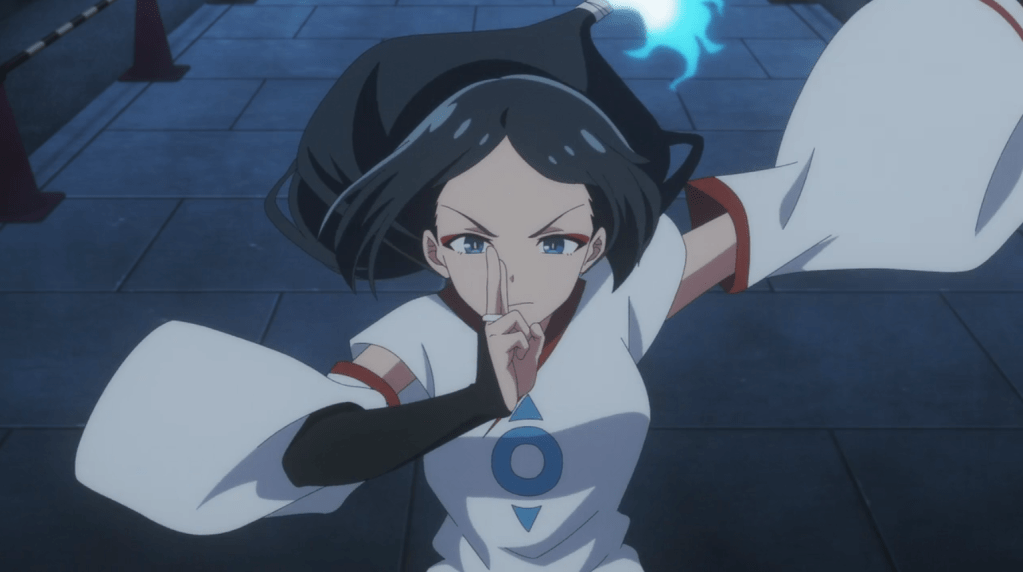
Is it a coincidence that the season’s two worst simuldubs are both on Prime Video? Probably not since both have the same director/scripter/caster. The dub job for this one wasn’t great during the first season but seems to have gotten worse, especially with stilted delivery and lines that don’t match well to lip flaps being frequent throughout. That’s the biggest drag on what is still a neat, corporate-focused take on modern magical girls, but it’s not the only one; the pace of the storytelling is sagging badly this season, too. On the plus side, the series has introduced how classical magic-using miko fit into the scheme in this setting, though I’d like to see a bit more commentary on how classic-form spellcasting morphed into technologically-supported spellcasting. Definitely will continue with the series but may be switching to the Japanese dub and subtitles.
Mushoku Tensei s3
Rating So Far: B+
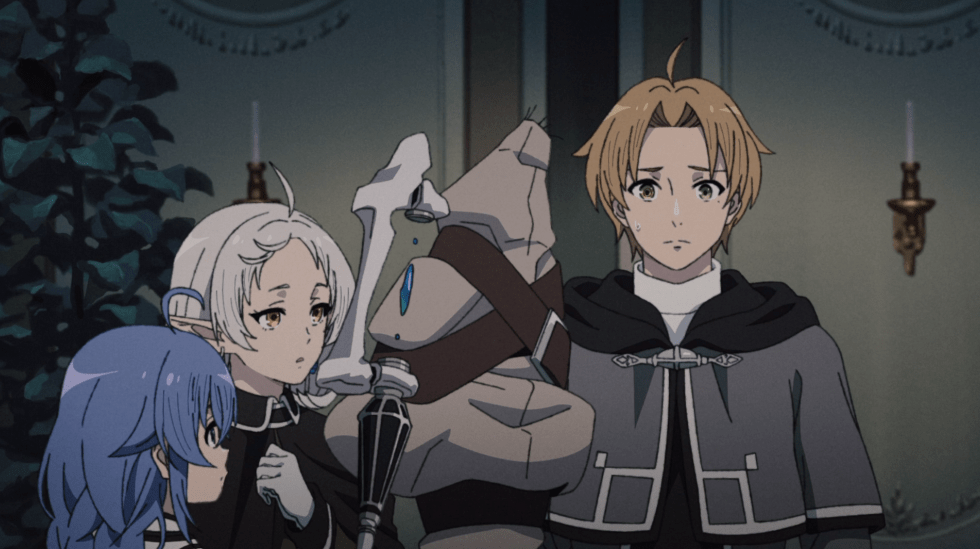
This season’s episodes are only getting a B+ so far because, frankly, the story has been a little too much on the slow, domestic side even if it has been covering a lot of necessary bases, such as finally showing what Eris has been up to, Sylphiette and Roxy settling into their dual marriage with Rudeus, Cliff and Elinalise getting married, Rudeus finally coming to terms with his past experiences with Sara, and Pursena and Linia graduating with a duel for clan leadership since neither found an acceptable husband. All of this has been handled with the excellent artistic and technical merits seen in previous seasons and Rudeus is coming across as far less of a creep now that he’s taken on more adult responsibilities. (That aspect isn’t entirely gone, though. . .) And it definitely looks like a much more exciting arc is upcoming. This is still a standard bearer-level isekai series.
The Frontier Lord Begins with Zero Subjects
Rating So Far: B-
This one has been a bit controversial so far because of the age gap romance (a 15-year-old is earnestly seeking to be the wife of a mid-30s man, although he seems uncomfortable with it because of her age), the emphasis on manliness being a predominant attracting factor for a woman’s mate in Alna’s culture, and the semblance of colonizing a land inhabited by an indigenous population, but I find those concerns to be overstated. This has mostly been a fairly standard civilization builder scenario so far, though there are some distinct background elements of Dias being caught up in political intrigues involving a succession struggle within his kingdom, and it turns out that the twin girls featured prominently in the OP and ED are adopted not-elves, not Dias and Alna’s kids after a time skip (as I first suspected). On the plus side, Alna is among my favorite characters of the season; I very much like that she is an indispensable partner to Dias rather than just window dressing, and he fully acknowledges her on that level even if he’s not ready yet to engage with her in other marital aspects. The plot is shifting in some interesting directions even as the cast continues to build (you don’t have to be a furry lover to appreciate the appeal of the new female dogkin!), so this one may be on a slight upswing going into its second half.
The Cat and the Dragon
Rating So Far: A-
To be clear, the “Winged Uncle” doesn’t even appear at all in some episodes of this semi-anthology series, and he’s often in a supporting role when he does appear, with each episode past the first typically focusing on a different cat (although some cats, like the mother cat and the hero black cat, have now made more than one such appearance). However, that hasn’t stopped this series one bit from being the season’s most adorable title. The most remarkable thing about the series so far is that every episode generates a different kind of appeal, a different way to make the viewer smile and chuckle, rather than just relying on standardized gimmicks. The production staff has thought this one through wonderfully well, too, such as how the “next episode” dialogue is voiced all in meows or the mind-bogglingly cute scenes of the dragon at full size playing with Cait Sith kittens. And while there isn’t exactly an ongoing plot, there is a definite continuity, with earlier characters and events sometimes influencing later ones. No other series this season is anywhere near as much of a pure, unadulterated, heatwarming delight to watch as this one is.
The Oblivious Saint Can’t Contain Her Power
Rating: C+
On the downside, this one has only mediocre artistic and technical merits and Carolina is far from impressive or compelling as the heroine, even for one who was oblivious to the nature of her divine power for the first four episodes. However, it has made at least some attempt to build up a greater sense of intrigue as Carolina’s powers come to light, and the amicable relationship she has with her husband (and that the series didn’t dawdle on getting her and Edward married) provides a nice contrast to her nasty older sister. I’ve been curious enough to see how the power dynamics play out to stick with this one, though it’s hardly doing anything fresh.
The last few episodes have had a more tactical “big picture” focus, leaving this season so far much lighter than the previous one on direct battle sequences. That changes with this episode as both Tanya and even Zettour get into the thick of things. The result is arguably the season’s best episode to date, one which beautifully balances tactical movements with the gritty, personal battle sequences frequently seen in the first season, all while maintaining a remarkably high level of constant tension. And for the first time since the earliest days of her military career, Tanya faces a manifest (rather than theoretical) life-or-death level challenge to her own safety. Even Mary Sue in the movie didn’t push her as hard, or come as close to actually killing Tanya, as Mikel does here.
While Rerugen has long been the one who seemed to best understand who Tanya is as a person, this episode shows that Zettour is the one who best understands how she thinks. He knows exactly how sharp she is, how she can see and take advantage of the bigger picture (even if she does sometimes get a bit carried away at it), and so he knows that she’ll react a certain way if he does the right set-up moves, even if they haven’t planned things out in advance. He knows that an officer bold enough to raid the Dacian capital (in an intimidation play) or the Federation capital (to force the Federation to pull back in defense) isn’t going to miss an opportunity to go on the offensive to complete a pincer maneuver, even if the original plan was for her forces to be playing the defense. And damned if he doesn’t have guts enough to put himself in harm’s way to carry the task out, with the assertion that his death could serve the purpose of shaking things up back on the home front. Honestly, he even seems to be enjoying himself even when things start to look grim. He also seems to have decided that if the Empire is going to ill-advisedly push forward with this war then the top brass should share the risk.
Meanwhile,Tanya runs into a different challenge: a mage who’s every bit as wily as she is and has a coordinated group around him which is at least as capable as the 203rd Aerial Battalion; in other words, this is the first foe Tanya’s faced who’s not going to underestimate her or get reckless, has support at least as good as hers, and can’t be overpowered by her normal gimmicks. The Federation mages also seem to have quality magical jewels, too. (The anime version doesn’t get into this point, but the source novel for this part clarifies that Federation jewels tend to be stronger on defense but weaker on offense compared to the versions used by Tanya’s forces.) That leads to an impressive display of coordinated battle tactics in a fantastic action sequence, one which fully realizes a flowing three-dimensional battle. The direction also smartly uses Tanya being the one to lose her cool in the face of a calm enemy (a juxtaposition of the norm for this series) to help promote the high level of tension throughout both the initial engagement and the regroup. The way Mikail just calmly and gracefully flew off when he had to retire from the battle (presumably because of not being able to maintain altitude without his jewel) was also a slick reminder that, for as capable as Tanya is, he’s the real veteran here. Someone being called “Devil of the Rhine” isn’t going to throw him off his game.
The episode had some other great moments, too. Serebreyokov’s decoy mission to draw off the Allied forces mages was a perfect bit of execution, and the scenes in the Federation camp were use efficiently to show that, while the Federation may have strong dedication in its structures, they sacrifice flexibility to maintain it. But my favorite scene may have been the one shown below, where Tanya and Zettour wind up fighting back-to-back after Zettour’s invite to tea after the battle, a statement whose irony he surely intended. It’s a wonderful bit of symbolism, with the “old guard” soldier using a bolt-action rifle while the vastly younger Tanya fights with a more modern gun, but both are ultimately soldiers in the end:
The series doesn’t forget to include its now-traditional light-hearted post-credit scene, either, this time showing Zettour pulling rank to snag the overwhelmed Grantz’s chocolate. Who knew Zettour had it in him?
Even with Re:Zero being back on starting with this week, this is still the top-performing series I’ve been following through the seasonal halfway point.
Osamu Tezuka’s 1953-56 manga Ribbon no Kishi(known in English as Princess Knight) is arguably the seminal work of modern shojo manga, as it was the first to apply narrative structure to manga aimed at girls. Its 1967-68 TV series anime adaptation is also easily one of the most influential of all anime titles; nearly every action heroine in anime arguably owes at least something to Sapphire, the princess born with the heart of both a boy and a girl who would dress and fight as a boy in order to protect her kingdom. She also inspired a wave of androgynous heroes/heroines and is certainly the direct predecessor of characters like Utena Tenjou. The original manga has seen a number of republishes and presentations in different formats over the years, including stage plays and musicals, and now director Yuki Igarashi and his new studio OUTLINE have produced an ambitious 109 minute movie version for Netflix.
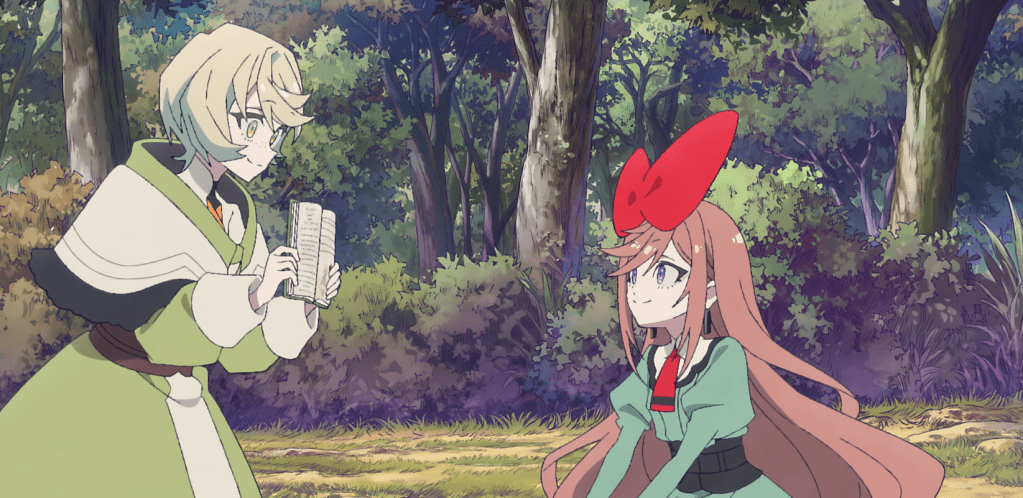
To be clear, The Ribbon Knight makes no attempt to be a direct adaptation of the original story, instead using some character names and concepts from the original to tell a vastly different tale about a princess of Silverland named Sapphire, who must flee the destruction of Silverland when it is attacked by the indomitable monster Nergal. With the “genius creator” Zirco in tow, she must find her way to Goldland and try to make a living there, but an incursion by a smaller version of Nergal unwittingly spurs her into transforming into the Ribbon Knight (so called because she wears – and seems to get her power from – a gigantic red ribbon) to try to fight it off. But there are complications along the way, as Sapphire doesn’t initially understand the true nature of Nergal (which the authorities in Goldland do seem to understand, or at least to a greater degree), and she is thrown mightily when she learns that the destruction of Silverland may have happened because her parents weren’t prepared to sacrifice her to Nergal. Only with the help of friends and allies she meets along the way – especially the girl Pine – can she eventually face the ultimate challenge presented by Nergal and try to avoid the fate of the countless heroes who went before her.
If you’re looking for any degree of narrative or thematic complexity, you won’t find it here. The story is so streamlined that at times it feels like it was edited down from a longer piece, resulting in a work which focuses almost entirely on establishing the exuberant Sapphire and giving her plenty of opportunities to get in action scenarios, with only bare hints of world-building to give the minimal amount of foundation to it all and minor logical leaps in several places. The writing doesn’t seem interested in explaining any of the mechanics, either; yeah, the recurring heart motif is pretty obvious in its implications, and a full explanation for why Sapphire has the power to transform that she does is hardly necessary when the movie is clearly leaning into magical girl trappings as well. However, the exact nature of Nergal, and why sacrifices can fend it off for a time, is never fully explained, and the corrupting influence of its presence, which is so prominent early on, is largely ignored in the late stages. The story also seems to largely forget that it gave Sapphire an artificial left arm, too.
In other words, this is one of the productions where you’re better off not thinking too hard about what it’s doing and just go with the flow. Taken that way, it can be a rousing action story, filled with fantastical fight scenes where the transformed Sapphire is leaping all around like gravity isn’t a factor. On the character front, Sapphire carries the story with verve to spare in both Sapphire and Ribbon Knight forms, but no other cast member is especially well-developed; there’s the girl Pine, who’s eager to claim Sapphire as her first friend her own age, and a knight defender of Goldland who doesn’t sound effeminate but certainly looks and dresses that way. Zirco is little more than a mascot, and a few other characters have distinct personalities but don’t stand out enough to be memorable.
The artistic effort is rich in eclectic detail, with a background style which has shades of fairy tale elements applied to a more gritty fantasy setting. It populates its world with a number of bizarre variations on standard critters, and that’s without considering the monstrous Nergal. The overall visual style shifts at times, sometimes evoking scenes reminiscent of a puppet play, but in default form it mostly strives for an older-school character design style, one where Sapphire’s Ribbon Knight form essentially modernizes the original Princess Knight look but her day-to-day appearance is entirely different, complete with that big, goofy, oversized hair ribbon. The CG animation of the Nergal doesn’t always blend perfectly with the character animation, but for the most part this is a slickly-animation production which emphasizes a wealth of motion and some spectacular use of color. The two full scenes where Sapphire is shown transforming also go hard-core magical girl theme, complete with the movie’s sole scenes of near-nudity.
The English dub was used for this review. It’s anchored by veteran anime VA Courtney Lin (Panty in New PANTY & STOCKING with GARTERBELT, Kana in Magilumiere Magical Girls Inc.), who hits exactly the right note as Sapphire, but none of the other casting choices or performance will be found wanting. Per the norm for Netflix productions, numerous other languages are also available. All dubs are backed by a fine, mostly symphonic musical score.
The story is told in a series of several numbered Acts, perhaps in a callback to the original story’s theatrical origins. (Tezuka drew inspiration for the original manga from Japan’s legendary Takarazuka Revue.) That keeps the pacing brisk and helps smooth some of the more jarring transitions. Overall, that helps this one work well as a lighter – though definitely not always light-hearted – viewing experience.
After an episode which focused heavily on Rudersdorf, it’s no surprise that episode 5 shifts the focus to Zettour. What happens to Zettour here would have been expected even I didn’t already know it was coming from the novels (and thus spoke incorrectly about its timing in an earlier review): in speaking to practicalities, he defied the will of “the people,” which is all-too-often far from rational. Rudersdorf, even though he initially advocated the same, did flip and capitulate to that will, which is why Zettour’s being sent east instead of him, and they seem to both understand that even if Rudersdorf doesn’t want to admit it. It’s a foolish move on the part of the Empire’s leadership, as they seem to be grossly underestimating how critical a role Zettour plays in keeping the war effort going, but as Tanya often laments herself, soldiers don’t make policy; they carry it out. They both understand that, too.
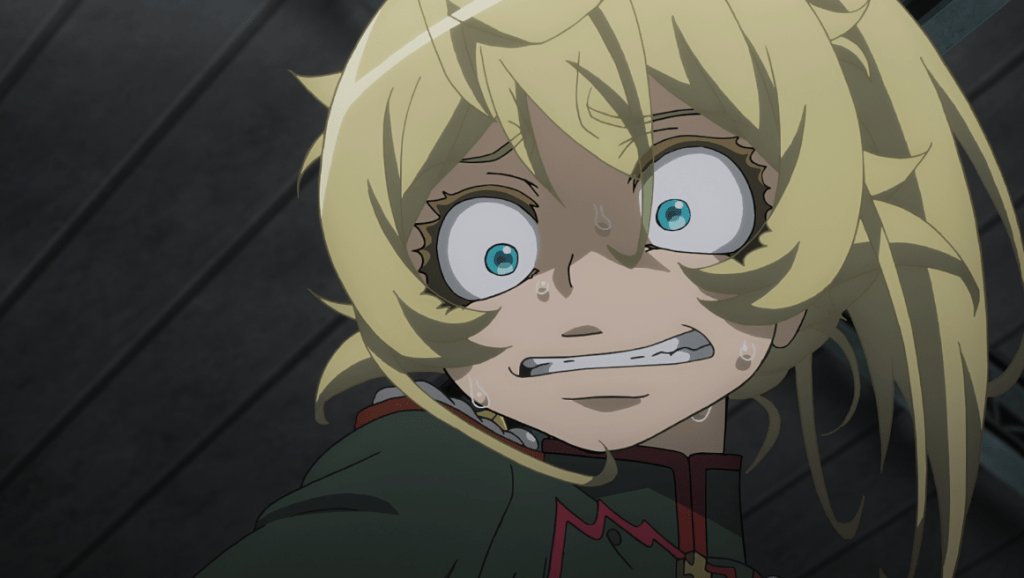
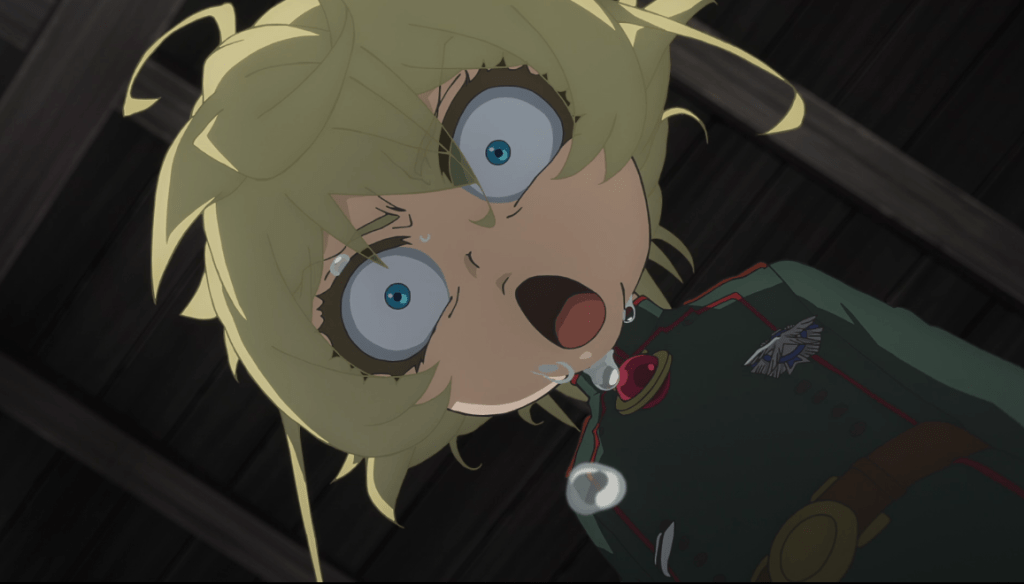
And it’s not like Zettour’s going to go down without a fight. He’s a crafty enough bastard that the Allied forces working with the Federation all but put a bounty on his head, and Tanya is certainly no match for him. Aoi Yuki once again earns respect for Tanya’s squeaky, nervous vocalizations during that wonderful scene, where Tanya’s world is symbolically falling apart around her as her long-term career plans start to crumble. (And kudos again for the production team for Tanya’s wonderful expressions and the way she scampers backwards in shock at one point in that scene, as well as a later scene where Serebreyakov almost casually catches Tanya as she’s about to be blown across the room by an explosion.) But like Zettour, she’s got an impossible job to do herself. And it’s just been made harder by the Federation mages finally coming into play and their leader, at least, proving that he’s on a level with Tanya’s elites. Does make one wonder how much better the Federation would be doing if it hadn’t shot itself in the foot by initially persecuting its mages, doesn’t? (Although there’s also a bit more going on here, as you should eventually see.)
This episode (and presumably the next, too) are a condensed version of novel 8, which almost entirely focuses on Operation Andromeda and the battle at Soldim 528 in particular. That’s still fine, though, as the original novel get bogged down a bit in the minutiae of the urban warfare scenario, while the anime is more firmly retaining its focus on broad strokes and individual character moments. In other words, this is still a case where not being a slavishly-loyal adaptation is ideal, as evidenced by the scene of Mary playing with the dog in the background as Drake is speaking to his uncle. That scene nicely reinforces that Mary is still an ordinary girl when she doesn’t let her vengeance-driven side taken hold of her, unlike what’s likely to happen next episode when she (presumably) crosses paths with Tanya again.
While this episode isn’t quite as crisp in execution as the previous few have been, it’s still another strong entry for the series.
One thing that this franchise has never previously delved into is the personal costs of the war to anyone on the Empire side. (It has certainly dealt with the personal costs to the Sue/Sioux family, though!) That is one thing new that episode 4 offers. Rudersdorf’s visits to an unspecified grave (possibly that of his son-in-law) are used as a framing device for the episode, and the mention that his wife and daughter currently live elsewhere due his daughter’s distress over the combat death of her husband further offers poignant commentary on how even the top generals aren’t immune to being affected by the war. And that helps set up the episode’s great irony.
To be fair,this series has never been a stranger to irony; much of its humor is based on that, in fact. However, never before has its irony seemed as painful as it does here. Operation Iron Hammer was planned and orchestrated with the idea of giving the Empire a stronger bargaining position in peace negotiations, since the leadership knew that a mere return to the status quo wouldn’t fly with the public given the war’s costs. In line with that, a great victory is, indeed, achieved by significantly whittling down the enemy’s forces with another clever encirclement maneuver involving Tanya’s forces infiltrating behind enemy lines – only this time joining paratroopers already there. However, the first irony comes in that Rudersdorf, who led the plan, has at least partly fallen into Tanya’s own trap of being a victim of his own success. That success has convinced civilian leadership that even more can be accomplished. It doesn’t matter how thin the military stretched itself to see this pulled off; the civilians only see the results. And those results tell them that they don’t need to be satisfied with the more favorable offer that the Federation makes in the wake of Iron Hammer.
Reaching for too much has ever been the undoing of a military power, and historically speaking, that’s especially true where Russia is involved. Maybe the military was underestimating the strength of public opinion (or the foolishness of the politicians) on this matter, but Rudersdorf was sunk the moment he said “difficult” rather than “impossible,” not anticipating that the politicians would take him literally rather than reading his implication. And now he’s trapped by a combination of that and his own feelings concerning whoever’s grave he’s been visiting. He must now push forward to achieve whatever standard of victory the politicians and public will find acceptable, even if the additional cost of trying to achieve it will make it nearly impossible to achieve enough gains to offset the costs so far. It’s a damning situation for the leadership.
The other interesting aspect of this episode is the infusion of some military elements more in line with World War 2 than World War 1. Although the first paratrooper missions technically happened during the latter, they weren’t used as a primary military maneuver until the former. The concept of soldiers riding forward on tanks also wasn’t introduced until WW2, although that one’s just Tanya applying some modern-world military knowledge. The way the tension of the infiltration mission was maintained and yet still infused with slight offhand doses of humor (Victoriya and her candy bars!) also was well-executed.
So not much true action this episode, but it certainly didn’t lack for drama. The other shoe’s going to drop on the Empire at some point here, and it increasingly feels like it’s just a matter of how soon it happens.