Has The Angel Next Door Spoiled You Rotten?

Review: The Angel Next Door Has Spoiled Me Rotten eps 1-10

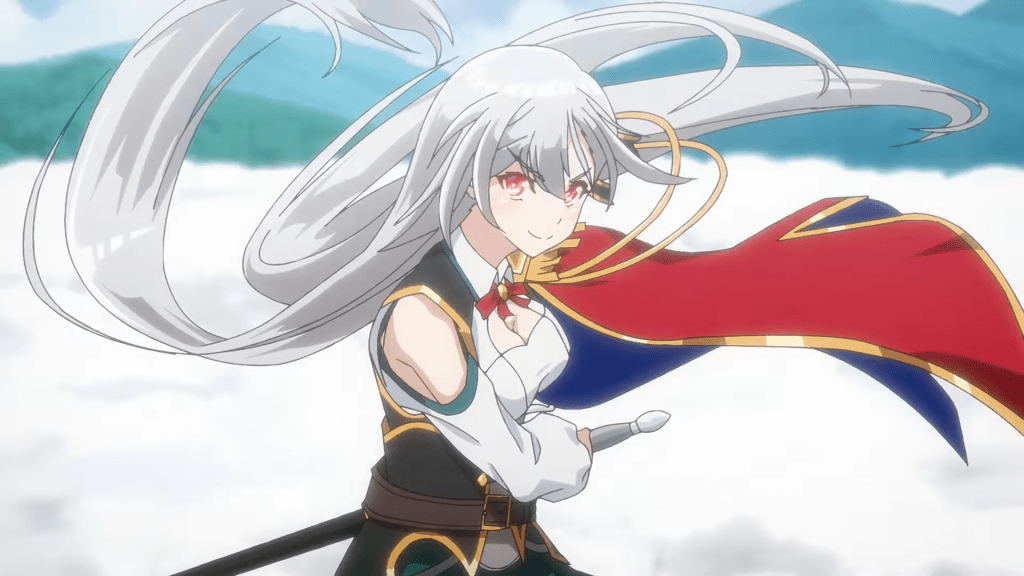
I would absolutely forgive anyone for dismissing this one as just another generic romcom about an ordinary guy who somehow gets the interest of the school’s Perfect Girl. Indeed, its early episodes, while still having some entertainment value, don’t leave much more of an impression than that. However, amidst all of its cliches, cutesiness, and male wish fulfillment is a slow, steady, and surprisingly endearing romantic build-up which can gradually whittle away at any resistances one might have.

It helps some if the series is classified properly. While the overall tone is light, this is more a pure romance story than a true romcom. The premise is a simple one for the genre: male high school student Amane is a nondescript, somewhat insecure young man who just happens to live alone in an apartment next door to his school’s Angel, Mahiru, who is also living alone. This is not something he reveals to anyone, and indeed, they barely interact at all until one rainy day when he finds her, morose and umbrella-less, in a playground near their apartment building. A simple “I lend you my umbrella and get sick from it, so you return the favor by helping me through my sickness” exchange later and the course is set for Mahiru to take it upon herself to go all domestic on Amane. She helps clean up his place, starts cooking dinner for him on a regular basis, and even becomes a regular in his apartment in her at-home clothing. Later on, they go on what essentially amounts to a date, too, even though neither (especially Amane!) is willing to openly admit that they’re more than friends. Throughout the process, only a handful of closest friends ever know about their relationship, and those who do proclaim that Amane and Mahiru practically act like a married couple. In other words, the plot (such as it is) is a very straightforward teen romantic path.

Although this is all absolutely male wish fulfillment, the series does take pains to establish more credibility than normal and work on carefully building the foundations for a deeper relationship. Amane lives alone partly because his mother would be a handful for anyone to deal with and partly because he felt a need to switch schools because of some things which happened at his middle school. (These aren’t big, dark, scarring events, but how they could shake his confidence in himself and encourage him to seek a change of venue is readily understandable.) He does have a close friend – or two, if the friend’s gregarious girlfriend is counted as well – but he’s developed somewhat of an inferiority complex and certainly think that Mahiru is above his level. Mahiru, meanwhile, drops hints early on that she’s living alone because of a wholly unpleasant family situation, and when the truth of that eventually comes out, why she would be looking for an excuse to make more than just a superficial connection with someone else is also easy to understand. Towards her, Amane is polite, comforting, and above all, respectful of boundaries. She doesn’t have to put up a “perfect girl” front around him (she can be rather pouty and a bit sharp-tongued) and can trust Amane to behave himself. Mahiru may be benefiting from just being a convenient outlet for Mahiru’s apparent wish to have a more interactive home life, but he’s also being very careful not to screw it up.

The one limitation here is that the story is told almost exclusively from Amane’s point of view. We never get to hear what’s going on inside Mahiru’ head, hence leaving viewers to intuit her motives. However, once the revelations about her family situation come into the picture, the implication is that she may be trying to simulate a version of the home life she never had a chance to have. Of course, she also gives the impression that she’s just having fun coddling Amane, even as she scolds him about not being more confident in himself. Although she has, since beginning, been an equal proponent to Amane on the “we’re just friends” claim, her most recent behavior and verbal slips have started to suggest that her emotions have shifted to the point that she might not object if Amane did make a move. Amane’s lack of confidence may be the only barrier to them going the full boyfriend/girlfriend route in the season’s final episodes; certainly she wants to see him have more faith in himself.

One of the main draws of the series is Mahiru’s adorability, and the series wastes few opportunities to play that up. Whether it’s her character design, the way she pouts or gets angry, the way she hides behind a couch pillow, or the very domestic way she dresses and behaves outside of school, everything about her is a finely-calculated level of more mature cuteness. The original writer and production team seemed to be aware that this alone would not carry the series, so Amane’s friend Itsuki and Itsuki’s girlfriend Chitose quickly become cast regulars and, later, confidants, and their presence is quite welcome. They offer a much more expressive verve and energy to the proceedings, as well as providing a good contrast to Amane and Mahiru and an example of what a successful high school relationship would look like – something which, sadly, is far too rare in series like these. While they are not usually at the center of events, the series would not work as well without them.

The technical merits are not strong on this one beyond the character designs, but the musical score adds a nice, soft touch and the opener has a neat late ’70s vibe to it.

Overall, this series will not blow anyone away or emotionally overwhelm anyone, but it delivers well enough on its core sentiments and romantic developments to be a sweet and endearing view. It’s definitely worthy of more attention than it’s getting.

Rating: B

Is It Wrong to Try to Pick Up Girls in a Dungeon? IV episode 21

Rating: B+

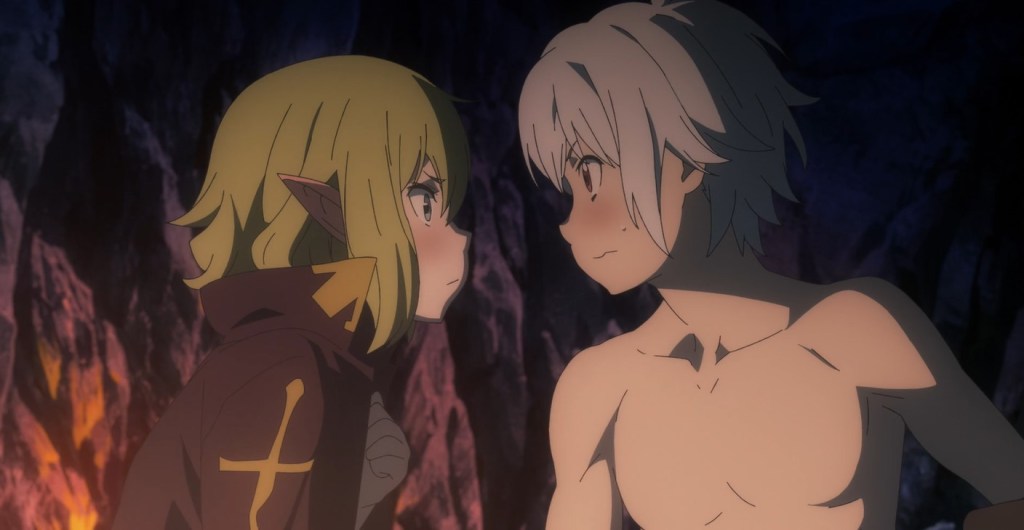
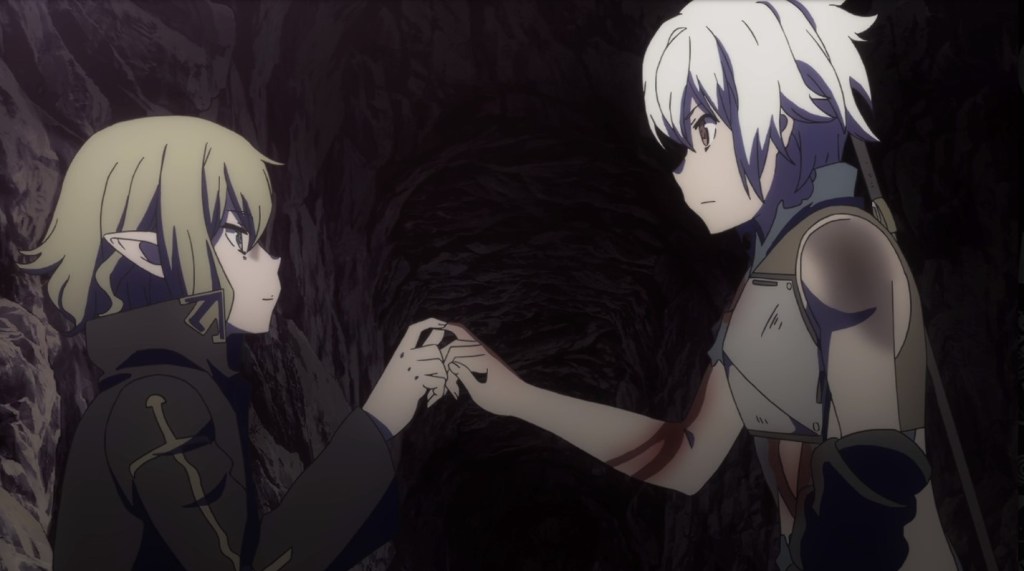
Original novel writer Fujino Omori is on record as wanting to have as many characters as possible fall for Bell, and he’s proven that statement to be at least half-serious; while some female characters have fixed romantic interest elsewhere (most notably Tiona, Mikoto, and Chigusa) and others are either neutral (Asfi), merely admirers (Tione), or otherwise have interest that isn’t specifically romantic (arguably Ais), Bell has quite the unofficial harem in his orbit already. After episode 21, you can all but officially add Ryu to that list, too. She might not be ready to admit it yet herself, but it’s as plain as day to the audience that she is falling for Bell.

As eye-rolling as this may seem, such turns don’t feel quite as gimmicky in this franchise as in many others. One of Omori’s strengths as a writer is the time and effort he devotes to establishing character feelings and motivations, and that has generally translated very effectively into anime form. Ryu’s growing sensitivity to Bell doesn’t come from nowhere; based on the way she was herself in her Astrea Familia days, she doubtless finds his purity of soul and intent appealing, and he has proven time and again that he’s not willing to give up on her even when she’s been willing to give up on herself. As he shows in this episode, he can simply and cleanly cut through her overwhelming survivor’s guilt with an innocent, reassuring reminder that this isn’t at all what Ryu’s familia would have wanted for her, and that she does have purpose in surviving. He’s also able to acknowledge her as a woman (something she apparently didn’t have much confidence about) while being considerate and non-threatening as possible. And, well, Bell has become pretty ripped in the last few months, too, so he’s got the manly stud factor going for him as well. It would be stranger if Ryu wasn’t falling for him by this point, no matter how much she might feel that betrays Syr.

I also have to give kudos to the production team here for not playing up the fan service angle here. Some was unavoidable, but emphasizing Ryu’s sex appeal too much would have been out of place in a mostly-serious scene that was aiming more for a feeling of warmth and security than prurient appeal. The little bit of humor that was worked in here – namely, Ryu’s uncertain assertion that she’d even hug a dwarf if necessary in a crisis – didn’t disrupt the mood at all and gives Ryu possibly my favorite expression for her to date.

But this is the penultimate episode, so the storytelling cannot dwell on Ryu’s building emotions too long. A bit more world-building precedes the long-expected return of the Juggernaut, who has been quite busy himself finding replacement body parts and going all chimera, hence adding extra dimensions to a creature who was already plenty deadly. Though this provides a fresh angle on the conflict, Ryu losing hope again as she goes unconscious near the end of the episode feels a little retread. But she does do everything she can to get Bell back on his feat before she passes out, giving him one more chance to play hero.

With only one episode left, will Bell defeat the hybrid Juggernaut before help arrives? And how will Ryu deal with feelings that she probably wished would go to the grave with her? Return next week for the big finale, which looks like it will safely round out novel 14.

Is It Wrong to Try to Pick Up Girls in a Dungeon IV episode 20

Rating: A-

The inevitable has arrived: the episode-opening flashbacks on Ryu’s past with Astrea Familia have finally led to the pivotal moment where the rest of her familia gets wiped out by a Juggernaut while trying to pin down Jura and his Evilus compatriots. And as expected, the perspectives of the only two survivors of that incident – Ryu and Jura – skew what actually happened.

When Ryu first brought the matter up back in episode 12 of season 1, she made it sound like her familia sisters had died in Rudra Familia’s trap. Jura’s conversation earlier this season clarified that this wasn’t the case, with the cameo by Fels a couple of episodes back explaining why Ryu earlier excluded the presence of Juggernaut in her explanation to Bell. (And it’s not like claiming that they died as a result of the trap was totally inaccurate, since the trap did summon Juggernaut.) The slaughter shown here in explicit detail makes this the most graphic single scene in the entire franchise – and keep in mind that this was done to a group of 11 young women who were all level 3 or 4 at the time. (Astrea Familia was at the top end of the middle tier in Orario’s power structure.)

More importantly, the whole incident shows that the last few surviving members of Astrea Familia – Lyra, Kaguya, and leader Alise – made a conscious choice to save Ryu at the expense of their lives. Part of their decision was clearly practical: Ryu was the least severely injured (and so the best able to escape), and the only one with the magic that could strike the Juggernaut down once its reflective scales were torn off. But some of it was emotional, too: Ryu was the youngest, and in Alise’s eyes in particular, the most pure in her beliefs about justice. If Alise was the familia’s heart, Ryu was the familia’s soul. Ryu never understood that, and her inability to strike down Juggernaut leading to their sacrifice only saving her only compounded the guilt she felt over it. Who wouldn’t be deeply traumatized by something like that?

Most of what transpires in the following scenes, where Ryu systematically goes about destroying Rudra Familia, has been described before in the series, with the added details that she briefly encountered Rudra himself (an anime-original scene) and asked Astrea to leave Orario beforehand so she wouldn’t see Ryu lose herself to vengeance. But what’s interesting here is how Ryu takes the most negative possible interpretation of everything which transpired. She believes that Astrea’s comment about how Ryu should “give up on justice” was an excommunication, but since Astrea never withdrew her Blessing, was it really? From a more neutral perspective, she could have just been cautioning Ryu not to lose herself to a more vengeful interpretation of justice. Ryu regards her ruthless pursuit of vengeance as her forsaking the spirit of justice, but would the citizens of Orario at the time have seen in that way? As ugly as her actions were, she did all but destroy one of the main branches of Evilus, who had been terrorizing the city for years up to that point and had come close to destroying Orario just a couple of years earlier. (This is described in detail in the Memoria Freese event “Astrea Record,” which is currently being rereleased in the game and can be seen in summary video form here.) The Guild – or, more precisely, Ouranos – did blacklist her because they had no choice, but never actively tried to hunt her down, and both Mia at Hostess of Fertility and Asfi of Hermes Familia are certainly aware of who she is but still accept her anyway. Her actions also led to a period of relative peace in Orario for the first time in almost a decade. Could not her actions to eliminate Rudra Familia be looked at as justice? And while her actions certainly weren’t moral and arguably weren’t righteous, was there anything actually impure about her motivations? As much as Ryu believes otherwise, Alise wasn’t wrong about her.

That’s why Bell’s perspective on Ryu is absolutely critical here. He might not know the idealistic version of Ryu, but he has seen her at her best, as the Elf who always gives him good advice, who contributed mightily to the defeat of Black Goliath, and who helped both him and his familia out on multiple occasions. As ugly and tainted as Ryu sees herself, he can see that she still has a good and noble heart. (And if this sounds like a familiar pattern, it is; see Liliruca and Haruhime.) He can help her accept that it’s okay to live on, that dying here would be shirking the unintentionally-cruel burden of carrying on for her familia laid upon her by Alise and Lyra. Perhaps he can even help her understand that, in her dream image, the rest of her familia wasn’t turning away from her as a rejection; they were turning away because it wasn’t her time to join them.

On other random points, the discovery of what looks to be a safe zone in a tunnel directly underneath the Colosseum is a fitting irony for the Dungeon. Also, notice that Ryu was specifically using the daggers left to her by Kaguya in part of her vengeance – the ones that Kaguya specifically told her to use. (And I think that Kaguya would have approved of how she used them.) I also must continue my regular praise of the music here, in particular the use of the insert song which plays out during the Astrea Familia’s final moments against the Juggernaut and the mournful strings arrangement which follows. Ryu’s seiyuu, Saori Hayami, also turns in a fantastic effort, especially in the scene where she’s casting Luminous Wind against Juggernaut.

This episode remains remarkably faithful to the source material and animated up through page 337, leaving about 80 pages for the remaining two episodes to cover. Is it finally time for the Juggernaut to show up again? We’ll see next episode.

Fantasy Farming Done Right

In an interesting coincidence, the Winter ’23 season marks the second in a row that a farming-themed fantasy series has aired. While last season’s I’ve Somehow Gotten Strong When I Improved My Farm-Related Skills (hereafter Farm-Related) and this season’s Farming Life in Another World (hereafter Farming Life) do have a few things in common, they are remarkably different in their approaches. Based on the first eight episodes, the latter is the better one.

Both Farm-Related and Farming Life feature a young man dedicated to building up and/or maintaining a farm, both are mostly light-hearted (though Farming Life sticks to that more purely than Farm-Related does), and both feature a veritable harem of young women of highly diverse natures eventually gathering around the protagonist. That’s about where the similarities end, however. Whereas Farm-Related was a pure fantasy tale set in a world using game-like mechanics, Farming Life is an isekai tale set in a world which doesn’t use game mechanics at all – and unlike certain other isekai series this season, the protagonist’s otherworldly origin has a distinct impact on his actions here.

In Farm-Related, farmer Al Wayne became uber-powerful when his farming skills maxed out, synthesizing into some ridiculously strong advanced abilities. That allows his produce to be superior-grade and leads him to work part-time as an adventurer, which gets him involved in matters including a princess, a descendant of a Hero, a long-missing sister, and a Guild Girl with a trickier-than-usual background. Later episodes reveal that his strength comes partly from a ridiculously-powerful mother (how she knows no limits in her affection and punishments is the series’ most prominent running gag) but mostly from a frightful encounter he had as a child. While the farming always remains Al’s home base and figures into the plot at times (Al would certainly say he’s a farmer first and an adventurer second), this was more an adventure series than a fantasy slice-of-life tale.

Farming Life, on the other hand, is more true fantasy slice-of-life. Protagonist Hiraku died from long-term illness in his original life, but because his death was partly the mistake of a god, said god grants him a new life with a healthy body. The body has no powers, but he does get one perk: the Almighty Farming Tool, which can become any implement Hiraku can imagine – even a weapon. Further, he doesn’t tire while using it, does not need to use seeds to sow crops with it, and all crops sown by it grow extra-fast. He’s plopped down in the middle of a forest that he later learns is called the Forest of Death and uses the AFT to gradually lay out a farm, complete with a toilet and eventually a house, too. He manages to befriend both local wolves (by sharing shelter when the female wolf’s birthing is imminent) and a giant demon spider (it likes the potatoes he grows), and gradually expands his farm. Eventually, a steady stream of newcomers arrive at his nascent village and, for various reasons, decide to settle down there.

In other words, Farming Life is practically Sim Farm, and it uses both its eye catches and other occasional features to further that impression. Each episode features new expansions, rebuilds, and/or additions to the original farm, some done by Hiraku, others done by new arrivals. Each episode also features Hiraku trying out new crops and/or recipes as he attempts to recreate familiar foods and cooking from Japan, albeit not always successfully. Unlike Farm-Related, action scenes are kept to a bare minimum; the first eight episodes have only a couple of significant ones (a giant boar encounter in episode 1 and a wyvern encounter later on), while a couple of other uses of the AFT as a weapon are resolved so quickly that they don’t really count.

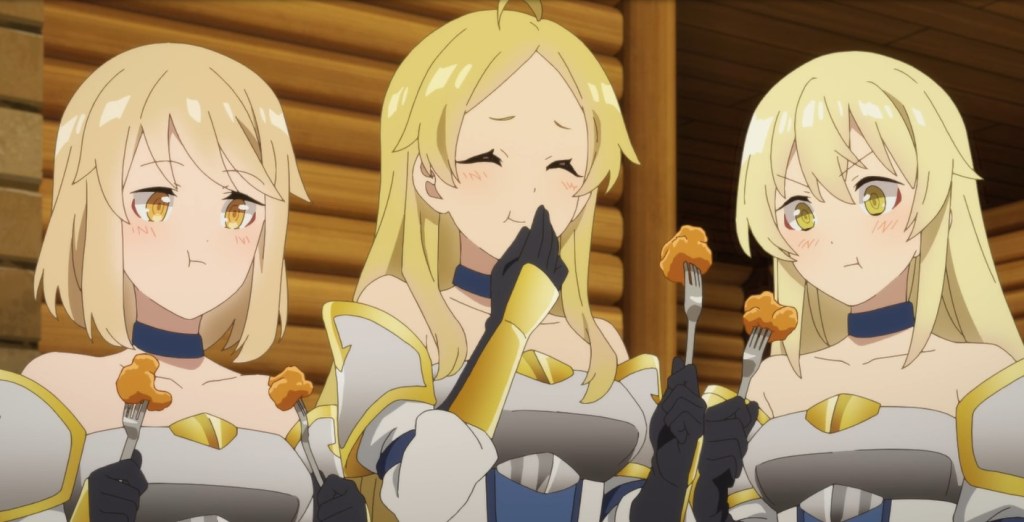
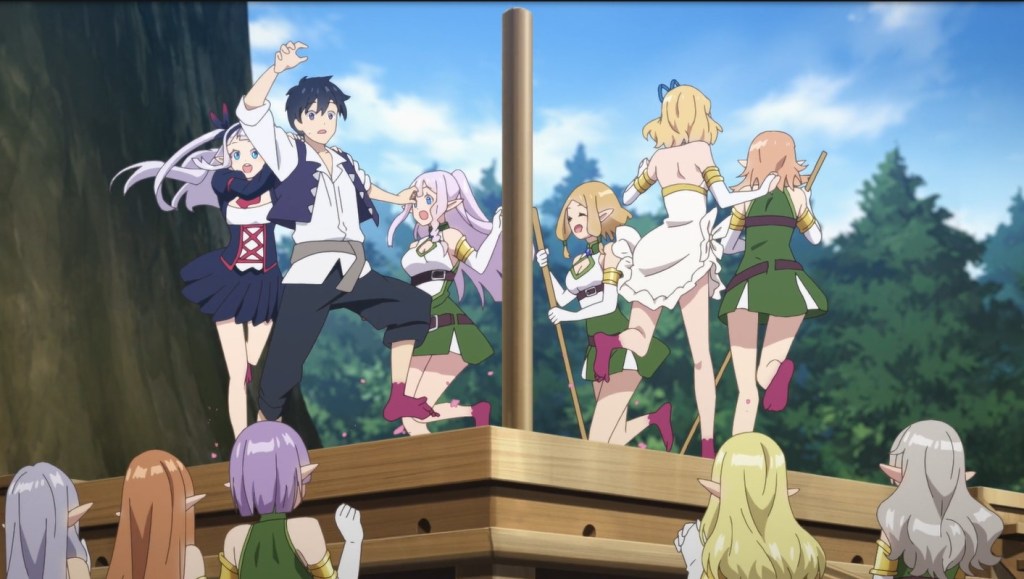
Farming Life also handles its supporting cast differently. While Farm-Related focuses more on diversity of background, Farming Life focuses more on racial diversity. Hiraku starts with intelligent animals like a greater demon spider and inferno wolves and then eventually collects vampires, angels (pictured above), elves, ogre maids, lizard men, beast people, a dragon (in humanoid form), dwarves, and even the daughter of a prominent demon. Outside of the lizard men and dwarves, nearly all of them are female, though at least in the case of the elves, there’s a specific reason that’s somewhat of a plot point: they’ve been a diaspora for centuries, with all of their men killed in the battles that destroyed their original home. All of the humanoids have different reasons for being there, too, ranging from being invited to stay by Hiraku to seeking a new home establishing trade relations to keeping tabs on a village recognized as a rising power by their respective factions.

As much as this might seem like an ultimate harem set-up, sex is not overtly part of this. Hiraku and the vampire Ru are informally married, but that they engage in sex off-screen is only vaguely implied; helping to service Hiraku is also only vaguely implied to be one of the reasons Ru invites the angel Tia to stay. (By reading between the lines, a high sexual stamina could be implied to be a side effect of Hiraku having a supremely healthy body.) They are shown to have their own separate rooms after a house rebuild, too. The elves actively talk about “repopulating our race,” but Hiraku, for now, seems to be avoiding having anything to do with that. No one so far is coming on strong to Hiraku, either. Matched with that is a surprising dearth of fan service; many of the female characters show off cleavage in their regular apparel, but that’s about it. Even one group bathing scene is minimalist about what it shows. This one is on the very low side of PG-13-level content.

Despite the minimal action, limited fan service, and some wholly unimpressive technical merits (especially in its quality control), the series is consistently entertaining, and to a surprising degree. Except for the wyvern incident, it mostly keeps things light and packs a fair amount of humor, which is used to enhance the show’s slice-of-life feel. A folksy musical score keeps the mood just right as Hiraku innocently goes about expanding what comes to be known as the Great Tree Village, while other powers in the area fret over the conglomeration of power building in that village. So far, no villain has appeared and there really isn’t any hint of an ongoing plot, but at this point, that’s just fine.

While I wouldn’t go as far as calling Farming Life one of the Winter season’s hidden gems, its first eight episodes offer plenty enough entertainment value that I can easily recommend the series, especially for those who like the more growth/development-focused isekai titles.

Rating to Date: B

Is It Wrong to Try to Pick Up Girls in a Dungeon? IV episode 19

Rating: A-

Episode 19 is the first one in the second half of season 4 to exclusively focus on Bell and Ryu’s plight on floor 37. That’s primarily because the other groups have now assembled and are in transit mode with a full rescue team, but this was also a necessary move in a thematic sense. Nearly everything which has transpired so far on floor 37 has led to the dramatic events at the monstrous Colosseum, and a full episode is necessary to make that experience properly pay off. And boy, does it ever!

Narratively speaking, the course of events here is easily predictable even for anime-only viewers. As cool, clear-headed, and collected as the current-day Ryu normally seems, she has shown signs in earlier content that she feels she lost her way in her devotion to vengeance, doing some terrible things towards that goal which don’t align well at all with the youthful idealism seen in this season’s flashbacks. Add in a big dose of survivor’s guilt shown earlier in season IV and the prum Lyla’s comments in this episode’s flashback and you have a crystal-clear set-up for self-sacrifice. She’s already indicated to the audience that her goal is to make sure Bell gets out alive, not herself, and what better place than here to make her final stand? It comes at the cost of her Elven pride, any hope of her remains ever being recovered, and any realistic hope that Bell will forgive her for this, but at least the shining star of the future (and the love interest of her most cherished person!) will live on, right?

Of course, Bell will never go along with that. Whether he’s consciously doing it or not, Bell is the Argonaut of the setting’s lore – the boy who would be a hero – and there’s no way he would allow such a sad scenario to play out. His purity and earnestness drive him to make things happen, and he bears a skill tailor-made for getting out of seemingly-impossible situations. Give him guidance, give him the back-up and emotional support he needs, and he will be the hero. And he proves that again here, by taking the item Ryu gave him and combining it with his own power in one spectacularly daring move.

Despite how predictable this all is, it still works beautifully because of how carefully it has been set up and how well the storytelling and especially musical score execute it. I feel like a broken record lauding the sound design and music of these episodes in every review, but the whole Colosseum sequence is further support for this series being one of the all-time anime greats on those fronts. The dread of this horrifying venue seeps into every frame, Ryu’s resignation is palpable, and the triumph of a slower take on the franchise’s signature heroic theme stirs the soul. Some outstanding vocal work by Yoshitsugu Matsuoka (the voice of Bell) also deserves recognition; as an April Fool’s Day joke one year, the Memoria Freese mobile game featured Matsuoka saying “Fire Bolt!” as bell 100 different ways, but he gets two really good, non-joke uses out of it here.

The addition to the world-building here is also interesting. The exterior visual design of the Colosseum is incredible, but so is its very existence. An infinite spawning point with immediate respawn certainly does sound like some sort of testing ground, but as Bell wonders for himself, for what? This would be an enormous concentration of energy and resources for the Dungeon, so it has to be purposeful, further suggesting that the Dungeon itself is sentient. The continuous threat factor makes it easy to understand why even top-tier parties would avoid it, hence giving the Dungeon full reign to experiment. Perhaps this is meant to refine monster designs, but this is a point that the source novel also leaves as mysterious, so further clarity on that should not be expected.

The only reason I’m not giving this episode a top score is because the animation quality control is a little shaky in places and the action scenes cut corners frequently. Bell’s most dramatic actions near the end are still well-animated, but the production is being even more carefully selective than normal about where it focuses its attention. Still, this continues to be great fare with significant rewatch value.

Is It Wrong to Try to Pick Up Girls in a Dungeon? IV episode 18

Rating: B+

In some respects, writing reviews when familiar with the source material is actually trickier, since you have to avoid spoilers and carefully gauge if an anime-only viewer could reasonably discern key points only from what’s been animated so far. In this case, though, I think it’s safe to say that the direction the series is going with the Bell/Ryu interactions as they try to survive the Deep Floors is obvious. Based on the regular, episode-opening flashbacks, Bell is, in a sense, the epitome of what Ryu was trying to accomplish in Astrea Familia. While he may not have been oriented towards ideals of “justice” like Ryu once was, he nonetheless is still young enough to possess naive but powerful ideals, and unlike Ryu, he may well have the ability to carry them out. In other words, Ryu is no longer looking at him just as a child to be fostered or her best friend’s love interest. Given the way this franchise operates, can this be going anywhere but one certain direction?

That aside, DanMachi has always done better than most fantasy titles at fight choreography and design, and Bell’s fights against the Werewolves and Barbarians showcases this once again. By fusing the physical training he did with Ais with the theory provided by Ryu, he is developing the slick fighting style to complement his skills and stats, and the animation this episode showcases that beautifully. Everything that Ryu taught him is on display here, especially his greater emphasis on getting monsters to do his work for him in crowded group fights, whether it’s leaping acrobatically over foes to put a body in the path of an enemy strike or twisting a foe around to use as a shield. He even finally gets a chance to put the Unicorn Horn blade that Welf made for him right before the expedition to good use, showing how effective it is at sapping out even the nastiest poison. (Eliminating diseases and poisons is one of the common powers attributed to a unicorn’s horn.)

But that’s not all that’s afoot on the 37th floor. The Juggernaut has finally shown up again, doubtless on a convergence path with the wayward adventurers. But first they have something interesting ahead: what seems to be a crude Colosseum of some sort in the depth of the Dungeon. Nothing like this has shown up or even been hinted at before in DanMachi lore, so this offers a potentially exciting new variation on this deadly dungeon crawl.

Meanwhile, the 27th floor fight comes to an end as both the Xenos and now Tsubaki and the maids converge on Hestia Familia’s expedition.* This confirms earlier suggestions that the maids are all powerful; like Ryu, they’re all level 4s. (If you want more details on who they actually are, check out the novel Familia Chronicle: Episode Lyu.) Marie also surreptitiously appears again to speak to her fellow Xenos, while Weine and Haruhime get to have a happy reunion and those who don’t know about the Xenos yet are, as expected, left scratching their heads over what’s going on. (Aisha’s grin at one point suggests that she has been filled in, also as expected.) Since Marie knows what actually happened to Bell and Ryu, their direction is set: the original expedition plus its newcomer reinforcements have to make it to the Deep Levels to rescue Bell and Ryu, and with a Level 5 and a trio of Level 4s plus the Xenos running interference ahead, that’s now a feasible task.

In adaptation terms, the Level 27 part fills in a big gap that had developed in the source novel between the floors 27 and 37. (These two parts did not alternate to this point, like they have in the anime.) Combined with the content from Floor 37 and the episode-opening flashbacks, that takes the adaptation to page 272, which is roughly the two-third mark. That puts the arc on pace to finish in probably three more episodes, perhaps four with a little stretching, so it looks like this who cour will just be adapting novel 14 after all. The one minor skip is a recognition that Cassandra has upon seeing a couple of the Xenos which would have tied in to events back in season 3, but since the anime skipped over that short scene then, it deletes the follow-up here, too.

Overall, this is another solid entry in the season. Next episode we’ll get to find out why the Colosseum would have made the dead adventurers turn back.

A Second Chance at Greatness: Reincarnation Stories in the Winter ’23 Season

One substantial recent subcategory of reincarnation series in anime (and its source materials) has been one where a man has achieved the height of power, but for one reason or another winds up dying and reincarnating either in a new world or in a later time period in the same world. The The Summer 2020 season delivered the great The Misfit of Demon King Academy, the Fall 2021 season gave us The World’s Finest Assassin, the Winter 2022 season saw the mediocre The Strongest Sage With the Weakest Crest and kinda-sorta She Professed Herself Pupil of the Wise Man, and the Spring 2022 season saw The Greatest Demon Lord is Reborn as a Typical Nobody. The Winter ’23 season trumps all of them by offering three series in this vein: the second season of Misfit and new series The Reincarnation of the Strongest Exorcist in Another World and Reborn to Master the Blade: From Hero-King to Extraordinary Squire. Taking a look at the similarities and differences of these titles showcases the variety (or lack thereof) provides a microcosm of the subgenre in general.

What’s Alike

Probably the most striking similarity between the titles is the one most indicative of the subgenre as a whole: the protagonist was always male originally. There is one prominent previous case with an originally-female co-protagonist – namely, Inuyasha – but that one is a very different animal from the current pack of reincarnation titles. This isn’t too surprising, since protagonists of reincarnation and/or isekai titles in general have been male (or originally male) the overwhelming majority of the time over the past 15 years, but enough titles in this subgenre have come up recently that you’d think at least one would be willing to break the mold.

Another common element is that, in each case, the reincarnate appears in a setting very different than what he originally knew; in two cases (Misfit and Reborn to Master), the protagonist is reborn centuries later in the same world, while the third case (Strongest Exorcist) is an isekai from a much earlier era of our world. Each of these carries some degree of mystery element, though in markedly different ways; Misfit‘s intrigue is more political in nature, while in Reborn to Master the mystery lies in how the world changed so much, especially in the magical sense, and Strongest Exorcist has at least some mystery element in how the summoning magic from the other world works normally in this new setting. All three series also involve situations where the protagonist has not only carried over much of his original power to his reincarnation but also is operating in a magic system where their carried-over power is either somewhat (Misfit) or very (Reborn to Master, Strongest Exorcist) different than the current standards and conventional wisdom, to the point of being a plot device at times. These are also common traits of the subgenre.

The other significant commonality amongst the three is that, in each case, the reincarnate has a shortage of close, personal attachments in his previous life and actively seeks to remedy that with his new one. This is not explicitly stated in Misfit but can easily be interpreted from the value Anos places on his parents and the extents he goes to in helping or protecting those close to him, while Inglis specifically states that he felt isolated as king and doesn’t want that again. Meanwhile, Haruyoshi was distanced to the point of a fatal betrayal and so, as Seika, is actively seeking to make closer bonds in his new life. (His is the most practical and mercenary of the approaches, though.)

What’s Not

The three titles do also have some significant differences. The most basic of these is how they ended up reincarnating. Anos sacrificed himself to end an epic war and ensure peace for 2,000 years, so he set his reincarnation in motion himself. Inglis, on the other hand, died of old age and reincarnated as a reward from a goddess. Haruyoshi, meanwhile, died from being betrayed, though he is also implied to have triggered his own reincarnation. The goals and approaches each take in their new lives are also very different: Anos actively seeks to be recognized as the Devil King incarnate, Inglis seeks to focus on fighting tough foes and developing martial skills to the ultimate level without being weighted down by responsibility, and Haruyoshi seeks to live incognito, or at least not with the spotlight on him. That doesn’t, of course, stop either of the latter two from freely using abilities decidedly OP by setting standards, but Haruyoshi/Seika is at least trying to be surreptitious about it. New-world heritages also vary; Anos is a commoner by birth, while Seika is a highly-ranked noble. (Inglis’s exact status is less clear, but she is the daughter of a knight captain and the niece of a duke, so she is probably a mid-ranked noble.) And of course Inglis differs from the other two by having undergone a gender switch.

How secondary characters fit into the scenarios also varies some. Anos is close with his parents throughout but has no siblings. Inglis also has no siblings, but her parents fade into the background after the first couple of episodes. Seika’s father is around on and off (especially at the beginning), but his mother never appears, and his two elder brothers are also out of the picture after the first couple of episodes. In terms of associates, Anos has both male and female friends that are fiercely loyal and a literal fan club, while Seika has a loyal servant his age who is referred to as a slave but never treated as such and a summoned spirit who’s a regular companion. He also comes to associate with two other like-aged girls, both of whom have Hero qualities. Inglis, meanwhile, is close to her like-aged female cousin (whom she is officially a squire to, though really in name only) and befriends the sister of a traitor, though she seems likely to be picking up other regulars as the series progresses into her Academy days. While there are indications of crushes afoot in the former two cases, and Seika’s closest spirit can be frisky when she takes human form, nothing explicitly romantic is going on in any of the titles at this point.

All of those differences are relatively trivial, however. The most striking distinction between the three titles is their general attitudes. Misfit is a title for those who enjoy a supremely cocky protagonist who can back it up and always seems to be on top of the situation – and even when he’s not 100% in control, he doesn’t let it show. It is also the least inclined of the three towards fan service. Reborn to Master, meanwhile, is all about a protagonist seeking to have fun, with a recurring joke being that what she imagines as “fun” would be horribly dangerous for anyone else. Seika, contrarily, is more of a measured and analytical sort, though he also seems to appreciate rising to a challenge. As a result, his series has the most serious tone.

The Evaluation

Thanks to its strong first installment, Misfit came into this season as, by far, the most-anticipated of these three titles. While its second season has by no means been a flop, it is still falling short of capturing the magic of the first season. The necessary change in the lead casting has a little to do with this, but only a little; the bigger problem is a story which is rather hard to follow and some seeming inconsistencies in how some tertiary characters behave. It still offers enough to be worth following by any fan of the first season, but it is not a priority view. It does, at least, have the best technical merits of the three, though that’s not saying much.

Grade so far: B-

Reborn to Master the Blade is easily the most purely fun series of the lot, thanks primarily to Inglis’s attitude. It is also the most sexy of the three, though fan service is not more than a minor component at this point and usually more evident in the OP and ED than episode content. I am a little disappointed that the series does not put more emphasis on how Inglis adapts to being a different gender, but it does at least acknowledge it beyond just Inglis’s initial dismay; the scene where she goes to the party and finds herself being subjected to the same kind of lewd stares she directed towards women in her former life, and realizes first-hand how uncomfortable that can be, was a nice touch. It has had some weak points on technical merits, but overall it’s a solid middle-tier title.

Grade so Far: B-

At this point, the weakest of the three entries is Strongest Exorcist. On the plus size, some of the summoning elements are neat (especially the ape-like creature which can read minds), and the scheming Seika does to avoid attracting too much attention can have some appeal. The problem is that it’s trying to use that gimmick in the same season as the vastly more twisted and entertaining take on it in The Eminence in Shadow. The story elements have also been rather bland, and some may be turned off by Seika matter-of-factly referring to Efa as a slave. While I have kept up with the series, its hooks are not strong enough to distinguish the title and its technical merits certainly won’t carry it.

Grade so far: C+

Is It Wrong to Try to Pick Up Girls in a Dungeon? Episode 17

Rating: A-

There’s a great line from the recent series 86 which immediately came to mind a couple of times while watching this episode: “It’s a child’s right to dream. I do respect that. And until that child wakes up from her dream, and finds herself crushed against the merciless rocks of an unyielding reality, an adult protects her.” Who is the adult and who is the child changes as this episode progresses, but the sentiment still applies.

In the opening flashback, the child is a younger Ryu (according to her novel/Memoria Freese stats, she was age 16 at the time), one still brimming with idealistic notions about justice, while Kaguya (who, according to official stats, was only a couple of years older at that time) is the jaded adult disgusted with how Ryu is missing the bigger picture. Despite that, Jura’s words in an earlier episode suggest that Kaguya was among those in Astrea Familia who sacrificed herself so that Ryu could get away from the Juggernaut, hence fulfilling her role as the adult to the very end. (No, this hasn’t been specified yet in the anime, but such a progression of events is entirely credible based on what we’ve seen of the familia, as is Ryu feeling like she abandoned them even though they pushed her to go.) She hit hard on the “unyielding reality” in that case, with her “justice” turning to unadulterated vengeance; doubtless she has plenty of regrets about that, too. Now it’s her turn to play the adult to Bell’s child – only this time the idealism is about mutual survival! – and she’s determined to follow in the footsteps of her familia big sisters. The difference is Ryu’s far more fatalistic take on the situation. Kaguya may have been a brutal realist, but she showed no sign of seeking death or absolution or having some notion about Ryu being more deserving to live. Hence the tribulations on the 37th floor are as much about saving Ryu’s soul as they are about just surviving. And that means that, once again, Bell has a chance to inspire a character to strive for more.

While that’s the crux of what is transpiring on the 37th floor, it’s also not the full story. Ryu seems well-suited to being an adventurer coach, and Bell is well-suited to being a student; he may have talent, the advantage of his unique skill, and Level 4 status, but he’s still pretty raw as experience and practical knowledge go. That part of the episode also works in some great additional world-building, including the nature of both the 37th floor’s unique construction and the Deep Levels in general. Some additional monsters types are thrown out (although Spartoi did also appear briefly in Sword Oratoria), and the idea presented in previous episodes that the Deep Levels are no place for a solo adventurer is reinforced; even when Ais came down this far to fight Udeaus in Sword Oratoria, she still had Riveria with her.

On other fronts, Bell’s main party has made it to the 27th floor, and thus to the aftermath of what happened back in episodes 9-11. But even with Welf’s potent new sword, they’re still in danger of being overwhelmed by monsters. This does, at least, give all of the melee types a chance to show off their individual styles in a pitched group battle, with Daphne skewering the eel-like denizens while Ouka and Aisha lop heads off. Who ultimately comes to their rescue should not be very surprising, though how this will be handled next episode should be interesting to see; Aisha should know about the Xenos because of being part of Hermes Familia, but the rest of the non-Hestia Familia members don’t. Based on the end of the episode, their plan seems to be to pretend to still be monsters while fighting off the Floor 27 denizens, but how is that going to work once Tsubaki and the maids (who have also made it to floor 27 and are now just a short distance behind the Hestia/Takemikazuchi/Miach party) arrive?

And speaking of that, this is the episode where we finally get to see what the maids can do. Despite her ditziness, Ahnya looks quite capable with her spear, Chloe is no slouch with her knives, and Lunor can take monsters down with just a punch. They all look about as strong as Ryu does, which would put them all at level 3 or 4. Consider that Mia is strong enough to impose her will even on them and that just furthers the notion that Hostess of Fertility is the last tavern in Orario where you want to create a ruckus.

Overall, the artistic side looked a bit more steady this time, so the episode gets a grade bump for putting all of its pieces together well. Next episode should be fun!

Sword Art Online The Movie – Progressive: Scherzo of Deep Night

The second of the Sword Art Online Progressive movies, Scherzo of Deep Night debuted in October 2022 in Japan and is now making the rounds in the States (and elsewhere) as a limited-run theatrical release. It does assume that the viewer has watch the first movie (Aria of a Starless Night), but no other familiarity with the franchise is required to appreciate it. Those familiar with the original series will appreciate certain parts of it more, however – especially the dramatically greater role of Argo, who appeared only briefly in the original Aincrad content.

Scherzo of Deep Night is the subtitle of the fourth Sword Art Online Progressive novel, which means that the animated version of the storyline is entirely skipping the parts of the first Progressive novel dealing with floor 2 and the entirety of novels 2 and 3. Despite that seemingly-big continuity gap, the movie may actually play better for viewers who have not read the novels. All that an anime-only viewer will missing is more details on a couple of points referenced here, such as Kirito having an earlier conflict with Morte, how Asuna upgraded her rapier, and how the two leading guilds – the Aincrad Liberation Squad (one of the groups that will later merge to form The Army of the original Aincrad arc in the first TV series) and the Dragon Knights Brigade (who weren’t even mentioned in the original Aincrad arc, and so likely either disbanded, were killed off, or absorbed into another guild over time) came to both spring up as competing successors to Diavel and key components of the game’s initial clearing group. However, none of this lack of background knowledge is crippling to understanding what’s going on here, as key background points are laid out sufficiently enough.

On the plus side, anime-only viewers will not be distracted by the other major element that’s missing, and so may appreciate the overall cohesiveness of the movie better. That major element is Kizmel, an autonomous AI-driven dark elf knight NPC, whom Kirito and Asuna fall in with starting on floor 3. Her absence has been very controversial with novel readers, but as much as it would have been nice to see Kizmel in animated form, this novel reader regards it as the right call. Kizmel’s presence is primarily in the context of a multi-floor quest arc Kirito and Asuna get involved with, which chews up a lot of time starting with novel 2 but is also mostly an aside to the main plot lines involving the efforts to clear the game and the rise of the PK guild Laughing Coffin as the setting’s chief player antagonists. In a TV series format, her presence may have been feasible, but major cuts had to be made to make this part of the story work in movie form, and Kizmel is the easiest big cut to make. Also, while Mito hardly fills the role of Kizmel, her continued presence essentially takes up Kizmel’s story space, and her more intimate connection to Asuna is more impactful anyway.

Aside from Kizmel’s absence, the movie hits all of the major story points of novel 4: the two guilds which have formed which compose the bulk of the clearing group aren’t getting along well despite certain members of each being romantically-connected, Morte and his associates are trying to push that into open conflict for their own twisted ends, Kirito and Asuna temporarily get separated by a trap in a dungeon, Asuna has to go to extraordinary lengths to recover something she loses, and Argo emerges to become much more directly involved in activities on the fifth floor, especially involving dealing with the tricky fifth floor boss and stopping a potentially problematic conflict over an item drop which could give a major advantage to one guild or the other. It tackles this by splitting the viewpoint more evenly between Asuna and Kirito’s points of view, though Asuna still gets decidedly more scenes exclusively featuring her than Kirito does. By contrast, Mito still has a presence, but her role is much reduced; prior to the climactic boss battle, she only appears in one scene, though this time both Asuna and Kirito independently interact with her. In the latter case, she serves as the sounding board for Kirito to voice some of his inner thoughts about Asuna and how he can see – even at this point – that she has the potential to become a leader in the game.

The most interesting addition here is the much greater role for Argo, the catty information broker who is rarely in the front of action but plays an integral behind-the-scenes role as the main person behind the production of the player guides. Though Asuna has met her previously to this, this part shows most effectively how the two become friends and how she’s hardly a push-over in a fight if she does get cornered, though her fighting style is far different from that of both Asuna and Kirito. The other highlight part for me was Asuna’s efforts to retrieve her lost item when she’s separated from Kirito. This is the first time since her semi-suicidal solo dungeon exploration midway through the first movie that she has had to act on her own, and she acquits herself well with the strategies she comes up with. Her sharp instincts and quick-thinking under pressure also come into play in the movie’s tense final scene. Hence, while Asuna shows some clear weaknesses here, and still feels at this point like she needs to be watched over, she also shows signs of the grit and capabilities which are the foundations of her eventual rise to being one of Aincrad’s most prominent players.

And of course it wouldn’t be SAO without some glamorous battle scenes. The movie opens with the boss battle on the fourth floor and feature a couple of cool, interesting duels before achieving its action climax with the battle against the Level 5 boss. I won’t spoil the specifics, but that boss offers an interestingly different kind of challenge, one which gives all the major participants – Asuna, Kirito, Argo, and Mito, among others – a chance to shine. Supporting technical merits are about the same as for the first movie, but the musical support, while still effective, did not achieve as much impact.

An English dub is supposedly circulating, too, but that was not available in my area.

Overall, the second movie does not achieve anywhere near the gravitas of the first, and largely because of that, it does not have as much impact or leave as much of an impression. It is still a solid game-oriented fantasy caper worthy of the franchise, and the direction is it taking (in terms of the skips it is making) is an acceptable one; frankly, the Progressive novels are a bit too thorough, and the movie does a respectable job of stripping the story down to its essence while still maintaining a place for new elements like Mito. Whether you’re a novel-reader or anime-only viewer, the movie is worth a look and going for the theater experience if you can.

Rating: B

Is It Wrong to Try to Pick Up Girls in a Dungeon? IV episode 16

Rating: B+

The split between three fronts continues in this episode, but this time the third front isn’t the rescue party, but rather Hestia talking to Hephaestus about where Tsubaki went. That short scene mostly just exists to reinforce scenes on the two main fronts, and so really isn’t of much importance.

What is transpiring on both Floor 37 and Floor 27 is much more important, especially in the latter case. This is Welf’s time to shine, as he tries to do a feat seemingly impossible in this setting: forge a magic sword in the Dungeon outside of a safe zone. Such a feat would normally be impossible because the constant threat factor does not normally allow the time and focus for such an endeavor even if one does have a portable hearth, but Bell’s whole party (and Bors!) band together to give him the chance to make it happen. That also proves key to giving Welf the focus necessary to pull his stunt off, with this episode suggesting that intrinsic motivation and conceptualization is at least as important in the process as raw skill.

The result is more impressive than it might seem. While the production team does a fair job of making the new magic sword’s display of power flashy (despite the CG on some of the flames being a little too obvious), it cannot quite capture the essence of just how important Welf’s new magic sword is. A magic sword which channels the wielder’s magic (rather than using its own), and thus will never break, might be fairly commonplace in other fantasy settings but it is a game-changer for this one. In FRPGs like Dungeons and Dragons, it would be equivalent to using spell slots rather than charges to power magical staves. As long as anyone in the party has any magic to contribute, Welf’s juiced-up sword can keep firing. And that gives Bell’s party the ability to break their despair.

Comparatively speaking, Bell and Ryu get less attention, although what’s going on there is important, too. Most tabletop RPG gamers wouldn’t think twice about rolling fallen bodies for equipment and loot, but it’s not hard at all to understand how someone like Bell – with his strong morals and sense of propriety – would find such a task odious to the point of sacrilege. But one of the critical lessons of survival in a hostile environment is to take advantage of anything you can, and in that case that means lifting armor and weapons from the trio of fallen adventurers. Promising to take the familia banner back to the surface may be a bit of rationalizing to justify what Bell sees as an offense, but again, you do what you have to do to get by. Every storyline in the franchise has been as much a learning experience for Bell as a test of his mettle, and this situation is no different.

The title of next episode suggests that the focus will be more on Bell and Ryu’s attempts to get out of Floor 37. Will a certain nasty beastie show up again after being sidelined for the last three episodes? Even if not present, plenty of danger still awaits. . .