Rating: A-
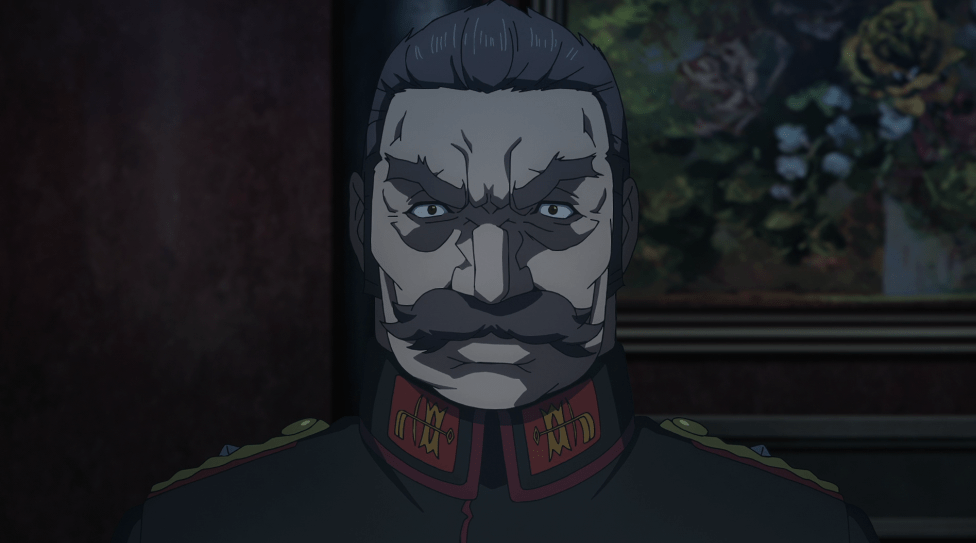
One thing that this franchise has never previously delved into is the personal costs of the war to anyone on the Empire side. (It has certainly dealt with the personal costs to the Sue/Sioux family, though!) That is one thing new that episode 4 offers. Rudersdorf’s visits to an unspecified grave (possibly that of his son-in-law) are used as a framing device for the episode, and the mention that his wife and daughter currently live elsewhere due his daughter’s distress over the combat death of her husband further offers poignant commentary on how even the top generals aren’t immune to being affected by the war. And that helps set up the episode’s great irony.
To be fair, this series has never been a stranger to irony; much of its humor is based on that, in fact. However, never before has its irony seemed as painful as it does here. Operation Iron Hammer was planned and orchestrated with the idea of giving the Empire a stronger bargaining position in peace negotiations, since the leadership knew that a mere return to the status quo wouldn’t fly with the public given the war’s costs. In line with that, a great victory is, indeed, achieved by significantly whittling down the enemy’s forces with another clever encirclement maneuver involving Tanya’s forces infiltrating behind enemy lines – only this time joining paratroopers already there. However, the first irony comes in that Rudersdorf, who led the plan, has at least partly fallen into Tanya’s own trap of being a victim of his own success. That success has convinced civilian leadership that even more can be accomplished. It doesn’t matter how thin the military stretched itself to see this pulled off; the civilians only see the results. And those results tell them that they don’t need to be satisfied with the more favorable offer that the Federation makes in the wake of Iron Hammer.
Reaching for too much has ever been the undoing of a military power, and historically speaking, that’s especially true where Russia is involved. Maybe the military was underestimating the strength of public opinion (or the foolishness of the politicians) on this matter, but Rudersdorf was sunk the moment he said “difficult” rather than “impossible,” not anticipating that the politicians would take him literally rather than reading his implication. And now he’s trapped by a combination of that and his own feelings concerning whoever’s grave he’s been visiting. He must now push forward to achieve whatever standard of victory the politicians and public will find acceptable, even if the additional cost of trying to achieve it will make it nearly impossible to achieve enough gains to offset the costs so far. It’s a damning situation for the leadership.
The other interesting aspect of this episode is the infusion of some military elements more in line with World War 2 than World War 1. Although the first paratrooper missions technically happened during the latter, they weren’t used as a primary military maneuver until the former. The concept of soldiers riding forward on tanks also wasn’t introduced until WW2, although that one’s just Tanya applying some modern-world military knowledge. The way the tension of the infiltration mission was maintained and yet still infused with slight offhand doses of humor (Victoriya and her candy bars!) also was well-executed.
So not much true action this episode, but it certainly didn’t lack for drama. The other shoe’s going to drop on the Empire at some point here, and it increasingly feels like it’s just a matter of how soon it happens.

