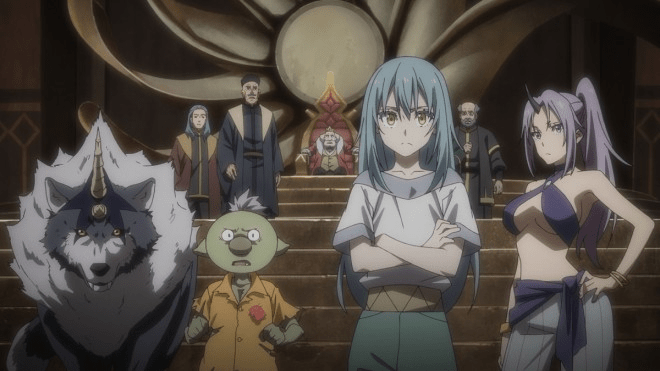
This movie tells an original story which specifically takes place after episode 1 of season 4 of the TV series (in fact, it incorporates a small part of episode 1) and likely before episode 2, even though there doesn’t seem to be that much of a time gap. In nearly every respect it feels just like one of those original movies for long-running shonen action series and plays out in a very similar fashion. But much like the Sword Art Online movie Ordinal Scale (which takes a similar path), it ends with a post-credits scene that is likely a lead-in to future canon developments – in this case, the minion that Diablo left to recruit in s4 episode 1.
Generally speaking, the connection to previous plot developments isn’t huge, so a viewer doesn’t necessarily need to be completely caught up on the series to follow it; only a familiarity with most of the major characters is truly required (though those not caught up will certainly not get certain references, especially Gobta’s claim to be one of Tempest’s Elite Four). In the wake of Tempest’s foundation festival, Elmesia, the elf monarch of Sorcerous Dynasty of Sarion, invites Rimuru and several of his key subordinates and allies (including Ramiris, Veldora, Milim, Valentine, and Hinata) to a resort island within her domain for a holiday. During their play they eventually cross paths with a priestess of the nearby underwater city of Kaien, who is fleeing ninja-like agents from her home city because she has run off with an invaluable flute (which can summon the city’s protector, the Water Dragon) due to her fear of it being used for nefarious purposes. Rimuru and friends get directly involved when Kaien’s messy internal affairs start threatening the resort island directly, resulting in the Water Dragon having to be dealt with.
Though virtually all of the promotional art and trailers feature Rimuru, Gobta is actually the featured character for much of the story and a virtual co-protagonist. He’s the one who first encounters the priestess Yura and the one who forms an initially-combative but later friendly relationship with Yura, and he’s the one featured (sometimes along with Yura) in most of the action scenes in the first two-thirds of the movie; only once the scale of the battles steps beyond what Gobta could reasonably handle do Rimuru and the other powerhouses take over. Though this means Rimuru has less time to show off, this feels like the right call in a narrative sense, as it gives Gobta a taste of the romance he’s longed for, romance for which Rimuru (who’s always studiously avoided it) would have been ill-suited. Besides, Rimuru is simply too powerful at this point for low-level fights like the efforts of the ninjas to capture Yura to offer any challenge.
Gobta getting so much attention doesn’t change how predictable the story beats are, though. Even the big late twist about who Yura actually is can probably be seen coming. (Some aspects may seem especially familiar if you’ve seen the DanMachi movie Arrow of Orion.) The setting of Kaien also suffers for a lack of distinctive cultural development and the story has a tendency to flat-out ignore cast members who should be present when it’s inconvenient, resulting in the story feeling somewhat rushed despite a 105 minute running time. For all those flaws, though, some key emotional aspects near the movie’s end do land, and it certainly doesn’t come up short on the action front. On the lower-power-scale end, Gobta and Yura’s fights and evasion against her pursuers provide some well-animated thrills, while Rimuru dishes out the high-powered action towards the end, also to impressive results.
In general, the animation effort is a distinct step above the TV series, while the artistic merits overall are only a slight improvement. Nothing about the design of the resort city dramatically stands out beyond seemingly taking some influence from certain Greek island (I was on a cruise in that area last year, and kept coming back to that during the island scenes), but it was generally more impressive in design than the underwater city. The musical effort was sufficient but not especially memorable. Because I saw a subtitled-only screening, I cannot comment on the English dub.
Overall, this isn’t a must-see entry in the franchise, but probably sufficient to satisfy established franchise fans. If you’re current on the TV series and decide not to check out the movie as a whole, I do recommend at least taking a look at the post-credits scene when it becomes available in streaming form.
Overall Rating: B-

