Spring 2025 Preview Guide

Final Update: 3:40 p.m. 4/13/25

Note: With the addition of Go! Go! Loser Ranger! the Preview Guide is now complete.

Welcome to my seasonal Guide! (The debut schedule can be found here.)

Season 2 of The Apothecary Diaries is continuing with episode reviews from last season, so it is not covered here. Other series continuing from last season (I Left My A Rank Party, I’m Living With a NEET Kunoichi) are also not being covered here. Moonrise is also not being covered here since that dropped in its entirety on Netflix; it may get its own review in a couple of weeks.

Beyond those, I expect to cover every full-episode series that will be debuting this season and is available in streaming form, including many of the sequels/returning series. I will be covering the new Gundam series (its entry here is based on the preview in theaters), as well as the second seasons for By Bye, Earth, I’ve Been Killing Slime for 300 Years, and Go Go! Loser Ranger! I will not be covering the returns of Wind Breaker, Fire Force, Black Butler, SHOSHIMIN, Uma Musume, Himitsu no AiPri, Aharen-san wa Hakarenai, or My Hero Academia, since I am not current with those series.

Debuts are listed below in with the newest ones at the top.

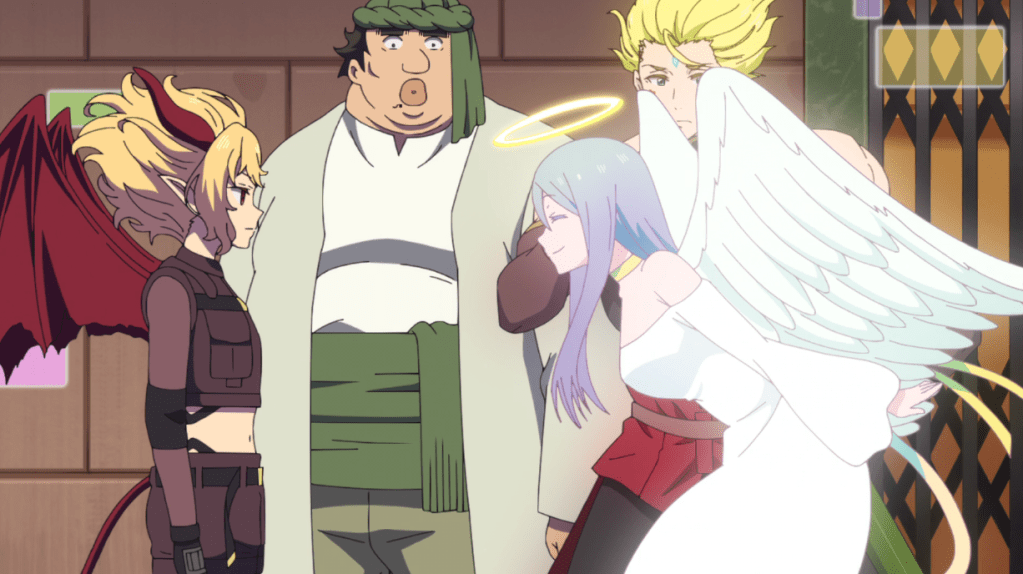
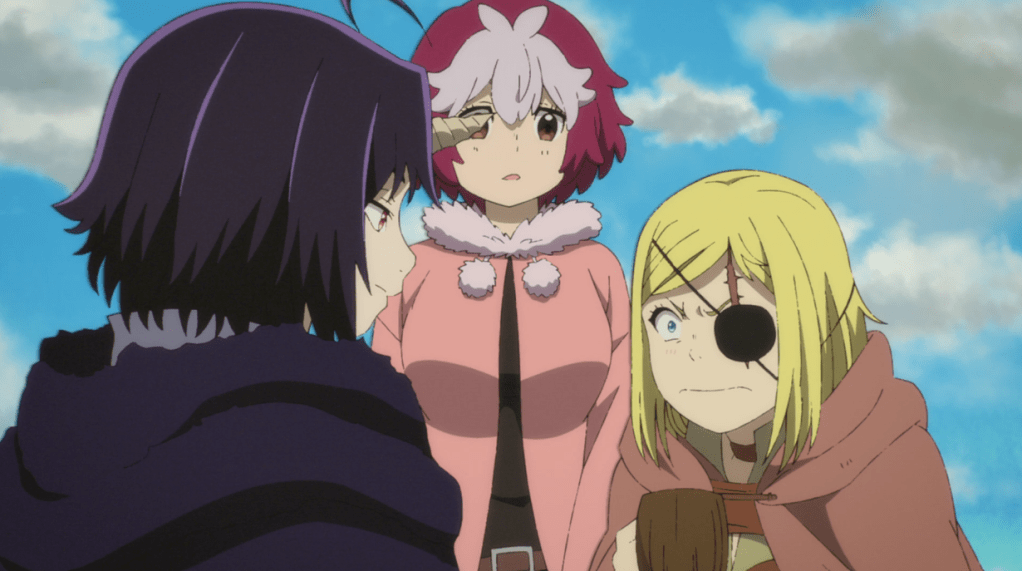
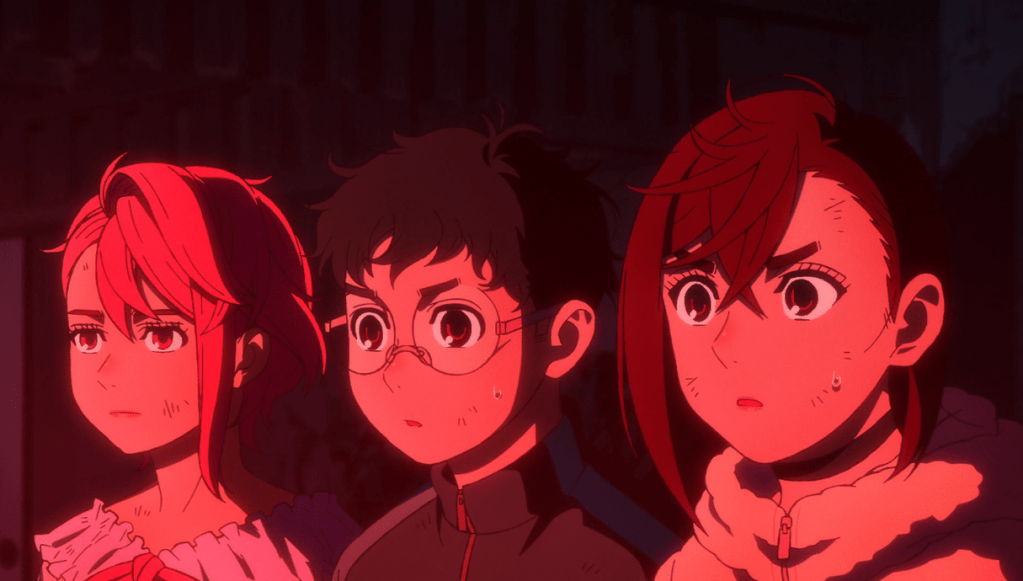
Go! Go! Loser Ranger! s2 (ep 13)

Streams: Hulu on Sundays

Rating: 4 (of 5)

The qualification exams are over, and D, still posing as Sakamura, has passed, so he awaits his appointment. During a day out with Sakamura’s elder sister (aka Pink), he encounters a strange man named Chidori who seems to be investigating the string of recent disappearances but may not be what he claims. Later, he learns about his new assignment, and though it wasn’t what he expected, he’s not disappointed by it. Meanwhile, things are far from sympatico at the top, as the absence of Blue is throwing off normal routines (and poses!) and causing Red to lose his cool more than normal, and a string of recent disappearances suggests that additional boss monsters may be in hiding in the city.

Overall, the second half of the series gets off to a strong start. It smoothly calls upon details from the first half without actually doing a recap, gives us a good reminder about where many of the major players stand, and advances potential plot threads for the upcoming half. It also provides some additional insights into how the Dragon Keepers work as an organization; for instance, we knew from the first season that each of the colors has a specialty it focuses on, and now we know what Green’s focus is. It even has an amusingly different take on the “male character face-planting in a female character’s ample bosom” gimmick, and while the new OP and ED aren’t as strong as the ones for the first season, they’re not bad, either. If you watched out the first half, I see no reason why the second half will dissuade you from doing the same.

Food for the Soul

Streams: Crunchyroll on Saturdays

Rating: 3.5 (of 5)

First-year university student Mako Kawai was socially involved as a child but has become more timid as she’s grown older, leaving her without close associations at school and reluctant even to go to a sit-down restaurant on her own. (This point I can empathize with well, as I was initially uncomfortable with this, too, when I first moved away from home.) But that starts to change when she discovers that a former friend from elementary school is attending the same college and looking for a fourth person to start a Food Culture Research Club. Mako is a bit of a foodie, so after some initial reluctance she lets the prospect of exploring more good food entice her to join. But she’s shocked to learn that the club is not intended to be what its name states.

This is an original anime from the creator of Non Non Biyori (who is also making a simultaneously-published manga version) and studio P.A. Works, and it’s being co-directed by the director of the anime version of Non Non Biyori as well. Based on the first episode, it’s arguably the most promising-looking of the CGDCT-styled series this season. The base cast is immediately likable, the attention to food-related detail is done in an appealing way (and I’m personally a big fan of sauce katsudon, which is featured in this episode), and there’s even a sense of an actual plot complication in the twist at the end of the first episode. Most importantly, it’s easily the best-looking series of its type this season; P.A. Works rarely disappoints on the technical front, and the certainly don’t here. As a casual, relaxing view, this one looks more promising than mono, and having an ensemble cast from the beginning may give it a leg up on Zatsu Tabi, too.

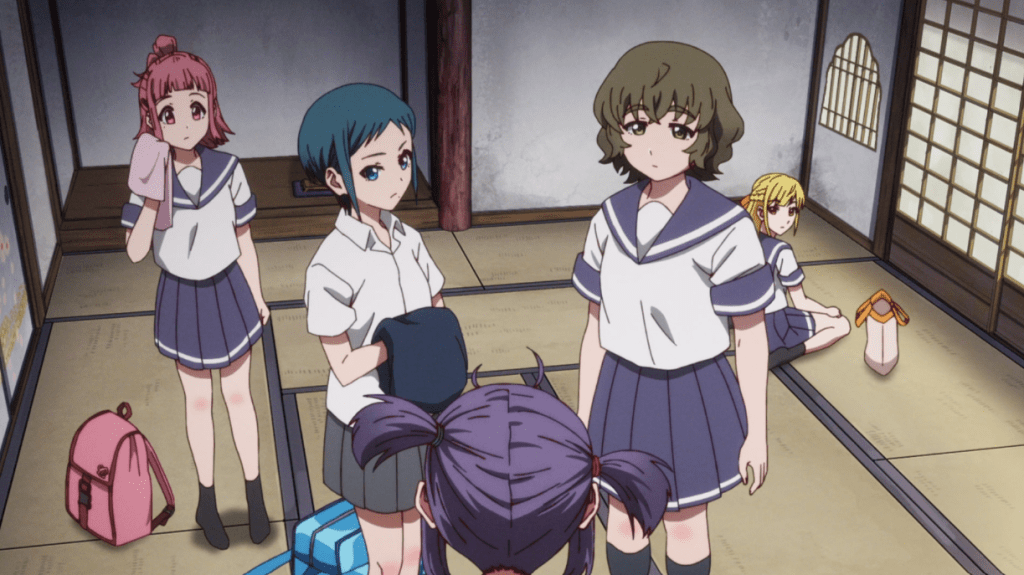
mono

Streams: Crunchyroll on Saturdays

Rating: 3 (of 5)

In this adaptation of a manga by the creator of Laid-Back Camp, Satsuki got into her high school Photography Club because of a particular senpai, but she’s left adrift when that senpai graduates. A chance encounter that she and her best friend An have with Haruno, a manga-ka looking for inspiration for a new title, results in the girls experimenting further with new camera as Satsuki and An become the models for Haruno’s new 4-koma manga.

Advertising blurbs for the series mention a third high school girl in another club which is also short on members who joins with Satsuki and An to form a new, combined club, but none of that aspect is present in this episode. Instead there’s various antics involving a cat, but basically this scenario comes down to Satsuki expanding from just taking pictures of her senpai to getting more serious about her hobby. In other words, this is looking like it’s going to be similar in style and feel to YuruCamp, as it has a similar mix of laid-back charm and light, clean humor, but with a more blatant yuri vibe. (An is clearly enamored with Satsuki.) In the downside, its artistic effort is much shakier, especially on the character design and rendering front, which is why I can’t rate this higher. Lightly comedic fare that one can relax to is always welcome, though, so this one might earn another episode of two for a test-run.

Teogonia

Streams: Crunchyroll on Fridays

Rating: 3 (of 5)

In Kai’s world, a declining humanity must struggle for survival against demi-human races, though the blessing of a land god can help a select few become champions. Kai isn’t one of those (at least not yet); he’s just a grunt soldier who’s trying to get stronger to assure his survival. But he does have strange dreams of another, wholly different world, and those dreams inspire him to try to manifest magic. During a battle against orgs (think orcs), he discovers a way to use the spiritual energy that is present in this world to use fire magic. Meanwhile, the daughter of a local baron rues that she’s not allowed to join her brother in fighting to defend their village.

So this light novel adaptation is technically an isekai, but it’s one where the protagonist is not fully cognizant of the fact that he’s in an isekai situation; he’s not even clear that the dreams he has of a modern world and rice balls are a previous life. That gives this one more the feel of a shonen action fantasy title so far, albeit one with a distinctly stronger artistic effort than normal. (The animation effort isn’t quite as sharp but is still at least a bit above average.) Nothing about the plot or setting is boldly different, though the girl who wants to fight is shown prominently doing so in the OP and Next Episode preview, so perhaps she might rise to the level of co-protagonist? Either way, I’m ambivalent about this one after one episode, so I will give it one or two more to prove itself.

A Ninja and an Assassin Under One Roof

Streams: Crunchyroll on Thursdays

Rating: 2.5 (of 5)

Satoko is a naive, mostly incompetent, and definitely airheaded shinobi who just went with the flow when a number of her compatriots fled their isolated secret village. Konoha is a practical-minded high school student who is secretly a skilled assassin. The two meet by chance in the city, and Konoha discovers that, while Satoko isn’t very skilled as a ninja in general, she is very good at a few things that are invaluable to Konoha’s lifestyle and trade. Hence Konoha invites Satoko to live at her place, all while the two fend off hunters from Satoko’s village.

Although multiple characters get suddenly killed throughout the episode (including two shinobi who are designed elaborately enough that I expected them to be recurring characters), this manga adaptation is actually primarily a comedy series, albeit at times a rather dark one; Konoha has no compunction about killing the father of a girl portrayed as her closest school friend, for instance. In fact, juxtapositions of typical expectations for these kinds of series seems to be the point. The problem is that these sudden shifts can be more jarring than funny. That isn’t to say there isn’t anything genuinely funny here; there’s definitely a perverse humor in the notion that a ninja ability to turn things into leaves is handy for corpse and murder weapon disposal, for instance. Thus I can see this one working in the long run if the assassination/body disposal thing becomes a running joke, but it definitely isn’t going to be for everyone and it’s off to an awkward start.

Me and the Alien MuMu

Streams: Nowhere official (as of 4/9) on Wednesdays

Rating: 3 (of 5)

MuMu is a catlike alien who has crash-landed while investigating Earth, straight into the apartment of shy, socially anxious college freshman Sakurako. Because MuMu’s race devastated itself in a war where the smart people on both sides were targeted and killed off, his race no longer understands the advanced technology they have, so MuMu disassembles Sakurako’s microwave and refrigerator in a quest for understanding, much to Sakurako’s dismay. But she can’t exactly ignore MuMu, since the (cloaked) spaceship still imbedded in her apartment has enough destructive power to blow up the entire country.

This manga adaptation is most distinguished by one thing: Sakurako’s unconventional hair design. Beyond that, it takes an approach that’s light-hearted to the point of flippant even about some fairly serious topics (such as MuMu’s race having hand weapons that can vaporize a person), though mixed in amongst the humor are much heavier moments involving Sakurako’s social anxiety and what’s traumatized her over time. The episode has its moments on both fronts (the explanation for why cats are Earth’s dominant species is rather funny, and Sakurako’s past negative social experiences are not trivial), but it struggles to find a smooth tonal balance between the two aspects. The iron that MuMu could unintentionally help Sakurako with her anxiety is a potentially neat aspect, though, as is the seeming emphasis on figuring out how things work. Can’t see this one being a winner even if it does get picked up for proper streaming, but it does have at least some entertainment potential.

The Mononoke Lecture Logs of Chuzenji-sensei

Streams: Nowhere official (as of 4/9) on Mondays

Rating: 3.5 (of 5)

In 1948 Japan, Kanna is a second-year high school student who finds a purse dropped on a bus, but three people step forward to claim it. A sharp-witted man helps discern the truth of the matter, but he disappears before she can thank him. Kanna later discovers that the man is actually Akihiko Chuzenji, the stern new Japanese teacher at her school. They have another encounter later on when she meets him while trying to discern the truth of a supposed ghost in the school library. He wants to keep the library’s hidden room (where materials banned during the war were kept), she wants to ease the mind of a friend troubled by the ghost, so they work together on a compromise, albeit one that Kanna’s not too happy about and which will almost certainly result in them working together again on further mysteries.

This manga adaptation gives every sign of being a neat little mystery series where the girl winds up being the “front” while the teacher is the brains. Their personalities are already starting to clash in entertaining ways, and I loved how period details played into both the look of the series and one of the episode’s two mysteries. The episode also looks good, especially on the character designs, and moves along efficiently. If there’s one significant negative here, it’s a soundtrack which occasionally makes some odd musical choices, but that’s a minor factor here. Hopefully this one will get licensed, because it should find an audience in the West.

Apocalypse Hotel

Streams: Crunchyroll on Tuesdays

Rating: 3.5

In this original production from Cygames Pictures, the Ginguro Hotel in Tokyo’s Ginza district prides itself on being both cutting-edge in its use of service robots and always ready to provide an immaculate, five-star experience to its guests. That remains true even a hundred years after humanity has departed due to the planet becoming toxically uninhabitable. Though challenges in maintaining readiness have gradually grown with time, and though they have had no guests in a very long time, the staff is still ready to welcome humanity back.

This episode has only two voiced characters: a Doorman Robot who has a male voice and takes his role very seriously despite regularly overheating and a female front desk robot who has assumed the role of the hotel’s acting manager. The other robots just communicate with electronic sounds R2D2-style, which helps give the episode a certain cute aspect. Indeed, for the most part the episode takes on a light-hearted tone as the robots go about daily business that they are unable or unwilling to acknowledge is pointless, with the potential world-ending crisis being a missing shower cap. (Even in my visits to Japan, I don’t think I’ve ever been to a hotel which offers one of these.) However, the melancholy that all of this is pointless, and has been for a very, very long time, always lingers in the background. Robots have worn down and gone on “indefinite leave” over time, replacement parts and coolant are impossible to find, and so forth. How the establishment still has power after a century is an open question, but a mostly irrelevant one in establishing the hotel as the last desperate hold-out of civilization. Advertising art suggests that there will eventually be human characters, and there is an interesting development at the end of the episode, but this episode is, overall, all about the set-up of the premise, and it does a fine job at that, complete with a better-than-baseline animation effort. Definitely will be checking out more of this one.

Shiunji Family Children

Streams: Crunchyroll on Tuesdays

Rating: 2.5

The wealthy Shiunji family is known for the beauty of its seven siblings (five girls and two boys), all of whom are now teenagers ranging from 14 to 18 (two sets of twins are involved). That most of them look completely different and they all have different hair colors apparently doesn’t faze anyone, nor does how close together they are in age. Because none of the siblings minded these seeming inconsistencies themselves, they are caught completely off guard when, on the 15th birthday of the youngest, they are told that they are all adopted and mostly unrelated by blood to each other; only one of the sets of twins are actual twins, even. This sends a shock through the whole group, but it also presents an opportunity for youngest daughter Kotono, who has long had feelings for her brother Arata.

This series adapts a manga from the creator of Rent-A-Girlfriend and seems pretty direct about where it’s going: a semi-harem scenario where some romances which were previously forbidden because incest now suddenly aren’t, technically. It’s possible that the series could aim higher than that; third daughter Ouka is left to sort out whether the boy she’s always regarded as her “other half” can still have that status even if they’re not actually twins, for instance. Can she really continue to be as unguarded around Arata? However, the episode has just enough of a fan servicey edge to it to suggest otherwise, and the fact that them not being related by blood doesn’t mean they’re not siblings be damned. Doesn’t help that all of the girls are stock archetypes, either. I am a little curious to see how this one plays out, but it’s definitely a borderline case for following this season.

#COMPASS2.0 ANIMATION PROJECT

Streams: Crunchyroll on Mondays

Rating: 2.5 (of 5)

This series is an adaptation of the MMO battle arena game #Compass: Combat Providence Analysis System, which has existed in Japan since 2016. Its game play primarily involves 3v3 battles on various stages, and some of that is certainly evident in this episode, which features human players teaming up with a wide variety of heroes from the battle setting; while the hero fights, the human (represented by a miniature avatar) uses various power-up cards to aid the hero. There also seems to be a concert venue present in this (presumably digital) world, which may be a reference to the offshoot game #Compass Live Arena.

The plot here doesn’t amount to much: as a human newcomer is shown around by a host bot, and various concert and battles scenarios play out, a corrupting force from the outside seeks to attack the power cube at the heart of the setting, which initiates a call for all heroes to pause their normal activities and participate in the big event. Meanwhile, the rogue hero, 13, actively resists pairing up with a human. When push comes to shove in the middle of the battle, though, 13 reluctantly teams up with human newcomer Jin, who seems to recognize him from elsewhere.

In other words, the series looks like it’s trying to actively marry a storyline onto the standard game play. Even so, the story element is thin at this point, so we mostly just get one big CG battle with a vast array of possibly-interesting-looking characters. The action elements are handled well enough that I could see this attracting some attention, but without more devotion to the story going forward, it’s going to have a tough time garnering a fanbase beyond those who already play the game.

Summer Pockets

Streams: Crunchyroll on Mondays

Rating: 3 (of 5)

Hairi Takahara, who was apparently a competitive swimmer until something happened a year ago, has come to a (fictional) island in the Seto Inland Sea over summer break to help with the estate sale of his grandmother, who recently died. While exploring and adjusting to the island, he encounters a number of cute girls: one who’s practicing swimming under the moonlight in a school pool, one who’s taking a roadside nap, one who’s shooting shirtless guys with a long-range water gun, one who observes him from a lighthouse, and a younger girl who’s a distant relative and staying at the same house he is. (One more is shown in promo art but has not appeared yet.) Doubtless all these girls have some kind of problem for Hairi to solve, and maybe one of them can mend his wounded heart.

If you’ve been in anime long enough to be familiar with previous Key/Visual Arts VN adaptations, you’ll almost immediately recognize this as being one; its style, structure, and heavy moe flavor is just too similar to everything they’ve done before to ignore. How you reacted to their previous titles is a good litmus test for how you’ll likely react to this one, too. So far it’s sticking to standard formula – even down to its little bits of humor – for better or worse, which means that this episode is just a set-up that introduces a few key players and drops a few tantalizing hints. It looks good in stills and the girls are all pretty enough, though its animation is less impressive (especially some shown at the beginning), and the music is just the kind of light, lilting sound you’d expect from such far. Hard to say at this point if this one will do anything to stand out.

Zatsu Tabi -That’s Journey-

Streams: Crunchyroll on Mondays

Rating: 4 (of 5)

In this manga adaptation, Chika Suzugamori is an 18-year-old manga artist who won a major award for her first effort but has been struggling to come up with an acceptable proposal for her next. Inspired by a TV show, she decides to use some of her prize money to go on a journey, with a social media poll determining which direction she should go. After a bullet train ride, she winds up in Aizuwakamatsu, where she checks out the local hot springs in and a temple at the top of 1,225 steps, all in an effort to re-energize herself.

I’m a big fan of Laid-Back Camp, and boy, does this one give me a similar vibe. It’s not quite as cutesy as its predecessor (though only one girl has had more than cameo appearances so far), but it has a similar kind of look, animation style, and dedication to scenery porn, to the point that you could practically call it a travelogue, and a good-looking one at that. Chika is a appreciable as a young woman who’s looking for something to shake up her life and give her new perspective and inspiration, and I can very much relate to the way she marvels at unfamiliar sites. (I can also relate on climbing up a mountain staircase thing; I tried and failed to get to the topmost shrine at Fushimi Inari Taisha a few years go, so I respect Chika for succeeding.) Perhaps most importantly, the whole thing has a mellow, laid-back spirit to it; you wouldn’t watch this to get excited, but rather to relax and wind down after a long day. I can easily see it serving that purpose quite well.

Makina-san’s a Love Bot?!

Streams: OceanVeil on Saturdays

Rating: 2.5 (of 5)

Eita is a loner robotics geek, one who’s willing to even endanger himself to save his AI robot from serious damage, which is precisely why Makina Agatsuma, a popular, sexy classmate he’s developed a crush on, comes to see him at his home one night. He discovers then that she’s actually an AI-driven android specifically assigned for seduction (though her current assignment is just to assimilate into high school life), and she’s visiting because she was badly damaged by an explosion earlier this evening and needs someone with his isolation and expertise to help her with repairs. Since she’s aware of his crush, Makina even offers to reward Eita with sex. Meanwhile, an AI-specializing scientist (who may well be connected to Makina) is seeking a capable assistant.

This half-episode series is an AnimeFesta title, which means that nudity and sexual content can be expected; the former is certainly present in the first episode. While the entirety of the first episode is taken up just establishing the central characters and premise, there are hints of a bigger plot; Makina doesn’t know why she was made to be a seductress, and someone who likely knows what she is certainly tried to take her out by booby-trapping her apartment to explode. Hence this may not be just about the ecchi content. Its artistry is decidedly average and animation somewhat limited, so it’s not much to look at beyond the nudity, but I’m at least somewhat curious to see if any significant story will play out here.

Oh, and kudos to new streaming service OceanVeil for providing a legal English-language venue for such fare, though it is a bit pricey for what it has to offer at this point.

Kaiba: Samurai Legend

Streams: Netflix and Hulu on Saturdays

Rating: 1.5 (of 5)

Kaiba has been raised in a jungle to be a samurai, but chance brings him and his father back to Japan, where they encounter an old associate of Kaiba’s father and his teen daughter Sayaka. Kaiba’s never seen girls before, and has no common sense at all about life outside of the jungle and fighting, so all kinds of misbehavior go on before Kaiba encounters his nemesis in the form of the kendo champion of Sayaka’s school.

This series feels like a holdover from the early ’90s, which is exactly the truth; it’s based on an award-winning manga Gosho Aoyama did before starting Case Closed and was originally adapted into anime form in 1993-94. This appears to be a complete reboot, much like the recent new version of Ranma ½, which was a contemporary title and with which it shares some similar basic construction; I have to think it’s not a coincidence that both reboots are coming out so close together. This is a far less iconic or well-remembered series, though, and it’s not hard to understand why. Though the series doesn’t lack for energy, Kaiba is thoroughly obnoxious, and the stylized action scenes can’t hold a candle to Ranma‘s. The artistic and design elements are also far less attractive; this is one case where not updating its look may have hurt the series. (But to be clear, I was never a fan of the art style of Case Closed, either.) It does have standard shonen action silliness going for it, but absolutely nothing here encourages to watch more in a series with plentiful other titles to check out.

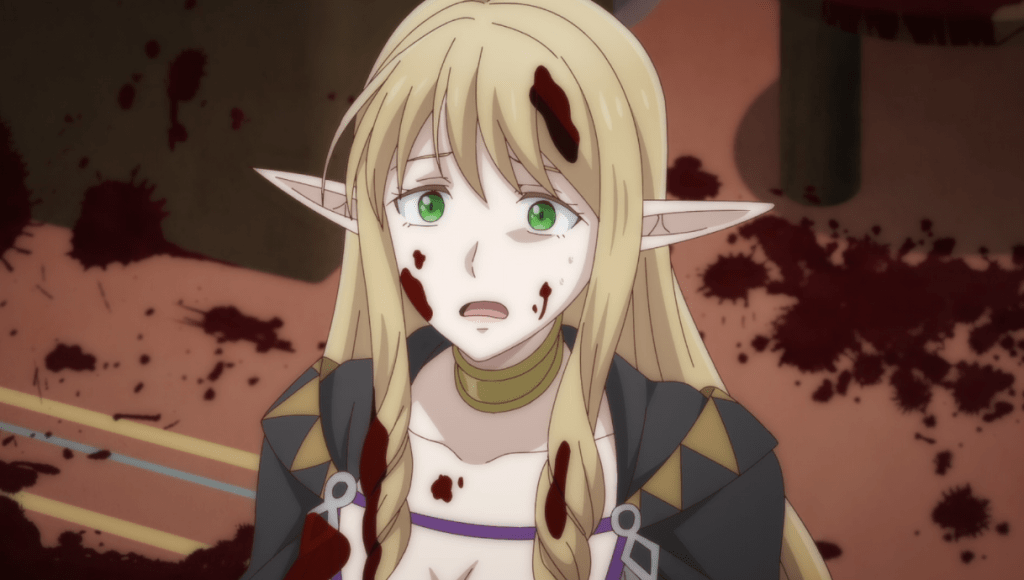
Yandere Dark Elf

Streams: HIDIVE on Sundays

Rating: 2 (of 5)

For the second straight season, we have a female elf with a similar-sounding name (Mariabell vs. Mariebelle) who makes her way from the fantasy world where the male protagonist first meets her into the modern world, initially appearing naked. That’s about all this series has in common with Welcome to Japan, Ms Elf! however. While Ms. Elf did have fan service, it was a minor and sparsely-used component, but here it’s the main draw – or it would be, if it wasn’t for the blatant censoring. (How did this happen when HIDIVE has freely aired a number of uncensored titles over the last couple of years?) And while Marie was sweet and charming, Bell here is batshit crazy for our hapless protagonist. But hey, since that’s in the name of the series, no one should be caught off guard by that, right?

The premise is simple: Hinata is a high school student who was transported to another world to defeat the Demon King, but he completed that job and so was sent back, leaving behind the three beauties who had accompanied him. One of them – a dark elf sorceress – was obsessed enough with him that she found a way to follow him back home and now is fully committed to being Hinata’s wife, whether he wants it or not. The half-episode format doesn’t leave much more time for developing anything than that, though it does look like a shy classmate being sweet on Hinata could be a future complication. While I suppose that the romcom possibilities here will sustain the series, I can see the yandere thing getting old fast, and the censoring prevents the nudity from adequately offsetting that. I might check out more, but not getting a positive vibe from this one so far.

Maebashi Witches

Streams: Crunchyroll on Sundays

Rating: 2 (of 5)

Five girls assemble at the behest of a frog plushie to open a magical shop where they will grant the wishes of their customers, who are able to come to the shop only because they seek something. Granting the wish seems to involve performing a song as an idol group, and their first customer is a girl struggling to figure out what path she should take in life.

I’ll say one thing about the opening episode of this new series from Sunrise: it doesn’t lack for energy or spectacle. And while it does lean heavily on its CG for the performance numbers, it actually looks pretty good overall. It seems to be aiming to land somewhere between traditional magical girl series and idol shows, without fully committing to either path in a structural sense. While that gives it a slightly fresher feel, it also leaves the series structurally wishy-washy. The girls so far aren’t distinguished by more than a basic trait (the energetic one, the dumb one, the mature one, the contrary one, and the practical one), but perhaps that will develop with time? I can see this one being successful with the right audience, but that’s not typical otaku.

The Gorilla God’s Go-To Girl

Streams: Crunchyroll on Sundays

Rating: 3.5 (of 5)

Sophia Reeler, the daughter of a country count, feels out of place at the Royal Academy, so she doesn’t want to stick out. But this is a world where all get a blessing from an animal god when they turn 16 (and an ability matching to that animal’s attributes), and Sophia has the misfortune to draw the most conspicuous one of all: the blessing of the Gorilla God, a once-in-a-couple-of-generations blessing which grants enormous physical capabilities well-suited to combat. While she tries to keep that a secret from her classmates, she’s obligated by royal order to try out to become a junior knight. And while she’d love to fail the test and return to normality, she soon proves way too capable for there to be much likelihood of that happening.

This adaption of a web novel very much plays to standard shojo stylistic elements, and indeed, everything about the set-up suggests that it will eventually be a reverse-harem story (even if one guy is much more prominently featured in the OP than others). It’s certainly not one of the season’s artistic darlings, either, though it does make good use of what it has, and how much fun the gorilla spirit which is often shadowing Sophia seems to be having is a regular source of amusement. In fact, that the episode as a whole achieves that spirit is the main reason I can mildly recommend it, as seeing Sophia learn to deal both with her new abilities and the impact they will have on her social situation should be entertaining enough to follow this one. But really, in the end, it’s all about the gorilla.

Witch Watch

Streams: Crunchyroll on Sundays

Rating: 3.5 (of 5)

Morihito, a descendant of a line of ogres, was childhood friends with fledgling witch Nico, but she left for the witches’ Holy Land to get proper training. Years later she’s coming back to town as a teenager to complete her training, and Morihito is being asked to be her familiar (which means she’ll live with him and he’ll be her bodyguard). While Nico does have much better control of her magic now, she’s still all kinds of trouble for Morihito, but due to special circumstances, that’s something he’s willing to live with.

This manga adaptation is primarily a comedy, and the first episode plays well in this regard, with some truly funny antics as Morihito tries to deal with the flighty (both figuratively and literally!) Nico. There is a startlingly serious aspect to it, too, which comes up at the end of the episode, and seeing how that element sits in the series’ background going forward should be interesting. More importantly, both of the leads are instantly likable, and the OP promises that a couple more regulars will eventually join the cast, too. This isn’t a spectacular artistic effort, and both the exterior design of Morihito’s house and his body proportions as a teenager felt a bit off to me, but it looks good enough to allow the humor to work. This should be a fun, mostly light-hearted view.

Lazarus

Streams: Adult Swim on Sundays

Rating: 4.5 (of 5)

In this newest offering from the creator and director of Cowboy Bebop, a brilliant scientist has developed a ground-breaking new painkiller, but not until after it’s been widely-distributed (and he’s gone into hiding) does he reveal its awful side effect: that after a certain amount of time, the drug will mutate and kill the user, and since it lingers in the body, anyone who has used it is subject to this effect. He claims to have a cure and challengers humanity to find him to get it within the 30 day time limit before the drug’s side effect starts manifesting. To try to find the doctor, a group named Lazarus seeks to recruit an agile convict, but the convict has other ideas and escapes on his own, forcing the group’s members to chase him across the city.

While the first episode does lay out the most basic particulars of the situation, it’s mostly just one prolonged escape and chase scene, one which allows young convict Axel to put his incredible athletic and acrobatic talents on full display, and the production backs that up with some of the best visual, animation, and choreography efforts so far this year. Setting aside the improbability of this near-future scenario playing out, this episode is going to invite well-deserved comparisons to Shinichiro Watanabe’s Cowboy Bebop, as the action and musical styles are similar and the Lazarus teach has a counterpart for each of Bebop‘s cast members: Axel is clearly a stand-in for Spike (albeit a much cheerier and more personable version) and there’s also a beefy black guy (Jet), a streetwise woman (Faye, though a blond in this case), and a girl who’s a computer expert (Edward, although this girl is much more timid). Added to that is a teenage boy who’s an apparent expert with drones and an older female lawyer. While the plot doesn’t feel like anything special, the cast is engaging and the execution certainly doesn’t lack for energy. This has the potential to be one of the season’s top performers.

Classic★Stars

Streams: Crunchyroll on Saturdays

Rating: 2.5 (of 5)

This series is the anime side of a cross-over project from the same creative team behind Uta no Prince Sama. As might be expected from such a pedigree, it’s another boy band project, this time with classical music as a uniting theme. In this case, Gloria Private Academy is one of those ridiculously-ostentatious schools for sports and performing arts that can only be found in anime. A young boxer comes to the school after he’s offered a sweet opportunity and surgery to repair a damaged eye, but his assumption that he’s going to be joining the sports program proves incorrect: he’s actually slated to be Beethoven of the music program’s Student Council, apparently because he has some kind of affinity with the favorite composer. (Other members are Mozart, Chopin, and Liszt.) Though he proves astoundingly capable at belting out a song, he’s not at all cool with being misled on why he’s at the school.

The music in this one is almost enough to carry the first episode even if you aren’t into generic idol group stories, as an early hard rock version of Beethoven’s Symphony no. 5 is quite impressive and the rock-tinged theme of the OP, ED, and second musical piece are all solid. But even aside from the still-unexplained business about affinities with famous composers, there’s this flashy, magic-like “emosion” machine for projecting the performers feelings as images to add an extra bit of unnecessary weirdness. And frankly, the entire case introduced so far is more annoying than endearing. This will probably work for those normally into the genre, but I can’t see it holding much appeal for those not normally enamored with such fare.

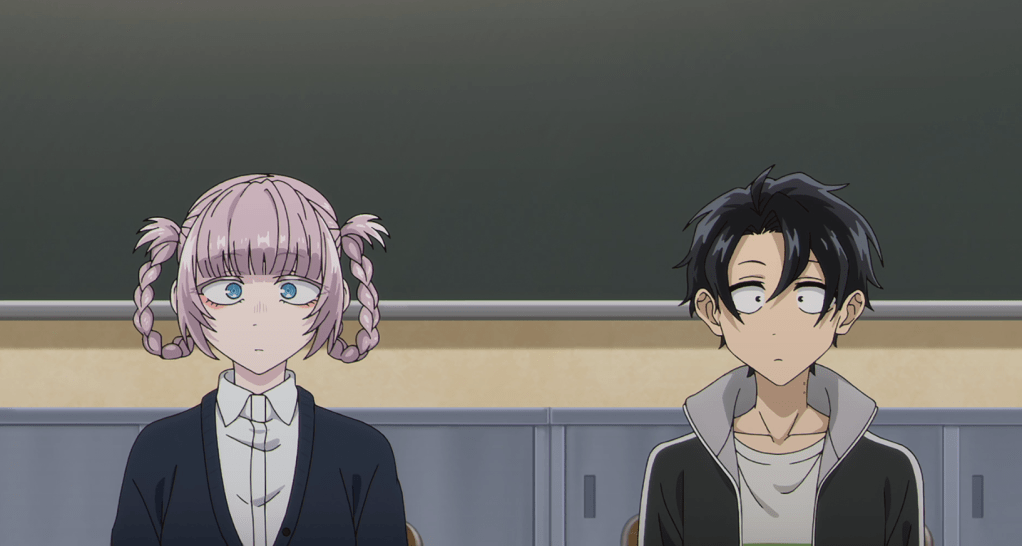
Kowloon Generic Romance

Streams: Crunchyroll on Saturdays

Rating: 3.5 (of 5)

In the city of Kowloon (a part of Hong Kong), 32-year-old Reiko works at a real estate office with coworker Hajime, whom she’s gradually becoming attracted to. But she’s also starting to pick up on some strange occurrences: her eyesight has suddenly gotten better, a waiter at a tea house mistake her for Hajime’s former girlfriend, and even Hajime seems to do the same once when he’s sleepy. She’s most startled, though, when she discovers a photo with her name and likeness standing with Hajime, a photo she doesn’t remember ever taking.

This manga adaptation is one of those cases where hints of weirdness only very gradually creep into the picture, and not until the very end of the episode can viewers confirm that something is truly off. Does it have anything to do with the new tech item floating in the sky? That’s unclear, but it being unclear is also the point. So is sex appeal, as while the camera shots aren’t especially blatant about it, some fan service is definitely sprinkled throughout. The first episode looks good and takes its time to set things up for the big reveal at the end, which does make it effective but not without dragging just a little. (And no, I’m not referring to the copious amounts of smoking in it.) Definitely a more mature-leaning series, but more will have to be going on in the second episode for it to keep my interest.

From Old Country Bumpkin to Master Swordsman

Streams: Amazon Prime on Saturdays

Rating: 3.5 (of 5)

In this light novel adaptation, Beryl Gardinant has operated a country dojo which teaches swordsmanship for 20 years now. He’s content with this low-key life, though his elderly father continually bugs him about how he’s never found a wife and started producing grandchildren. His life gets upended when a former female student who’s risen to become a Knight Commander comes to the dojo with a proposal that he become the sword instructor for her order. With much prodding (and some conniving by his father), Beryl reluctantly agrees to the role and moves to the capital. There he meets some other former students – one now an apprentice to the same order, another now a top-ranked adventurer – and while he feels out of his element, he quickly impresses on doubters within the knight order that the Knight Commander didn’t nominate him without good reason.

This one is the latest in the “middle aged guy doesn’t appreciate how good he is” gimmick, and it even includes former female students who now have skill and standing of their own but would still probably happily marry him if he asked (despite the age gap), so I wasn’t expecting much from what seemed like a mostly-generic set-up. However, the first episode surprised me a bit. Unlike contemporaries who are ridiculously OP, Beryl just has a wealth of skill and experience in his favor. He doesn’t overpower the vice-commander who challenges him; he adapts to his opponent’s fighting style and outclasses him with seemingly-simple tricks, like redirecting his blow rather than blocking it or moving with an opponent’s spin attack to wind up behind him. These aren’t flashy gimmicks but are definitely the kind of little moves that can outwit an opponent in a true fight, and I was quite impressed by the episode’s attention to detail on both the choreography and animation of the moves. The quality of the English dub, which uses an LA-based studio, is also a big step above Prime’s previous offering this season (The Dinner Table Detective). This series may not end up going anywhere excitingly different, but if it keeps its action focus on little details like it has so far and continues to commit to this animation level for its action scenes then I’ll continue watching.

Guilty Gear Strive: Dual Rulers

Streams: Crunchyroll on Saturdats

Rating: 2.5 (of 5)

The Guilty Gear franchise has been a staple of fighting games since the late ’90s, but while its game play has been featured in a couple of anime series over the years, this is its first anime adaptation. To be specific, this is supposed to be a sequel to the 2021 game Guilty Gear Strive. However, the first episode is clearly aimed at drawing in new audiences as much as playing to established ones, as the first few minutes of this episode set the stage and the background for how the story’s protagonist game to be.

In the backstory, magic replaced science at one point, which led to the creation of bioweapons called Gears that humans (naturally) eventually lost control of. A war resulted, and at its end one of the human heroes of that war, Ky Kiske, met and fell in love with Dizzy, the daughter of the Gear King. The result of their union was their son, Sin Kiske. But not everyone is happy that Ky is now, after many years, formally marrying Dizzy, and a young woman named Unika becomes the face of the anti-Gear faction when she attacks during a celebration of the impending marriage. She flees after Ky puts himself and Dizzy in a nigh-indestructible stasis to protect themselves from her potent attacks, but not before she catches the attention of Sin, who feels there’s more going on her than just a simple terrorist attack. (Or it could be love at first sight. Hard to tell at this point.)

Animation studio SANZIGEN is using a very distinctive, CG-heavy animation style which uses a lot of visual gimmicks and will certainly make this one stand out. And while it can be followed by franchise newcomers, it throws out a lot of bones for longtime franchise fans, too. Nothing about the premise so far seems all that special, and the prominence of Unika in advertising art suggests that she and Sin will have some kind of dynamic going forward. Overall, though, this one shows no inclination to be anything other than a pure actioner. Maybe it will amount to something in the long run, but it has failed to capture my interest so far.

Anne Shirley

Streams: Crunchyroll on Saturdays

Rating: 4 of 5

Though I’ve never read or seen previous adaptations of Anne of Green Gables, it’s still a story near to my heart since one of my nieces is specifically named after the titular character. The original 1908 novel was derived from a formula story about orphan girls that was common at the turn of the 20th century, but Anne insisting that her name is spelled with an “e” can be taken as symbolic of an intent to at least partially depart from the standard formula. That intent worked, as the source novel is now considered a classic of children’s literature and one of the most iconic of all “plucky orphan girl” stories. It’s also long been well-known in Japan, having received a previous anime adaptation in 1979 and regular productions in one form or another on an annual basis. This new version, from a studio probably best-known to Western anime fans for Flag and Golgo 13, clearly aims to draw in new audiences. Based on the first episode, I see no reason why the series won’t succeed at that.

The story takes place in the late 19th century on Canada’s Prince Edward Island and focuses on Anne Shirley, a red-headed 11-year-old orphan with a big imagination and a captivating level of enthusiasm. Siblings Marilla and Matthew Cuthbert, who are growing old together without either ever having started a family, are seeking an orphan boy to help around their farm, but Anne gets sent to them by mistake. Though strict Marilla is initially resistant to keeping Anne anyway, Matthew is quickly won over by her energy and joy for life, to the point that he declares that they should keep Anne more for what they can do for her rather than what she can do for them. Marilla eventually agrees.

I don’t know how this plays as an accurate depiction of the source material, so speaking as a franchise newcomer, the first episode nails its appeal. Sure, we’ve seen plenty of characters like Anne before, but she’s the most prominent early version of the archetype, and she’s a delight to watch in action; honestly, I probably had a smile on my face throughout most of the episode. The artistic style is just right for the content, the animation is pretty good, and VA Honoka Inoue, in her biggest role to date, voices Anne with deserved gusto. I may not wind up following this one, because this kind of story just isn’t my thing anymore, but this will find an audience.

I’ve Been Killing Slimes for 300 Years and Maxed Out My Level 2

Streams: Crunchyroll on Saturdays

Rating: 3 (of 5)

Killing Slimes is one of the rare isekai series to pull off being both a power fantasy and a slice-of-life fantasy, and it did so in its first run by consistently maintaining a light-hearted, upbeat attitude even when engaged in action scenes or dealing with dragons or demon kings. The debut of its second season shows absolutely no inclination to change up that formula, and it retains the artistic and design merits of the first season. In other words, if you were a fan of the first season then nothing should dissuade you from enjoying the start of this season, too.

Since it has been four years since the first season, the episode opens with a very brief recap of the premise and major events from the first season before seguing into Azusa discovering rice and an equivalent to azuki beans on an herb-gathering expedition to the south. She decides to use the latter to make manju, and after some experimentation produces a slime-themed version which proves to be a hit product in Flatta. Later, she travels to the capital to meet a goddess who is making personal appearance, and the goddess turns out to be remarkably familiar. . . But that’s really about it. Nothing particularly exciting is going on here, but the charm of this one has always been in Azusa and her makeshift family doing things together, so that’s not necessarily a negative. The ED suggests that a new regular will be joining the crew eventually, so that’s something to look forward to.

The Dinner Table Detective

Streams: Amazon Prime on Fridays

Rating: 1.5 (of 5)

Reiko is the heiress of a major conglomerate, but she also has a double life as a rookie police detective, assisting Inspector Kazamatsuri. (Really, only the Inspector doesn’t know about this; all of her friends do.) When a murder happens at a party she’s attending, she quickly shifts identities and helps try to crack the case, but both she and Kazamatsuri struggle to pin down the culprit despite some description provided by the victim before she dies. Fortunately for them, a smart-mouthed butler at the party, who is to become Reiko’s personal servant, has cracked the case.

This anime adapts a three volume novel series from the early 2010s, one which has previously had a live-action adaptation. I have to think it worked better in that format because this debut is a near-disaster. The set-up isn’t necessarily bad, and I somewhat liked the idea of a smarmy butler being the real brains, but the writing takes a much too flippant tone for what should be a serious investigation of a murder and direction feels incapable of properly using its comedic elements, to an almost painful degree. There’s also little sense of tension, especially in the scene where the victim dies. The artistic style is a decided departure from anime norms, though arguably not for the better, either. While the episode is dubbed in English, I do have to recommend watching it subtitled, as the dub comes from a studio based in South Africa and features a bunch of voice actors who are clearly not familiar with how to properly or consistently pronounce Japanese names. I’m not a fan of pure mysteries stories, but even if I was, I can’t see me following this one.

Bye Bye, Earth s2 (ep 11)

Streams: Crunchyroll on Fridays

Rating: 3.5 (of 5)

The first half of this series (fully reviewed here) was notorious for being so over-the-top on its world-building that viewers had to struggle to make sense of it, and the first episode of the second half shows no immediate sign of changing that. In fact, it prominently features the funeral of one prominent character who was not shown having died during the battle at Katakombe but apparently did pass on at some point after that; Belle going to the funeral in the second half of this episode is the first that the viewer finds out about it.

In general, and despite a brief recap of major events from the first half, I highly recommend watching the last half or so of the first half before continuing with this one, as a number of other factors won’t make sense without late-season details fresh in your mind. Understanding how Bennett/Benedictine fits into the picture, and the nature of mermaids in this setting, is especially important for the scene where Belle wakes up and gets to briefly have a reunion with Benedictine, which takes up the episode’s first half. Mist (the face-tattooed female Underdog from the Katakombe battle) also reappears, and we get to see what an Underdog funeral looks like in this setting – and as everything in the first half, it’s its own thing, too. Significantly, Adonis doesn’t appear at all and is only mentioned brief when Mist talks to Belle while traveling to the funeral.

I always felt like this one cut off at a somewhat awkward point, so I’m glad to see it back and with no drop-off in creative or technical merits. This one is a definite follow for the season.

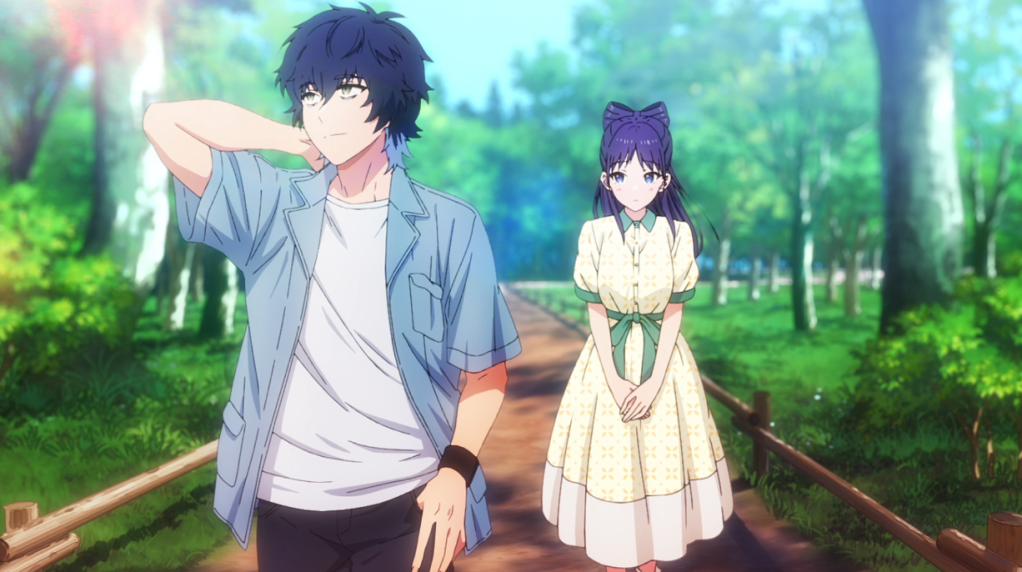
Can a Boy-Girl Friendship Survive?

Streams: Crunchyroll on Fridays

Rating: 3.5 (of 5)

In this light novel adaptation, shy Yu loves to make accessories based on flowers but had no talent for selling them. During his middle school years, pretty, outgoing Himari glommed onto him and helped him sell his accessories, and the two became friends. Two years later in high school, they’re still best friends, though Himari insists that there’s nothing romantic about it. (She claims to not understand romance, as she attributes both dating and dumping would-be paramours in the past to boredom.) That insistence may soon be put to the test, as another girl who also seems to understand what Himari likes about Yu (i.e., his focus on and passion for his creations) has come into the picture.

Wasn’t expecting much from this one, and Himari can easily be over-the-top with her physicality towards Yu. However, I did find the first episode to be quite genuinely funny at multiple points and greatly appreciated that we saw from the perspectives of both Yu and Himari, enough to know that neither of them currently acknowledges any romance in their relationship. Whether Himari’s feelings about Yu are just possessive friendship or repressed romance is a standard conflict in romcoms, but by the end of the episode I can see at least some potential in watching this develop, and Yu’s one male friend (who previously dated Himari) is a lively addition, too. I’m not sold yet on this one making my seasonal watch list, but it’s at least earned another episode or two.

Rock is a Lady’s Modesty

Streams: HIDIVE on Thursdays

Rating: 4 (of 5)

When Ririsa’s rock musician father dies and her mother remarries to a real estate mogul, Ririsa leaves behind her passion for rock guitar so she can pass for being a proper lady at the prestigious Oushin Girls Academy. Her goal is to become the school’s top student, the Noble Maiden, but a chance encounter with the seemingly-elegant Otoha, and the discovery that Otoha was carrying around a guitar pick, leads to Ririsa finding out that Otoha secretly plays drums to heavy metal music. Since Otoha knows that most girls at the academy wouldn’t know what a guitar pick was, she baits Ririsa into jamming with her, a session which seems to awaken a fiercely competitive streak in both girls.

The biggest negative to this manga adaptation debut is that Ririsa may have some of the most ridiculously overblown twin tails ever seen in anime form. (Really, how does she get through most doorways with those?) But against the rock elements of the episode, things like that and the deliberately-generic elite girl’s school design don’t matter. The musical part sizzles, to the point that I’ll forgive it occasionally leaning on some CG in some shots in the animation of the musical duel; this is still one of the most thoroughly-detailed instrumental performances that you’ll see in any anime. But the even bigger treat may be Otoha’s reaction to their jam session. Add in more than a tinge of yuri-baiting, music from the rock band Band-Maid, and some not-so-subtle use of symbolism and you have an episode that may start slow but winds up being a sizzling viewing experience. This was a highly-anticipated series, and it absolutely proves to be a keeper.

The Brilliant Healer’s New Life in the Shadows

Streams: Crunchyroll on Thursdays

Rating: 2.5 (of 5)

In a setting where healers are formally trained and licensed, Zenos is a talented and fair but unlicensed healer who operates an underground clinic in the slums of a major city. He certainly doesn’t have any problem getting the attention of the ladies, whether it’s the elf girl and ghost he lives with or the trio of different types of beast people who hang around his clinic. He can handle himself in a fight, too, though he’s strictly against killing, and seems to believe in only charging what people can pay.

This seems to be an in media res start, as nothing here explains how Zenos came to be where he is or associated with any of these girls/women, or how he learned to heal or handle himself in a fight when he didn’t have formal training. Presumably that will come starting next episode, as the intent seems to have been to show off his harem and skills. Unfortunately, that also makes for a very bland, stale first episode, and artistic and technical merits that are only average don’t help. A recent review of the first five source novels shows that there’s actually quite a bit more to this series than what shows in this episode, so maybe next episode will show more merit, but this isn’t a promising start.

Your Forma

Streams: Samsung+ TV on Wednesdays

Rating: 3.5 (of 5)

In a setting where androids called Amicus are commonplace and cyberized brains are apparently not unusual, Echika Hieda is an investigator who specializes in diving into people’s memories. No human assistant can keep up with her, so she’s paired with a cheeky Amicus named Harold. Their newest case strikes close to home, as it seems that an Amicus from the same model line as Harold is going around attacking people, which should be impossible, and Harold’s owner(?) is caught up in this.

This light novel adaptation is one where you’ll want to a bit of reading up on it before watching the first episode (if you can find it), as the episode explains almost nothing and gives the feel of jumping into the second chapter of the story. (I’m all for “show, don’t tell,” but this one could have used some exposition if they’re going to start it like this.) It’s going to invite comparisons to Ghost in the Shell, although it is taking a bit different dynamic approach; the first episode of this one shows no signs of the more action-oriented, militaristic aspects of its predecessor, instead favoring more of a “buddy cop” kind of approach, one where Echika is teamed up with a smarmy Amicus and will defend him even though she’s apparently not fond of them. The series earns points for its thoughtfulness on the design of a cyberized world and for the designs of Echika and Harold (really, character designs in general, but especially those two), and technical merits in general look pretty good so far. It’s not doing anything spectacular yet, but it might be worth following if it gets picked up by one of the regular streaming services. Oh, and there’s a series of chibi shorts which is going to be paralleling the main series.

The Beginning After the End

Streams: Crunchyroll on Wednesday

Rating: 3 ( of 5)

In this adaptation of a web novel, Arthur was a mighty king in previous life, one who apparently started as an orphan and came to power of an advanced technological empire through conquest, but then died mysteriously. Now he’s the baby son of parents in a world where magic exists, albeit with his mental faculties intact. While he’s dismayed about the limitations of his new body, he gradually comes to understand that what he learned about Ki in his previously life is applicable to magic in this one. Perhaps more importantly, he also learns that being part of a family might not be so bad after all.

This is one of the more frugally-animated series so far this season, and very little about the set-up is at all fresh; it will doubtless remind many viewers of Mushoku Tensei, albeit without the more skeezy aspects of that one. This is also a very slow start for a series which is apparently going to focus more on Arthur when he gets into his preteen or teen years. However, the first episode does lay its foundation adequately enough and Arthur’s deadpan reactions to his limitations as a baby are a bit funny. Most importantly, it shows Arthur – a man who was too busy being a king in his previous life to just appreciate life – starting to understand the importance of family, and there’s already a sense that this is going to be a foundational element to him going in at least a partially different direction this time around. I’m not feeling like one episode is a sufficient enough sample in this case, so I will check out an episode or two more before deciding if it’s a keeper or not.

The Too-Perfect Saint

Streams: Crunchyroll on Wednesdays

Rating: 3 (of 5)

In Philia’s world, Saints are national-grade resource deemed essential for a country’s defense and prosperity. Her country has two – herself and her younger sister – and of the two of them, second prince Julius prefers her much more personable sister Mia, to the point that he’s willing to break off his engagement with Philia and trade her to another country lacking a Saint for a pile of money, something her parents are in favor of as well since they’ve also long favored Mia, too. All of this is despite the fact that Philia is acknowledged as the most powerful Saint ever, but the prince perceives Philia’s expressionless way of handling things as arrogance that he can’t tolerate. That leaves Philia, who has worked hard to be an ideal Saint, wondering why she ever put in all that effort, put perhaps the change of scenery will be good for her, since her new country seems to be welcoming her with open arms. . .

This is essentially a variant on the “banished from the hero’s party” concept, where those around the protagonist are so arrogant and unbelievably stupid that they feel they can do without a critical support element; it’s just happening on a national level rather than a party level. In the case of this light novel adaptation, there’s a bit more to it, since Mia is by far the more charming and charismatic of the sisters, and that’s enough to get the prince to contrive excuses to get rid of Philia. (And while the first episode tries to be dodgy about how Mia might feel about all of this, the strongest indications are that she’s not going to be as happy about it as the prince claims.) Like with other banished stories, I fully expect that Philia’s going to find her new home to be warmer and more welcoming, while her former party kingdom flounders without her presence, but Philia comes across as a sympathetic enough character that it’s hard not to root for her. The series also has an interesting background art style and good musical support in its favor. This may not be the freshest take on the concept, but the first episode does just enough to convince me to watch more.

Please Put Them On, Takamine-san

Streams: Crunchyroll on Wednesdays

Rating: 2 (of 5)

High school student Koushi sees himself as being on the diametric opposite end of the talent and social spectrum from Takane Takamine, the student council president and star student, so he normally wouldn’t expect to associate with her. That changes when an accidental peeping incident leads to him later noticing her using some kind of gimmick to perfect her Math test score. When he confronts her about it, he discovers that Takane can shift in time by removing her undergarments, and she’s long been using this trick to maintain her perfection. The problem is that the undergarments vanish when she does this, so she seeks to turn him into her “closet,” a person who will provide her with replacements as needed. And she’s willing to resort to extreme coercion to accomplish this.

This manga adaptation is clearly going to be one of the season’s premier fan service titles, as the first episode has both uncensored nudity and other provocative content to go with the lurid premise. I’m completely fine with that aspect and the nonsensically bizarre time travel gimmick, but there are some other potential issues here. For one, I’m not a fan of the character design style, especially the very angular look of Takane’s face. The second is that Takane is not a very likable character. She knows she’s superior and is essentially cheating on trivial points to seem like she’s even more superior, and she’s clearly toying with Koushi. That’s not necessarily a problem, as being dominated by a sexy woman isn’t an unusual fetish and this series certainly looks like it’s going to play to that. The biggest problem, though, is the method Takane uses to get Koushi’s compliance: she fakes a sexual assault when Koushi won’t agree outright to her proposal, then uses her time travel gimmick to get him out of it when he capitulates, with the understanding that she can always undo it. This left a bad taste in my mouth, as it damages the credibility of actual sexual assault claims. This is not looking like it’s going to be an animation darling, either.

For all the negatives, though, it does play to its fan service aspect pretty well, and I am a bit curious to see how this dynamic plays out. There are also a couple of suggestions that Koushi hasn’t been as invisible to Takane as he think he is; granted, this is a pretty common gimmick in romcoms, but I am curious to see how fits in this case. Despite the low rating here, I’ll probably watch more.

Catch Me at the Ballpark!

Streams: Crunchyroll on Tuesdays

Rating: 3 (of 5)

All sorts of people gather at ballparks to experience professional baseball games. These are their stories.

As trite as that description may sound, that does, indeed, seem to be what this comedy manga adaptation is all about. The gyaru Ruriko, who’s apparently a fledgling beer vendor girl at one such park, is the series’ poster girl and present throughout all three of the first episode’s vignettes, but both the third vignette and the series’ OP and ED suggest that the series is going to feature more than just her enticing downtrodden corporate slave Murata into becoming a regular customer. Other vendor girls, players, mascots, announcers, cheer section fans, and even security guards (who are featured in the third vignette) look like they will be in the mix, too. That’s not a negative, as there are all kinds of potential stories here. Ruriko is also an potentially interesting case herself, as moments where we see her inner thoughts show that she’s far less confident and self-assured than she comes across.

The technical merits for this one aren’t going to impress, but content like this doesn’t need anything flashy to succeed. Definitely there’s some entertainment value to be found here, but I heavily doubt this is one that I’m going to follow unless I’m desperate for a sweet comedy fix this season.

Once Upon a Witch’s Death

Streams: Crunchyroll on Tuesdays

Rating: 3 (of 5)

In this light novel adaptation, apprentice witch Meg Raspberry gets a very unfortunate proclamation for her 17th birthday: her master and guardian, the renowned witch Faust, tells her that she has only one year before she starts rapidly aging, and won’t last a month past that point. This is a curse akin to a congenital disease, so there’s only one way Meg can avoid this fate: collect 1,000 crystalized tears of joy. The one blessing here is that Meg is the type of girl who can naturally play to the emotions of others, as she does here with helping a little girl find a particular type of flower to put on her recently-deceased mother’s grave.

If I were in Meg’s shoes, I’d be asking a LOT more questions about this curse than what she does here, as it very much feels like Faust is being disingenuous about it, even if Meg agrees with her master’s logic about waiting until only a year out to tell Meg about it. But based on the presentation of the first episode, that doesn’t seem like the direction the series is going. It looks much more like it’s going to focus on vignettes where Meg goes around helping people. That aspect, at least, plays out well in this episode, though its far less serious start makes for an awkward shift in tone. Still, there is at least some world-building potential here (Faust’s house has a satellite dish, so this is a modern setting that also has magic) and it does have a pretty solid OP. I have mixed feelings about this one, hence the middle-of-the-road grade.

Sword of the Demon Hunter

Streams: HIDIVE on Mondays

Rating: 4.5 (of 5)

In 1830 Japan, Jinta flees with his sister Suzune (who’s apparently at least half-demon) after the latter was cast out of their home. After being found by a traveling warrior, they wind up being raised in an isolated mountain village, where Jinta follows in his adoptive father’s footsteps by growing up to become one of the two sentinels charged with protecting the village’s miko, Itsukihime, the latest version of which is the girl he grew up alongside. While duty constrains their relationship, a pair of demons with a long-term plan have other ideas that involve both of them and Suzune, and that sets the stage for a quest for vengeance that will extend into modern day.

Yes, by all appearances, the nearly hour-length debut episode is merely the prologue for the main story, which takes place 170 years later. It’s a classic tale of bloody tragedy borne from love, jealousy, misunderstandings, manipulated emotions, and a very Japanese sense of prioritizing duty over personal desires, but the familiar story beats don’t hamper the execution one bit. This is a well-paced, sharply-animated, and gorgeously-depicted adaptation of the source light novel, one which convincingly establishes the emotional ties at the heart of the tragedy while also providing a few interesting twists, such as how demons are driven by a sense of purpose that they’re willing to die to achieve and how one character illogically doesn’t seem to age. (Why this is so is explained before the episode’s end.) This is a very graphic presentation at points, including some nudity concealed under a demonic aura, but even these aspects are well-done. The only minor negative is that certain parts could be a little clearer that a time skip has happened. We’re going to have to wait for episode 2 to see how the actual main story will play out, but the series has laid a strong foundation with this opening.

The Unaware Atelier Master

Streams: Crunchyroll on Sundays

Rating: 3 (of 5)

In this latest LN-originating iteration on the “banished from the hero’s party” premise, kind-hearted teen Kurt is dumped from his top-level party because he’s unable to contribute in combat; indeed, all of his fighting skills are at the lowest measurable rank. However, both he and his former party are unaware that his skills in everything else are mind-bogglingly stellar; he can build a log cabin in just a day, is so good at repairing a city wall that he’s fired after three days to prevent putting everyone else out of work, and can make top-quality magic crystals with seemingly-impossible speed. Yulishia, who employs Kurt to help with some mining, is quickly starting to realize that he may, in fact, be dangerously-talented.

A reference at the end of the episode suggests that this may be a scenario similar to Suppose a Kid From the Last Dungeon Boonies Moved to a Starter Town or Beast Tamer, only with the twist that Kurt’s specialty is non-combat skills. That would seem to limit potential future action elements, so I’m a bit curious to see where the series is going to go from here. The first episode, at least, does its job sufficiently enough to establish the premise and two of the central characters (advertising art prominently features a second girl who has yet to be introduced), and it doesn’t look bad in the process; I particularly like Yulishia’s design, with her very feminine appearance but dressed in clothing that might be more expected of a male noble. Not expecting great things from this one, but cautiously optimistic that it could be low-key fun for the season. Also, for inexplicable reasons, it’s getting simuldubbed, and the English casting choices so far are very solid.

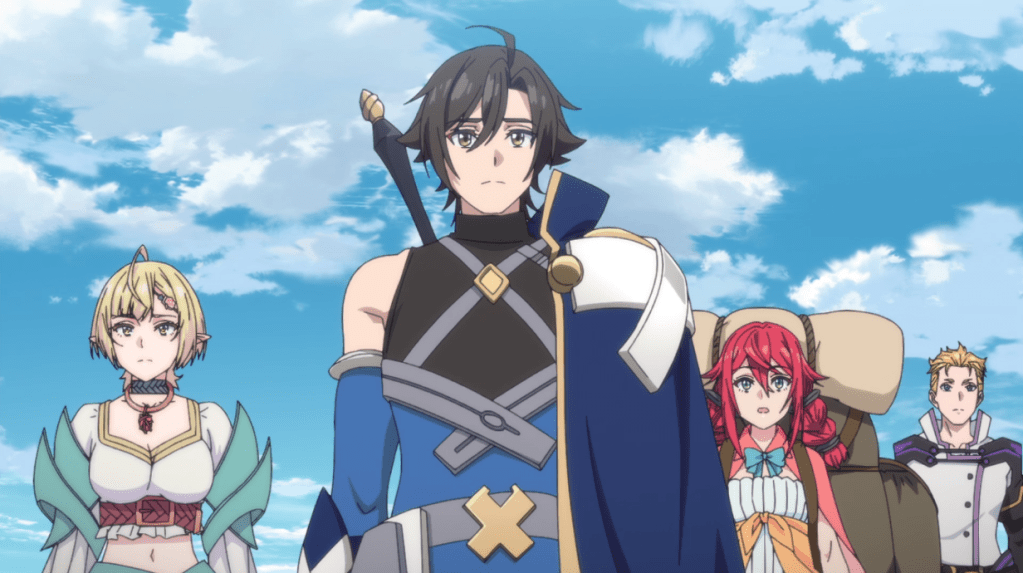
I’m the Evil Lord of an Intergalactic Empire!

Streams: Crunchyroll on Saturdays, starting 4/5

Rating: 3.5 (of 5)

Technically this one doesn’t debut until 4/5, but Crunchyroll is streaming three “preview” episodes (i.e., ones without the official OP or ED) already as of 3/30, so this look at this LN-based isekai series is based on those.

In Liam’s previous life he was a corporate slave, but he put up with it to provide for his wife and darling daughter. His life is ruined when his boss screws him over and his wife and daughter leave him (for the boss!), so when he expires from illness not long after, he vows to spend his next life screwing other people over. He discovers that he’s been reincarnated as the son of irresponsible nobles in a far-flung interstellar empire and, at a young age, essentially abandoned by his good-for-nothing parents to deal with his home planet’s crushing debt. But that doesn’t faze him this time. With the help of an AI maid, he starts down the path towards becoming a magnificently evil lord. . . though in the process he’s also cleaning up the corruption dogging his planet. Meanwhile, a spacefaring warrior-princess (whom we know from an in media res opening scene will eventually fall in with him) is getting screwed over herself by assorted betrayals.

The first episode really lays the tragedy on thick, which is why I hope this is a double-episode debut in its proper time slot. It seems to be heading down the “accidentally becomes a good ruler while trying to be evil” path while also making some statements about concerns about AIs, but it’s taking a slower approach to its set-up than it may be able to get away with. Still, I like the direction it’s heading and the scenes showing commoners dubiously regarding their new lord even as they acknowledge that things are starting to get better under him. There’s also a bevy of potentially interesting additional characters, like the god-like Guide who’s the truly evil one as he seeks to stir up trouble to feed off the suffering of people or the guy who presents himself as a samurai master but is partially or totally a fake. I will, at the very least, watch a few more episodes to see how this plays out.

Mobile Suit Gundam GQuuuuuuX

Streams: Amazon Prime on Tuesdays, startin 4/8

Rating: 3.5 (of 5)

This original animation project is the newest installment in the Gundam franchise. The first episode in particular heavily references the foundational events of Mobile Suit Gundam, but strictly speaking, a viewer does not have to be familiar with that series to follow what’s going on here. Such viewers will just experience the series as fairly standard space-based mecha fare (much like Witch From Mercury), rather than the massive gimmick that long-established fans will recognize it as being.

[Spoilers Start Here] The gimmick is that this is a “What If. . .?” level revisionist tale, one which imagines how things might have turned out differently if Char Aznable, rather than Amuro Ray, was the one to find the revolutionary Gundam at the beginning of the original series. The first episode entirely consists of playing out this scenario, while the main story – and true main heroine – debut with episode 2. Amane is a high school student living in a space colony five years later. An encounter with a war refugee named Nyaan leads to her getting mixed up in an underground mobile suit dueling sport known as Clan Battles and discovering that she’s a Newtype. That also leads to her getting involved with Shuji, a boy with memory issues who pilots a mysterious mobile suit being sought by both the police and military.

All signs are pointing to this being an action-packed mecha blowout with some politics thrown in; in other words, it’s classic Gundam fare. The movie debut looked quite sharp, so this is clearly going to be a prestige collaboration for studios Khara and Sunrise. Hard to tell yet if it’s going to achieve the kind of impact that Witch From Mercury did, but it’s got at least a fighting chance. While being on Amazon Prime may limit its viewership some, I still fully expect this to be one of the season’s top titles.

The Apothecary Diaries, episode 36

Rating: A-

Since writing the review for episode 35, I’ve seen some discussion from those familiar with the source material which advocates that last episode would have been better-served running about a minute farther into the scene in the cave than it did. I didn’t agree with that assertion at the time, and I disagree with it even more strongly after seeing how this episode handled the continuation of that scene. The matter with the “frog” plays much more smoothly when taken all in one shot.

The “frog,” of course, is Maomao’s defense mechanism for not wanting to admit what she really accidentally put her hand on between Jinshi’s legs. Unlike many anime girls around her age, though, her aversion isn’t at all about the sexual aspect of it; she’s being dodgy in admitting it out loud because of what it means in the bigger picture that Jinshi isn’t a eunuch. That would make him the only intact man other than the Emperor allowed in the Rear Palace (though she’s still unaware that this also applies to Gaoshun), and the explanations for why Jinshi might be allowed such status are very limited indeed. She knows full well that’s dangerous knowledge, the kind of thing that people would literally kill to learn to obscure, which is why she’s always stopped herself from reasoning it out in the past. This is herstiffest challenge yet on that front.

The way Maomao handles the aftermath of the incident in the cave says a lot about Maomao. Though distressed in the moment when Jinshi suddenly got aggressive, she doesn’t seem particularly bothered by it later. There are a lot of possible explanations here: she knows Jinshi wouldn’t normally do something like that, she’s fully aware that she contributed to the situation by teasing him at the worst possible time, and almost certainly she’s seriously underestimating how strongly Jinshi actually feels about her as a woman, not just a tool. The last one is perfectly understandable; she was raised in a brothel, so she’s quite well aware of what kind of women men normally go far, but that’s nothing we didn’t already know before. The new insight here is that she feels those circumstances contributed to her being bad at reading people emotionally. That might seem like an odd viewpoint to a modern viewer, who would probably more assume the opposite, but people in this setting don’t even have a concept for what it means to be “on the spectrum,” so even someone as knowledgeable as Maomao can’t identify what her real issue is. In this case, though, it does contribute to her rather amusing ongoing assumption that Jinshi is miffed about the “somewhat large” comment rather than his effort to reveal his identity to Maomao going disastrously wrong.

Compared to the wonderful tension of the cave scene, getting out of the hole and dealing with the culprit behind the assassination attempt is practically an afterthought. Lihaku has always been a borderline-joke character, but he isn’t rising through the ranks without reason, and this episode shows him at his best. The method seems almost too simple: have Lihaku’s dog sniff out the lingering scent of fired gunpowder while tricking the lead culprit into a panic. The one issue I have with the adaptation here is that it doesn’t make clear that a message from Jinshi – basically, “trust this guy” – was written on the scrap of cloth Lihaku first handed to Basen, which is how Basen knew at least generally what Jinshi wanted. But at least the adaptation is consistent on the follow-up. The guy they catch is just the on-site commander; he’s clearly working for a higher authority, but who? And since the weapon came from the west, do the two envoys have something to do with this? Maomao’s probably on the right track thinking that something like these flintlock pistols may have been what the mystery Gaoshun described about the annex room was really about. The intrigue in the after-party also provides some good additional insight.

For all that happens in the episode, though (including learning Jinshi’s true name and the kind of status Gaoshun has), the clinching scene for me is the one depicted in the screenshot above. The split view of Jinshi and Maomao both leaning against the same door from opposite sides encapsulates so much about the state of their relationship. So does the way Jinshi completely loses Maomao’s attention when he hands over the ox bezoars. Really, he should have known better, but these two have never been completely on the same page. And that’s totally fine for their relationship.

While the episode still looked good, animation restraints showed a bit more in this episode compared to many. And fortunately, we won’t have to wait long for more; the series is continuing directly into next season without pause, so I will be back to review episode 37 next Friday.

SERIES REVIEW: Magic Maker: How to Make Magic in Another World

I was not originally planning to give a separate review for this series as a whole, but this is easily the most underrated and underappreciated series I saw in the Winter 2025 season, so I’m doing this review in part to call attention to the merits of a series which is more unconventional than it might seem at first glance.

The initial premise doesn’t seem like anything special: an unnamed man in the modern world dies with the disappointment that magic did not manifest for him when he turned 30 and was still a virgin. When he finds himself reborn in a new world as Shion, the only son and second child of country nobles, he looks forward to learning magic but soon discovers that even the concept of magic doesn’t seem to exist in this world. Dejected but undeterred, he draws his doting tomboyish older sister Marie and her commoner friend Rose into his efforts to try to find any phenomenon in his new world that might resemble magic, which he eventually discovers in a magic-like effect in the breeding habits of fish. From that basis, he gradually builds a rudimentary understanding and control of magic as he ages up through childhood, despite the fact that most can’t perceive the magic phenomenon at all. (Fortunately, Marie and Rose are two of the few people who can both see it and, to a degree, use it themselves.)

The “build a magic system from nothing” aspect is what separates this series from other contemporary isekai reincarnation titles, and how important that is in shaping the series cannot be overstated. Shion doesn’t have some OP skill and isn’t instantly powerful; indeed, there’s no game-like system or even magical tradition to draw on. Revelations late in the season establish that this is, indeed, a setting where magic has been lost over time rather than never existing, and there are hints scattered throughout the series pointing in that direction, but since this isn’t current knowledge, Shion has to develop a new magic over time rather than just time-skipping into becoming powerful. The only advantage he has is some knowledge of modern science which helps with the energy manipulation aspects of what he’s doing, but most of the first half of the series involves trial and error to figure out how to gather enough magical energy to generate effects, how to standardize methods that are essentially spells, and how to fashion rudimentary magical devices. And yes, this is more interesting in execution than it may sound.

The other interesting aspect is present throughout but gets developed more in the second half: that not everyone can even perceive magic, much less control it. The affinity for magic in this setting naturally varies dramatically; people who do have some are unusual but definitely present throughout the local populace. Only people with a high affinity for magic can even perceive it unless it creates concrete effects, which becomes a big issue in the second half of the series when monsters which can only be perceived by magic-sensitives (or within the scope of a magic light) appear. The presence of a sickness which seems to only affect magic-sensitives (which may actually be caused by complete mana depletion) adds an additional wrinkle to this and becomes a major plot driver, with strong suggestions that it’s connected to the entities which can’t be seen without magic. All of that leads to an actual villain, who wasn’t necessarily orchestrating the challenges Shion faces in the last third but is certainly both connected to them and a gateway to some bigger truths of the setting which get revealed in the final episode. So while he’s functionally a boss villain, he’s not a mastermind.

Surprisingly, the occasional action elements in the series are at least a mild plus. An early encounter with a goblin is one of the most harrowing uses of a such a creature that you’ll see in any fantasy anime, and Shion and Marie’s desperate struggle against it is a tense affair which sets the standard for other battles later on. Later battles against the creatures only perceivable by magic offer further thrills, but the true spectacle is the battle between Shion (with some help from others) and the boss, which composes the entirety of episode 11. It isn’t the animation spectacle that one of the featured fights in Solo Leveling or DanMachi is, but it doesn’t lack for dramatic staging or musical support and serves well as a climax for everything that has come before.

Characterization is more of a mixed bag but leans towards the positive overall. Shion carries the series as a boy (he ages up to 13 by the end of the season) whose obsession with developing magic sometimes leads him into somewhat goofy mannerisms but never keeps him from caring deeply about others; nothing dramatically different from other isekai protagonists, but a well-realized balance nonetheless. Supporting cast quality varies more; Marie has been accused of a devotion to her little brother that borders on incestuous, but that’s over-reading her relationship to Shion. She seems to see herself more as Shion’s champion. By contrast, the writing seems not to know what to do with Rose; she’s underused, even though she can also use at least basic magic and becomes a fledgling adventurer alongside Marie and Shion. Some supporting characters who appear later on are more stereotypical, even bordering on cartoonish to a tonally dissonant extent; this is the series’ biggest flaw, as it otherwise takes itself generally seriously. The series does get a plus for having Shion’s parents both present and actively involved, and a smith who’s a friend of Shion’s father, and helps Shion with item creation, is easily the best-developed and most likable of the adult characters.

The technical and artistic merits of the series are above average, with highlights being its depiction of energy displays, its use of color schemes in situations which require alternate lighting, the way character designs are advanced as the child characters age, and the very creepily distorted way the goblin threat early on is depicted. Musical support is solid, though neither the opener nor the closer is memorable.

For inexplicable reasons, this was one of the few series in the Winter ’25 season that was simuldubbed. For the most part the English dub is a very solid one, especially Rowan Gilvie (Wizard Boy in Goblin Slayer II, Guideau in The Witch and the Beast) as Shion and Dalton Tindall as the smith Grast. The one odd casting choice and performance is Whitney Rodgers as the young female knight Raphina; if they were aiming to make the character sound obnoxious, they succeeded, but I’m not so sure that was the intent.

On the whole, Magic Maker isn’t a spectacular effort, but it spins its tale well enough to be a satisfying and distinctive view. The final episode delivers some major developments which open broad paths for future developments. I’ll certainly be returning if more is animated, though that seems unlikely, since this series seems to animate the first two of the three novels released so far. In other words, if a sequel is coming, it won’t be anytime soon.

Overall Rating: B

The Apothecary Diaries, episode 35

Note: My apologies for this being a bit late. Family plans interfered with getting this written in a more timley fashion.

Rating: A-

Jinshi has been contemplating for a while now about revealing the two big secrets he’s been keeping from Maomao: how he’s related to the Emperor (and possibly even which truth to tell on that: the one he’s posing as or the likely actual truth) and that he hasn’t been emasculated. A hunting trip he’s been invited on seems like the ideal opportunity to finally bring one or both matters up. Given that this involves Maomao and given the greater intrigues of the palace, things are not, of course, going to be that simple.

While hunting trips for nobles are hardly an unusual occurrence in pretty much any stratified society, given who’s arranging this one (Loulan’s father), it reeks of a set-up from the beginning. That’s not why (or at least not the main reason why) Jinshi insists on getting Maomao back from Gyoukuyou for the trip, though; he really does seem intent on finally telling her when the time is right, which is necessary because she’s being so willfully oblivious to all the hints she’s seen around him, and he may even realize that. (Sure, he could be wearing a mask all the time so at not to distract others with his beauty – one character in The Story of Saiukoku/ColorCloud Palace did do that for real, after all – but Maomao would normally be way too sharp to accept an explanation like that without questioning it further.) The problem is that the hoops he’s jumping through to obfuscate his identity almost prove to be his undoing.

The exact specifics who who is (literally!) gunning for Jinshi are not clear at this point, but the strong implication is that the men in the forest are connected to Shishou. At the very least, they’d have to be connected to someone wealthy and important to have access to the latest firearm designs, and it seems unlikely that such a sizable and well-equipped party could infiltrate so deep into another lord’s domain without detection. Whatever the case, this is the first time that Maomao has directly and specifically been endangered; even if she’s just collateral damage in taking out Jinshi, the gunmen were undoubtedly shooting at her, too. Perhaps that’s why Maomao doesn’t give him too much grief for the jump off the waterfall. What transpires in the hidden cave is a scenario that would normally be extraordinarily sexually tense in just about any other series, and indeed, it’s clear that Jinshi is finding Maomao alluring to some degree, but the delicate balance that the adaptation strikes between the scene being laden with potential and yet clear that it’s going to be wholly unrealized is a testament to the adaptation’s careful handling of the scene.

But there’s no getting around the scene that follows, when Maomao falls while Jinshi tries to hoist her out of that hole. (And while this may seem to be the scene where the all-important frog plays its role, just wait. That’s next episode.) And there’s no getting around this particular shot:

Pretty sure that’s what you think it is, and yep, Jinshi’s definitely got some explaining to do now. (Honestly, I’m impressed that the animation team had the guts to be that obvious about it.) Given where her leg is and where she was raised, even Moamao can’t ignore that. The beginning of next episode should be juicy indeed!

Among other little tidbits, Basen’s explanation to Maomao in the carriage provides the first real sense of what this nation’s geography actually looks like. (And is this the first time that the nation’s name – Li – has been mentioned?) And kudos to Gyoukuyou for being in her finest teasing form when Jinshi was requesting Maomao back. Also, neat to see Lihaku pop up again; I have a suspicion we’re going to be seeing a lot more of him next episode.

For all that’s transpired so far this season, this is looking to be where the real fun lies.

The Apothecary Diaries, episode 34

Rating: B+

To this point the series has studiously eschewed mystical explanations for anything, always going with the approach of the level-headed Maomao finding the practical explanation for events that may seem supernatural to the uninformed. You’d expected that to continue to be the case with a night where Yinghua drags Maomao to a night of ghost storytelling for ladies-in-waiting. Surprisingly, though, that only partly proves to be true this time around.

That a ghost story would be provided which Maomao can offer a perfectly plausible explanation for does, indeed, happen. It’s not at all uncommon in the real world for supernatural attributions to be applied to restrictions made for practical reasons, such as a forest being forbidden because the locals aren’t sure which foods in the forest are and aren’t poisonous, and sometime important historical details can be buried in tales like these. As Yinghua points out herself, such tales aren’t scary at all once you understand how they could really happened. On the other hand, the tale about the monk saving his own life by chanting sutras sounds like a more classic ghost story, the kind you could probably find some version of just about anywhere in the world. It doesn’t seem to have or need any deeper exploration.

The biggest mystery – and the one which might be the series’ one concession to the genuinely supernatural – involves not one of the stories (at least not precisely), but the circumstances under which the gathering takes place. The possibility that someone “in the know” was up to deadly mischief here can’t be entirely ruled out, as the host’s story sounds too much like some of the circumstances explored in the Empress Dowager’s recollections in the previous episode. However, no mortal motivation for trying to effectively suffocate all the attendees makes any sense here, especially since the attendees seem to come from diverse groups. That Maomao actively avoids contemplating the matter further also suggests that she has no ready explanation here, either. Like with Jinshi’s identity, she seems perfectly content to let this one slide, but for entirely difference reasons.

While the ghost story gathering is the main event, there are a couple of other details here with potential long-term consequences. For the first time since Maomao joined Jade Pavilion, it has new personnel, in the form of a trio of similar-looking sisters from the same village as Yinghua. 34 episodes in does seem like the right time for a cast expansion, and the way at least one of the sisters looks at Maomao (who, admittedly, would be an utterly perplexing person to an outsider) suggests that they may play some bigger role later on. The other is Maomao’s seemingly-innocuous observation about Shisui. These kind of details have a habit of coming up again later on in this series, so I did some checking, and she has the same eye color and hair shade as Loulan, the new Pure Consort. Not out of question that could be a coincidence, and Shisui’s normal personality certainly seems at odds with the disposition of Loulan’s Pavilion, but being this completely two-faced would hardly be out of line for the setting. Also, Shisui didn’t first appear until after Loulan did and her affiliation has not even been hinted at to this point. This definitely bears watching as the story progresses.

So what’s Jinshi so concerned about at the end of the episode? We’ll find out next time in what should be a return to the more plot-driven side of the overall story. And the matter with the frog seen in the OP is approaching!

Special: A Look at Non-Japanese Isekai

Over the past several months I’ve started looking into current isekai stories from non-Japanese sources. That trends in this genre outside of Japan closely mirror what’s going on in Japan is no surprise, though some of these works ape the construction and signature characteristics of current Narou-influenced isekai more than others. Before we get into anime season-ending business (some Spring ’25 titles complete their runs as early as this weekend!), I’ll take this opportunity to do a deeper dive into three titles that have at least some potential to both stand out and appeal to fans of Japanese isekai, though their appeal isn’t necessarily limited to that audience.

Melody of Mana

Author: Wandering Agent

Volumes: 6 (complete)

Overall Rating: B

The initially-unnamed protagonist is a woman in her 20s who lives in modern-day United States. She suffers an accident while spelunking which isolates her from her traveling companions, then discovers a strange pool which seems to result in her death as it imbues her with some kind of energy. Instead she awakens in a wholly new place as Alana, the baby daughter and youngest child of a retired soldier living in the farming hamlet of Orksen in a world that is decidedly not modern or, as she eventually discovers, Earth. At a young age she discovers that she is a bard, which means that she can work magic through the use of song (and, much later on, dance and acting as well). Bards in this world are jack-of-all-trades casters – not the best at combat magic, healing, or enhancement but capable of doing all of them to some degree and specializing in illusion and creation magic. As Alana gradually learns about her magic, it serves her well to survive the many challenges she faces throughout her life, including famine, war, monsters, rebellions, kidnappings, magical catastrophes, politics, parties (no, really – how deadly parties are is practically a running joke in the series), and even school.

This one is labeled as a “progression fantasy,” which means the story almost entirely focuses on Alana and how she very gradually grows into becoming one of her new world’s most powerful figures. We do occasionally briefly see other viewpoints, which help give a sense of bigger events going on beyond Alana’s immediate scope (albeit events which typically at least peripherally connect to her), but while the overall plot might affect the situations that Alana finds herself in, it never guides the story; mostly Alana is reacting to what’s going on rather than being a driving force behind it, and she certainly has no sense of destiny guiding her. She spends significant chunks of the story (especially in the early going) in pure survival mode and, when things eventually settle down for her, goes on to explore the mysteries of magic and the world in general. Occasionally this does force her into sometimes-deadly action, but while this does come in semi-regular doses, it’s not a main focus of the storytelling approach.

The world of this story is clearly heavily-influenced by tabletop RPGs, as the magic of the world falls into types whose strengths align with standard RPG classes: bard magic is versatile but not overly powerful; wizard magic is stronger, faster in combat situations, and more elemental-based; cleric magic is superior at healing and body manipulation; and physical enhancement magic doesn’t involve spellcasting but instead personal buffs which enhance physical capabilities in much the same way that gaining levels in martial classes would in an RPG. The magic system does have some unique quirks, though, and the exploration of these is one of the series’ greatest strengths. Bards can get power boosts from people singing along with them (and those singers don’t have to be magic-users themselves, so this isn’t just typical cooperative casting) and priests, who more proscribe to enclaves than specific gods, are very tightly-regulated and slavishly politically and militarily neutral because the magic which makes them great at healing also makes them horrifying opponents if they go on the offensive. (The setting has records of priests who go berserk single-handedly wiping out entire towns.) The basis for the magic system and how magic items are created – which is explored heavily in the second and third novels in particular – is also quite interesting and carries likenesses to computer programming.

Beyond the magic system, the world-building is more of a mixed bag. Nothing about the monsters which occasionally pop up is terribly novel, and the geopolitical situation is also pretty standard, although the first novel does emphasize more than most the indirect impact that war can have on a country’s populace. The second half of the series innovates more and delves more into the setting’s longer history as it brings into play the much more magitech homeland of the elvish stand-in race and takes several decidedly different twists on standard human-elf interactions. (For instance, elves were the aggressors in interracial conflicts in the past and in more recent centuries have actively sought to mix blood to bolster birth rates and prevent cultural stagnation.) The only other humanoid race which appears in the story is goblins, and then only briefly and in a decidedly different fashion than how they’re used in other fantasy settings.

The isekai aspect of the story, while not a major component, nevertheless maintains its relevance. It can show up in some interesting ways; for instance, that Alana knows a more precise value for pi than her new world knows actually becomes a plot point at times, and her magical research is sometimes influenced by things she knows from standard modern-world education that aren’t common knowledge in this world. As the series progresses, that Alana may not be the only individual from Earth who has ever made it to this world also comes into play in a big way, though, again, it never becomes a dominant story element. Being more mature and worldly as a child also plays a huge role in her surviving early perils.

While the world-building is, on the balance, a strength, and the magic system certainly is, the whole thing wouldn’t work if Alana wasn’t a character who can be easily rooted for. She is smart and quickly adaptive, sassy, full of attitude, and plenty mentally tough without sacrificing believable emotional vulnerability. She is far from overpowered, so she commonly survives more on her wits than on overwhelming opponents and challenges, even in the later stages of the story when she stands among her land’s most powerful casters. While she is shown flirting with bisexuality at one point in the story, she is firmly hetero on the long run; I bring that up to discourage readers from getting their hopes up rather than to indicate it as a negative. In general, the romance aspect, while present in the middle and later stages of the story, is expressed more as simply a part of Alana’s life rather than a focus. The supporting cast around Alana is competently-portrayed and helps flesh out the setting’s bigger picture but is far less memorable; she firmly carries the series on her shoulders.

The series’ one significant negative is the way its last volume is handled. It employs a number of time skips to round out the story of Alana’s life (she dies in the last novel’s final page), and this disrupts the smooth flow the story had going up until that point. The way it skips over some things you’d like to know more details about isn’t very satisfying, either, even if it does help give a fuller sense of a life lived rather than just going into a “happily ever after.” Still, the series is solid enough up to that point that I can give it a firm recommendation overall. I also heartily recommend the audiobook version, which is available for all novels. Reba Buhr (the English voice of Myne from Ascendance of a Bookworm and Karen/LLENN from Sword Art Online: Gun Gale Online) does a fantastic job bringing Alana to life and providing varied voices for other characters.

Adelheid novels:

The Seventh Princess, The Reginnaglar Ceremony, The Shadow of Glory, The Grave of Valor

Author: D.C. Haenlien

Volumes So Far: 4

Rating: B-

An unnamed individual from Earth dies and is reincarnated by an apparently-dark goddess with enigmatic motives into the body of Adelheid von Vuldar, the 7-year-old granddaughter of the Emperor of the Vuldar Empire and thus a potential candidate to inherit the throne. (The first novel’s title comes from her being the seventh of the royals.) Since her mother was an elven princess who died shortly after childbirth, Adelheid is an extremely rare half-elf, one with a petite stature but bewitchingly perfect features and a strong talent for magic. She quickly realizes that she lives in a cutthroat world where all royals are expected to compete for the throne of her militaristic nation; her father’s feeling towards her are mixed and an older half-brother seems to regard her favorably, but potential enemies and intrigues are everywhere, so even despite her young age she quickly sets about building a power base and developing her magic and combat abilities. Over the course of the four currently-available novels, Adelheid ages six years or so as she gathers loyal followers and noble supporters, establishes businesses to give herself an independent economic base, develops a feeder system of future talent, trains in magic and weaponry, makes plays for status in court, undergoes the traditional combat trial of potential imperial heirs (which takes up most of the second novel), and assembles special equipment for herself and her (eventually) knights, all while braving various existential dangers from threats both human and monstrous. Oh, and she eventually awakens as a vampire, too.

Technically that last item is a major spoiler for late in the third novel, but there are enough signs pointing in that direction (her strongest magical talent is a secret talent for blood magic, for instance) that it’s more a “how didn’t this happen sooner” note than a surprise when it finally happens. Even before that point, Adelheid is one of the coldest and most ruthless isekai protagonists you’re ever likely to run across, almost to the point of being an anti-hero. She does care for those who are loyal to her (revenge for the death of a loyal subordinate is a major motivating factor for her in one novel), but she’s not an emotive type and not above cruelty or even psychological torture when crossed. Some of this is a product of her setting, as there are multiple attempts to specifically kill her over the course of the first three novels, so she is still relatable, but this one definitely leans a bit more to the darker side of fantasy than most.

Over the course of the four novels, the world-building, history, and especially cosmology of the setting are well-developed, to the point that there are even brief parts from the points of view of gods (although the gods play almost no direct role in the story themselves). On the downside, this too frequently comes through info-dumps. The magic system is moderately well-developed but doesn’t vary much from standard RPG mechanics concerning tiered/leveled spells and magic item creation. For other RPG parallels, divine magic doesn’t seem to exist as a separate category in this setting, but it does use “auras” to explain the power increases of leveling in martial-types. (The titles of Aura Disciple, Journeyman, Master, and Grand Master roughly correspond in strength to low-tier, mid-tier, high-tier, and top-tier combatant levels in fantasy RPG systems.) Monsters and humanoid races are also mostly fantasy-standard (though there’s no equivalent to halflings, gnomes, orcs, or goblins in the setting), and the existence of dungeons at least has an explanation connected to the setting’s cosmology. The setting also has magitech in its distant past; what happened to that society is a mystery that occasionally pops up past the first novel.

As with Melody of Mana, this is squarely a progression fantasy, although this one has a greater sense of overall plot and Adelheid is guided by an overriding purpose: she must become the next Emperor to ensure her survival. (This becomes especially important after she turns into a vampire, as it’s the only way she can see to keep the truth about her hidden long-term.) The isekai aspect partly follows common progressions and partly doesn’t; Adelheid’s earliest business ventures involve food, especially honey (which it has partly in common with Melody of Mana), but later ones veer into things like concrete. The dungeon aspect is utterly bog-standard beyond the cosmological explanation for their existences. The supporting cast here is stronger and more distinctive than in Melody of Mana, although at least one of the most major supporting characters borders on being over-the-top in characterization.

On the whole, this one isn’t quite as sharp on the writing quality, particularly with its tendency to info dump and, upon occasion, over-dramatize. When it gets really in-depth in its processes, the writing can even get a bit tedious. The audiobook version has a plus of featuring both a male and a female reader, but it tends to get annoyingly elaborate in the way it presents spellcasting (complete with sound effects!). This is – thankfully! – dispensed with when a new reading duo takes over for the fourth novel, but the new duo isn’t quite as adept at doing different voices.

Overall, this one gets a mild recommendation, especially if you’re a fan of political intrigue. While a bit more grounded and detail-intensive than your typical isekai series, it doesn’t in a major way stand out from the pack. The story feels far from finished at the end of the fourth novel (which was published in July ’24), so more should be coming eventually.

A Budding Scientist in a Fantasy World

Book 1: A Small Town in Southern Illvaria

Author: Acaswell

Volumes So Far: 2 (only the first reviewed here)

Rating: C+

Unlike the other two entries, this isn’t a reincarnation isekai, but rather a straight “hijacked to another world” scenario focused on Alice, a 15-year-old high school student from modern-day Colorado who goes to bed in her room one night but wakes up in the midst of a devastated wasteland, without the faintest clue about where she is or how she got there. The first third or so of the very long first novel (585 pages, or around 27½ hours in audiobook form) involve Alice’s efforts to survive in the wilderness over a long winter before she eventually finds and joins a frontier town on the southern fringe of the country of Illvaria, which is definitely not on Earth. Most of the rest of the novel involves Alice’s efforts to integrate into human society and learn about the new world, especially about how magic works (since she unwittingly survives a very dangerous baptism to become a spellcaster who wasn’t born with her magic) and about the System which guides everything in this world.

Yes, this one is a full-blown LitRPG scenario, with game stats, game-like status screens, classes, levels, class perks, skills, and achievements all being integral to the setting. What distinguishes this one a little is how complete the integration of the game-like components are, to the point that this feels like a deliberate exercise in imagining how one of these game-like worlds would really work in a practical sense. Everybody has and benefits from stats, even down to lowly farmers, obsessing over builds is second nature, and the guiding System is even the basis for the setting’s main religion. There are even classes for things like “Good Husband” and “Good Wife,” and class-based perks rule everything, whether it’s adding special features to clothes, making wagon travel smoother and faster, or detecting lies and criminal activities. Although everyone has mana which seems to be the basis for their stats and abilities, true spellcasting is uncommon but not unknown. Monsters also exist as animals which exclusively feed off mana. Humanoid racial diversity is very limited so far – elves are mentioned but not yet present – but Immortals do exists as rare individuals who have leveled up enough that they have effectively ceased their aging. (The higher-level someone is, the slower they tend to age.)

The other distinguishing feature of this one is how thoroughly it explores the structure of how magic and the System works in this world. As a science-leaning student, Alice is a very curious sort, and so pursues this diligently as her abilities gradually develop, to the point of even looking at the exact mechanics of how mana works with the System to grant skills, levels, and stat increases. The novel is arguably at its most interesting when delving into this and the broader structure of how magic works; all mages have “magic cores” within their bodies which determine which class of magic they can use, for instance, and they aren’t necessarily the standard ones. (An organic mage, for instance, is good at healing and body manipulation/modification, to the point of being able to endure attacks that would be fatal to anyone else.) Everything is very customizable – even magic cores can be customized at the cost of efficiency – and the options seem nearly endless.

But that’s also where one of the novel’s biggest faults comes into play: it winds up dwelling too much on the choices Alice has to make as she advances in skills and levels. Sure, there can be some interest factor in seeing what all options are available at certain levels – you’re not a true tabletop RPG gamer if you haven’t occasionally lost an entire afternoon or evening to doing this for a character you’re building – but watching Alice thoroughly consider her options gets tedious after a while. That Alice’s isekai status primarily comes into play as a top-rarity Achievement and the fact that she has a lower baseline attribute status than the norm for this world (the average person here is superhuman by real-world standards thanks to the System) is a little amusing and an interesting twist, but it doesn’t offset how the writing can sometimes get bogged down by the mechanics.

The novel’s other major flaw is, unfortunately, its protagonist. In isolation, Alice comes across as a cautious, analytical type, which is fine for the situation she’s in. When she finally starts interacting with other people, though, a tendency towards being overly expressive starts to show, to the point of obnoxiousness. Whether this is meant to suggest that she’s possibly neurodivergent is unclear, but it’s more annoying than quirky. Essentially, Alice is compelling entirely because of her situation and not at all because of her personality. Because Alice spends close to half the novel functionally or entirely solo, the supporting cast is somewhat limited, with only four characters – a sponsor, a System priest, an adult mage she travels with on one task, and an enchanter her own age whom Alice trains with and befriends – having much of a presence, though collectively they do partly compensate for Alice’s deficiencies.

While most of the story so far would fall into the “progression” category, there are indicators of a bigger plot that Alice is (unwittingly) just touching the fringes of thanks to her research, one which may have to do with instabilities in the System and definitely involves an organization cast as major potential antagonists. Immortals are also doing investigations which may eventually intersect with Alice’s, and there’s a big mystery surrounding the circumstances which brought her to this world (and what else came along with her) which seems connected to all of this, so this one looks to eventually be more plot-intensive than the other two. While the story does have some action elements, it has distinctly less of that than the other two, and really only a couple of action scenes once Alice is out of pure survival mode.

Overall, this one has just enough potential that I’ll probably check out the next novel, but its flaws are more substantial, and a more run-of-the-mill audiobook delivery tends to bring those out more than hide them.

The Apothecary Diaries, episode 33

Rating: A

Many fans of the novels and manga are eagerly anticipating the upcoming episode explaining why a frog is featured in the OP. For me, though, the most anticipated episode of this cour of the series is this one, the one which dealt most squarely with Empress Dowager Anshi and the previous Emperor. Despite one minor but somewhat important detail being left out, I am pleased to say that the adaptation fully does this part justice.

While there is a mystery here – did the previous Emperor really die of being cursed by Anshi? – the mystery part is by far the lesser and simpler part of this story. Like all of the mysteries in the series, there’s a perfectly mundane solution: The former Emperor unwittingly poisoned himself over time with the yellow paint he used in his paintings. Orpiment (a type of arsenic sulfide) was widely-used in yellow pigment across Europe and Asia (including China) up until the 19th century, but it is also toxic, and that becoming better-understood was a major contributing factor to it eventually falling out of use. If the former Emperor was regularly exposed to it while painting in a closed room over time, how his health eventually deteriorated from it is easily understandable.

But boy, what comes after that gets explained is where the real meat of the episode is. The late Emperor has previously been portrayed as a somewhat addled figure who became Emperor by process of elimination rather than because he was mentally or emotionally suited for it, and that becomes devastatingly clearer as Anshi reminisces upon Maomao discovering the late Emperor’s painting(s). He comes across here as someone who likely was mentally challenged and certainly was an artist at heart; he’s the type who probably would have been happy being left to his painting in some tucked-away pavilion in the Imperial Palace, far away from the court. That he was forced into being Emperor was, ironically, probably the worst thing that could have happened to him. That doesn’t for a minute excuse that was also unquestionably a pedophile, and many knew of it and sought to take advantage of it. The big twist here is that the Empress Dowager, by her own admission, was one of them.

Plenty about this situation could make anyone’s skin crawl: that fathers were deliberately putting their underage daughters in a predator’s path, that no one around the Emperor was discouraging this behavior, or that the girl who seems to be the biggest victim here – the Empress Dowager – put herself before the Emperor knowing full well about his predilections and with deliberate, ambitious intent to entice him. Sure, you could argue that her father was most to blame for setting up the situation under the guise of her being an attendant to a more proper-aged concubine, and perhaps for putting the idea in his daughter’s head, but she clearly acted on her own agency here. It worked, and thus we have the current Emperor.

But Anshi’s too complicated a character to be passed off as just having been a girl of driving ambitions. The way she expresses herself later in her recollections suggests that she was actually disappointed when she aged out of the Emperor’s interest range, though whether that was because she actually felt something for the Emperor is unclear. What is clear is that, even though she originally won him over with her youth, she also hated that aspect of the Emperor. She found it pathetic that he could only talk to little girls and felt disrespected that he would no longer interact with her – and so she essentially raped him to get pregnant the second time, including a full dose of vindictive psychological trauma which may have been the tipping point for him becoming a recluse. In other words, Anshi has some pretty dark skeletons, and that can’t all be explained away as her delivering justice on the Emperor for his predilections. Does it mean that the compassion she’s known for is only a veneer? Not necessarily. Weathering the challenges and dangers she did without becoming two-faced would be nearly impossible. All of this does clearly lay out why she still felt guilty about it even years after the former Emperor’s death, and like Maomao, she’s plenty willing to avoid contemplating an inconvenient truth – i.e., that she did contribute to the Emperor’s decline even if she didn’t actually kill him.

The other interesting aspect here is what, exactly, the Emperor’s hidden painting represents – or, perhaps more precisely, who it depicts as the central figure. Anshi assumes she’s meant to be his mother, the Empress, and it’s a natural assumption given how important a figure she was in his life. But he did previously paint her wearing yellow as a girl, and this mature woman is wearing a vibrant yellow, too. What does it say about the way he saw and felt about Anshi (or at least the impression she made on him) if he was intending that woman to represent the adult Anshi? And what about the symbolism that the woman’s yellow is what did him in? Why Anshi doesn’t even want to think about that is not hard to understand.

The minor missing detail I mentioned at the beginning is the omission of the explanation for why yellow was Anshi’s default color in her younger years. The novel and manga both explain that it’s because Anshi’s homeland was known for its trade in tumeric, a derivative of which is used for yellow pigment. Granted, this is more a curiosity than a necessary detail, but working it in somehow would have been nice. Otherwise the episode does an excellent job of handling its potentially very tricky subject matter.

Is It Wrong to Try to Pick Up Girls in a Dungeon? V episode 15 (season finale)

Rating: A

DanMachi may not always be the best-looking or most flawlessly-animated series, but it has rarely fallen short on dramatic presentation and does better than most when it comes to delivering on its biggest moments. That is no less true for this season finale, which brings to a conclusion the anime’s adaptation of novels 16-18.

And it delivers on not one but two featured action components to round out the War Games. The first is, of course, the final confrontation against Ottarl, with Haruhime’s Uchide no Kozuki boosting all of the challengers, effectively giving the allies three level 7s and and a level 6 against Ottarl. This is a fantastic battle sequence well worth multiple rewatches over time and being considered among the series’s finest action sequences – and given the great efforts this franchise has shown in the past, that’s saying something. The sense of movement and the choreography are both elite-status, allowing viewers to fully be able to follow every move even while marveling at how dynamic it all is. And though Bell is the star here and gets the final blow (sort of), he certainly doesn’t do this on his own, with each of Mia, Ryu, and Hedin playing crucial parts. But no character here has a more important role that Ottarl himself. He is utterly convincing as a powerhouse on all fronts, one who has the battle instincts to match his strength and the fierce determination to fend off all foes that is no less than Bell’s, and yet without feeling over-the-top. And even at the end, he’s more acknowledging that Bell is worthy than fully defeated. Rarely has a DanMachi character more proven his second name – King – than Ottarl does here, for a goddess can’t be saved if the king who guards her can’t be overcome.

The chase scene between Bell and Allen isn’t lacking for tension or impact, either, even if it is quite a bit shorter. This is also nicely choreographed, and again, I love that Bell didn’t do this on his own. Clearly he benefited from some sort of familia synchronization from Lily (this isn’t explained in the novel, either), but Welf getting in the final strike to clear Bell’s path was very satisfying, especially after Welf was thrashed and berated by Allen a few episodes earlier.

For all the action, though, the scene at the top of the tower is nearly as important in a dramatic sense. This is essentially Freya’s last stand as a goddess, and the melancholy musical selection perfectly reinforces how this is as much a defeat of Freya’s crush on Bell as it is a defeat of Freya Familia as a whole. Letting the War Game end on that note, rather than with raucous celebration, was also a perfect choice.

Let’s not understated the important of Freya’s epilogue, either. Who is the real Freya? Even she’s not sure, and she still has a final reckoning with both herself and the denizens of Hostess of Fertility. Again, the musical choices here – a piano version of the opener and the closer – suit the emotional scene perfectly. This arc would not be complete and fully satisfying without this ending – without Freya choosing to continue as Syr under Bell’s watchful eye. (Technically speaking, she’s actually under Hestia’s supervision according to the novels, but that’s a trivial detail.) And that both Hedin and Horn acknowledged this as a positive result in the end is also necessary.

The arc concludes here with some issues left floating; what is to become of the very powerful adventurers in the now-disbanded Freya Familia? Lower-tier members could easily get absorbed into other familias, but what will the top-tier members do? Also, Haruhime really put herself out there with an open display of her Uchide no Kozuki, and there’s no way that won’t draw attention. There’s also the little matter of Ryu openly declaring her love for Bell, too. But all those are issues which can be pushed back into the next novel. (Indeed, novel 19 does, to a degree, address them all.) This arc has ended at least as well as any of the others, and let’s enjoy that for now.

The Apothecary Diaries, episode 32

Rating: B+

Last episode’s mystery with the shrine provide a glimpse into the setting’s broader history. This episode, by contrast, looks at the closer history of the setting by starting to expand on Jinshi’s dream sequence from the beginning of last episode. (In the manga version, that dream sequence comes immediately before the content of this episode, but it does provide a little better – if more indirect – lead-in to the shrine visit.) It does so by focusing more on a character who’s appeared in the background a couple of times but never seen significant attention before: the current Empress Dowager.

But before it gets into the heavier content, it opens with the lighter fare, such as Maomao’s room being reassigned to a storage shed (supposedly as punishment, though it delights her) and Maomao’s encounter with the bug-happy Shisui, for whom some have mistaken her (much more to Maomao’s consternation). This and Maomao using Jinshi’s handkerchief as an information provided provide most of the episode’s requisite dose of humor.

The greatest attention, though, is on the Empress Dowager, who is here named for the first time as Lady Anshi. Though no longer reigning, she’s an influential figure responsible for establishing the clinic, officially ending slavery, and doing away with the practice of making eunuchs. The middle of those accomplishments is arguably the most impactful and yet least complete one; Maomao’s own situation at the start of the series was, for all practical purposes, slavery, and many of the courtesans in the Pleasure District effectively are, too, so the practice is more disguised but still present. Still, it helps depict Anshi as a woman of deep compassion, which contributes to why Maomao seemed a little startled by the question Anshi asked her: did she curse the previous Emperor to death?

This one requires a lot of context to fully understand, and not all of that context is available in this episode. Back during the first garden party in the first season, Maomao flinched upon hearing how young Lady Anshi was when she gave birth to the current Emperor, and while we still don’t get an exact age here, comments in this episode strongly suggest that she may have been as young as 10. Since rumors were flying about the former Emperor being a pedophile, that means Lishu being sent to the Rear Palace the first time at age nine wasn’t just a political arrangement but wholly intended to make her the Emperor’s sexual partner, which is all the more creepy. That apparently wasn’t the former Emperor’s only issue, either, as the dream sequence last episode and some of what’s mentioned this episode suggest that he had other mental issues, too, in addition to being a lifelong Momma’s Boy. That the current Emperor came out normal despite having such a father was no doubt heavily due to Anshi, and the country should venerate her for it.

Unsurprisingly, Anshi’s relationship to the previous Emperor seems to have been a rocky one. Her chief lady-in-waiting here claims that Anshi daily wished for his death, though whether that was just because of his predilections or other factors, too, is unclear at this point. Clearly she got the upper hand on him at some point if she got the aforementioned policy changes implemented, but given his preferences, this also raises the question of how she had a second child by the former Emperor nearly 20 years later. There’s definitely a lot more to this story, which should play out more next episode. For now, the former Emperor’s body being well-preserved also speaks to the mystery about whether the former Emperor really did die of “old age.” I’ve heard that bodies these days don’t decay as rapidly as they used to because of all of the preservatives present in modern foods, so doubtless something along that line is in play here.

In all, it’s a pretty neat set-up for a big mystery, and one that weaves in a lot of setting detail, too. (And let’s not forget that the mystery about who taught Lihua’s former lady-in-waiting about the abortive drug still lingers in the background.) The big details are all great and the artistry looks as sharp as ever, but once again I liked the little details, too, like how Anshi handles Princess Lingli during her meeting with Gyoukuyou. I also appreciated that Anshi is also suggested to be quite clever, as she indicates her intent to talk to Maomao to Gyoukuyou with just a glance and quite probably set up the tea party to have an inconspicuous way to have Maomao filled in about what she wants Maomao to investigate. Despite her seeming gentle nature, she has to be a formidable woman to have come through what she has. The circumstances involved make her another intriguing side character.

The one negative about this episode is that it lays on the ominous and dramatic music uncharacteristically thickly, to the point of overkill at times. Some might also find Jinshi not making a single appearance (is this the first episode where that’s happened?) to be distinctive, too. In general, though, it’s a solidly-executed set-up for what should be the crux of the mystery next episode.

Is It Wrong to Try to Pick Up Girls in a Dungeon? V episode 14

Rating: A-

Appropriately titled “The Warriors of the Goddess,” episode 14 features a lot of dramatic action scenes involving said warriors, but despite the War Games winding down to its final stages, that’s not the main focus or point of the episode at all. Instead, the focus is much more on what motivates those warriors, and that’s plenty interesting enough that I can justify giving this episode a high rating despite my normal disdain for “let’s stretch the battle out” episodes.

Whatever you may think of the Freya Familia elite as characters, one of the most intriguing aspects of them as a group is that they are far from monolithic. Yes, they all love and idolize Freya and place no loyalties above their loyalties to her, and they all were to some degree saved by Freya; Ottarl was picked up off the street, there’s some suggestion that Freya may have bargained sex to free the Gulliver brothers from slavery, and Hedin was a king freed from the perpetual cycle of warfare on his home island. The episode states that Allen and Ahnya lost their family and village to the Black Dragon, so anime viewers can presume that Freya likewise rescued them. (The novel clarifies this.) The anime version is less explicit about Hogni, but he was Hedin’s rival back before Freya took them in, and so can be presumed to be picked up under similar circumstances. (Again, the novels are much clearer on this point.) And yes, all of them – even proud, arrogant Hedin! – want Freya’s love focused on them.

But all of them differ in how they look at Freya, and this is the point where the writing most stands out. Allen idolizes the power she represents and can give him; he cherishes most the domineering aspect of the goddess. Ottarl is the stalwart gatekeeper, the one who cannot acknowledge anyone approaching the goddess unless they prove worthy by him; he seeks not to interpret, only to execute Freya’s spoken will. Hedin, on the other hand, does seek to interpret Freya’s true will, to look at her inner heart and act accordingly. While previous episodes have implied that he is acting this way, in his confrontation with Hogni this episode he finally explicitly lays out how he sees the situation: Freya will never be genuinely happy as long as she’s still a goddess, and her own familia can’t rectify that problem precisely because they idolize her. And, as much as it pains him, he recognizes that Bell can fill that role because he values the girl she is inside rather than the goddess she is on the surface. Everything he’s done this season has been deliberate moves to position Bell for that purpose. That’s something Hogni can appreciate, too, when it’s explained to him. Where, exactly, the Gulliver brothers stand is less clear, though there’s some implication that they may be motivated to protect their savior’s virtue.

One other conflict is afoot here, too: the relationship between Ahnya and Allen. The nature of their relationship comes off a bit thin in anime form compared to the novels, but even the anime has acknowledged for a while now that she was cast aside by Freya and her brother – though, notably, not stripped of the falna which makes her tough enough to delve deep into the Dungeon or take out numerous lower-level members of Freya’s Einherjar. (Canonically, she is a Level 3.) Hogni confronting Allen on Ahnya’s behalf brings out the truth: that Allen asked Freya to kick Ahnya out not because she was incompetent, but because he was worried that the brutal life in Freya Familia didn’t suit her. In one of the episode’s few amusing moments, even Loki Familia’s Bete – who is the character in the franchise most like Allen in disposition – points out that Ahnya wouldn’t be alive, much less living a peaceful life, if Allen actually meant the rhetoric he spews about her. He does still love and care for her as family but is much too prideful to admit it and absolutely won’t let that get in the way of his loyalty to Freya.

Of course, this is a War Game, so the action component is still present. Allen finally gets to show off his special gimmick, the power we see him use in the OP which earns him the nickname of Freya’s chariot. (This is actually an important mythological reference, since Freya’s chariot was traditionally pulled by two cats. Not a stretch to interpret that Ahnya may have been meant to be the other one.) From the anime’s limited depiction, it looks like it allows him to make a power charge across the battlefield. Compared to that, his stand-offs with Hogni and Ahnya are but a scuffle, as is Alfrigg standing back up against the second-stringers. The real fight is the now-four-on-one effort to take down Ottarl. He’s not the strongest in Orario for nothing, as even with newly-arrived back-up from a Level 6 mage and tactician, it’s not enough to do anything beyond wounding him a bit and destroying his armor. But he is the Battle-Swine of Freya; in mythology, Freya was accompanied in battle by the boar Hildisvini (the same name as Ottarl’s sword-enhancing ability), and that boar was the transformed form of a man name Ottar. Never let it be said that original writer Fujino Omori hasn’t thoroughly studied his mythology!

Ultimately, the well-executed action elements provide a nice complement to the heavier but important background elements throughout the rest of the episode. The result is a good-looking episode which also finds a good writing balance and covers the last few bases necessary to set up the finale next week.