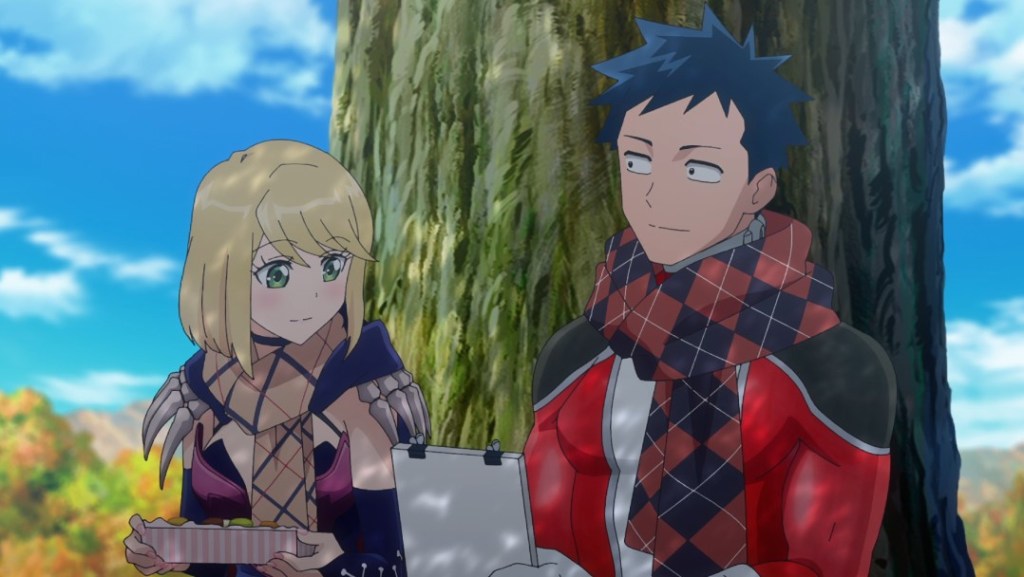
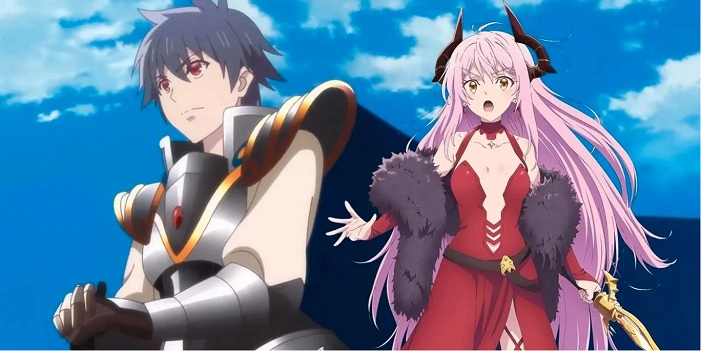
The first episode was well-spent preparing for Hestia Familia’s first on-the-books Guild-assigned expedition, so with episode 2 the whole gang actually gets down to business. The result is a well-balanced episode which showcases much of what has made DanMachi so entertaining so far.
Although the quintet of Bell, Lily, Welf, Mikoto, and Haruhime are entertaining enough on their own, the additional cast members add some welcome extra dynamic to the group interactions. They already show in early, more minor encounters that they can work together well in a fight, but the additional personalities also offer neat extra little quirks, like how timidly Cassandra hugs the walls while going down a cliffside trail or how Aisha can poke Lily just right to prompt her greed to override her caution while Daphne provides Lily the reassurance that she’s doing her commander job well or gives Cassandra a playful head-butt. It also makes the camp scene more lively and provides room for observations on various characters, especially Bell.
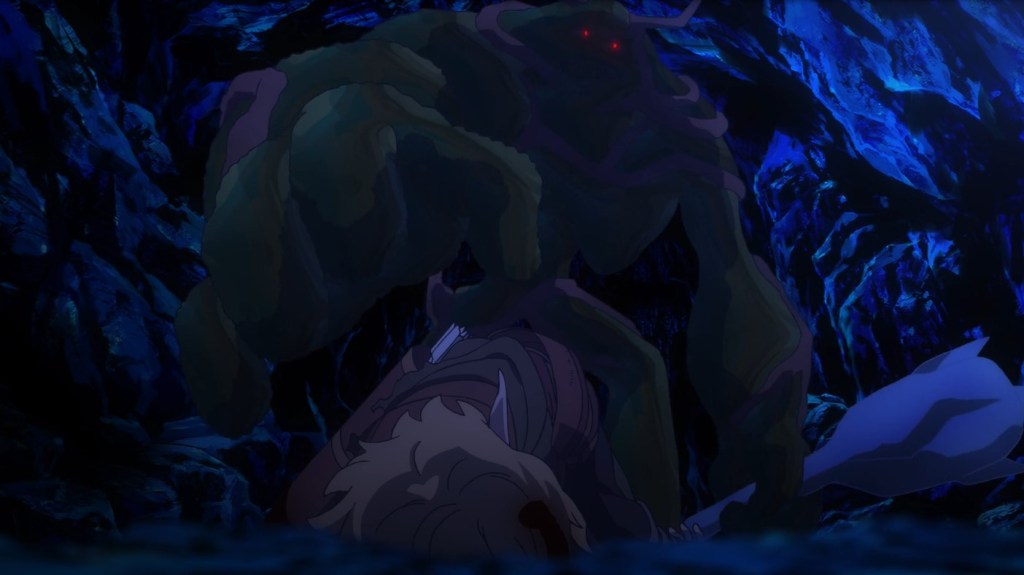
The episode strains a little more to keep everyone involved in the action scenes, with Daphne, Cassandra, Chigusa, and Haruhime all having little to show off at this point. Still, the Great Falls offers a diverse variety of threats from every angle, giving most of the other characters at least some opportunity to show off. My favorite move prior to the feature encounter was probably Mikoto’s somersaulting kick, but even that pales in comparison to the far more substantial threat presented by the moss monster. Though Enhanced Species have popped up on a few occasions in Sword Oratoria, this is Bell and crew’s first encounter with one that wasn’t a Xenos, and it presents a suitably terrifying foe. It’s clearly intelligent, has some nifty moves, and an area-spray attack with projectiles that can grow plants out of wounds on successful hits. Kudos to the adaptation team for making the monster every bit as much of a threat in visuals as it was in writing.
The quality work on the background art also cannot be overlooked. The different venues of the Dungeon can provide a wide variety of looks, but the team has outdone itself here. The only minor complaint is that the character animation sometimes stands out a little too much against the CG used for the water, but the visuals are impressive enough otherwise to allow that to be overlooked.
On the whole, this episode is a perfect encapsulation of what it means to be on an adventure in a fantasy RPG. I have little concern that the adaptation of the rest of novel 12 won’t also be at least as strong.
(NOTE: Given how late this series is debuting, I have decided to post this as a separate post rather than temporarily kick the main Preview Guide post back to sticky status.)
This new light comedy series features protagonist Yuuri, a boy who has lost his parents to an accident and, due to financial constraints, has decided to dismiss his servants and try to live alone in the family’s small mansion. A mysterious, sexy, purple-eyed maid (whose name he later learns is Lilith) suddenly shows up on his doorstep as he’s struggling to get by and offers to work as a servant just for room and board. But she seems a little too good to be true, and Yuuri finds himself so overwhelmed by her presence that he starts to suspect that she’s up to something. (And he clearly can’t tell when she’s just trying to mess with him.) While she does seem to have an ulterior motive, it’s nothing so nefarious as Yuuri imagines.
As premises for a potential romantic comedy go, this isn’t a bad one. However, the execution is decidedly lacking. A review of the first volume of the source manga criticized the content harshly for being obnoxiously repetitive with a single joke (i.e., that Lilith is up to something devious when she’s really not), and that problem definitely carries over to anime form. The gimmick with Yuuri misinterpreting in the most paranoid way what Lilith is or isn’t doing, and Lilith playing along with it only for that to backfire when it makes the situation even worse, is mildly funny the first time but gets increasingly tedious as it repeats in variations as the episode progresses. Doesn’t also help that there some inexplicable details here, or that Yuuri is an idiot; if there’s a profile of your mysterious maid in a book in the mansion’s library and you’re curious about her, why just look at her name instead of the whole profile? The end implies that Lilith does already know Yuuri and came to the mansion to help him upon learning of his parents’ death, so there may be a sweet story here, but the attempts to set it up don’t gel. Another problem is that neither character proves all that interesting; Lilith just isn’t playful enough for her character to be effective, for instance.
Technical merits and character designs also fail to impress here, leaving the series with little to fall back on. Maybe this one will get better as additional characters shown in the opener get added in, but will anyone still be watching by that point?
The first episode ended with the bombshell revelation that Alas Ramus, the toddler who appeared from a golden apple and was capable of stopping Better Half with her bare hands, regards Satan and Emilia as her parents. This episode starts by showing that she’s absolutely adamant about that belief, no matter how little sense it actually makes, so now the whole gang must deal with the consequences.
The most immediate – though hardly most problematic – of those consequences is who’s going to look after the tyke. That Maou would eventually decide to take responsibility is not surprising, though Suzuno admitting that she has experience with kids is a bit of a surprise given her demeanor. Explaining Alas Ramus’s presence, and who she claims her parents are, to anyone outside of the Enta Islans (and their immediate confidante Chiho) proves at least as harrowing as having to deal with a toddler unhappy that one of her parents isn’t present, though. The episode offers two different types of problem cases on that: one is Emi’s meddlesome, drama-loving friend Rika, while the other is Maou’s manager, Ms. Kisaki. The former is just having fun with the situation, while the latter has some valuable advice about appearances that neither Chiho nor Maou is fully considering even once Maou does come up with some kind of cover story. She’s right, too, even though the situation is a lot more complicated than she realizes.
Essentially, most of the episode involves the cast adjusting to the presence of Alas Ramus and setting up for her “Mama and Papa” to take her to the amusement park together, despite the misgivings that both (especially Emi) have about the endeavor; Kisaki’s words about appearances also echo here, and I have to wonder if Emi’s decision to visit a salon in preparation for the outing isn’t going to backfire because of that. Going that far to prepare for a “family outing” certainly suggests something more than just a display of pride, but the way intent and appearances conflict has been a running theme of the franchise so far. Meanwhile, the mysterious woman from the first episode’s prologue is not only in Japan but also keeping an eye on Alas Ramus, while another angel looks to be Gating to Japan. Urushihara also has his own problems, as the comment about how even a seeming 2-year-old is more responsible about cleaning up after herself than him apparently got to him.
The big picture here still has only been vaguely hinted at by the end of the episode, but there are clues present if one knows what to look for. The mysterious woman has hair color of a similar hue to both the angelic-looking figure at the end of the episode and to Emilia’s Hero form (and, for that matter, Alas Ramus, too). Since that form represents Emilia manifesting her half-angel side, it’s safe to say that the woman is either an angel or closely linked to them. The meaning of Alas Ramus’s name is also significant here, as the “wing” part could be an angelic reference and the “branch” part seems more suspicious after seeing the tree prominently-featured at the end of the episode. Not enough information has yet been provided to piece together where this is headed, but the bread crumbs are starting to accumulate.
In an adaptation sense, the anime version is definitely condensing some things as it takes the first novel past the halfway point (i.e., to page 139 of 251), but it is not leaving out anything important. Even so, the pacing here – which is much faster than for the first season – strongly suggests an intent to spend only four episodes adapting novel 3. Also, the scene shown at the end involving the tree and the presumed angel isn’t just anime-original; it’s providing visual details that don’t come up until vastly later in the novels. That makes its inclusion an interesting one, to the point that I have to wonder what the production team’s intent is here. Clearly, the people producing the series had read the source material through to the final novel.
Overall, this is another solid episode which manages the established cast well while both using its trademark style of humor and setting up for what seems like a potential conflict next episode.
NOTE: An episode 0 does also exist for this season, but it is entirely a recap of the first three seasons narrated by Bell and Hestia, with scenes from the trailer for season 4 thrown on at the end. It is fully skippable.
DanMachi has returned for another season! Like with the previous two seasons, it opens with an episode that is mostly set-up for the new arc, but in this case there’s plenty enough set-up to go around as the standing cast positions itself for the featured activity: Hestia Familia’s first official expedition.
In Orario, familias that register as exploring (i.e., Dungeon-delving) familias are expected to go on Guild-ordered expeditions with set goals once they reach a certain status, all to prove that they are as capable as their status indicates. And Bell leveling up again – to Level 4 – has pushed Hestia Familia up to the level of getting expeditions. Though the requirement may be a pain, Bell is motivated anyway when he hears from Fels that reaching the bottom of the Dungeon will be necessary for the Xenos to live peacefully with surface-dwelling races, so this episode primarily becomes about assembling and structuring the expedition centered around Hestia Familia. Ouka and Chigusa join from Takemikazuchi Familia, Cassandra and Daphne join from Miach Familia, and Aisha joins Just Because. (That she’s a plant for Hermes is not out of the question, though between her interest in Bell and her protectiveness towards Haruhime, she has plenty of her own motivation.)
This results in some standard preparatory content, which will doubtless result in most expedition members showing new tricks. The most important of these is probably Daphne convincing the still-level-1-Liliruca to follow the path of fellow prum Finn Dieme and serve as the expedition’s commander. She has effectively been the strategist of Bell’s parties (and later Hestia Familia) ever since joining Bell, so this seems like a natural role for her, and Daphne’s not wrong that a group of ten needs someone like that to be efficient. The episode-ending action scene already shows some of the kind of impact she will have despite being under-leveled for an expedition that looks to be heading to floor 25. What Haruhime’s new power will be will have to wait (although it has been hinted at in trailers), but we do get to see Ouka’s new Welf-forged axe and new battle garb for several of the characters.
And that’s all that really happens in the episode, aside from Hestia going out drinking with her fellow goddesses and Eina dealing with elf and dwarf adventurers who seem enamored with her. Despite a seeming dearth of meatiness, this is still one of the series’ best downtime episodes to date, as it balances well the attention it spreads among various participants and provides all kinds of set-ups and lead-ins to things that will happen later on. It even finds a way to work in the aforementioned elf and dwarf, who were introduced in print in a novel 8 short story that the anime skipped adapting but who will unavoidably figure into later events in this arc. Solid technical merits for this episode also don’t hurt.
In general, the episode also is a reasonable adaptation of the first 57 pages of novel 12, with the one significant omission being the Denatus which takes place right after Bell levels up again. Skipping that Chigusa leveled up and earned a title isn’t a big deal, as it will hardly be relevant, but I am surprised that no mention is made of Bell earning a new title, too. It also skips references to some minor details that were not adapted in previous seasons, but those are trivial changes. In all, it’s a quite satisfying start for what should be a good run.
After more than nine years off, this beloved anime adaptation is finally back! It features a new animation studio, new director, and substantial but not complete turnover in the primary staff, but all of the original seiyuu for the major roles reprise them here. The result is an episode which spends most of its run time reacquainting the audience with the cast from the first series before dropping a bombshell character introduction, one who will define the course of this season’s first story arc and set in motion the story’s overarching plot.
Before getting to that, the episode opens with a brief recap of the premise before showing the current status of the cast. Nearly all of the recurring cast members get at least some attention, which was doubtless the episode’s goal; the only significant absences are Emilia’s coworker/friend Rika and the landlord Mikitty, but both would have been difficult to shoehorn in here. The antics are just what you’d expect based on the first season: fretting over mundane activities, getting triumphant over minute successes, exploring cultural elements that differ between the two worlds, a dash of romantic hijinks, bad-mouthing each other to the point of violence, and so forth, including a silly sequence of excessive drama and overkill involving a cockroach. While getting back into the swing of things like this can be fun, it also makes for a slow start to the episode.
That all changes about 3/4 of the way through, when a Gate opens and deposits a golden apple which turns into a toddler with silver hair featuring a purple streak. (That streak is actually an important detail, though it may not come up again for a while.) Clearly to viewers, this has something to do with whatever the mysterious woman in the prologue was doing at the former Demon Castle, but that the toddler Alas Ramus can stop Better Half (Emilia’s sword) cold with her baby hands means she’s no ordinary child. Her true identity, and the truth behind her jaw-dropping claim about who her parents are, gives the episode a juicy twist/cliffhanger that finally spurs the story into a higher activity level. Seeing how this plays out should be fun.
This episode adapts the prologue and first chapter of the third source novel (about 64 pages) with a mix of utter faithfulness and some shifting and tweaking of details that nonetheless remain fully in the spirit of the series; for instance, the cockroach scene is anime-original and Sariel’s cameo in startlingly overweight mode doesn’t come up until later in the same novel, but both scenes still fit here. The shifting of the character design style will definitely take some getting used to, as it tends to give the characters softer and more rounded features, which makes most of them look younger. The animation further gives them much more exaggerated expressions, which is a very hit-or-miss effect. Newcomer Alas Ramus has an adorably roly-poly design sure to endear to viewers, however, and the animation quality is decent if unexciting.
Overall, the first episode is exactly what it needs to be for reintroducing the series, even if it does go a bit slow.
Welcome to my version of the Summer 2022 Preview Guide! I expect to cover every full-episode series that will be debuting this season and some but not all of the sequels. (I will cover the new installments of Utawarerumono, Overlord, Made in Abyss, The Devil is a Part-Timer,DanMachi, and Luminous Witches, the new entry in the Strike Witches franchise.) These will be listed in newest to oldest order, and this post will be updated multiple times per day on busier days.
Note #1:Bastard!! will not be a part of this Preview Guide, as I have posted a separate full review on all 13 episodes here.
Note #2:The Devil is a Part-Timer 2 and DanMachi 2 are both going straight to episode reviews as they debut, as I intend to cover both this season. I might consider covering something else as well (Overlord 4, for instance), as long as it doesn’t air on a TH or FR.
SHINEPOST
Streams: HIDIVE on Tuesdays
Rating: 3 of 5)
I was not expecting any more for this one (which is, surprisingly, a novel adaptation) than a typical idol show, and nothing about the debut episode convinced me to watch more. Thus the answer to the pertinent question, “can this attract the attention of those who aren’t established idol show fans” is “no.” However, the episode is not without merit, and it has some hooks that could make it successful with the right audiences.
One of those is a surprisingly high level of technical achievement. Studio Kai hardly has a sterling reputation, but this is a good-looking series with attractive, well-defined character designs and better-than-average animation, even in the opening performance number. The use of camera is also better than normal. The other is the interesting twist about the exact nature of the would-be producer’s special ability and why it matters so much in this scenario about a trio of girls who were all inspired by a top idol, and seem to have talent, but have had little success putting together a good attendance so far, to the point that their agency’s boss have given them an ultimatum. The lead trio’s personalities flow well but are still stereotypical for the genre, and two more girls look like they may eventually get involved as well. So yeah, there is at least some potential for this one to shine a little.
Parallel World Pharmacy
Streams: Crunchyroll on Sundays
Rating: 3 (of 5)
The premise here seems quite standard: a promising pharmacist apparently expires from overwork and finds himself reborn in the body of a boy not-subtly named Farma, one who is the second son of a noble family renowned for medieval-level pharmaceutical skills. (The boy apparently expired from a lightning strike.) He can now wield magic, but it’s quite unusually powerful, and he naturally, he seems to have the blessing of a particular god, too.
I was all ready to write this off as just another utterly generic isekai series in the more sedate “let’s start a business in a fantasy world” model, until it got to the late scenes where Farma is trying convince his tutor that he’s not really a new person as a result of the lightning strike. Her reactions to Farma utilizing both magic power and a special injury-analyzing eye that far beyond reasonable human capabilities was fear, and not in a comical sense, either. This is an angle that isekai shows rarely take, and it’s left me to wonder if this might amount to something. I’m going to give it at least one more episode to prove itself.
Black Summoner
Streams: Crunchyroll on Saturdays
Rating: 3 (of 5)
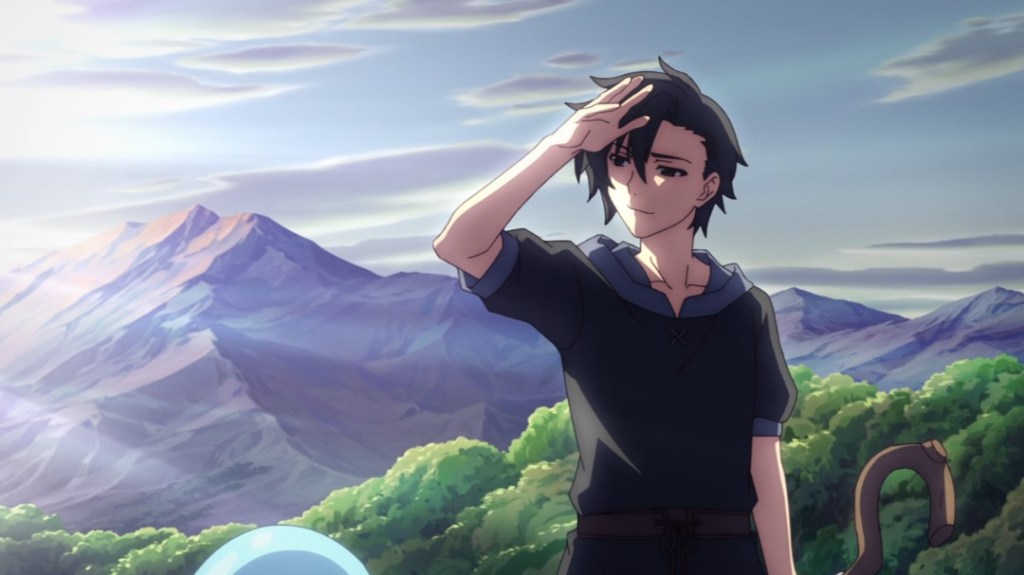
This light novel adaptation has about the most generic isekai premise imaginable: a young man is reincarnated into a fantasy world operating on game-like principles (at least from his perspective, anyway). He has one truly OP ability, though he has to be wary about letting anyone know about it because it’s so rare and powerful that it would attract unwanted attention. He joins an adventurer’s guild, bonds with a slime, and starts doing missions. The slight twist is that the voice in his head explaining things is actually the Goddess of Reincarnation, who agreed to be one of his summonable servants as a way of taking a vacation from her normal duties, though he isn’t yet strong enough to actually summon her (he fell in love with her at first sight). He also doesn’t remember anything from his previous life, but that’s just a convenient way to not have to bring it up. Oh, yes, and a half-elf slave girl also does pop up, though in a mildly surprising twist, he has not (yet) bought her by the end of the episode. But surely that’s coming, right?
Really, the first episode would have to try hard to be more utterly generic than this. In fact, it so lacks any degree of visual, conceptual, or storytelling originality that it feels lazy; even the pact with the goddess has been done in other series (more seriously in Ah! My Goddess and more comically in KONOSUBA) before, and the Guild Girls could have been borrowed directly from any of a dozen other series. I am still giving it a middling grade because the visual and technical merits are on the high side for generic isekai series, including a remarkable detailed first battle between protagonist Kelvin and a blue slime, and the interactions between Kelvin and the goddess Melfina are fun. But if there’s anything special about this one, it has yet to show.
Shine On! Bakumatsu Bad Boys
Streams: Crunchyroll on Saturdays?
Rating: 3 (of 5)
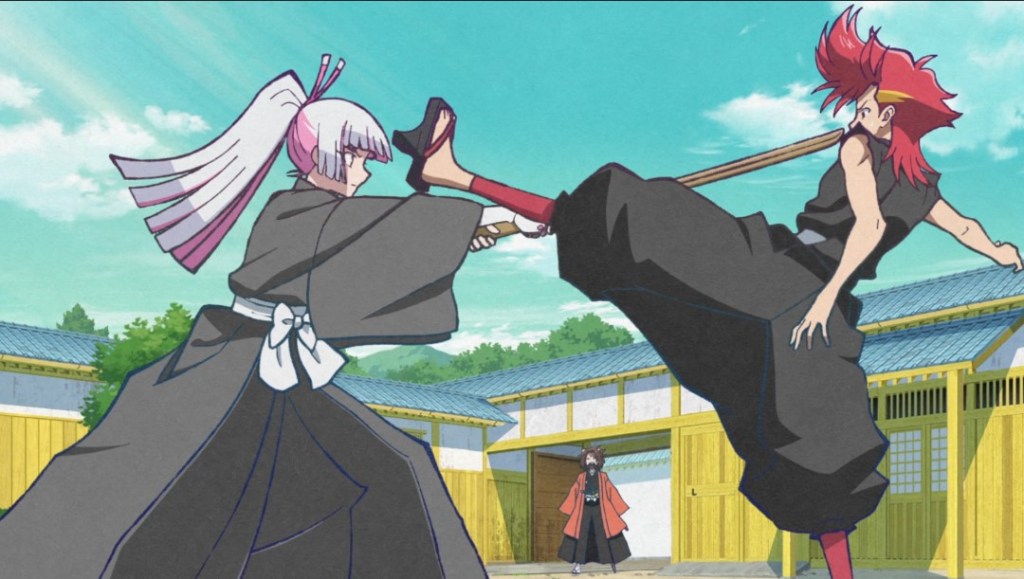
Anime has seen a number of fanciful portrayals of the Shinsengumi (the special police force which served the Tokugawa Shogunate during the mid-to-late 1860s) over the years, but this original anime series provides one of the odder takes on that storied group. It supposes that most of the Shinsengumi got assassinated on the day that they officially took that name, so one of the few survivors, unit captain Todo Heisuke, chose eight condemned criminals to take on the swords and roles of the dead in order to fill the role that the Shinsengumi were expected to take on. Naturally, the criminals are a colorful and divers lot, including a professional killer, a sinful monk, a “psycho doctor,” a huge glutton, a cross-dressing woman, a professional criminal, and a revenge-driven idiot seeking the same masked samurai who is behind the slaughter of the original Shinsengumi. Oh, and mystically-imbued swords are going to be a thing here, too.
This is hardly one of the prettier-looking series of the season, but it does at least have a lot of boisterous energy and some reasonable attempts at active action sequences. Given how many historical names it throws around, I am a bit curious to see how thoroughly it integrates in actual historical events, and it does look like some of the character interactions could be fun, but this series is likely to fall below the cut line for me this season.
Extreme Hearts
Streams: Crunchyroll on Saturdays
Rating: 2.5 (of 5)
Aspiring to be a singer is a common dream for teenagers, but even for those who do get as far as a debut, it often just won’t work out in the long run. A series about someone who tried their best, didn’t succeed, and ultimately had to find a different path might actually be interesting to watch, but in this setting, there’s one more alternative: go into mixed extreme sports. Because sports enhanced by sci fi-grade sports equipment are a natural avenue for would-be idols, right?
That’s the premise that this new series from the creator of Magical Girl Lyrical Nanoha is asking viewers to swallow. The exact mechanics behind how this all works is left quite vague, so viewers are expected to just go with the flow on “rule of cool” here. Thanks to some solid character foundations for lead Hiyori and her #2 fan Saki, it almost works for a while, too. However, I found the concept just too eye-rolling to handle when they introduced the “AI players” to fill out Hiyori’s short-field soccer team. It’s almost like the series is saying, “we can’t be bothered to provide any better explanation for why Hiyori has fill-in team members,” to say nothing of how bizarre it is that the rules of the Extreme Hearts competition apparently allow this. Maybe there’s enough story here to overcome hang-ups like this, and some of the girls featured in the promo art and opener (shown at the end of the episode) have yet to appear, but I don’t see enough here to convince me to stick around to find out.
When Will Ayumu Make His Move?
Streams: HIDIVE on Fridays
Rating: 3.5 (of 5)
Despite the boy’s serious, deadpan demeanor, the girl is absolutely convinced that the boy who’s the only other member of her shogi “club” is in love with her and she aches to see him outright admit it. She’s not wrong, and he does say just about everything short of that to show his interest, but what she doesn’t know is that he’s fixated on not confessing until he can beat her straight-up at shogi. Hence a sort of contest of wills plays out across the shogi board.
I can see this one inviting all kinds of comparisons to Kaguya-sama, as this is another case where pride is getting in the way of both leads making any declarations, but it’s not really the same kind of romantic comedy. The conflict here is not between the two, but rather within each of them, so any mind games going on here are strictly internal ones. That turns out to be more entertaining to watch than I expected, as female lead Urushi is thoroughly adorable in the way she tries to reconcile Ayumu’s aggressive forthrightness in some areas with this seeming passivity in others. And while we get very little of this scenario from Ayumu’s point of view, we get just enough to occasionally confirm his sincerity and that yes, he’s absolutely taken with Urushi. He just gets nervous and defensive about saying anything more than flattery to Urushi, and that is reflected in his game play as well. Light use of a musical score also nicely helps set the pleasant, comfortable tone. Basically, there’s not much for laugh-out-loud moments or to get terribly excited about here, but it’s an appreciable watch nonetheless.
Lucifer and the Biscuit Hammer
Streams: Crunchyroll on Fridays
Rating: 2 (of 5)
The name of this one has intrigued me ever since I first heard about its source manga, so I went into this one expecting it to be something exciting. What we get instead is one of the more underwhelming openers so far this season.
The set-up is fairly typical: a young man is approached about being a knight who must help find a princess and then defeat an evil wizard who is both seeking the princess and seeking to destroy the world. Yuuhi steadfastly won’t have any of this, especially since the pitch is coming from a lizard almost no one else can see and he can’t get rid of. Turns out the monsters sent by the wizard are real, the neighbor girl is the princess, and she’s both quite capable and quite ambitious in a devilish way (hence the “Lucifer” in the title). Oh, and there really is a giant-ass hammer hanging out there in space called the Biscuit Hammer that’s ready to destroy the world.
I think I can see what this first episode was trying to do, but it just doesn’t work. Almost nothing the episode tries to do clicks; the jokes aren’t funny, Yuuhi is more annoying than sympathetic in his denials, the ridiculous elements are more eye-rolling than enjoyable, and the one monster tries to cover up for just being odd by moving in a flash; that’s the part that maybe comes the closest to working. Yuuhi’s ending exhilaration at connecting with the “princess” is under-supported as well, and the interactions with his teacher are dull. The visual effort is also decidedly mediocre. Perhaps most importantly, the episode just lacks the spirit of fun that it feels like it should have. This is directed by the same person behind last season’s awful Don’t Hurt Me, My Healer!, and apparently I should have taken that as a warning. Overall, it’s not a total disaster (I did rather like and sympathize with the talking lizard), but definitely not worth watching more.
Prima Doll
Streams: HIDIVE on Fridays
Rating: 3.5 (of 5)
The heyday of anime adaptations of Visual Arts/Key properties may be past, but the company still remains unmatched in its ability to suffuse its titles with nearly overwhelming amounts of sentiment and raw emotional appeal. Such is the case with the first episode of this series, which looks to be focusing on the repurposing of onetime-combat androids in a sort of “what’s left for soldiers after their battles are over” kind of scenario – done Visual Arts/Key style, of course.
To be clear, the “Dolls” in this setting don’t look like they actually did the fighting themselves. They instead controlled cruder and bulkier Mechanica who were specialized for direct combat and made up a large chunk of this setting’s military forces. Hence the wear and tear on them was less physical and more in a processing sense, as in this episode’s case of the broken Doll Yugiri, who has trouble remembering anything, not even the little girl who adores her., but doesn’t want that little girl to know. Sure, she could get her processor replaced, but that would also reset her to the point of not being Yugiri anymore. That has apparently already happened to protagonist Doll Haizakura, who cannot remember anything and seems fragile and clumsy but still retains an apparently-unparalleled command/control ability. While her situation gets sorted out, she is learning to work at a cafe which entirely employs retired Dolls (for the up-front staff) and Mechanica (for the kitchen staff).
The emotional beats here are remarkably strong for a first episode, in part because a lot of subtext can be read into these situations. (The clear intent is, I think, to equate broken androids with psychologically damaged people.) The first episode also smoothly works a good amount of world-building into a story which seems narrowly-focused and lacks exposition. Never been a fan of the distinctive Visual Arts/Key cute girl character designs, and that is where the episode is most stereotypical, but this has just enough going for it to earn a mild recommendation, especially for CGDCT fans.
The Yakuza’s Guide to Babysitting
Streams: Crunchyroll on Fridays
Rating: 4 (of 5)
Adults ill-suited for dealing with children getting paired up with little kids for both comedy and endearing empathy is a trope hardly limited to anime titles, but there have been a few good ones in recent years in anime – most recently, of course, Spy x Family. This manga adaptation, whose character designs show distinct shojo influences, has the strong potential to be the next success story in that realm. By the end of the episode it has already found a good balance between its violent and tender sides.
A lot of this is thanks to lead protagonist Kirishima Tooru, aka “The Demon of Sakuragi” (with the “Sakuragi” being the yakuza organization in question), a 28-year-old enforcer given the task of looking after the boss’s 7-year-old daughter, Yaeka. The implication is that the boss is doing it to teach Kirishima about responsibility, but rather than grumbling about it, Kirishima takes the task seriously and does seem to genuinely be trying to understand Yaeka. Meanwhile, she is initially distant but already seems to be warming to him a little by the end of the episode. As for where her mother is in this scenario? An aunt is present, but the post-credit scene implies that the mother his hospitalized long-term, which could explain Yaeka’s disposition.
In other words, there’s a strong sense of story and underlying drama to this scenario than most of these type of series show, though the more comic elements still (effectively) dominate on the surface. In all, this is an effective and well-executed opener for what should be a solidly entertaining series.
Chimimo
Streams: HIDIVE on Thursdays
Rating: 3 (of 5)
Shocking, this original animation is a full-length episode rather than a short, and it’s not (entirely) a kid’s show, even if it does traffic heavily in family-friendly cuteness. The little white blobs – each of which has some distinguishing feature, like glasses or a mustache – are actually evil spirits from Hell called Chimimiyo, who work with an emissary from Hell (later named Mr. Hell), who comes to the human world with the intent of researching it and implementing Hell on Earth. The problem is that he didn’t count on running into a trio of sisters, one who has won over the Chimimiyo, another who can drunkenly barf on him, and a third who not only can beat the crap out of him but also trim his hair down and give him a room with a rent charge.
Essentially, the whole thing is one big exercise in cuteness a few hints of perversity underlying the situation, and its simple, pastel-flavored artistry and character designs reinforce that. Don’t expect much more than fluffy, passive fun and this one might entertain.
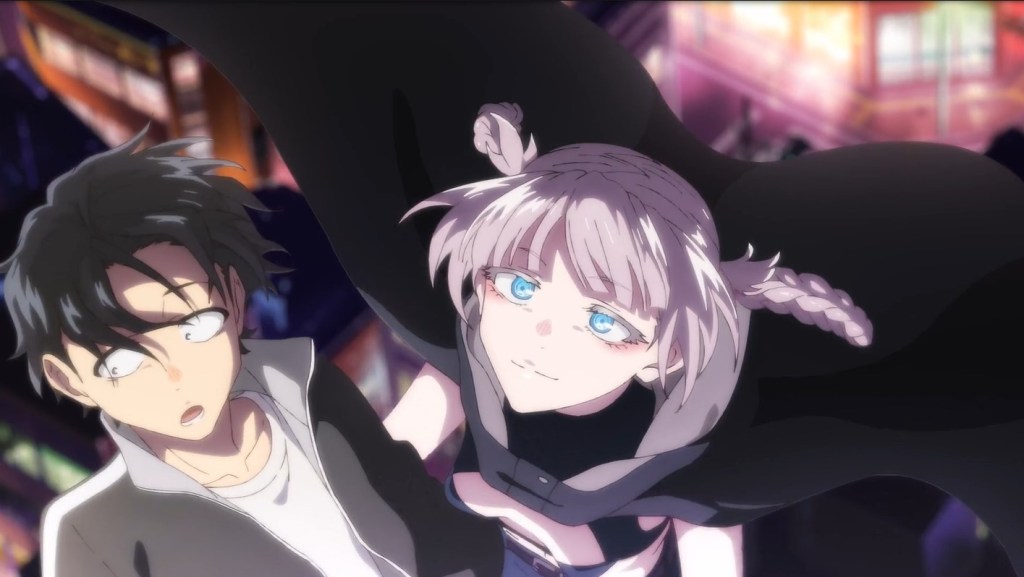
Call of the Night
Streams: HIDIVE on Thursdays
Rating: 4.5 (of 5)
This manga adaptation was among the most highly-anticipated debuts of the season, and after seeing the first episode I can understand why. This production has a style, spirit, and flow to it that I can easily see making it one of the season’s biggest hits.
That style and spirit starts with the music. Japanese hip-hop group Creepy Nuts provides both the jazz-influenced opener and more pure hip-hop closer, and man, I could put both on looped play even though I’m not normally a hip-hop fan. (The OP’s visuals are nothing to sneeze at, either.) Music director Yoshiaki Dewa, who’s done great work in titles like IRODUKU, The aquatope on white sand, and The Idaten Deities Know Only Peace, maintains that flow throughout the episode, giving the episode a seamless musical theme. That all backs the account of a 14-year-old boy who doesn’t understand love enough to accept a confession and can’t sleep, only now finding freedom at night. Naturally that means he’s going to run into a vampire, in this case the philosophically-minded, hot pants-wearing Nazuna (wonderfully-voiced by the prolific Sora Amamiya), who might be taking an interest in him or might be just seeking her next meal. Before everything’s said and done, he announces his intent to figure out how to fall in love with Nazuna, as that’s a requirement in this setting for a vampire turning someone into offspring.
This could easily be just a run-of-the-mill premise, but this is the director behind the much-lauded The Case Study of Vanitas and many of the Monogatari franchise titles, and he keeps an episode mostly based on one long conversation flowing along merrily. It doesn’t do anything too fancy visually – and frankly, I’m not a fan of the character design aesthetic – but every little visual and storytelling detail it has works together well, culminating in a slow-speed flight through the night sky that is more beautiful than it has any right to be. Also doesn’t hurt that Nazuna is quite the character as vampires go, and the amusing expressiveness of her face fully supports that.
So yeah, this one gets a strong recommendation. It’s worth your time to check out even if vampire tales are not normally your thing.
My Stepmom’s Daughter is My Ex
Streams: Crunchyroll on Wednesdays
Rating: 3.5 (of 5)
Dating and breaking up is a perfectly normal part of middle and high school life, as is the break-ups sometimes not being amicable. But what if you not only couldn’t get apart from your ex, but had to pretend to get along with them because Fate gave you a mean twist?
That’s the underlying conceit of this new light novel adaptation, which offers one of the sauciest premises since Domestic Girlfriend‘s gloriously trashy run a couple of years back. In this case, the contrivance forcing former nerdy couple Mizuto and Yume back together is their parents marrying and them thus becoming stepsiblings. Both want their parents to be happy, so neither wants to intimate that they don’t get along, but now they have to both live together and attend the same school; in fact, they’re even stuck together in the same class. That results in a lot of catty behavior behind the scenes as they arrange a contest to see who is considered the elder sibling (they were born on the same day within a half-hour of each other as well), and some of that can be fun to watch. The additional (and completely predictable) complication is that neither is as completely free of their feelings for the other as they like to think, and that’s already showing some tension before the end of the episode.
The biggest knock against the series at this point is that absolutely nothing about the visual presentation stands out. It’s competently-done, but looks like a dozen or more series we’ve seen before, and even some relatively mild fan service doesn’t change that. (Seeing Yume try to tease Mizuto with her body without really understanding what she’s doing does put an interestingly different twist on this, however.) Still, the first episode is put together well enough, and has just enough hints of greater development potential, that I am very cautiously optimistic about it.
Harem in the Labyrinth of Another World
Streams: Crunchyroll on Wednesdays
Rating: 2 (of 5)
Perhaps the most complimentary thing that can be said about this series’ debut is that the title and opener are completely up-front about which direction the series is going in. Hence no one should stumble into this one unaware of what they’re getting into: an isekai story about a protagonist who assembles a harem to go exploring a dungeon with by purchasing sexy slave girls.
Actually, the first episode only clarifies that main girl Roxanne (i.e., the very busty one featured in promo art for the series) starts as a slave, and Generic Isekai Protagonist #1,256 (aka Michio) hasn’t collected enough money to buy her by the end of the episode. The story is definitely headed in that direction, however, and she’s not even the bustiest one shown in the opener. Sexual predation of slave girls also seems to be an expected thing in this setting, and while the setting does not seem to use magical compulsions for slaves, a master dying means death rather than freedom for a slave (unless there’s an inheritance arrangement, of course), so a slave killing her master would be suicidal and slaves have a vested interest in keeping their masters safe and well. Escape isn’t a worthwhile option, either, since the magical equivalent of identity cards insures that escaped slaves get treated as bandits.
In other words, the one thing this first episode does well is lay out its well-thought-out slavery system. Fan service also looks to be a significant component, as the episode features extensive censoring (though sometimes also for very graphic violence) as well. With unremarkable design elements and only the vaguest hint of a backstory for Michio, this one looks like an isekai title purely for the fan service appreciation crowed.
Made in Abyss: The Golden City of the Scorching Sun
Streams: HIDIVE on Wednesdays
Rating: 4.5 (of 5)
This is a sequel to the movie Dawn of the Deep Soul, which absolutely should be watched before proceeding with this season. It’s also absolutely not a jumping-on point for the franchise, as very little that’s going on here will make any sense to newcomers.
The first episode take an interesting approach: it steps back into the history before a town formed around the pit to focus on a group of adventurers (mostly children led by one adult) who set out for the island holding the Abyss in search of a Golden City within its depths. This is coordinated with scenes of Reg, Riko, and Nanachi making their transition down from the fifth layer, suggesting that whatever the protagonist trio find in the Golden City (they arrive just as the episode ends) is going to be descended from those previous adventurers. There are even some faint visual suggestions that Reg might be connected to those earlier adventurers.
All of this is accomplished with the high animation quality, wonderful musical score, beautifully creative design elements, and sharp characterizations which typified the first series. The ugly side of the first series is also present, including a rare fully-animated scene of someone vomiting, a graphic display of human entrails and a scorched corpse, and a strong implication of branding and child rape. I didn’t have a problem with the latter depiction, as I felt it was sufficiently portrayed as ugly and is in no way titillating, but others may take more issue with it. Despite all of that, the episode is so well-crafted that it makes for the strongest debut so far this season.
Smile of the Arsnotoria the Animation
Streams: Crunchyroll on Wednesdays
Rating: 2 (of 5)
This is the anime side of a multimedia project which started last year with a mobile game and will eventually include a novel later this summer. That doesn’t at all help explain what this series is actually about, though, and neither, frankly, does this first episode. The first 19½ minutes of the episode is simply a CGDCT exercise involving five girls assembling to have tea. From various tidbits dropped throughout, we can tell that they are students (Pentagrams, I think?) at a magic academy, the the magic academy is located up in the sky, that exterminating bugs is part of their curriculum, that they have to keep a regular watch (though for what is not even hinted at), and that some weird stuff wanders around the halls of the academy if one watches closely. No sign of anyone not female, either. Nothing in that content in the slightest suggests what happens in the last two minutes, which shifts to a darker art style, presents a venue with buildings aflame, and shows cloaked figures and a sword-wielding noble bloodily slaughtering older adults.
Both the opener and images I’ve found from the game indicate that this sharp visual and content dichotomy is a key element of the franchise, and the game does seem to have a battle element. Getting inkling on why is going to require more than just this episode, however. The episode does at least plainly lay out the personalities and mannerisms of each of the five central girls, and some of the background design details can be quite interesting, but this should have been a two-episode starter if the first episode was going to be this laid-back and lacking in context. Might watch a second episode just to get a sense of what the hell is actually going on here, but it’s going to have to be more forthcoming to keep its audience.
Tokyo Mew Mew New
Streams: HIDIVE on Tuesdays
Rating: 2 (of 5) for general audiences, higher for magical girl fans
Though I was part of anime fandom at the time the original Tokyo Mew Mew aired in 2002, I wasn’t at all into cutesy magical girl series at the time, so I was aware of the title (mostly from its prominent presence in AMVs and anime magazines) but never watched it. Thus this is my first direct exposure to the franchise. I didn’t have any trouble following the first episode, though, as this appears to be a complete reboot of the original, one wholly intended to draw in a whole new generation to environmentally-themed cuteness.
That being said, the new version doesn’t feel like an update at all. It is every bit a series that has been dragged forward from the early 2000s, down even to some of the style points of its animation, with its only minor concession to the passing years so far being the presence of VR goggles. Its characterizations and story beats will be familiar to anyone who has watched pure, kid-friendly magical girl series over the years, to the point that established magical girl fans might find this to be comfort food. However, those traits also make it unlikely to have any cross-over appeal. The only distinguishing gimmick here is that each of the magical girls – including first episode featured girl Ichigo – has an endangered animal theme, and that’s not enough on its own to make it worth watching.
Vermeil in Gold
Streams: HIDIVE on Tuesdays
Rating: 3 ( of 5)
The Magical Girlfriend trope dates back at least 30 years in anime and has regularly popped up ever since despite changing trends in anime over the decades. This shonen manga adaptation is one of the purest distillations of that trope to come along in some time: Alto, a student at a magic academy who excels at everything else, faces being held back because his one weakness is summoning a familiar, which is essential to have for the next level. In desperation to find something that works, he uses a ritual in an old tome that falls on his head with suspicious convenience, but is shocked by what appears: a voluptuous, naked demon named Vermeil. Normally contracting with demons is deadly to humans, but she determines that Alto’s magic is capable of handling it so she agrees to being his familiar as the price to pay for her freedom (from being sealed in the book). But Lilia, a longtime friend of Alto’s who’s clearly in love with him (Vermeil realizes this, but he’s oblivious), takes exception to Vermeil hanging on Alto and is only forced to get along with her after a duel shows that Vermeil – even when passing as human – is no pushover.
So yeah, the series is progressing down a well-trodden path, including annoying stereotypes like Alto being skittish around sexual elements and the jealous long-time female friend. The technical merits don’t impress, either despite some distinct fan service moments. Vermeil helps save the first episode thanks in part to a wonderfully sultry performance by veteran seiyuu Maaya Uchida, and both the OP and ED hint that she may have an involved backstory, so at least some depth is possible. There are also some interesting magical mechanics in play, such as how strong mana could actually repel weaker familiars and how demon contracts commonly end badly because the summoner can’t handle the mana output needed. This gives me just enough hope that the series could amount to something that I will likely give it another episode or two to prove itself, though I’m still not expecting anything great.
Overlord s4
Streams: Crunchyroll on Tuesdays
Rating: 3.5 (of 5)
After nearly four years off, Overlord has returned to continue the story about the establishment of Ains Ooal Goan’s new Sorcerer Kingdom. As with previous seasons, it’s a slow start, with the first episode again being more of a directional establishment than an episode where anything major actually happens. Ains interacts with four of his chief subordinates (Albedo, Aura, Mare, Hamsuke,and Pandora’s Actor), gets a new outfit more suitingly-resplendent than his normal attire, and deals with some business matters. The two main long-term development points to come up are dispatching Albedo as an emissary to the Re-Estize Kingdom and bringing the local adventurer’s guild into the fold of the Sorcerer Kingdom in order to give it a revamped mission: make them adventurers in the truest, most traditional sense, by exploring and making contact with other lands, rather than just being monster exterminators. Both of those feel like paths to eventual greater development.
On the whole, the episode is just business as normal for the franchise. It is solidly-executed on both technical and storytelling elements, but with nothing exciting going on beyond reaffirming that Ains still feels like he’s in way over his head and has to keep an act up while his underlings fawn over him to an uncomfortable degree. Sure, this is the kind of thing that we have come to expect from the franchise, and it certainly scratches an itch for franchise fans, but did we really need a full episode of it? Hopefully the next episode will, at least, expand out into other areas introduced in previous seasons and bring the series into new ones as well. (I hear that dwarves are getting introduced this time around.)
My Isekai Life
Streams: HIDIVE on Mondays
Rating: 3 (of 5)
Rarely has an isekai series been so blasé about its set-up as this one is. The first episode only references protagonist Yuji having a prior life in a modern world once, and when a bit of the backstory does come up about halfway through the second of this two-episode preview, it hand-waves everything. Yuji gets all of these skills and slimes under his control with startling quickness, though how he met and tamed the wolf and the dryad seen in the first episode remains to be revealed. The writing just seems to regard the set-up as trivial and prefers to get to the more interesting content right away.
And honestly, that may have been the correct call. The first two episodes have a peculiar kind of charm to them that works better than the generic, game-styled set-up and circumstances might suggest. Yuju’s minions have plenty enough personality to make up for their master’s deadpan style, though as he shows when casting grand spells, he does have a bit of flair when he wants to. His matter-of-fact way of dealing with problems sometimes makes for some good humor, too. The first two episodes also show a distinct plot thread and some clever uses for magic, especially channeling spells remotely through slimes. Technical merits are mediocre at best, but the ED is almost ridiculously catchy.
This one has every potential to end up just being another bland isekai power fantasy, but I am cautiously optimistic that it could prove entertaining.
Yurei Deco
Streams: Crunchyroll on Sundays
Rating: 3 (of 5)
If you want to see possibly the weirdest and most high-concept show of the season, and the one the auteur anime fans are going to be talking about, then check this one out. Actually, I recommend checking it out anyway, as it’s rather hard to describe in any simple fashion.
This is the latest production from Science SARU, the studio which has done all of Masakai Yuasa’s stuff and also fare like last year’s The Heike Story, and that distinctive visual style is evident here. The concept here is not subtle: the story is set in a world where Love ratings (which look suspiciously like Facebook “likes”) quantify everything and everyone, represent purchasing power, and even can effectively be used to quell criminal activity. In other words, peace is maintained through authoritarian application of social media. Naturally, that means that one of the main characters exists at least partly outside the system, and there is a mysterious phenomenon called Zero Phantom which can negate Love.
Yeeeah, no social commentary all is intended there, right? I’m not going to bother to try to carefully analyze this one, as I’m sure others will have voluminous commentary on it. This kind of thing isn’t my style at all, so I probably won’t watch more no matter how much others might rave about it, but if you want keep up with what may be the most talked-about new series this season (and certainly the most-anticipated one among critics), then be sure to give this one a look.
Luminous Witches
Streams: Crunchyroll on Sundays
Rating: 3.5 (of 5)
This title is part of the Strike Witches franchise, and the first episode does not bother to lay out the franchise’s underlying conceits, so a general conceptual familiarity is assumed: an invasion by the alien Neuroi has effectively made an alternate antagonist for World War 2, witches exist who have familiars and magic but lose them around age 20, and witches have become a key part of the anti-Neuroi defenses via the use of Striker Units that harness their magic and allow them to fly (and thus essentially make them anthropomorphized WW2 fighter planes). That’s about all one needs to know to handle the first episode, however, as this does not seem directly connected to any previous franchise title.
The first episode is entirely taken up with introducing the girls who will form the core cast, so there’s almost no plot movement yet, but the essential idea here seems to be the answer to an important question in the franchise: what do witches who are not suited for battle (whether because of injury, erratic magic, lack of knowledge, aging out, or just general magical incompetence) do? The answer the series seems to be headed towards is to form a morale-boosting performing troupe – and since this is anime, that of course means it must be done idol group-style. So yeah, this looks to be the franchise’s idol show version.
This is more than just a completely logical extension of the franchise, as it even fits within the franchise’s historical context; essentially, the girls are going to be this setting’s equivalent of the USO. That doesn’t divorce this from being an idol series, but I am curious to see how the wartime elements get integrated into the normal course of idol show events. Visual style and animation quality are consistent with franchise norms, and in a promising sign, a lovely rendition of “Amazing Grace” sung in Japanese is featured in one scene. Overall, this shows some promise, and might not just be for franchise fans.
Shoot! Goal to the Future
Streams: Crunchyroll on Saturdays
Rating: 2 (of 5)
I think I’ve made it clear in previous seasons that I’m not a soccer fan, and even less so am I a fan of soccer anime, so this one had the deck heavily stacked against it for me. Nothing about this debut episode is going to change that opinion, although I do have to give this one some credit for laying on the drama thicker than normal. Even so, this is still just a more serious version of the typical “former ace has become disaffected by the sport, but others are trying to drag him back in” gimmick. And how much does it say about how tired this gimmick is when the former soccer buddy who was implied all along to be dead instead just turns out to have left the former ace, and that’s the episode’s major twist?
One other thing about this one: although it can be taken and fully understood as a standalone, it actually appears to be a next-gen follow-up to the series Aoki Densetsu Shoot!, which aired in 1993-94. The coach figure, Kamiya, is even implied to be one of the main characters from that series. (There was an Atsushi Kamiya in the main cast.) So this is also going to be a “rebuild the team to its past glory” scenario. Not enough to get me watching any more of it, though.
Teppen!!!!!!!!!!!! Laughing ’til You Cry
Streams: Crunchyroll on Saturdays
Rating: 3 (of 5)
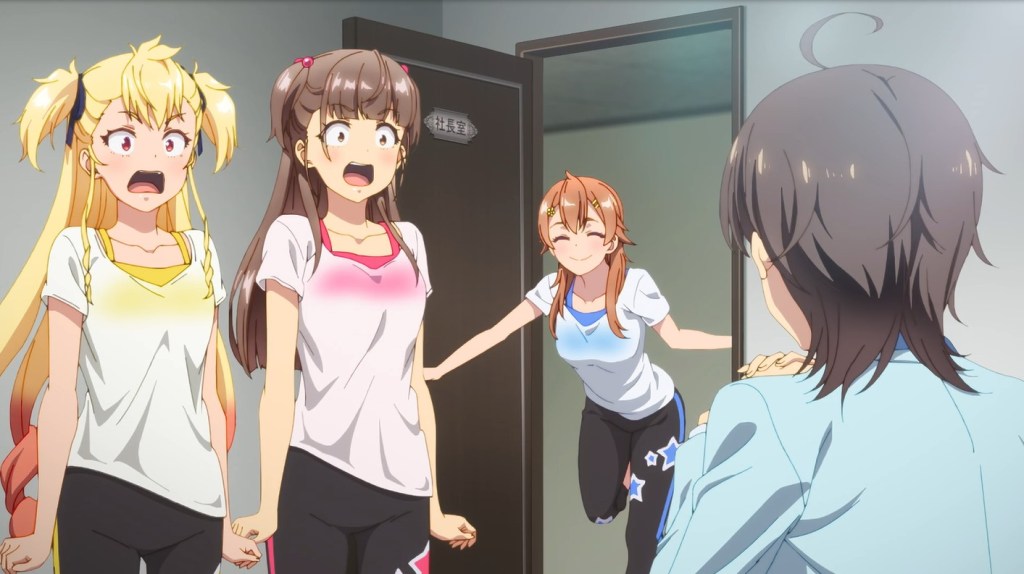
This is a series about trios of girls living in a boarding house for finalists in a national manzai trio competition. (Manzai is a traditional Japanese comedy routine style similar to stand-up, though usually done with two people.) The first episode introduces us to both the muscle-bound house manager and five very eccentric trios, with the focus primarily on the trio Young Wai-Wai and their misadventures with a bodybuilding trophy, which serve as fodder for their manzai routine. I would expect that future episodes will cycle through focusing on each of the other four groups, including one with an alien theme, one with a Rich Girl theme, one with a “not from Tokyo” theme, and I’m not clear yet what the Bullet Kunoichi team is going for.
I really, really did not expect to like this at all, especially since I tend to prefer improv for stand-up comedy rather than more formalized routines, but more than once this episode made me laugh despite myself. (The best gag is undoubtedly the one about the damage trophy’s final form.) Though I found it tedious at first, the flow of the humor in it gradually grew on me. Not sure if I’ll watch more, and the technical merits are definitely nothing special. Even if you don’t check the whole episode out, though, you owe it to yourself to at least check out the mostly-rapped opener, which is one of the more memorable ones so far this year.
Lycoris Recoil
Streams: Crunchyroll on Saturdays
Rating: 4 (of 5)
From studio A-1 Pictures and the creator of Ben-To comes this new original series. The premise here is that there’s a secret organization in Japan called DA (for “Direct Attack”) which keeps the peace though the use of young female agents called Lycoris. These highly-skilled girls surreptitiously deal with all kinds of threats, using lethal force when necessary, though they can also still pass as normal teen girls. Takina Inoue is one such agent who gets demoted after going overboard on a mission and sent to train under supposedly the best Lycoris ever, one Chisato Nishikigi, who works out of Cafe LycoReco. But the seemingly-flighty Chisato throws Takina for a loop, both because of her character and because of her current penchant for using non-lethal force and taking on private sector assignments normally deemed beneath DA’s attention. As Takina learns, however, Chisato didn’t earn her reputation for nothing.
In other words, this is one of these “cute girls take on odd jobs” kind of scenarios crossed with a “girls with guns” scenario, one that can get surprisingly harshly violent. (And no, you’re not supposed to ask any questions about why the agents are all teen girls.) The first episode does an effective job of establishing the central duo – a standard light-haired genki girl with dark-haired serious girl combo – and setting up both what Chisato does now and some hints of broader plot points, including a hacker with a penchant for quoting James Joyce and a mysterious philanthropist who is somehow up to no good. Character designs are sharp and the overall visual merits should make this one of the better-looking anime series of the new season, including some crisp action sequences. (Some of the credit for this probably goes to director Shingo Adachi, who is helming his first series but is the long-time character designer and action director for the SAO franchise.) The setting raises a lot of dicey questions about the overall structure of the government in this setting, but overall, I came away with a positive enough impression of this one that I will almost certainly watch more.
Engage Kiss
Streams: Crunchyroll on Saturdays
Rating: 2.5 (of 5)
In this new multimedia project from Aniplex, Shu Ogata is a young private contractor on Bayron City, an independent Mega-Float city in the Pacific Ocean which is on the cutting edge of new energy mining. Shu specializes in dealing with “D Hazards,” demonic transformations which threaten the city, but his finances are in dire straits due to no recent work. What success and financial support he does have comes from Kisara, who attends school as a high school student but is actually a high-class demon who has made a contract with Shu. And the price of that contract – and what fuels her powers – is draining kisses. She also happens to be a very jealous and possessive sort, as Shu’s ex at his previous job quickly discovers.
Despite the sci fi/fantasy trappings, this series is actually listed as a romantic comedy, and some elements of that do show through in the first episode. A good chunk of the episode is taken up by a fight scene, though, with the “gimmick” that Shu’s current girl and ex seem to be attacking each other as they take out the bad guy’s minions. That works about as well as anything else in the opening series – which is to say, barely at all. The first episode is not outright bad, and Kisara does look at least a little cool when she goes into demon form, but the lackluster production and concept make it hard to get enthusiastic about this one.
Utawarerumono Mask of Truth
Streams: Crunchyroll on Saturdays
Rating: 3.5 (of 5)
This two-episode opener begins the adaptation of the third of the three games in the source game series. As such, it is absolutely not a franchise entry point. Even with the opening montage (which references both the previous anime series), anyone not familiar with all previous content will be lost. In fact, I’d even recommend going back and at least reviewing what happened towards the end of the second series before watching this, as the events here follow directly from those events.
While just saying, “if you’ve liked previous entries in the franchise, you’ll like this” may seem like an oversimplification, it is the unvarnished truth in this case. Everything that made the previous seasons a solid viewing experience is back: the gorgeous setting and character designs, strong musical score, broad mix of personalities, involved plot, and of course the mass battle scenes. It picks up with Oshtor, now formally taking over the mask from Haku, leading the poisoned true princess of Yamato to Ennakamuy. His former Royal Guards have come to join them, but have to fight their way there. Meanwhile, in the capital, a fake princess is being propped up and the other Eight Pillar Generals are scheming. On the whole, it’s a solid start to the story’s next chapter.
Phantom of the Idol
Streams: HIDIVE on Fridays
Rating: 4 (of 5)
I may be overrating this episode slightly, but I felt compelled to give it a bump due to my mild shock over how well it worked. This title isn’t exactly coming from nowhere, as it did garner some attention in the run-up to the season, but I think it has the potential to be one of the season’s sleeper hits.
The concept is simple and straightforward: Yuuya is a lazy bum who let himself get scouted to be an idol (because of his looks) because he figured it would be easy money. He’s so put off by the effort and enthusiasm needed to become a proper idol that he’s willing to let himself get fired from the male idol duo ZING (due to half-assed performances) rather than continue. Asahi Mogami was an up-and-coming teen idol with enthusiasm and dedication to spare when she died in an auto accident a year ago. She can’t let go of her urge to perform, so she wandered, undetected, until both realize that Yuuya can see her. When they discover that Asahi can possess Yuuya, they strike up a bargain where she will posses him for performance. She gets to exult in the stage once more, he gets paid without having to put in the effort himself. A win-win scenario, right?
Yeah, it’s gimmicky, and yeah, Yuuya can come across as somewhat of a scumbag in this scenario. However, this is clearly not just a one-sided deal; if Yuuya is using Asahi to make his life easier, Asahi is still getting what she most wants and loves out of it, too. Also, I already get the sense that Yuuya is not being totally honest about his motivations. Asahi’s appeal to him got through to him more than he probably cares to admit, so seeing how this relationship plays out on character development and emotional levels could be interesting. Aside from their central story, it looks like a group of devoted Yuuya fans may also be regular, and the episode does have some decent comedy beats. The performance by ZING is also noteworthy for being fully-animated despite not resorting to any CG, which was a surprise for a production that doesn’t otherwise feel high-budget. Overall, this looks promising.
To put into perspective just how big a hit Spy x Family is as the Spring 2022 season comes to an end, it is approaching 75,000 ratings on Crunchyroll for just a single 12-episode season. This is a mind-boggling number that’s 10k more than Demon Slayer, 16k above Attack on Titan, and dwarfs last season’s most popular title (My Dress-up Darling) by multiples. It’s also nearly half again above the next-nearest title for the season on MAL (and with the second-highest star rating behind only Kaguya-sama). Series don’t get numbers like these just by being popular with their target audiences. This is a title whose popularity and appreciation is cutting across an abnormally-wide swath of fandom, and I will be quite surprised if it doesn’t prove to be a breakthrough hit with casual fans as well. I will be shocked if it doesn’t show up on Adult Swim at some point.
The season’s final episode shows ample reasons why the series has such a broad appeal, and may, in fact, be one of the series’ most perfectly-balanced episodes so far, as it gives time for all three of its trio to shine. I have long wondered if Twilight might be doing some other smaller jobs while carrying out the longer-term Operation Strix, and this episode shows that he’s stayed quite active – maybe too much so, as the stress is getting to him. The feeding stunt with the penguins was a beautifully-inspired scene which gave me a hearty laugh, and that was far from his only moment to shine. Yor also got her opportunities, both in the scene where she’s concerned about getting the blood from a recent assassination washed off and especially when she literally kicks Anya’s “kidnapper” into the ceiling and then wonders if she went overboard. As usual, Anya gets her opportunities by figuring out which penguin is Twilight’s likely target and then figuring out a little girl-like way to point that out to him. The “kidnapping” stunt, which she knows full well will provoke Yor, also deserves kudos for cleverness. She’s going to be a monster of a manipulator when she grows up! The scene where the aquarium worker that Twilight temporarily replaced gets the promotion he didn’t earn was also a neat touch.
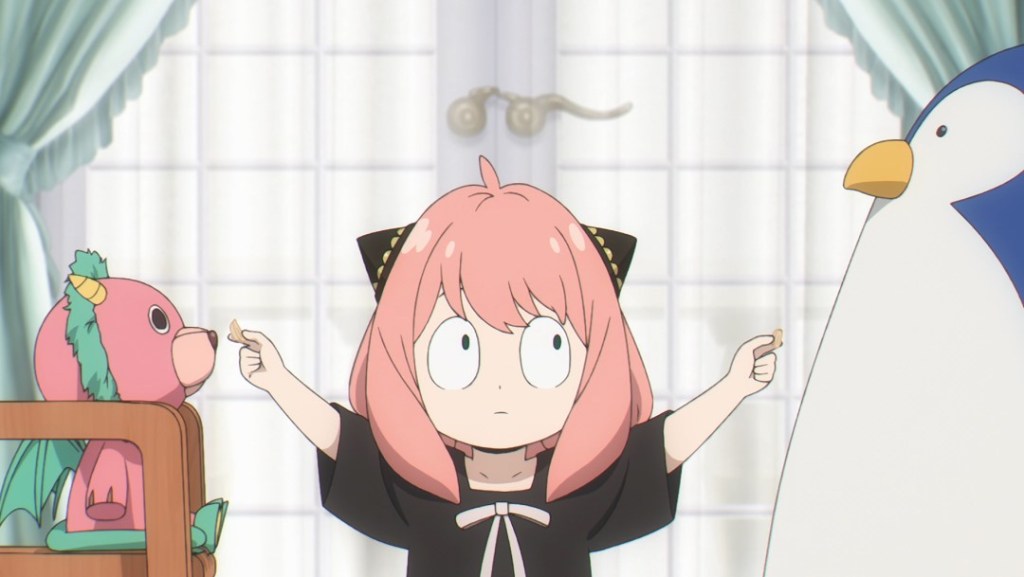
But for all of the hijinks at the aquarium, the best part was undoubtedly the final segment where they are back home and Anya is playing pretend-spy with her plushies. Anya may have her telepathy and be quite clever for her age, but she’s still a little kid, and that was a beautifully-portrayed full-blown Kid Mode there. (Of course, the irony that her make-believe isn’t that far from the truth is probably lost on no one.) The way Loid and Yor instantly jumped to play along to calm Anya down after she ventured towards dangerous areas was a wonderfully charming bit of parenting, too.
In other words, the series is earning the attention and ratings that it is getting. Really, this is a once-in-a-decade level of magic going on here, which is why the second half of the series not airing until the Fall 2022 season is a bit of a disappointment. (On the other hand, there are plenty of big-name sequels coming out in the Summer ’22 season, so at least some other viewing distractions will be out of the way by then.) Based on what has aired so far, however, this one gets my top recommendation.
Other Series That I Am Following:
Date a Live season 4 – This one has ended with a notice that season 5 has been green-lit, which is good since the series ends on a couple of major twists and somewhat of a cliffhanger. The final arc about Kurumi (aka Nightmare aka The Worst Spirit) is easily the season’s high point and contains some of the franchise’s most compelling content to date. This is, I believe, the first time in my following the franchise that I am actually looking forward to the next season.
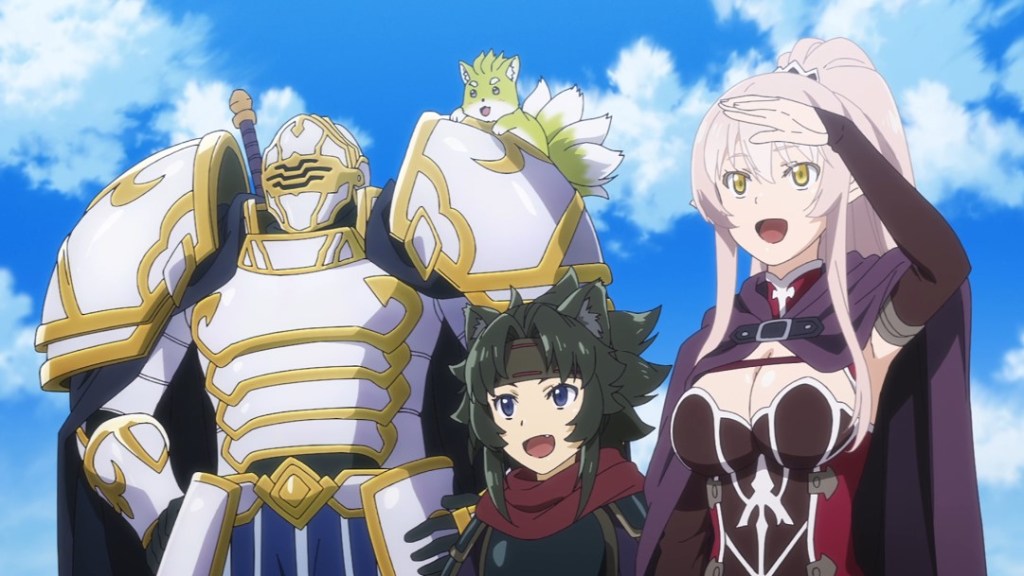
The concept for this series could not be more generic: a dedicated gamer wakes up to find himself in a fantasy world in the form of his uber-powerful game avatar. He doesn’t know how he ended up there or why, so he decides to just go with the flow and begins adventuring. Along the way, he acquires three equally-stereotypical adventuring companions: a cute spirit creature who cannot talk but seems quite intelligent, a sexy elf on a mission, and a ninja catgirl. He also performs many feats that are mind-bogglingly powerful by the standards of his new world and involves himself in great feats of derring-do despite claiming that he is trying to not draw attention to himself. The only minor catch is that he cannot take off his armor in public since he is only a skeleton underneath. (This results from him using a special skin for his avatar in the game setting, which translates into a curse in this world that can only briefly be remedied.)
As bland as this may sound, the series works – and is a title that I have no reservations about recommending to isekai fans – because it gloriously captures a spirit of pure fun. Plot points can get serious and the content is, at times, rather dark (assassinations, human trafficking, attempted rape, and extreme graphic violence are present), but the story content never loses sight of the fact that Arc is on a grand adventure and is fully committed to experiencing that to the hilt. Not everything may go his way, and he plays things very cautiously until he gets a sense of where he stands in his new world’s power scale, but even when he’s being careful he still has a grand time. Most importantly, the series accomplishes this without ever giving him the stuffy, smug feel that all too many other power fantasy protagonists have.
As appreciable as Arc is as a character, the supporting cast make big contributions as well. Ponta may fill the requisite Mascot character role, but he is somehow less obnoxious than most of these characters are and serves an important purpose by showing that Arc, despite his oddities, can be trusted. (Creatures of his type are known to never associate with those who aren’t good at heart.) The busty, sword-specialized elf Arianne fills the requisite Sexy Female Companion role, and does seem to be gradually growing to like Arc as he helps her rescue some elves caught up in human trafficking (elf trafficking?), but she earns points for being both quite capable on her own and having a steadfast purpose beyond just accompanying Arc; that he is accompanying her is, in fact, a far more accurate description. The way they grow to respect each other feels natural as well. Much later, they encounter and eventually start working with Chiyome, a ninja catgirl from an animal person village that appears to have been heavily influenced by a previous isekai visitor. (Don’t expect that tantalizing mystery to be explored further before the end of the series, though.) She is not around Arc enough for much of a relationship to develop before the end of the season, but she is also quite capable and has a skill set which complements the other two well. There’s also a male ninja from her village who constantly gets into contests of brute strength with Arc but also teams up with him quite synergistically when the need arises, but (sadly) he is not a regular traveling companion.
The other big plus for the series is that, while its power fantasy status is never in doubt, it isn’t just that; it also has two distinct, somewhat interrelated plot lines running through it, one which Arc influences directly and the other which Arc unwittingly plays a key role in. The former involves the aforementioned elf trafficking, which proves to have links to royalty. The other involves power plays within that royalty, which results in the assassination of a princess who is innocently seeking to ease tensions with the elves. But with someone like Arc around, she doesn’t stay dead, and that generates its own new batch of complications, especially when that princess mistakenly takes being anonymously raised by Arc as divine favor for her mission. Arc did at least worry about what impact his actions might have, but he still may have underestimated on that once again, and that will likely have bigger (and welcome) repercussions should a sequel ever be made.
Another key to the series’ success is the balance it achieves, and central to that is the revelation that being vastly more powerful does not also mean that Arc is vastly more skilled. Thought not as powerful as him, Arianne can match or exceed him when it comes to combat skill, and when faced against an opponent where only skill matters, he gets soundly trounced. This is something that I have long felt gets all-too-often overlooked in these isekai tales, as fighting in a game does not at all equate to real-life fighting, so I am pleased to see its inclusion here.
Technical merits are solid on both visual and audio fronts. The character designs are unquestionably the visual highlights, whether it’s Arc, Arianne, Chiyome, or the aforementioned princess. Animation quality has its moments but isn’t exceptional overall, with moderate reliance on shortcuts and occasional slips some on quality control. Monster designs are far more generic, but despite the production’s flaws, it still gets enough right with dramatic look and feel for a lot of flash and some cool action scenes. A jaunty musical score complements the tone of the work nicely, including an opener which harkens back to ’80s rock dramatics (and sports some fun visuals on its own) and a peppy, partly-CG-animated closer with a catchy beat. Kudos also go to Tomoaki Maeno, the voice of Arc, for an iconic performance, especially his hearty laughs. English voice actor Brandon Johnson, in his first lead role, gives it a fine effort that would be sufficient if you listen to the English dub first, but Maeno’s performance is better still. By comparison, Caitlin Glass is ideally-cast as Arianne and Sarah Wiedenheft and Emi Lo make good choices as Chiyome and Ponta, respectively.
The one problem with the series is that its most potentially objectionable content is in the beginning – like, the very first scene. Nothing as severe as that comes up in any of the later 11 episodes, however, so if you can tolerate that then you’re in for a fun ride.
Rating: B*
* – While I have been using number values so far, letter grades feel more natural to me, so I am going to use them for everything other than Preview Guide entries from now on.
Other Series That Have Finished
Love After World Domination – Not sure what more I can say about this one that I have not already said. Sure, the series can be watched for all of its homages to (and parodies of) Super Sentai series, including such delightful details as how loyalty to an evil organization can be a family calling, but the true enjoyment comes from watching the interactions of Fudo and Desumi in their quasi-Romeo-and-Juliet-style relationship. 2022 has already offered up some strong competition for Best Duo, including Life With an Ordinary Guy‘s Tachibana and Jinguji and My Dress-Up Darling‘s Wakana and Marin, but Fudo and Desumi are just so adorable together – and so made for each other – that I now consider them the front-runners. This one is every bit as fun a romp as Skeleton Knight, albeit in entirely different ways. Grade: B+.
If you had asked me early in the season what series I thought might have been worthy of a full review at the end of the season, I’m Quitting Heroing probably would not have been one of the titles to come up. Sure, it uses a novel twist on the standard Hero/Demon King fantasy premise, but nothing that the series does its early going at all suggests the quality it gradually develops or the weighty, redefining twists it uses in its later stages. This is a far more involved story than it initially appears, and that makes its success in the later stages end one of the season’s mild surprises.
The premise here seems straightforward enough: the Hero, Leo Demonheart, is tasked with defending the human realms against the invading forces of the Demon King. This he accomplishes virtually single-handedly, but in a classic “the warrior has no place after the war” scenario, the people fear his overwhelming might to the point that Leo no longer feels welcome in human lands. Hence, in an apparent rejection of this behavior, he decides to go somewhere he feels his abilities might be more appreciated: to the Demon Queen, who sorely needs help restoring her Leo-decimated forces. There he makes a very business-like pitch to offer his services in helping her rebuild, but the Demon Queen Echidna, of course, has none of this after Leo soundly thrashed her. To get around her resistance, Leo instead works with her generals under a disguise (which is initially known to only one of the generals) and does exactly what he claimed he would to ingratiate himself to Echidna.
However, while Leo did not lie about what he would do, he was less than forthright about why he was doing it, and that is where the series’ unexpected depth lies. Leo has a much bigger goal in helping the Demon Queen Echidna than what he lets on, one which asks surprisingly deep questions about identity and purpose. In the process, the series redefines the meaning (or, perhaps more accurately, the extremity) of its title and presents a more involved and philosophical take on the role of the Hero than most fantasy titles do. To what extremes might the Hero go if he literally has no identity beyond being the Hero and no purpose beyond saving humanity? And what if conditions force your calling as a Hero to be endless rather than just a one-time thing?
While the first episode implies that acceptance is a big part of this scenario, that is only a relatively minor factor in the end. The story is ultimately mostly about Leo finding a new role for himself, one which doesn’t involve playing the hero. This isn’t exactly a novel storytelling approach, as other recent fantasy series (most notably Banished from the Hero’s Party) have tackled a somewhat similar premise, but this series takes a much different angle on the concept. That is not initially apparent, as the first half or so of the series focuses on Leo cycling through each of Echidna’s four Generals and helping them learn to carry out their roles more effectively and efficiently. That starts to change when a mid-series revelation shows that this is not, by far, Leo’s first time around as a Hero, and that being a Hero is an imperative rather than a calling for him. The gradual revelation of Leo’s backstory leads to some harsh twists later in the series, which makes the second half of the series much more compelling. Even somewhat chickening out at the end doesn’t hurt that much. Slightly more of a problem is the way the pacing drags things out a bit in the late episodes, but again, that’s not a crippling problem.
The effectiveness of the cast in supporting this varies widely, and that is the series’ main weak point. Leo is a more interesting character than he appears at first, Echidna is instantly-likable, and female general Steiner is appreciable as (essentially) the Demon Army’s manager, though her role wanes considerably as the series progresses. By comparison, Edvard is a standard pride-obsessed musclehead, assassin-like Melnes is clearly aiming too much for the Emo Teen stereotype, and Lily is just annoying as the cute animal girl who has absolutely no business having the responsibilities that she does (although that is also part of the point of the episode focusing on her). Fortunately, the three better ones are enough to carry the weaker ones, and an imp who has a major role in one flashback episode also makes an impact as a guest appearance.
Artistic merits for the series are about average. The only character designs which stand out are those for Echidna (which give her a young look which flirts with being sexy but never really sexualizes her) and especially for Edvald’s daughter Julietta; she’s one of the most appealing-looking fantasy females to come along in a while, which makes it disappointing that she has only cameo appearances outside of the episode focused on Edvald. A surprisingly limited number of action scenes do offer some pop, but this is not the series’ strength. It does better with its background art, especially some nice-looking mountain landscapes and the beat-up look of the Demon Queen’s castle. Musical merits are competent but mostly forgettable.
Overall, I’m Quitting Heroing is an unexpectedly solid non-isekai fantasy series, one whose strengths are enough to overcome its more mediocre aspects. It is a series that I can recommend.
The Rising of the Shield Hero – Over, season 2 has mostly been a disappointment compared to season 1, and the climactic resolution of this season’s storyline in episode 12’s finale doesn’t change that. The dramatic presentation of the final fight scene just does not come together well, but that has been a problem throughout the season; the emotional intensity just isn’t there. I also had some issue with the unsettled status of the relationship between Naofumi’s group and L’Arc’s group; they seem to want to be chummy, but these were also the same people who tried rather hard to screw over the world Naofumi was protecting in the name of protecting their own. Yes, Kizuna wasn’t part of that, but there is a disconnect here. The one part of this season that I do like is that Raphtalia, by becoming the Katana Wielder, is no longer technically Naofumi’s slave and now has the power and status to stand beside him rather than just be helping him. (This does, of course, leave lingering the question of what consequences there might be for such an important weapon leaving that world, but perhaps that will be addressed in future seasons, if there are any.) The ending certainly leaves the door opening for more animation, as it throws out some character cameos that seem to be teasers for future developments. I would welcome more, but hope that any future seasons put together a more compelling story.