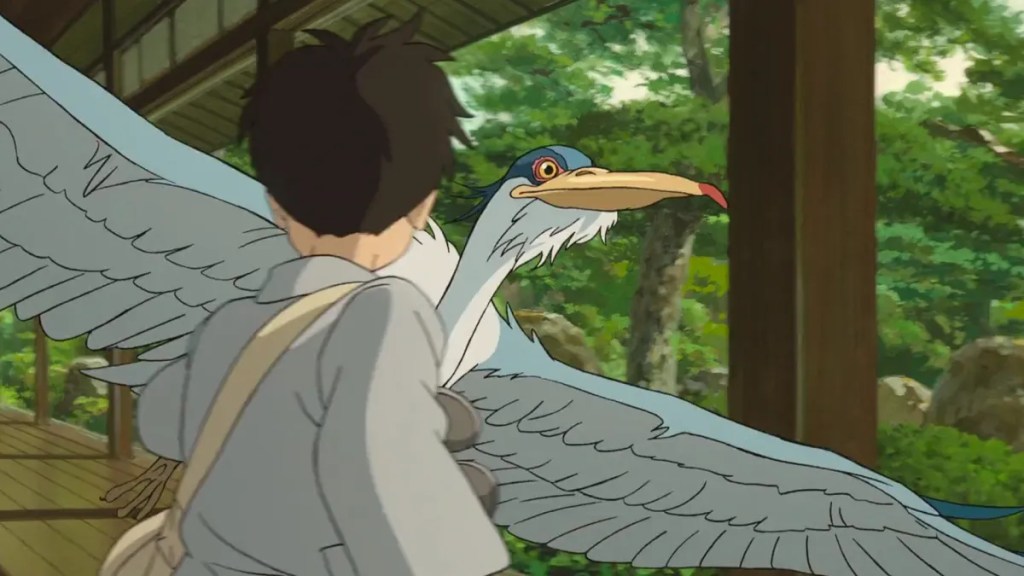
Whether this ends up being Miyazaki’s last film or not, all of the work that went into it is quite evident on the screen. The movie is resplendent with all manner of visual creativity, a fair amount of symbolism, and a wealth of fine details. What it does or does not accomplish narratively is another story, however, and in that respect the movie is one of the least of Miyazaki’s titles.
In the story, which is set in 1945 Japan, Mahito is a boy whose mother is killed in the firebombings of Tokyo during World War II (specifically, March 9-10 1945), much like protagonist Seita from Studio Ghibli’s Grave of the Fireflies. Unlike Seita, though, Mahito’s father is still around and both move out to the countryside to live at the family home with his pregnant aunt. There Mahito encounters the titular heron and its connection to a mysterious, ruined tower nearby, one that belonged to a great uncle who mysteriously disappeared decades earlier. Naturally, Mahito investigates once he learns that the heron can talk, and that sends him on a world-hopping adventure when his aunt goes missing.
That’s a perfectly fine set-up, but the biggest problem is that Mahito just isn’t that compelling as a protagonist. Compared to the likes of a Nausicaa, Ashitaka, or Chihiro, he has little character or distinguishing traits, beyond resorting to self-harm to get himself out of problematic relationships at his new school. He’s handy and determined, but that’s about it, and he doesn’t feel like he’s carrying the expected emotional baggage. This hampers the film greatly in the late stages, making some attempts at emotional resonance feel a bit flat. A second problem is that the movie operates at a smooth and gradual pace for much of its run, only to rush its climax and cut its follow-up short. Because of this, one character who doesn’t appear at all until near the end has an outsized role in the climax. The justifications for certain actions – like why the aunt wanders off, for instance – are also poorly-developed and explained.
Despite these problems, the movie still has a lot of admirable content. The artistic style may not be the crispest we’ve seen from Ghibli, but it is so rich in detail that a second viewing may be necessary to catch it all, especially little things like how furniture or even roof tiles look worn from weather and/or usage. The animation is amazing, and the venues and character and critter designs don’t lack for variety and expressiveness. Symbolism – which Miyazaki is certainly no stranger to using – is also liberally scattered throughout the project, and often a bit subtler than that seen in films like Spirited Away or Howl’s Moving Castle. This site provides a good breakdown of details that those not raised in Japanese culture might not catch. Some of the symbolism present here may also be speculative; I’ve heard a theory that the mysterious tower is meant to represent Studio Ghibli, for instance, and certain characters are meant to represent certain prominent Ghibli personnel. I am inclined to believe this, since too many details fit too neatly into that interpretation, including how some characters look suspiciously like characters from other Ghibli titles, the way the tower accesses other worlds, and some other details that are too spoilerish to bring up here.
Despite some flaws, this is still a movie well worth seeing. It’s just not one of Miyazaki’s best and not the anime movie released in 2023 that’s most worthy of an Academy Award nomination.
As I watched this week’s episode, I was struck by the thought that I have been overlooking one big inherent irony: Shadow Garden’s behavior is itself very cult-like, especially in the way it idolizes and even (in some cases) outright worships Shadow. That comes through clearly in the different reactions of 559 and Epsilon to Cid. Epsilon clearly loves him, but 559’s reaction to watching Cid eat the fruit she served him goes beyond that. She likened Shadow to a god last episode, and I think it’s pretty clear that she now sees him that way. Would Cid be flattered or horrified if he ever realized that?
The opening part of the episode, where Lambda is asking about Rose, also brings up another point: one of the inherent flaws of an organization built around an eminently-powerful figure is that there is no recourse to challenge that figure’s whims if a member disagrees with something the leader is doing but is still loyal to the cause overall. That’s the kind of thing which can cause schisms in the long run. We’re nowhere near in danger of this yet, even with the incident concerning Rose factored in, but the seed of it may at least exist here.
The real core of the episode, though, is about what’s going on with Rose in the Oriana Kingdom. The presumption at the end of last episode was that Rose was being coerced to cooperate against her mother’s safety, and while that proved to be true, the irony is that her mother not only wasn’t at risk, but may have even been cooperating willingly. While she’s almost certainly not a co-conspirator or Cult of Diablos member, she’s certainly acting here like Perv seduced her. However, this again raises the question about why Rose’s mother can’t just take over the throne. Why does does it have to be Rose when Perv could just marry the mother instead? It may be that the Cult wants Rose specifically because she’s a Possessed, or (less likely) that the mother is past childbearing age. A bit more elaboration on the political and succession structure in Oriana would certainly be welcome, as right now this just looks like a mechanism for putting Rose in this predicament.
The differing ways each involved party is reacting to this is also interesting. Rose feels fatalistically trapped in this scenario, while the Seven Shadows are, somewhat surprisingly, hesitant to be too judgmental since they feel at least partially culpable for the scenario. (Allowing Rose to go on this mission without informing her about her mother’s status was an uncharacteristically bad miscalculation.) Cid, meanwhile, was clearly upset at first over his plans for Rose being thwarted, but now that he’s calmed down he’s being remarkably sympathetic. His words to Rose about how he can relate to her because she’s also bucking convention (with her desire to focus on swordplay in a kingdom not fond of it) don’t sound like his normal Shadow shtick, so this might be the most honest we ever see Cid being.
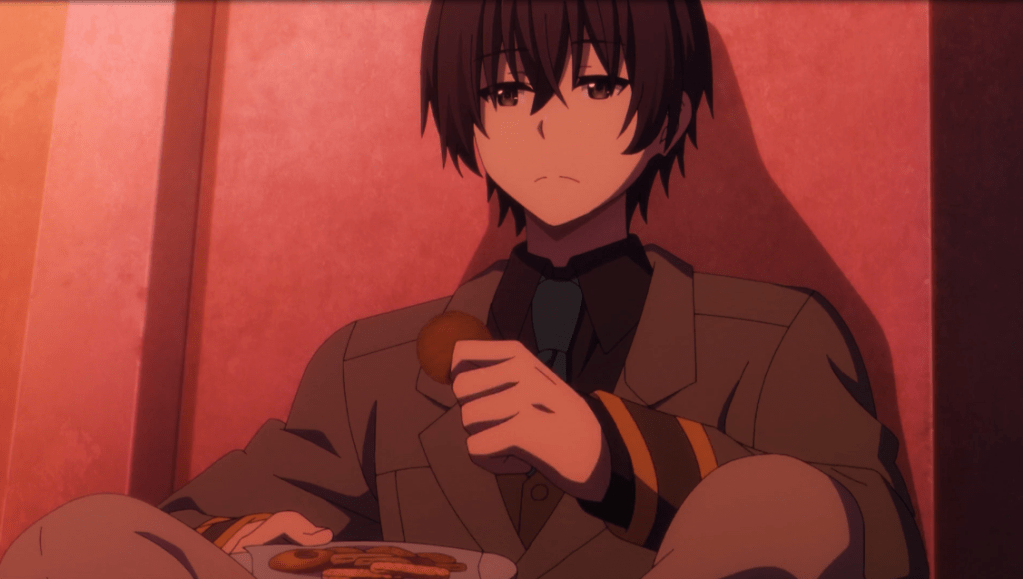
Of course, this series being what it is, it can’t take things too seriously. The jokes populate the episode aplenty, whether it’s Lambda doing her best rendition of a tired tour guide, the overly-optimistic amorous guard in the garden, Cid using his powers to escape from a clingy maid or steal jewelry during his piano performance (and somehow not getting noticed at this), or Cid unwittingly filching the item at the center of the whole Oriana Kingdom scenario. The very pointed emphasis on Cid enjoying the cookies while dealing with Rose is also par for the course; Cid would hardly be the first anime character who doesn’t let even high drama stop him from enjoying his snacks, but how in-your-face the series is about it without letting it distract from the main events of the scene is somehow terribly amusing. So, too, is episode’s pointed emphasis on jiggling bosoms; how far Epsilon is going with making her falsies seem realistic is almost as funny as Cid’s dispassionate analysis of both her slime-created ones and the maid’s real ones.
So what’s Cid’s “Plan B” in this scenario? Looks like we’ll find out next episode, but I’m sure it won’t disappoint.
One of the major factors which makes this series a top-tier title for both the season and year is its effortless ability to mix its comedic and serious components and still excel at both. Episode 9 is a great example of that. Many other series could stand to use it as a model. (I’m looking at you again, Kingdoms of Ruin.)
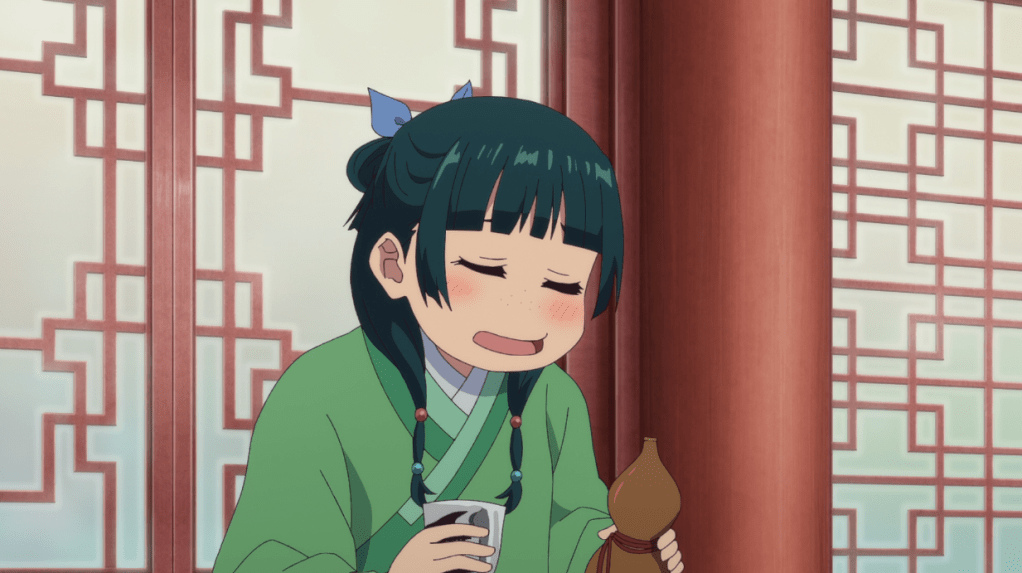
On the humorous side, watching someone as elegant and proper as Gyokuyou continue to bust a gut over Maomao’s highly misleading explanation about how she awarded Lihaku for being her guarantor is entertaining in itself, but so is Maomao’s reaction to getting her hands on some alcohol. (Given her background, it’s really not surprising that she would have had opportunities to develop a taste for it young.) Jinshi is a little too sharp to always be the victim in such situations, though, and so seeing him get back at Maomao a bit with the probably-made-up-on-the-spot proposed law about changing the legal drinking age was quite fitting. The explanation for why Maomao isn’t allowed to touch corpses is also fitting, as is everyone’s reactions to hearing it; Maomao even seems to sheepishly acknowledge that her father wasn’t wrong about her on this point.
But two people are also dead this episode, and the series continues to deliver on taking things more seriously when it needs to. Both cases initially look like either accidental deaths or suicide, but neither may be. The first case – involving an older male servant that Jinshi was close to – may be a more accidental homicide than an intentional one, since deliberately killing someone that way would require some extremely specialized knowledge. However, we’ve had no indication that the mystery behind the poisoning at the garden party has been solved, and while that is still outstanding, a possible connection cannot be ruled out. Same with the death of the female servant in the moat. The manga and novel versions clarify that bodies turning up in the moat aren’t that rare, whether from suicide or a failed escape attempt, but as Maomao points out here, women with bound feet in particular would have difficulty making the climb up the wall, and the state of her fingers suggests that she at least tried to climb out of the moat. This more strongly suggests deliberate murder, perhaps the disposal of someone who knew too much, and looks far more suspicious.
The episode’s strongest content spins off of that. Maomao has mentioned matters of mortality in a matter-of-fact fashion on many occasions, and going into a contemplative mode is a staple for her. However, I believe that this is the first time that the two have been connected, especially concerning her own mortality. Seeing whoever it was in the Verdigris House annex last episode and the dead servant in this episode have apparently given Maomao cause to consider how she might die herself, which engenders her unsettling request of Jinshi. That she sees this as a practical request, while Jinshi is clearly upset by having to even consider it, shows the continuing disconnect between the two, but that’s both logical and a storytelling necessity at this point. Even though their paths have intersected, they still come very different worlds.
The bonus at the end of the episode is a new lead on the incident from a few episodes back, the one with the chemically-treated boards and the burnt dress. Now we know who was likely wearing that dress, and that the lady-in-waiting in question was thus likely connected to those treated boards, but not why. That character is scheduled to appear next episode (along with a repeat appearance by Lishu), so the greater plot at work behind the scenes is starting to advance more distinctly. That promises some interesting developments for next episode, too, but this one is still a good one.
The prostitute Marie was shown too prominently back in episode 21 for her to not pop up again later, so it’s little surprise that her reappearance comes as the story shifts to what Cid was doing after he stepped out of the picture for a while at the end of episode 27. Unfortunately, her decision to open up an inn in the Oriana town of First Fort was an ill-timed one, for she has gotten caught up in a veritable civil war over succession to the Oriana throne – a crisis that was, of course, predicated by Rose’s actions in episode 19. Hence we have two of the story’s loose ends converging here as Cid arrives on the scene. To further elevate the coincidence level, the much-used 664-666 trio is on the job here, too, for reasons that are initially unrelated. One has to wonder if anyone else in Shadow Garden is out doing missions at this point. . .
Actually, the presence of Rose’s squad isn’t a coincidence at all, given that Oriana’s royal family has a home here. And it seems like 559 has a bone to pick with her too, since Rose is the only other individual in the organization outside of the Seven Shadows and 559 herself to get her power directly from Shadow – in other words, she was personally recruited by Shadow rather than the Seven Shadows. Exactly how that happened has yet to be animated (and may never be, unless she continues to be a prominent character), but other online sources indicate that she did have a cameo in season 1: she was one of the two people fighting as Rose was led into Alexandria by Alpha. (The other was the 89 briefly mentioned in this episode.)
Really, you have to feel at least a bit of pity for Rose here, as the only people who are even somewhat looking out for her are 664 and 665, and that’s not saying much. Her mother is (most likely) being coerced to help the Cult of Diablos, 559 is trying to kill her mother and calling Rose a traitor when she jumps to defend her mother from 559, and Shadow Garden (or at least Gamma), the Cult of Diablos, and Shadow all are trying to use her to their own ends. Why exactly the Cult wants her isn’t clear, but her being the rightful successor to Oriana’s throne probably has something to do with it. Shadow Garden, meanwhile, seems content to let her be in the Cult’s clutches for now to draw out some of the Cult’s key leadership, and Cid/Shadow has struck on the notion of setting Rose up as a tyrant-queen that he can later defeat in showy fashion. Really, she’s pretty screwed.
This whole scenario also raises another question: can’t the queen (Rose’s mother) take over the government and thus prevent the civil war? Or is Oriana a state where woman cannot take the top spot?
Regardless, and as usual, no one is on the same page here. Cid is also personally back in action, whether it’s mixing in a bit of Robin Hood, re-invigorating 559, or his very condensed account of all the scenarios he tried while trying to figure out the coolest way to take advantage of this situation. This does not result in the season’s sharpest wit (hence the somewhat lower grade), but the episode still touches plenty enough of the normal bases.
Maomao’s back home, so naturally she’s going to get involved in a brothel-related mystery while there. Actually, two arise, and both are left open-ended, though in dramatically different ways.
The first is what initially appears to be an attempted double-suicide involving a courtesan and a customer. However, a few things don’t add up, not the least of which is the awful reputation of the customer. Really, a courtesan he jilted trying to poison him should have been a tip-off that the guy needed to change his ways, but he’d hardly be the first man who let his arrogance and vices override his common sense. The most interesting aspects of the case, however, are not the case itself but the other details involved. We’ve already seen that Maomao can forcefully take action when the situation demands it, and the scene where she attempts to revive the courtesan and guide another one to revive the man is her in action at her very best. Her father arriving at the scene also shows us who Maomao learned to be such an accomplished detective from, and perhaps also a bit about how she learned to restrain herself from getting too deeply involved. Then there’s the hints of the bigger picture here and the strong – but not certain! – suggestions that the courtesan responsible for the poisoning (which was clever but risky) may not have acted alone. We probably won’t ever get more details about that case, but that’s kind of the point here: sometimes knowing the full story isn’t always the best thing.
The other, far shorter mystery in this episode is who, exactly, Maomao visited in Verdigris’s annex after her bath with Meimei. It is also left open-ended, but based on the way Maomao acts, the strongest implication is that this is either her mother, who has not even been mentioned previously. Whomever it is, we can infer a couple of things: that she’s in an annex of Verdigris means that she was a courtesan, and that she’s in a darkened annex probably means she’s in this setting’s equivalent of hospice care. Given that, her not being shown fully may be a blessing. After all, syphilis has already been mentioned in this setting, and the late-stage effects of that are not pretty. If this is her mother, and she was a Verdigris courtesan, then all the pieces would fit about why Maomao was raised around brothels and is considered a little sister by its aces. Like with the cryptic comments by Maomao’s father, there’s definitely more to the story here.
But the mysteries don’t take up all the episode, allowing the last few minutes to be devoted to the comedy side of things. Not sure if I should feel sorry for Lihaku or not, as his future finances aren’t looking great but he certainly looks to have gotten one hell of an experience for it. (Which probably also means that Maomao has earned a permanent ally in Lihaku.) Much better, though, are Jinshi’s reactions. Maomao still only seems to understand the practical, rather than full symbolic, meaning of the hairpin, so why Jinshi is upset that he wasn’t the one relied on is a bit understandable, but his reaction to Maomao’s description of her “repayment” to Lihaku is priceless. I’m not entirely clear if Maomao accidentally or deliberately said things in such a way that she made Jinshi imagine she did it herself (either is possible, given the way her mind has worked at other times on sexual content), but the reactions of the others outside – especially Gyokuyou – were also priceless. The latter is getting so much amusement out of Maomao that she doubtless has no regrets about taking Maomao on as a lady-in-waiting.
Overall, this episode had a little bit of everything which makes this series so great, hence the high rating.
What self-respecting anime series with a bevy of sexy ladies in its cast – especially one with a reputation for pointed use of fan service – wouldn’t have one or more of a beach, water park, or hot springs episode? With Cid gone for a season (in fear of the girls’ displeasure with his recent antics), the girls get to play. . . er, puzzle out Shadow’s true intent in “allowing” school pals Skel and Po to use passes for Mitsugoshi’s exclusive hot springs debut to ask Mitsugoshi girls out on a group date. No, really. That’s what they’re actually doing. Yeah.
The series’ signature irony certainly applies here: the whole thing harkens back to a fickle comment Shadow made years earlier about finding the Dragon’s Tears, which led to the discovery of the hot spring, and that it turns out that the legend about the Dragon’s Tears was actually real. Let’s also not forget the signature irony that the Seven Shadows take a situation predicated on a stupid lie (but this time by Skel and Po!) and blow it up to a comically dramatic level. However, the defining task and mystery both take a back seat to the episode’s real focus: the girls at play.
And play they do. (Whether they admit they’re doing that or not.) That allows all of the Numbers and their chief subordinates chances to show off their personality quirks as well as their bodies, and that’s where the real fun lies. The much-underused Eta in particular is a joy here, but so is Delta’s unrestrained stupidity and playfulness, Beta’s raging insecurities, and the little slips starting to creep into Alpha’s normally-serious, collected disposition. Little treats can also be found in the look at some of the subordinate Shadow Garden members, such as the way they meaningfully file out of the meeting room when the Seven Shadows are going to have their contest to see who goes on the group date or Nu’s expressions as she reacts to Skel and Po at the beginning. Also watch for a couple of cameos by a certain vampire princess and her maid.
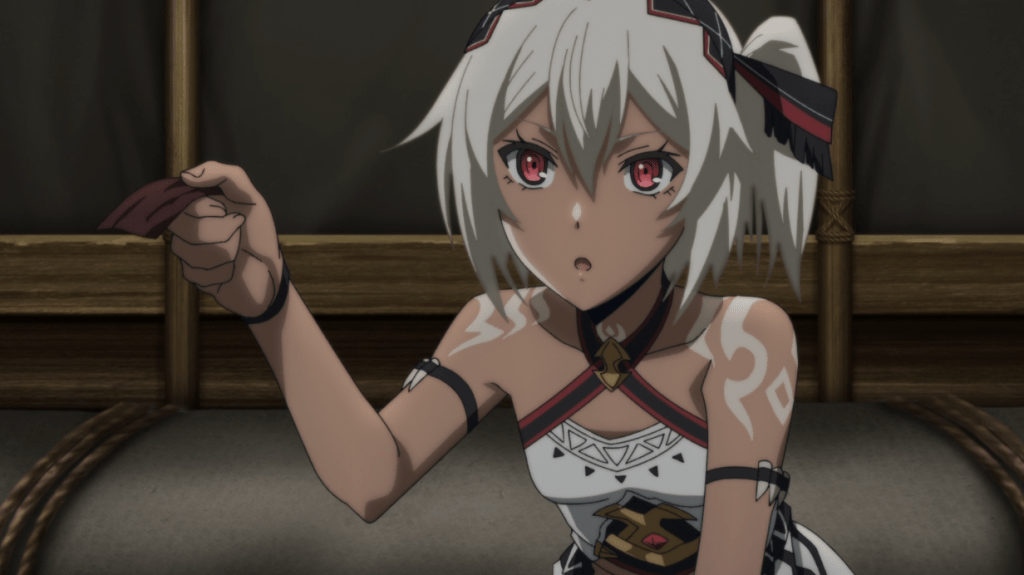
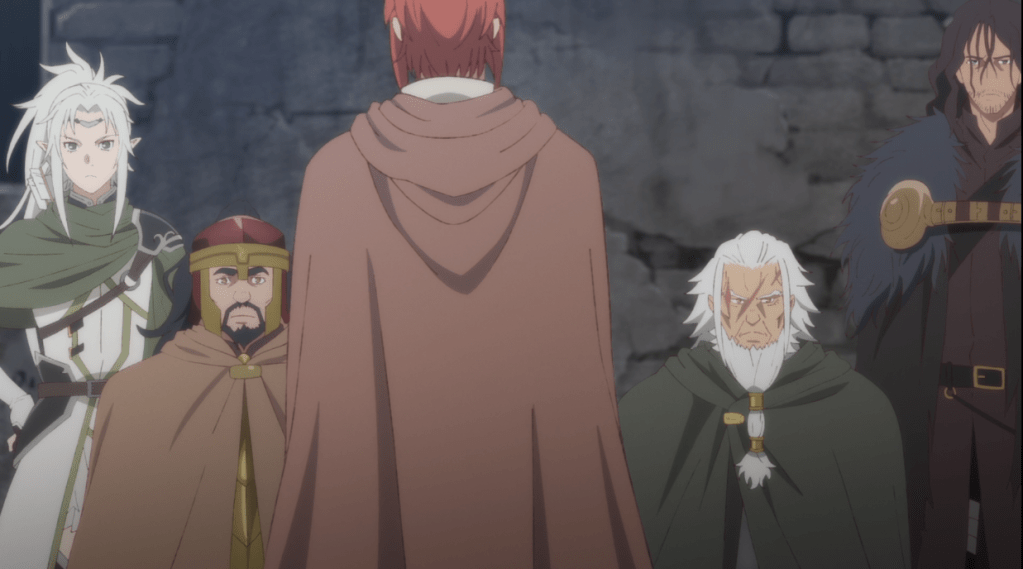
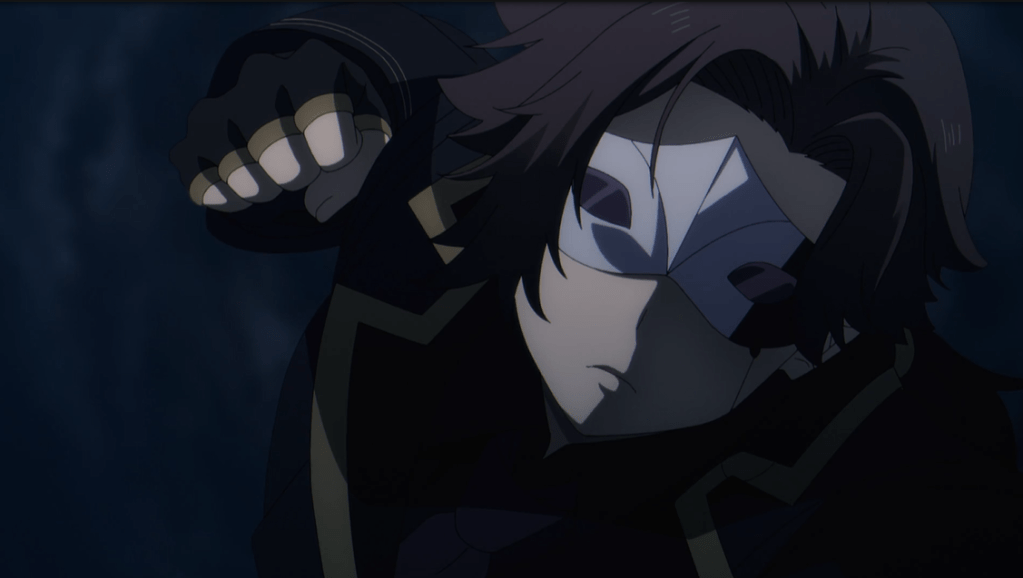
One of the highlights, though, is the Seven Shadows using the costumes shown in the screen shot, which are the same ones they used in the first season opener. The latter use felt like it was making a point, a contrast between the super hero-ish nature of Shadow Garden and their actual “in the shadows” activities, but this use – under the guise of “we don’t want to expose our true identities” – is a cleverly ironic spoof of something that was itself a spoof. Let’s not forget the grainy movie strip flashback or the puppet theater show illustrating the story of the Dragon and the Princess, either.
Sid/Shadow is the story driver, but this episode shows that both the girls and the series in general can get along without him when needed.
For the last two seasons, I have done a mid-season round of of isekai titles. While there are certainly enough of them this season (eight total, if you include reverse-isekai) to do a piece on just them, We also have a bevy of series about characters displaced within their own timelines (four in all!) and a number of other quality and not-so-quality series that I feel are well deserving of some mention. Hence, this time will be more a general survey of titles that I am following and where they stand at this point.
Note #1: I am not including the two titles that I am episode-reviewing, so look for the individual posts on The Eminence in Shadow and The Apothecary Diaries. A few other titles – among them Precure Full Bloom, Ragna Crimson, Undead Unluck, and The Vexations of a Shut-In Vampire Princess – fall into the “I might still finish them but I am not fully caught up” category.Pluto will almost certainly get a full write-up once I have a chance to finish it.
Note #2: Finally, I solve the technical problem, so this post is now intact! All commentary is based on episodes aired through 11/21/23.
A Returner’s Magic Should Be Special
Rating So Far: C
This “transported back in time into my earlier self” scenario features the protagonist reliving his training days in an effort to produce a better outcome than “everyone dies.” Fine concept, but the series so far has mainly used it to justify why younger Desir is both abnormally knowledgeable and skilled for his situation. Classism plays a strong part here, but this is a wholly run-of-the-mill treatment of that aspect. Nothing in the training scenarios excites much, either, and action scenes are limited by the mediocre animation effort. Even after seven episodes, it isn’t gelling into anything special.
Berserk of Gluttony
Rating So Far: C-
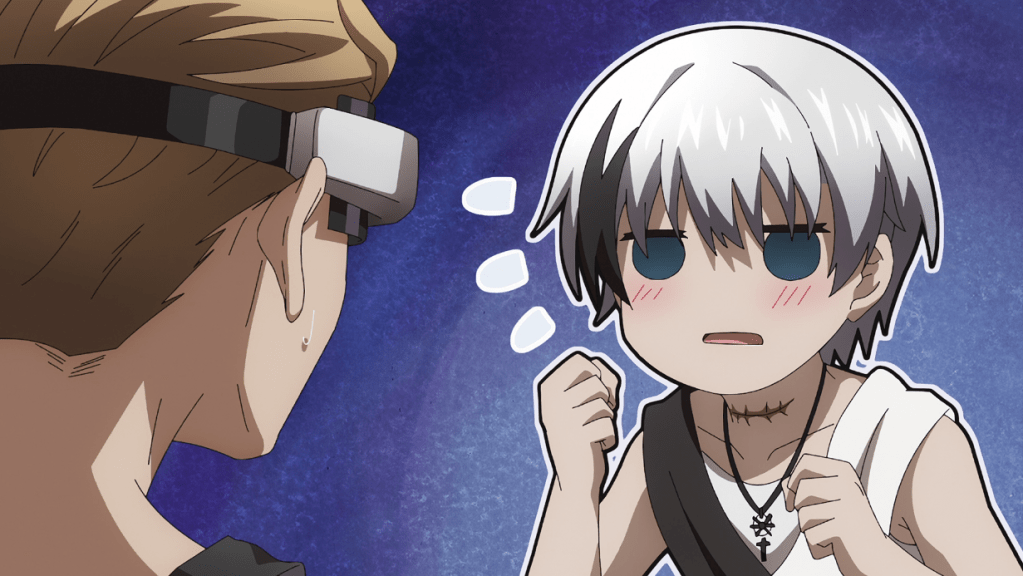
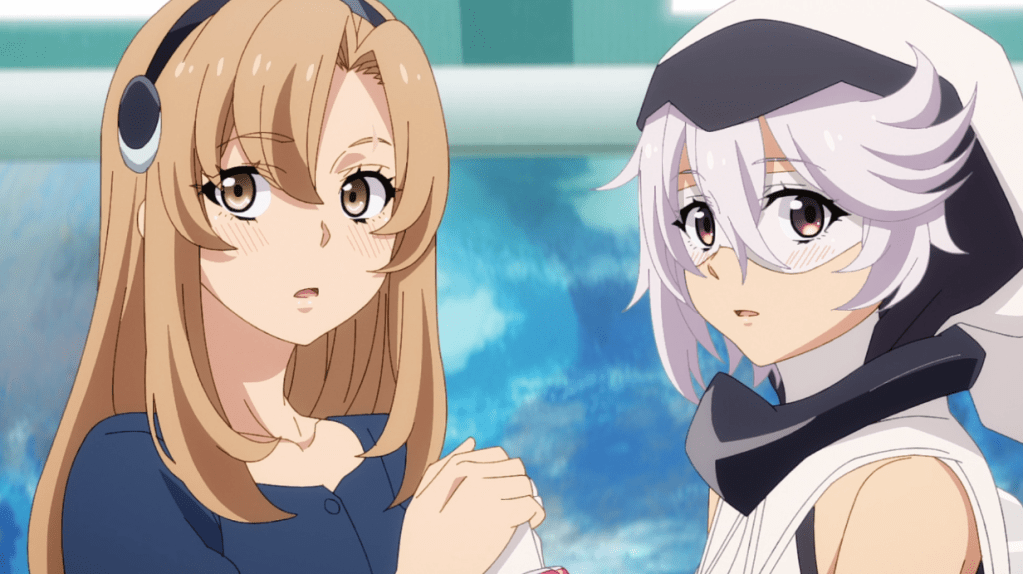
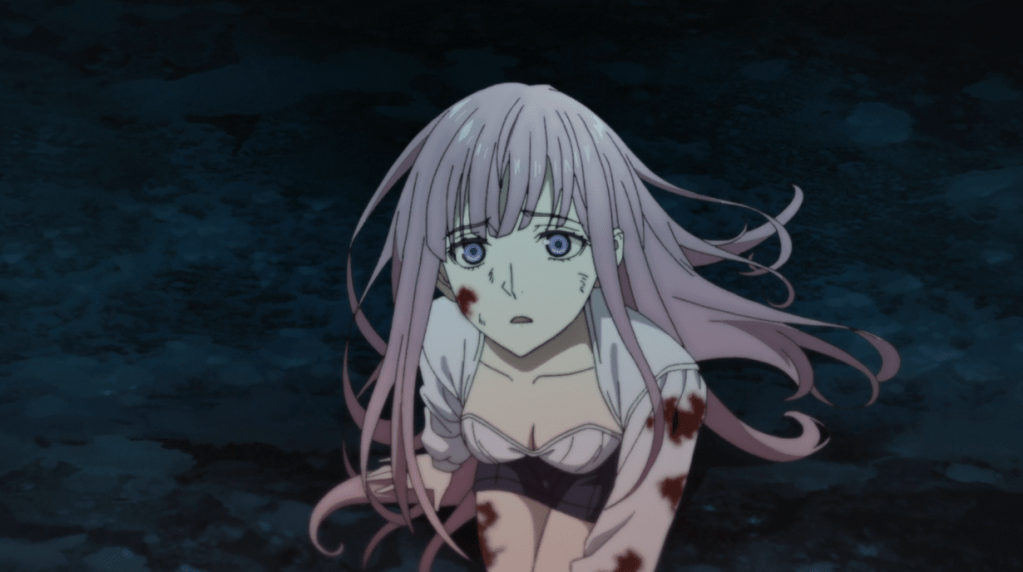
It pains me to rate this one this low, as I am a fan of the source novels, but this is one of the year’s most disappointing adaptations. I am not impressed by the character design aesthetic (with faces that are too long and chins that are too pointed), and the storytelling and production values just sap much of the sense of danger and dark moodiness that the content is supposed to have. Even Myne (above), who should have been a stand-out character design, does not impress. The novels were always more than a bit edgelord, but the anime version fails at adequately conveying that. The series does have some mildly interesting concepts and a saving grace in the character of the sword Greed, but I can’t recommend this feels-like-an-isekai-but-isn’t series.
Butareba
Rating So Far: B
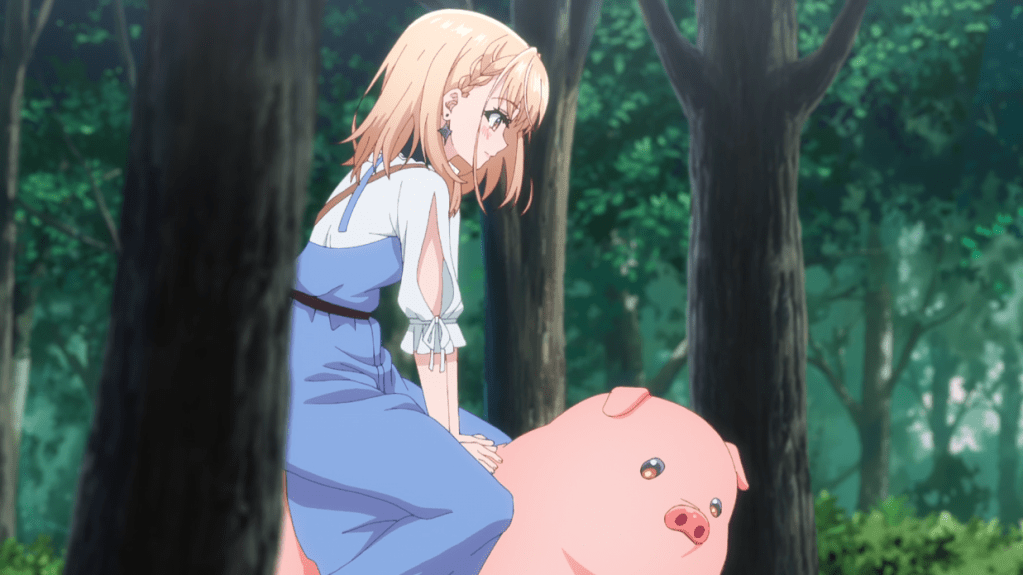
This story about an otaku getting reincarnated into a pig with a motormouth thought track (voiced by Yoshitsugu Matsuoka) was not well-received at first, which is unfortunate, because that’s selling the series very short. The relationship which forms between the pig and Yethma girl Jess continues to lie at the center of the story, and it is a pleasant and sometimes playful one, which the pig can’t always dominate; Jess is well capable of occasionally throwing him off with somewhat flirtatious teasing. However, the bigger attracting factor for many may be the world-building. Something is very strange about these telepathic girls who wear silver collars and how they fit into the world’s picture, and the more Pig (and the audience) learn about it, the more shifty it gets. Violating a Yethma will get a person executed, but so will transporting a Yethma in any kind of cart or carriage? But yet Yethma have to travel to the mysterious Capital once they reach a certain age, and never return? The series has done a good job so far of building a vague sense of unease and dread at what fate might ultimately await Jess on her journey, and that’s carrying the story at least as much at this point as Pig and Jess are. This one I can recommend.
Dead Mount Death Play
Rating So Far: B+
The second season (or second half?) of this reverse-isekai title has been packed with all sorts of intersecting plot threads, and the plethora of story lines to follow here make each episode a delight. The bigger picture is starting to emerge, and that’s helping to make the second half even stronger than the first. In a weaker year, this would a contender for a Top 10 title for the year. Sadly, there’s just too much good stuff out there this season alone.
Frieren: Beyond Journey’s End
Rating So Far: A
Speaking of “good stuff,” this one joins the two I’m episode-reviewing as top of the class. This tale about an immortal elf wizard who’s outlived the Hero’s Party she was once part of, and is only after the Hero’s death starting to realize how much that (for her) comparatively-brief time meant to her, is a triumph of fantasy storytelling. For a character who isn’t very outwardly expressive or emotional, Frieren is still a joy to watch, and the series’ approach is a wholly fresh angle on standard fantasy storylines. The writing beautifully uses flashbacks to support points made in Frieren’s modern times and promote subtle, sentimental connections, such as the implication that the Hero Himmel’s penchant for having statues made of him may have less been an exercise in vanity and more about making sure one special person didn’t forget him. The thoughtfulness of the overall approach is making me look at fantasy stories in a different way, and the little bits of humor stuck in here and there are cute without being distracting. The series also looks great, has remarkably robust action sequences, one of the year’s better OPs, and a leading contender for the year’s top ED. If you’re any kind of fantasy fan, you should be watching it.
Goblin Slayer II
Rating So Far: B
I am tempted just to say “more of the same” here and leave it at that, but this season has shown a bit more character development than the first, especially for Goblin Slayer. His laser focus on goblins isn’t quite so complete, as he’s shown helping to train newbies and interact more with those around him, even including having a night out drinking with the guys at one point. He’s also much more appreciative of those around him, even if he doesn’t usually say it directly. It’s a positive change, which helps offset the slight negative of the stylistic shift on character designers. (I’ve gotten used to it after a few episode, but the differences were very distinct at first.) Except for one episode that puts most of the prominent female cast members in swimsuits, there hasn’t been a lot this season to get hugely excited about, but the series also doesn’t disappoint. Its OP “Entertainment” is one of the year’s best, too.
Helck
Rating So Far (for this season’s half): C
Talk about a series that’s squandering its early potential! This half has been hamstrung by a flashback explaining Helck’s past (and the situation in the human realm) which took a whopping 6½ episodes to play out. This being twice as long (or more) than it needed to be isn’t the writing’s only sin; it also keeps Vermilio – who is arguably the series’ most interesting character – sidelined for all that time. And while there was some payoff for all that plodding, I have yet to be convinced that the wait was worth it. Helck was on a downward slide before the end of last season, and it definitely bottomed out during the flashback. Episodes 19 and 20 have given some signs of the series starting to pick back up again, so we’ll see if it can recover.
I’m Giving The Disgraced Noble Lady I Rescued A Crash Course in Naughtiness
Rating So Far: B-
This has been a silly, cute, and surprisingly enjoyable little story about a cantankerous sorcerer who’s trying to get a noblewoman on the run to break out of her shell, have a little fun, and enjoy life. How tame the “Demon Lord’s” naughtiness is has practically become a running joke at this point, but watching Charlotte gradually get more confident – and the way Allen is clearly starting to fall for her despite himself – has been quite appreciable. This isn’t the most memorable of shows, but it has proven to be fun and makes for some good light viewing.
I’m in Love With The Villainess
Rating so Far: B-
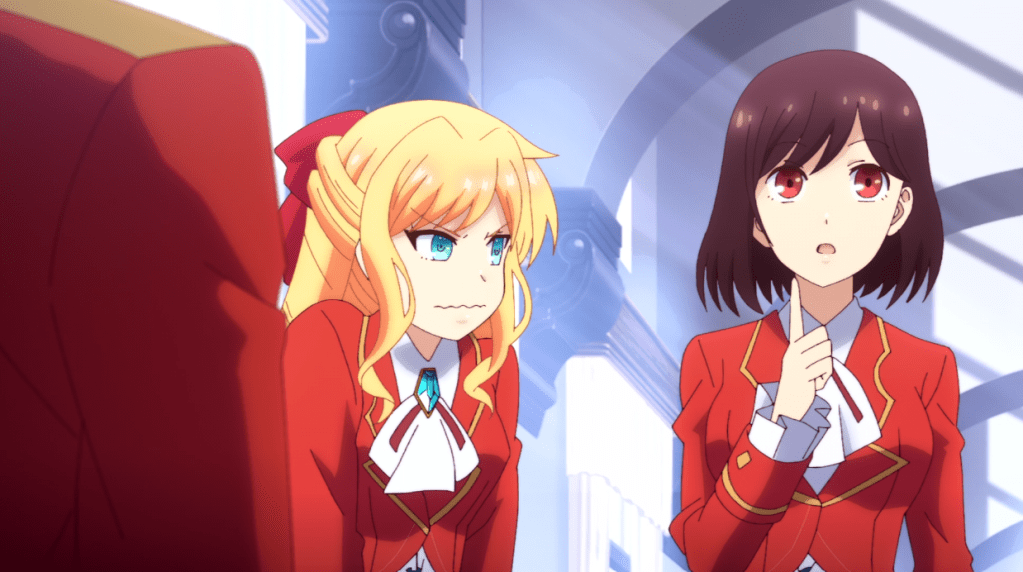
This “transported into an otome game” isekai variation is a mostly-pure comedy about main character Rae falling madly in love with nominal villainness Claire and the latter’s consternation about how every effort to dissuade Rae only has the opposite effect. However, amidst all of the fun there have been a handful of impactful serious moments, such as Rae’s frank admission that she is an actual lesbian but doesn’t expect Claire to reciprocate in that way, despite all her expressions of adoration. Episode 8 also brings a startlingly-serious plot turn, with promises of more. It’s not a high-priority series for me to watch each week, but I always get around to it eventually.
KimiZero (aka Our Dating Story: The Experienced You and The Inexperienced ME)
Rating So Far: B
Except for a week 4 spike, this has been one of the lower-rated series of the season on Anime News Network, and I don’t understand why. Granted, there’s nothing terribly different about it; much of the content so far has been very typical relationship-building scenes. Also, protagonist Ryuto still seems a bit too blushy around Runa despite them having dating for a couple of months as of episode 7. However, watching the way that their relationship is changing both of them in positive ways has been really sweet; Ryuto is ever so gradually learning to to be bolder and more confident, and Runa is learning that sex can be a goal in a relationship rather than a foundation of it. Sure, it’s never going to escape a gimmicky feel – we are still talking about a “hottest girl in school” type hanging out with a guy who would normally be Background Character A, after all – but they’re so good for each other that I can overlook that. Also, the twist about the girl Ryuto once got turned down by coming back into the picture in a big way is a lively one.
My Daughter Left The Nest and Return An S-Ranked Adventurer
Rating So Far: B-
Disappointingly, this one is saddled by some of the weakest artistry and technical merits of any series this season, but the sturdy affability of Belgrieve (“The Red Ogre”) helps anchor a series about a retired (but still very formidable) adventurer and his relationship with an adoptive daughter who’s become powerful and successful but is still a comically possessive Daddy’s Girl. More recent episodes have brought out elements of a bigger plotline and started to raise suggestions again that daughter Angeline might have a less-than-normal origin, which helps keep the series from being too narrow in its approach. Though the series does have some serious elements, it still makes for a serviceable lighter-side fantasy adventure.
Shangri-La Frontier
Rating So Far: B+
BOFURI proved that a series can be almost entirely based on watching pure game play-through and still be entertaining, but this series takes it to another level. Despite the events of the first several episodes mostly being nothing special on paper, they have been gloriously rendered here with some of the most eye-popping action animation and choreography this season (if not this year). This one is way more thrilling than it has any right to be (a killer metal-themed OP doesn’t hurt, either) and turns competitor A Playthrough of a Certain VRMMO Player’s Life into an afterthought. Highly recommended for any action fan.
Shy
Rating So Far: B
Shy initially looked liked it was going to be a halfway point between a traditional super-hero series and a traditional magical girl series, and it has more or less played out exactly like that. It has done a good job so far of showing protagonist Teru’s gradual growth into being a proper hero in her own way, and Teru’s journey – and the people who walk beside her and support her on the journey – is much more the major attraction for the show than the schemes of mysterious bad boy Stigma. The series looks pretty good, too. It’s one of the more low-key offerings of the season but worth checking out.
Spy x Family
Rating so Far (for this season): B
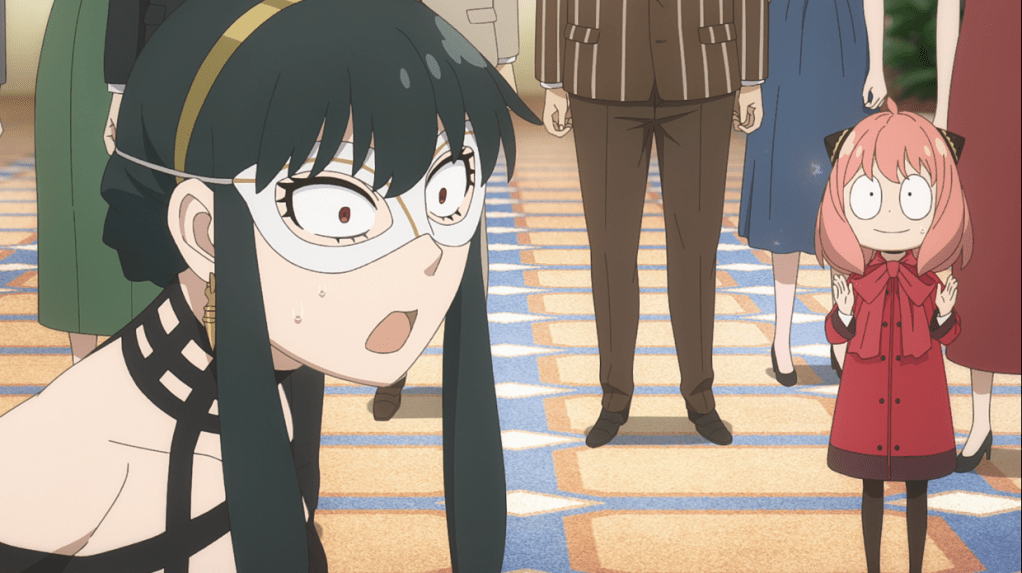
Honestly, the episodes this season – which typically consisted of two or more random vignettes prior to the cruise arc – haven’t had quite the level of comedy bite as the franchise’s preceding content. However, that has partly been offset by the deeper delve into Yor as the cruise arc has progressed. She’s now starting to think more about where she might be going forward rather than just where she stands right now. Originally this family was just a cover for her, but is it becoming more than that for her? Yuri doesn’t need her anymore, so it time to step away from the assassin gig make her current situation permanent? The comedy elements are still there, but this aspect is intriguing me way more right now.
Tearmoon Empire
Rating So Far: B
This one has been the surprise of the season for me. I didn’t think much of it after the first episode because of what I saw as an unwieldy balance of serious and comedic elements, but that has since smoothed out, turning this “jump back into an earlier self to prevent the bad future” caper into a neat, cute little comedy romp. The utter disconnect between Mia’s mostly-selfish motives to avoid her future execution and the wisdom with which she’s credited is the great running joke here (much like it is in The Eminence in Shadow), and unlike other series of its ilk, it never takes itself too seriously. Seeing Mia possibly getting involved in blossoming young romance is also a neat touch, and a scene with her dancing at a party is one of the highlight moments so far. Can’t overstate how adorable she is artistically, either. (Also unlike Eminence, where sex appeal is more the emphasis.) I’m hooked.
The Ancient Magus’ Bride 2
Rating So Far: A-
The switch to the school setting at the beginning of the first cour shifted the focus of the series some; the wonder and terror of magic was still part of it, but more an element than a focal point, with the emphasis now more on interactions with the expanded cast. The first few episodes of the second half continue that, as the comparatively mundane activities of the students under their magical lockdown provide a lot nice individual character moments and form the backdrop for Philomela’s deteriorating condition and growing menace of the missing book. This all comes to a gloriously dark head in episode 18’s reveal of the culprit, with episodes 18 and 19 forming some of the strongest animated content in the franchise to date. Everything which makes this series great is on display in these two episodes, and the careful build-up to that makes this season a triumph so far. This is a strong contender to at least make the Top 10 list for the year at this point. Its OP is also one of the best of the year in a conceptual sense.
The Demon Sword Master of Excalibur Academy
Rating So Far: B-
Rather than a “transported into a younger self” structure (like three other series airing this season), this one jumps the protagonist forward to a reincarnation a millennium later, much like Winter 2023’s Reborn to Master the Blade or The Misfit of Demon King Academy. Much like Misfit, what has transpired in those centuries to create the current situation is an ongoing mystery, which is gradually becoming more important as the series progresses and it starts to look like the epic battles the Demon Lord fought have been deliberately forgotten or obscured. That and that protagonist Leo actually Liselia into a Vampire Queen minion rather than saving her life (because he didn’t know healing magic) adds a little more meat to what is otherwise a mostly-standard magic academy-type story, complete with a mostly-standard foe – although there are increasing signs that the Voids may be connected to what happened in the past, too. Production values have been mid-tier, so this one falls into the “appreciable but nothing special” category.
The Faraway Paladin: The Lord of Rust Mountain
Rating So Far: B
In general, I like what this series is doing. It’s taking a gradual, thorough approach to setting up the circumstances for its seasonal plotline, which is heavily borrowed from The Hobbit: a legendary dragon took over the dwarven kingdom of the Iron Mountains during the battles 200 years ago, and it’s now showing signs of starting to awaken. Thus Will, Menel, Reystov, and some new dwarf allies go deal with this really dangerous foe, both to restore the honor, pride, and homeland of the dwarven refugees who have come to Will’s Torch Town and to eliminate a future threat to Torch Town. I liked the way the culture and feelings of the dwarves factor into this, and the way the young lord of the dwarves learns from Will about courage and leadership, and a return back to Will’s home, and a meet with Gus, along the way to the dragon is a real treat. A full elf has also gotten involved in the most recent episode. The knock here is that the series may be too thorough and workmanlike in its approach.
The Kingdoms of Ruin
Rating So Far: C (if I’m in a charitable mood)
I could probably write a whole article about what’s wrong with this edgy, revenge-fueled tale. The supposition the series is based on is somewhat interesting: witches were originally intermediaries between humans and the gods, until humanity advanced enough that they not only didn’t need them anymore, but also actively saw them as a threat. Problem #1 is that the writing seems to be taking a perverse glee in showing that just about everyone is corrupted and evil, whether it’s the humans or the witches. Only a small number of individuals – like the witch Dorokka here – are capable of stepping outside of that, and she spends a couple of episodes dead for her trouble. Problem #2 is a wholly unlikable ass of a protagonist, one who’s so thoroughly consumed with revenge that he has no personality beyond that and makes some really odd decisions in pursuit of his bloodletting. And problem #3 is a really horribly timed and executed sense of humor, one which completely detracts from the series’ grim, edgy tone. And oh, yes, the always-veiled queen proves to be the real mastermind (in one of the least surprising reveals ever), and her reasons for all this chaos and carnage are pathetic.
In other words, this one’s a complete mess. I can’t recommend it.
The Rising of the Shield Hero
Rating So Far: B
After the letdown that was season 2, this season has been a distinct improvement. Some interesting new faces have joined, problems logically resulting from what Naofumi has been doing arise, and (oh, joy) two of the other three Cardinal Heroes have popped up again, both with issues as bad as Naofumi at his lowest. The big twist so far has been the appearance of hero-hunters from yet another different world (and a girl hero from another world as well), though what their ultimate goal is beyond wanting to attack heroes is unclear. There are too many better series this season to count this one as must-see, but if you stuck with the series through season two then this season is worth checking out.
The Saint’s Magic Power is Omnipotent
Rating So Far: B-
The first season of this series mostly involved Sei growing into the role of the Saint. With the second season, Sei is already established as the Saint, so the focus shifts to a broader picture. There are still a few final miasma swamps to be quelled, but the mission she was summoned for is winding down. So what comes next? Helping out a foreign prince without revealing her true identity, getting some business ventures underway, and romancing more with Commander Hawke. Marriage could be on the horizon, too, and gee, there seems to be a perfectly suitable guy who’s already keen on her right at hand. . . Basically, this is the most languidly-paced of all the isekai series this season, to the point that it may be dull for those who don’t buy into the romance aspect. But it still looks better than average and makes for a nice, light diversion with more of a mature flavor than typical teen-centric isekai fare.
If last episode was the big showpiece of the garden party, this episode is the metaphorical side of the clean-up. It covers in efficient fashion a number of matters brought up last episode, providing the smoothest and clearest sense of plot progression seen so far in the series.
Few details from last episode are left unaddressed. Maomao has recovered fine because of her experience with poisons, but the minister who also tasted the soup is still very sick, hence maintaining the poisoning as a Major Incident. Maomao also gets to go into investigation mode over the soup, whose contents and bowl are efficiently provided by Gaoshun. Although modern forensic use of fingerprints did not emerge until the late 19th century, the concept of fingerprint or handprint use in crime scenes did exist in early China, so Maomao knowing about how to find fingerprints isn’t so far-fetched. Even though she cannot identify the culprit with the fingerprints, Maomao is still able to deduce an impressive amount just from where they are located; ironically, it’s her experiences in the Rear Palace, rather than her background knowledge, which give her the insight on who all probably handled the bowl and how. Most critically, it confirms two things: that Lishu’s food taster tester did deliberately switch the bowls (rather than it being a mistake by the server) and that the actual poisoner was a fourth party, rather than the food taster or a server, who was probably responsible for the actual poisoning.
That spins into the matter of Lishu. The supposition that could reasonably be drawn from last episode was that some or all of Lishu’s ladies-in-waiting were trying to mess with her, and Maomao elaborates on that this episode. The irony here is that some of that bullying unwittingly saved the life of the bully (i.e., the food taster), but even beyond that there was a clear effort to embarrass Lishu on her dress color. Exactly why still has yet to be revealed, but the awkward position Lishu is in doubtless has a lot to do with it. Maomao also confirms another point suggested by last episode: that she went comparatively easy on Lishu’s food taster because she sympathized with her situation, even if Maomao does find her actions towards her mistress repulsive.
The significance of the hairpins also gets more elaboration. It is, indeed, a sign of favor, but a man giving it to a woman typically means romantic favor. Maomao still seems to be either ignoring or missing that aspect, but she seizes on the opportunity such pins can provide to temporarily leave the confines of the Rear Palace with a man of sufficient standing vouching for her. Maomao wouldn’t be Maomao if she didn’t exploit that, and her past connection to Verdigris gives her the ideal method to entice the soldier Lihaku: offer an introduction to an elite courtesan whom he could normally only dream of approaching.
The key part of this is that it allows Maomao to go back home for a couple of days, though the business about one of the elite courtesans possibly taking to Lihaku because of his muscles isn’t an idle plot point; it will come back up again later. The most interesting part of this is how genuinely happy Maomao seems to be back in her father’s humble dwelling, and how comfortably and innocently she’s sleeping in that environment. Her father’s curious comment about the Rear Palace at the end of the episode suggests a story to tell there, too. After all, a man of his talents living and working where he is seems out of place.
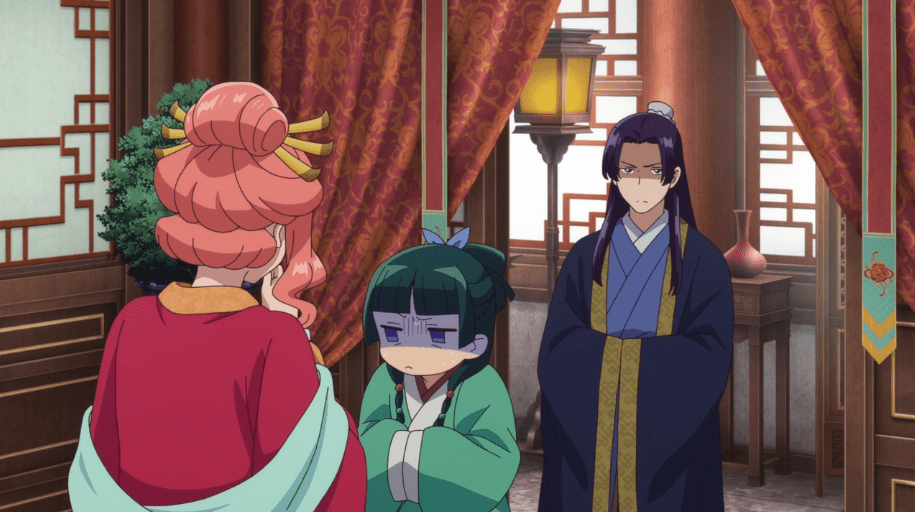
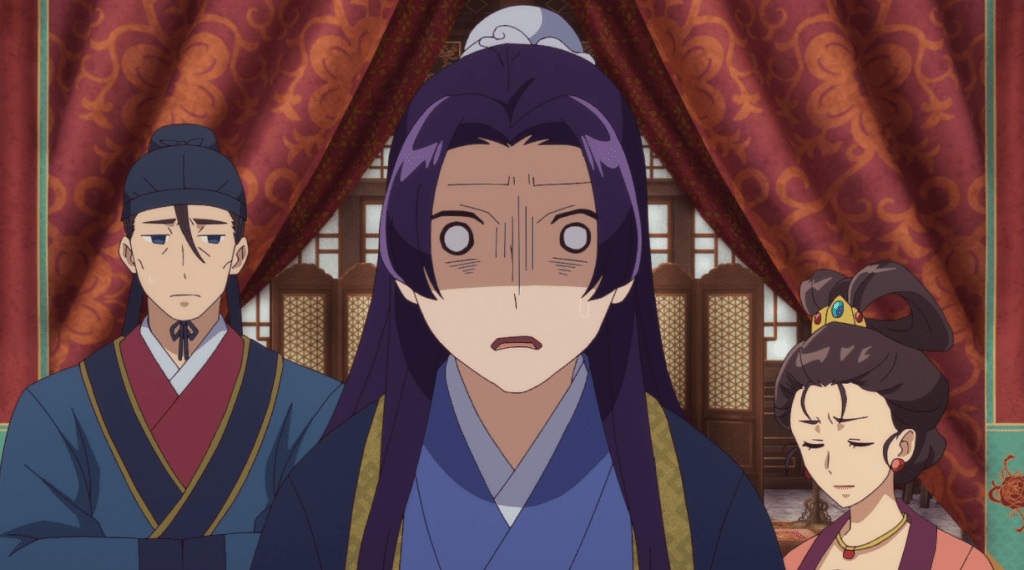
The story hasn’t forgotten about Jinshi in all of this. His conversation with Gaoshun – and especially the comments about his hairpin and that Gaoshun has been attending him since birth – even more strongly suggest that he is actually the Emperor’s younger brother but hiding that fact in the Rear Palace for some reason. The best scene concerning him, though, was his reaction to Gyokuyou’s tease about Maomao being gone for good. This creates one of my favorite reaction shots in a series already loaded with them, and as much because of the reactions of the attendants in the background:
Gyokuyou may be a kind-hearted and pleasant woman, but she also seems to get her fun from watching how people react to things. I have to wonder if that isn’t as much the reason for choosing Maomao as a lady-in-waiting as it was a thank-you for saving the princess’s life. She certainly seems to delight in watching how Maomao and Jinshi interact.
Strong technical merits which pay attention to all sorts of little details help bolster this as another solid, enjoyable episode.
Confirmation bias is a psychological characteristic whereby people tend to search for, interpret, favor, and recall information in ways that align with their pre-existing beliefs or values. It lies at the heart of many of the ironies in this series, and it is very much on display in this episode, where the Shadow Garden leadership must comes to terms with their founder’s seemingly-inexplicable actions. All it takes is an encoded note and a few bits of information for them to leap to the conclusion that Shadow hasn’t actually abandoned them; he was just running a bigger con than any of them could appreciate. Of course, as usual the jest here is that what both they (and later Yukime) assume is happening is quite far from the actual truth.
In other words, Cid is getting away with treating his organization like crap because of a string of coincidences and misinterpretations that work in his favor. At least this time he seems to realize that he may have ticked them all off, since he decides at the end to dodge the girls for a few months until he imagines things have cooled down. (Even though, in actuality, they probably aren’t now upset with him at all, since Shadow Garden did come out ahead in the whole affair.) He also did hedge his bets at least a bit with that coded note, though I’m presuming he didn’t intend them to decipher it fast enough to pull the legs out from underneath his ultimate goal: stockpiling money strictly for himself. That only further reinforces the persistent theme of him underestimating what Shadow Garden is capable of, both to his benefit and his detriment.
Shadow Garden leaders aren’t the only ones drawn into misinterpreting him this time, though. Yukime also thinks that John Smith is treating her as the precious thing the dying Gettan is referring to, when to John Smith it’s actually his missing gold, which he mistakenly thinks Gettan was responsible for. In other words, Gettan is getting a deserved thrashing, just not for the reasons he should have been getting it. The even more remarkable thing here is that this scene still brings the Yukime-Gettan connection to the sad but satisfying conclusion that it warranted; despite all of the series’ normal shenanigans, Yukime and Gettan still come off as a tragic couple in the end.
But we’re not done with Yukime, because she’s getting recruited into Shadow Garden, too. Alpha seems to recognize that anyone capable of pulling off the counterfeiting scheme certainly has the talent to be of value to the organization, and that her former love was ruined by associating with the Cult of Diablos would give her the right motivation. (Alpha may not be aware that Yukime also seems to be falling for John Smith, too, so that makes her an even better-suited recruit than Alpha realizes.) I could see her being invaluable to the business side of Mitsugoshi, and just as they’re going to be expanding after the Cult-connected Merchant Association gets ruined, too.
So yeah, everything’s somehow working out neatly. Delta even finds something where Shadow was digging for the gold he though Gettan had indicated that he had buried. Will that just be an idle detail, or a hook for the next storyline? Either way, this episode was as fun as usual.
Note: This review is based on the subtitled version. A dubbed version is apparently also circulating, but that was not shown in my area.
The Tunnel to Summer is a late 2022 movie which has only recently had a U.S. theatrical run, courtesy of HIDIVE. It adapts a 2019 light novel and is adapted and directed by Tomohisa Taguchi, the current director of Bleach:Thousand-Year Blood War and past efforts including Twin Star Exorcists and the 2017 Kino’s Journey revival. Given his action-oriented pedigree, this project about love and loss is a distinct departure from the norm for Taguchi, but the result is an indication that he’s well-capable of branching out beyond action fare. It didn’t win an award at the 2023 Annecy Film Festival for nothing.
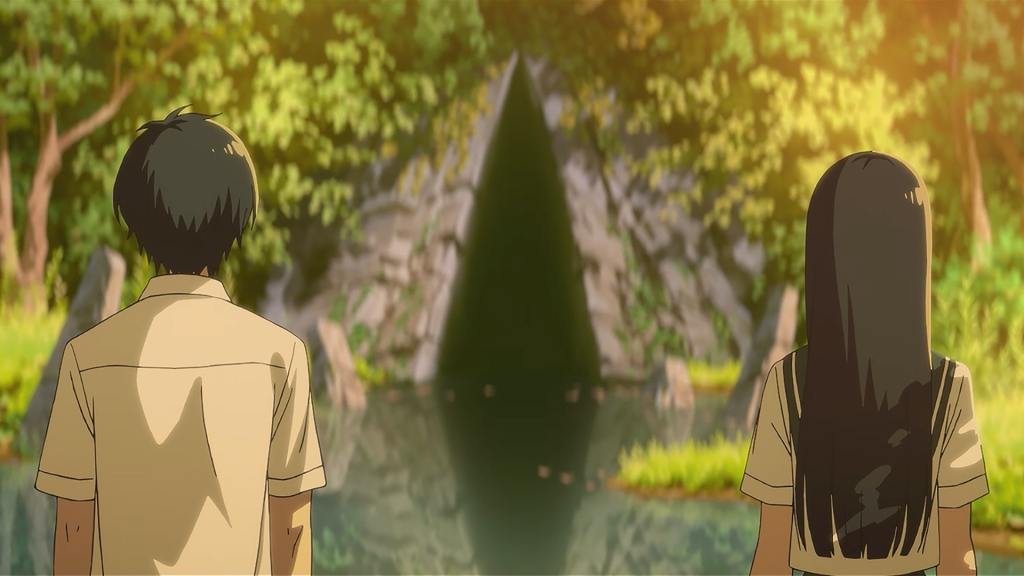
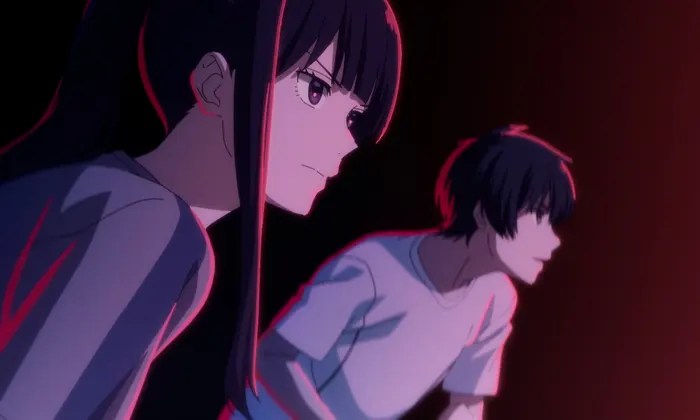
In the story, Kaoru Tono is a teenager in a rural area who has heard rumors about a secret area tunnel that can grant one who enters it a wish, but at the cost of 100 years of the person’s life. He certainly has a wish he’d like to see fulfilled, too: a younger sister died and he feels like he’s to blame, both for it and the way it tore his family apart. (And his father certainly thinks so.) One day while fleeing from strife at home, he stumbles across said tunnel, and after an initial experiment proves that there may be something to the stories, he finds himself joined by new classmate Anzu, who also has a wish she wants to see fulfilled. As they agree to study and quantify the properties of the tunnel before making a serious effort to journey to its end, a deeper relationship starts to blossom between the two. But even though they figure out some things about the tunnel, it ultimately isn’t what either of them initially thinks, and that leads to big complications when one of them eventually finds less reason to gamble on the possibilities the tunnel may offer.
I would be shocked if both original writer Mei Hachimoku and director Taguchi don’t admit to being at least partially influenced by the works of Makoto Shinkai, as The Tunnel to Summer has a very similar feel to his works. It doesn’t aim for the depth of sentimentality that Shinkai is known for, but themes about connections and separations across space and time resonate as powerfully here as they do in Shinkai’s works, as does the budding romance which lies as much as the core of the story as its more fantastical elements do. Kaoru and Anzu are two kids who find common ground in both being detached from their families (albeit for entirely different reasons) and seeking to recover something precious that they have lost. They are individually well-rounded and believable characters and make a convincing couple, and the development of their relationship from an initially somewhat antagonist one to a cooperative and supportive one feels very natural. That is absolutely critical to making the crisis which composes the last quarter of the movie emotionally effective. I won’t get into the details of that here, other than to say that certain aspects of it resemble a certain Shinkai work too much for it to be a coincidence.
The feel of the movie may be familiar and the plot may be on the simplistic side, but it certainly doesn’t lack for visual support. This is animated by studio CLAP, which previously earned attention for animating the wonderful-looking 2021 film Pompo: The Cinephile. Here the film takes a more subdued, realistic approach most of the time, with quality animation, detail work, and setting designs all being features. The only place it truly gets showy is in its vibrant depiction of the interior of the tunnel, but this is a film meant to impress more on the little details than on the big ones, and it does that quite well.
The Tunnel to Summer, the Exit of Goodbyes may not blow you away, but it will impress and entertain, and it is well worth checking out when HIDIVE eventually gets to the point of streaming it. (It is also due out in January on Blu-Ray.)
Overall Rating: A- (B+ for writing, A for visuals)











 USA Anime