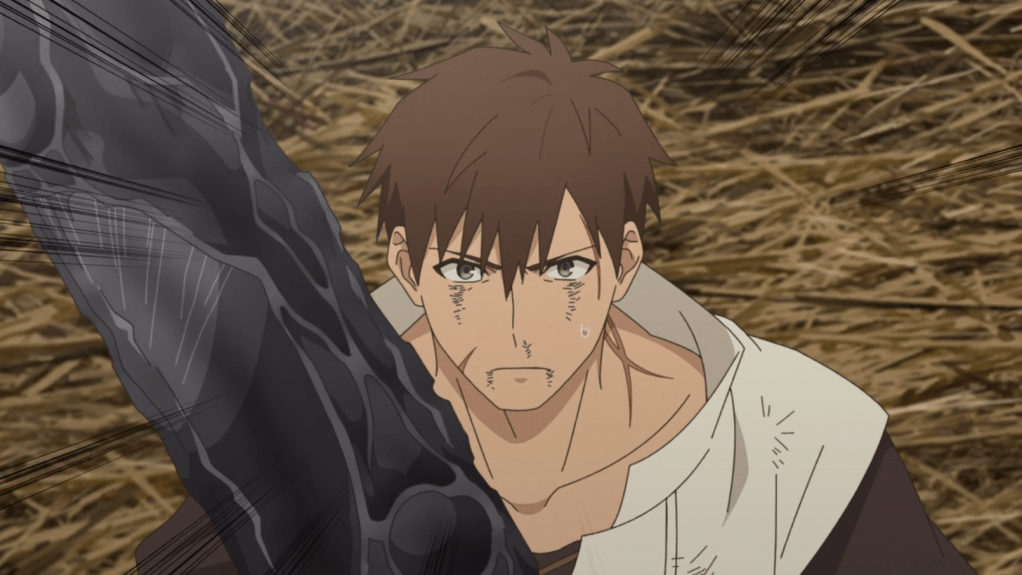
Review: My Oni Girl

On Friday May 17th, the Studio Colorido original project My Oni Girl had its world premiere at Anime Central, ahead of its wider release on Netflix on May 24th. Director/writer Tomotaka Shibayama (A Whisker Away) and producer Karen Imagawa were present for the screening and to take audience questions afterwards.

In the roughly two hour long movie, first-year high school student Hiiragi is struggling to fit in at his new school when he encounters Tsumugi, a girl on a journey whom only he can see is actually an oni. (Their horns aren’t visible to most normal folk.) She has left her people’s Hidden Village on a quest to find her mother, who left her when she was little. Hiiragi winds up accompanying Tsumugi on her quest, partly because he’s drawn to her free spirit and partly as a way to escape a conflict with his father, who wants him to be privately tutored rather than attend a cram school, a move that Hiiragi feels would only isolate himself further. As the two goes on a number of misadventures – first on a trek to a shrine Tsumugi believes her mother went to, and later to the Hidden Village – they must contend with masked spirits who seem to be pursuing them, Hiiragi’s own supernatural transformation, and contrasting personalities that both draw the two together and push them away from each other.

Director Shibayama’s first job in the industry was working for Studio Ghibli (he did digital work for Spirited Away), and that Ghibli influence shows clearly throughout every facet of this project. The journey that Hiiragi and Tsumugi go on, the kinds of people that they meet, the supernatural flair, the production approach (Shibayama was storyboarding the movie as he wrote it, an approach Miyazaki has been known to use), the designs of the Snow Gods – all of it has a decided Ghibli feel. The only real major deviation is that, unlike in most Ghibli films featuring youths, the protagonists are not entirely left to their own devices. The fathers of both actively come after them and are integrally involved in some parts of the story (although Tsumugi’s father is much more present than Hiiragi’s).

To call this just a Ghibli knock-off would be unfair, though. Shibayama has a clear message he is pushing throughout the movie: that Japanese youths are too caught up in not showing their true hearts, and that can lead to serious complications. That takes literal form in the movie, as people (like Hiiragi) who lie too much about their own heart can start to generate “mini-oni” and will turn into oni themselves if that goes on for too long. In a more figurative sense, it is also the major impetus driving Hiiragi forward and occasionally even becomes a point of conflict; one of the movie’s best scenes is a tiff the two have with a swing used as a prop, and Hiiragi’s unwillingness to be forthright about his feelings is at the heart of it.

Characterization is another strength of the movie. Whereas Hiiragi tends to repress his feelings, Tsumugi is very forthright about hers, and that both creates a fine contrast and provides a reasonable foundation for why Hiiragi chooses on the spur of the moment to help Tsumugi; he’s drawn to the traits he wishes he could muster himself. Of course, Hiiragi’s personality isn’t without its own problems, as her free spirit leads her to try to tackle problems on her own that she probably shouldn’t, and so Tsumugi becomes both a co-conspirator and something of a safety net. Even when fighting, the two have a good chemistry going.

The storytelling does have its weak points, however. That Shibayama did not have the story fully plotted out in advance shows in its late stages as the action moves to the Hidden Village. In particular, the reason why Tsumugi’s mother is not around is poorly explained and developed, and why she had to do what she did is only barely implied. Why Tsumugi’s father did not ever tell her the truth of the matter is also unclear; yes, it may represent the village’s dark underbelly, but all of the adults were clearly aware of it and children would need to know about it eventually. The disrupts the flow of the dramatic climax a bit and leaves audiences scratching their heads too much when they should be absorbed in the emotions of the climax. The very interesting physical structure of the village also gets entirely too little attention and exploration; imagine what Spirited Away would have been like if only a half-hour of the movie took place in the Bath House of the Gods. The pacing also becomes more erratic as the urgency of events ramps up in the last third after playing out at a more evenly leisurely pace before that.

The movie’s technical merits are more consistent. Its strengths lie in its artistic design, especially for the snowbound, multi-tiered Hidden Village and the Snow Gods. On the downside, the supporting music is consistently pedestrian, though not to the point of being a negative. The animation effort is solid for a movie-level production but not quite on an elite level.

On the whole, My Oni Girl does not succeed at everything it tries to do, but it does find a satisfying core in interesting characters and guides them capably with both internal and external motivations. It is definitely worth checking out.

Overall Rating: B+

Spice & Wolf (2024) episode 8

Rating: B

Like its name suggests, the episode “Fellow Traveler and Foreboding News” deals with two plot threads running in parallel: one concerning Lawrence and Holo’s encounter with the shepherdess Nora (and her dog Enek) and the other concerning various ominous notes about Lawrence’s business situation. Exactly how the two are connected is unclear as of yet, but the emphasis placed on Lawrence treating his encounter with Nora as a future business opportunity certainly suggests that the two paths will eventually converge again.

The source novel makes a point of emphasizing that Nora is both young (she’s implied to be in her mid-teens) and scrawny, and while the latter may not be as obvious, the former certainly is. She certainly sounds young, which is a credit to long-time veteran seiyuu Mai Nakahara, who also voiced Nora in the original adaptation. (You can also currently hear her as Princess Lily in Tsukimichi and Liz in The Duke of Death and His Maid.) The animation also does an excellent job of giving her youngish mannerisms and body language. By comparison, something looks and feels a bit artificial about how Enek is drawn and animated, though he still effectively shows his skills as a sheep-herding dog. They’re supposed to work closely in tandem, and this adaptation does a fine job of depicting that as well.

The scenes of Nora conversing with Lawrence also gives some sense of the kind of life Nora leads. She’s most likely an orphan raised by the Church and has taken on the job of tending the local Church’s literal flock. However, being a shepherd can be a lonely, isolating life, and because she’s young and relatively new (at four years), she’s forced to the fringes on top of that; is it any surprise that prime grazing territory is jealousy guarded? (Even in modern day, there have been troublesome disputes over this in the U.S. West.) The question left up in the air here is whether her skill is mystical or just a result of working well with an excellent dog. The latter seems more likely, since Holo is not reacting as if Nora is inhuman, and she would certainly be able to sniff that out. And from the meaningful look Enek gives her at one point, he clearly has an inkling of what she really is, too.

Of course, Holo being Holo, she’s less than thrilled about all of this. How much of that is her being territorial and how much is a general aversion to shepherds (the natural enemy of wolves) is debatable, but Holo has certainly shown before that her great wisdom doesn’t preclude her at all from more base emotions. Lawrence is becoming a bit more adept at managing her, but he still has a ways to go.

On the other front, nothing really outright declares that something is wrong, but the reactions of guards and officials as Lawrence comes into Ruvinheigen suggest that something is definitely up, and it definitely has to do with Lawrence transporting armor. The rider arriving at the end suggests that the merchant from the previous town might be delivering a bit of spite over being outmaneuvered, but the other reactions can’t have anything to do with that, and a merchant house which is getting no trade traffic for days smells of big problems, too; that can’t be a casual inclusion. By comparisons, the look that the priest gives Nora as she arrives also speaks to her not being so welcome, though exactly why is hard to fathom unless she is suspected by the Church of having a mystical character, too.

In terms of comparing adaptations, this one contains the exact same scenes and covers the exact same ground as the original. The original emphasizes a bit more that Nora isn’t the most welcome of individuals in town and gives a slightly greater sense of impending trouble, but this version covers its bases adequately enough.

On the whole, the episode does a solid but unspectacular job of covering this part of the story.

Spring ’24 Mid-Season Report, part 2 ver. 2

See here for Part 1.

Last time around I looked at earlier-debuting series; this time around I’ll be looking at the later-debuting ones, including the first and second episodes of the new season of Demon Slayer.

While I have previously covered The Misfit at Demon King Academy, I have fallen off pace on that one (mostly due to losing interest), and so will not be covering here. I also will cover Girls Band Cry at some point (probably at the end of the season, or whenever it becomes legally available via streaming, whichever comes first) and will be looking at the new movie Oni Girl in a separate post.

NOTE: Entries with an asterisk on the Rating So Far may not include the most recent episode, since this is a reconstitution of a post from 5/17/24 which had technical issues and I am behind on some series because of the convention covering this past weekend.

A Salad Bowl of Eccentrics

Rating So Far*: B

True to its name, this has proven to be a very eclectic series, one which distinctly borrows some influence from Hinamatsuri but goes in different directions with the basic premise. Its princess lives with a detective and assists him in cases in some episodes, while others focus on the female knight, who seems comfortable living homeless and occasionally gets dragged into all sorts of weirdness, including working at a questionable hostess club, befriending a singer whose band has collapsed, and almost getting dragged into a cult. And now it looks like the knight, the cult leader, and the singer are going to form a girl band! While it’s been an interesting series, the rating takes a hit because the content seems too random, with the only uniting theme so far being that it’s practically a travelogue for Gifu Prefecture. Still, the characters are likable enough that I’m willing to let it continue to play out.

As A Reincarnated Aristocrat. . .

Rating So Far: B+

This one joins An Archdemon’s Dilemma as one of the season’s most underappreciated series. Unlike many of its fellow isekai series, the protagonist is not OP; his special ability just allows him to gather the best people around him, and since he makes a habit of picking downtrodden individuals who can show extraordinary talent if given a chance, he tends to engender fierce loyalty from such individuals – including, as it turns out, the girl he’s betrothed to. This is far less eye-rolling in practice than it may sound, and the series has certainly had its satisfyingly dramatic, heavy moments. It also benefits from particularly strong music support. The most recent episode has brought is establishment arc to a close, and forced protagonist Ars into a true leadership role during a time of strife, so I am eager to see where this one goes next.

Chillin’ in Another World with Level 2 Super Cheat Powers

Rating So Far: B-

I was going to rate this lower, but episode 6 revealed that it can successfully take itself quite seriously when it needs to, as well as not playing around for too long on acknowledging that main girl Fenrys is formally Flio’s wife. I still have a bit of a problem with how little explanation has been given so far for how and why Flio is so ridiculously powerful, but that is partly offset by some other cute bits, including how the Dark Lord seems to be smitten with the female knight of the group of adventurers who live with Flio and Fenrys (much to the dismay of the knight); an upcoming episode even looks like it will focus on that. Not a world-beater by any means, but it’s entertaining enough and does have one of the most cutesy of all recent OPs.

Date A Live 5

Rating So Far: B

Boy, this one hasn’t been shy about pulling out all of the stops on major reveals! The entirety of the season so far has consisted of a major battle that’s nowhere near done, the lead-up to that battle, and flashbacks that cover nearly two full episodes. But those flashbacks are game-changers, as they reveal the full truth behind the Spirit of Origin and how she’s connected to Elliott, Westcott, Ellen, and, most importantly, Shido. It also explains how Shido winding up meeting all of the Spirits wasn’t just a coincidence and how Reine fits into all of this, amongst other big revelations. The biggest mystery outstanding at this point is how Mana fits into the picture, and there are some dramatic incongruities between her current state and presence in certain flashbacks, but hey, the season’s only half-done. The CG used for the battle scenes is a bit wonky at times, and I do think the series is hurt a bit by having to take itself too seriously (which isn’t its strength) but this is everything that long-time fans of the franchise have been hoping for.

Delicious in Dungeon

Rating So Far This Season: A-

With Frieren and The Apothecary Diaries no longer overshadowing it, this one is breaking out as the top series of the season so far. It handled its more serious content in episodes 14 and 15 remarkably well but also showed that it can easily slip back into form, too, and the seeming addition of Izutsumi to the regular cast adds a dynamic new dimension to the party, both in terms of personality and combat capability. (And with Marcille getting integrated into the monster-eating fold more than she’d care to admit, Izursumi can now take over the outsider view.) Lots of fun dungeon-crawling and cooking ensue as the series gradually builds out the characters more, and it looks great, too. There’s a reason why this was one of the most heavily-cosplayed series at the anime convention I just came back from.

Demon Slayer: Hashira Training Arc

Rating So Far: B+

At its best, Demon Slayer is one of the all-time-great shonen action series, and even when not at its best it’s still one of the best-looking action series TV anime has ever produced. However, the series has been saddled by writing problems in the last couple of seasons, especially on the pacing front. After a double-length first episode and regular-length second episode, the series has yet to show that it has passed beyond those problems. Still, it’s early, and still laying the foundation for the season, so I’m willing to be a bit patient, and exploring the background of first Giyu and (next episode) Kocho should give more insight into developments this season, including Giyu’s ongoing attitude issues. On the downside, the early foundation of the season is training regimens – something that the series is probably overdue for, but how many times have we seen fare like this in other titles? More promising is Tamayo’s invitation to come to the mansion to work with Kocho and the way Nezuko essentially becoming a Daywalker lies at the heart of everything that’s going to happen this season. And the opening acting sequence of the first episode lives up to the series’ reputation, too, just with different Hashira than before getting the attention. At this point, I am cautiously optimistic that this will be a strong season.

Go! Go! Loser Ranger

Rating So Far*: B

I love the concept behind the series, and it has expanded on that by showing that elements within the Dragon Keepers organization are well aware that thing are corrupt at the top. The addition of a female monster is also promising, as is the twist about the current identity of one of the Dragon Keepers. It also has a delightful closer which should be check out even if you don’t watch the rest of the series. My one concern so far is that the series may be taking itself too seriously for its own good. Granted, that does give it a darker edge, but given how ridiculous the base concept is, do you really want that? May be worthy of a higher grade, but I’m going conservative on it for now.

Jellyfish Can’t Swim in the Night

Rating So Far*: B

How much you like this one may depend entirely on how much you appreciate the cast of misfits that’s coming together to make music videos: one’s an artist who lost her confidence in the fast of criticism, another is a “retired” idol trying to start anew, a third is a troubled piano expert who found inspiration in the idol’s music, and a fourth is a Vtuber who’s also more than a bit of a shut-in. All of the girls are outside of social norms to one degree or another, and the series is rolling with the idea that such a situation can spark great artistic creativity. The series has been modestly successful so far as it takes the girls through various travails of the creative process, but I can’t rate this one higher because, honestly, I have struggled to become invested with it. Still, the recent story about an older idol and her relationship with her daughter was a sweet one, so there’s still potential here.

Kaiju No. 8

Rating So Far: A+ at peak, B overall

In many respects this is a very typical shonen action series; the protagonist may be much older than normal, but he’s still working hard as an underdog to fulfill a childhood promise, and that includes the standard qualifying exam that gets unexpected hairy and him eking his way in because he can’t reveal his true power but, dammit, he has other merits. (And I do appreciate that one of his superiors is recognizing the expertise he brings to the table, and how the most recent episode shows that he’s well worth having on the team for that expertise in monster biology, even he’s not the greatest fighter under normal circumstances.) And of course, it’s silly when it can get away with it, too. But what makes this one stand out is that when it hits on the action front, it hits hard (double meaning intended), and as gloriously (and gorily!) as the best shonen action series. That the hyper-competent girl who would normally look down on him is privy to his secrets is also an interesting angle, though the teen girl maybe starting to have a thing for the much older guy tosses out shades of Tiger & Bunny. The show many never escape the run-of-the-mill shonen action vibes at its core, but it has enough else going for it right now, including a fine mystery about the other human-sized kaiju who can pass as human.

KONOSUBA 3

Rating So Far: B+

For the most part, the series is up to its usual antics, and that is a Good Thing. A visit to the princess provides new avenues for all sorts of humor and hijinks (much to the dismay of Darkness, who’s trying to maintain decorum as a noblewoman), but there’s also an actual plot starting to build, too, with Eris (and thus Chris) seeking to recover special OP artifacts which originally belonged to isekaied individuals and threaten to unbalance the world if not tucked away. Nope, no way a mission to collect those could go wrong. . . The art style is as loose as ever, but if you’ve liked previous seasons, you should like this one, too.

Mission: Yozakura Family

Rating So Far*: B-

This one rides mostly on energy and crazy, spy-related hijinks, and it’s been doing a fair job at it so far. The routines are fairly typical: the spy house is loaded with traps which protagonist Taiyo must learn to navigate, he’s getting trained rigorously by the eccentric family members and going out on missions with them, he has to protect both Mutsumi and himself from threats, and so far, but it’s mostly approached with a light-hearted spirit somewhat in line with Spy x Family, and that Mutsumi isn’t ignorant or helpless (even given that she has no special abilities) is a plus. Works pretty well when you need a dose of mindless fun.

Mushoku Tensei s2 p2

Rating So Far: B+

This quarter has seen almost no action as it deals with the mundanities of Rudeus settling down into family like, including getting a house, formally starting to live with Sylphie, and accepting both his sister Norn and half-sister Aisha as wards while Paul is off to find Zenith. This period features some strong character development, especially involving Nanahoshi and Norn, but again, not much actually happens until Turning Point 3 arrives. It features both a major development and a plot transition which should force the series back into a more active mode, though this time the turning point comes down more to a critical choice Rudeus must make than a dramatic situation that he’s been stuck in, and this time he’s facing it essentially as an adult. I have very much liked how the series has handled Rudeus’s development through this part, and the visuals are still strong, so this one almost rated a notch higher. It’s currently one of the season’s top-rated series on ANN, and I don’t see that changing anytime soon.

The Many Sides of Voice Actor Radio

Rating So Far: B-

Most previous series focusing on voice actors had featured adults struggling to make it in the business, so a series focusing on high school students is a mild twist on the concept. In just a few episodes, the series has taken the leads through many travails – a social media blow-up about a possible casting couch situation, the ins and outs of how voice actor radio shows work, stage vs. private personas, and even how parents can influence the actions of the voice actors at that age. The most interesting aspects so far have been the dramatic contrasts in personality types, balances of strengths and weakness, and envy of the other for leads Chika and Yumiko; the latter envies the former’s talent, while the former envies how outgoing and sociable the latter can be. The strength of the follow-through on the issues the series raises is a concern, as is the ordinary artistic quality, but the yuri teases have gradually increased; this is definitely not as forthright about it as something like Whisper Me a Love Song, though. There has been some (somewhat incongruous) fan service. I am still cautiously optimistic about this one.

The New Gate

Rating So Far: C-

This series had one of the weakest opening episodes of the season, and little to nothing it has done since then gives any indication that it’s going to get better. “Trapped in a game that’s become real” scenarios have been done before and done much better than this, with flaws including a boring lead who’s infallibly powerful, mostly-uninteresting supporting cast, run-of-the-mill mechanics, and limited action sequences. This might have fared better if it had come out a few years ago, but now it’s just a sad retread of concepts borrowed from many other franchises.

Unnamed Memory

Rating So Far: C

Rating this series this low pains me, as I really, really want to like it. Oscar and Tinasha are potentially interesting characters with a potentially interesting relationship, and there is some potentially interesting backstory afoot, too. However, “potential” is all the series has managed so far. It feels like it’s being rushed, though the pacing it is adapting the books atsuggests that this is more a case of the series suffering badly from connecting tissue being trimmed rather than the pacing being rushed. I intend to stick with the series to see if it improves as it moves into adapting the second source novel, but so far this has been the season’s biggest disappointment.

Whisper Me a Love Song

Rating So Far*: B+

I am not a big fan of pure romances, but I love the way this one has progressed. Younger girl Himari is normally the outgoing one, while Yori is the shy one, but when the matter of romance is raised between the two, the roles effectively reverse; Yori is the one to openly declare both romantic love and that she will win Himari over, while Himari is the one who’s unsure whether what she feels is romantic or platonic love. The addition of a love triangle element does not so much spice things up as push Himari, while seeing Yori’s quest to win Himari’s feelings push her to formally join the band and seek to write a love song for the first time is a delight. The only flaw so far – and the reason I’m not rating this even higher – is the very limited animation. Still, this is one of my favorite new series of the season.

That’s it for now. Watch for a special review of the movie Oni Girl later this week, and possibly a mini-feature on Anime Central, too.

Spice & Wolf (2024) episode 7

Rating: B+
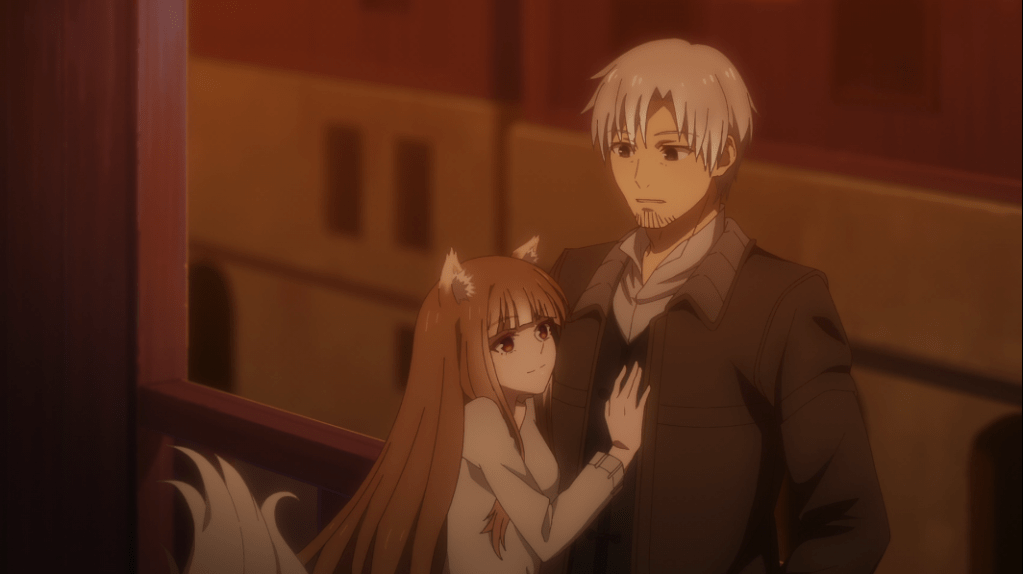
With this episode, this take on the source novels begins its adaptation of the second novel. It equates to episode 8 of the original series, since the original episode 7 was only released on DVD and adapts a short story which comes up later in the novels (but chronologically happens between novels 1 and 2). More importantly, it introduces a character who will play a major role throughout the second arc: the shepherdess Noa.

Actually, “introduces” may be overstating the case, since she only briefly appears at the beginning of the episode as an enigmatic cloaked figure and then again at the end as she encounters Lawrence and Holo – and in this version, she doesn’t even have a line of dialog. Still, bringing her into the picture explains her prominence in both the opener and closer. It also makes for an interesting reveal: she is the kind of human that Holo hates the most. Given who Holo is, it’s not hard to understand why, but this also carries a double meaning. Proclaiming shepherds to be the basest enemies of wolves is not a stretch, but the fact that this one is female – and a very young, pretty woman at that – was almost certainly not lost on Holo, too. Wise as she may be, Holo is also a very emotional being, so petty, unfounded jealousy would certainly not be out of character for her.

Some of the gossip that Lawrence and Holo hear prior to encountering Noa is also interesting here. Tales are being spread of a sorcerer in the area who controls wolves. If “keep wolves at bay” can be interpreted as controlling them, then a skilled shepherd could, to those not knowledgeable about the profession, seem to have almost mystical abilities. Shepherds also traditionally exist at the fringes of society because of the nature of their occupation, and throughout the real Middle Ages individuals on the fringes were the ones most commonly targeted by accusations of witchcraft. Hence supernatural traits being attributed to a shepherd is quite believable. Or is there something more about Noa than immediately meets the eye? One of the main characters is the human form of a giant wolf, after all.

But future episodes will deal more with that. More immediately, Holo gets another opportunity to help Lawrence put one over on a merchant, this time one who was using a slightly tilted table to reap an advantage in a trade agreement concerning Lawrence’s pepper. While it is another opportunity for both characters to be clever, the merchant’s reaction to Lawrence’s insistence on taking his new goods in armor seems a little suspicious. Lawrence takes the armor with the intent of selling it in the city of Ruvinheigen, where annual crusades against pagans start, but that’s not the only vague inkling that something may be going on market-wise that Lawrence doesn’t know about. A second clue comes in the presence of mercenaries moving south from Ruvinheigen. This version does not elaborate on the significance of this point like the original does, but still, the fact that mercenaries would be moving south when, theoretically, a crusade should be gathering also seems suspicious. This smells like the seeds of an upcoming crisis, as does the not-so-casual reference to packs of wolves in the area. Holo can likely deal with them without issue, but that also seems like a significant point.

On the whole, this version covers the same territory and major points as the original adaptation, but here we start to see more variance in the details. This version includes some details from the source novel that the original skipped over (such as the bit about Holo having met “Saint” Ruvinheigen long in the past) but omits others that the original version does include (such as the aforementioned elaboration on the significance of the mercenaries). It also presents some of the same information in different ways and under different circumstances, though these differences are not meaningful to the overall story. Most notably, the scene where Lawrence and Holo are talking in the room in the inn before going to see the merchant about the pepper continues a trend in this adaptation of portraying Holo in a more playful, cutesy fashion. That gives Holo a bit of a different allure here compared to the original, but in this case it’s not a negative.

What opportunities will arise with meeting the shepherdess? And what seemingly-innocuous details spilled in this episode are going to become important later on? Come back next week to find out!

Spring ’24 Mid-Season Report, Part 1

We’re approaching the midpoint of the Spring 2024 season, and thanks to having more free time on my hands than expected, I am still keeping up with way too many series. Hence, to keep this mid-season round-up from getting too cumbersome, I am once again splitting it into two parts.

Last time I split the list according to what was and was not getting weekly episode reviews on Anime News Network. This time around there’s a spread of as many as three episodes on where series are at this point (one series is still on episode 4 as I write this due to taking an unplanned week off, while a few others have already hit episode 7), so this first installment will cover titles that have at least reached their sixth episode as of 5/11/24 and the second installment will cover the rest. Since the two titles I am episode-reviewing fall into the former category, this installment will be a little shorter. Also, I will not be covering The Misfit at Demon King Academy, since I finally lost interest in that one and dropped it after this season’s first couple of episodes.

NOTE: References to MAL are to the site MyAnimeList.

A Salad Bowl of Eccentrics

Rating So Far: B

This one is almost as much an advertisement for Gifu Prefecture as it is a series, but beyond that, it lives up to its name by focusing on an eclectic bunch that include a detective; a young, practical-minded princess from a fantasy world living with the detective; the female knight of said princess who’s mostly been living homeless; the leader of a cult who’s trying to recruit the female knight as a savior; and a former sex worker who was the lead singer in a failed girl band. The latter three seem to be on course to make this the fourth series this season to feature the formation of an all-girl band, while the detective/princess duo tackle random cases in other episodes. The characters and the odd situations they get in keep the series entertaining enough, and the technical merits are solid, but the whole thing feels directionless. That may be the point, though; these are just a bunch of weirdos hanging out in Gifu. Not a high-priority view, but definitely a solid keeper.

Delicious in Dungeon

Rating So Far (this cour): A-

With Frieren and The Apothecary Diaries no longer hanging over it, this one is stepping up to become one of the season’s top performers. Episodes 14-17 took a more dramatic turn, which may not set as well with those who have become enamored with the cast just goofing around, but episode 18 (and, to a lesser extent, 19) represent a return to its more typical form of the cast having to figure out how to get through all kinds of odd situations in sometimes-screwball fashion. It’s certainly one of the best-looking series of the season (with a highlight being the design of the Falin chimera), the well-balanced cast continues to be delightful, and the take on various dungeon scenarios and foes is rather clever. Continues to be highly recommended for any fantasy RPG fan.

I Was Reincarnated as the 7th Prince

Rating So Far: C

Of all the series in this part, this is the one closest to the chopping block. (I’m only still watching it because I have commonly had little to do on Monday nights this season.) That’s mostly because Lloyd has become one of the most irritating protagonists that I have encountered in quite some time. It’s not how OP he is; it’s his character’s attitude. The series does have some decent technical merits and gets some entertainment value from its more involved looks at how magic works in the setting, some respectable action sequences, and some likable supporting characters (especially Tao). However, the series has yet to prove that it can be compelling or involving.

Laid-Back Camp 3

Rating So Far: B+

The artistic tweaks resulting from the studio change may have taken some time to adjust to, but ultimately this season has all the same appeal that the previous installments did. The only other real difference is that Nadeshiko’s former friend Ayano, who only barely appeared previously, is a major character for the season’s first half (at the expense of a trio of regulars), but that didn’t change the balance or functionality of the series one bit since Ayano fits in seamlessly with the normal antics. Lots of camping, eating, travelogue elements, scenery porn, and girls cutely delighting in it all, which combine to give the audience warm fuzzies. What more is there to ask for here?

Re:Monster

Rating So Far: B-

Wow, this series has some definite issues that it plays off in a fashion that may be too flippant for some viewers’ tolerances. Like in Goblin Slayer, female captives are used by goblins as brood mares, though this aspect is barely touched on early and dodged around afterwards by the existing ones dying off. (Why goblins need to do that is unclear, since there are clearly female goblins in this setting.) Goburo/Oguro essentially does away with this practice, but most of the female captives wind up having sex with him anyway – some willingly, some not, and the unwilling inevitably being members of enemy forces doesn’t soften that much. The series also dodges around the protagonist eating humanoids, too. The narrative format used in the first episode continues throughout, but I don’t mind that. The bigger problem is how much the goblins are accomplishing in such a short time frame; events that play out in about 2½ months would be more sensible spread over a whole year. And of course there’s the whole issue of how OP the protagonist is quickly getting; he’s already at the point where nothing can seriously challenge him.

Despite the issues, I have found this one to be largely entertaining, and it’s got a fantastic simuldub; this is the first lead role for Sean Letourneau (the voice Goburo/Oguro), but he’s a real talent. Not a priority view, but still a solid one if you aren’t chased off by its questionable aspects.

Studio Apartment, Good Lighting, Angel Included

Rating So Far: C+

This one looked from the start to be a completely traditional supernatural harem romcom series, and after seven episodes it has proven to be such a dedicated stylistic throwback that I almost wonder if the writing is doing that intentionally. Towa is every bit Belldandy from Ah! My Goddess (down even to having a kid sister angel show up!) and a childhood friend and blond yuki-onna are in the mix, too, as friends who might want to be more. (Okay, the childhood friend definitely does.) The most recent episode has also introduced an older aunt and her editor (think Fruits Basket) and an eyepatch-sporting girl who is definitely a chunibyo and may or may not be a vampire, too. (The character being both would be a fresh twist.) All the antics and little joys are utterly run-of-the-mill fare, and none of the characters so far are overly memorable, but at least the series looks pretty good. Although decent entertainment, the series is bland enough that generating any enthusiasm for it is difficult.

That Time I Got Reincarnated as a Slime 3

Rating So Far: C+

This series does involve more than than just strategy meetings, right? Yet it feels like at least half of this third season (including some entire episodes!) have just been one big strategy meeting or another. Granted, the scale on which Rimiru must now operate has necessitated this to a certain extent, as both he and the nation of Tempest are now literal world powers, and it’s not like the series has entirely lost its charm; the familiar characters are who they always were and some of the developments (such as the road design and defense) have interesting technical aspects. Also, a long-awaited Rimiru/Hinata meeting is finally on the near horizon, and new schemers have revealed themselves. Technical merits aren’t great, but that was never a main selling point of the franchise. Overall, it’s been a decent but unexciting season so far for this one.

The Banished Former Hero Lives as He Pleases

Rating So Far: D

This is persistently the lowest-rated series in ANN’s weekly rankings and the second-lowest-rated show of the season on both Crunchyroll and MAL (behind only Highspeed Etoile in both cases, which isn’t making the ranking on ANN’s lists), so it should be no surprise that it’s also the clear bottomfeeder of the two dozen or so series I am following this season. Its one plus is that closer “Meritocracy” by Aimi is easily one of the season’s best EDs, but everything else it does is at best mediocre and outright fails much more often than that. Weak animation, lackluster artistic efforts, an uninteresting protagonist, cartoonish villains, poorly-executed action scenes, an utter lack of compelling characters or drama. . . the list of faults is long. Episode 7, which adds a slightly interesting twist on standard reincarnation scenarios, is a little better, but the series has dug itself a hole that may be insurmountably deep.

The Irregular at Magic High School 3

Rating So Far: B

This franchise has always had certain irksome aspects which keep me from fully embracing it, but thankfully those haven’t been as prevalent this season. Instead, the series has mostly focused on what it’s good at: complicated, multi-layered scheming and magical mechanics. To be sure, there have still been some elaborate action sequences here and there, and that aspect looks like it could be heating up as the series plunges into the heart of its second arc of the season, but the emphasis has been much more on establishing new characters, implementing schemes, and figuring out said schemes and making counter-moves. In that regard it’s been much like Slime, but all of the plotting and planning seems less out of character here.

Tsukimichi -Moonlit Fantasy- 2

Rating So Far (this cour): B-

In some senses, this series is also in the same story mode as Slime. As it has progressed through its second half, it has continued to be more plot-driven than the first series, at the expense of the crazy spirit which enticingly characterized the first series. Even so, the (almost too broad) supporting cast is decent, and at least some of the plot twists have been intriguing, if not necessarily original; even the most novel one – about Makoto and his business running afoul of the Merchant’s Guild – has parallels to Parallel World Pharmacy, though here it takes on a more practical and less villainous aspect. (It also presents a welcome rare case where Makoto and his allies can’t solve a problem just by overpowering it.) In other words, the series is still good entertainment, just not for the same reasons that it was in the first season.

That’s it for now. I will return in either one or two weeks for Part 2. (Next weekend there may be a review of the movie Oni-Girl instead, since I intend to be at its world debut at Anime Central.)

Spice & Wolf (2024) episode 6

Rating: B-

Whether you’re a newcomer to the franchise with this series or a long-established fan, this was always going to be the make-or-break episode for this adaptation’s first story arc: the point where Holo finally fully reveals her true form. Up until this point, the new adaptation has done a mostly-worthy job of matching the late 2000s version as it follows the same story beat-for-beat. This episode continues to succeed on the latter point, as absolutely nothing happens here that didn’t happen in the original’s episode 6. However, it falls woefully short on the former, enough so that even newcomers may be underwhelmed by what should be a very impactful episode.

I could point to a number of small contributing factors to this weak performance: the music is, at best, only mediocre at setting the tone (and vastly inferior to what’s used in the original for this whole episode), scene staging is more pedestrian, Lawrence isn’t convincingly enough scared of Holo’s true form, and Yarei just doesn’t carry quite the same impact in the appeal to Lawrence when they finally meet as Chloe did in the original adaptation. (The latter point may be controversial, but I stick by it.) However, the biggest culprit is one thing that has arguably been the newest adaptation’s biggest strength up to this point: the design of Holo. Her giant wolf form is so vastly less intimidating here – so almost cute, even – that I could not shake the impression of her just being a large pet dog. Compare that to her much fiercer look in the original, especially in the eyes:

The novel describes Holo’s true form as being inherently terrifying, well beyond her just being a massive wolf. Which screen shot more effectively conveys that?

Beyond that, the first 2/3 of the episode is the most action-oriented the series ever gets, with an extended chase sequence, Holo scaring off hunting dogs with a howl, and even some brief, decently-handled fight scenes. These sequences do convey effectively that with the amount of manpower Medio is devoting to hunting Lawrence and Holo (or, really, specifically Holo) down in the sewers, them getting cornered eventually was inevitable, which was why this was always a desperate gambit to begin with. But as both the incident and its aftermath show, the fatal flaw to cornering the two in the sewers is that Holo can use her true form without fear of revealing herself to the general public, and Lawrence’s show of loyalty in the face of deadly peril is all the impetus she needs to go through with it.

But this whole scenario would not be complete without the conversation between Lawrence and Richten afterwards. It wraps up the economic side of things as effectively as Holo’s transformation wrapped up the physical danger side, and the the play Richten relates to Lawrence is a nice little touch which guides the series directly towards the “spice” part of its title. (I also like the added touch of how the king essentially soaked Milone on transaction fees to minimize his losses. Some aspects of business don’t change even despite the passage of hundreds of years.) The reuniting of Lawrence and Holo at the end was just as effective here as it was in the original, with the implication that Holo sent off that invoice knowing well how Lawrence would react to it; she was essentially saying, “if you were serious, come get me.” A little more reflection by Yarei might have been nice in here, too, but that wasn’t in the original novel and I’m not sure there was any convenient place to put it anyway.

In all, this episode bring the adaptation of the first novel – and thus the series’ first story arc – to a conclusion that justifies the series’ title and is at least satisfying in plot and character development senses. It definitely falls short of achieving what it could have, though.

An Archdemon’s Dilemma: How to Love Your Elf Bride eps 5-6

Episode 5 Rating: B+

Episode 6 Rating: B

Episode 4 ended with Zagan kicking Nephy out in an effort to distance her from the threats she might face by being associated with an Archdemon. The next two episodes demonstrate that, as well-intentioned as Zagan may have been, this was a terrible idea which negatively affects both characters involved – and, somewhat ironically, proves why they should be together.

Episode 5 also accomplishes one other important task: it proves that the series can function fine with Zagan mostly absent for a whole episode. Nephy has always had an undeniable cute appeal, but she has also slowly become stronger and more interesting as a character. Zagan’s “why be bothered by what makes you different” attitude seems to have made her more comfortable with herself, to the point that she is becoming more assertive, more willing to clearly stake out what she wants and pursue it with determination. She’s no longer a doormat; she wants to be with Zagan, both because he can understand her and because she can sense his vulnerability, and is willing to resist another sorcerer even from a disadvantageous position in order to affirm that conviction. She’s now a character who can be rooted for rather than just regarded as eye candy.

Episode 5 also brings two other female characters featured in the OP more prominently into play. Manuela had only appeared once before – as the harpy who runs the clothing shop and dressed Nephy up in an outrageous outfit or two – but she clearly took a liking to Nephy at that point, so coming to the abandoned Nephy’s defense in this case seems reasonable. Chastille, meanwhile, was already wavering in her convictions about Zagan, and she’s too good-hearted to hold anything against Nephy despite her association with Zagan. Whether intentionally or not, they play crucial roles by helping Nephy sort out her feelings and understand why Zagan did what he did.

Barbatos turning out to be the mastermind in this case was no surprise, though him being the apprentice of the sorcerer Zagan killed as a child was a more interesting twist. His complete curb-stomping by Zagan – who arrives in time to rescue Nephy after Barbatos takes both Nephy and Chastille – was expected, but that ultimately proves to be one of the least interesting aspects of these two episodes. (This is also why I’m rating episode 6 a bit lower.)

Far more interesting are the world-building aspects in play here. In episode 4, the other Archdemons spoke about the ability Zagan had which made him worthy to join their ranks, but seeing it in action here clarifies why they found it impressive enough to warrant that consideration. Even if they’re more powerful, any sorcerer would have a difficult time facing Zagan down one-on-one, especially with his gimmick now reinforced by the power of an Archdemon’s seal. In many TTRPGs, being able to reliably counterspell allows a caster to control the flow of magical battles, and the “battle” between Zagan and Barbatos in episode 6 is Exhibit A on why. With the big boost the Archdemon emblem gives Zagan, he’s not going to run short on mana (i.e., spell slots) first, either. At least as interesting, though, is the nature of demons in this setting. The adaptation does an excellent job of making the demon an intimidating presence despite its rather amorphous form, and that the demon was beholden to Zagan’s emblem raises big questions about the nature of those emblems and the foundation of Archdemon power.

But that’s a concern for the long term. The more immediate delight is that Nephy and Zagan are back again and Zagan effectively proposed (clumsy as it was). Issue can definitely be taken with Nephy effectively requesting that the slave collar be used as a stand-in for an engagement ring, as it smacks uncomfortably of Raphtalia doing something somewhat similar in The Rising of the Shield Hero with the slave seal. In both cases, the girls do this as a sign of their firm commitment to the guy in question, and any negative connotations be damned. (That we know neither master is going to abuse it is irrelevant on this matter) I do wonder what the townspeople and Nephy’s new female friends (who both saw her without the collar) are going to think about that, but I’m not holding my breath to see if the series will even bring that up.

Taken together, these two episodes round out the adaptation of the first source novel. (Episode 5 adapts Chapter 4 of the original novel, while episode 6 adapts Chapter 5.) Now that the relationship between the two has been firmed up (even if each of them is unsure how far it goes!), I am curious to see where the story goes next.

Spice & Wolf (2024) episode 5

Rating: B+

Episode 4 ended with a crisis which demanded quick action. But while this series is many things, it’s definitely not an action series at heart. It has its own way of dealing with a crisis, and that is beautifully demonstrated by how episode 5 plays out.

As much as the series is about Holo and Lawrence, it is also a thinking person’s series. Understanding an opponent’s motive and goals is critical in a situation like this, as is using the clues that the situation gives Lawrence and Richten to deduce how far along the opposition is in their own plan and how they might logically react to various approaches. By avoiding panic, they realize that using Holo as a playing chip isn’t without some complications on Medio’s side, and that restricts Medio’s actions enough to give them a chance to outmaneuver Medio enough to force a compromise. And that rescuing Holo and going into hiding for a day or two is a necessary part of that plan gives Lawrence the opportunity he needs to prove that Holo’s trust in him was warranted. This is exactly why Holo allowed herself to get caught to protect Lawrence, even if the rescue part didn’t go quite the way she anticipated.

That whole business makes clear one thing about Holo that has been somewhat implied by previous episodes: she’s quite the romantic soul, even if she would probably fiercely deny it as a matter of pride. As much as she might tease, she has definite expectations for any male she might call a companion. It’s also why Yarei’s declaration to her hit her harshly, even though she had resolved to leave the village behind. She had wistfully believed that she was doing so because she was no longer needed, but being so bluntly rejected was a bitter repudiation of her long service to the village. That Yarei was going to see her turned over to the Church was a blow much more because it was a final affirmation that the village had moved on from her than because her life was at risk – because, as she later points out to Lawrence, it really wasn’t as long as he carried some of the wheat.

The series wouldn’t be true to itself without plenty of direct banter between Lawrence and Holo, which is why the wagon scene between them was such a delight. One of Holo’s most devilish aspects is how swiftly she can transition between displaying genuine emotion and teasing, but Lawrence is now at least halfway to holding his own in such exchanges. Easily the most fun part is the way Holo, now in a good mood, is goofing around in the background while Lawrence talks to the wagon driver. I’ll likely be repeatedly replaying that scene for a long time, and it’s a rare new addition to the series for this time around.

Besides that goofing around, the only difference of any significance between this episode 5 and episode 5 of the first adaptation is Yarei appearing instead of Chloe – and frankly, the significance of that reversion to the original novel is debatable, since whether the character from Pasloe speaking to Holo is male or female is inconsequential to how that scene plays out. The episode starts and stops in the same place and uses the exact same scenes, just with some altered building designs. In general, Holo’s expressiveness is a little more pronounced in this version, but that comes at the cost of weaker music support. As I’ve said on previous occasions, Penkin’s music is not bad here, but especially in the wagon scene it just doesn’t carry the same impact.

One more episode to go this adaptation of the first novel. The final scenes strongly suggest that a showdown is coming. This version has proven the equal of the original in most respects so far; can it hold that true through the dramatic events to come?

Spice & Wolf (2024) episode 4

Rating: A-

With its fourth episode, the economic scheme that Lawrence has gotten a whiff of expands, with Lawrence wading into deeper water as he arranges a deal with the Milone Trading Company. But while the potential returns are fantastic, this also leads to the series’ first true crisis and cliffhanger ending.

In the long run this is going to be a valuable lesson for Lawrence, because, though still relatively young, he’s experienced enough that he should have anticipated the trouble. (Holo, who’s not a merchant, did, but her vices kept her from remembering until almost too late.) A gain big enough that he could open his own store has his head in the clouds, and thus not able to see the dangerous situation he’s put himself in. Economically speaking, merchants like him are small fish in a vast sea, and he has swum into the territory of sharks. With so much money potentially at stake, naturally there will be some who won’t be above using violence to make sure that others don’t interfere. And while there’s no better protection in the city than the grounds of a major trading company (which is virtually an embassy), such a company isn’t going to help you in a crisis unless there’s a vested interest in them doing so, either.

Which brings us to the matter of why, exactly, the Medio Trading Company (who’s behind the scheme) went after Lawrence and Holo. Richten, the Milone branch manager, is rightly confused about this point, since under normal circumstances having Lawrence and Holo captive gives Medio no leverage; Lawrence has already passed on the crucial info, after all, and their plans are already in motion. The clue to that goes back to the series’ first current-timeline scene: Lawrence’s conversation at the military checkpoint. The Church of this world, which has been portrayed as analogous to the Roman Catholic Church of medieval/Renaissance Europe, would regard beings like Holo as heretical. The Church has waged wars against pagans, and so would prosecute vigorously anyone associated with a heretic. Even a great company like Milone would be in a tight spot if they were known to be working with a heretic, so the not-so-veiled threat to turn over Holo to the Church is no idle warning.

But for Medio to go after Lawrence and Holo with intent to use them (or, more precisely, Holo) for this kind of leverage, they would have had to know who Holo was. Lawrence wasn’t shy about using Holo’s name, but since she was an obscure local god, only someone from that area would recognize it. Given how episode 1 played out, only two characters could possibly fit that role, and one makes far more sense to be the mysterious arrival in the episode’s epilogue than the other. And that effectively reveals who the noble behind Medio has to be, too.

The episode isn’t all crisis, though. Lawrence is in the best mood we’ve seen him in prior to that, which prompts him to share his long-term dreams. A traveling merchant’s greatest desire being to settle down in a town and open a store is a goal also explored in Ascendance of a Bookworm, so it’s little surprise that Lawrence has a similar goal, but while Holo is genuinely happy to see Lawrence potentially be that successful, it also puts her in a fix. She’s looking to travel north, not settle down, and as she makes clear in her weaker moments this episode, companionship is everything to her now. She’s been alone too long, so she is getting every bit as much out of this relationship as Lawrence is, maybe more. Unlike Lawrence, she just doesn’t measure the value in coins. How effectively the writing portrays that may be the actual true highlight of the the episode.

In terms of comparison, this episode covers the exact same ground as the original episode 4 and stops in the exact same place, and minor adjustments to scene design and framing don’t create any exciting improvements. While the artistic merits are perhaps a bit higher, this production also leans more into darker lighting, not always to the production’s benefit.

After three generally more relaxed episodes, the plot is cranking hard and the tension is building. How will Lawrence be able to pull off the rescue of Holo that she expects? Come back next episode to see!

An Archdemon’s Dilemma: How to Love Your Elf Bride episodes 2-4

Episode 2 Rating: B

Episode 3, 4 Rating: B+

In my Preview Guide entry for episode 1, I had mixed feelings about this series and the seemingly-stereotypical path it was going down, but I did recognize some potential positive points. In the three episodes since then, those positive points have blossomed and been joined by some unexpected elements, gradually turning this into one of the season’s most welcome surprises. And the series is accomplishing this despite not doing anything all the different or special.

Indeed, a lot of what transpires in these three episodes feels very familiar. Zakan is very much cut from the same cloth as Takuma/Diablo in How NOT to Summon A Demon Lord: a powerful sorcerer who’s such a social misfit that he has no normal friends or clue how to talk to girls (or really anyone else), which commonly results in him coming off as more gruff than he intends. He’s actually a more decent guy at heart than he gives him credit for, though, and is determined to do right by Nephy rather than treat her as property, which results in his behavior being markedly different with her around. There are clothes to buy for Nephy, honest money to earn to pay for them, and new foods for both of them to try. On a more serious note, because sorcerers are persecuted by the Church in this setting, there’s conflict to be had there, too.

One fact which helps set this series apart a bit is how cloyingly cute the interactions between Nephy and Zakan are. Nephy is a gorgeous character design to begin with, and her reactions to things – especially how she blushes in her ears and twitches them when happy – are thoroughly adorable. A good dynamic also starts to form between them as they both get more comfortable with each other, which is especially evident in episode 4. The real turning point, though, comes in episode 3, when Zakan has to fend of some Church knights who have become convinced that he’s behind a spate of recent kidnappings. That’s when the truth about why Nephy refers to herself as a Cursed Child starts to come out: she’s a true mage in an environment which only knows sorcery, and quite powerfully capable in a pinch because of that. (The relationship between magic and sorcery in this setting seems to be somewhat similar to how it works in The Ancient Magus’ Bride – one of the many similarities between that property and this one.) She’s had a rough time in life because people haven’t understood that, and in a surprising move, she reveals that she’s not above taking some satisfaction in the kin that had long mistreated her getting slaughtered. But none of that is a problem for Zakan because he can relate; his life was pretty crappy, too, and he would have conducted the slaughter himself in Nephy’s situation. As the story pushes into episode 4 and he starts formally instructing Nephy in magic, there’s a growing sense that Zakan is as ideal a fit for her as she is for him.

The story shifts more to plot and word-building with the second half of episode 4, as the first half of the title finally comes into play. Apparently Archdemon isn’t just a title in this world; it carries literal, rather than just figurative, power. Zakan’s not the most powerful sorcerer among the candidates to fill the recent vacancy in the Archdemon ranks, but he has an unusual talent which could eventually make him among the greatest of sorcerers, and the other Archdemons recognize that. But they also give the very distinct sense that choosing Zakan is as much about keeping a potential future threat close at hand. Though that certainly ensures that Zakan will be powerful enough to survive anything, he also recognizes how this could endanger Nephy, leading to a heartbreaking but predictable major plot twist.

For as serious and heavy as some aspects of the series are, though, it has a pronounced light-hearted side, too. The one good joke in the first episode proves not to have been a fluke, and the series is arguably at its most entertaining when it leans into its cutesy humor. The closest the series has gotten to fan service is the sputter-worthy first outfit that the winged clothing story proprietress puts her in, but even that is, in a sense, adorable, too. The biggest concern at this point is some troubling signs of the artistic quality not holding up, but that isn’t yet to the level of being a significant distraction.

An Archdemon’s Dilemma will probably never be regarded as one of the season’s prestige titles, and that’s fair. However, it is proving to be a solid mid-tier performer, to the point that it is now a priority view for me. I may not end up reviewing this one every week, but I feel certain that this isn’t the last time I’ll be talking about this series.