Episode Rating: A
Overall Series Rating: A-
Compared to its first season, OVA, and movie, this season of Saga of Tanya the Evil has had a remarkably low military action quotient. Granted, it hasn’t really needed it since it’s (capably) leaned much more heavy into its philosophical and military drama angles, but that is part of the franchise’s foundation, so its production team would be remiss if it didn’t end the season with its biggest action blowout of the season (and maybe the franchise to date). That’s exactly what we get, although the writing doesn’t neglect to throw in a big twist or two as well.
That the attempted assassination of Rudersdorf was somehow going to intersect with the Allies’ goal of attempting to take Rudersdorf out was practically a given after what played out last episode, but I was definitely curious to see how Tanya would play it when confronted with the situation. Turns out she handled it just like everything else: fight like a demon to give the appearance that she’s actually doing her job but then try to use the circumstances to her advantage. She’s also always been careful to try to organize events (or at least her thoughts) in such a manner that she has at least some degree of moral or legal justification for her actions. (Whether we would see it that way or not isn’t a concern.) She’s too much of a pragmatist to let morality actually get in her way, but if she can lay the dirtiest work off on someone else, she will. In that regard the Federation forces showing up are practically a godsend, as it allows her a way to accomplish her objective without having to (literally!) press the button herself. The trick, of course, is to actually survive the experience while making it look like she hasn’t shirked.
I don’t think anyone who witnessed that chaotic battle and survived is going to question that Tanya went all-out. Faced with the two strongest foes she’s encountered, she couldn’t just overpower the enemy like in most fights; she had to resort to cleverness and tenacity to draw the single-minded Mary into oxygen deprivation and bait the over-equipped Mikel into underestimating her. And knowing that Mary would be obsessively gunning for her, she could set up the shot she actually wanted by making it look like she was doing her darnedest to shield the plane. It was a very risky ploy, but Tanya showed way back in episode 2 that she could pull a stunt like this off, and it worked. Rudersdorf’s plane is obliterated, and no one’s the wiser that it was actually the original intent.
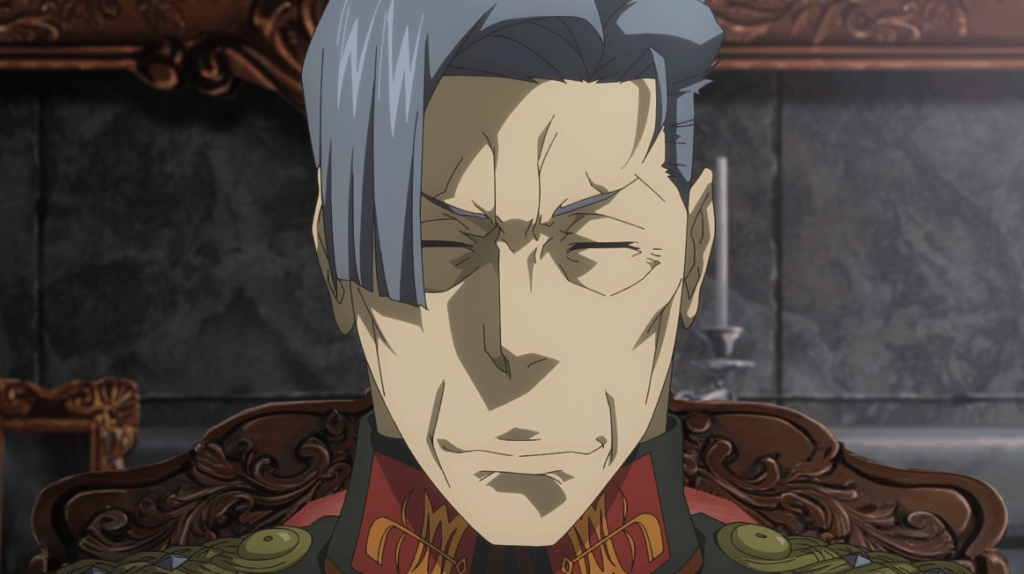
But for as great as the battle sequence was (especially in the design and flow for how the three-dimensional fight played out), the other aspects were just as important. Rudersdorf demonstrated that he understood his longtime friend Zettour all too well: they had come to an intractable impasse over the war, and he knew that Zettour might see no recourse but to eliminate him. In fact, he was even half-expecting it, and only the utterly coincidental appearance of the Allied and Federation forces convinced him otherwise. His remark that he felt more comfortable being targeted by the enemy than a friend was interesting, but completely in character; he always seemed to prefer to approach his problems head-on.
Zettour’s behavior in the end may seem a contradiction to the plan he stated to Tanya – about seeking an exit – but it actually isn’t if you consider one key statement he made to Rudersdorf last episode:
“We got them interested enough that they’re willing to give us conditions. Then, if we both lose another million, no, ten million lives, even the stupidest of them will be willing to talk.“
While that sounded like hyperbole at the time, Zettour seems to have decided that the only exit strategy which doesn’t result in the Empire’s destruction is to make continuing the war so catastrophically bloody that neither side is going to reject negotiating to end it, and he’s fully ready to take the fall to make that happen. (Something to that effect is likely what he told the Emperor.) That’s a pretty twisted strategy, and one that’s going to leave him painted as a villain for eternity if his true motives aren’t understood, but it’s not the nihilistic bent that we often see from villains, and that’s what makes it interesting.
Pair all of this with high artistic, technical, and musical merits and we have the series’ second season ending with one of its strongest entries. With this episode factored is, this series is my Best of Season pick and a strong candidate to make my Top 10 list for the year.

