The movie version of Machiko Kyo’s incredibly harsh source manga opens with a disclaimer that this is a fictionalized account, though it is based on true events. In the documentary which follows the movie (which is only a bit over an hour long) in its theatrical run, director Toko Ina mentions that the intent of the anime adaptation is to make it a more timeless story, and thus more accessible even to modern teenagers, by toning down period-specific elements. While the movie does, in a way, succeed at that, even a viewer who isn’t well-versed in history is going to recognize this as probably being set during World War 2. Those who are versed in the Battle of Okinawa during that war are going to recognize that this is clearly about the infamous Himeyuri students, a group of 240 female students and teachers essentially conscripted to work in field hospitals and munitions transportation in support of the Japanese defense of the island; they were left to fend for themselves when the defense effort turned dire, resulting in only 11 students and two teachers surviving the battle. Whether dodging the direct reference is a deliberate cop-out to avoid confronting this dark episode in Japanese history or merely a side effect of the director’s choice to focus on characters and themes instead is debatable.
The events in the movie closely mirror much of what happened with the Himeyuri students, but that’s the framing device rather than the focus of the story. That instead falls on San, a somewhat timid and very empathetic girl who, along with close friend Mayu and her classmates, finds herself building fortifications rather than studying. There are dangers to be watched for – they have to be constantly vigilant for air raids – but their lives are are initially still casual enough to even do things like celebrates birthdays. And while they’re not thrilled about helping with soldiers in a hospital, they’re not too concerned about it, either. Then they discover that the field hospital is in a cave, and not long after that the bomb drops – literally.
The incident which transitions the story from its more relaxed first third into its more intense second third is jarring in both dramatic and tonal shift senses, and that’s far from the last time the movie can make you shift uncomfortably in your seat. The extreme graphic content of the source manga (especially in portraying the injuries of the soldiers and the kinds of things the girls are assisting with in the field hospital) is dramatically softened, and that the girls may have been subjected to sexual assaults by their own soldiers is only vaguely implied. Toning both elements down so much is going to be controversial, as it is a disservice to the historical figures this story is based on, but it does at least support the director’s “accessibility” goal (for better or worse). Besides, intuiting what those scenes were meant to suggest isn’t hard; I wasn’t aware of the Himeyuri girls before seeing the movie and I still had little doubt about what two certain scenes meant even if they weren’t framed in a sexual fashion.
The most devastating part of the movie is its third act, however, where San, Mayu, and most of their classmates are released to fend for themselves. This is also where the movie’s most interesting visual choices land. When the girls come under fire (here it feels like they’re being specifically targeted, whereas in the actual history they were commonly caught in crossfires), we don’t even see the soldiers doing the shooting until near the very end. Ultimately, who the shooters are doesn’t matter because the girls are still getting gunned down, but whereas blood was shown earlier on, here the blood and viscera manifest in the form of flower petals (much like the fluff in SHIBOYUGI) because of a “spell” Mayu put on San to shield her from the worst of what was going on. This makes for a stunning visual impression which loses almost nothing for impact against seeing actual blood. And the circumstance under which San does start seeing actual blood again carries considerable weight because of what it means. Other incidents, like the group of girls seeking to blow themselves up with a grenade because they fear what the enemy troops might do (based on what their soldiers said), are also based on actual history.
But for all of the harshness even of this late content, the movie never loses track of the theme embodied in its title. San is fascinated by the life cycle of silkworms even as she’s horrified that the silk is gained by boiling the cocooned worms alive, and especially by how they can’t fly even though they have wings because the ability to fly has been bred out of them by humans. This becomes a metaphor for her progression throughout the movie. She is the silkworm, and if she’s going to survive then she’s going to have to burst out of her cocoon. The moment where that happens comes with little fanfare but still delivers a wallop, as like the silkworm, she’s completely different when she finally bursts out. It’s easily the movie’s most compelling character moment. The situation with Mayu’s real identity – which is more implied than fully revealed – isn’t handled as smoothly (viewers may have suspicions about it from early on) and isn’t as satisfying on its reveal, but it still carries some dramatic weight.
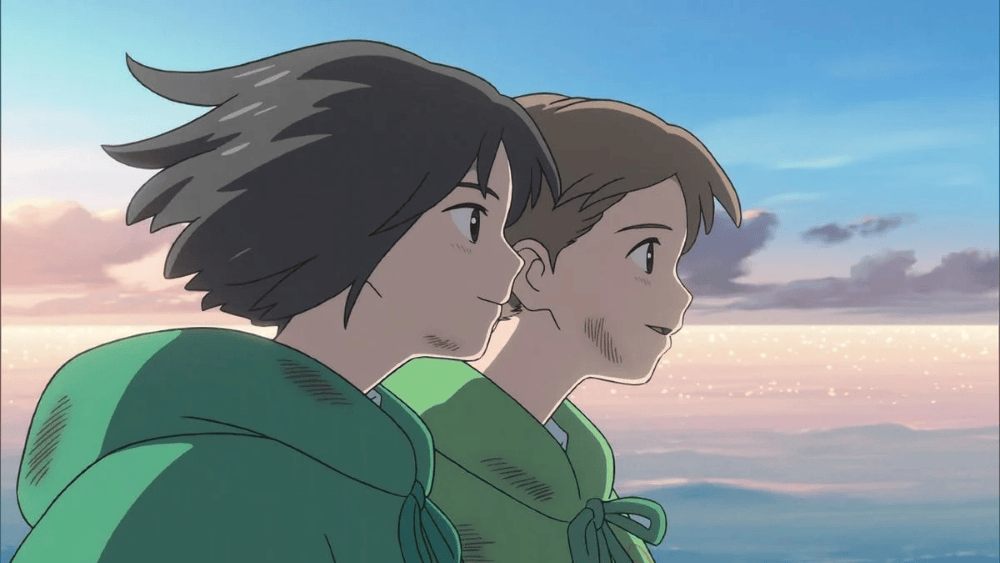
The visual effort is suffused with some clear Studio Ghibli influences, especially in the lovely way it depicts background art. The limitations of having originally been a made-for-TV movie show more in the characters, which are hampered by simpler designs and less-than-perfect consistency on modeling (though they are nowhere near as simple as in the original manga). The sense of movement provided by the animation is still much more evident than in a typical TV series, though, though, and the impression made by the aforementioned highlight visuals still lands. Kensuke Ushio (Chainsaw Man, DAN DA DAN, Journal with Witch) provides a musical score which may be the movie’s strongest production element, as the care and thought he put into why each scene needs to sound the way it does is evident even if you don’t watch the accompanying documentary footage (which focuses on him).
While the end of the movie suitably completes the theme (San may not have been able to fly away, but she did survive), I also felt it was a missed opportunity to make an even stronger statement; it’s my understanding that the manga version ended with San in a POW camp rather than in what looks like a post-war village, and keeping that would have made more impact because of the irony that she was treated better there than she was by her own countrymen. But, admittedly, that irony also would have distracted from the thematic focus.
Overall, you should not let the movie’s first third lull you, as it almost did with me; even in its toned down version, the movie isn’t at all a light view in the end. Even if it being a consequential look at a dark corner of history wasn’t its focus, the thematic emphasis doesn’t prevent it from accomplishing that.
Overall Rating: B+


One thought on “Review: cocoon – One Summer of Girlhood”