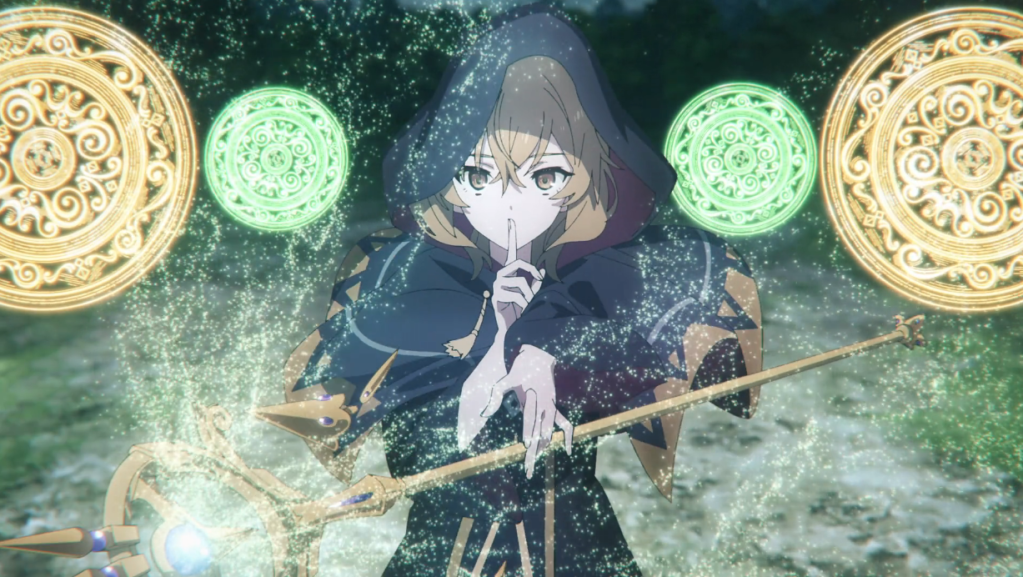
In the kingdom of Ridill, the seven preeminent mages are known as the Seven Sages. Each of the seven has a title reflective of their specialty: the Barrier Mage, The Star-Seer Witch, the Witch of Thorns, and so forth. Of them, the most extraordinary is also the youngest: Monica Everett, called the Silent Witch because of her unprecedented mastery of incantation-free spellcasting. Though capable enough in magic that even one of her peers refers to her as a “monster,” she’s actually an extremely anxious and timid girl whose development of silent casting was her solution to getting around having to chant in front of others. Because of her specialty and few knowing her face, she gets cajoled into becoming the secret bodyguard for Felix, the kingdom’s second prince, and that means attending the prestigious Serendia Academy boarding school to go undercover as a ordinary, low-ranking noble student. Despite her shyness, Monica is able to develop a few friends and confidants as she deals both with assorted threats and a prince who’s far less oblivious, and far more amused by her antics, than initially expected.
So goes the premise for this 13 episode (14 if recap episode 9.5 is included) adaptation of the first three light novels from author Matsuri Isora, which aired during the Summer 2025 season. Though hardly one of the season’s flashiest titles, it still ranked among the season’s best and most entertaining series and was a personal favorite despite some stiff competition. It accomplished this by taking a somewhat unusual approach for recent entries in the fantasy genre: rather than making Monica an up-and-coming talent or emphasizing how powerful she is, the writing made her supremely vulnerable, the kind of person who can get the job done when really needed but is a complete mess otherwise.
The angle of having a cripplingly socially awkward protagonist is hardly a new one in anime (see Bocchi the Rock, among others), but pulling that off requires walking a tightrope. The character must be sympathetic without seeming too pathetic and any humor involving that awkwardness has to be tempered so that it doesn’t seem mean. Thankfully, this is the realm where Secrets stands strongest. Laughs at Monica’s foibles are most commonly sympathetic ones, and she’s hardly the only source of humor; Ryn, the spirit familiar who serves as the maid and messenger for the Barrier Mage, is also a particular delight with her stone-faced sardonic wit, and other characters have their moments, too. The humor also excels at its timing; jokes never get in the way of the flow of other events and never run too long.
The story isn’t just light-hearted frivolity, though. While its crises rarely approach the potentially calamitous level of scenes involving the dragons in episode 1, the story does have serious threads about plots against the prince, embezzlement, mana run amok, potential friends who feel forced by circumstances to resort to drastic action, poisoning, and dealing with past emotional trauma. The social elements aren’t forgotten, either; one of the girls who ultimately befriends Monica in her school identity is dogged by other noble girls looking down on her for being nouveau riche, for instance, and social standing frequently plays into events in other ways, too.
The heart of the series is, of course, Monica, a slight, mousy (or perhaps squirrely, since she’s sometimes compared to one) girl who’s enormously timid about most things but can flip into analytical or even passionate modes when either of her twin loves of magic and mathematics are involved. Flashbacks reveal that emotional trauma involving family, a former school friend, and severe bullying helped make her this way, and moments where Monica seems a slave to those influences are heartbreaking. Contrarily, little moments throughout where friends and associates help coax a bit more confidence out of her prove eminently satisfying. Moments where she must overcome challenges with some combination of math and magic also convincingly show that she doesn’t deserve her Seven Sages standing just because of her silent spellcasting.
While Monica can carry the series on her own, she doesn’t have to, as she’s surrounded by a solid supporting cast. Nero, her talking cat familiar, provides the most direct emotional support with his reassuring paw pats, and the aforementioned Ryn is a delight as a comedy straight woman. (Things get especially amusing when Nero and Ryn team up in human forms later in the series.) Isabel, the daughter of a Count, has entirely too much fun playing up being a villainess as part of Monica’s cover story (and her maid/accomplice has clearly bought into her mistress’s efforts, too!), though Isabel also makes it quite clear that her unquestionable loyalty is to Monica for having saved both her personally and her realm in general from the dragons in episode 1. Each of the boys on the student council shows themselves to be at least a little more than the stereotypical pretty boys as they interact with Monica (though the other girl on the student council, Bridget, is given little to do beyond make occasional observations on other council members), and both Casey (a horse-loving friend with a big secret) and Claudia (a raven-haired beauty who stands as a blunt voice of reason but also has her quirks) make big contributions in the middle and later stages of the series. And we can’t forget Louis, the Barrier Mage, and his predilection to “bully the strong.”
Among the supporting cast, Prince Felix deserves special mention, as his presence and behavior elevates the series. He can smoothly transition between being kind, playful, and harshly judgmental all while maintaining a soft voice and gentle smile but he’s also quite sharp; he’s well aware of where he stands politically and how people perceive him and uses that to his advantage. Though he suspects Monica may not be what she appears, he seems to take an interest in her for other reasons. She amuses him, yes (one of the series’ funniest scenes is one where he feeds cookies to a nearly-passed-out Monica) and he certainly recognizes and appreciates her mathematical talents, but there are also hints that he sympathizes with her, too, and wants to help her the same way a senior once helped him. He also seems fascinated by how his normal charms don’t work on Monica. Many of the series’ best non-magic-use scenes involve the two directly interacting, even though romantic tension is more wishful thinking than intended.

The series’ charms aren’t just limited to the writing. Beyond the spectacular scene near the end of the first episode, dramatic visual displays of magic are limited and of a generally smaller scope than many other magic school series, yet they sacrifice little on the impression that they make; this isn’t at all a battle series, and those go in expecting the scene in episode 1 to be a staple may be disappointed. The artistic effort led by Studio Gokumi makes efficient use of the more eventful scenes it does have, though, and supports them well with sharp, detailed background art and distinctive character designs (especially Monica’s makeover in the last quarter) which vary just enough from common archetypes to not feel like retreads. It also handles its SD comedy moments effectively and occasionally gives Monica some great facial expressions. Musical support is strong as well, with the score expertly evoking whatever emotions the scene requires, whether it be dramatic, comedic, or sorrowful; this is one worthy of listening to as a separate OST. Opener “Feel” by hitsujibungaku (who also did the great closer for the second season of Osihi ni Ko) also perfectly matches the feel of the series both audibly and visually. Gentler and more wistful closer “mild days” by the same band also fits well but makes much less of a visual impression.
The series also has a complete English dub at this point. While it’s not flawless – there are a handful of places where slightly awkward pauses are used to assist in aligning with lip flaps – the casting choices and performances are generally solid, especially the little-used Harrison Xu as Prince Felix and Brenna Larsen as the maid/familiar Ryn. (She also voices Bridget.)
Nothing has been announced at this point about a second season, but there are still enough more novels for a couple more seasons and enough potential plot threads left open to provide a good lead-in to more, so I dearly hope additional animation is coming. The series seems to have been a solid performer based on Crunchyroll any MyAnimeList rankings, coming in near the top end of the middle tier (in the same vicinity as The Water Mage) so popularity sufficient to warrant more is there, and it’s certainly deserving on a qualitative level. With high merits on many fronts, it easily deserves to be considered among its season’s best titles.
Overall Rating: B+


I too found it to be a good watch. I did have criticisms as I found it to be a little too hasty with its resolutions, particularly if Monica went magical. As her magical solutions mostly ended up being the nuclear option and rapidly solved all issues. To the point where the betrayal story line actually having long reaching consequences to its resolution felt remarkably different to then stories norms.
Still it was charming, perhaps a tad over cooked in its misery stirring but also most important of all: It was fresh and enjoyable.
Thanks for the review.
LikeLike