
See here for part 1.
This half of the report covers the rest of the titles I’m following that didn’t make part 1. All of these titles have hit either episode 6 or (in most cases) episode 7 since part 1 was posted. Additionally, a look at one title which debuted too late to make the Preview Guide is included.
Apocalypse Hotel

Rating So Far: B+
This is easily one of the oddest and least predictable series to air so far this year, as in any given episode the robot-run hotel lingering a century or more after humanity left might deal with bloblike aliens, a family of space tanuki leaving piles of poop all over the place, a planetary destroyer who falls in love, or a mission to send an advertising satellite/protective weapon system into orbit. It’s a mix that might be more expected of a wacky sci fi comedy series, and indeed, there are distinct comedy elements to this one, but this is much more about using the robot and aliens to explore the human condition and political issues, with a healthy dose of background melancholy over the truth that the humans head robot Yachiyo expects to eventually come back might not exist anymore as the centuries pass. The series raises lots of practical questions, but dwelling on those is not the point here. It’s delightfully different and sports one of the season’s most memorable OPs.
Go! Go! Loser Ranger

Rating So Far: B
The trial against the snake-themed monster boss dragged on too long, hence the reason the grade for this one drops a bit from last season. This series still looks better than most, though, and features some fairly sharp writing in the way it shows D’s struggles to balance his goals with the fact that he’s actually coming to like some of the people he’s working with during his infiltration. Also good to see the original Hibiki pop up again and Red Keeper being as evil as ever.
Makina-san is a Love Bot!?
Rating So Far: C+
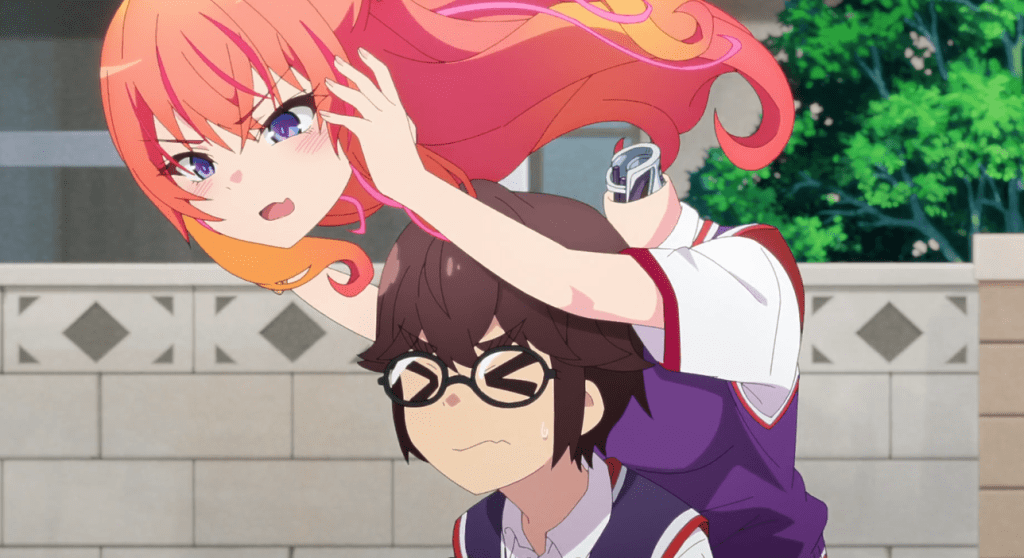
Both of this season’s leading fan service titles are similar in some ways: the female lead is voluptuous, very sexually aggressive, and non-human, while the male lead is smaller, more meek in most circumstances, and definitely overwhelmed by the female lead. They’re also both half-episode endeavors. What passes for a plot diverges greatly between the two, however. This one has much more of one, and it has become increasingly more prominent in the last couple of episodes as Makina’s sister unit comes into the picture. The series still doesn’t lack for fan service, but nothing here is really any racier than some titles HIDIVE has streamed in the last year or two, so I have to wonder why this one got relegated to new platform OceanVeil. Regardless, it’s a decent but unexceptional fan service fest, the kind unlikely to be remembered past this season unless its second half offers more.
Mobile Suit Gundam GQuuuuuuX

Rating So Far: B
Whatever else might be said about this series, it certainly doesn’t waste time on getting to major plot developments, with episode 7 having the kind of stunning, game-changing transition normally seen on a seasonal break point. The bigger plot points are getting increasingly harder to follow if one is not intimately familiar with the original Mobile Suit Gundam, as the series doesn’t do much to explain who some of the important names being thrown around are. However, the series makes up for that by using character dynamics for the central cast that anyone can appreciate, with a clear love triangle forming between Shuji, Nyaan, and Machu and all the drama that involves when all three are teen Newtypes participating in illegal mecha battles and being sought by different governments for various reasons. Battle scenes are still among the season’s most visually dynamic, though they can also sometimes be hard to follow. I have some issue with the series maintaining any pretense that its mecha are technological rather than magical, and think the series is softballing a bit on how people are getting killed in these Clan Battles, but it is certainly never boring.
Our Last Crusade p2

Rating: C
While the animation quality of the revamped episodes is a distinct improvement, this is still far from being one of the season’s better-looking titles. The updates made also didn’t improve the story quality one bit. There is still a firm plot in play as Elletear schemes to overthrow the queen while the Empire’s Saint Disciples, in a partially-related move, make their strike, and Iska and crew still have their hands full keeping Sisbell safe. However, the execution is all a mess; the infiltration seems too easy unless Elletear was pulling some strings that have yet to be revealed, and why certain other events happen the way they do don’t make much sense yet. The writing also seems to have forgotten that the Iska/Alice interactions lay at the series’ core, and their interactions are currently far too limited. If the writing doesn’t improve then this grade could sink further by the end of the season.
SHIROHIYO (debut)

Rating So Far: B
This one immediately stands out for one particular reason: protagonist Ageha is, to put it nicely, chubby. (He regularly refers to himself as a “white pig.”) Beyond that, it’s a fairly standard isekai in some respects: after a bad fever, a five year old noble’s son in a fantasy setting realizes that he has memories from a past life as an adult man in Japan. There are status screens, and he’s abnormally good at certain skills for his age. In his case, though, those skills involve cooking, cleaning, and craftwork, things that were pastimes for him in his previous life. As the first six episodes progress, he’s also discovered to be able to imbue the embroidery he does with enhancement magic, too. A goddess is involved, but he impresses her with his singing instead. He’s also got an elf tutor whom he eventually discovers is a famous adventurer and a younger half-brother he looks out for once they meet. Unfortunately him, his parents are shit, though not in the over-the-top way commonly seen in these series. They don’t get along to the point of detesting him because he’s the factor which irrevocably connects therm.
In other words, this one can get surprisingly heavily despite its light color scheme and general spirit, though it does have its more easygoing aspects, too. It’s got a better-than-average supporting cast (the elf tutor and goddess can both be quite the characters) and has taken a mostly-pure development aspect so far; Ageha has yet to make any move to learn fighting skills, instead focusing more on bettering his family’s domain so that the half-brother he expects to take over some day will have good, educated people around him. Looks pretty good, too. Overall, it isn’t doing anything extraordinary, but it was solid enough that I ended up watching all six available episodes despite only intending to watch the first two.
Summer Pockets

Rating: B-
If you’ve been around long enough in fandom to be familiar with the classic Key/Visual Art’s anime adaptation, it should suffice to say that this series is proving par for the course for such fare. For those who haven’t, there are plenty of cute girls with sometime-humorous and always-adorable quirks for the protagonist to interact with, including at least one who’s seriously ill even though she doesn’t look it. Toss in some baggage for the protagonist, a male friend who’s a comic foil, and a dash or two of mystical elements and you have the standard sentiment-dripping formula in action. The most interesting aspect so far is a suggestion that the problem of shifting between the original virtual novel’s different paths is going to be handled by some kind of time-looping mechanism, which effectively resets the story in episode 7 after finishing one girl’s arc in episode 6. Further, the story implies that one specific girl is the trigger for this, so seeing how that plays out adds a welcome extra dose of intrigue; perhaps she’ll prove, in a way, to be the series’ final boss? Overall, the series isn’t doing anything noteworthy so far, just executing adequately for its type.
Teogonia

Rating So Far: B-
This one is proving to be an isekai more on a technicality, as the fact that Kai originally came from another world (which he’s only hazily aware of) is only mildly relevant maybe three or four times in this block of six episodes. Even then, it really only meaningfully comes into play in terms of giving Kai new ideas for using the power of his Divine Crest. The series also makes more of an effort than most to establish distinct setting and cultural identities, down even to having alternate languages for its non-human humanoid races, and Kai is shaping up to be a worthy action hero. The action scenes, while not top-tier, aren’t bad, either, and the character design work in particular stands out. This is an easy series to overlook, but it’s worth checking out.
The Gorilla God’s Go-To Girl

Rating So Far: B
I’d really like to rate this one higher, since it is one of my two favorites among new titles this season, but the animation effort is just too weak to justify going higher than this. Despite that, it’s still the most fun that I’ve had with a reverse-harem series in quite some time, and the series not beating around the bush about hooking up Louis and Sophia (they’re all but officially a couple by the end of episode 7) is an extra-big plus. There’s also a developing plot involving some terrorists, but that’s secondary to how sweet and adorable the character dynamics are. It’s a title well worth a look even if the genre isn’t normally your thing.
The Mononoke Lectures of Chuzenji-sensei

Rating So Far: B
Really, why is this one not licensed by a U.S. streaming provider? It generally looks pretty good, is competently written, and fills an underserved niche that otaku are known to go for (i.e., pure mystery stories). While the name suggests a supernatural element, most of the cases the central duo get involved with concern providing supernatural explanations for mundane occurrences, in some cases exposing actual (generally nonviolent) crimes, such as a counterfeit ring in one episode. The relationship between student Kanna and know-it-all teacher Akihiko Chuzenji is a neat one, and the period details are a nice touch (though I would like to see that aspect emphasized more; despite being set in 1948, the series dodges around bringing up the war except in the context of certain adults being former soldiers). It also has one of the season’s better OPs, and a seemingly-smart cat has been added to the regular cast with the most recent episode. Unfortunately, you’ll have to do some hunting to track this one down, but it’s worth the effort if you can.
Witch Watch
Rating So Far: B+
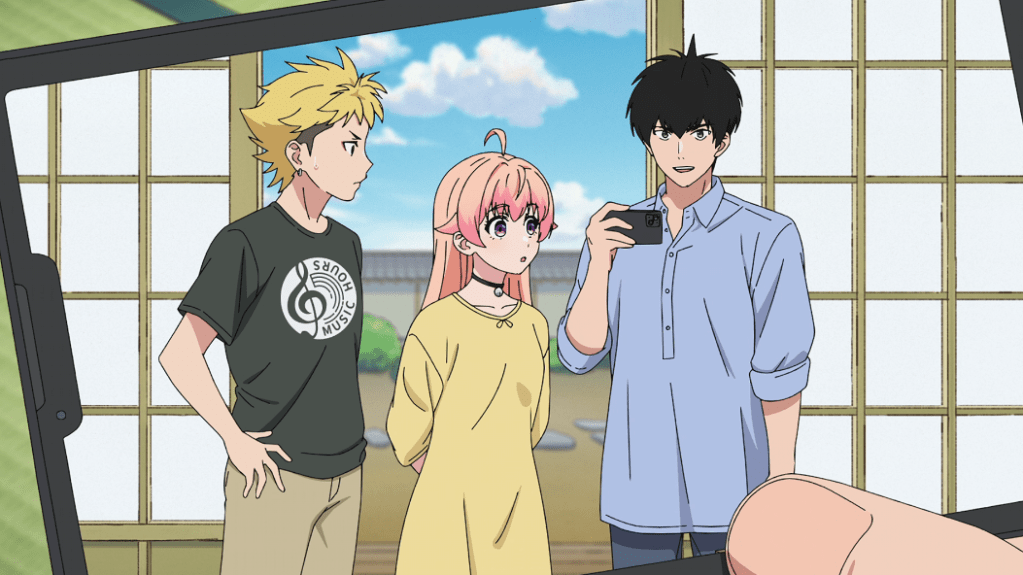
This is a generally-funny series which spikes to being extremely funny at least a couple of times each episode. While the pairing of serious-minded ogre Morihito and ditzy witch Nico carries the show, it still benefits greatly from the addition of Kanshi, Nico’s tengu familiar, who becomes her regular partner in hare-brained ideas as well as being the third vertex of a developing love triangle. Nemu, a fellow witch who can turn into a cat, has also been introduced and seems promising, too, but has only appeared in one episode so far. A couple of mentions of concerning prophecies involving Nico have been brought up, so the series isn’t entirely fun and games, but antics mostly (but not always!) involving Nico’s eccentric magic use are the series’ staples, and those work quite well. Also has the season’s premier OP, courtesy of yet another catchy number by YOASOBI.
Yandere Dark Elf

Rating So Far: C-
This one would merit a grade at least a notch or two higher if HIDIVE had the uncensored version, but sadly that’s not the case. (As you can see here, even male nipples are being censored.) That aside, Hinata is firmly in a love triangle with Mariabell and classmate Sakura by this point, and his other two former female adventuring companions have come to Earth as his next-door neighbors to keep an eye on Mariabell. Typical antics continue, with an emphasis on providing nudity multiple times per episode, though the series aims at least a little higher with one episode where Sakura is babysitting a baby cousin. The series is also noteworthy for a clear Gushing Over Magical Girls call-out if you watch carefully.
That’s all for this time around! And now back to your regularly scheduled programming. . .
 USA Anime
I might be a bit jaded these days but I feel like Gundamium alloy and the super power and neural links it creates that only can be piloted by newtypes has always been magical. To the point that certain series are known for being the realistic ones when the good guys can actually take damage (outside of the special gundam vs gundam duels).
Its always had a sense of incorporating super sentai style giant robot magic, just with a sci-fi explanation for it.
I have been glad that the two Shoujo’s that started with somewhat overdone premises have each managed to find their feet mid season to do their own thing. Mia and her revenge / perseverance in the face of terrible people has been quite engaging in contrast with Philia’s normal Japanese overworking complex and under valued self esteem. And Gorilla Gods Girl’s romance has managed to cross boundaries into real romance over its basic harem setup. Elevating themselves over their early season average to over done tropes.
I wonder if Watanabe’s works have reached a point where they do not resonate with modern audiences, similar to how Jun Maeda’s works continued with their themes but didnt catch on after Little Busters.
LikeLike
I picked up SHIROHIYO based on your review. It has a similar vibe to Ascendance of a Bookworm. Thanks for pointing that one out.
LikeLike
Ascendance of a Bookworm is also the series I kept thinking of as I watched this one. The vibe is somewhat similar even if it’s a wholly different situation.
LikeLike