With its 28th episode, Frieren: Beyond Journey’s End ends its initial run. By any reasonable metric, it has been a huge hit on both sides of the Pacific, to the degree that it not eventually getting further animation is inconceivable. (My guess is that we’ll see more late next year.)
I could write a full review to add to the masses singing the series’s praises, but given the tenor of the series, a different angle might be more interesting. One of the recurring themes of the series was the learning of valuable lessons, especially that even someone more than 1,000 years old still has as much to learn as she does to teach. So let’s look at eight lessons we can take away from the series.
Note: The following assumes that you have watched all of the anime series or are at least familiar with its equivalent source manga. There will be spoilers for those who haven’t!
Lesson 1: Heroes Can Be Self-Made

Of all the many flashbacks to Himmel in the series, the one that may have had the deepest impact on me was the one in episode 12, where Frieren recalled how Himmel failed to pull the Hero’s Sword from the stone in the Village of the Sword. That meant that Himmel was not predestined to be the Hero; he didn’t have a divine prophecy backing him, wasn’t plucked from another world by a goddess to fill that role, didn’t seem to have special powers or equipment, didn’t come from an OP village, and didn’t have Hero as a title from video game-like stats. But he, a boy from an ordinary village, went on to become a legitimate Hero anyway, not being deterred for a minute by the sword incident. He had the will to make it happen and the determination to see it through, and in so doing became arguably one of the greatest of all anime fantasy heroes. Too bad he fell hard for the girl who wouldn’t figure out how much he meant to her until after his death.
Lesson 2: Little “Good Deeds” Are As Important As Big Ones

While this is most directly addressed in the final episode, all throughout the series we are told about numerous small things that Himmel did (or led his party in doing) which served as complements to his great deeds. He wasn’t above simple, seemingly insignificant kindnesses like helping to carry items or protect a traveler because he believed in helping where he could, no matter how trivial that help may be. While this can be looked at as Himmel just being an inherently good person, such acts do serve a purpose. They are direct, tangible actions that make a common person’s life better (or at least easier), and people remember that. When those memories are passed on to following generations, they can inspire others just as assuredly as the grand deeds do.
Lesson 3: Vanity Can Serve A Purpose

One of Himmel’s few genuine faults was that he was very conscious of his image, to the point of one time spending hours just determining the right pose for a statue to be made of him. However, Himmel was a lot more subtle and clever than Frieren ever gave him credit for. Himmel understood how important it was to leave behind inspiration for those who would follow (as would, much later, prove to be the case with Wirbel in particular). More personally, he also wanted to make sure that one certain person would never forget him, no matter how many years might pass or where her journeys might take her. Himmel passed it off as a joke when he said that he was having all the statues made so Frieren wouldn’t be lonely after he was gone, but many later scenes suggest that it wasn’t a joke at all.
Lesson 4: There’s No Age Limit on Being Childish
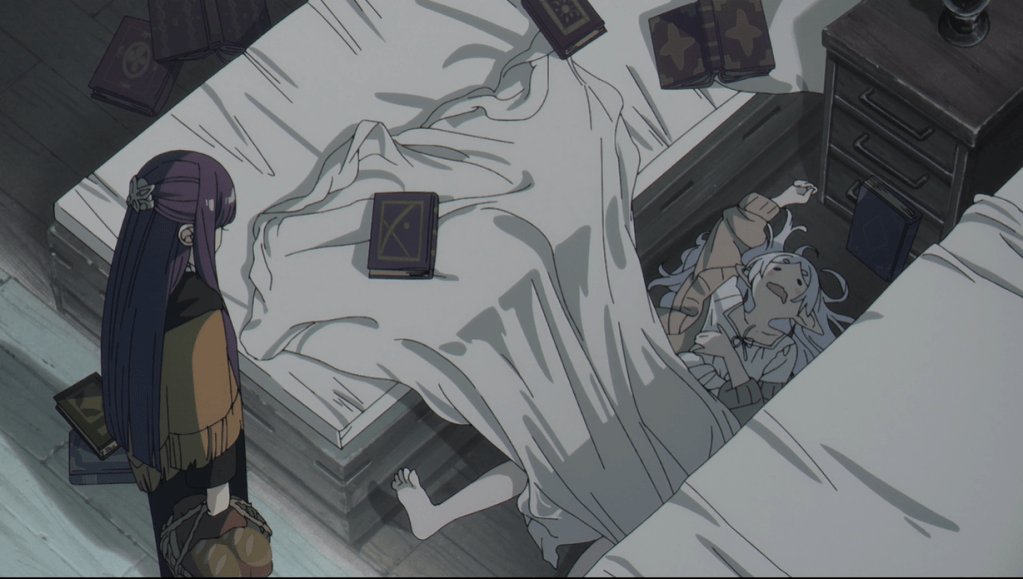
One recurring joke throughout the series is that, despite the immense age difference between Fern and Frieren, Fern sometimes comes off as the adult in their relationship. She’s certainly the more mature and responsible one when it comes to everyday activities or even something as simple as how one sleeps. Watching Frieren lie in bed, kicking her feet as she reads a book, in episode 12 also seemed very incongruous with her supposed maturity level. Serie, who’s even older, shows that she can be childishly petty in the late episodes, too. (This makes for an amusing contrast to Fern’s immature pouting at times or the constant squabbles between Lawine and Kanne which result in physical tussling.) Frieren also shows on a few occasions that she’s not above patting even full-grown adults on the head as if they were children.
Lesson 5: Magic Is What You Make of It

Although this comes through most strongly during the First-Class Mage Test, a recurring world-building aspect is that there’s no one right way to use magic (despite what Serie seems to think). It absolutely has its valid combat and defensive applications, but it also has plenty of peaceful applications, too, such as cleaning clothes, warming tea, waking someone up, or making a field of flowers. And as useless as some of those applications might seem in the big picture, they can play key roles in changing the world in unexpected ways.
Lesson 6: Questing to Save The World Doesn’t Mean You Can’t Have Fun Along The Way

Though Himmel was passionate about becoming a Hero and defeating the Demon King, he also seemed to recognize that taking things too seriously – prioritizing efficiency too much – could also be detrimental. (Either that or he was just a very whimsical soul.) Sure, there was the the running joke about Heiter’s drinking (which, ironically, only got funnier as the series progressed), but this aspect showed more clearly in early incidents like the Hero’s Party members frolicking in the field of flowers in episode 2 or playing with orphans at an orphanage in episode 11. Later in the series, it also comes up in Himmel’s dedication to enjoying the process of clearing dungeons. Frieren’s fascination with magical junk could also be considered an aspect of this.
Lesson 7: Being Remembered (and Being Able to Remember) is Important
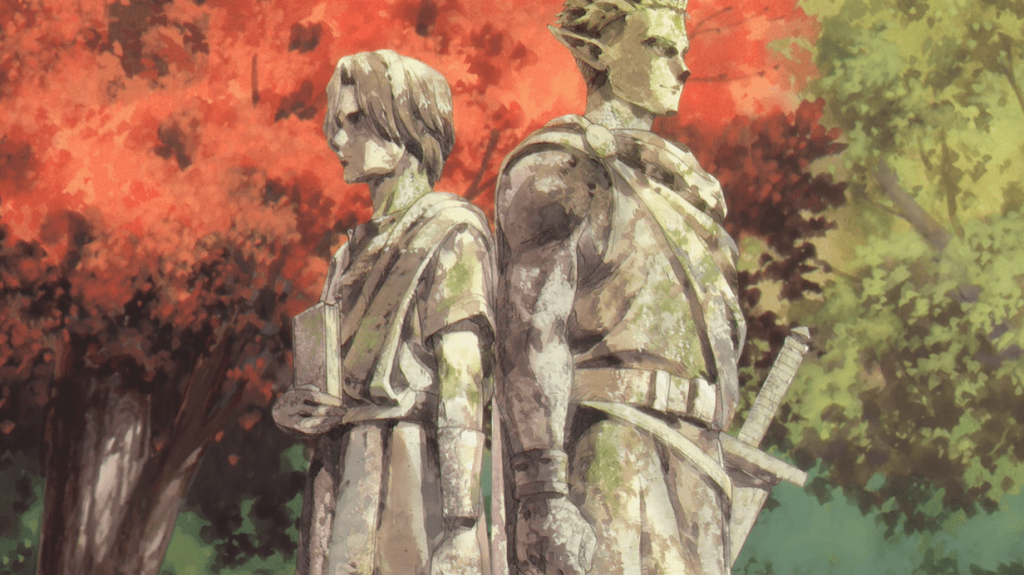
Of all the recurring themes in Frieren, none are more pervasive than the importance of remembering and being remembered. As early as episode 1, Himmel entrusts Frieren with remembering the Hero’s Party and what it accomplished because she was going to outlive everyone. Himmel had all of the statues made at least in part to make sure Frieren didn’t forget him. Frieren’s entire journey is about exploring her memories of her time with Himmel and crew, and on many, many occasions throughout the series we are exposed to people who have been influenced by their memories of what the heroes did. On the flip side, Voll is guided by his memory of his wife but troubled that he can’t remember her clearly. Serie also reveals in the final episode how she’s never forgotten about those she’s trained, even though, like Flamme, they didn’t succeed to the degree that she wanted. And Kraft sought religion because his great deeds have been forgotten; even when physical evidence remains, people don’t know what it means, but surely the Goddess will, right? The second closer is all about remembrance, too.
Lesson 8: Beware of Mimics!

That 1% chance it’s not a mimic isn’t worth it.
That’s it for now. Look for the Winter ’24 Wrap-Up coming in a few days.
 USA Anime
Loved, Lesson 8, it was a nice running gag and worked into your Lesson 4 and Frieren’s character in general. To the degree that it made me overlook that mimics and other clear video game/RPG structures usually pull me out of any fantasy series (to me Record of Lodoss War is the gold standard, it is literally a D&D campaign, but manages to look and feel like classic fantasy).
LikeLike