Last Updated: Thursday 10/12 10:05 p.m. EDT
Welcome to my seasonal Guide! (For the debut schedule, see here.) I expect to cover every full-episode series that will be debuting this season and several of the sequels/returning series, including The Saint’s Magic Power is Omnipotent, The Eminence in Shadow, The Ancient Magus’ Bride, The Rising of the Shield Hero, Arknights: Perish in the Frost, Goblin Slayer, The Faraway Paladin, Spy x Family, and Dead Mount Death Play. I will not be covering sequels for Kizuna no Allele, Uma Musume Pretty Derby, Rail Romanesque, Girlfriend, Girlfriend, HYPNOSISMIC, or Dr. Stone. Jury’s out on whether or not I’ll preview this season’s Precure and Seven Deadly Sins installments; I will if they seem to be stand-alones.
Note: With the debut of Good Night World and the belated posting of PreCure 23, this season’s Preview Guide is now complete. The Apothecary Diaries will go directly to episode reviews when it debuts on 10/21 (The review may not be posted until the 22nd since I’ll be traveling that day) and Pluto will likely get a special review either when it debuts or when it finishes.

Power of Hope: Precure Full Bloom
Streams: Crunchyroll on Saturdays
Rating: 3.5 (of 5)
I wasn’t going to do this one, since it is a follow-up to PreCure 5 and its related titles, and I haven’t seen any of those. However, commentary suggesting that you don’t really need to know the predecessor to be able to make sense of this one, coupled with a concept that always intrigues me – i.e., what are the heroes doing 10 years later, after all of the heroics are done? – encouraged me to go back and give this one a chance.
While the first episode wasn’t earth-shaking, I wasn’t disappointed. It takes a team of magical girls and forwards the clock roughly a decade, so they’re now all adults pursuing their respective careers. That they are facing adult problems now – ones that can’t be fixed by just turning into a magical girl (even if they still could!) – seems to be the theme of the episode, if not the series as a whole. There’s only so far that dreams and hard work can carry you when faced with things like global warming or a divorce and failing business by her father forcing a girl to change schools. That’s not so say that there isn’t any magical component here; apathy about pollution and the environment is shown to be a key in breeding a new batch of monsters, which will no doubt soon prove to be a menace, and the whole team assembling by chance despite having scattered (only a couple seems to have kept in touch with each other) does seem a bit too much of a coincidence, given their backgrounds. Still, they have at least a chance to commiserate as adults before the crisis arises.
Not at all clear where this is going next; are they going to regain the transformation devices which disappeared on them and becoming PreCures again? If so, will they look like adults or age regress back to their original transformed forms? The series is being coy about this so far, but either option is an interesting one. This franchise 20th anniversary title could well end up being one of the franchise’s most novel entries, and that could warrant another look.
Good Night World
Streams: Netflix on Thursdays
Rating: 3/5 (of 5)
Note: Although Netflix apparently dropped the whole series today, I am only covering the first episode.
In the virtual game PLANET, the quartet forms the Akabane family, the most powerful group of players in the game. In real life, however, they are the ultimate in dysfunctional families. However, because the members of the Akabane family strictly don’t talk about who they are in the real world, none of them seem to be aware that they are a family there, too, as each is in their own world there: separated or divorced parents who don’t live together, a hikkikimori elder son, and an honor student younger son who seems to want to keep communication running within the family but is unable to get anyone else to cooperate.
That’s the central gimmick of this adaptation of a completed manga series from the mid-2010s. The first episode establishes the stark contrast between the happy in-game life for the Akabane family and the miserable real life of the four members of the Arima family. Even the artistry emphasizes this contrast: the virtual world is a mostly-bright and energetic place, while the real-world house is dark, gloomy and somewhat trashy. A couple of other in-game antagonist groups also get introduced, as does a long-term game quest and an upcoming conflict, but the real story is probably going to be about how the real and virtual worlds gradually converge for the central family and how they deal with it. That has a lot of juicy potential, hence my mildly positive score, and in a lighter season this would be a sure-thing follow. Looking like a pass for me.

Dead Mount Death Play s2 (ep 13)
Streams: Crunchyroll on Mondays
Rating: 3 (of 5)
The first season of this reverse-isekai franchise was one of the more fun entries in the Spring ’23 season, so its return is welcome. The problem is that the first season (or first half, depending on how you look at it) left so many wide-open story threads that merely wrangling all of them takes up much of this episode’s content. The only new addition is an enterprising reporter who’s ostensibly out to interview the new fortune teller Corpse God but is actually seeking to make connections to bigger cases and mysteries, much like the police are.
That doesn’t mean that nothing’s going on. The masked snipers from episode 10 are back and now in Clarissa’s employ, which is good since it looked at the end of the episode like she just lost one of her servants to another extra-tall assassin. Everyone that’s not in Polka’s group is investigating the hands that Polka manifested in episode 12 and trying to figure out what they mean, while Xaioyu is seeking clarity from his boss and the rest of Polka’s group is trying to stay out of trouble and/or get a better line on the Bastard Children of Sabaramond mentioned in episodes 11 and 12. Basically, there’s a whole lot of extension and follow-up on the developments of the last 3-4 episodes of last season, all of which is apparent set-up for the main plot thrusts of this season. So probably by next episode we’ll be back into the depths of the antics and scheming that this series is know for. Patience is a virtue here.
Kawagoe Boys Sing
Streams: Crunchyroll on Mondays
Rating: 2.5 (of 5)
A “genius conductor” is out of a job because of his attitude and how little he listens to others, so to get a recommendation to get back into conducting, he’s assigned to form a champion boys’ choir out of nothing at the school his grandmother runs. The first trio he rather forcefully recruits is Tenshi, who loves to sing but cannot do it in front of other people, and his two friends, but others clearly take notice after the trio is cajoled into doing a test performance in the school’s gym.
In other words, this is a fairly standard “difficult/oddball teacher uses unorthodox methods to get the most out of his students” scenario, though it seems to be aimed more at developing the equivalent of a show choir rather than an idol group. Conductor Haruo is more annoying than likable as the eccentric teacher, but otherwise he only two oddities here are the principal having a civet for a pet and a shower scene that, if the genders were flipped, would probably be highly objectionable. Between being pretty bland overall and a weak artistic effort, the only thing to recommend here is some pretty good Engrish singing early on.

Stardust Telepath
Streams: Crunchyroll on Mondays
Rating: 3.5 (of 5)
In this manga adaptation, Umika is a girl just entering high school who is so limited by her crippling social anxiety that she feels her words don’t reach other humans, so she dreams of befriending aliens instead. To her shock, she gets her chance when latecomer Yu steps into the picture, boldly declares that she is an alien, and quickly takes an interest in Umika. Yu claims she has an ability she calls “foreheadpathy” (i.e., she can read the feelings of others by touching foreheads with them), and that and Yu’s cheery acceptance of Umika helps Umika to finally start to communicate.
This is a sweet little series which could easily be interpreted as having yuri undertones, though I don’t get the impression that is the primary intent. It’s much more of a “finding someone I can connect with” kind of story, one with a distinct mystery element: is Yu really an alien, or just a human girl who has, perhaps, created her own alien fantasy to cope with her own problems? That is very carefully left ambiguous at the end of the episode, as all of Yu’s odd circumstances (living in an abandoned lighthouse, not remembering her alien life before appearing in her current form) could be explained in conventional terms; even her “foreheadpathy” could just be advanced intuition. Regardless, seeing Umika start to bond with Yu promotes all kind of warm fuzzies, which the soft artistry and background music capably support. The OP and ED indicate that this will eventually be a quartet, but it’s starting from a solid foundation with this duo.
The 100 Girlfriends Who Really, Really, Really, Really, REALLY Love You
Streams: Crunchyroll on Sundays
Rating: 2.5 (of 5)
This was actually one of the most-anticipated new series of the season, especially by those familiar with the manga. After seeing the first episode, I don’t understand why. There’s absolutely nothing special about its visual quality, it’s far from the funniest things I’ve seen this season (in fact, I think I only got a chuckle or two out of it), it leans very heavily on hoary harem tropes, and its unique spin on the harem concept is just another convenient mechanism to artificially justify the existence of a harem, especially one where the protagonist has done little to earn it. In fact, only one scene stood out as particularly sincere and meritorious. If this is supposed to be something special, its appeal is beyond me.
In this case, Rentaro is a hopeless romantic who’s been striking out with the ladies since he was an infant – 100 times by the end of middle school, in fact. During a shrine visit to pray for luck in love, the shrine god – a God of Love – appears and tells him that he will find love – 100 times in fact, since he has 100 soul mates due to a silly clerical error. The problem is that there are bad consequences for soul mates not hooking up, and he meets two right away on the first day of school: the buxom peach-themed Hakari and the tsundere orange-themed Karane. The only solution he can come up with is to date them both, which they agree to since a three-way is better than no Rentaro at all. But there are many more (including three who get brief cameos) waiting in the wings. . .
So what does the series do with this that hasn’t been done by numerous other harem series before Essentially, nothing. There are few fourth-wall-breaking attempts at humor early on, and maybe that could turn into a running joke if maintained, but the whole things just seems like a ball of energy that’s not going anywhere. It’s not actually bad by genre standards, but it has yet to show anything special.

Butareba – The Story of a Man Turned Into A Pig
Streams: Crunchyroll on Saturdays
Rating: 3 (of 5)
I have more mixed feelings about this light novel adaptation than probably any other series which has debuted so far this season, so I had an especially difficult time settling on a grade for this one. The premise is pretty simple: this is an isekai reincarnation tale where a hopeless otaku had been reborn as a pig in a fantasy world and meets a pretty girl who can actually talk to him (and recognize that he has a human rather than swine mind) because she’s telepathic. That premise isn’t actually as crazy as it sounds, because narratives involving men being turned into pigs go back at least as far as ancient Greece (see the sorceress Circe), and apparently, things like that happened at one point in this setting, too. There’s also the added irony that a person who was pretty much a pig inwardly in his former life is now one outwardly, too.
Both the most interesting, and most potentially problematic, component of the series is the human in this human/animal relationship. Jess, who’s a member of a clan (or perhaps subspecies?) which is capable of telepathy, is a blatant otaku ideal. She pampers him to a degree, is willing to do things he asks (or even just thinks about), and doesn’t even take offense when some of Pig’s thoughts stray into the crude realm, even after he knows she can hear them. That can very easily be taken as pandering, even to the point that Pig recognizes it himself. Why Jess is this way is the potentially interesting point, though. She had dreams of being rescued by a prince (but from what?), but she seems unconvinced of her own attractiveness or worth and seems to regard Pig as being refreshingly honest even when he’s just stream-of-consciousness babbling. She gives the impression of not having much for positive interactions with other people, so perhaps she sees Pig as a safe alternative? There’s also the matter of the collar she wears and an apparent state of servitude. The visual detail work on Jess is also impressive, especially compared to the plain-looking Pig. (And doubtless that’s intentional.)
I’m just enough interested in the possible bigger picture here that I may give this one another episode or two to prove itself. Some people in real life do find their pets to be better companions than other humans, so it’s not a big leap to extend that to a clearly-sentient pig, too.
Protocol: Rain
Streams: Crunchyroll on Saturdays
Rating: 2 (of 5)
In this original anime project, Shun was an ace FPS gamer until something happened three years ago which caused enough trauma to get him to stop gaming. The exact event isn’t detailed here, but there’s a dead father and a younger sister who’s apparently paraplegic now (but wasn’t always so) in the picture, so maybe one or both of those is involved? Even so, he came to work for an esports café owned by the family of a friend, and the café getting in financial trouble – and thus the owner (his friend’s father) looking to an esports team to bail them out – may be what forces him back in.
There is definite room for a good dramatic story here, and a quality OP certainly seems to suggest that, but man, the series is going to need more than it’s currently offering to keep an audience. There’s absolutely nothing all that dramatic about the game in question, Shun isn’t particularly compelling or even interesting as a protagonist, and the production values aside from the game don’t impress, either. Part of the problem could just be that I don’t get the appeal of esports at all – the only time I’ve ever watched playthroughs is when I’m stuck on how to beat a particular part of a game – but I’ve seen complaints from others on these points, too. While I’m mildly interested in the circumstances which caused Shun’s absence from the game and how “Explosion-kun” (who seems to be an actress/model IRL) fits into this, it’s not enough to keep me watching.

I Shall Survive Using Potions!
Streams: Crunchyroll on Saturdays
Rating: 3.5 (of 5)
In modern Japan, Kaoru is an office worker who getting accidentally killed when a god’s effort to correct a spatial distortion has an unfortunate side effect. As compensation for accepting reincarnation in a medieval-level world, she is granted an ability of her choice: to be able to manifest potions of all types at will, including appropriate containers. (She also gets an Item Box and the ability to read, write, and speak all languages – which she soon learns includes animal languages, too.) She has decided that this is the best way to stay healthy and have an easy way to make a living. What she soon discovers, though, is that while magic and monsters do exist in this world, magical potions are a far more special commodity than she anticipated, and that can be just as problematic as it is helpful.
Based on the cutesy look of this one and the silly behavior of the god and goddess who appear early on, I was not expecting much from this one. By the end of the episode, though, Kaoru had won me over. She is quite the enterprising lady, one who jumps into action with cleverness and takes control of situation, whether it be normal humans, a Baron, or even gods; she even had such a reputation for this that when she appears in her family’s dreams to explain what happened (a great little scene, BTW), they fully expect her to be successful in the new world. She even makes some of the most innovative use I’ve seen for an Item Box, too. Despite essentially being an isekai with an OP protagonist, this one shows enough measured energy and charm that it could prove to be a fun little view.

A Returner’s Magic Should Be Special
Streams: Crunchyroll on Saturdays
Rating: 3 (of 5)
This one has a slightly unusual origin, in that it’s based on a Korean novel that was originally animated as a Korean webtoon in 2018. However, it still stands as the second series debuting on Saturday 10/7 which sees the protagonist traveling back in time to get a second chance after a Bad Ending. Unlike with Tearmoon Empire, there is no concern about tonal dissonance this time around; it remains an almost entirely serious tale throughout. But it’s also nowhere near as pretty.
The story focuses on Desir Herrman, a commoner who plays a crucial role in the final Shadow World fight against the tyrant dragon Boromir Napolitan by locking down the dragon’s magic so the rest of the surviving six heroes can defeat him. Even getting to that point came at great cost, and even the heroes can’t survive the dragon’s ultimate self-destruct after being defeated. But Desir finds himself back 13 years earlier, at the point where he first joined Herbion Academy. That gives him a chance to find away to avoid the future fate, especially concerning the death of a girl he apparently loved, all while dealing with generic classism and mediocre artistic merits, especially in the CG animation of Boromir.
Except for the aforementioned CG, nothing this episode does is bad, but nothing stands out, either. I could easily see it getting lost and forgotten among the swarm of anime fantasy titles this season.

Tearmoon Empire
Streams: Crunchyroll on Saturdays
Rating: 2.5 (of 5)
I have heard that the source novels for this adaptation are a fun read where the humor is mostly based on the absurdity of the disconnect between what Princess Mia is thinking (and especially her selfish motivations) and how people interpret her actions. Perhaps that aspect will develop more as the series goes on, but the first episode shows very little of it. Instead, we get one of the most tonally dissonant anime debuts that I’ve seen in quite some time. At some times this is a dark story clearly inspired by Marie Antoinette and the French Revolution, with protagonist Mia being the downfallen princess whose life ends at the guillotine three years after a popular revolt resulted in her being imprisoned. However, when it time-jumps eight years earlier to Mia at age 12, it turns into a cutesy, more high-spirited affair. While Mia’s experiences from the revolution have clearly affected her (once she accepts that they weren’t just a nightmare), the gravitas of that acceptance isn’t fully there, making the flashbacks (flashforwards?) feel sharply at odds with her actions as a 12-year-old.
There’s an equally sharp contrast in the visuals between the dank imagery of the prison and the gorgeous backgrounds of the palace after the time-jump (and this really is some of the prettiest background art design we’ve seen in recent years), but that is doubtlessly more intentional. The main problem with this one, though, is that Mia just isn’t a very likable character. She clearly hasn’t fully learned or taken to heart the lessons she should have from the circumstances that led to her former death, and at least so far, that’s making her minor efforts to change things feel unsatisfying. There might be a good story here long-term, but it’s not showing so far.
Spy x Family s3
Streams: Crunchyroll on Saturdays
Rating: 3.5 (of 5)
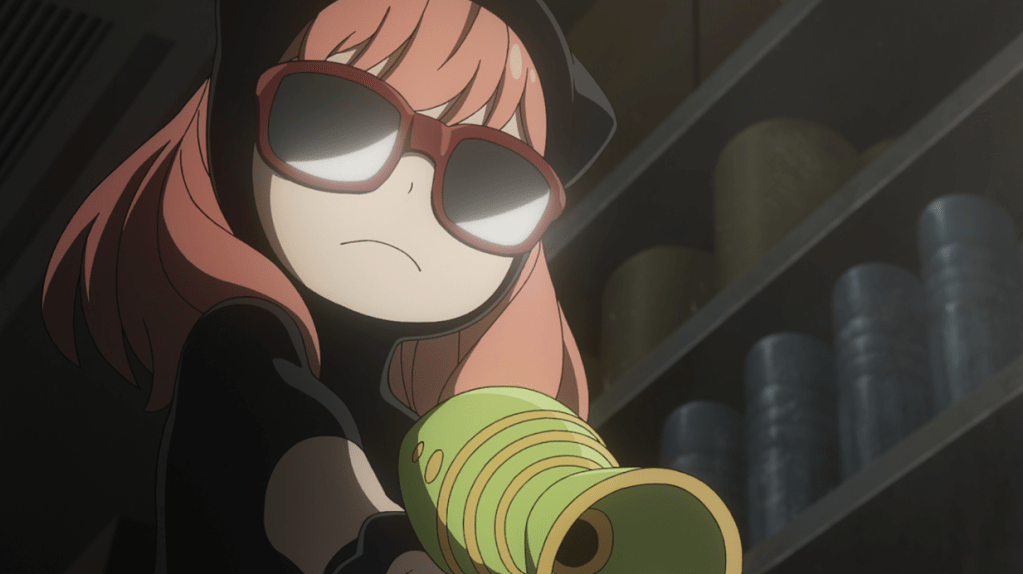
The Forger family is back for another round of spy-themed intrigue and fun! This time around, Loid has invited Yor out on a date in hopes of improving her inexplicably foul mood (all for the sake of the bigger mission, of course). However, he’s unaware that Yor’s mood is actually her being in pain from a butt injury she suffered during an assassination job, and while she’s eager to experience the date, that complicates things. Naturally, Anya has to tail them and even thwart the guy who got away from Yor the night before from taking revenge, in the latter case without her parents knowing.
Anyone who’s watched and enjoyed the first two seasons of the series will probably enjoy this episode, too, though it’s definitely not one of the series’ best. Still, seeing Anya go into her interpretation of Secret Agent Mode (and, more importantly, the bad guy actually buying her as a minion of the Thorn Princess) was rather amusing, as was the nature of Yor’s eventual painkiller. Yor also got some great expression this episode, and the technical effort is still solid.

My New Boss is Goofy
Streams: Crunchyroll on Saturdays
Rating: 2.5 (of 5)
Kentaro Momose had such a rough time with his abusive previous boss that he was driven to ulcers, so he has serious anxiety about his new one at the new ad agency he hires on with. Fortunately for him, new boss Shirosake is not only a much kinder and more helpful supervisor but also almost comically incompetent at anything not involving his job, which helps put Momose at ease. And nope, there’s absolutely nothing for BL vibes in this scenario. . .
This manga adaptation has a number of sweet and lightly comical moments in it, with the latter mostly focusing on all of the silly minor things that boss Shirosake gets tripped up by, such as accidentally spinning 360° in his chair when he only intends to do a 180 or accidentally poking his finger with his pen. However, the mediocre artistic effort and especially the unattractiveness of the squarish, shojo-styled character designs overwhelmed any other possible merits this show might have had. I can see some audiences being entertained by this series, but I’m not part of that audience.

The Vexations of a Shut-In Vampire Princess
Streams: HIDIVE on Saturdays
Rating: 3 (of 5)
So nice to see Taiga from Toradora back in action! Oh, wait. . .
Seriously, though, this light novel adaptation features Terakomari Gandesblood, scion of a prestigious noble vampire clan, who’s literally as weak as they come when it comes to vampires. That’s a real problem in an empire where personal power means everything and has contributed to her being a shut-in for years. She gets dragged out of her isolation when her father misinterpreting something she said leads to the empress appointing her as one of the Seven Crimson Lords, who are supposed to be the empire’s elite. Continue to succeed in battle and she’ll be a candidate to become Empress herself; continue to fail she’ll be executed. (Though how truthful that statement actually is remains to be seen.) Only a new maid knows the truth of the matter, so Terakomari has to put on the act of being the bold military commander she always dreamed about.
This is presented mostly as a comedy, complete with a couple of bits of fan service, though the closing scenes also suggest past bullying. The setting also has one interesting world-building element: no one permanently dies in wars fought in a neutral war zone due to some funky magic, so battles can be endlessly-fought without long-term attrition. How this reality might affect things and a few genuinely funny moments, combined with decent artistry and technical merits, make this a passable start overall, but I’d have to see it do a bit more to seriously consider it for my weekly viewing list.
The Faraway Paladin: The Lord of Rust Mountain
Streams: Crunchyroll on Saturdays
Rating: 4 (of 5)
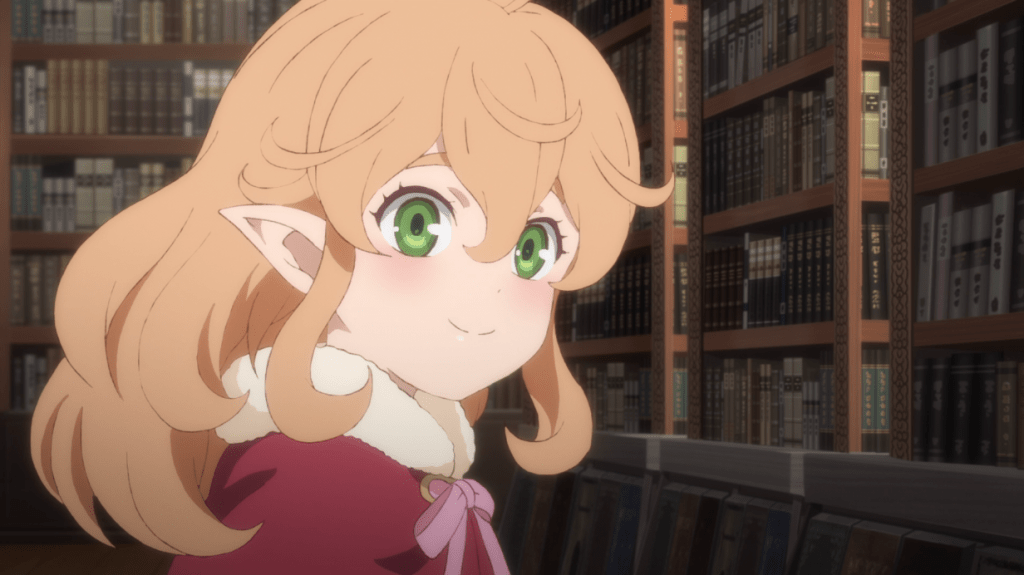
I have rewatched The Faraway Paladin at least a couple of times since its Fall 2021 debut, partly because it’s just a solidly-made series and partly because it’s the best representation I’ve ever seen of what it means to become a true paladin. This low-key start to season 2 expands on that theme as it primarily focuses on Will taking Bee to visit a renowned but hard-to-reach Academy of Magic. Just getting there is a feat akin to an RPG mini-adventure, but the real meat of the episode is what Bee wanted to see at the Academy and, more importantly, why. In exploring those matters, the story gets to the heart of why Bee chose to become a wandering troubadour in the first place: inspired by a former traveling companion, she wants to make sure that heroic deeds – which can give people hope but which can also be easily disappear with the passage of time if not properly recorded and continually relayed – do not get forgotten.
As simple as that sounds, the spirit with which Bee approaches this lifelong task gives it an energy and solemnity worthy of a true fantasy bard. (And really, Bee has one of anime’s most infectious smiles, too.) It is, perhaps, a message to Will, too: doing great deeds is fine, but what’s important in the long run is that they are recognized and remembered so others can draw courage and resolve from them. That’s incredibly important for someone seeking to reestablish an entire faith, and an affirmation of why Bee is just as indispensable to Will’s mission as any of his other companions. The series’s typically-strong technical merits are also back, too. All-in-all, it’s not an exciting return to action, but one which still fits well within the framework of the series.
Undead Unluck
Streams: Hulu+ on Fridays
Rating: 4.5 (of 5)
Well, damn. Guess I’m keeping my Hulu subscription for another season and adding yet another title to an already-crowded Friday viewing schedule. Because there’s no way I’m not going to watch more after seeing such a balls-to-the-wall crazy opening episode.
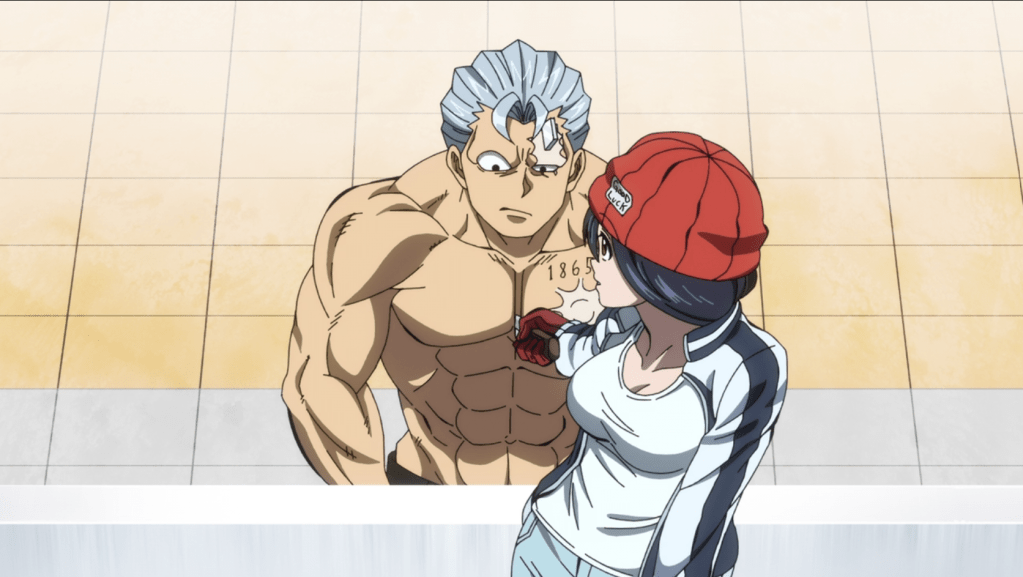
You have an undead guy who literally can’t be more than briefly killed by anything and is looking for a way to die. You have a young woman who is planning to commit suicide because of her peculiar condition: anyone who makes skin-to-skin contact with her gets fatally unlucky. Perfect combination, right? Oh, and the undead guy can also jet himself forward on severed limbs by controlling the way his regeneration works. Yes, that’s every bit as eye-poppingly insane in execution as it sounds, and that’s not even close to the full extend of what goes down here. Really, I watched much of this episode with my jaw on the floor.
Doesn’t hurt that studio david production brought their A game to the table here, either. This is as much of an artistic spectacle as anything that’s aired this season, including some amusing self-censoring since Undead is stark naked for much of the episode. It’s bloody to the point of absurdity, so this isn’t a title for the kiddos, but if you can handle that then you owe it to yourself to check this one out.
The Kingdoms of Ruin
Streams: Crunchyroll on Fridays
Rating: 3 (of 5)
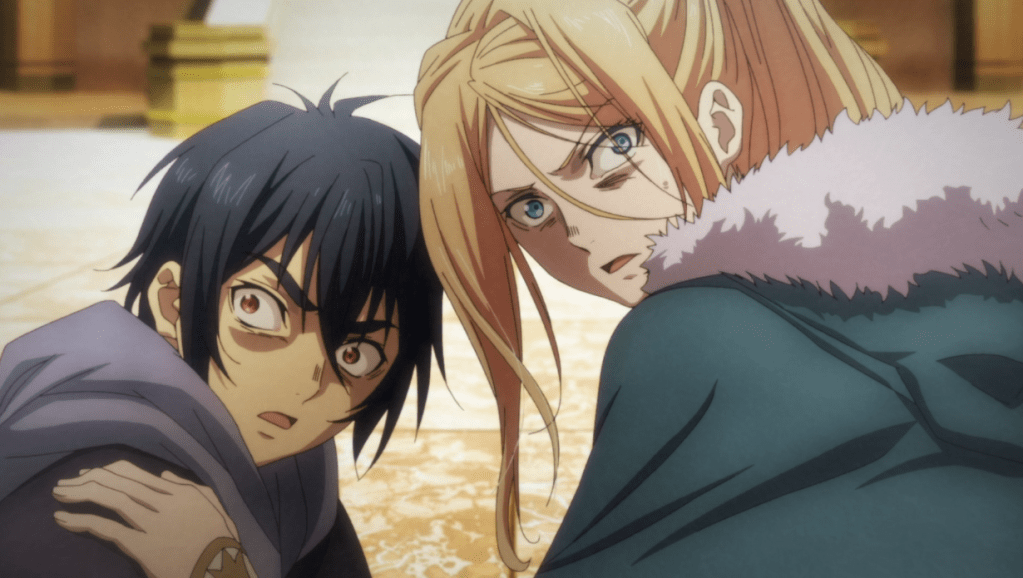
In most stories involving witches, they are persecuted for being the enemies of God. In this manga adaptation, however, they were originally the representatives of God in the physical world, charged with aiding and protecting humanity. Once humanity sufficiently advanced, however, they came to despise the witches rather than revere them and so took to exterminating them. Ironically, this brought about the dark times that were prophesized to happen when witches and humans became at odds, though the Redia Empire and its citizens probably wouldn’t agree. Adonis is a young man who, as a boy, was raised by a witch and taught magic, only to see her publicly executed. Doroka is a young woman who, a decade later, was a war prisoner of the Redia Empire when she escaped and tried to free the other prisoners, though in the process it appears she also freed the long-imprisoned Adonis, too. This isn’t going to go well for someone.
What sounded in its advertising blurb like it was going to be a pure fantasy series actually turns out to be a “science and magic” series instead, with true magic existing alongside smartphones and scientific magic nullification devices. This is a dark, almost dystopian setting, one which features graphic public executions, war prisoners being sold as sex slaves, a public driven by hate, and a male protagonist who’s going to be driven by revenge, despite his witch mentor doing everything she could to prevent that outcome. It makes for a fine story base, but the behavior of the apparent female protagonist just seems much too incongruous with the tone the series is otherwise fostering, and there are a couple of other expressions and moments which pop up which feel like they would be much more appropriate in lighter fare. That occasional tonal incongruity is the chief reason why I’m not rating this higher, although the visual so far have been a mixed bag, too; some good design elements, but animation that is frustratingly limited in places and occasional quality control slips in character rendering. I’m going to give this one another episode to prove itself, but it faces stiff competition on an already-packed day.
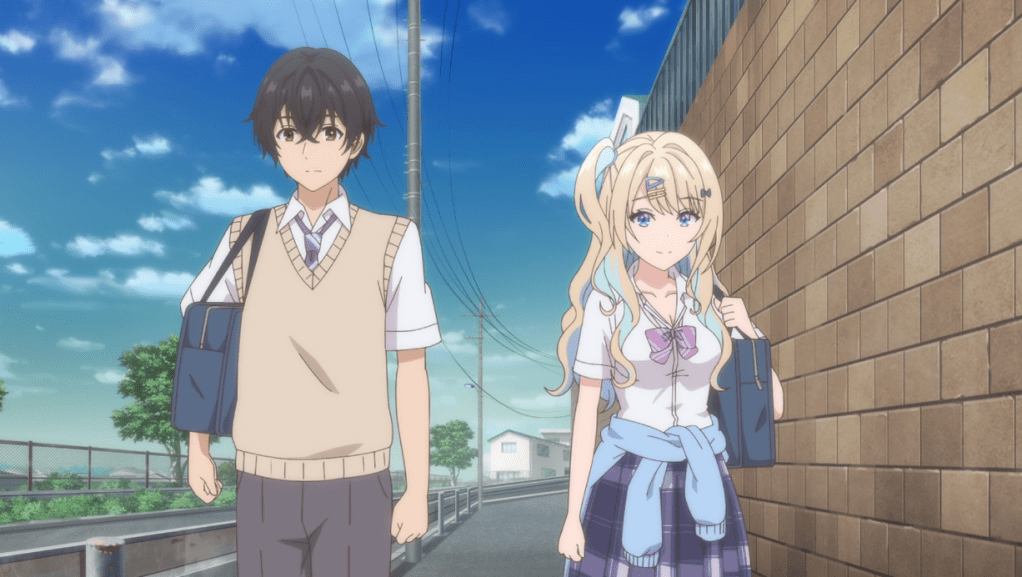
KimiZero (aka Our Dating Story: The Experienced You and The Inexperienced Me)
Streams: Crunchyroll on Fridays
Rating: 3.5 (of 5)
The premise of this light novel-based series is as basic as can be: a geeky introvert loses a bet and has to confess to the girl he secretly likes, a pretty, outgoing, popular girl rumored to be a very active dater. To his shock, she accepts, and they start dating. What makes this one interesting – and potentially more worth following than many others of its ilk – is that this may not be as shallow a story as it might initially appear to be. Runa, the sexy gal-type girl that protagonist Ryuto asks out, accepts because she believes in giving “like” a try to see if it can develop into more, but her numerous past relationships never have. Following scenes suggest why: somewhere along the line, she got the idea in her head that sex was just something that’s expected as the foundation of a boyfriend-girlfriend relationship. She’s expecting the same here, so she doesn’t waste time in inviting Ryuto to her room. This raises the strong suggestion (which Ryuto picks up on himself) that her past relationships didn’t last because the boys were only interested in that. But while Ryuto absolutely wants to do it with her, he sees that more as a goal in a relationship rather than a starting point. For Ryuto, sex should only come when she wants it, not when she thinks it’s expected of her. And Runa finds that to be an interesting change of pace.
I do hope the series eventually delves into Runa’s viewpoint on things, as seeing how she ended up with this mindset would be very interesting. Regardless, getting the big elephant in the room out of the way up front makes for a promising foundation for a developing relationship; too many anime romances just skirt around sex as long as they can. While I’m not expecting great things out of this series, there’s enough promise here in its look at relationship mindsets that I will probably, at the least, check back in on this series from time to time.

Goblin Slayer s2
Streams: Crunchyroll on Fridays
Ratingg: 3.5 ( of 5)
While I wouldn’t say it’s the best straight fantasy series in recent years, Goblin Slayer is certainly one of my favorites, so I was eagerly looking forward to its continuation here. With all the familiar faces from the first season back and an interesting new story angle developing, it doesn’t disappoint – at least on the storytelling side, anyway.
This episode does specifically follow the events of the movie Goblin Crown, and it has a specific reference to Fencer (the prominent character introduced in that movie), so seeing the movie first is highly recommended. The framing device is the beginning of Priestess’s second year as an adventurer, and she’s looking to rank up as a whole new crop of rookie adventurers comes into the picture. Among the rookies is a brash, red-haired wizard boy who seems especially determined to hunt and kill goblins. Goblin Slayer is unconvinced that he’s ready or capable, but Priestess is also having trouble increasing her Guild rank because she’s seen too much as a supporter for a party of Silver ranks, so a compromise is struck: form a temporary party of lower-ranks, with Priestess as the leader and the boy as a member. (And, I presume, trainees from other parties shown prominently last year joining in, too.)
Seeing the series blend together previously-established threads (like Fencer and the proposed rookie training program) is quite satisfying, as is seeing a return to the emphasis on rookies in the adventuring world. While the regular group has a fun and effective dynamic, this is an interesting angle to explore. The writing also deftly mixes in many of the familiar faces, shows how perceptions of Goblin Slayer have changed amongst the veterans, and even finds time for some rookie viewpoints, too. (And speaking of viewpoints, the goblin’s-eye-view of the critical events from episode 1 of season 1 was a neat trick.) New OP “Entertainment” by Mili (who also did the OP for the first season) is also among the season’s best. Sadly, the rest of the visual quality doesn’t hold up, which is why I’m not rating this higher. The studio switch – from WHITE FOX to LIDEN FILMS – has, so far, resulted in a significant visual downgrade, with almost everything looking at least a bit rougher. If this is the series’ new visual standard then it’s going to be a drag on the whole season.
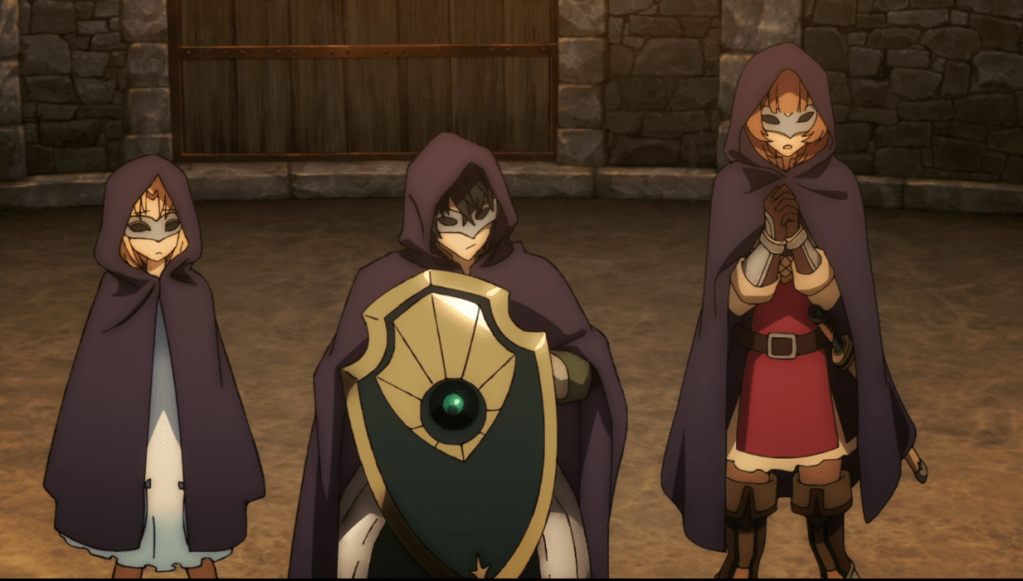
The Rising of the Shield Hero s3
Streams: Crunchyroll on Fridays
Rating: 3.5 (of 5)
With Naofumi and his party now back in Melromac, a lot of clean-up and fall-out from the Spirt Tortoise incident has to be attended to while still preparing for the eventual appearance of the Phoenix. For the queen, that means fretting over where the other Cardinal Heroes have disappeared, where most of the Vassal Heroes of this world might be, and why a supposed ally has troops stationed suspiciously. For Naofumi, that means rounding up as many of the former Lurolona villagers who still remain enslaved as possible. Ironically, the Shield Hero becoming the lord for Lurolona has economic forces in motion which complicate that mission, leading to the nation of Zeltoble and some surreptitious arena fighting.
In other words, this is mostly a set-up episode for the events upcoming this season. It features cameo appearances by a number of individuals who, based on the new opener, are going to be regular players in events this season, introduces a new locale, and sets up a surprisingly complex economic situation; essentially, Lurolona has now become a figurative brand in slave trading thanks to the Shield Hero. I am interested to see how this plays out, especially how intricate the plotting gets and how many other moving pieces might be in play here, so there is reason for optimism after a mostly-disappointing second season.

Under Ninja
Streams: Crunchyroll on Thursdays
Rating: 3.5 (of 5)
In modern Japan, there are ninjas. A LOT of them. And nobody knows who they are or where they are because they look just like average people and do Average People jobs. A true ninja blends in and does whatever is needed, whether it’s utterly-normal delivery work, walking on walls over a woman on a toilet to get a badly-placed roll of toilet paper, or preparing to fight a rival band of ninjas using out-of-date ganguro styles and make-up.
The subtle and not-so-subtle absurdity of these situations is the core of this debut, and it’s where the offbeat humor of this series lies. Much of what the first episode does may seem very random at first, but by the end of the episode events do seem to be gradually converging into a more cohesive whole, revealing a very abnormal but still coherent sense of logic. This is very definitely not going to be a series for everyone, as even aside from its weird structuring, it has a very earthy nature to it, but I could see this series gradually growing on people if they give it a chance.

The Ancient Magus’ Bride season 2 ep 13
Streams: Crunchyroll on Thursdays
Rating: 4 (of 5)
The first half ended with the College being both magically and physically locked down due to the spate of recent dangerous incident. The second half mostly consists of the fallout of that incident, primarily from the viewpoint of the students. Everyone in Chise’s main friend group is concerned about Philomela – even Lucy, who’s finally back in action – but they first have to deal with a combat exercise with the familiars of Zaccheroni, one where they must use weapons rather than sorcery. (Only Chise doesn’t need a weapon.) Despite performing quite competently, Philomela falls ill in reaction to the lesson on not relying too completely on sorcery. Meanwhile, Elias discusses further with Simeon what it means to be a friend and Headmistress Quillyn called in some outside investigative help concerning a certain missing book.
All-in-all, this is a fine start to the second half, including an interestingly different new OP and a solid but less impressive new ED. The combat exercise showed that the series may now have a few too many characters to manage fully, but the important ones get adequate shares of time and the most interesting case beyond Chise – Philomela – is starting to take center stage. So much is swirling around here that this looks to be a meaty second half of the season.

16 Bit Sensation: Another Layer
Streams: Crunchyroll on Wednesdays
Rating: 3 (of 5)
On paper, this looks like just another time travel jaunt; in this case, a game artist in 2023 finds herself back in 1992, at the cusp of the bishoujo game boom, after opening an old game obtained at a mysterious second-hand shop. That artist is Kaori Shimoda, who joined a game company with dreams of designing pretty girls for epic games, but laments when economic realities result in her working on basic ecchi games instead. Spilling her laments to the old proprietor of the second-hand shop sets up the chain of events which send her back to 1992. Once she overcomes her shock, she may well get the chance to fulfill her dreams, since she (literally) runs into the son of the owner of a small game design company at that time.
There’s absolutely nothing special about the visuals or premise, but this debut deserves credit for its surprisingly compelling earnestness and message. Saori’s laments may well be the laments of an entire industry, as the heyday of bishoujo games has been swallowed up by the rise of gacha games and much more complex video games. Epic bishoujo games like Kanon (which is featured prominently in the episode) just can’t get made anymore. The choice of the game Dokyusei as the time travel trigger is significant here, as is the fact that it takes Saori back to 1992, as that is when that pivotal release came out. (It established many of the standards for what would become dating sim games.) The series has a lot of other bishoujo cameos of more modern anime and games, too, including To Heart and Madoka Magika. Really, it feels like this series is trying to make a point rather than just tell a story, that is why I am very cautiously optimistic about it.

KamiErabi GOD.app
Streams: Crunchyroll on Wednesdays
Rating: 1 (of 5)
This is one of the few original series of the season, a creation by the director of the games Drakenguard, Nier, and Nier: Automata. It is also, sadly, the clear worst series of the season so far. The concept is a basic and familiar one: high school students randomly get involved in an app-based death game to determine who will become God. Then they go and kill each other. Unfortunately for protagonist Goro, a girl he’s starting to crush gets involved in this as he does and suddenly starts trying to kill him with a giant, cleaver-like weapon generated by stabbing meat. Oh, and for some bizarre reason he masturbates in front of her before this happens.
As weak as the premise is, the visual are the real problem here. The CG modeling is stiff and basic, the color designs off-putting (I can see what they were going with by only coloring relevant characters, but it looks gimmicky rather than cool), and who thought a uniform design which looks like a reject from a German elementary school was a good idea? There have been much better (and much better-looking) versions of this concept in recent years, so don’t waste your time here.

The Eminence in Shadow s2 (ep 21)
Streams: HIDIVE on Wednesdays
Rating: 5 (of 5)
I am giving this one a maximum rating because I simply cannot imagine how the return of this much-beloved series could have more perfectly encapsulated everything that this series is. It’s bloody, gratuitously sexy, chaotic, edgelord-styled dramatic to the point of self-parody, frightfully funny, utterly ironic, and in general just one big mass of darkly-hued fun.
It doesn’t take long to get to business, either. The episode’s single funniest moment comes only a minute and a half in, when Cid/Shadow dramatically says, “I smell it” (implying trouble in a report he was hearing) and all his minions react literally (as they always have!) and start checking to see if they have BO or open a window to air out the room. I laughed so hard at that one that I had to pause the stream, and it was far from the last time the episode exercised the franchise’s quirky sense of humor. One of the best later gags involves a red-haired vampire hunter spouting off a series of very generic-sounding dramatic warnings to Cid when he’s not-so-threatened by ghouls, and him taking such a fancy to those lines that he insists on repeating them to anyone he protects from rampaging ghouls as Shadow. The episode is just packed with all sorts of moments like those as Cid (literally) gets dragged by his sister Claire to Lawless City, where a bunch of vampires are unleashing a plot involving a Red Moon to awaken their long-slumbering leader.
I could write a whole essay about all of the fun stuff here, but let’s just leave it at how there’s all sorts of potentially interesting new faces popping up here as well as old faces doing what they do best, whether it’s Skel and Po making fools of themselves or Claire casually kicking the head off a ghoul before teaming up with the vampire hunter. Cid, of course, still thinks this is all his own fantasy playing out even though every bit of it is real, and it still looks impressive in a darkly flashy way. If you watched the first season, this episode will only get you hyped further for this one.

I’m Giving the Disgraced Noble Lady I Rescued a Crash Course in Naughtiness
Streams: Crunchyroll on Wednesdays
Rating: 3.5 (of 5)
This light novel adaptation has easily the longest and cheekiest title of the season, but based on the first episode, it’s also going to be one of the season’s most fun titles. In it, Allen Crawford is a sorcerer with such a contrary disposition that he’s referred to as the “Demon Lord” and lives in a mansion deep in the forest. One morning he happens across a young woman who’s collapsed in the forest after spending the night fleeing from soldiers, rescues her from said soldiers, and after hearing her sad tale about how she was framed by a foreign prince who sought to get rid of her (she was his long-standing fiancée), decides to make Charlotte into his housekeeper – even if that means using her faultlessly-kind disposition against her to coerce her (by putting a death curse on himself until she agrees). Since she has not been treated well even beyond the false charges, Allen decides to spoil her by treating her to all manner of naughty habits.
Despite the title, this is a surprisingly clean, cute, and even mildly sweet tale, and definitely a funny one, too. Though Allen can be a bit of a jerk (one of his favorite hobbies is gleefully poking holes in research papers on magic), he is also a victim of past mistreatment by others, so he sympathizes with Charlotte’s plight more strongly than he may realize and seems to take joy in showing Charlotte that life doesn’t have to suck. Nothing is even the slightest bit lewd or fan servicey about this, either, which may be hard for some to reconcile with the fact that Allen’s seiyuu just got done portraying past-life Rudy in Mushoku Tensei (and Tomokazu Sugita is using practically the same voice and delivery here). It’s only about average on technical and visual merits, but that’s fine for a series like this. This has the potential to be one of the season’s surprises, so i
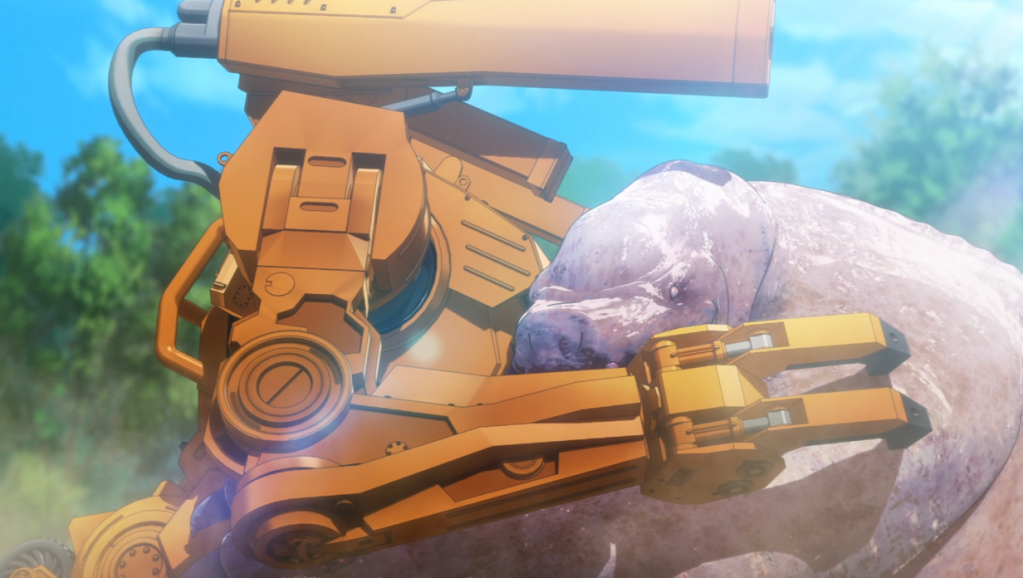
Bullbuster
Streams: Crunchyroll on Wednesdays
Rating: 3.5 (of 5)
This season’s dedicated mecha entry is a decidedly unconventional one. Sure, it still has mecha fighting large monsters, but these are tractor-sized mecha which, in the cruder versions, look and feel more like actual construction equipment. Even the new, titular model is not the elegant knight of the battlefield so commonly-seen in mecha series. And this is, I think, the point.
Bullbuster is less a true mecha series and more a workplace comedy/drama which happens to involve mecha. The titular mecha is the newest model being leased to a small extermination company, and its hotshot pilot/developer is woefully unprepared for what Namidome Industries is exterminating: giant beasts which have apparently taken over a formerly-inhabited island. (Nothing about how this happened is explained in this episode.) Enthusiam runs headlong into teal-world practicalities, like whether or not the newcomer has all his paperwork in place before going out on his first job, and the advantages/ disadvantages of bipedal vs. track-based mecha come into play once the action hits. The series looks pretty good (despite the ill-defined CG monster), and all the cast members introduced in the first episode are clearly-defined right from the start, making for an efficient and effective opening episode. You might not necessarily need to be a mecha fan to appreciate this one.
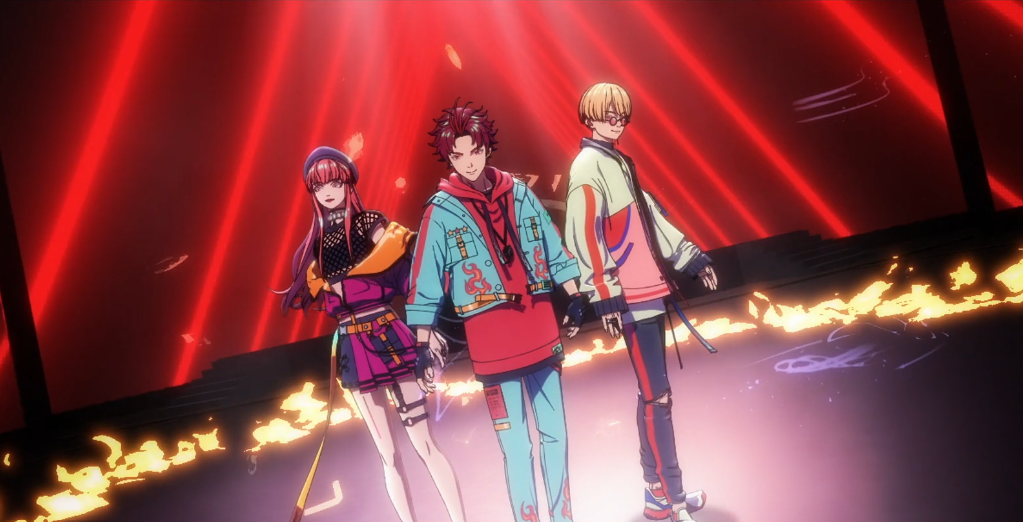
Paradox Live the Animation
Streams: Crunchyroll on Tuesdays
Rating: 3 (of 5)
This is the anime branch of a mixed-media project with singles dating back to 2020 and albums dating to 2021. In the anime, a legendary hip-hop club and the legendary duo who run it have resurfaced and declared a music battle for four invited groups, with the winners getting a massive cash prize and the right to duel the legends on-stage. The extra gimmick here is a special metal which allows performers to manifest illusory visual effects to augment their performances, though there is some suggestion at the end of the episode that these effects are linked to past trauma.
In other words, you have colorful CG performers duking it out musically with all kinds of fancy visual effects. The CG actually isn’t bad, and the one group shown performing (apparent central trio BAE) does have some snappy performances. Some hints are dropped about bigger plot points and mysteries, but this one’s mostly about the performance pieces. I found it a chore to watch, but have to acknowledge that it’s pretty well-done for what it is.

The Saint’s Magic Power is Omnipotent s2
Streams: Crunchyroll on Tuesdays
Rating: 3 (of 5)
Despite being an isekai series featuring an OP heroine, the first season of The Saint’s Magic Power largely avoided many of the common complaints which come with such series because it was careful to show that Sei, despite being the most powerful magic-user in the land, couldn’t do everything on her own. Her powers are geared entirely for support roles rather than offense, so she excelled best with a capable contingent around her. Signs of that continuing are already apparent in the first episode, which features Sei establishing her own trade company in order to market her cosmetics. Of course, the work of setting it up and running it is left to the experts; Sei is only the idea person behind it. The romantic aspect also gets addressed as Sei as a pleasant café visit with Commander Hawke, and that’s where the vague mystery aspect comes in: the new “foreign drink” is actually coffee. That gets Sei interested in finding out if rice also exists in this world, which mean a visit to a port city is on the agenda.
In other words, nothing terribly exciting happens, and the port city excursion provides the only vague hint of a future plot. The whole business with setting up a trade company – which would be an episode or more-long affair in many other isekai titles – gets glossed over too slickly, but unlike something like Parallel World Pharmacy, that isn’t the main focus of the story so it’s partly forgivable. Nothing has changed on the technical front, either, for better or worse. On the whole, the series remains as pleasant as ever and should be a fine continuation for established fans.
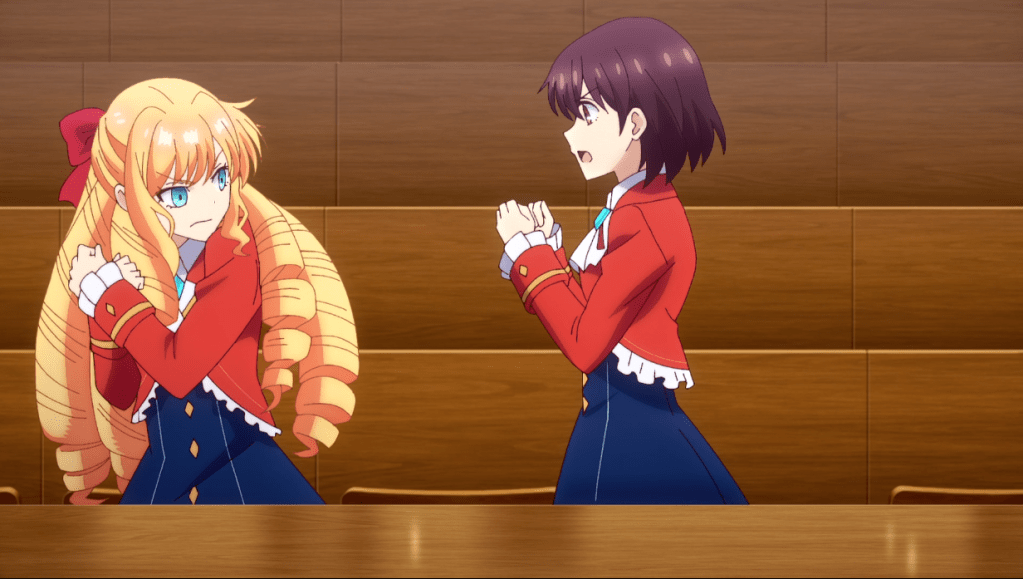
I’m in Love with the Villainess
Streams: Crunchyroll on Mondays
Rating: 3.5 (of 5)
This one isn’t subtle about its focus; Ii wastes no time in getting straight to the heart of its title. The instant a female office drone finds herself inside the otome game she obsesses over, she immediately declares her love for Miss Claire, the noble who serves as the game’s villain. No amount of bullying conducted by Claire in the slightest discourages Rei; in fact, the latter eats it up to a masochistic degree, which utterly throws Claire off her game. So what is a somewhat principled bully to do when all of her efforts are having the opposite effect?
The result here is easily the funniest debut so far this season. I’m not a fan of this subgenre of isekai, and I’m definitely not a fan of that drill-like hairstyle, but I still had at least a smile on my face practically the whole episode. Additionally, I find the notion of an otome game being upended by the player’s character suddenly taking a hard lesbian turn to be quite amusing. The English dub also strongly hits the mark in all cases. I’m not sure how long this humor thread can continue before wearing out its welcome, but so far it is exploiting its comedy base for all it’s worth.
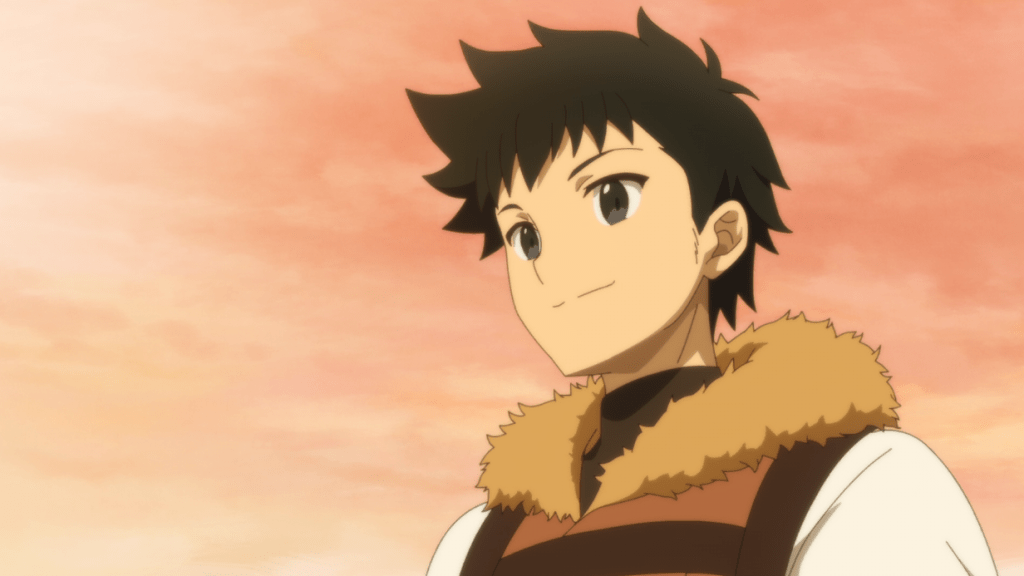
Playthrough of a Certain Dude’s VRMMO Life
Streams: Crunchyroll on Mondays
Rating: 1.5 (of 5)
To a certain degree, I can see where this series is coming from. As a long-time RPG gamer,I haven’t always ruthlessly min-maxed my characters, instead sometimes making class, skill, or spell choices just to fit a theme or see if they will work. Sometimes they do beautifully; other times, they get thrown in the trash bin. The unnamed protagonist of this series seems to be in that mode by default. He’s just playing to play and see if he can get odd combos to work, and just happens into the right skills when a crisis arises in the game or players are seeking something different. That’s totally fine, but that doesn’t make for an exciting view.
And that’s the main problem with this light novel adaptation: it’s more boring than bad. Nothing all that interesting actually happens, and there’s certainly nothing about the protagonist and his practical-minded approach that makes him compelling. Easily one of the weakest artistic efforts of the season and bland world-building for the VRMMO setting also hold this one down. Maybe this will be of interest to those who are looking for a series about a guy just doing random things in a VRMMO setting, but even then, there is far more interesting fare out there.

Shy
Streams: Crunchyroll on Mondays
Rating: 4.5 (of 5)
A hero is able to save everyone during an amusement park calamity, but because the hero can only ferry down one person at a time, the last person gets badly injured when the calamity compounds to the point of straining the hero to her limit. How responsible should the hero be? How responsible should the hero feel?
That’s a heady moral quandary to dump out in the first episode of a new super-hero title, especially when the hero in question is Shy, an aptly-named 14-year-old who’s relatively new to the business. Since no one else at the scene could have acted quickly enough, and since the girl would have clearly died if Shy had not found a way to stop the runaway coaster car, she shouldn’t feel guilty, but she does, and the media isn’t kind, either, in the way it emphasizes her failure rather than her success. (But that’s also realistic.) She has to find a way to accept what she can and can’t do and move on, because a hero cannot be a hero if she’s afraid to act.
This provides a rock-solid foundation for a fantastic first episode, then follows it up with the twist at the end that the injured girl becomes the heroine’s new classmate. As intriguing a turn as that is, though, it’s the emotions behind Teru’s actions – and the way we get an in-depth look at her right from the start – which drives this episode. Strong production values certainly don’t hurt, and this is directed by the same person who led quality titles like School-Live! and Scum’s Wish, so the potential for the quality effort is certainly there. This one has plenty enough of the right spirit to be a keeper for me.

The Demon Swordmaster of Excalibur Academy
Streams: HIDIVE on Mondays
Rating: 3 (of 5)
A thousand years in the past, the undead Leonis, last of the Demon Lords, faced eventual defeat in the face of the Six Heroes. Since he had not yet fulfilled a promise made to his goddess, he chose to undergo reincarnation rather than battle to the end. When awakened what he presumes to be a millennium later by the pretty young human woman Lisella, he discovers that he has been reincarnated as a human child and much has changed, including magic being lost, human civilization having advanced dramatically, and humanity being besieged by a threat from Voids, who may be the aliens. Seeking more information (and only that, he assures himself), he secretly saves Lisella’s life when she is mortally wounded defending “Leo” (whom she assumes is an amnesiac child) from a Void and decides to go with her.
On the surface, this sounds like a variation on The Misfit at Demon King Academy crossed with the ‘90s post-apocalyptic series Blue Gender. And indeed, a lot of the story and visual elements here feel very familiar from other series, too. However, the series does look pretty good (Lisella being a total anime goddess of a design certainly doesn’t hurt!) and have some potentially intriguing hooks, including the strong suggestion that Leonis was a fallen Hero before he was a Demon Lord and that the Voids could be the beings “from another world” that his goddess warned him about. I’m not ruling out that this one could descend into being just another bout of Magic(ish) Academy blandness, but I see enough signs of hope here to at least check out more.
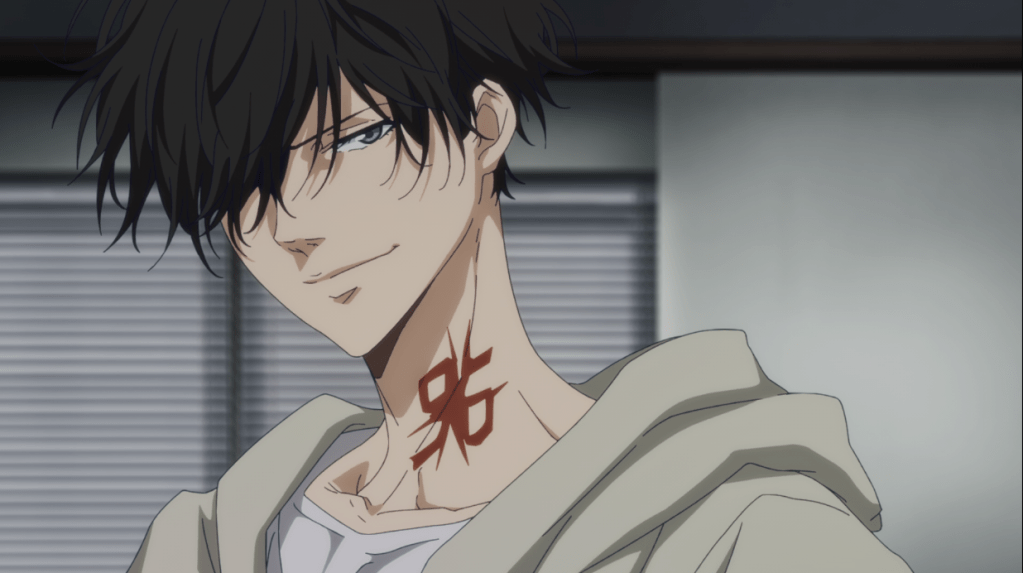
Ron Kamanohashi’s Forbidden Deductions
Streams: Crunchyroll on Mondays
Rating: 3 (of 5)
The format of an eccentric detective being paired up with an oft-flabbergasted straight man is a staple of the mystery series format across all media, and anime is no different. This manga adaptation is just the latest such entry in that field. In this case, young, ineffective detective Totomaru Isshiki is sent to call on a veritable hermit, Ron Kamanohashi, who is trying to lead an indolent, contactless life because he cannot help but get passionately involved in a mystery if he hears about one, and that’s led to fatal consequences in the past, to the point that he was banned from investigating mysteries. But “Toto” happens to be the right kind of naïve fool to get Ron back on track, in this case to solve a serial murder about men turning up drowned despite not being near any body of water.
Admittedly, Ron does have a decided flair about him that even extends to the way he moves, and that can be interesting to watch. The series isn’t badly animated, either. Even so, I just can’t see Ron’s peculiar style being enough to attract in viewers who are not normally mystery fans, especially with “Toto” being as generic as they come for a sidekick.
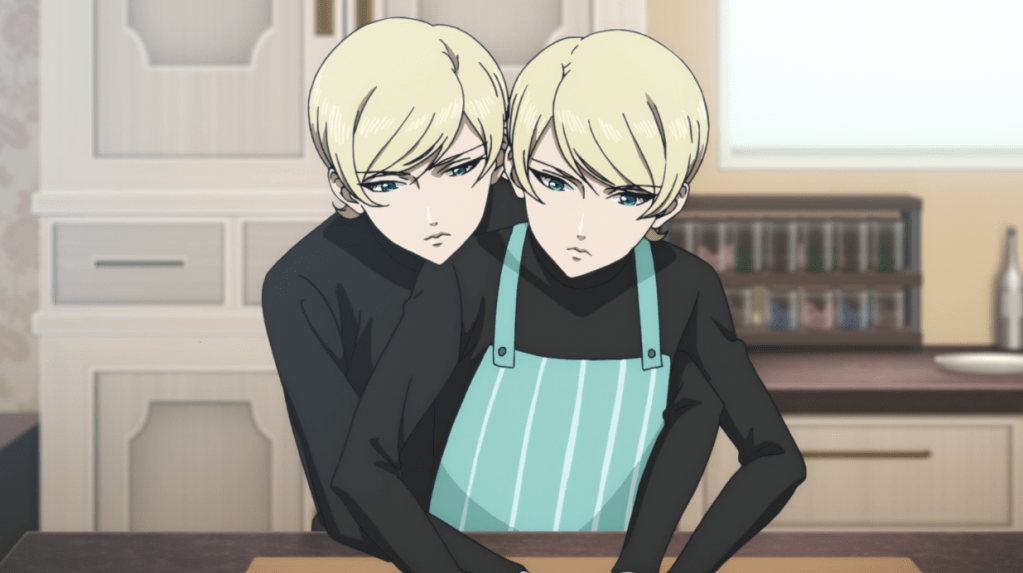
Migi & Dali
Streams: Mondays on Crunchyroll
Rating: 3 (of 5)
In 1989, an older, childless couple seeks to adopt one child from an orphanage. They wind up being impressed by a beautiful 12-year-old boy named Hitori and choose him. What they don’t know is that instead of just getting one boy, they actually got two – identical twins, in fact, who regularly trade places to make it seem like there’s just one person.
That’s the entire premise of what is easily the most bizarre series concept to come up so far this season. The whole episode is about how slickly Migi and Dali trade places, work together, and study their new parents to utterly ingratiate themselves to the old couple, sometimes resorting to acrobatic-level feats to pull the stunts off. A wonderfully creepy musical score gives the whole thing a certain flair, and viewers also have to always watch carefully for where the second twin might be hiding to listen in/await his opportunity. (The name choice they use for their apparent singular identity is also significant, as “Hitori” means “alone.”) Be sure to watch for the post-credits scene, which shows how thoroughly they scheme. Though a neat concept, I have to wonder how far the gimmick can actually carry the series.

Overtake!
Streams: Sundays on Crunchyroll
Rating: 4 (of 5)
This season has two series about auto racing (the other being MF Ghost). Based on first episodes alone, this original effort is, by far, the superior of the two. Overtake! focuses on a washed-up photographer’s discovery of Formula 4 racing, which is an actual open-wheel racing league which serves as a sort of minor league to the more famous and illustrious Formula 1. This means it features primarily younger and/or newer drivers and operates on a lower budget which makes it more accessible to companies which are wholly-dedicated race teams, though (as one character points out) money is still a significant factor. The first episode provides an introduction to this type of racing and how it’s often used as an undercard for GT racing, while also focusing on photographer Koya’s growing interest in one particular minor team and its driver, young Haruka.
Really, literally everything the first episode does is anywhere from a little to a lot better than MF Ghost. Koya has a much more compelling backstory, with suggestions that a past tragedy involving filming has left him reluctant to photograph people, while the way Karuka brusquely insists that he doesn’t even need applause to support him suggests that he has his own issues. The character design work and animation is also far better, and so it the commitment to showing some actual racing. F4 is not that much different from Indy Car races (which I am somewhat familiar with) in the way the cars look and work, and the racing sequence towards the end of the episode beautifully captures the energy and intensity of those racing moves without being needlessly dramatic.
I probably won’t be keeping up with this one myself, but if there is only one racing series you watch this season, it should probably be this one.

The Family Circumstances of the Irregular Witch eps 1 and 2
Streams: Crunchyroll on Sundays
Rating: 3 (of 5)
Frieren: Beyond Journey’s End having a multi-episode debut is understandable, and Ragna Crismon have a double-length debut was an absolute necessity. Why this gag comedy series debuts with two episodes, though, is far more of a mystery. What it is and what you’re going to get is clear from the first half of the first episode.
Coincidentally, this is the second fantasy series already this season about an unlikely parent raising a foundling daughter who turns out to be quite powerful and almost obsessively adoring of her parent. Whereas My Daughter Left the Nest and Returned as an S-Ranked Adventurer is a fantasy RPG-influenced series with some comedy elements, though, this one is a pure sketch comedy in a fantasy setting. Both episodes consist of short vignettes where the running joke is that the childish-looking one is actually the two-century-old mother and the buxom, adult-looking one is actually the mentally-immature 16-year-old. This does mean a lot of boob-related humor, as well as several jokes about how mother Alyssa is concerned about guys going after her daughter, while Viola is much more concerned about guys going after her mother. A phoenix who looks like a child’s drawing who becomes Viola’s familiar is also a recurring character, as is a very muscular female shopkeeper who served as Viola’s wet nurse.
Much of the humor is on the silly level, and the first episode in particular succeeds more on volume than quality. The series gets markedly funnier in the second half of episode 2 with the introduction of the elf merchant Fennel, who is sweet on Alyssa (who sees him as a little brother) and combative with Viola; this was enough of an improvement for me to raise my grade a notch. Overall, this series may serve as a light diversion, but it’s not can’t-miss viewing.

Berserk of Gluttony
Streams: Crunchyroll on Sundays
Rating: 3 (of 5)
Among new series this season, this is the one besides Frieren that I was most looking forward to, primarily because I have read and enjoyed it first few source light novels. It is a purely fantasy series (albeit with game-like mechanics) which focuses on Fate Graphite, a “have-not” who is barely eking out an existence as a substitute gate guard because his gods-given skill – Gluttony – not only seems useless but also leaves him perpetually hungry. That starts to change the night he helps a Holy Knight thwart a burglary by killing a fleeing thief and discovers that his skill absorbs the stats and skill of those he kills rather than giving him the experience to level up. He gets a further boost when a seeming trash sword he purchases turns out to be the sentient weapon Greed – almost like it was waiting there to be found by someone with Gluttony. . .
Despite being a highly-anticipated series for me, I approached this episode with some trepidation after seeing a far-less-than-stellar-looking trailer for it. Sadly, that concern proved to be true. This is not one of the better-looking or better-animated debuts of the season – in fact, its animation is depressingly limited – and there’s only so much that its dark tones and edgy visual style can do to compensate for that. At least the episode does clearly-establish the contrast between the good Holy Knights (the angelic Ais Wallenstein Roxy) and the bad ones (the abusive Vleric siblings) and provide some vague hints about the greater scheming of the latter, though it does not go far enough to get into the moral quandaries that Fate is going to face.
This is one of the darker and more edgelord-leaning titles of the current fantasy crop, and the first episode does that just well enough for this to be worthy of a mild recommendation. But I had hoped for better.
Shangri-La Frontier
Streams: Crunchyroll on Sundays
Rating: 4 ( of 5)
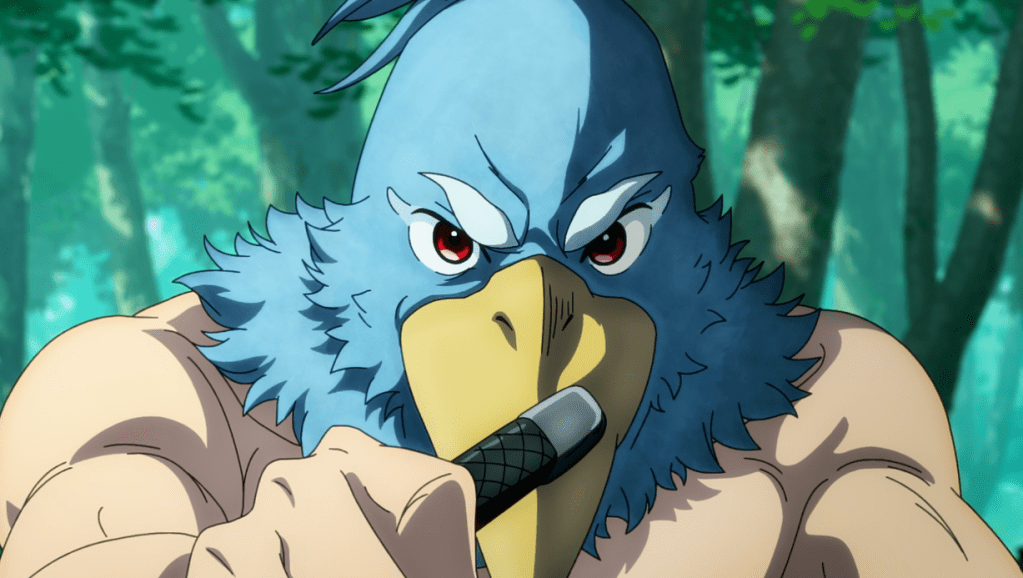
The premise to this light novel adaptation – a high schooler who specializes in beating crappy VRMMO games decides to try a top-tier one for a change – is so basic that I wasn’t expecting much out of this one, and a girl who’s secretly crushing on him probably seeking to meet him in the titular game barely rates as a twist. But this is from the same director/studio combo which brought us the expectation-breaking Handyman Saito in Another World earlier this year, and it looks like they may be pulling off their magic again. This is a far, far stronger first episode than it has any right to be.
Certainly, a surprisingly high level of visual quality in both design and animation has a lot to do with this. Even in ordinary scenes, the episode looks great, but the action scenes in the games are where the animation really shines. They use a dynamic visual approach which shows that the preciseness of the character’s moves have been carefully thought out, and that combined with deft use of camera angles provides a thrill factor even to a basic encounter with an introductory goblin mob. The episode also finds the right balance between game minutiae and action, partly by having protagonist Rakura/Sunraku be a “dive right in” type of player, and even works in some non-intrusive narration by making it partly a humor element. Perhaps most importantly, the episode maintains a thorough but not too exaggerated spirit of energy and fun. It even has some “Mini” bits at the end to follow up on points in the episode.
This title was decidedly not on my radar, but it is now. Even in a packed season, it’s worth a look.

MF Ghost
Streams: Crunchyroll on Saturdays?*
Rating: 3 (of 5)
Note: This title was listed as airing on Sundays, but it debuted a day early.
Apparently this new car-racing title is distantly-connected to Initial D, arguably the most iconic of all car-racing anime; my impression is that it might be a “next generation” situation. However, the first episode does not give the impression that any familiarity with its predecessor is expected. Though one probably has to be a car enthusiast to fully appreciate it, it is easily accessible to newcomers.
That’s because the first episode spends its time purely on set-up. In the near future, a road-racing circuit called MFG has emerged and gained world-wide popularity. Half-Japanese rookie Kanata has come from England partly to find the father he doesn’t know and partly to race, and Ren, the daughter of his host family (who works as one of the girls who holds the timing signs up at the start of MFG races) is instantly smitten. She also finds the notion of helping him find his father to be romantic. Kanata’s mechanic and a veteran racer who takes to mentoring Kanata also get introduced. However, while the potential romantic aspect and certain mysteries about Kanata’s father can provide an alternate hook, this series is clearly going to be at least as much about the cars. Not enough of them is shown in action in this episode, but what is shown demonstrates meticulous attention to detail that will doubtless be the series’ hallmark.
This one sets up well enough, and ends at a dramatic enough point, that I will probably check out the second episode, but I can’t see this being a long-term keeper in a crowded season.
Ragna Crimson
Streams: Crunchyroll on Saturdays
Rating: 3.5 (of 5)
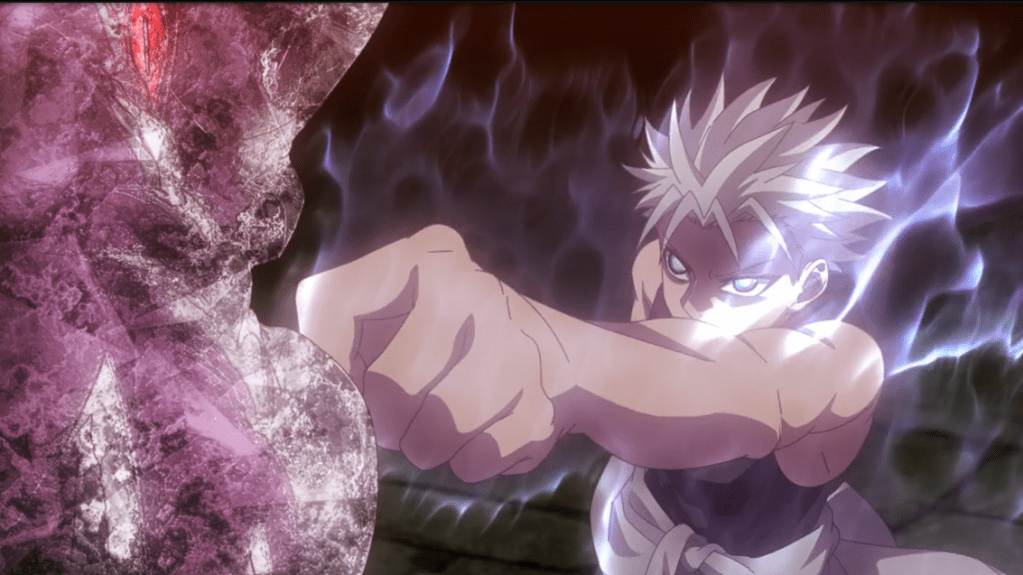
If ever a series fully needed the double-length debut it got, it’s this one, as cutting this one off at a mere 22-23 minutes would have been a narrative catastrophe. Taken as whole, the debut presents a surprisingly dramatic and engaging shonen action-esque start, one which takes a much different than normal angle on creating an OP protagonist and raises some intriguing questions.
In a setting where dragon-hunting provides livelihood for adventurers, Ragna was a boy who seemed cursed to attract dragons but always survive while those around him died. He has fallen in as an assistant to Leo, the 12-year-old prodigy girl, but laments his powerlessness and suffers from terrible nightmares of Leo’s impending death, even though she seems indomitable. When the moment finally comes, he essentially makes a pact for power with his future self, who went on to become an all-powerful killer of dragons but always regretted not having the power to save Leo at that time. That allows him to harness his future power when dragons go on a rampages at the order of the Dragon God, but at what ultimate cost? And who is the mysterious figure whom Future Ragna associates with and how will she encounter Current Ragna?
So yeah, he powers up, by harnessing his future power raises all kinds of interesting possibilities for future consequences. We also get cameos of all of the dragon bad-asses that he’s probably destined to fight, too. For all that this feels liked a retread of standard shonen action themes, though, this one might have a little more to it. I am dumbfounded that Leo – a girl with a scar running across the middle of her face – does survive this (rather than her death again being Leo’s inspiration to get stronger), but she is fun to watch and seeing how the sudden flip-flop in the power balance between them affects their relationship could be interesting. The real strength of the first episode, though, is its pacing and dramatic staging. This content shouldn’t be as effective as it is, but it admirably captures the sense of urgency and desperation that the concept requires to work. Saturdays in particular are probably going to be much too packed for this title to make my regular viewing list, but it isn’t for lack of effort.
Firefighter Diago: Rescuer in Orange
Streams: Crunchyroll on Saturdays
Rating: 3.5 (of 5)
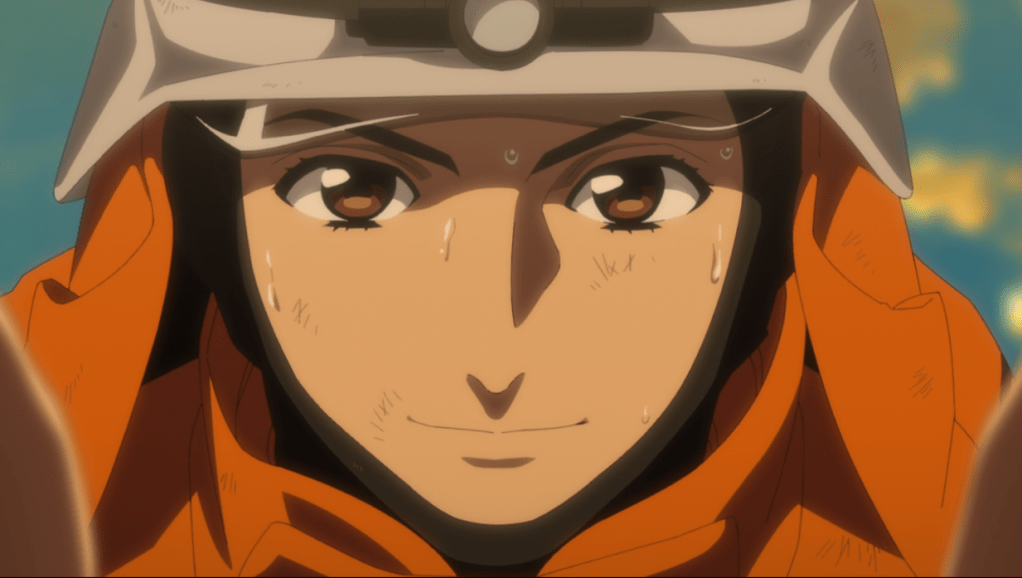
I haven’t been much interested in firefighter drama since the movie Backdraft, and based on the first episode of this one, this series isn’t likely to change my mind on that. It’s well-made on the narrative front, provides a lot of behind-the-scenes details on firefighter training and activities, and looks surprisingly good in designs, coloring, and animation, but I can’t see it sufficiently keeping my attention in a season so loaded with premium titles.
It certainly tries, though. It opens with an in media res sequence of firefighters engaged in high-stakes rescue efforts in a major, city-wide disaster, presumably in order to get audiences pumped up on rescue theatrics before flashing back a few years to the training of the three central raw recruits: titular character Diago, viewpoint character Shun, and Yuki, the sole female recruit in training for the elite rescue corps. The rest of the episode concentrates more on the training regimens than getting to know the characters well, though the opener suggests that each has a particular reason to be a firefighter.
The whole thing has the feel of an older shonen action series, and indeed, the most direct source manga is a recent sequel to a manga that originally ran in the late 1990s (which focused on Daigo prior to him making it to the rescue corps). I am a little concerned that over-dramatization could make it hard to take this one seriously, but the first episode has enough going for it to be worth a look if firefighters are your thing.

Frieren: Beyond Journey’s End
Streams: Crunchyroll on Fridays
Rating: 4.75 (of 5)
Note: The first four episodes are actually immediately available. This preview covers only the first two.
This adaptation of an acclaimed shonen manga was widely-regarded as the most-anticipated new series of the season, and it lives up to that billing in all senses except maybe artistry. It is an utterly different kind of fantasy series than the norm and defies all normal expectations for shonen manga, as it almost entirely eschews action content in favor of asking bigger, tougher, and longer questions and spending its time wholly focused on exploring the answers to those questions.
The defining question at the core of the series is, “what happens after the heroes have triumphed and now must move on?” Several other titles in recent years have broached this question to some degree – including the likes of Classroom of Heroes, Level 1 Demon Lord and One Room Hero, and perhaps most pointedly, I’m Quitting Heroing – but none even close to doing it to the degree that this series does. In this case, the story focuses an essentially-immortal elvish wizard who was part of the Hero’s team during the ten years they spent combating and eventually defeating the Demon Lord. While that was a life-defining event to others, to her it was but a brief time. Only as she sees her previous companions die of old age decades later does she start to realize that she undervalued her time with them. As she starts trying to relate more to those she meets, she winds up tutoring a war orphan who is a budding mage and eventually becomes her traveling companion, too.
The biggest difference between this and other series with a similar gimmick is the long view it takes. The first two episodes play out over the course of 76 years, during which time we get to see some characters grow up and others grow old and die, all while Frieren remains (outwardly) unchanged. This and the use of flashbacks to Frieren’s time in the Hero’s party lend a hefty dose of sentimentality to the proceedings, which blend seamlessly into Frieren’s endless hobby of collecting new spells big and small and the exploration that entails. The first two episodes also find time for lighter moments – Frieren getting caught in something with only her legs exposed and kicking futilely is a recurring joke – though those moments are handled in such a matter-of-fact fashion that they do not disrupt the gently caressing spirit of the story at all. And while Frieren is not herself the most dynamic of personalities, her quirks and emotions do show through in smaller, sometimes subtler ways, which, combined with the humor, still make her a fully-engaging character.
The one possible knock against the first two episodes is some quirks in artistic style, especially in some of the character designs. However, any artistic shortcomings are balanced out by other truly lovely shots and the way the generally-soft looking artistry and coloring complement the tone of the series. The music is also particularly effective at this, and both the regular OP and ED (especially the latter) are good enough that they could pop up in year-end awards in their categories. With the emotional weight that these two episodes can pack, this is a legitimate contender to be one of the year’s top series if it can maintain even close to the impact and quality seen in these two episodes.

A Girl & Her Guard Dog
Streams: Crunchyroll on Thursdays
Rating: 2 (of 5)
Isaku lost her parents at an early age and was raised by her yakuza grandfather – or, perhaps more precisely, mostly by Keiya, one of his younger subordinates. As Isaku hits her teen years, she enrolls in a high school far away so that the stigma of being from a yakuza family doesn’t dog her. But she gets a dog of a different kind when her long-time caretaker – the now-26-year-old Keiya – poses as a high school student to join her at school, for the reason stated in the screenshot. Getting Keiya not to be over-protective proves even harder than making friends, and harder still is that she can’t shake her not-so-familial affection for Keiya.
This one would get an even lower rating if it wasn’t for a couple of genuinely funny moments, but it has a mountain of problems. It adapts a shojo manga and, for better or worse (worse in my opinion), it retains many characteristic shojo style points. There are also a couple of points beyond that which are just off to me; the mouth design, maybe, and certainly how Isaku’s body dimensions seem to vary some. Keiya also looks way to old to convincingly pass for a high school student (even when he actually was that age!) and his shift between overboard antics and (later) pouting wears thin fast. The big point for some will, of course, be that she’s in love with the guy who basically raised her. I struggled to sit through the whole first episode, so this is a hard pass for me.
My Daughter Left the Nest and Returned an S-Ranked Adventure
Streams: Crunchyroll on Thursdays
Rating: 3 (of 5)
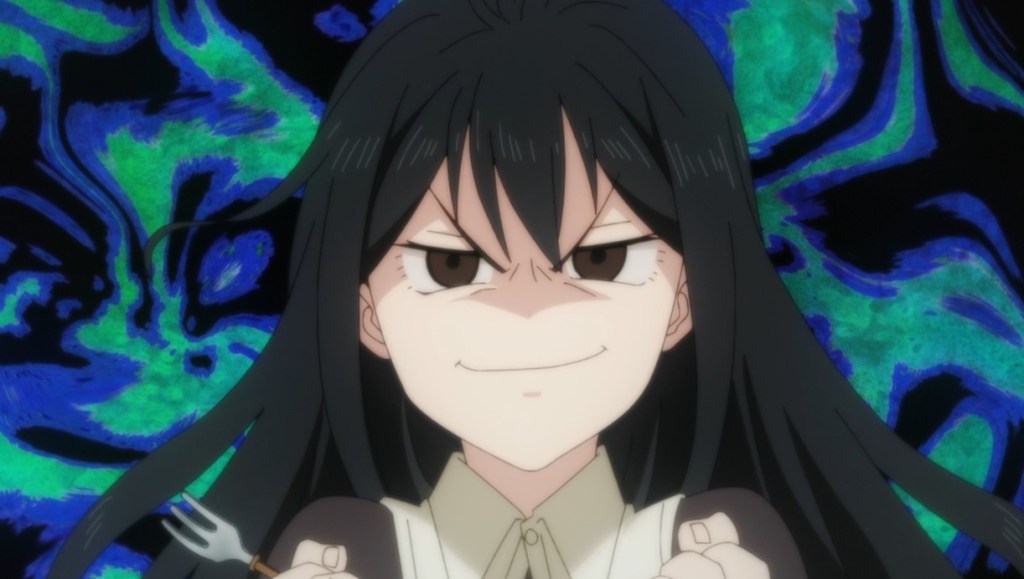
Swordsman Belgrieve was a good enough adventurer to earn the title Red Ogre (for his red hair and beard), but losing a lower leg forced him to retire to a village. One day he finds an abandoned baby, names her Angeline, and raises her as his daughter. She leaves at age 12 to follow in her father’s footsteps, and after five years she’s become an S-ranked adventurer – the highest ranked the Adventurer’s Guild bestows – and even has her own party. The problem is that the constant demands on an elite adventurer make it difficult for her to get back home for a visit, and things just seem to come up each time she tries. Will Ange’s temper boil over if she keeps getting keeps getting thwarted on her visits?
So goes this (at least so far) mostly light-hearted fantasy light novel adaptation. Even though Belgrieve’s efforts to raise Ange get summarized into just a couple of minutes, Ange still gets effectively established as a tomboyish Daddy’s Girl and there’s a certain sweetness to the way they stay connected through letters. The first episode is split about evenly between focusing on Ange and on Belgrieve, which I feel is a good balance since Ange’s shtick could get old quickly otherwise. Another potential interest factor is the vague implication that Ange may not have been an ordinary foundling, a mystery I assumed will get explored eventually. While the first episode does have some action elements, this is not a series that’s going to sell itself on its visuals or (lack of) creativity on monster designs, hence the conservative score. Still, the first episode establishes enough potentially-interesting characters and story hooks that this one may be worth following.
 USA Anime
Oh, I was kind of planning to skip My Daughter Left the Nest . . . , but this actually sound pretty sweet! Maybe I’ll watch a few episodes.
LikeLiked by 1 person
I’d like to warn you in advance Hypnosis Mic might be a bit of a tricky one to cover if you’re an anime-only fan – season 1 only covers the 1st DRB, but this has been advertised as being set after the 2nd DRB (to the point reading the anime’s character pages reveals a whole bunch of things you’re not meant to know unless you follow its other media as well).
Anyways, I’ll be back in this comment section after I watch Frieren, although I sort of saw (from watching the ANN trailer watch party) the Girl and her Guard Dog comments coming.
LikeLike
(…ah, I didn’t read the disclaimer properly *facepalms*.)
Anyways, I said I’d be back for commenting on Frieren, so here I am again. I could tell the 1st episode was something special but didn’t 100% charm me – I mean, I’m immensely biased towards properties which have proven their worth to me – but the 2nd episode helped me find a thread connecting several of the anime I love by exploring that same narrative matter – that need for leaving a legacy behind – and in that way, fully knocked my socks off.
Also, according to ep. 2 of Migi and Dali, the “tori” in “Hitori” means “bird”, so I’d hazard a guess the “hi” would be the character for “to fly”.
LikeLike
The Great Sage of the Tearmoon Empire will yet covert you to her side through her overwhelming magnanimity and wisdom! Believe that!
LikeLike
seems like Kingdoms of Ruin is causing a mess discussion wise and i’m still personally disconnected to Eminence in Shadow
Still, show wise, i’m enjoying Spy x Family and Frieren
LikeLike