Posted: 9/10/2023I
n anticipation of the upcoming release of what may well be Hayao Miyazaki’s final movie, Fathom Entertainment is rereleasing many of Miyazaki’s past films in American theaters as one-night-only events. Last month, they did so with Porco Rosso, The Wind Rises, and Princess Mononoke. Since the latter is near and dear to my heart (and since I don’t have good topics amongst newer anime to write about this week), I’m going to use my visit to its special showing as an excuse to do something I was never able to do during my time at Anime News Network: write a full review for it.
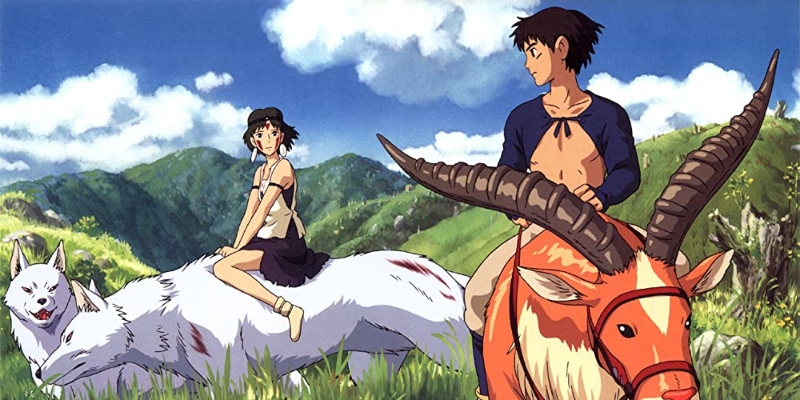
In terms of anime titles that are intimately important to me, Princess Mononoke may rank second only to Akira (my gateway title). It was my first Miyazaki film, the first anime I ever saw in a theater (during its 1999 theatrical release in the States), and my first anime on DVD; in fact, I bought my first DVD player for Christmas in 2000 specifically so I could play that acquisition. I also consider it the best of all of Miyazaki’s films; Spirited Away has better visuals and technical merits overall and a more widely-accessible story, but Princess Mononoke is no visual slouch and has the most mature, thoughtful, and cohesive story of all of Miyazaki’s works. (I should qualify here that I have somehow missed seeing both The Wind Rises and Lupin III: The Castle of Coglisotro, so I have not truly seen all of Miyazaki’s full-length productions.)
At 133 minutes, Princess Mononoke is the longest animated project Miyazaki has ever directed. It tells the story of Ashitaka, the last prince of the isolated Emishi people. (This was an actual ethnic group which fought against the establishment of the Yamato Empire empire during the 8th century A.D. but was largely integrated, pushed out, and/or wiped out by the early 9th century. They were renown for being masterful mounted archers – as Ashitaka is in the film – but they rode horses rather than elks.) His time is one where ancient Beast Gods still exist, and he is pushed into action when a corrupted boar god attacks his village. In slaying the boar, Ashitaka is tainted by its corruption and becomes cursed himself. Though the curse gives him great strength, it will also eventually kill him, and his one hope to avoid that is to travel west in search of the source of the iron ball found in the boar’s body, which apparently drove the boar god mad. In his travels, he first comes across the monk Jigo, then later San, a human girl who seems to be living with giant wolves.
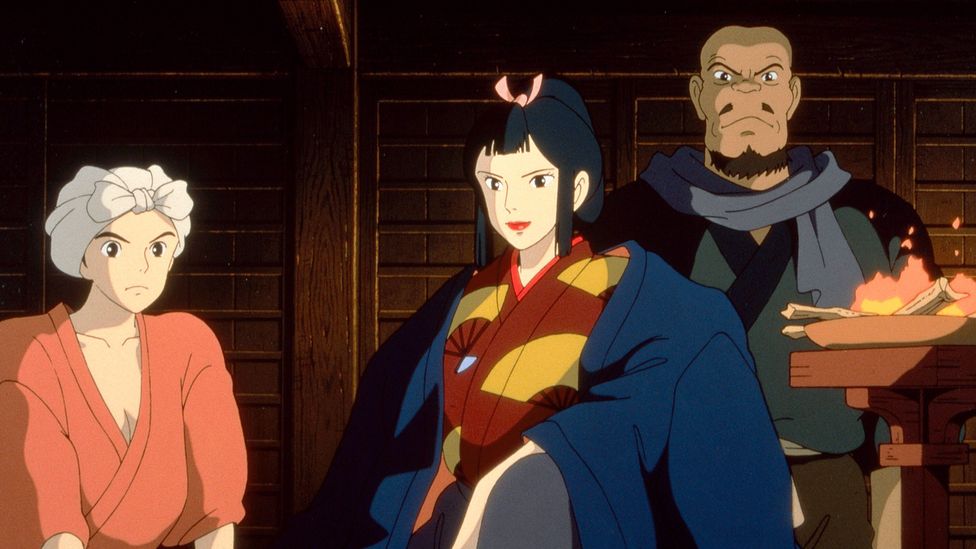
Those encounters, and the discovery of some badly-injured men, lead Ashitaka to Iron Town, a walled village led by Lady Eboshi and built around the smelting of iron ore. There he learns that Lady Eboshi and San – whom Eboshi refers to as “Princess of Beasts” (aka “Mononoke-Hime”) – are mortal enemies in the struggle between the Beast Gods who seek to protect the forests and the humans who seek to expand and secure their industry. A third faction is a samurai warlord who seeks control of Iron Town’s profitable iron, while the monk Jigo leads a fourth in the form of agents of the Emperor seeking the head of the Spirit of the Forest, which is said to grant immortality. Within these conflicts, Ashitaka must struggle to find if there is a way for him to live and a place for San, who is caught between the beast and human worlds without fully being part of either.
Many of Miyazaki’s movies have environmentalist themes as a crucial element, and nowhere in his body of work is that more foundational to the story, or more smoothly integrated into it, than it is here. The central theme – the struggle between nature and man – plays out in the most literal sense here, with a setting on both the figurative and literal border between the decline of the ancient Beast Gods and the rise of humanity. One of the most interesting aspects of the movie is that it largely does not play favorites here. These are life-or-death struggles for both sides, and both sides have their sympathetic elements; like most of Miyazaki’s movies, there isn’t really a true villain. The Beast Gods can’t be seen as evil because they are just protecting their long-standing homelands, but neither is Lady Eboshi a true villain for using her guns and tactics to drive them away. She can be harsh when circumstances demand bold leadership, but her compassion is beyond reproach, too; in Iron Town, she has made a home for former prostitutes and lepers, and she is much beloved and respected for this; they may jokingly say that she wants to “rule the world,” but she is clearly devoutly determined to carve out a place for humanity and advance her people into a new era. If any character who actually appears is a villain, it’s Jigo, who seems to have the most selfish motives but, again, calling him evil doesn’t quite fit.
Some themes, story elements, and artistic stylistic elements present here carry over from Miyazaki’s 1984 movie Nausicaa of the Valley of the Wind, to the point that calling Princess Mononoke a more refined version of Nausicaa wouldn’t be a big stretch. Whereas Nausicaa was capable of being fierce, she usually only used violence as a last resort, but that’s San’s default nature. San is also a much more flawed and reckless character than the almost-too-perfect Nausicaa, which has long made me wonder if Miyazaki didn’t eventually realize that he had idealized Nausicaa too much and designed San specifically with that in mind. Unlike Nausicaa, this one also has a male co-protagonist; in fact, the viewpoint is much more often Ashitaka’s than San’s. Though he has one of the milder personalities in the movie, Ashitaka nonetheless serves well as a noble figure who doesn’t hesitate when action is required and can provide an outside perspective to those caught in the entrenched beast-vs-human conflict. Though he proves to be an indomitable fighter, he is ultimately more valuable for recognizing where priorities should ultimately lie and convincing those on both sides (who often wonder about his motives) to do what’s really necessary to survive.
Another marked difference is that, unlike Nausicaa, Princess Mononoke is primarily a pessimistic tale. It may be awash in natural beauty, but a lot of bad things are happening, whether it’s samurai attacking a farming village, landslides long having wiped out another, the death and destruction from the human/beast battles, or the suffering on all sides. The movie even climaxes in an essentially apocalyptic scenario. A recurring theme is “life is a struggle, but you have to find a way to live,” whether it’s San’s situation, Ashitaka’s curse, the beset citizens of Iron Town, or the disease-ravaged lepers. This is most embodied in one beautiful scene midway through the movie where the Spirit of the Forest heals Ashitaka’s grave injuries but does not remove his curse; Ashitaka may have earned some grace, but he still has to solve his own problems. (This lends a great irony to the climax of the movie.)
If the storytelling has a flaw, it’s in the romantic aspect. Ashitaka is clearly struck by San at first sight, and San more gradually grows to appreciate him as well, but the story just doesn’t have room for their relationship to develop much beyond reciprocation and working together for mutual interest, and truly tender moments between them are few. That makes San’s semi-confession to Ashitaka at the end of the movie ring a bit hollow. But the movie isn’t meant to be a love story at its core, so this isn’t a big problem.

The beauty and impact of the movie shows most in its artistry and animation. Small animation flaws can be spotted if one looks closely, but this is still an impressively-animated endeavor, whether it’s the jaw-dropping complexity of Ashitaka’s early fight against the corrupted boar god (where the corruption constantly squiggles all over the boar like a wave of greasy worms), the terrific fight scene between San and Eboshi in Iron Town, the graceful movements of the wolves and elk contrasted to the lumbering movements of the boars, or the incredible imagery of the Spirit of the Forest approaching the wounded Ashitaka, where every one of its steps causes plants to quickly grow and then decay. The settings are also equally beautiful, whether it’s awe-inspiring primeval forest, the bold functionality of Iron Town, the scenic vistas Ashitaka travels across, or even all the little details of the Emishi village at the beginning. Character animal, and spirit designs have some typical Miyazaki flavor but also shine and carefully distinguish source cultures with even simple differences in clothing design; my one slight gripe here is that San’s apparel seems a little too neat for the way she lives, but she is also one of the most unconventional-looking of all of Miyazaki’s heroines, with the image of her face stained with blood from trying to suck out her wolf mother’s wound being a common advertisement. (The cute little kodoma spirits were also enormously popular, but, frankly, I found them more creepy than cute.)
While many of Miyazaki’s films have substantial action components, Princess Mononoke is easily his most graphic film. Limbs get torn off, decapitations happen, one character gets shot in the back with a firearm, and numerous humans and beast get killed. There’s probably also more blood in this one than in all of Miyazaki’s other movies combined, as well as some occasionally somewhat racy dress for some of the ex-prostitutes. This movie pulled an official PG-13 rating in the States, but consider the movie at the high end of that range; rating it R would have probably been justified.

As beautiful as the movie looks, and as strong as its themes are, the musical score by long-time Miyazaki collaborator Joe Hisaishi binds it all together and elevates the content further. This is also my favorite soundtrack out of all of Miyazaki films, and I still to this day have the official OST in circulation in my musical collection. It soaring orchestral themes and dramatic or melancholy numbers perfectly capture the tone of each scene, whether characters are awed, alarmed, or frightened by what’s going on. Hisaishi has done a lot of great work over his long career, but this is definitely some of his best.
The theatrical event I saw used the English dub made for the movie’s American release. As was common for anime movies at the time, it was given an all-star Hollywood cast rather than done through normal anime dubbing channels (although a few familiar anime dubbing voices do pop up in minor roles, like KT Vogt), with somewhat mixed results. Great casting choices and performances include Billy Crudup (later Dr. Manhattan in Watchmen) as Ashitaka, Minnie Driver as Lady Eboshi, and Jada Pinkett-Smith as ex-prostitute crew leader Toki. A more questionable choice is Clair Danes (who had become a teen star for the TV series My So-Called Life and the movie Romeo + Juliet) as San. Her acting isn’t horrible, but her voice is too deep and rough and she only fully hits the right notes in San’s fiercest scenes. Billy Bob Thornton is also a mixed bag as Jigo, but the problem there may be the English script; he sounds fine in the role, but at times it feels like he’s rushing to get in more dialog than what actually fits the scene. The biggest trouble spot is Gillian “X Files” Anderson as the wolf Moro. Her voice doesn’t fit, and she never truly sounds like she’s embodying the character, but this was also a weird casting choice in Japanese, where her voice sounded more male. (The Japanese voice actor was a relatively famous drag queen.)
I have found that this movie is not necessarily to everyone’s tastes, especially if they are not at least borderline anime fans, and anyone who expects more typical family-friendly anime fare from animation may be in for a big shock. (Disney certainly was when they acquired the title back in the late ’90s sight-unseen, which was probably why its theatrical release at the time was so limited in both theaters and promotion.) Still, it stands as a legitimate animation classic in general, and is one that every anime fan who’s a teen or older owes it to themselves to check out if they’ve never seen it.
Rating: A
 USA Anime
My first Ghibli films were Spirited Away and Castle in the Sky, so when I watched Princess Mononoke, I was really surprised at how mature the story was. At first I didn’t really like it, but as I’ve gotten older I’ve grown to really appreciate the depth of the story and the complex themes in this film.
LikeLiked by 1 person
It is a very very strong film, which makes it a hard rewatch with the injustices of man going un-answered except Karmically at times. None of that makes it bad, as you said it is very even handed and humanist in its treatment. That gives it a very strong feeling that is no popcorn experience. Instead a heavy treatise on the destructive forces of life and human greed.
LikeLike