A fairly stacked spring season has finally come to a conclusion, so it’s time to take a look at how an assortment of titles turned out.
Title of The Season: Oshi no Ko
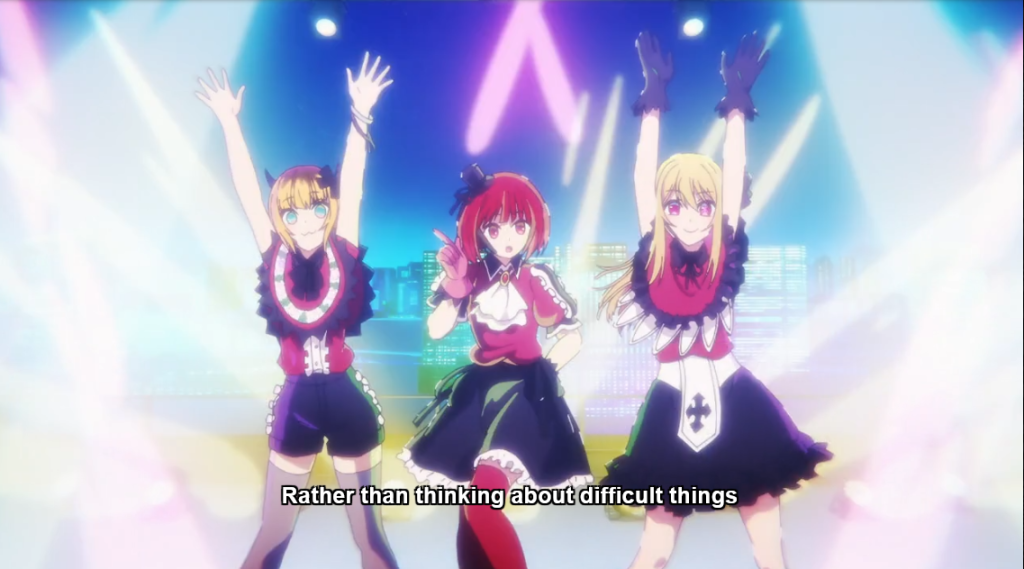
I have covered this series extensively in episode reviews, so the only additional commentary I’ll add here is that it is solidly my pick for the top title of the season. Its balance of humor and serious content was sometimes a little awkward, but no series this season was its equal in terms of depth of thematic development and it had only a couple of equals on character development fronts. Combined that with insightfully biting industry commentary, bold twists, strong direction, and terrific feature songs and you have a strong candidate for the year’s top series. A handful of other series were legitimate candidates for runner-up, and they will be noted in individual entries below.
Featured Title: The Café Terrace and Its Goddesses

This title – which I marathoned most of during the season’s last week – was not one that I initially expected to give more than a blurb to, but in the end it was the one I felt I had the most to say about even though it clearly was not among the season’s best. The premise is fairly basic: a Tokyo University student returns home upon the death of his grandmother (his only living relative) with the intent of tearing down the house and adjoining café, but discovers five young women that his grandmother had been boarding living there. They eventually convince him to reopen Café Familia and serve part-time as its staff while attending high school (one), college (two), technical school (one), or job-hunting/band-leading (one). Though the relationship between the new owner and the girls is mostly prickly at first, both sides gradually learn to work with and even appreciate the other. And is love in the air, too?
While this series is classified by some as a romantic comedy, labeling it a romantic dramedy might be more accurate. It certainly has its humorous elements but takes itself seriously just as often, mostly through analyzing four of the five “goddesses” in detail; dumb, immature jock Ami is the only one left out, but unlike the others, she also gives no indication of any major complications in her backstory. Among the other four, two have different kinds of family issues that they are escaping from by living there, one is trying to dodge a past as a child actor (which she feels tore her family apart), and one is guarding a secret on behalf of the grandmother. Along the way, Hayato learns (sometimes the hard way!) how to not be a jerk as he gives his own brand of help to each girl in turn. Naturally, some of the girls gradually fall for him in the process, and a scene in the final episode reveals that he did eventually end up marrying and having a daughter with one of them – though that scene is, of course, coy about which one it was. After all, a second season has been green-lit for 2024, so you can’t spoil the fun this early, right?
If all of the above sounds like one of those old-school shows where the male protagonist goes around solving the problems of all of the girls, you wouldn’t be far off. Protagonist Hayato’s more acerbic personality sets him apart from the typical “male insert” feel of the such male protagonists, but the familiar structure is still there. A decided harem element does also gradually develop, with three of the girls openly expressing romantic interest by the final episode. (The idiot also declares love, but the feel is that her interest isn’t romantic.) The harem element is also supported by liberal doses of fan service; this is heaviest in the early going but never fully goes away and is occasionally even used deliberately by the girls to tease or otherwise distract Hayato.
While the series is graced with sexy designs, good artistry in general, and surprisingly solid animation, I found big portions of it to be a slog. The main problem is that the series is clear on what it is trying to accomplish but doesn’t achieve the emotional resonance necessary for its content to be fully effective. Some of this stems from using too little set-up and depending too much on stock gimmicks, and it doesn’t help that the series throws in some slapstick-style humor which would feel more at home in more purely comedic fare. And despite the camera being guided by a male eye, the girls at times get away with being outright mean to Hayato, while he gets blamed for much more than he’s responsible for. Even so, just enough of the humor, sexiness, and drama lands for the series to not feel like a total waste. I doubt I’ll be back for the continuation next year, though.
Overall Rating: C+
Other Titles I Finished
These are ordered by when they aired during the week. (Certain titles that I watch multiple episodes of but did not finish – like Kuma Kuma Kuma Bear Punch! – are not covered here.)

Mobile Suit Gundam: Witch From Mercury part 2 (Rating: B+) – This cour certainly wasn’t dull, with a ton of major reveals and twists to go along with respectable action scenes and some thematic depth. The course of events was very Gundam-esque, which in layman’s terms means that the story gets messy and political and not everyone survives, but I mean that as a positive here. The season was hampered some by the distance maintained between Miorine and Suletta (as the relationship between the two was an important factor in the first half), but I liked the character development course it offered for Suletta in particular and the way some other characters matured over the course of the story as well. Its strong (and complete!) ending isn’t entirely without flaws, but it should be very satisfying to most fans and helps elevate the series into Top 5 status for the season.
The Aristocrat’s Otherworldly Adventure (Rating: C-) – The rating for this one might be even lower if not for a handful of stronger scenes here and there, but the ridiculously over-the-top nature of the protagonist’s abilities overwhelmed what other few positives the season may have achieved. It’s not a series I can recommend even to dedicated isekai fans.
Demon Slayer: Swordsmith Village Arc (Rating: C+) – A lot has been said elsewhere about the flaws of this season, so I’ll only add I find most of the criticisms about it to be fair ones. It would get a lower score if not for Nezuko’s status at the end (and how this cleverly plays into the overall plot rather than just being a feel-good detail) and the fact that it still looked damned good even when tediously stretching things out.
Why Raeliana Ended Up At The Duke’s Mansion (Rating: B+) – I almost made this one my feature piece instead and would consider it for my Top 5 for the season. Certainly it was the pleasant surprise of the season for me, as through to the end I found it unexpectedly enthralling, to the point that I would look forward to more if a second season ever gets made. Though the second half of the series continued to suffer on the animation front, Raeliana was a delight to watch in action, character development was solid elsewhere, and it plays with intriguing notions, like what happens to a story when a character thrown into it completely disrupts its course? And did the intended protagonist of the story possibly have wholly different (and wholly less wholesome) motives than what was told in the story the protagonist knows? Accompanied by a stellar English dub, it gets a high recommendation from me.
Dead Mount Death Play (Rating: B) – This one’s weird balance of very dark and comedic elements remains fun through to the end, though I have to knock it a bit for the somewhat awkward and (comparatively) low-key way it shuffles into a seasonal break. (A second season is coming in October.) The dynamics of the setting that the reincarnated Corpse God finds himself in continue to be interesting as the series delves deeper into host body Polka’s family, police investigation into supercriminals, and (in one of the more surprising twists) one of those supercriminal’s own investigations into hints of a secret organization that may be connected to Corpse God’s original world. Will definitely be back for more in the fall.
I Got a Cheat Skill in Another World. . . (Rating: C+) – This one loses a bit of its early luster as its second half slides more towards typical harem tensions, and its limited animation in action scenes never improves, but the strengths that set it slightly above the bottom-feeding isekai of the season still remain: gorgeous character designs, a protagonist who’s more relatable due to his insecurities, and a lead love interest who was interested in Yuya before he became a stud (and seems a bit threatened by the broader interest he’s drawing now that he is one). The thing with the talking rabbit who trains Yuya in kick attacks is just weird, but some plot expansions late in the second half and the addition to the regular cast of the assassin girl liven things up further. If a second season gets made, I’ll probably be back for it.
KONOSUBA – An Explosion on This Wonderful World (Rating: C) – Kinda hate to give such a low grade to a spin-off of one of my favorite isekai franchises, but the magic that made KONOSUBA‘s main series work mostly doesn’t land here. Megumin may be a fan-favorite character, but this prequel shows that (unlike with Mikoto in the A Certain Magical Index franchise) she can’t carry a season alone; it was the zaniness of the interaction of the central quartet, as much as their individual quirks and personalities, which made the original the success that it was. Playing the concept too seriously also hurt the series overall, and Yunyun is better as a gag character than a primary supporting character. The alternate perspective it showed on the first couple of episodes of the original was neat, as was the explanation for where the Axis Church’s aggressive recruiting methods and Megumin’s fascination with Explosion magic come from, but that isn’t enough to balance out other weaknesses. I so lost interest during the season that I had to marathon the second half at the end to finish it, and it felt too much like a slog that way. Hopefully the next KONOSUBA project (a sequel to the main series recently announced as due sometime in 2024) will put the franchise back on more solid ground.

The Ancient Magus’s Bride, season 2 p1 (Rating: A-) – The first season and both OVA series focusing almost entirely on developing Chise and Elias created a very insular story, so this season season represents a paradigm shift, and a welcome one. Sending them to magic college greatly expands their exposure to other people in the magic community, which also greatly broadens the story possibilities. Chise and Elias also get to focus more on interacting with other people rather than just coming to understand themselves and each other, and the big cast of new regular bring all sorts of fascinating problems, idiosyncrasies, and personalities to the table, which collectively expand the magical world-building much further; this is not the standard collection of stock archetypes for a school series. An overall plotline which gradually starts to materialize as the season progresses also raises the stakes, as does Chise having to come to terms with how dangerously strong she may be. Along with G-Witch and Hell’s Paradise, it’s one of my top contenders for the #2 spot for the season.
My One-Hit Kill Sister (Rating: C) – This one is being rated slightly above the season’s other bottomfeeding isekai only because it managed the most impressive-looking action and magical displays of the three. (And the dance routine in the ED – especially with its gender-reversal on the typical dance roles is still neat.) Asahi does see a little true growth by the series’ end, but any positive progress the series makes continues to be balanced out by Maya’s obnoxiously clingy, brocon behavior. Not a series I can recommend, unless you’re really into big sisters with incestuous interest in their little brothers.
Mashle: Magic and Muscles (Rating: B-) – This story about a magic-less musclehead pretending to be a mage at a magic academy has flaws rooted in its formula shonen action nature and flounders anytime it tries to get too serious. However, the stupefying feats of physical prowess that Mash pulls off every episode make up for that, turning this series into a mostly fun ride overall. More is coming next year, and I’ll probably watch it, too.
Tonikawa: Over the Moon for You s2 (Rating: B-) – The exploration into Tsukasa’s past that one might have hoped for here still remains at the the vaguely-hinted-at level, beyond providing further evidence that Tsukasa is centuries old. That raises the question of how Tsukasa apparently didn’t ever have the kind of intimate relationship she has with Nasa before modern day, but they make such a warm and appreciable couple that I’m willing to let that detail slide. The series isn’t doing anything special, but it doesn’t need to in order to continue providing the level of cutesy entertainment that it has provided so far. Not an exciting season, but I will be back for the short run this coming season.
Otaku Elf (Rating: B) – The concept here – that an elf was summoned to this world to be a shrine goddess 400 years ago but is now a hikkikomori-like recluse – had more play than I expected, turning this into a neat, enjoyable series that I can easily recommend. The addition of other summoned elves who each have their own issues helped some, but the series carries itself just fine on the foibles of Elda and her relationship with Koito. The “this was how it was done in the Edo Period” references that Elda regularly adds in are also neat touches for a history buff like me, the supporting cast is eminently-likable, and the role Elda plays in the community – and how she is appreciated and even loved for it despite her oddities – adds an occasional poignant note, too. Also has one of the more underrated OPs of the season. It would easily make my seasonal Top 5 (maybe even top 3) in most other seasons, but the competition this season is just too strong.
Heavenly Delusion (Rating: A-) – Complaints about it being on Hulu aside, this is easily one of the best-looking series of the season, as well as one of the weirdest. It goes into places that are occasionally very dark and graphic as it follows two gradually-converging storylines which, in all likelihood, are in generationally-disparate time frames: one at a research facility where some kind of bizarre experimentation with kids is going on and one in a post-apocalyptic setting where a young woman (who thinks she’s actually her brother in her sister’s body) and her charge (who has an ability which can destroy the man-eating monsters which roam about) are on a quest to find both the mysterious Heaven (which may be the aforementioned research facility, or may not) and the woman’s older brother figure. Love how the series mixes its weirdness with more grounded dramatic elements, which contributes heavily to being one of the season’s top titles. Will be back for the presumed continuation.
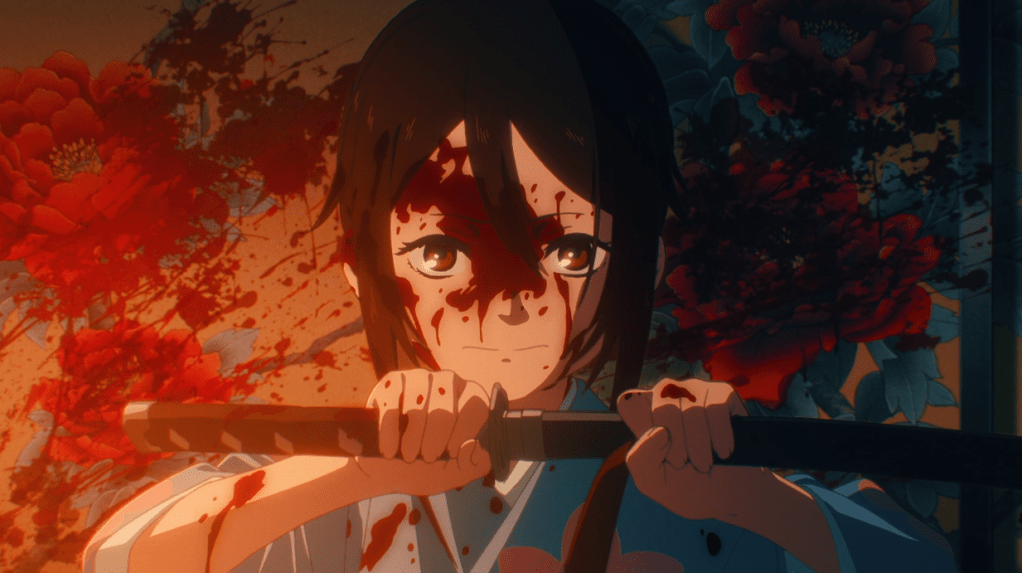
Hell’s Paradise (Rating: B+) – This one is another contender for the season’s best-looking series, though more for its striking use of color (especially in the visually spectacular opener). This was a solid actioner throughout, one which found a good balance between action scenes, character exploration, world-building, and mystery and mystery elements. A strong final episode caps the season out with both its most heartbreaking death scene to date, a major development for one of the lead characters, and a stunning suggestion that one of the foundational premises of the season may be a complete lie. Good – if also very graphic – stuff which easily earns a Top 5 ranking from me for the season, and I’ll certainly be back for its announced continuation.
A Galaxy Next Door (Rating: B-) – This series has been criticized for being too bland, but I found it to be a sweet, low-key look at two young adults who find that the connection between them which was forced by supernatural elements doesn’t define their growing (romantic) relationship; they would have fallen in love anyway. Ichiro and Shiori make for a lovely couple, and I appreciated how Ichiro’s younger siblings were a factor. Good character designs are also a strong point. It may not end up being a memorable series, but it made for a nice complement to TONIKAWA.
Summoned to Another World for a Second Time (Rating: D) – This one had a somewhat interesting premise – that one of the class of students summoned to another world is making the trip for a second time, with a five-year time lapse in the destination world between incidents – and mostly wastes it. This production was lackluster on all fronts, with some of the weakest fight scenes in an isekai series in recent memory being a particular problem spot, one of the most pathetic excuses for a Demon Lord you’ll see anywhere, and a series of eye-rolling plot developments which let no one but the protagonist earn any substantial victory. This is the bottom of the barrel for the season, and at least near the bottom for the genre as a whole.
 USA Anime
I think my estimations and feelings are roughly on par with the shows I saw this season and your own. I particularly liked the 2 stand out Shoujo titles of the season in Raelina and Yamada for genuinely good character work. Demon Slayer was a slog thematically while still looking good. I truly hope Nezuko doesnt get boxed after finally being able to talk again.
It was a hard season to stay in touch with many titles, despite being an on season (Spring and Autumn).
LikeLike
Galaxy’s main problem is that it aired in the same season as Skip and Loafer, My Love Affair With Yamada-kun, Insomniacs After School, and Dangers In My Heart… It wasn’t a bad show, it was just a high-2nd-tier show in a season otherwise packed with top tier romance stories.
LikeLike