Last Update: Thursday 7/13 2:57 p.m. EDT (probable final update)
NOTE: With the posting of the last debut that I will be covering (i.e., The Devil is a Part-Timer! s2 p2), this preview guide is now complete.
Welcome to my seasonal Guide! (For the debut schedule, see here.) I expect to cover every full-episode series that will be debuting this season and several of the sequels, including Mushoku Tensei, Masamune-kun’s Revenge R, Bleach: Thousand-Year Blood War, The Devil is a Part-Timer!!, and the TONIKAWA short season. I will not be covering sequels/continuations for Bungo Stray Dogs, Spy Classroom, The Duke of Death and His Maid, Rent-A-Girlfriend, Sugar Apple Fairy Tale, or Jujutsu Kaisen, and probably not the second season of Malevolent Spirits: Mononogatari.
These previews are listed in newest to oldest order. Without further ado. . .
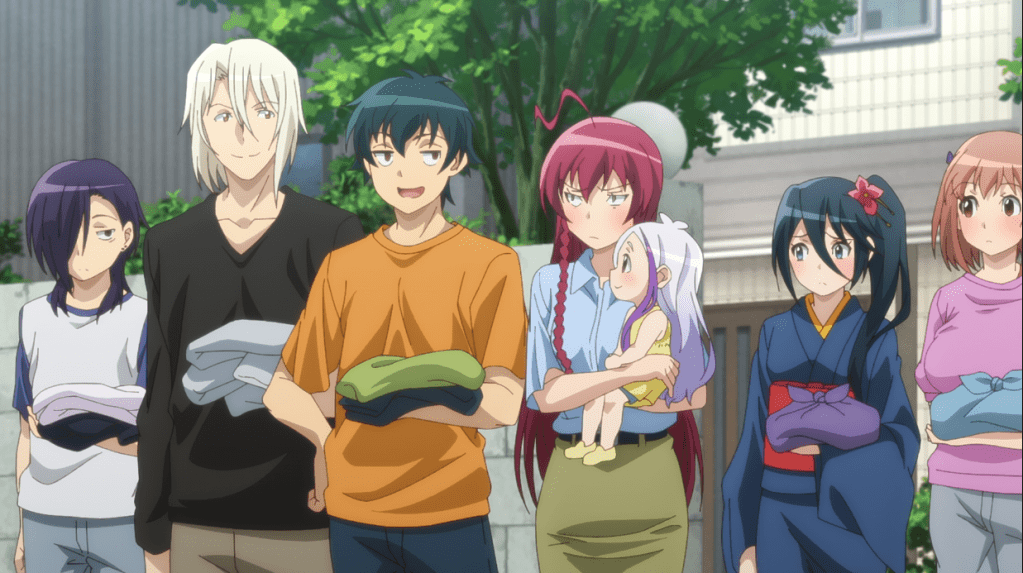
The Devil is a Part-Timer! s2 p2 (ep 13)
Streams: Crunchyroll on Thursdays
Rating: 3.5 (of 5)
In the wake of the encounters with Gabriel and Raguel at the end of last season, life seems to have returned to normal, with the newly-refurbished MgRonald’s now reopened and Alas Ramus getting regular visits to hang with “Daddy” Maou. But Emilia and Suzuna seem to be up to something with Chiho, enough so that that the devils investigate. At a group bath house visit, they learn the truth: Chiho has been undergoing a sort of training under Emi and Suzuno’s guidance.
This episode is adapting an interstitial period in the overall story (i.e., roughly the first third of novel 6), so not much is happening at this point. Still, there are some important things going on here with long-term consequences, including Chiho’s training, the flashback to Maou’s youth at the beginning (and a clear indication that the angel set Maou on his path), and the all-but-outright confirmation that Emi’s angelic mother and the angel who encountered Maou as a youth were one and the same. Amusingly, the boys are the ones who get the fan service treatment in the batho house, while the ladies stay modestly covered up, and the almost-certainly-not-human-herself landlady makes a cameo too! So not a lot to get excited about here, but definitely enough to hold interest.
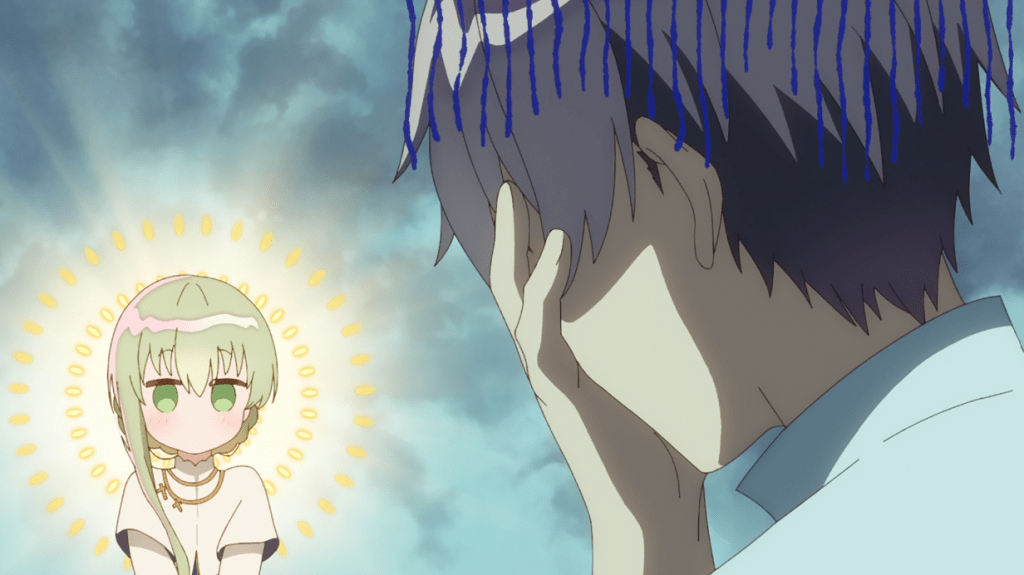
Saint Cecilia and Pastor Lawrence
Streams: Crunchyroll on Wednesdays
Rating: 2.5 (of 5)
In this manga adaptation, Cecilia was a child who wandered into Pastor Lawrence’s village one day and later proved to be an honest-to-goodness saint (albeit one whose miracles aren’t visible to most). Pastor Lawrence looks after her – almost too protectively, in fact – as she shows a lazy side to him but the image of a perfect saint to everyone else. She is also quite clearly smitten with him, though Lawrence is, of course, oblivious.
That’s all there is to this one, which looks to be a fluffy romantic comedy. Cecilia reacts in cutesy fashion to Lawrence in assorted situations, Lawrence either fails to notice it or misinterprets it while being a nice guy himself. . . it’s all pretty saccharine and spends most of the episode playing that scenario over and over again, to the point of doldrums. That and some mediocre artistic merits (but better animation!) are why I can’t rate this episode any higher even though it is occasionally actually funny. These kind of shows can work, but so far the chemistry between the two leads just isn’t there.

TONIKAWA ~High School Days~
Streams: Crunchyroll on alternating Tuesdays?
Rating: 4 (of 5)
This is a four episode miniseries that will apparently be airing every two weeks and seems to take place after the events of the recently-completed season 2. In it, Nasa is drafted by Yanagi-sensei to serve as a guest lecturer on programming at her school, which is woefully incapable of meeting new standards for computer literacy. The big catch is that Yanagi-sensei has moved up to teaching at an all-girls high school, which makes both Tsukasa and Nasa anxious (albeit for very different reasons). The girls are understandably curious about Nasa being married at such a young age, and there may even be one eccentric girl who’s as smart as he is.
As TONIKAWA episodes go, this one is above-average. It provides an adequate set-up for how Nasa can be in this situation, cutely plays up Tsukasa’s minor insecurities, and throws in a bevy of new characters to liven things up. Both of the Arisugawa sisters are also in fine form, and Tsukasa once again dazzles with his brilliance. (Entire companies are devoted to producing what Nasa creates overnight for charting student performance.) It also provides an intriguing mystery with the masked girl who apparently wants to go to the moon, which should make an inevitable encounter between her and Tsukasa interesting indeed. I don’t think this is a side story, so it should be on the viewing list for any established franchise fan.
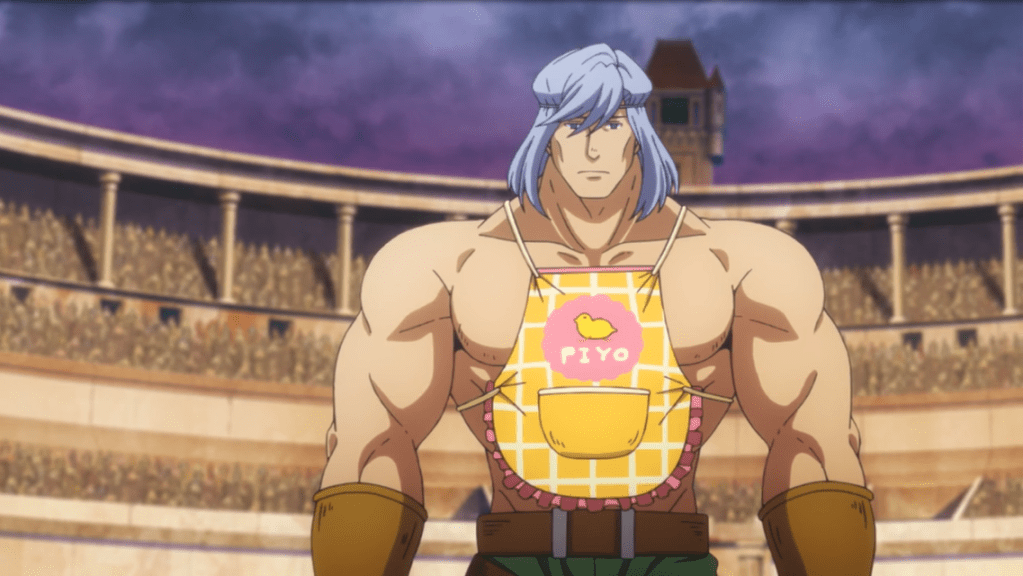
Helck
Streams: HIDIVE on Tuesdays
Rating: 3.5 (of 5)
The Demon King has been defeated by the human Hero, so the demons are holding a tournament to seek a replacement. But the top contender so far is an indomitable human name Helck, much to the dismay of Vermilio the Red, the high-ranking demon in charge of the tournament. What’s more, Helck is surprisingly popular with the public, in part because he is very sportsmanlike and because he asserts that he hates humans but loves the demon realm. Vermilio doesn’t trust his motives, and so does everything she can to put challenges before him that will thwart him, but he’s just too good at everything. However, there are mysterious circumstances afoot in the human realms, and a human attack that may or may not have anything to do with Helck.
This is an adaptation of a finished manga which was released in Japan in the mid-to-late 2010s but has only this year started to be released in the States. Its first episode succeeds because of many likable components. Helck is a goofy, lovable oaf and Vemilio is a likable ball of not-always-contained rage well-suited to her name, a demon who’s obsessed with the notion that Helck has ulterior motives for his presence in the tournament. In fact, reading too much into what’s going on is a recurring theme in the episode, though the irony is that some big conspiracy really does seem to be going on, too, and that may involve Helck even if he’s not a participant in it. So yes, the first episode manages to be both funny and set up a dramatic mystery.
I don’t see much for high-tier action coming out of this one, and the rating should be considered a conservative one. This was one of the more anticipated shows of the season, and it does show the potential to back that up.

Synduality: Noir
Streams: HULU+ on Mondays
Rating: 3.5 (of 5)
This is the anime branch of a mixed-media project from Bandi Namco Group that will soon also include the action RPG Synduality: Echo of Ada. It is set in a post-apocalyptic world where humans live in giant shelters and use Drifters (read: mecha pilots) to defend against alien-looking creatures called Enders. Protagonist Kanata isn’t a Drifter, but he is paired with one in a scavenging team. While on such a job, he finds a strange, inactive Rei Ayanami clone Magus girl and takes her home. (Magus are apparently humanlike androids who assist Drifters in piloting mecha by controlling the technical aspects so the Drifter can focus on directing it.) She awakens as an amnesiac who doesn’t seem to know anything but, in a crisis, proves to be quite capable in assisting Kanata at piloting. It’s then that Kanata learns her name is Noir.
The first episode distinctifies itself with upper-end CG animation of Sakura Wars-size mecha and nasty-seeming aliens; in fact, the overall animation effort is quite good. Don’t expect any explanation about what’s going on with the setting, as the writing seems committed to having viewers figure that out from scattered tidbits – for better or worse. I’m also concerned that Noir has too little personality so far. Still, the visuals are good enough, and the dialog smooth-flowing and natural enough, that I am willing to watch more.

Dark Gathering
Streams: HIDIVE on Sundays
Rating: 4 (of 5)
This manga adaptation was another of the more highly-anticipated series for the season, and the first episode capably shows why. Finding just the right balance of silly cuteness and effective horror is one of the more difficult genre combinations to pull off in anime, but this debut delivers in a way that will enthuse audiences about coming back for more.
Keitaro is a college freshman who attracts spirits to such a degree that it drove him to be a hikkikimori for a couple of years. Yayoi is a little girl with skull-shaped eyes that allow her to see spirits who is looking for the spirit of her dead mother. Eiko is a cousin to the latter and longtime friend to the former who brings them together, though she cannot see or sense spirits herself. Keitaro is terrified of spirits (or at least insists that he is), but spirits seem to be terrified of Yayoi, who proves quite capable of dealing with a phone booth spirit whom Keitaro attracts. They’ll make a great team!
I really didn’t think this was going to work at first, but as the story progressed, Yayoi gradually won me over. She’s a cute, mostly emotionless menace, and the direction smoothly transitions her between her cutesy behavior and the terrors that only she can usually see. By the end of the episode, it’s not hard to understand why spirits fear her. The artistic and musical efforts are also effective at convincing viewers that dark things which should be feared do exist, and the late reveal of one of Keitaro’s hidden proclivities is a neat touch which connects to that and casts his earlier hikkikimori stint in a different light. (Maybe he just couldn’t come to terms with that?) There’s a lot to like here, and it will contribute to a stacked Sunday for quality shows this summer.

Classroom For Heroes
Streams: Crunchyroll on Sundays
Rating: 2.5 (of 5)
In this light novel adaptation, the aptly-named Blade was a Hero who defeated the Demon Lord. Now he’s looking forward to a normal school life where he can make friends. To that end, he joins Rosewood Academy, a school set up to inculcate students to be the next great Hero. There he encounters Earnest Flaming, an heiress and intimidating top student, whom he works hard to befriend despite her hostile attitude. And it turns out she has a little problem with a demon sword, which he can help resolve.
While watching this episode, I often found myself thinking of last year’s The Iceblade Sorcerer Shall Rule The World, which has a somewhat similar premise. Unlike that one, though, this one has two major problems: its first episode moves along too fast, and perhaps partly because of that, it cannot seem to settle on a consistent tone. It badly wants to be both funny and serious, and while finding such a balance is certainly possible, the episode switches back-and-forth with whiplash-inducing intensity. That it condenses a storyline which would normally be spread over two episodes into one is a big contributor to that, but at least the episode does get Earnest past her gruff stage quickly. The series also delivers a stark contrast between the normal-looking students and the very motley assortment of Advanced Class members, who mostly look like rejects from My Hero Academy. Technical merits are average at best, though the episode does deliver a fair amount of fan service (all at Earnest’s expense), including significant amounts of undefined nudity.
There might be something watchable here if the story settles down a bit, but this debut is all over the place too much to recommend at this point.

Zom 100: Bucket List of the Dead
Streams: Crunchyroll on Sundays
Rating: 5 (out of 5)
This was one of the most-anticipated new series of the season, and that may have been an under-estimation of its potential appeal. If any new series this season is going to be a break-out hit, it’s this one. Only a somewhat slow start hampers it from being one of the best debuts in recent memory.
Even so, that slow start – which details how protagonist Akira’s optimism about his new job gets crushed under the weight of abusive work conditions – is still necessary for fully appreciating what the first episode is doing. It shows that Akira had effectively become a corporate zombie, hence setting up the supreme ironic contrast with the second half of the episode, where a zombie apocalypse actually happening for real (and not just in the movie he was watching) proves to be a liberating experience simply because he doesn’t have to go to work anymore. Probably no one in any form of media has ever had a more joyous expression while actively being chased by a pack of flesh-hungry zombies, and the episode hits a grand-slam home run in its effectiveness at conveying how Akira’s world has become brighter even as it’s descending into utter chaos.
And it can do that because the episode excels on every production front. This is a top-rate animation effort backed by lavish, eye-popping visual and color design (blood splotches on those other than Akira are done in an array of colors, which can make a bloody scene look like avant-garde art instead) and supported well by an on-point musical score. The series even has a person specifically for “zombie design” in its credits, which may be why the zombies here feel a little more exciting than normal.
The graphic content is high, but if you can tolerate that then this is a must-see debut. It will be on my seasonal watch list.

Bleach: Thousand-Year Blood War p2 (ep 14)
Streams: Hulu+ on Saturdays
Rating: 3 (of 5)
After taking half a year off, Bleach is finally back to continue its story about the Quincies wreaking vengeance on the Soul Society. This grand return is marked by. . . not doing much of anything, really.
To be sure, this is one of those transitional episodes that sets up for this season’s part of the arc. As a result, we git tidbits from many fronts. The biggest and most potentially consequential event is Uryu formally siding with Yhwatch, to the point of being named his successor. Interestingly (and perhaps not surprisingly), many of the Stern Ritters aren’t too happy about this. Beyond that, Byakuya’s back on his feet, Shunsui makes an odd visit to Ichigo’s human classmates back in the physical world (not sure how he’s able to do that, since I though Captains appearing there wasn’t normally allowed because it’s too disruptive), and various others are training. And that’s it, aside from the Quncies making their move as the episode closes out.
As much as this is mostly a low-key episode, I can easily see some major consequences resulting. The discontent among the Stern Ritters over Uryu is certain to boil up again, and I’m not at all convinced that Uryu is genuinely siding with Yhwatch, no matter how contentious his attitude towards Soul Reapers has always been. Some stylish opening visuals and new OP and ED also mark this return. Have to give the episode a middling grade because the episode ultimately didn’t accomplish much, but we should be back to action frenzy soon.

TenPuru
Streams: Crunchyroll on Saturdays
Rating: 1.5 (of 5)
Akemitsu Akegami’s father was an infamous playboy, and Akemitsu is determined to distance himself from the notoriety that has dogged him even up to his college years. That has meant avoiding anything to do with women, until a chance encounter left him with love at first sight. Desperate to overcome how obsessing on that is wrecking his life, he decides to become a monk, only to discover that the monastery he was sent to has converted to a nunnery. Sexy hijinks ensue.
Yeah, this manga adaptation is a throwback to the more slapstick-laden harem romcoms of the ’90s and 2000s. It gives every indication that it is going to be fan service-heavy, too, though the OP probably has more fan service in it than the actual episode does. While the fan service quality isn’t bad, the humor mostly doesn’t land and neither the technical merits nor the character designs impress. I have nothing against fan service-heavy series in general, but this one shows little hope for offering anything besides that.
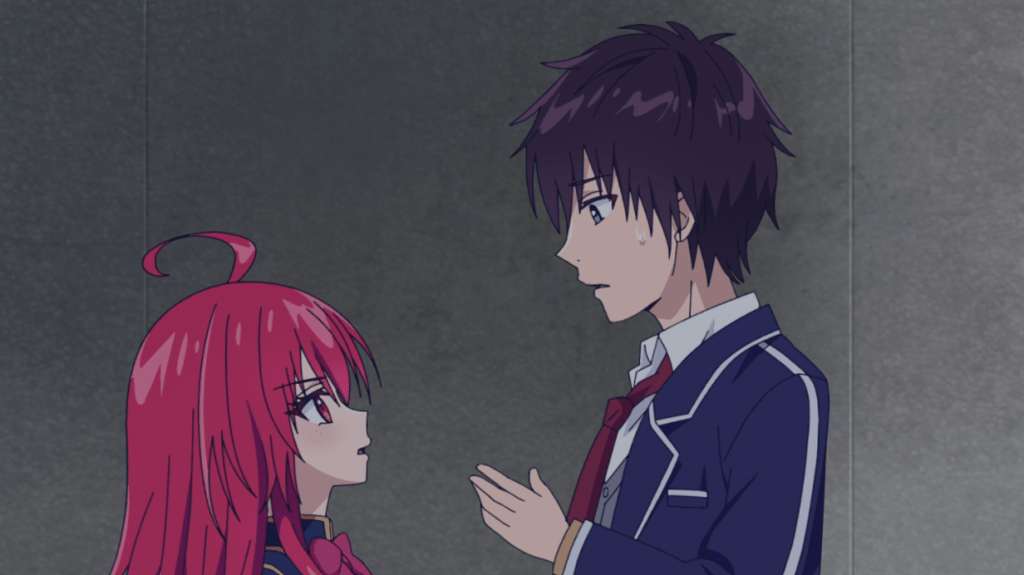
Liar Liar
Streams: Crunchyroll on Saturdays
Rating: 2.5 (of 5)
On Academy Island, competition is everything and ranks are determined by stars earned from winning/losing games. New transfer student Hiroto is the new hotshot Seven Star (which essentially means that he’s the top-ranked student on the island), having defeared the previous Seven Star (aka “Empress”), Sarasa. But Hiroto’s ranking and arrogance are both complete acts, his win over the Empress was a fluke, and his indomitable ability is supported by secret, illegal tech support, all powered by a special star ranking that allows him to get away with a big lie. Sarasa also has her own huge lie, and it would be trouble if Hiroto was defeated by anyone else (and thus her lie comes out), so the two form a secret working alliance while Hiroto is also assisted by his assigned maid in maintaining the deception.
This light novel adaptation is another one of these illogical “games determine everything” school stories, a la Kakegurui, but without a fraction of that one’s style and flair and with decidedly weaker artistic and technical merits beyond some interesting uses of symbolism. It also has more logical holes than normal, such as why a girl so indomitable at games could so easily be flummoxed; surely someone would have discovered that weakness before now? Hiroto is quite capable of putting on an act, but otherwise none of the major characters introduced in the first two episodes (episode 1 was broadcast early in Japan but not on Crunchyroll, apparently) varies much from standard archetypes, either. The one factor which could make the series just barely watchable is the increasingly more involved layers of lies that Hiroto and Sarasa are operating under, and I presume that other characters will have their own secrets, too. Not confident that’s going to be enough to keep me watching, though.

My Unique Skill Makes Me OP even at Level 1
Streams: Crunchyroll on Saturdays
Rating: 3 (of 5)
Ryota was a corporate slave at a probable “black company.” Whether he died at work or was transported through some other mechanism is uncertain, but he wakes up in a dungeon in a world where all production (even food, apparently?) comes via drops in dungeons. Through contact with maul-using adventurer Emily, he soon learns that the new world operates on game mechanics and that he’s stuck at level 1, though he does have one useful ability: his drop stats are maxed out, which means that he’ll always get vastly better drops than anyone else for the same effort. Discovering a way (apparently exclusive to him) also helps him get ahead, allowing him to purchase a run-down little home and start living with Emily. Then the bunny girl shows up.
Honestly, I wanted to rate this one lower, as the art style is not that appealing, the animation is basic, and almost nothing that the first episode shows is fresh. However, the way Ryota is weak and yet capable of totally busting the economic basis of the world is intriguing, and his interactions with Emily have a certain amount of charm. I can’t this one ever being good, but it has at least some potential as a fluff watch.
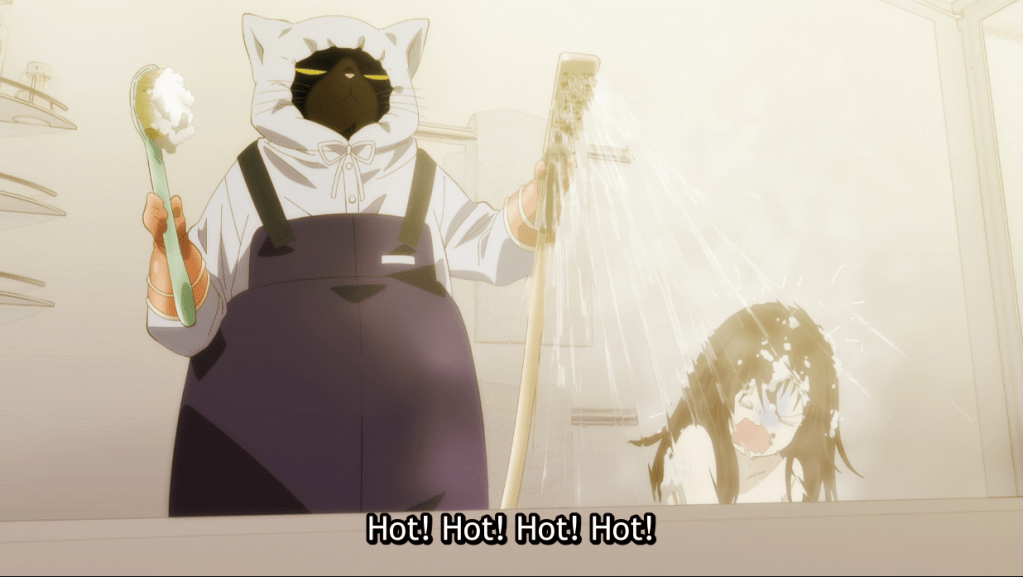
The Masterful Cat is Depressed
Streams: Crunchyroll on Fridays
Rating: 4 (of 5)
This one comes with a caveat: it is the second of the two Studo GoHands productions this season (and somehow features the same principal production team), and it uses many of the same visual gimmicks that their other series – The Girl I Like Forgot Her Glasses – does. As a result, anyone who had problems with the visuals on that one is going to have some of the same problems with this one, even if this one is toned down a little by comparison.
Get past that, though, and you’ll find what could easily be the funniest series of the season, if not the year to date. It features Saku, a young office drone who, a few years ago, took in an abandoned kitten during a snowstorm. The kitten she dubs Yukichi has now grown up – and we’re talking about big even for human size and walking around on two legs. Yukichi doesn’t talk, but he’s clearly quite intelligent (maybe more so than his master!) and has become a domestic god, cooking all of Saku’s meals, doing her laundry, and even looking after her when she gets drunk. Saku’s such a mess that she needs looking after, but Yukichi seems to be both happy to do it and take pride in it, though he still hates water so much that he wears a raincoat when washing the tub.
The magic here is that what might be mildly funny with just an ordinary human filling the role becomes tremendously funny when an anthropomorphic cat does it, and Yukichi conveying everything through just grunts and body language makes it even funnier. I will be recommending this one even to my cat-loving friends who aren’t big anime fans.
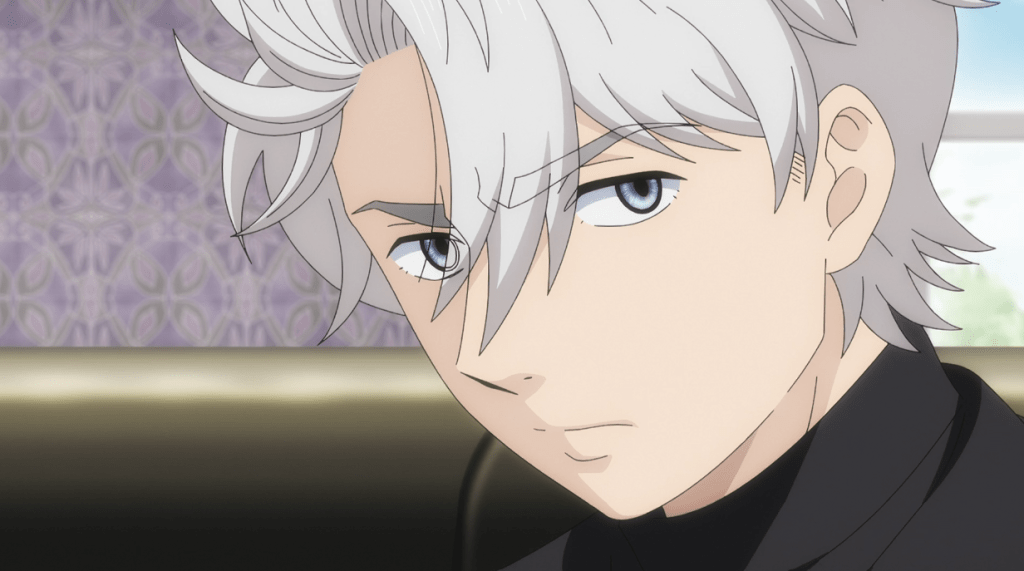
The Gene of AI
Streams: Crunchyroll on Fridays
Rating: 4.5 (of 5)
Anime which explore deeper themes aren’t terribly usual, but anime which are truly thought-provoking only come along once every few years. This manga adaptation could b very well be the next such title. That makes the first episode a bit of a challenge to watch (although I don’t mean that in a bad way), I can guarantee you that I won’t be forgetting about it anytime soon.
The setting is a near-future world where advances in AI and robotics have made artificial humans, called Humanoids, and augmentations to human brains possible. However, making copies of neural networks – even for backup purposes – has been deemed illegal, in part because of its past use in terrorism schemes. That isn’t the only factor making the process morally and ethically questionable, though, and that is the issue that Humanoid-specializing doctor/technician Hikaru Sudo must confront as he assumes his underground identity to work with a couple where the mother caught a terminal virus from a back-up attempt. Yes, the mother can be cured by being restored from the back-up, but that requires wiping out everything currently there. The husband sees that as just the sacrifice of a few days of memories, but both the mother and their adopted human daughter must confront whether or not the back-up is really still the same person. For the mother, the back-up represents loss of self, while the daughter faces the transfer of emotional attachment. The relevance of this to Hikaru’s own story makes this case hit a bit harder for him.
Technical merits are not exciting, but the Next Episode preview suggests that weighty content will be the norm. This is a concept that I cannot see ending up being very popular, but I have to respect a series that is aiming as high as this one is. This is one of the big outliers for the season, and I will definitely be watching more.

Reign of the Seven Spellblades
Streams: Crunchyroll on Fridays
Rating: 3.5 (of 5)
The Kimberly Magic Academy is a dangerous place: fully 20% of its students are “consumed by the spell (i.e., either die, get spirited away, or lose their magic) before graduating. Even so, it’s prestigious enough that teens from all over the continent come there to study. Due in part to a bit of excitement during their arrival, six incoming freshmen from very diverse backgrounds – people who might otherwise never meet – start associating with each other.
As opening episodes for Magic Academy series go, this one is unspectacular but gets the job done. It introduces the six main cast members (which raises the question of who the seventh Spellblade is supposed to be), spills a little about the school, and gives the main cast a chance to get involved in an exciting/dangerous incident where they get to show off their magic. Personality types are a mostly standard mix, with the one aberration being the the samurai girl is the simple-minded, good-natured one rather than the stern one, but the initial interactions between them are promising; this is a group that already feels like it can bond well even before the first episode ends. Most are already showing signs of specialties; one is a flora specialist, one is a fauna specialist, one is a strategist, one is a melee fighter, one is a diplomat, and one is, essentially, Hermione. All of this is fine but, like the technical merits, not special.
However, there is hope that this will amount to more. The meet-and-greet scene throws out one tantalizing hint of a more involved background story, and the final scene, where the strategist boy meets first a secret agent and then the samurai girl, throws out some bigger hooks. There are some stories to tell here, and that’s enough to get me coming back for at least a couple more weeks.

Rurouni Kenshin (2023)
Streams: Crunchyroll on Wednesdays
Rating: 4 (of 5), if you ignore the baggage
Though I was active in fandom back around the time the original Rurouni Kenshin animation aired, I somehow never saw more than a random episode or two from the franchise and only know a bit about the characters. Hence, I am reviewing this reboot as a relative franchise newcomer. I also am going to evaluate the series on the content it presents alone; I perfectly understand if some wish not to engage with the property any further because of the offenses of its creator, but that is not a factor in this evaluation.
Based on that, this first episode should do quite well at attracting whole new generations of fans to the Rurouni Kenshin franchise. The tweaks to the designs of franchise mainstays Kenshin and Kaori bring them in line with more recent visual trends, and its sensibilities about action shortcuts are typical for recent series which don’t have lavish budgets. In all, the first episode looks very good, and I can see the hip hop-infused OP quickly becoming a hit. The story is also easily relatable: 11 years into the Meiji era, a wandering former samurai with an easy, low-key outward nature encounters a young woman struggling to keep her family’s dojo and sword style alive, especially in light of a killer using her dojo’s style name to commit crimes. Kenshin, who was a notorious killer during the strife which marked the beginning of their Meiji era, finds Kaori’s willingness to overlook a person’s past to be naïve but also enticing, so he not only helps her out with her current predicament but agrees to stay on.
Overall, this looks like a successful restart to a franchise which hasn’t lost its edge with the years.

The Great Cleric
Streams: Crunchyroll on Thursdays
Rating: 2.5 (of 5)
I will at least give this one credit for finding a novel way to put a protagonist into a reincarnation situation (i.e., getting hit by a stray bullet when a police officer tackles an armed suspect). That’s about all that is novel about this light novel adaptation, however. In the story, Luciel is a newly-reincarnated former salaryman who has chosen the profession of Healer in his new fantasy setting, partly because he’s sure he can find work with that occupation and partly because he feels he doesn’t have what it takes to go face-to-face with monsters. He goes to the nearest town, gets set up in the Healer’s Guild, and trains via repetition until he can cast Heal, then sets out to find work. An opportunity to use his new talents comes quickly when he encounters a party of badly-injured adventurers.
Yep, there’s nothing more to it than that. Luciel doesn’t seem to be OP so far, but his previous occupation does give him a mindset towards learning and adapting quickly, which may mean that he will develop faster than normal as a fledgling healer. I’m fine with that, and there are at least some mildly interesting world-building tidbits here: an order of female paladins, for instance, and a well-structured Healing Guild network, complete with concerns about corruption. That makes up some for lackluster technical and artistic merits, uninspired world visual design, and a generally-dull execution. Luciel’s cheery disposition also feels at odds with his work ethic. This series needs to show something more quickly to draw any kind of audience.
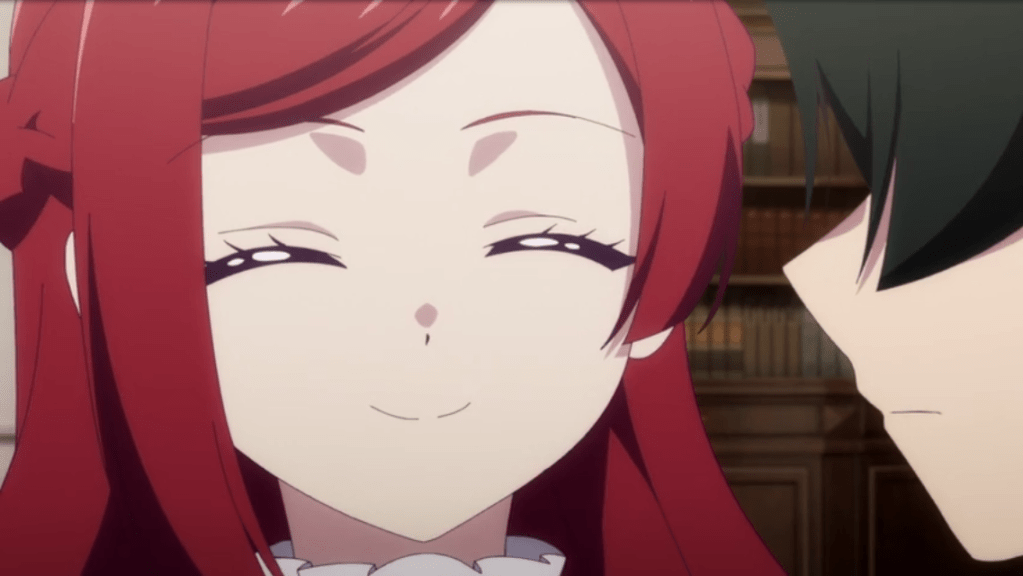
The Most Heretical Last Boss Queen: From Villainess to Savior
Streams: HIDIVE on Thursdays
Rating: 3 (of 5)
The set-up here is about as stereotypical as could be imagined for a “reincarnated as a villainess” story: a young woman eager to get the most recent release of her favorite otome game series is killed by Truck-kun and awakens as the 8-year-old Princess Pride from the story. This is a problem because the Pride in the story is wicked to the core, to the point of destroying the kingdom several years later when she’s ascended to the throne and being killed off by the love interests of the main character: her younger sister. She is determined to both prevent that from happening and guide Pride away from her demoniacally evil path.
The problem is that this series is debuting right after one of the better entries in this genre – How Raeliana Ended Up at the Duke’s Mansion – ends. It certainly looks better than Raeliana, with sharp character designs and better animation, but Pride comes across as too much of a crybaby and her effort to turn around Pride’s behavior aren’t anywhere near as compelling, perhaps in part because her life isn’t (yet) on the line. Her adopted younger brother/assistant Stale also can’t hold a candle to Raeliana’s Duke Noah. There are some nice touches here; the way magic interacts with politics in this setting is interesting, and the servants’ body language efficiently shows how rotten Pride was before, and in general, there’s nothing actually wrong with the first episode. It just doesn’t stand out in any way in an increasingly-populated subgenre.

My Happy Marriage
Streams: Netflix on Wednesdays (weekly)
Rating: 3.5 (of 5)
Despite the title,Miyo Saimori is anything but happy. Though she is the eldest daughter of the Saimori, she is treated as nothing more than a servant by her father’s second wife and her half-sister and regarded with disdain by both. Even the attention of a boy who’s interested in her can’t soften the blow, especially when he’s betrothed (against his wishes) to Miyo’s half-sister. She, meanwhile, is sent to be the wife of the notoriously cold Kiyoka Kudo. But despite his brusque manner, Miyo fines a rare light of hope in their first meeting.
The advertising blurb for this light novel adaptation indicates the presence of a supernatural component, but you couldn’t tell that from the first episode, and I see no need for it anyway. This looks exactly like a straight-up Meiji-era period drama, with only clothing and building styles differentiating it from an 18/19th century European period romance about a young woman being sent away to marry someone she’s never met before. Even the fact that she’s escaping a home where she was treated poorly follows that same progression. Doubtlessly Kiyoka will prove difficult but still with a certain kind of appeal, and hopefully his home will provide an environment where the morose Miyo can learn to stop hating herself. If not, this story would be too depressing by far.
This Kinema Citrus production is one of the best-looking debuts of the season so far, whether in character designs, backgrounds, or animation, and is supported by a soft, subdued tone. The problem I had is that the first episode goes comparatively overboard in being mean to Miyo. Her half-sister is such a piece of work that she strays into evil caricature and her stepmother isn’t any better. Her stern father doesn’t seem entirely unsympathetic, but he barely defends her and does not cut her any breaks, either. The first episode also progresses a bit too slowly, seemingly stretching things out so it can end with Kiyoka’s introduction. Still, this is made well enough that I may give it at least a couple more episodes to prove itself.

Undead Murder Farce
Streams: Crunchyroll on Wednesdays
Rating: 3.5 (of 5)
For as many people as were highly-anticipating this one, I was rather surprised to see that “sneak preview” ratings for the first episode were mediocre. After seeing the first episode, I can understand why. For as interesting as its concept is, the first episode devolves way too much into a bunch of talking heads – both figuratively and literally.
The literal talking head is an Immortal who as lost her body to an attacker and would rather just die than be stuck like that forever. She approaches the freakshow performer Oni Slayer because she can sense that he actually is part oni, and thus capable of killing her. She’ll save him from going full-oni (which he, ironically, is not objectionable to, since he sees it as a dramatic way to go out) in exchange for him offing her, but he proposes an alternate option: track down the body-snatching culprit instead, since he may be linked to how Oni Slayer ended up like he is.
That’s a cool idea, and the visuals and animation (especially in action scenes) both look a cut above. It’s even directed by the guy who helped turn the Kaguya-Sama franchise into a big hit. However, the first episode bogs down when it gets the to the point of explaining the severed head’s situation and goals, and even attempts to keep the characters moving don’t fully offset that. The foundation is here for this to be one of the season’s signature series, so hopefully the first episode is just a fluke on pacing.

Reborn as a Vending Machine, I Now Wander The Dungeon
Streams: Crunchyroll on Wednesdays
Rating: 4 (of 5)
A vending machine otaku ironically dies from being struck by a vending machine which has fallen off the back of a truck, so what more fitting fate for him than to be reborn as a vending machine in a dungeon? He soon discovers that taking in coins gives him points that can be used for health, abilities, or even changing his offerings and power himself, but being in a wilderness area leaves him in dire straits until he’s found by Lammis, a young female Hunter (read: adventurer). With a Blessing of super-strength, she picks him up and carries him back to her village after sampling his wares. There he soon becomes a hit and earns the name Boxxo.
I am probably a bit biased here, as I have read the first source novel and know how this one plays out, but the weird concept here actually works and, if the series remains faithful to the novel, should continue to do so. The one minor change – that Lammis is decidedly less outrageously busty in this version compared to novel art – is an improvement in my book, and there are already hints of the neat relationship which will develop between Lammis and Boxxo. There’s some interesting world-building going on here, too, with this being a dungeon setting despite looking like outdoors and with Boxxo limited to only saying things that Japanese vending machines can say. Technical merits are not stellar, but designs are likable enough to far. I encourage people to give this one a chance even if reincarnation isekai is not normally your thing, as it may surprise you.

The Girl I Like Forgot Her Glasses
Streams: Crunchyroll on Tuesdays
Rating: 3.5 (of 5)
To a degree, I can sympathize here with both male lead Komura and female lead Mie.
In the latter case, I started wearing glasses in my upper elementary school years and probably forgot to take them to school on numerous occasion before I got to driving age (I can’t drive without them, which gives me a hard reminder), but unlike Mie, I wasn’t practically blind without them. I can also completely relate to Komura’s fascination with a seat neighbor, and I was probably nearly as loopy and skittish about it as Komura is here. The series’ writing nails that and also makes Mie understandably appealing, hence making this one of the more believable and finely-tuned of the “guy fascinated with odd girl” series out there.
The possible downside for some is that this is a Studio GoHands production, which means you can expect lots of weird angles and a freely-roving camera mixed in with an impressive level of background animation. Frankly, the production overdoes the visual gimmickry, but I’m not sure if I saw any completely still frames in the whole episode, which would be extremely unusual for a basic slice-of-life series like this. That contributes to an overall mildly positive impression (though I suspect that my reaction may be one of the more favorable ones).

Sweet Reincarnation
Streams: Crunchyroll on Mondays
Rating: 2.5 (of 5)
In this light novel adaptation, an unnamed genius pâtissier dies from an accident during his moment of triumph. He laments not being able to create a world of sweets, but then discovers that he’s been given a second chance – but as the son and youngest child of a rural suzerain lord. (Really, how often have we seen this come up in isekai reincarnation stories in the past few years?) But before he can realize his perfect world, he has to help his father protect his fief from skilled marauding bandits. And that means finally unleashing the special magic he’s been endowed with.
Rather than getting a double-episode debut, this one gets two regular episodes. After seeing both, I can understand why: the first episode only reveals that protagonist Pas (short for Pastry, naturally) got magic from his early coming-of-age ceremony, not what he got. That reveal is the one thing which keeps this debut from being totally uninteresting: Pas’s magic can replicate things. . . and that can include injuries as well. Used offensively, it’s a devastating power, as only one member of a unit would need to be grievously wounded to take out the whole unit. I’m sure it has even broader non-combat uses, too. It’s almost worth watching more just to see what Pastry can do with this power, and he isn’t grossly OP like some of his recent contemporaries have been, but unimpressive technical merits, too many OP boys, and the way his pastry dreams don’t fit well with the setting are just too many negatives. And really, I can’t take seriously a series where one of the most important characters is literally named Lord Casserole. . . (Food-based names are a recurring theme.)

The Dreaming Boy is a Realist
Stream: Crunchyroll on Mondays
Rating: 3 (of 5)
In this light novel adaptation, Wataru has so persistently romantically pursued his idol Aika (despite many rejections) that classmates and even his teacher have come to regard it as the normal state of things. Hence they’re all thrown for a loop when Wataru has an epiphany that he’s being a pest and decides to back off to just supporting her from a distance. However, what he didn’t bank on is that no one is more thrown off by this than Aika. He has utterly failed to notice that Aika may have welcomed his attention more than she ever let on.
The big problem this one faces is its weak technical merits; it’s never a good sign when characters look off-model even in the first episode. I am much more ambivalent about the premise. It still hints at being a male wish fulfillment scenario, but the roundabout path it’s taking creates a different sort of tension than usual. There’s also some potentially interesting angles in the friend of Aki who seems to be her chief defender but may actually be aware of the weird dynamic between them, or one other girl who briefly expresses interest in Wataru with ulterior motives. Another episode or two may be necessary to determine if this one is a keeper or not, hence the default middle score.

Masamune-kun’s Revenge R
Streams: Crunchyroll on Mondays
Rating: 2.5 (of 5)
Of all of the sequels this season, this one is easily the least expected. Though the first season (in 2017) ended so weakly that a continuation felt necessary, I have to wonder why it is happening now. After all, it’s been six years, and the source manga has been finished for four. I’ve seen nothing to indicate that the series is enduringly popular, either. I guess the fact that it’s in the Top 200 for popularity on MAL means it still has fans?
Anyway, though I episode-reviewed the first season, I remembered so little about it that I had to go back and review. The first season was the story of a young man who, as a chubby boy, was cruelly rejected by his love interest, so he hatched a plan to better himself, get her to fall in love with him as teenagers, and then reject her. The approach and brand of humor the series used was enough on the mean side that some viewers grew to hate it, and neither of the leads was especially likable, but a good collection of twists and turns and a decent supporting cast mostly carried the series. This season looks like more of the same, with it starting during a class trip to Paris. (Having been to Paris myself only three weeks ago, I can refute the bit about seeing PDAs everywhere.) Masamune and Aki cross paths with a French girl who’s enough of an otaku that she knows some Japanese and seeks to make her own Japanese-style manga, and they can’t help getting involved on their free time when she’s implied to have a mobster-style family behind her. In an amusing bit of irony, they are left with the difficult task to show Muriel what Japanese romcoms actually look like. Meanwhile, other characters are making their moves, including a big secret being dropped about Masamune’s rival Kanetsugu and maid Yoshino’s secret pact with Masamune coming to light.
The only thing which looks promising about this season is seeing where the two aforementioned twists go. Technical merits were never a strong point of the first season, and that hasn’t changed. Five years ago I might have still watched this despite its mediocre first episode, but for me at least, the series’ time has passed.
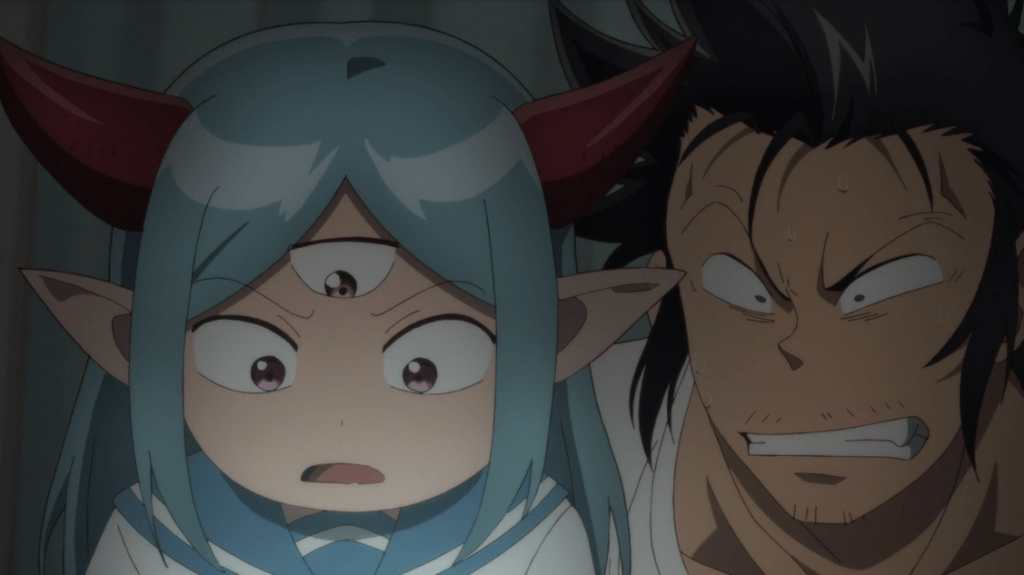
Level 1 Demon Lord and One Room Hero
Streams: HIDIVE on Mondays
Rating: 4 (of 5)
Back in 2013, The Devil is a Part-Timer! spun a wonderfully farcical tale about a Demon Lord and Hero both brought low by modern society in the wake of their climactic battle. This series is an alternate angle on that same concept, one which takes a more earthy approach to its humor as it addresses a pertinent question: what does a world do with a Hero once his battle is over?
Though everything here is presented in comedic form, the answer is sad but realistic: Max the Hero isn’t needed anymore, and falls victim to a press and social media eager to find faults. (Although there is a tacit implication that Max brought at least some of this on himself through less-than-careful actions.) By the time a decade has passed, Max has become disillusioned and disgusted with the world, to the point of becoming a recluse and not caring if the revived Demon Lord destroys it, which leave the Demon Lord (reborn into a chibi form) utterly aghast. Though the Demon Lord vowed revenge, he also respected the Hero for having defeated him, and seeing that he lost to a man who has become such a loser is a blow to his pride. So he decides to move in with Max to reform him, much to Max’s dismay.
The premise is a solid one, and director Keisuke Inoue (who adapted My Nnxt Life as a Villainess: All Routes Lead to Doom! into a genre-defining success in anime form) shows a keen sense of pacing and timing, as well as an ability to mix the sympathetic notes with the humorous ones without them getting in the way of each other. Technical merits are also quite solid, enough of the humor works, and plenty of hooks are dropped for future content. The humor is sometimes on the ribald side – an onahole pops up, for instance (if you don’t know what that is, looking it up is NSFW) – but I didn’t see that as a problem. Overall, this debut worked way better than expected, and I’ll probably watch more.

Mushoku Tensei: Jobless Reincarnation II
Streams: Crunchyroll on Sundays
Rating: 4.5 (of 5)
Crunchyroll is listing this as episode 0 of the second season, and indeed, the episode does cover content that, like the OVA episode for the first season, is more filling a gap between the seasons than actually starting the second season. In this case, it’s answering one of the pertinent questions outstanding at the end of the first season: what happened to Sylphie that she ended up with the people she was briefly shown with and looking like that?
Turns out that Sylphie was hurtled across the sky in the Kingdom of Asura, where her desperate attempt to save herself from the fall coincidentally killed a monster who was attacking one of the kingdom’s Royal Princesses. (The stress of this is what prematurely grays her hair.) Ariel, who’s not first in line for the throne but covertly competing for it nonetheless, takes Sylvie under her wings under the name Fitz. Not clear why Sylphie has to wear the sunglasses (or how Ariel even has something like that, since their tech seems incongruous with the rest of the world), but Ariel gradually starts to Sylphie more as a friend than a protector/servant, which suits both girls: Ariel probably values Sylphie highly since her delicate political situation means she can ill afford to be trusting anyone like-aged to be a true friend, while Sylphie had difficulty making friends other than Rudeus. The episode ends with the two and a loyal knight setting out on a journey in the wake of an assassination attempt Sylphie fends off, with their ultimate destination presumably being the school setting shown at the end of first season’s final regular episode.
As with the first season, the animation effort here is on another level compared to probably anything else that will air this season (and multiple notches above anything we’ve seen so far this season); it’s just so refreshing to see how beautifully-detailed are the slight changes of expression and posture used to show reactions. Dialogue zings with all manner of innuendo and subtext, one brief insert song shines, and the thwarted assassination is an action scene which loses nothing to those seen in season 1. The princess is even a little naughty, too; I’d give a content warning here, but anyone who handled the first season content well enough to still be watching won’t be thrown off by this. This is the strongest debut (by far!) to date and a leading candidate for episode reviews this season.

Yohane The Perihelion – Sunshine in the Mirror
Streams: Crunchyroll on Sundays (normally)
Rating: 3 (of 5)
NOTE: This series normally streams on Sundays, but was available several days early on CR, hence why it is covered now.
Yohane left her very rural town to try to become an idol in the big city, but partly due to her arrogant attitude, that was wasn’t working out after two years, so she’s forced to come home. She laments this (even though her hometown is far from ordinary!) and left pouty by seeing a former friend be successful at her chosen craft where Yohane wasn’t. In a nearby forest atop a tree stump stage, though, she finds her own magic.
This one is actually a spin-off of the Love Live! franchise, one which apparently takes the characters from Sunshine!! and recasts them in different roles in a different setting. (I am reminded of My-Otome‘s relationship to My-Hime, but I am also probably dating myself by using that comparison. . .) It’s a neat idea, but I also don’t think it’s strictly necessary to be familiar with the source franchise in order to appreciate this one; I’ve certainly never watched any significant amount of any installment in the franchise, and still had a mildly positive reaction here. It’s cute, lively, and has good songs, which is mostly what matters here. I probably won’t watch anymore, but I expect it will find an audience.
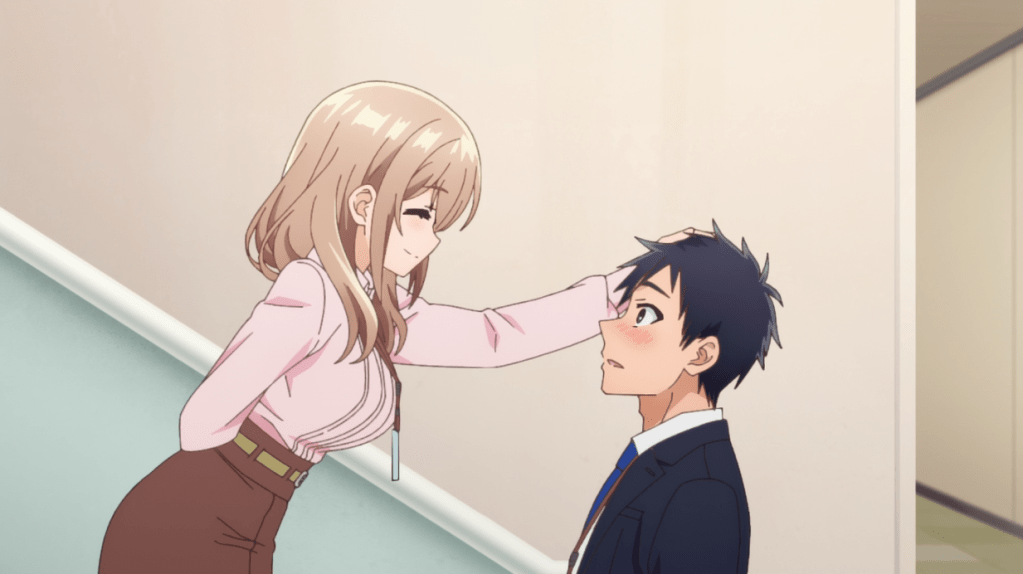
My Tiny Senpai
Streams: Crunchyroll on Saturdays
Rating: 2.5 (of 5)
The premise for this one is pretty much all in the title: Shinozaki is a relatively new employee whose senpai is midget-level short (she’s standing four steps up in this screenshot) but also very cheery and doting, and with catlike affinities, too. She’s constantly cheery and looks out for him to the point the he can’t help but fantasize a little. And there are indications that she likes him more than she’d care to admit, too.
And that’s about it. This the latest in a string of cutesy office comedies where the main gimmick is a very short woman, and like its predecessors, it operates mostly in short vignettes. The one minor difference here is that senpai Katase is very busty for her size (we’re talking Danmachi‘s Hestia-level build), and that puts an element of sex appeal into this that like series don’t have. I’m generally not a fan of workplace comedies – the only anime one I think I’ve ever watched to completion was Wotakoi – so maybe this will work better for other audiences, but I got tired of the shtick pretty quickly. Probably not watching more.

Am I Actually The Strongest?
Streams: Crunchyroll on Saturdays
Rating: 2 (of 5)
Yawn. Yet another hikkikomori winds up getting reincarnated into a fantasy world as a prince, but his magic power is so unexpectedly low that he is discarded as failure. Problem is, the idiot goddess who reincarnated him gave him such a high magic level that human instruments couldn’t read it accurately, as he’s actually mind-bogglingly power at barrier magic. He uses this to survive, get a giant wolf in human form as a caretaker, and even enhance his fighting ability when, at age nine, the top-grade warrior who surreptitiously took him in seeks to train him in his sword. If only his sister didn’t seem to dislike him. . .
Yeah, this is another one of those stupidly-OP isekai power fantasies. At least it’s not as outrageously over-the-top as last season’s Aristocrat, as protagonist Haruto is channeling all of his capabilities through clever use of one power rather than being a stats monster across the board. It does also show at least some potential for charm, but that’s balanced out by Haruto’s unpleasant attitude. I did wind up stomaching Aristocrat through to the end last season, so I may give this one another episode or two to see if it amounts to anything, but I’m not getting my hopes up here.

Ayaka
Streams: Crunchyroll on Saturdays
Rating: 3 (of 5)
In this new, anime-original project from the creator of the K franchise, Yukito is the most generic-looking shonen action protagonist imaginable with a comparatively generic background: he’s lived in a foster home for years since losing his father at age 5, and now, upon his middle school graduation, he’s called back to a home island chain that he cannot remember. Naturally, he has untrained powers (in his case, water manipulation-based) that he doesn’t understand and has trouble controlling, but that’s not unusual for the mystical Ayaka Islands or being the son of a famous Ley Master. (His mother, by contrast, isn’t in the picture and no one even knows who she was.)
There’s nothing really wrong with this opener; it looks pretty good, gets straight to the point, and features some decent action and power use. However, nothing about it sticks out, either, other than an implication based on character designs that this is intended to appeal to female audiences. Unless it shows something far more interesting in upcoming episodes, it looks eminently forgettable.

Atelier Ryza: Ever Darkness & the Secret Hideout The Animation
Streams: Crunchyroll on Saturdays
Rating: 3 (of 5)
This series is an adaptation of the first game of the most recent subseries of the longstanding Atelier fantasy RPG video game franchise. Based on the double-length first episode, it looks like the series is going to stick closely to plot descriptions that I’ve read for the game. Certainly it has the look, design style, and feel of any of a number of (largely-forgettable) fantasy RPG adaptations from over the years – for better or worse.
The story centers on the titular Ryza, a teen farmer’s daughter who simply isn’t satisfied with life in her (curiously-deliberately) isolated island village. Using the distraction of a rare arriving outside merchant, she convinces longtime friends Lent (the warrior-type) and Tao (the bookish one) to go on an adventure, where they encounter the merchant’s daughter Klaudia (who seems like a prime candidate to eventually join them as an archer). They have to get rescued from monsters by the alchemist Empel and his bodyguard Lila, and seeing Empel in action inspires Ryza to become an alchemist herself – and, to Empel’s surprise, she shows an aptitude for it, too. Upon that discovery, and learning that the trio have books and knowledge of local ruins that could be of interest to Empel, the duo agrees to train the trio. The aforementioned ruins, the stories of a fallen kingdom, the mystery behind the isolation of the village, and alchemy in general all look to be core story elements.
The first episode takes its time getting to the main premise, which is why the double-episode preview is necessary. The animation is not anything special, but the art is clean and attractive, albeit with a curious focus on Ryza’s hips and thighs. (She has a slightly thicker build overall than typical anime female protagonists.) I am hesitant to give the series a recommendation at this point, as everything about the series feels a little too generic for it to distinguish itself, but it presents just enough interest factor in its set-up that I will likely give it a couple more episodes to prove itself.
 USA Anime
Said enough about the previous season to not worry about a seasonal summary?
LikeLike
It’s 90% done. Have one more season finale to look at, so it will be up sometime later today.
LikeLike
Thanks for all the reviews. I tried Zom 100 based on your recommendation. I’m not really into horror as a genre (my thing is pretty much romantic comedies), but I’ll try to give it a few more episodes.
Overall, It’s a pretty weird season for me. Lots of returning series, but not much in the way of new stuff that does it for me. As such, I think the shows I’ll be looking forward to the most each week are Mushoku Tensei Season 2 and Horimiya: The Missing Pieces.
LikeLike
I commend you on being able to overlook GoHands’ animation for the Cat show. I wanted to watch that show so badly, but I just couldn’t handle the animation. Comedies, of all the genres, can afford to cheap out on the animation (e.g. Househusband) but they cannot survive being (badly) animated like an action thriller (maybe if they are spoofing an action thriller, but not by GoHands).
LikeLike
The animation settles down after the first 3-4 minutes and hasn’t returned to that level of overkill again through the end of episode 2. Grit through that first part and you’ll probably find it to be funny enough to be worth watching.
LikeLike