DanMachi may not always be the best-looking or most flawlessly-animated series, but it has rarely fallen short on dramatic presentation and does better than most when it comes to delivering on its biggest moments. That is no less true for this season finale, which brings to a conclusion the anime’s adaptation of novels 16-18.
And it delivers on not one but two featured action components to round out the War Games. The first is, of course, the final confrontation against Ottarl, with Haruhime’s Uchide no Kozuki boosting all of the challengers, effectively giving the allies three level 7s and and a level 6 against Ottarl. This is a fantastic battle sequence well worth multiple rewatches over time and being considered among the series’s finest action sequences – and given the great efforts this franchise has shown in the past, that’s saying something. The sense of movement and the choreography are both elite-status, allowing viewers to fully be able to follow every move even while marveling at how dynamic it all is. And though Bell is the star here and gets the final blow (sort of), he certainly doesn’t do this on his own, with each of Mia, Ryu, and Hedin playing crucial parts. But no character here has a more important role that Ottarl himself. He is utterly convincing as a powerhouse on all fronts, one who has the battle instincts to match his strength and the fierce determination to fend off all foes that is no less than Bell’s, and yet without feeling over-the-top. And even at the end, he’s more acknowledging that Bell is worthy than fully defeated. Rarely has a DanMachi character more proven his second name – King – than Ottarl does here, for a goddess can’t be saved if the king who guards her can’t be overcome.
The chase scene between Bell and Allen isn’t lacking for tension or impact, either, even if it is quite a bit shorter. This is also nicely choreographed, and again, I love that Bell didn’t do this on his own. Clearly he benefited from some sort of familia synchronization from Lily (this isn’t explained in the novel, either), but Welf getting in the final strike to clear Bell’s path was very satisfying, especially after Welf was thrashed and berated by Allen a few episodes earlier.
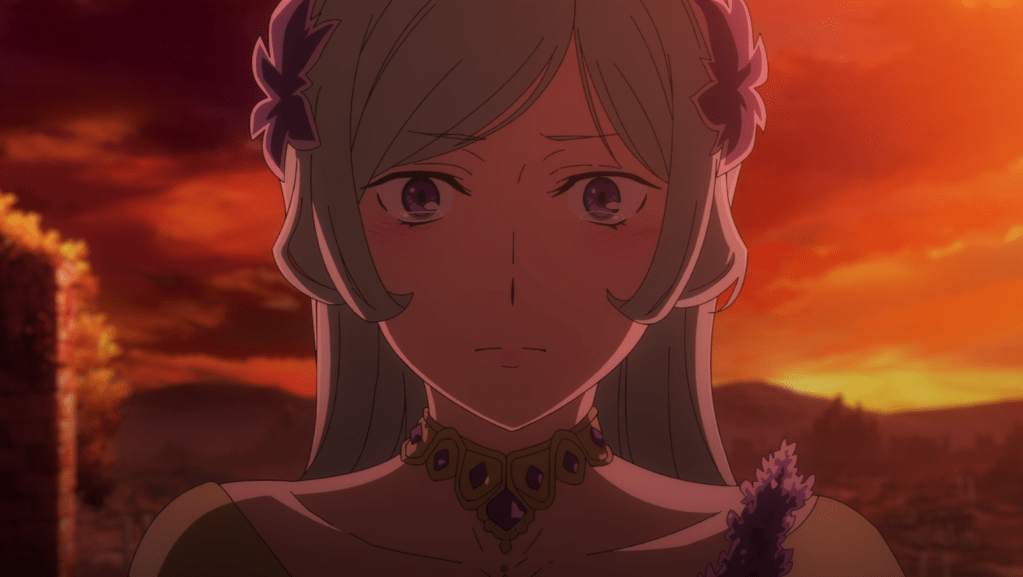
For all the action, though, the scene at the top of the tower is nearly as important in a dramatic sense. This is essentially Freya’s last stand as a goddess, and the melancholy musical selection perfectly reinforces how this is as much a defeat of Freya’s crush on Bell as it is a defeat of Freya Familia as a whole. Letting the War Game end on that note, rather than with raucous celebration, was also a perfect choice.
Let’s not understated the important of Freya’s epilogue, either. Who is the real Freya? Even she’s not sure, and she still has a final reckoning with both herself and the denizens of Hostess of Fertility. Again, the musical choices here – a piano version of the opener and the closer – suit the emotional scene perfectly. This arc would not be complete and fully satisfying without this ending – without Freya choosing to continue as Syr under Bell’s watchful eye. (Technically speaking, she’s actually under Hestia’s supervision according to the novels, but that’s a trivial detail.) And that both Hedin and Horn acknowledged this as a positive result in the end is also necessary.
The arc concludes here with some issues left floating; what is to become of the very powerful adventurers in the now-disbanded Freya Familia? Lower-tier members could easily get absorbed into other familias, but what will the top-tier members do? Also, Haruhime really put herself out there with an open display of her Uchide no Kozuki, and there’s no way that won’t draw attention. There’s also the little matter of Ryu openly declaring her love for Bell, too. But all those are issues which can be pushed back into the next novel. (Indeed, novel 19 does, to a degree, address them all.) This arc has ended at least as well as any of the others, and let’s enjoy that for now.
Last episode’s mystery with the shrine provide a glimpse into the setting’s broader history. This episode, by contrast, looks at the closer history of the setting by starting to expand on Jinshi’s dream sequence from the beginning of last episode. (In the manga version, that dream sequence comes immediately before the content of this episode, but it does provide a little better – if more indirect – lead-in to the shrine visit.) It does so by focusing more on a character who’s appeared in the background a couple of times but never seen significant attention before: the current Empress Dowager.
But before it gets into the heavier content, it opens with the lighter fare, such as Maomao’s room being reassigned to a storage shed (supposedly as punishment, though it delights her) and Maomao’s encounter with the bug-happy Shisui, for whom some have mistaken her (much more to Maomao’s consternation). This and Maomao using Jinshi’s handkerchief as an information provided provide most of the episode’s requisite dose of humor.
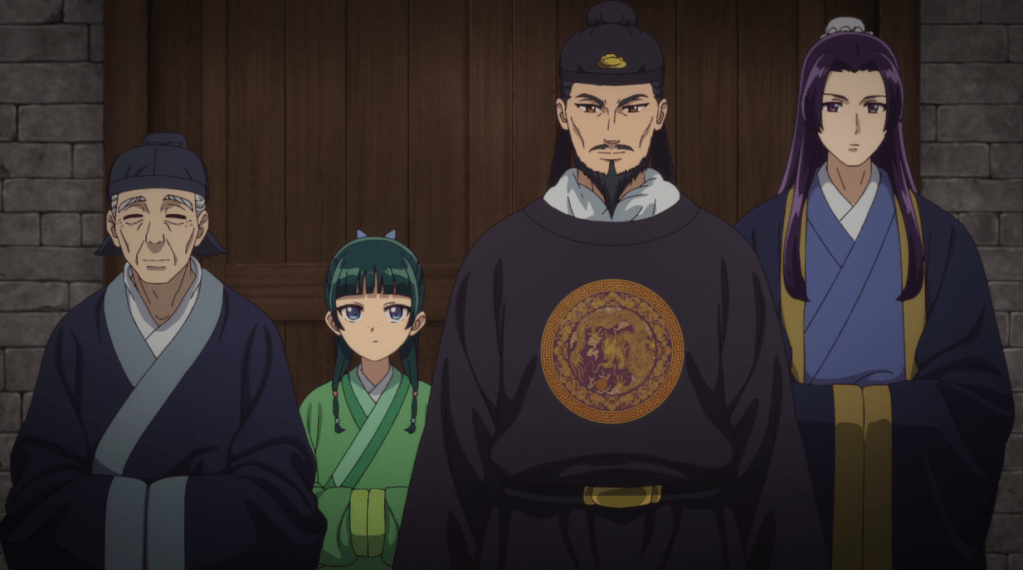
The greatest attention, though, is on the Empress Dowager, who is here named for the first time as Lady Anshi. Though no longer reigning, she’s an influential figure responsible for establishing the clinic, officially ending slavery, and doing away with the practice of making eunuchs. The middle of those accomplishments is arguably the most impactful and yet least complete one; Maomao’s own situation at the start of the series was, for all practical purposes, slavery, and many of the courtesans in the Pleasure District effectively are, too, so the practice is more disguised but still present. Still, it helps depict Anshi as a woman of deep compassion, which contributes to why Maomao seemed a little startled by the question Anshi asked her: did she curse the previous Emperor to death?
This one requires a lot of context to fully understand, and not all of that context is available in this episode. Back during the first garden party in the first season, Maomao flinched upon hearing how young Lady Anshi was when she gave birth to the current Emperor, and while we still don’t get an exact age here, comments in this episode strongly suggest that she may have been as young as 10. Since rumors were flying about the former Emperor being a pedophile, that means Lishu being sent to the Rear Palace the first time at age nine wasn’t just a political arrangement but wholly intended to make her the Emperor’s sexual partner, which is all the more creepy. That apparently wasn’t the former Emperor’s only issue, either, as the dream sequence last episode and some of what’s mentioned this episode suggest that he had other mental issues, too, in addition to being a lifelong Momma’s Boy. That the current Emperor came out normal despite having such a father was no doubt heavily due to Anshi, and the country should venerate her for it.
Unsurprisingly, Anshi’s relationship to the previous Emperor seems to have been a rocky one. Her chief lady-in-waiting here claims that Anshi daily wished for his death, though whether that was just because of his predilections or other factors, too, is unclear at this point. Clearly she got the upper hand on him at some point if she got the aforementioned policy changes implemented, but given his preferences, this also raises the question of how she had a second child by the former Emperor nearly 20 years later. There’s definitely a lot more to this story, which should play out more next episode. For now, the former Emperor’s body being well-preserved also speaks to the mystery about whether the former Emperor really did die of “old age.” I’ve heard that bodies these days don’t decay as rapidly as they used to because of all of the preservatives present in modern foods, so doubtless something along that line is in play here.
In all, it’s a pretty neat set-up for a big mystery, and one that weaves in a lot of setting detail, too. (And let’s not forget that the mystery about who taught Lihua’s former lady-in-waiting about the abortive drug still lingers in the background.) The big details are all great and the artistry looks as sharp as ever, but once again I liked the little details, too, like how Anshi handles Princess Lingli during her meeting with Gyoukuyou. I also appreciated that Anshi is also suggested to be quite clever, as she indicates her intent to talk to Maomao to Gyoukuyou with just a glance and quite probably set up the tea party to have an inconspicuous way to have Maomao filled in about what she wants Maomao to investigate. Despite her seeming gentle nature, she has to be a formidable woman to have come through what she has. The circumstances involved make her another intriguing side character.
The one negative about this episode is that it lays on the ominous and dramatic music uncharacteristically thickly, to the point of overkill at times. Some might also find Jinshi not making a single appearance (is this the first episode where that’s happened?) to be distinctive, too. In general, though, it’s a solidly-executed set-up for what should be the crux of the mystery next episode.
Appropriately titled “The Warriors of the Goddess,” episode 14 features a lot of dramatic action scenes involving said warriors, but despite the War Games winding down to its final stages, that’s not the main focus or point of the episode at all. Instead, the focus is much more on what motivates those warriors, and that’s plenty interesting enough that I can justify giving this episode a high rating despite my normal disdain for “let’s stretch the battle out” episodes.
Whatever you may think of the Freya Familia elite as characters, one of the most intriguing aspects of them as a group is that they are far from monolithic. Yes, they all love and idolize Freya and place no loyalties above their loyalties to her, and they all were to some degree saved by Freya; Ottarl was picked up off the street, there’s some suggestion that Freya may have bargained sex to free the Gulliver brothers from slavery, and Hedin was a king freed from the perpetual cycle of warfare on his home island. The episode states that Allen and Ahnya lost their family and village to the Black Dragon, so anime viewers can presume that Freya likewise rescued them. (The novel clarifies this.) The anime version is less explicit about Hogni, but he was Hedin’s rival back before Freya took them in, and so can be presumed to be picked up under similar circumstances. (Again, the novels are much clearer on this point.) And yes, all of them – even proud, arrogant Hedin! – want Freya’s love focused on them.
But all of them differ in how they look at Freya, and this is the point where the writing most stands out. Allen idolizes the power she represents and can give him; he cherishes most the domineering aspect of the goddess. Ottarl is the stalwart gatekeeper, the one who cannot acknowledge anyone approaching the goddess unless they prove worthy by him; he seeks not to interpret, only to execute Freya’s spoken will. Hedin, on the other hand, does seek tointerpret Freya’s true will, to look at her inner heart and act accordingly. While previous episodes have implied that he is acting this way, in his confrontation with Hogni this episode he finally explicitly lays out how he sees the situation: Freya will never be genuinely happy as long as she’s still a goddess, and her own familia can’t rectify that problem precisely because they idolize her. And, as much as it pains him, he recognizes that Bell can fill that role because he values the girl she is inside rather than the goddess she is on the surface. Everything he’s done this season has been deliberate moves to position Bell for that purpose. That’s something Hogni can appreciate, too, when it’s explained to him. Where, exactly, the Gulliver brothers stand is less clear, though there’s some implication that they may be motivated to protect their savior’s virtue.
One other conflict is afoot here, too: the relationship between Ahnya and Allen. The nature of their relationship comes off a bit thin in anime form compared to the novels, but even the anime has acknowledged for a while now that she was cast aside by Freya and her brother – though, notably, not stripped of the falna which makes her tough enough to delve deep into the Dungeon or take out numerous lower-level members of Freya’s Einherjar. (Canonically, she is a Level 3.) Hogni confronting Allen on Ahnya’s behalf brings out the truth: that Allen asked Freya to kick Ahnya out not because she was incompetent, but because he was worried that the brutal life in Freya Familia didn’t suit her. In one of the episode’s few amusing moments, even Loki Familia’s Bete – who is the character in the franchise most like Allen in disposition – points out that Ahnya wouldn’t be alive, much less living a peaceful life, if Allen actually meant the rhetoric he spews about her. He does still love and care for her as family but is much too prideful to admit it and absolutely won’t let that get in the way of his loyalty to Freya.
Of course, this is a War Game, so the action component is still present. Allen finally gets to show off his special gimmick, the power we see him use in the OP which earns him the nickname of Freya’s chariot. (This is actually an important mythological reference, since Freya’s chariot was traditionally pulled by two cats. Not a stretch to interpret that Ahnya may have been meant to be the other one.) From the anime’s limited depiction, it looks like it allows him to make a power charge across the battlefield. Compared to that, his stand-offs with Hogni and Ahnya are but a scuffle, as is Alfrigg standing back up against the second-stringers. The real fight is the now-four-on-one effort to take down Ottarl. He’s not the strongest in Orario for nothing, as even with newly-arrived back-up from a Level 6 mage and tactician, it’s not enough to do anything beyond wounding him a bit and destroying his armor. But he is the Battle-Swine of Freya; in mythology, Freya was accompanied in battle by the boar Hildisvini (the same name as Ottarl’s sword-enhancing ability), and that boar was the transformed form of a man name Ottar. Never let it be said that original writer Fujino Omori hasn’t thoroughly studied his mythology!
Ultimately, the well-executed action elements provide a nice complement to the heavier but important background elements throughout the rest of the episode. The result is a good-looking episode which also finds a good writing balance and covers the last few bases necessary to set up the finale next week.
This half deals with titles which hit either their 6th or 7th episodes during the week of 2/17/25-2/23/25. It also includes the remainder of season 3 of Arifureta, which finished airing during this time frame.
Arifureta s3 episodes 12-16
Rating (these episodes only): B-
After a short delay, the third season of Arifureta finished its run over the last five weeks, bringing to a conclusion both the arc involving the last Labyrinth and the broader quest to create an item capable of allowing Hajime and his classmates (and those from this world who would go back with him) to return to their original world. This run of episodes mostly involves Hajime and crew having to fight their inner demons mostly in isolation, and as a result it features some of this installment’s best character development moments. This is, of course, uneven, as Hajime is still just too perfect, but the other who has the easiest time of it – Shea – feels far less hackneyed, since she’s been confronting herself over the course of her journey with Hajime. Shizuku gets arguably the most interesting results out of it, while Kouki’s frustration and difficulties finally come to a head. By the end, all that’s left is to tie up a few loose ends and collect everyone, but that’s going to include a jaunt to the demon realm to get Eri, and as episode 16’s final shot shows, that’s not going to be trivial. Feels like one more season might wrap this up, and honestly, I’m curious at this point to see how it will end, especially with the improved technical merits holding steady.
Even Given the Worthless “Appraiser” Class, I’m Actually the Strongest
Rating So Far: C
Protagonist Ein may have to work at getting stronger at first, and confidence does remain a bit of an ongoing issue, but this series still suffers from making him too strong too fast. Moreover, it does this not by showing that his Appraiser class is more powerful than expected, but by giving him a major upgrade to his ability, which cuts into any feeling that he’s earned his greater power. (At least him earning his harem members as he gathers Yuri’s “sisters” is taking a little more effort.) Text which doesn’t stay on the screen long enough to be read is a frequently-recurring problem with this one, too. The character dynamics aren’t bad, and the mystery of why one of the World Trees has turned evil (which the main cast isn’t even aware of yet as of episode 7!) is a little interesting, but the visuals are nothing special and too little of any of this feels fresh. It’s struggling to remain compelling and is thus one of my lowest-priority views.
From Bureaucrat to Villainess: Dad’s Been Reincarnated!
Rating So Far: B+
This may not be one of the best-looking or best-animated series of the season, but it’s easily one of the most fun ones, as the gimmick of a 52-year-old father trying his best to be a villainess works even better that I might have imagined. Watching “Grace” unwittingly slip into “Dad mode” is a regular delight, but so are the flashbacks to all of his family stuff and how that influences what’s going on now. The series deserves special recognition for the clever way that it keeps real-world characters active in the story while Kenzaburo is progressing in the game. Its closer, which I understand is a parody of something that American audiences probably wouldn’t be familiar with, is also special. This one gets a high recommendation.
I Left My A-Rank Party
Rating So Far: B
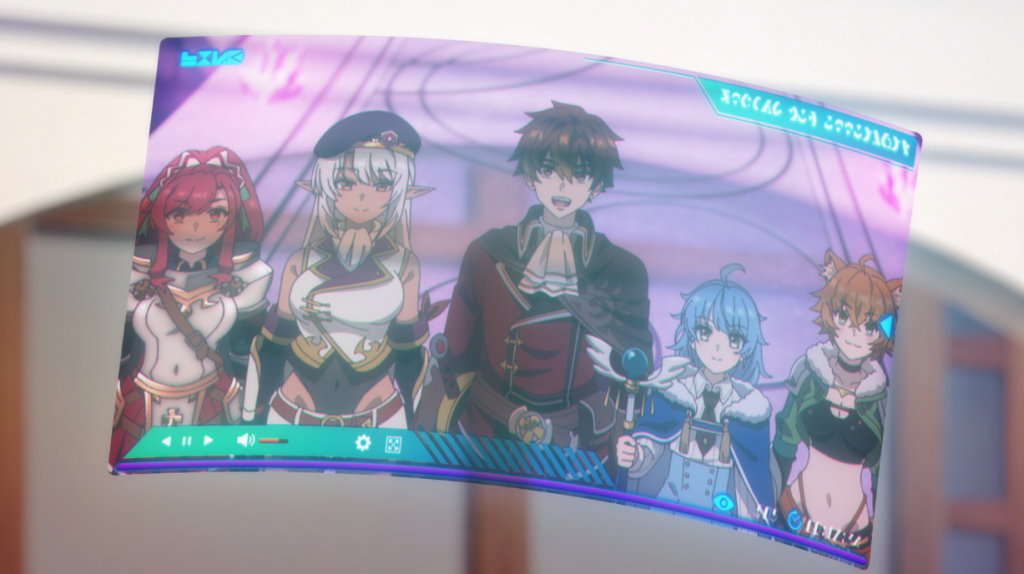
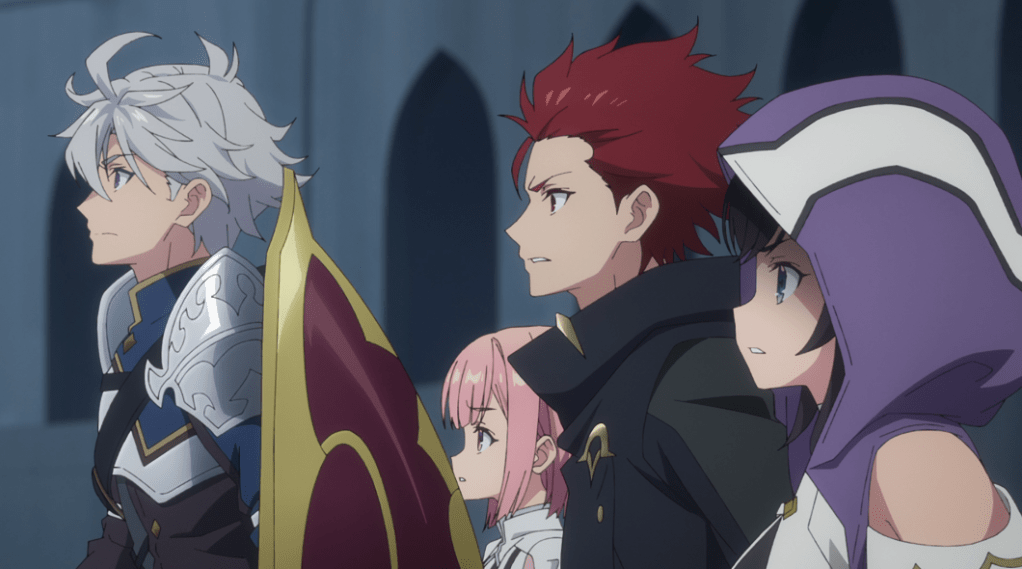
One of the minor surprises of the season so far is that this straight fantasy series doesn’t suck. The “I left my party under bad terms” premise for a fantasy series has been very hit-or-miss so far in anime, but this one hits by not entirely going the conventional route. Sure, the twist of dungeon delving being magically live-streamed is a bit gimmicky, and the rising villainy of the party protagonist Yuke left behind is completely rote at this point, but the way he works together with a trio of fledgling female adventurers he previously trained has been neat and surprisingly wholesome, with an emphasis placed on them using the lessons he’s taught them about how to be careful and savvy dungeon adventurers. It has not dipped at all into harem antics (yet?) despite being perfectly set up for it and it’s almost entirely avoided fan service, too, despite at least two of the girls having looks which could easily be fan service bait. Episode 7 does take a significantly darker turn, which isn’t bad but has the potential to shake up the status quo, so the only real flaw so far is some inconsistent artistic quality. It’s definitely a better series than its name and blurb might suggest.
I May Be a Guild Receptionist
Rating So Far: B+
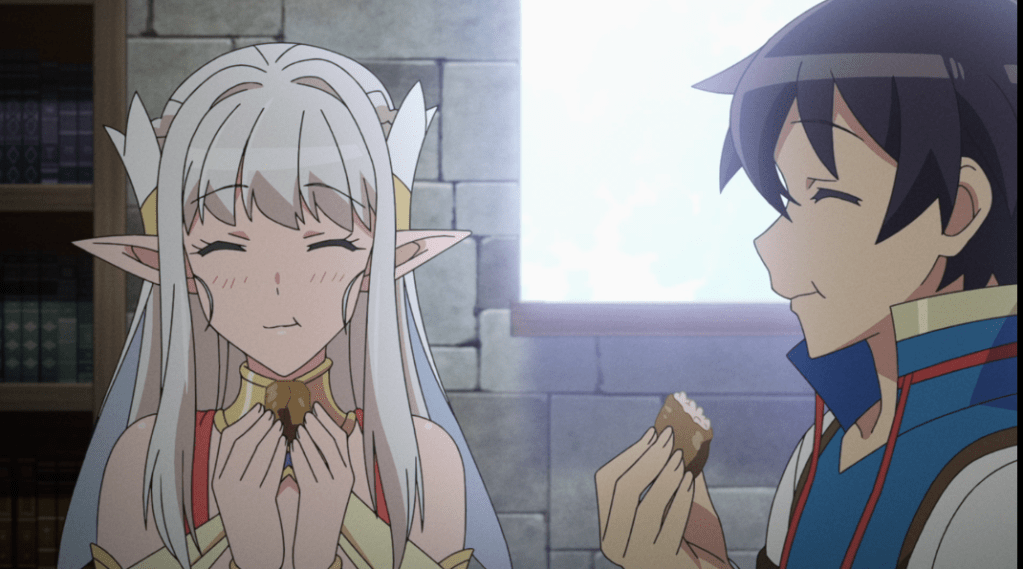
I plan to review this one fully at the end of the season, so I’ll limit my comments on it for now. I will say that it’s been the most pleasant surprise so far this season, to the point that it has become my top-priority view in any given week (even over The Apothecary Diaries!) and is the series whose episodes I’ve rewatched the most. Its OP and ED (which the series uses interchangeably) are among the season’s best, Alina is a delight as a veritable goddess of vengeance for the working woman, and her budding relationship with Jade (at left) has become cute. It gets my highest recommendation.
Ishura s2
Rating: B
Maybe eventually this story will get to the actual tournament? So far, it’s still continuing the same pattern it took in the first season: introduce a bevy of colorful characters with even more colorful titles, with only occasional connections being made. There is a sense of timeline progression and hints of broader scheming, but the story still feels like it’s in its preliminary stages. At least most of the characters and vignettes introduced are interesting (although the robot/golem who sounds like a little kid gets obnoxious quickly!), and the design and technical merits are still pretty strong.
Magic Maker: How to Make Magic in Another World
Rating So Far: B
If I had to pick a Most Underappreciated Series for the season to date, this would easily be one of my top two choices. I know some were put off my some early vaguely incestuous vibes, but that hasn’t been a thing going forward in the story and it undercuts just how different this is from a lot of other isekai reincarnation tales. Sion is constructing a magic system from the ground up rather than tapping into an established tradition, and because of that he’s had to work every little aspect of it out for himself over time, rather than become instantly powerful. In recent episodes he’s even gradually starting to get a glimpse of bigger truths, such as a monster that’s only readily visible to someone who has magic or a magic-charged light and an illness which quite probably has magical origins. It also has a harrowing early goblin attack involving one of the scariest goblins you’ll see in any anime series. Action animation is far from the smoothest, and it would be nice see the girls get to do more, but I like the approach that the series is taking with its storytelling and am interested to see where the series goes with it.
My Happy Marriage s2
Rating So Far: A-
This is the other top-level series so far this season. It easily stands among the best looking, matching even The Apothecary Diaries and Orb on its art design and gorgeous costuming, but it’s also managed a fairly compelling plot so far this season, too, including a suitably-intimidating villain and a new female friend for Miyo, who’s still working to fully understand her apparently-prodigious powers. The romance element has also been satisfyingly sweet. In general, this one has been a joy to watch.
Sakamoto Days
Rating So Far: B
Unquestionably this series has some of the best action staging and animation of the season, and the series is a success primarily on that strength. It does, at times, have some effective humor, and the way that Sakamoto’s “Dad bod” is a stark contrast to his godly skills is a constant source of amusement. So is how he fears his cute wife’s wrath worse than any assassin out to kill him. Shin serves well as the audience viewpoint, but later addition Lu has added far less to the mix so far. In general, the writing, plotting, and characterizations all feel pretty ordinary. Because of this, I can’t justify giving it a higher grade, but the series sure is fun to look at.
The 100 Girlfriends Who Really, Really, Really, Really, Really Love You s2
Rating So Far: B
This is another show where I can acknowledge that it’s good for its type without personally appreciating it. It definitely has its funny content in its second season episodes, including regular doses of fourth wall-breaking moments, and I’m finally starting to appreciate the zeal with which Rentaro endeavors to make all his girlfriends happy while collecting a few more. The new additions so far this season are little more than walking anime clichés: the Hungry Girl, the Devoted Maid, and most recently the Sports Jock, who is giving strong hits of doubling as the masochist. The cheesy business with the dinosaur-themed women’s baseball players was rather amusing, too. For all its effectiveness, though, I still can’t get much into the series and haven’t found its sheer ridiculousness (including a DBZ parody of all things!) enough to win me over. It’s one of the week’s lowest-priority views for me.
The Red Ranger Becomes an Adventurer in Another World
Rating So Far: B
This one is the other of my two top picks for Most Underappreciated Series this season. In playing its bombastic sentai team style straight, it finds a great balance between mildly serious content and sheer ridiculousness, all while finding a fair number of opportunities for sex appeal. (There’s even a strong suggestion in episode 6 that the two leads actually “get busy.”) Its genius is in getting the logic behind all the sentai team stuff to work, including especially the different ways that Red can power up by forming varying kinds of bonds with others. Doesn’t hurt that leads Red and Teltina have at least some chemistry, either. Hardly highbrow stuff, but definitely worth more of a look than it’s getting.
Übel Blatt
Rating So Far: C
The series is clearly trying to be an edgy, bloody fantasy revenge story. While the set-up is certainly there for it, the execution is sorely lacking, and I’m not sure if the blame rests more heavily on the writing or the direction; probably both. The story doesn’t flow well at all in its early stages, moments that are supposed to be emotionally intense end up feeling unintentionally comical, and despite a number of flashbacks, the story still hasn’t really firmed up yet why the foundational betrayal took place at all. Some of the costume design choices leave a lot to be desired, too, and some of the gimmickry being used to attempt to disguise limited animation looks painfully artificial. The last couple of episodes are a little better, but this series is, so far, nothing more than a wannabe in the realm of revenge thrillers.
Unnamed MemoryAct.2
Rating So Far: B-
While its pacing, editing, and general story presentation are still far from flawless, this season is a distinct improvement over the first one in terms of presenting a coherent story. The story flows a bit more smoothly as the fact that Tuldarr never fell, and Tinasha never (technically) became a witch, alters how Oscar and Tinasha meet, what kind of crises they face, and how they gradually start to fall for each other. (Or, more precisely, Oscar is the one who has to be won over this time rather than Tinasha.) While the story has advanced to the point of the two effectively being betrothed by episode 7, some characters who were prominent in the first part never appear (Lucrezia has yet to debut in this timeline), while others play a much bigger role (Valt). The Witch of Silence shows up this time, and the truth behind why Oscar was cursed comes out, and satisfyingly, why this didn’t happen the first time around is made clear: the reasons behind it wouldn’t have made sense without Oscar traveling into the past. I still wouldn’t go as far as calling this a good series at this point, but it’s no longer a bottomfeeder, either.
Welcome to Japan, Ms. Elf!
Rating So Far: B
A number of other series outshine this one on the artistic front this season, but none – not even Guild Receptionist – beat it out when it comes to Best Couple. (Even if Kazuhiho and Marie don’t want to admit that they’re a romantic couple, they certainly give off that vibe.) The series has maintained a good balance between Modern Japan and Fantasy World elements so far, and I love that they haven’t just ignored the language barrier issue; it’s even been a major plot element at points, especially in the Japan side. In general, though, the series is just a pleasant, adorable view, one whose main flaw is shaky artistic merits.
ZENSHU.
Rating So Far: A-
For most of its run, this has been a series that I acknowledged as good rather than actually appreciated. MAPPA’s visual presentation has been strong, but I’ve found the power-up sequences to be overused, felt that the series at times solved its problems too easily (most notably in the case of Memerun), and made Natsuko’s ability too much of a deus ex machina device. Thankfully, episode 5 showed that Natsuko’s power is not infallible, but episode 7 is what has really both saved and elevated the series for me. It’s a fairly standard flashback-type episode to look at Natsuko’s past, but it’s cleverly done through the lens of how others both perceived Natsuko and experienced their first love towards her – to which she was, of course, completely oblivious. It’s a beautiful irony, since the lack of that is what’s caused Natsuko to hit a creative brick wall, but the visual presentation is handled so well that it may be the best overall episode of any series so far this season. What happens at the end of that episode also sets some intriguing possibilities for where the series will go next. For the first time this season, I’m actually enthusiastic about this one.
That’s it for now! As mentioned above, Guild Receptionist will get a full review when it finishes, and I am expecting at least one or two other special reviews over the course of March in addition to the weekly reviews of The Apothecary Diaries, so keep an eye out for those.
The episode titled “The Shrine of Choosing” primarily involves one mystery while also setting up another. Unlike many other mysteries in the series, though, these aren’t life-or-death matters or (necessarily) connected to a bigger plot. Instead, these are mysteries which delves into the history of the setting.
The one that’s being set up for later is actually at the beginning of the episode and involves Jinshi’s dreams back to his early childhood. If we follow previous implications to assume that Jinshi is the current emperor’s actual son rather than younger brother, then the old man would be his great-grandfather and the current Emperor’s grandfather, which would make that man the one who was Emperor at the time of the envoy’s visit more than 50 years ago – in other words, the man who established the capital where it currently is and at least started the building of the current palace. (This is, incidentally, a point which is much clearer in the subtitles than in the English dub for episode 28 due to the way one line by the matron is translated. I will be curious to see if the dub script does something to compensate for that when it gets to this episode.) That dream strongly suggests that he went senile and so was tucked away somewhere on the palace grounds by the time Jinshi was a child, which means there’s a big story afoot there. The golden-looking item in the old man’s hand is also featured in the OP, so it has some later significance, too. But that’s all for next episode; none of that has anything to do with this episode’s post-OP content.
The main mystery involves a building that was briefly featured in the background back in episode 28: the Shrine of Choosing. Here it’s revealed to have once been a test for the nation’s rulers; only one who could successfully pass all the way through to a particular balcony could be substantiated as a worthy ruler. It fell out of that role two generations back due to circumstances causing any question of succession to be avoided, but the building still remains, and apparently the current Emperor has tried it once before; even though he didn’t need to, he still apparently desired the satisfaction of having his right to rule affirmed by tradition. But now he’s got a particularly smart servant girl at his disposal who might be able to solve the mystery that he couldn’t on his own.
Like many of the series’ mysteries, the design of this one is quite clever, as it’s based on an inherited genetic quirk. While color blindness is known in Asian populations, it’s much less common than in Caucasian populations. (That being said, Maomao’s comments about it in this episode are overstating how extreme the difference in frequency is if this is based on real-world data. Caucasian men are only twice as likely to have it as Asian men with the lowest frequency.) And since it can be hidden relatively easily, it not being common knowledge in such a population is believable, even for rulers. That determining the correct path is dependent on having (or at least being aware of) a certain kind of color blindness is a neat trick and an interesting (if imperfect) way to assure a pure lineage and certain degree of political influence.
The setting of the story has always lacked a bit for a deep sense of history, so I appreciate greatly that the second season seems to be emphasizing delving into at the least the recent past of the setting beyond just the last 20 years. I also appreciated the series bringing up the way foundational stories can be used to manipulative both historical and political narratives. Having extra little bits like that regularly worked in helps round out the series further.
The Winter 2025 season is wrapping up its seventh week, so it’s time to see how several of its series are doing.
Like with the past few seasons, I am mostly or entirely keeping up with a massive number of series this season (25 this time around), so I am once again splitting this endeavor into two parts to keep it from being too cumbersome a read. The titles in this part are ones which have reached at least their seventh episode of this season by 2/16/25. The second installment will cover titles that are hitting episode 6 or 7 in the period of 2/17-2/23. Neither will include The Apothecary Diaries or the delayed episodes of DanMachi (both of which I’m episode-reviewing separately), and Re:Zero will likely not be included in either since it’s only aired a couple of episodes so far; it will absolutely be covered in the season-ending wrap-up, though!
So without further ado. . .
Beheneko
Rating So Far: C+
The promise of the first episode wasn’t exaggerated: this is a prestige fan service title, with every one of the first eight episodes finding some excuse for defined nudity. It also eventually reveals itself to be a harem series, with no less than three of the ladies having some degree of sexual interest in the cat-presenting MC. (It makes sense in two cases, as blacksmith Vulcan is a cat person and Stella is a reincarnated dragon home Tama defeated. Aria, OTOH, just has some kinks.) If you can deal with that aspect and the possibly-offensive gay stereotype that is Anna, though, then this is a fun RPG-styled fantasy series which requires little mental commitment. Just don’t expect too much for consistent artistic quality, which is the main reason I’m not rating this one higher.
Bogus Skill <<Fruitmaster>>
Rating So Far: C
This one isn’t so much bad as just very, very ordinary. Its biggest mistake is having Light immediately get a super-strong second skill, rather than having to cycle through a few minor ones first. (This does happen later on in the midst of the series’ biggest fight of the first half, and how lame some of the skills are is one of the most interesting occurrences in the first half.) At least it does have some intrigue going on, and the presentation of Ayla’s Appraisal skill as invaluable is a marked contrast to one certain other series this season. This one does have a little bit of fan service (thankfully not involving Ayla) and doesn’t look bad, but there’s just not much here to get excited about.
Headhunted to Another World: From Salaryman to Big Four!
Rating So Far: B-
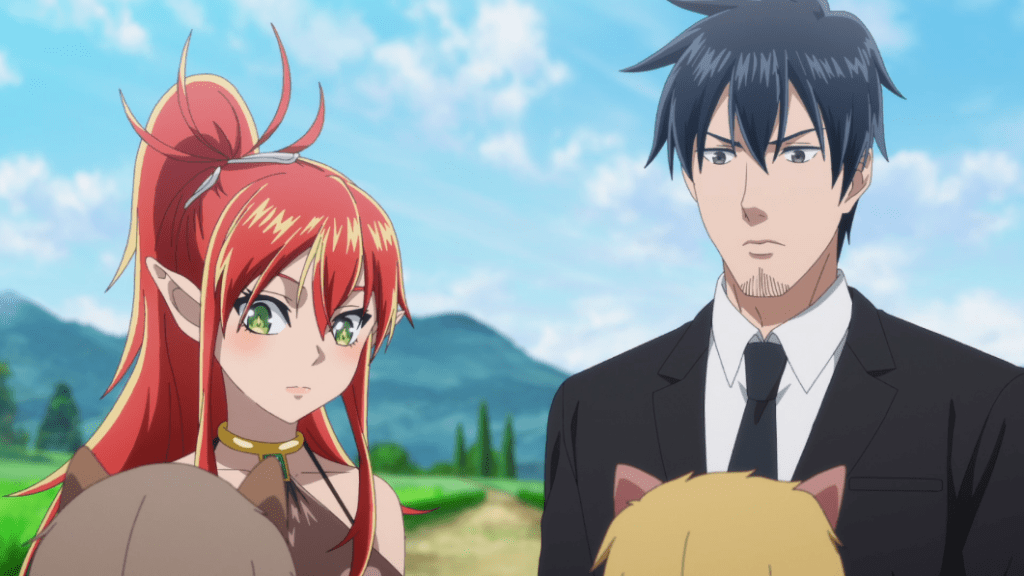
This one is taking a distinctly different trajectory compared to other isekai titles this season, in large part because Uchimura isn’t personally powerful; in fact, that he has no magic, special powers, or fighting skills at all makes him a major outlier among isekai protagonists. He’s just a businessman, but it’s his business acumen that the Demon Lord needs to grow his kingdom, and the series does a good job of finding ways for him to impress others by applying those skills. Basically, he’s the kind of guy that any major organization needs behind the scenes in order to grow and advance. The bar scenes where he does his personal reflections are neat, too. I could do without the somewhat harem-y lean, though, since at least one of the other generals is clearly romantically interested in him and the other two are gradually showing to be favorably disposed to him, too, and that gives the series a more ordinary feel. Still, it does enough to stand out as different enough in an overloaded field. The explanation for why demons dress so skimpily (it’s partly a fashion statement but not just that) is also a neat touch.
I’m a Noble on the Brink of Ruin, So I Might as Well Try Mastering Magic
Rating So Far: C
There are a handful of isekai power fantasy series this season where the protagonist gets stupidly-powerful super-fast, and this is definitely on of them. By episode 7 he’s become betrothed to a princess (in a political marriage), founded his own village, is being pushed to found his own nation, gathered a cadre of powerful followers from assorted races (who all evolve for making familiar contracts with him), and oh, yeah, he has an ancient dragon within him, too – and that’s without factoring in the two pretty girls who are close confidants and wouldn’t necessarily object to him taking advantage of them even though he’s only 12 or maybe 13. Some of the dynamics here aren’t too much different from Farming Life in Another World, but this one doesn’t have half the charm that one does, and even Liam’s explorations into expanding his magic aren’t all that interesting. Coming up with things to keep legitimately challenging Liam is going to be a challenge, as is just finding things that will keep the viewer’s attention. At least it looks pretty decent.
I’m Living With a NEET Kunoichi
Rating So Far: C+
I fail to understand why this series is structured the way it is, as they’re literally airing two half-episodes together, complete with separate OP and ED for each. Why not either combine it into a true full-length episode or else just air each half as a separate episode? Are they using the extra plays of the reduced-length OP and ED to chew up time? (They do seem to be rotating through varying EDs, though.) That issue aside, this one started out as just a silly romp whose humor was mostly rote, predictable jokes that were very hit-or-miss, to the point that my interest in it was seriously flagging. A decidedly more serious turn in episode 6, followed by strong indications of an actual ongoing plot, have contributed heavily to renewing my interest in the series, however. It’s still a low-priority view in any given week, but I’m definitely grading it higher after episodes 6 and 7 (6a/b and 7a/b?) than I would have before.
I’m Getting Married to a Girl I Hate in My Class
Rating So Far: C+
In some senses the marriage gimmick has provided a slightly fresher angle on what is otherwise a bog-standard harem romcom (three girls are now clearly romantically interested in Saito, with Akane being the tsundere, and the end of episode 7 indicates that a potential fourth is incoming), but in other senses it weights the series down, limiting its more free-flowing energy. Doesn’t help that the writing feels like it’s forcing along Akane much more than Saito, either. But the series is being remarkably fan service-light and I can give it credit for at least trying to build more involved character dynamics. Right now it’s one of the two or three series closest to my cut line, so hopefully this newcomer will keep things interesting.
Orb: On the Movements of the Earth
RatingSo Far: A
Despite killing off core cast members on a semi-regular basis, the series doesn’t miss a beat as it progresses through two time skips to advance the timeline a total of 25 years. That brings the printing press and the Protestant Reformation into play and leads to the story focusing on Draka, a young Gypsy (?) woman whose conviction is tied to money rather than God or heliocentrism but nonetheless finds herself bridging the past and future when she comes upon Oczy’s book. She’s every bit as involving as the series’ previous leads (albeit in a markedly different way) and finds herself in no shortage of philosophical discussions as she interacts with the knights of the Heretic Liberation Front. Welcome returns by a couple of familiar faces are highlights, as is one of the most biting bits of irony ever put into an anime series, and production values on all writing and technical fronts continues to be high. This one will easily compete with The Apothecary Diaries for seasonal honors and will probably again be a top 5 series for the year if it continues what it’s doing so far.
Shangri-La Frontiers2
Rating So Far This Season: B+
This series was the reigning champ of video game play-throughs coming into this season, and nothing which has transpired during this season changes that. The first few episodes wrap up the encounter with Lycagon, and the series doesn’t dawdle long before pushing into the next big unique monster scenario: Ctarnidd of the Abyss, which is implied to be some kind of Kraken. That gives the series an excuse to set out on a boat before transitioning to an underwater scenario in an inverted city and allows for the introduction of a potentially interesting new recurring PC, all while keeping a few familiar faces from the Lycagon affair in the mix. A long-term plot were Rakuro getting invited to a video game tournament outside of SLF also gets thrown in. The series continues to reliably deliver on its action, technical merits, and dramatic OPs.
Solo Leveling
Rating So Far: B
In a season stocked with naked power fantasies, this is one of the purest and most edgelord of the lot. It’s all about Jinwoo being an ultimate badass at this point, and any semblance of a personality he had has largely been lost. That being said, the series does at least execute at a fairly high level, with a strong musical score, well-staged action scenes, plenty of flair, and at least a modicum of intrigue. The twist about Jinwoo’s long-lost father briefly showing up also promises interesting future developments, as does Jinwoo now officially being recognized as Rank S, and the thing about the flying monsters looks like it’s finally more than just foreshadowing. And hey, Jinwoo’s even getting a female groupie, too, in the form of the sexy female S-ranked Hunter! For all its faults, it’s genuinely one of the best series of its type right now.
That’s it for now. Come back next week for part 2!
Episodes 29 and 30 represent two different mysteries which may or may not be connected, though they do both fall under the general umbrella of being derived to some degree from the caravan’s arrival earlier this season. They are also, in some ways, contrasts: one represents an external threat to the order of the palace (and the Rear Palace in particular), while the other mostly represents an internal threat.
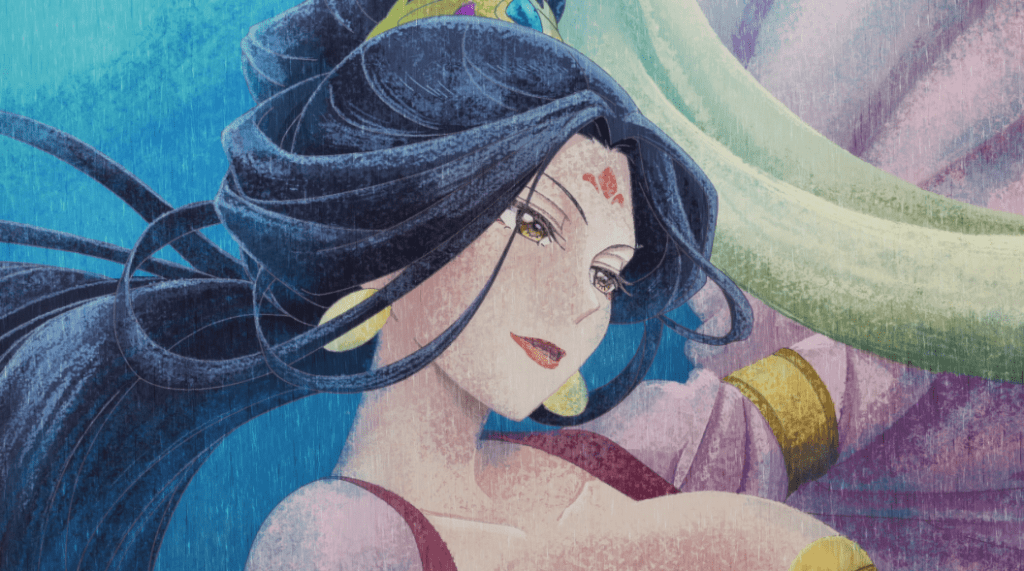
The first half of episode 29 finishes resolving the matter of the Moon Fairy by showing the execution of the scheme to pass a cross-dressing Jinshi up as the legendary beauty. The pivotal display was remarkably well-executed within the confines of the animation budget, especially in its careful use of lighting and color schemes, but the most impressive detail was actually a background one: the explanation for the drifting lights in the old matron’s painting. Just explaining them off as luminescent moths would have alone been a neat trick, but connecting them to the insect carcasses rubbed on the matron’s clothing (as described previously) explains why they would have been hovering around her as she danced. The way this series covers its bases on the gimmickry it uses is a constant delight.
But that still leaves the question of what, exactly, the envoys are playing at. Clearly they’re scheming to get close to the Emperor and his brother, as evidenced by the bold approach of one of them to the Emperor during the show, but how involved are they in scheming beyond that? How much, if any, connection do they have to what else is going on? The one shot of the envoy in the darkened room certainly suggest that there’s more going on involving them, though the story doesn’t returning to them again before the end of episode 30.
The second half of episode 29 introduces the clinic, where ill court ladies and ladies-in-waiting go for isolation when contagious. Jinshi’s ruminations on it when he encounters Maomao outside of it brings to light the awkward state of medical care in the Rear Palace: since only men can be doctors, there can’t be any in the Rear Palace, which leaves them woefully short on trained medical personnel. Older ladies-in-waiting seem to be effectively serving as nurse practitioners, though they aren’t allowed to compound medicines. Starting the school may have set the path for one long-term goal, but this is another issue which must be dealt with eventually.
The clinic’s introduction also provides the set-up for episode 30’s focus: the ill servant at the Crystal Pavilion. This is, presumably, the same one we saw coughing a few episodes back. The way she’s being treated here illustrates a point that’s been brought up before about how servant girls can be treated as disposable, but it also provides a doorway to the episode’s feature crisis: why some of the banned scented oils are still tucked away in the storehouse of the Crystal Pavilion, despite Jinshi’s edict that they be removed. Again the culprit is a scheming chief lady-in-waiting, but this time for completely different motives. Though her actions were misguided, Fengming did at least act out of loyalty to her mistress Ah-Duo, but by contrast, Shin quietly has an antagonistic attitude towards Lihua, her mistress (and cousin, it turns out). She’s long felt slighted that the Emperor chose Lihua over her to be a high-ranking concubine despite her equally good looks (the difference-maker is, of course, implied to be that Lihua is simply bustier), and so she may or may not have been carrying this to the level of promoting a miscarriage for the newly-pregnant Lihua.
That also raises the very big question of whether the way Lihua was wasting away in the early stages of the series might have at least partly been a deliberate machination, too. At the very least, Shin was at least partly indirectly (and perhaps unintentionally) responsible for the death of Lihua’s son since she was the one who brushed away Maomao’s warning back in episode 1. But the big delight here was Lihua’s dramatic slap and clear intent to do more if needed. As Maomao observed, that feistiness is a clear indicator that her recovery from her earlier depression is complete.
There’s still a big loose end here, though: who is educating the denizens of the Rear Palace on poisons and abortifacients? And perhaps more broadly, what is the ultimate goal of it all? That underlying mystery still lingers, even as the end of the episode is busy setting up the next story arc: the Shrine of Choosing.
As a final thought, surely I’m not the only one who can’t look at those scratches on Maomao’s face and not thing of cat whiskers, right?
While both episodes are covered together here, I felt I had enough to say specifically about each to write each one up separately.
Rating – Episode 12: A
Though its animation effort may have its flaws, DanMachi has always excelled above most other fantasy series in the dramatic staging of its fights and the emotions that its fights can carry. Ryu’s final confrontation with the Juggernaut near the end of season 4 perfectly captured both, and episode 12 of this season beautifully brings those strengths to the fore yet again, playing a big role in this being one of this installment’s strongest episodes.
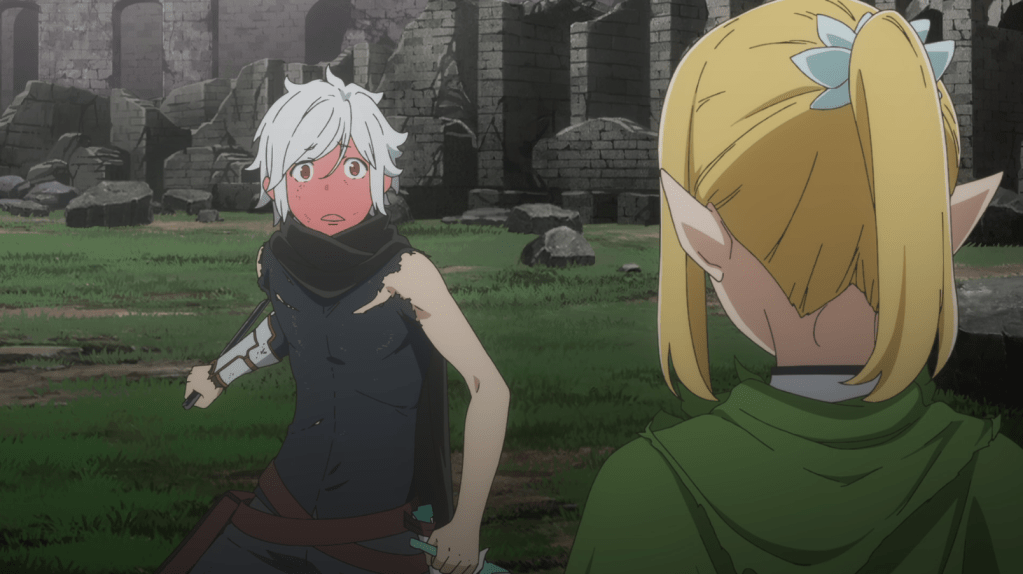
And at the heart of it is Ryu, the Gale Wind. Even if the OP hadn’t spoiled it, her return in dramatic and timely fashion was an absolute given, since, narratively speaking, she had plenty of reasons to get involved. Yes, she’s in love with Bell, but that may be the least of the factors in play here. Freya hurt Ryu arguably more than anyone else, and more personally than anyone else, with her actions and words involving Syr, and it was pretty clearly deliberate, as if Freya were specifically trying to push her away. Freya Familia members had also gotten the better of Ryu more than once earlier this season. But even more than that, Ryu had faced a major personal reckoning in coming to terms with what happened to Astrea Familia last season, and one aspect of that had not yet been resolved: she had not gone back to Astrea. We see brief flashes of that reunion (which is detailed more fully in a side story that I don’t believe has yet been published in English), but it’s plenty enough to understand that Astrea not only welcomed her back but also came back specifically to allow Ryu to participate in the War Game, with her reconstituted familia as escort. Ryu also gets a new weapon and a massive status update; considering that it’s her first in several years and what all she has accomplished since then, an unprecedented double level-up isn’t a stretch at all. She was always one of Orario’s most capable adventurers, one just shy of being able to stand among the city’s true elite. Now she can.
But even that isn’t as significant as what else she gained. Her Luminous Wind has, predictably, become stronger with her new level, but she’s also picked up the new skill perfectly suited to her: Astrea Record, which allows her to call upon the abilities of her familia sisters who have passed on. Despite what Hermes says, the mechanic isn’t that much different in execution than Lefiya’s Elf Ring in Sword Oratoria, but seeing Astrea Record in action packs a far greater emotional punch. In particular, seeing Ryu use Alise Lovell’s signature power, Scarlet Harnel, to dance across the battlefield just feels so right, and Keiji Inai’s musical selection for the scene, which infuses the spirit of a traditional folk dance with just a touch of one of the franchise’s core dramatic themes, strikes the perfect note. Being an adherent of the Goddess of Justice obligates one to pursue justice, but rather than insist on a rigid interpretation of it, Astrea allows her followers to pursue their own ideal of justice. And that it what Ryu is delivering to Freya Familia – and Hegni in particular – in this episode.
For all that the animation may not be flawless, the animation team stillgoes all-out to make Ryu’s fight look dynamic. The way she dodges is especially impressive, as is the fluid flow as she weaves around both the battlefield in general and Hogni in particular. Ryu’s fighting style has always been portrayed as more graceful than brutal, and nowhere does that come through more clearly than here, as she literally glides around on flaming feet. She also shows the power to be convincing as a newly-minted Level 6, and frankly, I’m a fan of the ponytail, too.
But there are plenty of other little tidbits to appreciate here as well. Hogni and Ganesha Familia captain Shakti are far from the only ones who acknowledge what Astrea Familia accomplished; the public clearly remembers them, too, and their reaction to seeing public evidence of the return of one of that group’s heroes is one of yearning. (For more details on why, read the Astrea Record novel trilogy, now fully available from Yen Press.) Astrea also makes a personal appearance as she accepts her flower and joins the fight. Of the other two gods with her, one we already know as Demeter, and the lithe, well-built man is Njord, the Norse god of the sea and wind (and venerated by fishermen), who comes from the nearby port town of Melen; this is his debut in the main series, but he figures quite prominently in one of the Sword Oratoria novels. As to why they’re also getting involved? We’ll see next episode. We also get a brief cameo by Astrea’s new familia and a neat scene showing how puissant a combatant Takemikazuchi is; most gods are pushovers in a fight, but Freya Familia’s rank-and-file have trouble dealing with him even when going several-on-one. Seeing Daphne’s power in action is also neat, and hey, the episode doesn’t miss the chance for some casual fan service, too.
Bell may be getting the crap kicked out of him by Ottarl, and Allen may be leading a rampage through the hide-and-seek gods, but the bigger strategy here may be almost as neat as Ryu’s fights. Forcing Hogni to personally defeat so many foes plays against the same weakness Dix showed back during season 3: cursed weapons are nasty-strong, but they have side effects on the user, too, so the allies getting mowed down was actually a deliberate plan to make it possible to beat Hogni. And that seemed to play directly into Hedin’s plan, too, as he seemed to be waiting for the moment the allies proved capable of striking down one of the Freya Familia elites to make his own move. More about that next episode, but it’s a satisfying round-out to what was, overall, a stellar episode.
Rating – Episode 13: B+
This episode gets rated lower because it does not have anywhere near the same level of emotional impact as its predecessor, but it’s still a fun episode which allows a number of its second-tier and even third-tier characters to shine while also formally bringing a major new powerhouse into the fray. And oh, yes, it features newly-confident Ryu’s confession scene and Bell’s classic reaction to it.
But that’s actually a minor moment in what is otherwise a packed episode. On the Bell/Ottarl side, two new challengers enter the fray. One is Ryu, and the other is the action debut of Mia. We always knew she was an intimidating figure, and more recently we’ve learned that she’s a former leader of Freya Familia, and her actions here strongly suggest she’s a Level 6, too. Even if Ottarl insists that he’s the stronger one now, and she may not be able to beat him alone, she can still stand toe-to-toe with Ottarl in a slugfest, and all while wielding one damn tough shovel. But Ottarl, even aside from being the only Level 7 in Orario, is also the city’s mightiest physical powerhouse on physique alone. Can even two level 6s and a level 5 take him down? He certainly seems to have no qualms about facing all three. But the high points of that fight are reserved for next episode.
That’s because a lot is going on over on the other main fronts, too. Hedin has seemingly turned on Freya, only he, in typical arrogant Hedin fashion, claims he’s doing it out of his own interpretation of loyalty, rather than a true betrayal. He’s long given the sense that his true commitment is to what he’s interpreting Freya really wants, not what she says she wants, and he’s certainly planned well. This episode makes more clear that he scemed this all along if the fighting got to a certain point, with the trigger presumably being one of his elite brethren falling. That’s presumably a signal to him that the allies have the might necessary to pull off what he wants, and gee, isn’t it nice that Allen and Ottarl are nowhere in the vicinity? His ambitions can’t work if Freya’s healers – the true linchpins of the familia’s indomitability – aren’t taken out first, and he’s probably trusting the allied forces to take out the Bringars now that the healers and Hogni are out of the way. The arrival of the waitresses gives the allies the boost they need to deal with the brothers.
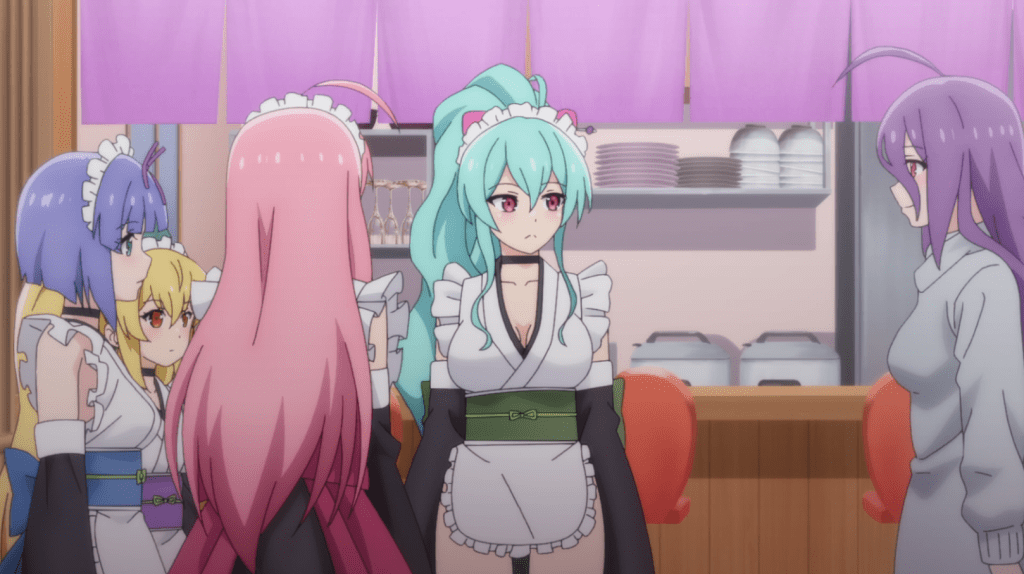
What follows is the truth about who really came to visit Anya a couple of episodes back (the anime nicely led the audience along on this point), how she gets convinced to join the fight, and just as importantly, what she can really do; how devastating her howl is reminds us that, as ridiculous as she normally seems, she is a mid-tier adventurer and has the strength and abilities to prove it. Anya’s not the only one who gets to show off her power. We also get to see Chloe’s magic, and the debut of Nahza’s spell, too (and is the first time the main series has revealed her artificial arm? I don’t recall), and the best look yet at Lunor’s physical martial arts might. The presence of Chloe and Lunor also explains why Demeter and Njord arrived last episode; they are the gods for the two waitresses even if neither waitress participates in the activities of their deities’ familia. (The circumstances of this are explained in detail in the novel and manga versions of Familia Chronicle – Episode Lyu.)
For all of the big action, though, two specific moments stand out for the bigger consequences they will generate. The longer-term consequence is Haruhime openly using her power. That won’t matter so much in this arc, but it’ll be a big problem down the road, since her security is predicated on as few people as possible knowing what she can really do. She may be weak individually, but her ability to level-boost multiple allies (even if only for a few minutes at a time) is a game-breaker when used strategically. The more immediate consequence is Mia’s words to Loki about Freya in a flashback, the same one which clarifies more specifically why Mia hasn’t stepped in before: that Syr, by Mia’s observation, represents Freya’s true heart. Horn knows this, Bell clearly suspects this, and Hedin’s actions this season make perfect sense if he has figured that out, too. Can’t rule out that Ottarl also understands this, though the anime version has provided less evidence of this. Most or all of Freya’s other followers idolize her too much and/or are too possessive of her to realize this, but it’s the key to nearly everything in play this season.
There are, of course, still two big hurdles for the allies. One is Ottarl, and the other is the swiftly-returning Allen. An Allen-Anya confrontation seems like, while the three-on-one vs. Ottarl will probably be next episode’s centerpiece. Sadly, we’ll have to wait until February 26th for episode 14, but at least it won’t be a month and a half wait this time.
In one respect, The Apothecary Diaries can be a frustrating experience, as its mysteries operate on three different levels and it’s often not clear which level a particular mystery is on. Some of its mysteries are pure stand-alones (such as the military poisoning incident straddling episodes 1 and 2 or the dancer on the wall in episode 3), others are part of lesser plots (the poisoning at the garden party in episode 6, the servant’s death in the moat in episode 9), and still others are part of grand plots (the death of Jinshi’s acquaintance in episode 9, most of the mysteries in the third quarter of season 1). There’s even cases like the treated boards in episode 5, where we still don’t fully know how that fits in even 23 episodes later. To an extent, this ambiguity is expected, as whether certain details are part of a bigger conspiracy or not is a common element in mystery shows. On the short term, though, that can be a little bothersome.
Such is the case with episode 28. Gaoshun’s story about the two sisters feels like a standalone mystery, but there are too many potential connections here to discount. His behavior and thorough knowledge of the circumstances suggests that he was more intimately involved than he’s letting on, and both the sisters looking very similar and a large mirror being a key part of the mystery have connections to other things going on in the episode. Maybe it’s just thematic consistency, but I can’t shake the impression that this has something to do with the arrival of the duo of female envoys who were bringing large mirrors with them as gifts – mirrors that, as Maomao points out, are extravagant gifts in that era given the difficulty of both manufacturing and especially transporting them.
The other “mystery,” which is is more intrinsically linked to the envoys, involved the “Moon Fairy.” Here the mystery is less about who the Moon Fairy was – as Maomao almost immediately realizes that it has to have been the manager of Verdigris House – and more about how to duplicate the legend to impress the envoys. (Presumably, this is deemed necessary because the Emperor has to counter the lavish opening gifts brought by the envoys or be left at a disadvantage in the trad negotiations.) Finding a stand-in for the original dancer is the easy part, even if Jinshi isn’t happy about the solution both Maomao and Gaoshun quickly come to; the series has made diligent efforts to portray Jinshi as having an almost unearthly, feminine beauty about him, after all. The rest of the mystery is about how to replicate the glowing lights shown in the painting. Given what Shisui is shown doing at the end of the episode (presumably collecting insects and then seeing a seemingly luminescent flying creature), she will doubtless come into play on that.
The other aspect of this episode that I liked was how smoothly it worked in various setting details. The old woman’s tales from 50 years past is the first indication we’ve had that the current capital city has only been around for a few decades, and the palace for even less than that; this had felt like a long-established setting rich in centuries of tradition, but apparently it’s not. That the capital is built on old ruins – and that some of the ruins may still be present even within the palace grounds – is also interesting and practically screams for attention in some future mystery, though they don’t seem relevant so far. Curiously, the northern part of the palace grounds is again involved. (And this isn’t the last time this season that will happen, either.)
In many respects, this episode feels similar to episode 5: a lead-up to a big, key event. Will we have the same dramatics at this party as what we got on that occasion?
Although the circumstances comprising this episode were set up at the end of last episode, this one is largely a self-contained “mystery of the week” style caper, akin to what the series engaged in through much of the first half of the first season. For not the first time, a death is involved, but also for not the first time, the mystery isn’t about how the death happened or (mostly not) who was responsible. Instead, the mystery is more about who actually died and how it was covered up.
Gather more than 2,000 people into a contained, competitive environment and conflicts are likely to arise, and the Rear Palace – where not only a woman’s entire future but also the prosperity of her family may be at stake – is certainly no different. As we see here, the scheming isn’t just limited to high-ranking concubines, either. What, exactly, is going on here can be hard to follow on a single viewing, but the gist of it is that Jin, a concubine who (as I understand it) ranks just a step below Gyokuyou, Lishu, and Lihua, was a disagreeable sort who wasn’t getting any attention from the Emperor. (Most likely this was because she was a diagreeable sort.) Two years ago, she was likely responsible for poisoning concubine Son, who survived but with bad side effects, but no one could prove it. A year ago, she got into an altercation with Tao, a lower-ranked concubine who looked like her and had a marriage arranged at the end of her term (and whom she was probably bullying). An altercation broke out that accidentally resulted in Jin’s death, so her ladies-in-waiting had Jin’s body buried in secret and pressed Tao into being a stand-in for her, with the story that she had also been poisoned and her wrapped in bandages as a cover. With time for Tao’s marriage approaching, the ladies-in-waiting got desperate and poisoned Tao to match their cover story and passed her death off as Jin’s. Or at least that’s Maomao’s understanding of what happened.
That things could escalate to such an extreme is hardly a stretch when one considers the matter with Fengming in season 1 and how harsh and thorough the consequences were there. The whole situation reminds us that Maomao’s comments in episode 1 about keeping her head down and just blending in weren’t without good reason.
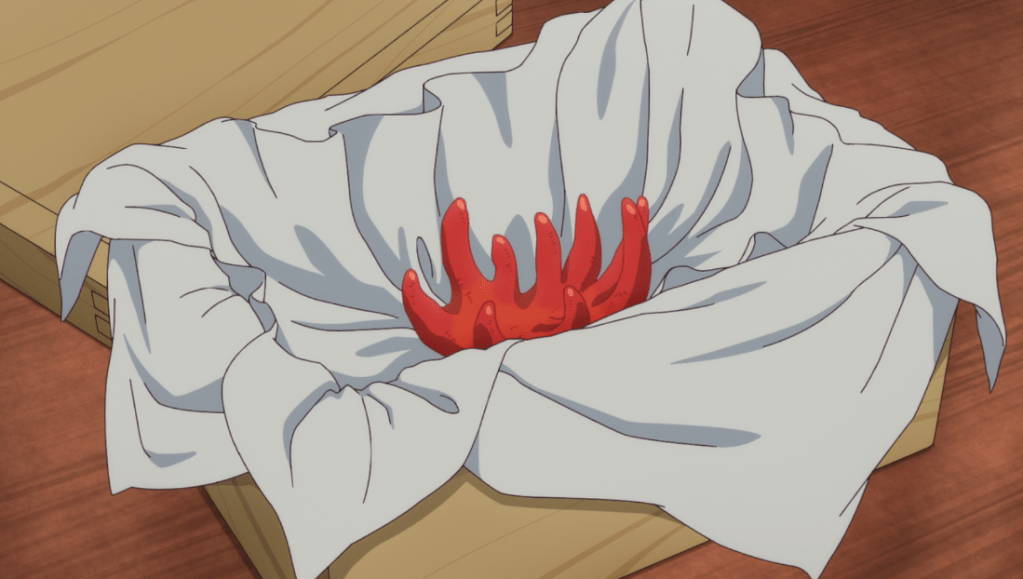
The framing device for the whole affair is mushrooms. They are both the instrument of chaos and the key to sorting out the mystery. The featured mushroom here (shown below) is poison fire coral, an actual mushroom that is among the most poisonous fungi in the world. Direct contact can cause inflammation, death is possible from ingesting it, and it can be found widely in Asia:
Other types of mushrooms, meanwhile, proved key to finding where the real Jin’s body was buried. The writing here condenses Maomao’s investigation quite a bit, as the payoff here is more important than the methods for getting to it in this case, but comments about the smell last episode proved, as expected, to not be idle details.
Manipulating Maomao into digging into this matter (heh!) isn’t the only thing afoot this episode, either. Jinshi’s grand plan isn’t just about distributing novels as a roundabout way to encourage more servant girls to get educated; he’s looking to use that as a stepping stone for drawing more of the girls into formal education. Whether he came up with that idea on his own or was influenced by his interactions with Maomao is irrelevant; the end result will be a more formalized version of what Maomao was doing with Xiaolin. That Jinshi and Gaoshun were alarmed when Maomao seemed pleased by it is one of the episode’s funniest moments.
While there are other humorous moments slickly mixed into the very serious content, my favorite isn’t that one but instead Maomao contemplating Jinshi’s motives while in line to pay respects at what was supposedly Jin’s funeral. The way Maomao just nonchalantly approved when she suspected that Jinshi may have been looking at her as a possible poisoner culprit, and thus set her on this task partly as a test, is as much a classic Maomao moment as her catty reactions.
But the adventures with the north side of the palace grounds aren’t done yet! If I am interpreting the Next Episode segment correctly, we’ll be back there again next episode.













 USA Anime