Before I get into the review, a bit of news. According to a report first posted on ScreenRant, episodes 45 and 46 will air as normal over the next two Fridays, but episode 47 will be delayed by a week, thus airing on June 27th instead of June 20th. In its place a special episode featuring some of the series’ key Japanese voice actors will air, though whether Crunchyroll will get this or not is unclear.
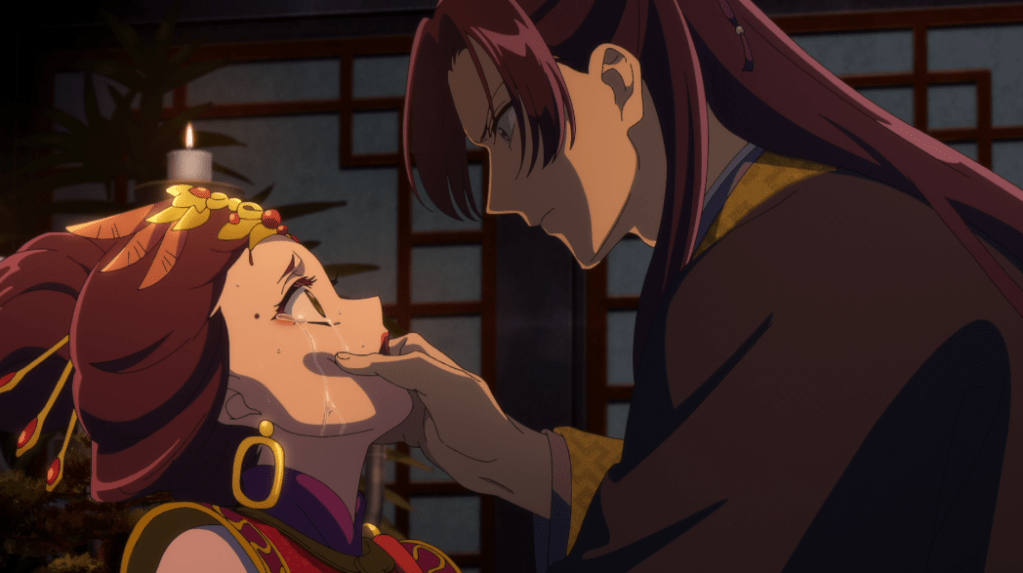
But that’s three weeks off, and there’s certainly plenty to talk about concerning episode 44. The biggest, of course, is the absolute confirmation of what I was speculating about in my episode 42 review: that Loulan is Shisui – or, to be clear, the Shisui that the audience is familiar with. However, what Suirei explains to Maomao is nearly as important, and even more loaded than it might seem. She is Loulan’s half-sister and the original Shisui, fathered by Shishou before he married into the Shi clan, which certainly explains why Shishou’s current wife Shenmei hates her and why she was forced to give up a name with the family name in it. But it’s also previously been heavily implied that Taiho was Suirei’s mother. Does that mean that Shisou was the doctor in the tale told a couple of times previously about the one who fathered a child by a servant? The details between what Jinshi mulls over in episode 42 and what Suirei reveals in this episode don’t seem to perfectly align on that point, but it’s still a plausible scenario if at least one of the two isn’t completely reliable in their understanding of events.
No less important is the first look at Loulan’s thoughts. (For consistency’s sake, I’m going to refer to her by that name from this point out.) They, combined with her comments last episode, clearly show that her demeanor as the high-ranking concubine is the personality she developed to avoid the wrath of her mother Shenmei. Combined with snippets showing how Loulan interacts with Suirei outside of her mother’s presence, it reinforces that her Shisui personality is more genuine. (This and Suirei’s previous words also suggest that using “Shisui” as her alias when pretending to be a servant girl was a very meaningful choice, likely meant to honor her sister.) But it also gives the impression that, though she’s not essentially on house arrest like Maomao is, she’s every bit as trapped in her role here.
This all raises even bigger questions about why Suirei and Loulan coerced Maomao into coming along. While Loulan is clearly covering for Maomao in the opening scene, was filling the role of a missing apothecary the original intent for bringing Maomao along, or just a convenient way to get her out of punishment? And was it more by Suirei’s will or Loulan’s that Maomao was brought along? Suirei increasingly feels like she holds nothing against Maomoao, and both she and Loulan seem to have reasons for wanting Maomao to be aware of what is transpiring, especially since neither can stop the brewing rebellion. Since Suirei, at the least, knows who Maomao’s biological father is, was Maomao perhaps kidnapped as a way to force certain powerful individuals into awareness and action? If so, they still have to know that the bloodletting which will result from all of this will be severe. Hard to call either a tragic figure yet, since Suirei, at least, was definitely directly involved in an assassination attempt, but the story feels like it’s shading in that direction.
Events are momentous in the Jinshi front, too. With Lahan providing further evidence that Shisou (or, perhaps more accurately, Shenmei through Shisou) is fomenting a rebellion and Lakan no longer bothering to pretend that he doesn’t know exactly who Jinshi is, Jinshi’s being backed into a corner. The only way he can both rescue Maomao and deal with this building problem is to finally assert himself in his true identity. The amusing thing here is how deferential Lakan is to Luomen when he arrives (brought by Lahan!) to rein Lakan in. I especially liked the subtle shift in the lighting when Luomen finally convinced Lakan to approach the situation in a more proper fashion, one that Jinshi would have a harder time resisting.
The Next Episode preview suggests that most or all of next episode will take place on the Maomao front, but a move towards a big confrontation is now building. This is the most plot-intensive run of the series to date, and the storytelling quality certainly isn’t hurting for it.
NOTE: Due to travel plans, reviews for the next two weeks could be much later than normal and may be combined into a single review for both episodes 45 and 46.
No matter her situation, Maomao can’t stop being Maomao.
The narrator spoke to this at the end of episode 1, and we’ve seen countless examples of it over the course of the series, but nowhere is that statement more true than in this episode. Though not treated as a hostage, that’s what Maomao ostensibly is in the fox village, and that should urge caution upon her; indeed, most of the time she sticks to that. However, that doesn’t completely stop her curiosity from getting the better of her on two occasions, and at least one of those instances looks like it could have bigger consequences.
The first, of course, is with the “resurrection” drug. We all knew that it was just a matter of time until Maomao couldn’t restrain herself anymore about asking about it, but the suddenness with which Maomao exploded on Suirei uncharacteristically caught the latter off guard. Interestingly, Suirei, while not exactly enthusiastic about answering Maomao’s questions, didn’t seem averse to it, either. Shisui is stretching to say that Maomao and Suirei gt along, but I do have to wonder if these two might have gotten along under different circumstances. They’re both sharp, studious, and thorough.
Sadly, that’s not a long-term option here. Maomao’s other bit of curiosity isn’t even aimed at a major discovery: just trying to puzzle out why one wheat field is underperforming compared to others. But that leads to accidentally discovering that this village is where those mysterious firearms are being assembled. Given the actions Suirei has taken and the attempt on Jinshi’s life with those same firearms, the only reasonable conclusion is that the village is either arming itself for a rebellion or supporting one, and Maomao is highly unlikely to want to go along with that.
The “why” is still a big question here, especially since Shisui is still treating Maomao like her BFF. The episode does give us some clues on that: the village was became home to some refugees from the west, who interbred with the locals over time. This is the same “west” that the Royal Mother came from, and so a fair number of these people also have the color-blind issue that the Royal Mother had. This means Loulan’s father almost certainly has close relations with these people (as if we needed any more proof of that). This raises the possibility that the western influence has waned over the decades and some are seeking to reestablish it, but that feels too simple. There’s a lot more still to be revealed here, especially since none of that even hints at why Maomao was taken as a hostage. Is the intent, perhaps, to use her to draw certain individuals out?
All that aside, the part of the episode involving the festival was my favorite part. The details here are so well-though-out that I have to think they’re based on some actual traditions, and the symbolism of the masks (and whether they burn or sink) adds a lot of additional depth, too. The whole thing also gave the impression of dropping all sorts of little hints. with the camera pausing meaningfully on Shisui numerous times. A later scene where Shisui gives Maomao her hairpin also can be interpreted as loaded; back during the garden party, hairpins are practically a courting mechanism, so this could be seen as Shisui laying personal claim to Maomao. Doubtless this is going to come up again.
The episode ends on a seemingly-dire note, but the Next Episode preview assures that nothing too bad is going to come from it; perhaps this Shenmei won’t appreciate how big a deal it is that Maomao has found out about the guns. Whatever the case may be on that, I look forward to a return to having Jinshi and Maomao both in the same episode (if not necessarily the same location) again.
This half of the report covers the rest of the titles I’m following that didn’t make part 1. All of these titles have hit either episode 6 or (in most cases) episode 7 since part 1 was posted. Additionally, a look at one title which debuted too late to make the Preview Guide is included.
Apocalypse Hotel
Rating So Far: B+
This is easily one of the oddest and least predictable series to air so far this year, as in any given episode the robot-run hotel lingering a century or more after humanity left might deal with bloblike aliens, a family of space tanuki leaving piles of poop all over the place, a planetary destroyer who falls in love, or a mission to send an advertising satellite/protective weapon system into orbit. It’s a mix that might be more expected of a wacky sci fi comedy series, and indeed, there are distinct comedy elements to this one, but this is much more about using the robot and aliens to explore the human condition and political issues, with a healthy dose of background melancholy over the truth that the humans head robot Yachiyo expects to eventually come back might not exist anymore as the centuries pass. The series raises lots of practical questions, but dwelling on those is not the point here. It’s delightfully different and sports one of the season’s most memorable OPs.
Go! Go! Loser Ranger
Rating So Far: B
The trial against the snake-themed monster boss dragged on too long, hence the reason the grade for this one drops a bit from last season. This series still looks better than most, though, and features some fairly sharp writing in the way it shows D’s struggles to balance his goals with the fact that he’s actually coming to like some of the people he’s working with during his infiltration. Also good to see the original Hibiki pop up again and Red Keeper being as evil as ever.
Makina-san is a Love Bot!?
Rating So Far: C+
Both of this season’s leading fan service titles are similar in some ways: the female lead is voluptuous, very sexually aggressive, and non-human, while the male lead is smaller, more meek in most circumstances, and definitely overwhelmed by the female lead. They’re also both half-episode endeavors. What passes for a plot diverges greatly between the two, however. This one has much more of one, and it has become increasingly more prominent in the last couple of episodes as Makina’s sister unit comes into the picture. The series still doesn’t lack for fan service, but nothing here is really any racier than some titles HIDIVE has streamed in the last year or two, so I have to wonder why this one got relegated to new platform OceanVeil. Regardless, it’s a decent but unexceptional fan service fest, the kind unlikely to be remembered past this season unless its second half offers more.
Mobile Suit Gundam GQuuuuuuX
Rating So Far: B
Whatever else might be said about this series, it certainly doesn’t waste time on getting to major plot developments, with episode 7 having the kind of stunning, game-changing transition normally seen on a seasonal break point. The bigger plot points are getting increasingly harder to follow if one is not intimately familiar with the original Mobile Suit Gundam, as the series doesn’t do much to explain who some of the important names being thrown around are. However, the series makes up for that by using character dynamics for the central cast that anyone can appreciate, with a clear love triangle forming between Shuji, Nyaan, and Machu and all the drama that involves when all three are teen Newtypes participating in illegal mecha battles and being sought by different governments for various reasons. Battle scenes are still among the season’s most visually dynamic, though they can also sometimes be hard to follow. I have some issue with the series maintaining any pretense that its mecha are technological rather than magical, and think the series is softballing a bit on how people are getting killed in these Clan Battles, but it is certainly never boring.
Our Last Crusade p2
Rating: C
While the animation quality of the revamped episodes is a distinct improvement, this is still far from being one of the season’s better-looking titles. The updates made also didn’t improve the story quality one bit. There is still a firm plot in play as Elletear schemes to overthrow the queen while the Empire’s Saint Disciples, in a partially-related move, make their strike, and Iska and crew still have their hands full keeping Sisbell safe. However, the execution is all a mess; the infiltration seems too easy unless Elletear was pulling some strings that have yet to be revealed, and why certain other events happen the way they do don’t make much sense yet. The writing also seems to have forgotten that the Iska/Alice interactions lay at the series’ core, and their interactions are currently far too limited. If the writing doesn’t improve then this grade could sink further by the end of the season.
SHIROHIYO (debut)
Rating So Far: B
This one immediately stands out for one particular reason: protagonist Ageha is, to put it nicely, chubby. (He regularly refers to himself as a “white pig.”) Beyond that, it’s a fairly standard isekai in some respects: after a bad fever, a five year old noble’s son in a fantasy setting realizes that he has memories from a past life as an adult man in Japan. There are status screens, and he’s abnormally good at certain skills for his age. In his case, though, those skills involve cooking, cleaning, and craftwork, things that were pastimes for him in his previous life. As the first six episodes progress, he’s also discovered to be able to imbue the embroidery he does with enhancement magic, too. A goddess is involved, but he impresses her with his singing instead. He’s also got an elf tutor whom he eventually discovers is a famous adventurer and a younger half-brother he looks out for once they meet. Unfortunately him, his parents are shit, though not in the over-the-top way commonly seen in these series. They don’t get along to the point of detesting him because he’s the factor which irrevocably connects therm.
In other words, this one can get surprisingly heavily despite its light color scheme and general spirit, though it does have its more easygoing aspects, too. It’s got a better-than-average supporting cast (the elf tutor and goddess can both be quite the characters) and has taken a mostly-pure development aspect so far; Ageha has yet to make any move to learn fighting skills, instead focusing more on bettering his family’s domain so that the half-brother he expects to take over some day will have good, educated people around him. Looks pretty good, too. Overall, it isn’t doing anything extraordinary, but it was solid enough that I ended up watching all six available episodes despite only intending to watch the first two.
Summer Pockets
Rating: B-
If you’ve been around long enough in fandom to be familiar with the classic Key/Visual Art’s anime adaptation, it should suffice to say that this series is proving par for the course for such fare. For those who haven’t, there are plenty of cute girls with sometime-humorous and always-adorable quirks for the protagonist to interact with, including at least one who’s seriously ill even though she doesn’t look it. Toss in some baggage for the protagonist, a male friend who’s a comic foil, and a dash or two of mystical elements and you have the standard sentiment-dripping formula in action. The most interesting aspect so far is a suggestion that the problem of shifting between the original virtual novel’s different paths is going to be handled by some kind of time-looping mechanism, which effectively resets the story in episode 7 after finishing one girl’s arc in episode 6. Further, the story implies that one specific girl is the trigger for this, so seeing how that plays out adds a welcome extra dose of intrigue; perhaps she’ll prove, in a way, to be the series’ final boss? Overall, the series isn’t doing anything noteworthy so far, just executing adequately for its type.
Teogonia
Rating So Far: B-
This one is proving to be an isekai more on a technicality, as the fact that Kai originally came from another world (which he’s only hazily aware of) is only mildly relevant maybe three or four times in this block of six episodes. Even then, it really only meaningfully comes into play in terms of giving Kai new ideas for using the power of his Divine Crest. The series also makes more of an effort than most to establish distinct setting and cultural identities, down even to having alternate languages for its non-human humanoid races, and Kai is shaping up to be a worthy action hero. The action scenes, while not top-tier, aren’t bad, either, and the character design work in particular stands out. This is an easy series to overlook, but it’s worth checking out.
The Gorilla God’s Go-To Girl
Rating So Far: B
I’d really like to rate this one higher, since it is one of my two favorites among new titles this season, but the animation effort is just too weak to justify going higher than this. Despite that, it’s still the most fun that I’ve had with a reverse-harem series in quite some time, and the series not beating around the bush about hooking up Louis and Sophia (they’re all but officially a couple by the end of episode 7) is an extra-big plus. There’s also a developing plot involving some terrorists, but that’s secondary to how sweet and adorable the character dynamics are. It’s a title well worth a look even if the genre isn’t normally your thing.
The Mononoke Lectures of Chuzenji-sensei
Rating So Far: B
Really, why is this one not licensed by a U.S. streaming provider? It generally looks pretty good, is competently written, and fills an underserved niche that otaku are known to go for (i.e., pure mystery stories). While the name suggests a supernatural element, most of the cases the central duo get involved with concern providing supernatural explanations for mundane occurrences, in some cases exposing actual (generally nonviolent) crimes, such as a counterfeit ring in one episode. The relationship between student Kanna and know-it-all teacher Akihiko Chuzenji is a neat one, and the period details are a nice touch (though I would like to see that aspect emphasized more; despite being set in 1948, the series dodges around bringing up the war except in the context of certain adults being former soldiers). It also has one of the season’s better OPs, and a seemingly-smart cat has been added to the regular cast with the most recent episode. Unfortunately, you’ll have to do some hunting to track this one down, but it’s worth the effort if you can.
Witch Watch
Rating So Far: B+
This is a generally-funny series which spikes to being extremely funny at least a couple of times each episode. While the pairing of serious-minded ogre Morihito and ditzy witch Nico carries the show, it still benefits greatly from the addition of Kanshi, Nico’s tengu familiar, who becomes her regular partner in hare-brained ideas as well as being the third vertex of a developing love triangle. Nemu, a fellow witch who can turn into a cat, has also been introduced and seems promising, too, but has only appeared in one episode so far. A couple of mentions of concerning prophecies involving Nico have been brought up, so the series isn’t entirely fun and games, but antics mostly (but not always!) involving Nico’s eccentric magic use are the series’ staples, and those work quite well. Also has the season’s premier OP, courtesy of yet another catchy number by YOASOBI.
Yandere Dark Elf
Rating So Far: C-
This one would merit a grade at least a notch or two higher if HIDIVE had the uncensored version, but sadly that’s not the case. (As you can see here, even male nipples are being censored.) That aside, Hinata is firmly in a love triangle with Mariabell and classmate Sakura by this point, and his other two former female adventuring companions have come to Earth as his next-door neighbors to keep an eye on Mariabell. Typical antics continue, with an emphasis on providing nudity multiple times per episode, though the series aims at least a little higher with one episode where Sakura is babysitting a baby cousin. The series is also noteworthy for a clear Gushing Over Magical Girls call-out if you watch carefully.
That’s all for this time around! And now back to your regularly scheduled programming. . .
With the Spring 2025 season entering its seventh week, it’s time to take a look at how some of the season’s titles are doing so far.
While I’ve taken a conscious effort to be a bit more conservative on my viewing list for this season, I still wound up following 20 series which debuted or returned this season, two which continued from the previous season, and one which unceremoniously is getting a revamped rebroadcast and continuation (i.e, Our Last Crusade). Even with The Apothecary Diaries being covered in episode reviews, that still leaves 22 titles, so I am again splitting this endeavor into two weekly installments. Unlike in past seasons, I have a less clear break based on episode counts aired, so this part includes the four titles which have already hit episode 7 by 5/14/25 plus the next seven scheduled to hit episode 7 as the week progresses. The rest, including the three shows which have only aired five episodes by 5/14 (Teogonia, Our Last Crusade, and Go! Go! Loser Ranger), will be covered in next week’s installment.
Bye, Bye Earth s2
Rating So Far: B-
Maybe at some point this series will start making sense? I’m not holding my breath on that anymore, though, because at 16 episodes in, it still doesn’t. My complaints about this second season are still largely the same as they were at the end of the first season: lots and lots of neat ideas, but the structure to pull them all together is lacking. At least Adonis’s slide into being the main antagonist makes sense given the nature of his abilities shown in the first season, and the funeral scene (albeit for a character who was never shown as having died!) was pretty neat. Overall, its use of all these ideas is fresh enough to earn the series some style points, and it still looks pretty good.
From Old Country Bumpkin to Master Swordsman
Rating So Far: B
Of all the series in the last year or two which have had harem (or reverse harem) elements to them, this is the one where it’s least welcome and the series which could most do without it; isn’t it enough that they deeply respect him and/or could look to him as a father figure? (Yeah, I know the older guy attracting the attention of the fillies is part of the point here, but still.) That aside, I do very much like how the series has remained focused on how Beryl out-skills opponents with little moves rather than grand, overpowering stunts, and recent episodes have shown a growing inclination towards a bigger and broader plot. I also like how Beryl, for all his skill, isn’t shown having to do it all on his own. There’s also something to said for how Beryl makes for an impressive figure as a solidly-built mature man, so I guess I can understand a bit why he might attract romantic attention. (Still, I’d rather see that come at least some from ladies closer to his own age, even as someone who’s closer in age to Beryl than most other anime leading men.) Not a top-tier series, but a definite keeper.
I Left My A-Rank Party
Rating So Far This Season: B
The regular cast is expanding again, with Niberune now being a staple member and Jamie on the verge of coming back into the picture, thus completing the line-up shown in this season’s OP. Despite some bigger plot movements, the series still retains much of the charm that made this series one of the Winter 2025 season’s overperformers, and the ongoing relationship between Yuke and Rain is especially neat and welcome. There’s been a slight push more in a harem direction, but it’s still (mostly) resisting that for now, with Rain still being the only one overtly romantically interested in Yuke. I am a little more concerned about some occasional dips in artistic and animation quality, but this is still, overall, a solid performer.
I’m the Evil Overlord of an Intergalactic Empire
Rating So Far: C+
On the plus side, the “isekai in space” concept is a more novel variation, as is the interdimensional being seeking to sow and feed off of sorrow remaining semi-actively involved. I also do appreciate the generally flippant attitude on most things, such as the absurdity of an “impoverished” noble being able to afford 300 space battleships or the fake martial arts instructor/grifter who finds his student actually pulling off his make-believe stunts for real. However, the series also falls flat on some light fan service moments that I think are meant to be funny and the tone can whip around quite hard; one episode has pronounced body horror elements, for instance. At six episodes in, the series still feels like it hasn’t quite hit its stride.
I’ve Been Killing Slimes for 300 Years and Maxed Out My Levels2
Rating So Far: C
Azusa and her family do light-hearted stuff while expanding their family a bit more, this time adding in a sentient mandragora (who is, of course, a cute girl). The world-building expands a little bit, too, with the introduction of other spirits in one episode and other witches in another. Basically, the series is still exactly what it was in its first season, for better or worse, and that includes on the technical front. That’s not necessarily bad, since it allows for a nice, relaxing view, but there’s nothing stimulating about it.
Rock is a Lady’s Modesty
Rating So Far: B+
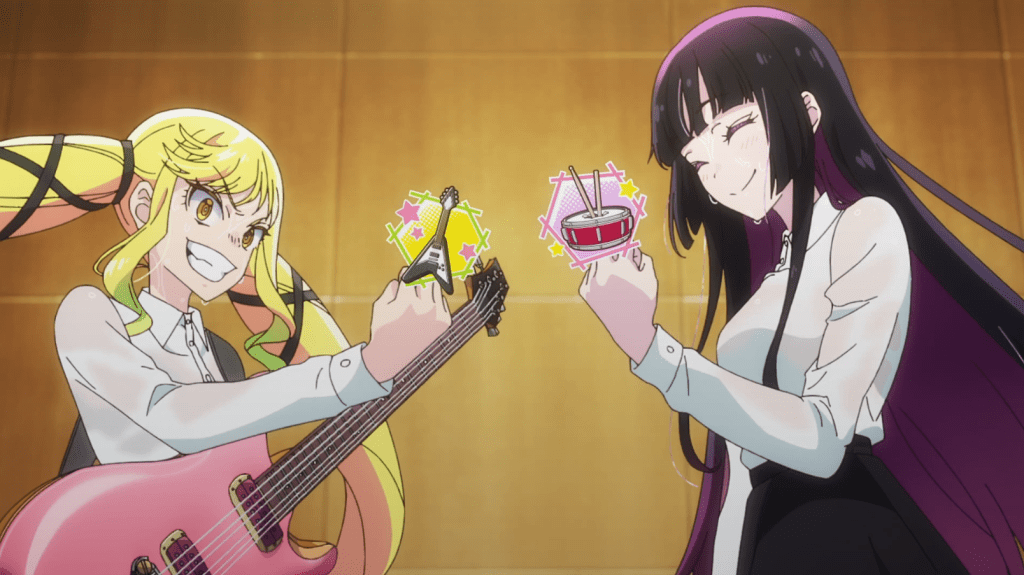
Yeah, you can maybe criticize the series for resorting to CG in some of the performance numbers, but I also have to respect a series which can so drastically flip the switch between its genteel Lady Mode and its savage Rock Mode. Some of the expressions for Lilisa and Otoha are classic and scenes where they go into full-blown, foul-mouthed trash-talking mode towards each other (and later others) are an absolute delight. There’s even a fair bit of story and character development, too, particularly in Lilisa’s relationship with her stepsister and what’s now being implied about Lilisa’s mother. The two other band members featured in the OP and ED have also finally now come into the picture with episode 6, too. (And speaking of that, OP “Ready to Rock” by BAND-MAID is easily one of the season’s best.) While it does have some serious moments, this has been a fun ride so far.
Sword of the Demon Hunter
Rating so Far: A-
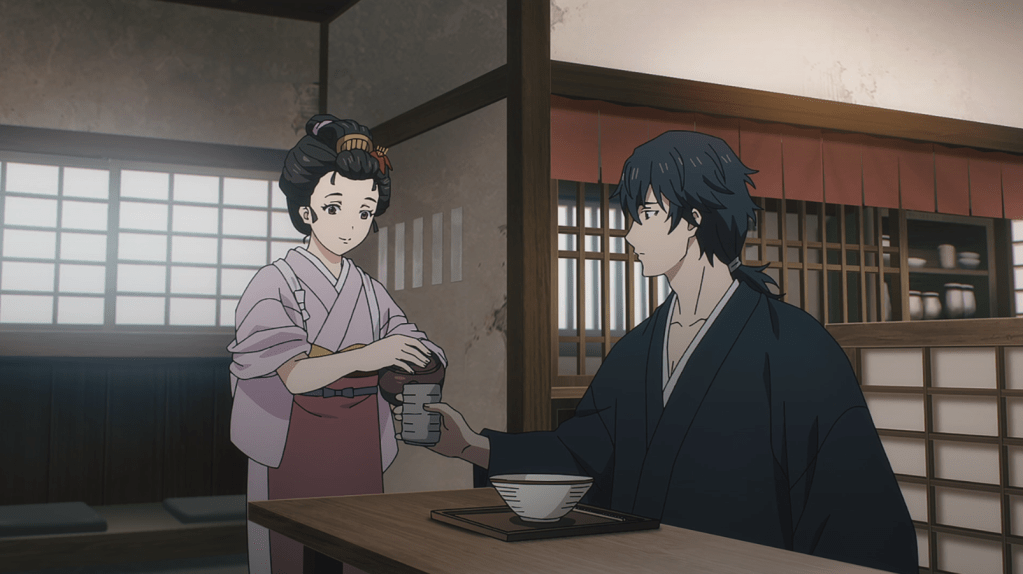
What’s the best series that isn’t getting weekly episode reviews at Anime News Network? This one, and I can’t say that I expected to be saying that at this point in the season. Contrary to what was implied at the end of episode 1, the series has not jumped forward into the modern day, instead continuing with a series of stories set in 1850s Edo, where Jinya deals with a variety of cases that usually involve demons. These go well beyond being just basic “monster of the week” stories, though. They carry more depth, emotion, surprising inter-connectedness, and lingering meaning, especially the implication of a sort-of reconciliation between Jinya and his true father. There aren’t always demons to defeat, either, or even demons at all; possibly the best episode so far is one with zero mystical or action component to it, where Jinya looks into a painter who may or may not be cursed. The artistic and animation effort are also above-average and the series is awash in a wealth of period detail. I’d still like to see how the story is eventually going to get to modern day, but so far it’s hard to complain about what it’s done with its late Edo period content.
The Beginning After the End
Rating So Far: C
This one is mostly following a traditional “reincarnated into a later era”path, complete with a distinct change to the way magic works, but with the protagonist being separated from his parents for a few years as a result of a bandit attack and winding up living first with a dragon, and later with elves. The dragon incident gives hints of a bigger plot; that has yet to lead to anything, but hey, Arthur does get to befriend a tomboyish elvish princess! This one has taken some heat for the way the adaptation has been carried out, but my main problem with it so far is how ordinary elves in this world are; there’s essentially nothing besides the ears which seems to distinguish them from humans, and even the design of their home feels like a half-hearted effort at distinctiveness. On the whole, there’s nothing glaringly bad about the series, but it isn’t doing anything to stand out so far, either.
The Brilliant Healer’s New Life in the Shadows
Rating So Far: C+
Like Meister, Too-Perfect Saint, and to a lesser extent Bumpkin, this is another one of those series where the protagonist has no proper frame of reference to appreciate how OP he actually is within his specialty, and like Meister and Saint, it embraces the “party is too arrogant/stupid to appreciate how good they had it” trope, too. It has also made no pretense about going the harem route, either, but that was obvious from the first episode, and Zenos is still too dense to appreciate that. I do like the character designs so far here, and the series has made at least some effort to bring up some social issues (such as how the nobles are deliberately keeping the slums down rather than being uncaring or neglectful). There’s also, of course, the mystery about why Zenos is so much stronger a healer than anyone else. For all that the series isn’t doing anything special, though, it’s still entertaining me and remains firmly on my viewing list.
The Too-Perfect Saint
Rating So Far: B+
I expected this one to be little more than a minor variation on the “banished from the party” concept, but starting with episode 3 in particular, the series has proved to be so much more than that. The pivotal decision was to split the focus between titular heroine Philia and her younger sister Mia, who outwardly masks that she is inwardly furious over the sister she idolized being unceremoniously shipped off. In a big twist from convention, she seeks to covertly undermine the prince who raises her to the station of Saint in Philia’s place and plans to marry her. That puts a much fresher spin on the concept, but it isn’t just that which makes this one stand out. I’ve also loved the emphasis on those now around Phiia helping her reconstruct her devastated self-image and appreciate the remarkable things she’s done that everyone but her can see, as well as an unusually high degree of long-term plotting and scheming. The series is unfortunately limited by a mediocre animation effort, but on the storytelling front it’s one of the season’s stronger offerings.
The Unaware Atelier Meister
Rating So Far: C+
As much as I’d love to completely rag on this one, it does have a couple of key redeeming features. One is that the series has successfully made a rather funny running joke out of the absurdity of what Kurt can matter-of-factly do outside of combat, like construct an entire mansion or lake in a day. The other is Yulishia, the dusky-skinned adventurer who’s actually dressed in garb much more suited to being an adventurer (including pants!) than the fantasy anime norm for female characters and takes a more motherly than romantic interest in Kurt. The series has also found a fairly good balance between its more serious and more flippant elements so far. So while it does have unimpressive technical merits and a generic feel, it’s not at all without light entertainment value.
That’s it for this installment. Watch for Part 2 to roll out same time next week!
On a couple of occasions in this series’ run, we’ve had episodes where Jinshi was either functionally or completely absent. However, this episode is, I believe, the first one where Maomao has nothing more than a cameo appearance. Remarkably, that doesn’t weaken the series one bit because it still has Jinshi, and he’s a compelling enough character to nearly be able to carry a series on his own. Of course, it doesn’t hurt that most of the episode is one massive, intricate game of connect-the-dots on little clues scattered throughout the series (though primarily this season), complete with a startling twist and a strong, shocking implication on the true identity of one of this season’s staple characters. Altogether, it makes for an excellent, thought-provoking episode.
One of the predominant recurring themes of the second season has been the devastating long-term impact of the previous Emperor’s pedophilia. Anshi’s veritable rape of the previous Emperor to become pregnant with her second child may well have limited the number of victims, but plenty of damage had already been done, as seen all too clearly with Shenlu in episode 40. The Emperor’s young victims were never allowed to leave the court, and so they went on to become the clinic workers, organize ghost-telling get-togethers, and even eventually die without ever leaving the Rear Palace. Trapped as they were, their resentment could only fester, and bad things happen when such resentment festers for decades. And when such individuals cross paths with others with serious reasons to carry grudges against the Imperial family, real trouble brews.
In this case, the other branch of the story concerns the tale told on a couple of occasions a few episodes back about the scandal involving the court doctor who got the attendant of a concubine pregnant, the affair which directly led to the Rear Palace being staffed by eunuchs. We knew at the time that the baby left the Rear Palace with the doctor but the concubine didn’t. The fate of that baby was left a mystery, but the strong implication now is that the baby grew up to become Suirei. Since her mother was stuck in the Rear Palace until she – the woman who organized the ghost stories – died last year, Suirei’s presence before the grave a few episodes back now makes sense, as does why she might be looking to kill an Imperial. Whether Jinshi is the brother of the Emperor or his son probably doesn’t matter; he’s still related to the awful previous Emperor (and his mother), who caused so much grief. And apparently, Jinshi even looks a lot like the previous Emperor at the same age, too, enough so to induce trauma in Shenlu (one of the very few to know both the previous Emperor in his younger years and Jinshi) when Jinshi puts on his “pretty eunuch” act. That’s a pretty damn chilling bit of irony, and Jinshi’s stunned reaction indicates that it’s definitely not lost on him.
But that’s not the only factor here. The concubine Suirei’s mother served went on to become Shishou’s wife and, thus, Loulan’s mother. Jinshi discovering the imposter posing as Loulan in Garnet Pavilion, and the report that Loulan has left with no intent to return, indicates that all her heavy make-up and odd behavior was just a ruse to set up the circumstances allowing for an imposter – and gee, haven’t we already seen a scenario about an imposter for a concubine already this season? More importantly, the timing of Loulan’s disappearance here is way too suspicious. Couple that with with matching hair and eye color, how we’ve never heard Loulan’s voice (she doesn’t even have a voice actress assigned), and Maomao’s observations that Shisui sometimes acts like a different person and it all points to one thing: Shisui is Loulan. After all, it’s not like the series hasn’t already established how a woman can completely transform through dress and make-up. . .
The obvious question now is about how long Loulan has been using imposters. Assuming I’m right about the deduction above, clearly she’s been doing it long enough to go gallivanting around as Shisui, but it could be even longer than that? The little tidbit in the first season about how Loulan seemed like a different person every time the Emperor visited now might have a lot more significance to it.
Regardless, this isn’t even the full picture. Someone – probably Shishou – has been conducting subtle price manipulations to fund something, and likely that has something to do with the fox village. Clearly, we still haven’t seen the full extent of the plot yet. But hey, that gives the series an excuse to finally formally introduce Lakan’s adopted son, who seems to be Lakan’s successor in more ways than one.
Whew! Been a while since I’ve found the week-to-week plotting of a series so intensely juicy. Next episode looks like it’s returning to the fox village and Maomao, so that should fill in further gaps. Can’t wait!
No list of the most important and influential of all manga titles would be complete without including The Rose of Versailles. Its 1972-73 publication transformed the shojo genre by introducing fully-rounded characters, complex plotting, deep exploration of sexuality and gender roles, and permanent deaths, thus elevating the genre from being just kiddie fare. It inspired a generation of shojo manga-ka, triggered a wave of interest in France (especially Versailles) in Japan, and played a significant role in encouraging the regular publication of manga in collected (tankoubon) format. Unsurprisingly, it has seen multiple adaptations over the last 50 years, including a 1979-80 anime series adaptation, a 1979 live-action movie, a 1987 OVA compilation of the TV series, and various musical performances over the years by the all-female Takarazuka Revue. This movie, released in theaters in Japan in January 2025 and now available on Netflix, is the franchise’s 50th anniversary project.
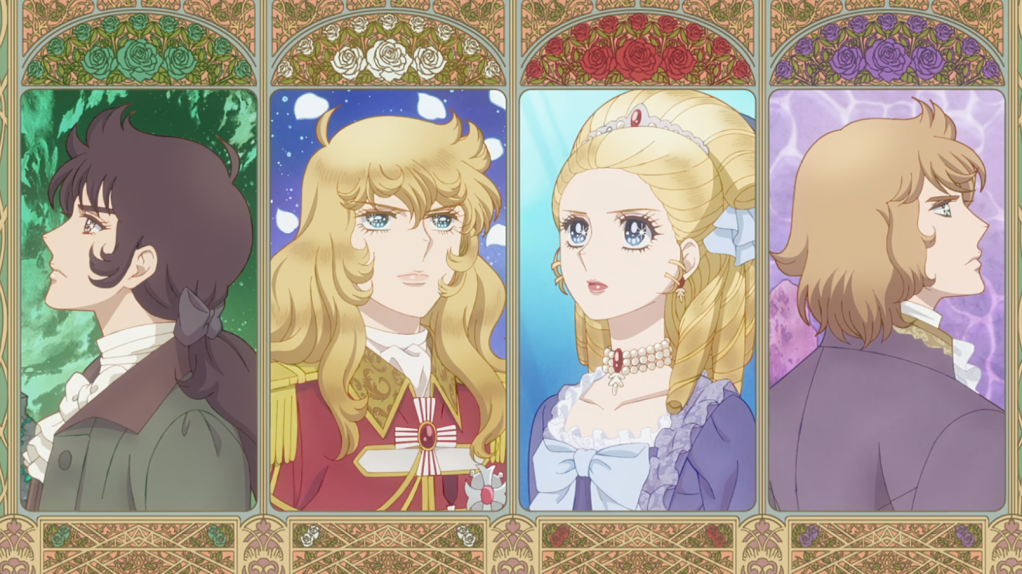
The movie tells the story of two women – one real, one fictional – who stood at the heart of France in the two decades leading up to the French Revolution. The historical one is Marie Antoinette, the 14-year-old daughter of Maria Theresa of Austria, who comes to France to marry the Dauphin, the prince who would become King Louis XVI, in 1770. The fictional one is Oscar Francois de Jarjayes, a noblewoman raised as a man, who encounters Marie Antoinette during her service in the Royal Guard and becomes the princess’s personal protector. Though the two are initially quite close, they gradually grow more distant over the years as Oscar becomes dismayed over Marie’s flirting with a Swedish nobleman and her lack of financial restraint as France starts to become more economically distressed. Things eventually completely fall apart as the French Revolution gets underway. Also factoring prominently into the story are two men: the real-life Hans Axel von Fersen (lighter hair above), whom both Marie and (less prominently) Oscar have romantic entanglements with, and the fictional Andre, a loyal lifetime servant and eventual lover for Oscar.
As the story weaves through actual historical events, it places great emphasis on the roles each woman take on and how they react emotionally to them. Early emphasis falls mostly on Marie, who seems to have everything but what she really wants the most: a storybook love. This version of the story heavily implies that her long-standing emotional (but, based on letters, apparently not physical) connection to von Fersen is a product of her seeking the emotional fulfillment that Louis cannot give her. As time passes (and, likely not coincidentally, Marie becomes a less sympathetic character), the focus shifts more purely to Oscar, who has so thoroughly embraced the role of behaving like a man that she has trouble seeing herself as a woman when faced with later challenges such as her own crush on von Fersen and a potential arranged marriage. She is also, for a long time, unsure how she feels about Andre. But for all of her uncertainties of the heart, she is still at her strongest when boldly and uncompromisingly pushing forward, even if that means eventually leaving the Royal Guard and ultimately siding with the citizens as revolution brews. Oscar may not be an original as a cross-dressing noblewoman (that would go to Sapphire in the even earlier Princess Knight), but it’s not hard to see from this why she became a template for innumerable strong female characters who followed.
The movie’s biggest flaw is evident early on: because it’s condensing a story which took 10 manga volumes and 41 TV episodes into a mere 114 minutes, it never escapes the feel of being a compilation movie, even if it technically isn’t. Some important characters (most notably Madame du Barry, Louis XV’s mistress) are skipped over entirely and others have only cameo appearances, and many parts of the story are greatly reduced or simplified. It partly covers for this by using musical numbers to suggest relationships and circumstances rather than fully playing them out, with mixed results; this definitely isn’t Les Miserables, but some of the songs are still effective at conveying where various characters stand in more compact form. For all the compacting, though, the emotional aspects of the story do come through well enough and the course of events is suitably compelling, especially in the late stages. You won’t feel like you’re missing anything major even if this is your first exposure to the franchise.
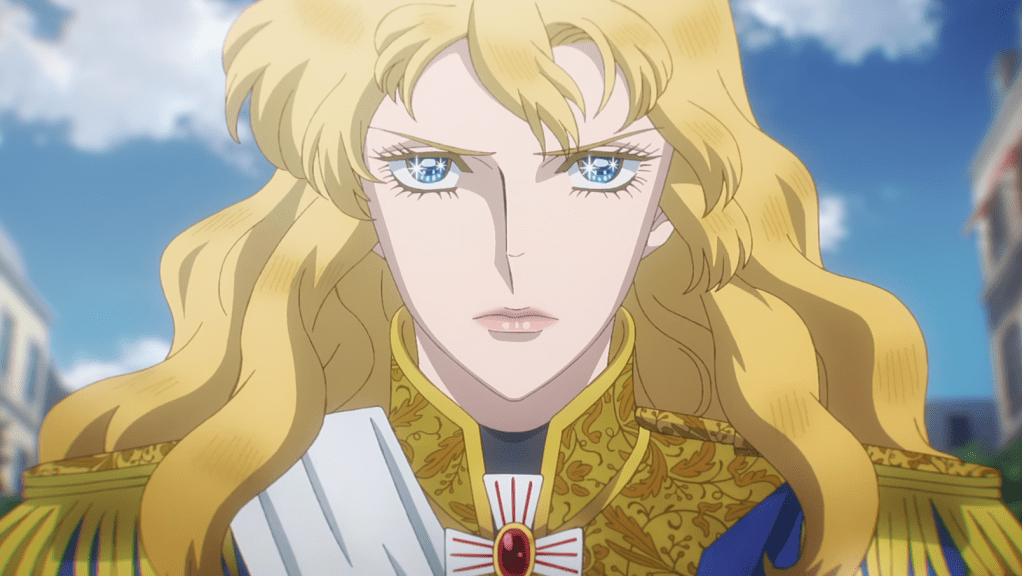
The production effort is led by studio MAPPA and directed by Ai Yoshimura, who is probably best-known for previously directing My Teen Romantic Comedy SNAFU. For the most part the movie looks gorgeous, with particular strengths in background design, costume, design, and especially vibrant uses of colors. Character designs also do a fine job of aging both Marie, Louis, and Andre over the years, though Oscar remains more static in design beyond a uniform change. The starry-eyed looks can be a little much, and seems out of place in more mature characters (Oscar would have to be be in her late 30s in the screenshot above), and the flower-themed motifs typical of shojo titles abound, but the artistry can also get effectively graphically violent in battle scenes near the end. Some visual flaws show up in some less-than-perfect CG integration and an animation effort that isn’t always the smoothest, but this is still a step up from most TV series.
The musical score outside of the numerous songs is also a strength, but you’d expect nothing less from the individuals behind the scores for 86, Attack on Titan, Aldnoah.Zero, and Solo Leveling. The Japanese dub is capably anchored by veterans Aya Hirano as Marie and Miyuki Sawashiro (Celty from Durarara, Sinon from SAO), who presumably do all their own singing since both are well-established singers. The English dub is perfectly fine in speaking roles, with Caitlin Glass feeling like an especially good fit for Oscar. However, it works much less well in the singing elements. Male singing voices are generally fine, but key male roles also have designated singing voices. Female singing is much more shaky, though much of the problem is definitely some translated lyrics which fit awkwardly with the music and don’t flow well when sung.
In all, the movie version of Rose of Versailles isn’t a flawless production, but it is one that any audience – whether familiar with previous versions or not and whether shojo storytelling is normally your thing or not – can appreciate. At essence, it’s a story about what one does with the freedoms one has, for better or wore, and that and the historical elements ultimately stand at least equal with the romantic parts. The story is also notable for the way it ultimately handles Marie Antoinette; she’s not made out to be the villainess (which some at the time certainly strove for), but neither does it let her off the hook for the selfish ways she acted and how her actions at best contributed to a public relations fiasco and at worst towards the French Revolution. It’s willing to fully acknowledge the costs of the paths both women chose, and that helps make it more compelling than what it might seem at first.
The writing and pacing of The Apothecary Diaries have always been skillful at providing some answers while continuing to raise other questions, and episode 41, “Fox Village,” is no different. It provides a couple of big reveals but nowhere near the full truth on what’s going on and redirects some previous mysteries.
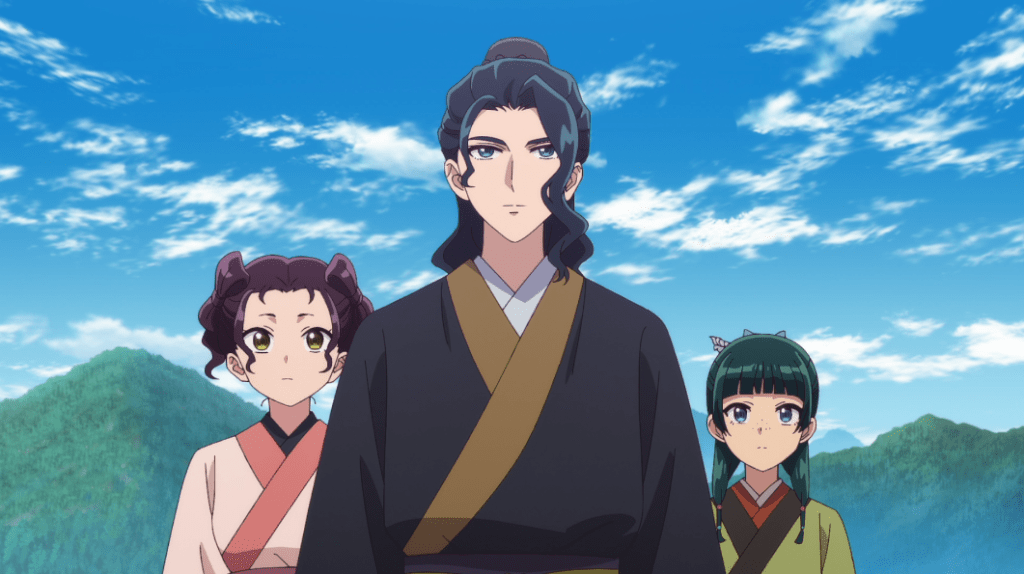
Much of this surrounds Shisui. She’s always been a mysterious character, since despite being dressed as a servant girl, she seemed to have no specific job affiliation (we never did see her at work, unlike with Xiaolin) and came and went as she pleased. Hence the revelations that she never actually was a servant girl, but instead a spy all along, aren’t even mild shockers. The only surprise on that point is that her being a spy actually explains the presence of the cat Maomao, whose ability to get into the Rear Palace has always been a mystery but – until now – one of trivial importance. Her apparently being related to Suiren is more unexpected, though as Maomao points out, there was always a hint in the similar syllables in their names. (But given how many characters in this series have similar-sounding names, that’s a clue that, understandably, could be easily overlooked.) I especially liked how that reveal was presaged by Shisui shifting her position in the marching order to screen Suiren from the snake, a detail Maomao clearly noticed. Given the size of the population in the Rear Palace, that her presence as someone who didn’t belong went unnoticed for so long is also perfectly understandable, and that she never crossed paths with Jinshi also now seems more significant, rather than just a trivial detail.
So where does that leave Shisui, then? Her personality doesn’t change one bit after the reveal, so it’s safe to assume that the behavior we saw from her prior to this is at least mostly genuine. How much she likes Maomao also seems to be genuine, since she doesn’t stop behaving like Maomao is her bestie even once they reach the village. That raises really big questions about what her motivations are in all of this; why would someone with her temperament be acting like a spy? How much was she involved in Suiren’s schemes? And is there still someone else in the Rear Palace that she’s connected to? The presence of the envoy in the fox village certainly indicates a much bigger plot, and given hints that have been dropped to viewers over time, one particular person in the Rear Palace sticks out like a sore thumb as a candidate.
The other curious detail is the business with the snake. That a woman as composed and sharp-witted as Suiren is terrified to the point of hyperventilating over snakes seems uncharacteristic, so there has to be a story there. And given the way this series has been written so far, that story has to be relevant in some way.
On Maomao’s side, exactly why Suiren is going through all the trouble to coerce/bribe Maomao into going along peacefully remains a mystery at this point. Clearly Maomao has caught her attention, but what is she hoping to gain by bringing Maomao out to this village? Especially since she does seem to know who Maomao’s blood father is, and since she was posing as a court lady for a while, she has to know his reputation. (And I agree with Maomao: trying to coerce someone like Lakan by threatening his daughter is just asking for trouble, and Suiren probably knows it, so that is unlikely to be her motivation.) And why was Maomao allowed to keep the hairpin? If Suiren was targeting Jinshi, she must have known who he really is, and so should have recognized that token.
On the Rear Palace front, seems like Lakan’s scene last episode happened at some point after most of the scenes this episode, as Jinshi and the others are only gradually piecing together Maomao’s disappearance. This all makes me appreciate again how hardly anyone involved is treated as a fool. (Excepting the quack doctor, of course.) Luomen recognizes Maomao’s secret message and the silvervine, a type of fruit long known in East Asian cultures for medicinal and energizing properties and as a stronger version of catnip where cats are concerned. Jinshi is quick to make connections once provided with information, and Seki-u is apparently good at deciphering handwriting. By the end of the episode, they have already pinned down the exit route and have ideas on parties who might be involved, so it isn’t going to take Jinshi long to piece together at least some of the bigger picture. (Indeed, the Next Episode preview suggests that will happen next episode.) The most interesting aspect here is how Lakan is going to react and get involved.
Will taking Maomao along prove to be Suiren’s undoing? It seems possible, but she also has to know that such is a risk, so now I’m more curious than ever to see where this is going. (And surely I’m not the only person who wishes the scene with Maomao and Shisui sleeping with their heads against each other wasn’t in such poor lighting. . .)
I expected the intrigue to ramp up a bit with the return of Loumen to the Rear Palace, as a person with his insight, expertise, and experience is the kind of person who could be a catalyst for action even if he’s not directly part of it. Episode 40 shows how completely I underestimated the series on that point, however. In terms of the extent and intricacy of the intrigue in play here, this one matches even episode 19 as the most loaded of the entire series so far and represents a major escalation of the series’ overall plot. And unlike 19, it’s coming from more than one different direction. (Although it’s also entirely possible that both directions eventually wind back to the same source.)
There’s a lot to unpack here, but first let’s start with the scenes involving Lakan and Loulan’s father, Shushi. The latter is supposed to be one of the most powerful and wily men in court, but you wouldn’t know that from the way Lakan runs circles around him during their scenes together. Lakan may act on intuition, but he also knows exactly what he’s doing and seems to understand exactly how he’s perceived, and he takes full advantage of that. Even his rambling about his wife’s Go game may have been more than just his eccentricities showing; not out of the question that it was at least partly a ploy to unsettle Shushi. Clearly he suspects Shushi (those guns would have been too difficult for anyone of lesser station to acquire in secret), and while Shushi carefully avoided saying anything that could imply guilt, his answers were also a little too noncommittal. Shushi also essentially admitted that he was color-blind without saying so, which was unquestionably the point of Lakan’s grape juice stunt. Not entirely sure what he’s trying to prove with that, but color blindness has previously been established as a distinguishing trait of the imperial bloodline. . .
Equally fascinating is how what initially looked to be a more laid-back episode on Maomao’s side so quickly spun into something major from the mere impetus of Luomen innocently being clever about getting an advice notice copied for wide distribution. Much like episode 19, the way little tidbits of information from throughout the series (but especially season 2) gradually coalesced into Maomao getting a glimpse of an insidious conspiracy, and how the tension very slowly builds throughout that process, is a marvel of both source writing and production execution. So many little details that seemed innocuous at the time come together here, such as Shisui’s offhand comment in episode 29 about how there are so many insects around the Rear Palace that she’d “only seen in books.” It didn’t register at the time that a servant girl having access to the kind of books that would have insect pictures should be highly unusual, or the even earlier reveal that she had done sketches on paper. While how she ended up being involved in this incident isn’t clear yet, that Shisui has connections more substantial than most servant girls is clear, and someone with those kind of connections being a servant girl is seeming increasingly suspicious.
But not as suspicious as the old lady at the clinic. Maomao’s supposition reads like a conspiracy theory, and she know it, but details to support it are both present and credible: all the young girls sacrificed to the Emperor’s proclivities, the way them not being allowed to leave (or having nowhere to leave to) might breed festering resentment, and the way the safety notices Luomen distributed during his previous stint in the Rear Palace may have inadvertently given them ideas about how they could strike back forms a logical progression, and the way that no one currently in the Rear Palace seemed to know about poisonous face powder even though there had previously been warnings about it suggests that someone deliberately made sure that knowledge disappeared as servants, concubines, and eunuchs alike cycled in and out. Someone who had been around long-term also explains how knowledge about abortifacients got disseminated, and could have encouraged merchants in the caravan to carry the appropriate aromatic oils on future visits. If true, this is a scenario that’s been decades in the making and one that would be fiendishly hard to detect.
And then there’s the one other major revelation: that the “pretty eunuch” was actually Suirei in disguise. Really, this one shouldn’t have caught me by surprise as much as it did. After all, that Suirei was going to pop up again at some point was practically a given, and Maomao’s speculation back in episode 20 did place her dressing as a eunuch to leave inconspicuously after she woke up. She had both the height and build to pull it off, too. This does raise the question of whose grave she was looking at as episode 39 ended; could be her fake grave, but being involved in something like this suggests a much longer and deeper grudge. She knows how to box Maomao into cooperating without having to resort to violence, too. She clearly acknowledges Maomao as a concern, which makes what she wants to show Maomao all the more curious. Is she going to try to recruit Maomao? And does she understand how much attention she’s going to draw by coercing Maomao, especially given who Jinshi and her father are? Or is that part of the plan, too?
Whatever the case proves to be, the end of this episode is one of the series’ biggest cliffhangers to date. Also nice to see Ah-Duo making a guest appearance as a Jinshi stand-in; hopefully this is not the last we see of her for a while. The wait to see how this shakes out next week will be long indeed.
More so than most episodes of this series, this one is a composition of two completely different parts, one which has its serious aspects but is lighter in general and one which is almost completely serious and introduces a potentially major development for the setting’s status quo. The contrast between the two unrelated parts is so sharp that I’m almost surprised that the episode wasn’t given a split title.
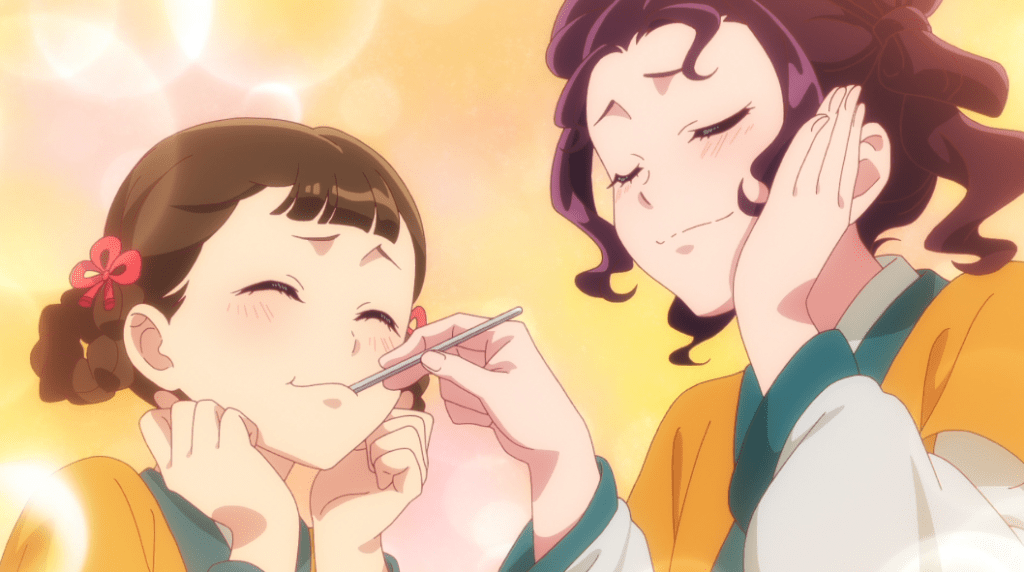
The first part provides the episode title (“Ice”) and spins off the development at the end of last episode, where Xiaolin accidentally bumped a eunuch hauling a block of ice to Loulan, resulting in it being damaged and thus unsuitable to present to Loulan. The potential punishment for the eunuch is severe, so both his distress and Xaiolin’s terror at getting punished by extension are easily understandable. Naturally, quick-witted Maomao comes up with a plan: since the ice was meant to cool the concubine, disguise the damage by turning it into something edible which could serve the same purpose. In other words, she essentially makes ice cream.
The method Maomao is using here is what is classically referred to as the “pot-freezer method.” Since it’s not specified in the episode, what Maomao pours into the bowl of crushed ice is salt. Salty water freezes at lower temperatures, so it can more effectively draw out the heat from something being mixed in a container in it. Mixing the milk and firming agents (the other thing Maomao is seen pouring in before mixing) with a whisk is considered crucial if doing it by hand, and it must be done thoroughly. Without sugar available, flavoring it with chopped fruit is standard practice. This was the method generally used before hand-cranked churns came onto the scene in the mid-19th century, and there’s plenty of evidence that the method would have been known about in China, so Maomao having come across it at some point is not unrealistic. Her being able to get it made in the limited time frame presented in this episode is much more of a stretch; my parents made homemade ice cream from time to time when I was a kid, and I don’t remember it being that quick a process. It’s a tolerable stretch for dramatic purposes, though, especially given how cute the reactions to it are.
The episode’s second half starts a new matter that, to some degree, will probably take a few episodes to play out. (NOTE: This is now pure speculation, as this is the point where the storytelling progresses beyond what I’ve read in the manga version.) Ever since we learned that Loumen once served in the Rear Palace, I’ve wondered if the series wouldn’t find some excuse to get him back there, and that it would happen as part of a recommendation from Maomao was a natural assumption. That turns out to be exactly the case here, because Maomao has finally encountered a medical matter beyond her skill level: a potential breech birth for Gyokuyou’s second child. She knows enough to know the signs, but she’s also fully aware that handling such a matter – especially if it could necessitate a c-section – requires a trained and experienced doctor, not just a midwife or someone who has studied up on birthing techniques (as Hongniang did with Lingli’s birth). Loumen has those qualifications, has delivered royals before, and he’s a eunuch, too. With his Western training, Maomao actually probably isn’t exaggerating by calling him the best doctor in the country.
While Hongniang is understandably defensive – she clearly sees protecting Gyokuyou as her #1 priority – Gyokuyou is well aware of how capable Maomao is, so that she would trust a eunuch that Maomao personally recommends is no surprise. Nor is it a surprise that Jinshi would go along with the request; we know from the first season that he knows about Loumen, and even if Maomao wasn’t his favorite, she’s done plenty enough to justify trusting her recommendation. That does bring up a lot of interesting potential for future encounters, though, since it’s quite possible that Loumen would recognize Jinshi for who he is. That also raises the much more real possibility of Loumen encountering Lakan at some point, and indeed, the latter does show up in the Next Episode previews. In fact, Loumen’s presence could wind up being the trigger for any number of potentially interesting upcoming complications.
Particular kudos here go to Aoi Yuki (Maomao) and Misaki Kuno (Xioalan) for some excellent work varying voices appropriately for their characters’ more anxious states. And the humor near the end, where Gyokuyou’s ladies-in-waiting all ponder how Maomao ended up the way she did given her father was a welcome respite from the very serious concerns up to that point.
The ominous music in the final scene suggests that the pretty new eunuch paying respects at a plain grave suggests more strongly that there’s something going on with him. Is he part of a bigger plot or is this a private matter? We’ll see going forward.
In Alina Clover’s fantasy world, adventuring is a real (if dangerous) profession and an Adventurers Guild exists to manage job requests and dungeons left behind by a lost, more powerful predecessor civilization. Alina isn’t an adventurer, though, or at least not officially; she opted instead to become a guild receptionist, partly on the recommendation of an adventurer she knew in her youth and partly because it’s a safe, stable, well-paying job that – at least theoretically – has consistent hours, allowing her to afford a home where she can just laze around after work. She values a good work-life balance above all else, so she’s positively mortified by overtime caused by paperwork which can crop up especially heavily when new dungeons are discovered or adventurers take a long time to clear established dungeons. At times, her frustration about overtime boils over to the point where she decides to take matters into her own hands. And due to a quirk of fate, she secretly has the power to do something about that, something which Jade, the handsome tank and leader for top adventuring group Silver Swords, accidentally discovers. Now he’s trying to both recruit her to be the Silver Swords’ striker and woo her romantically.
Adventurers Guilds have been a staple in anime for at least a decade now, and so has the Guild Receptionist Girl. While GRGs can occasionally do more – Eina in DanMachi is also protagonist Bell’s dungeoneering coach and adviser, for instance – they’re usually just pretty faces who interact with adventurers and occasionally serve as potential love interests. This adaptation of an award-winning light novel series turns that stereotype on its head by making the GRG secretly be the setting’s most powerful adventurer. This is hardly a fresh gimmick, as the “innocuous person is secretly the strongest” trope goes as least as far back as the Clark Kent/Superman alter ego and has appeared in many other forms in anime over the years, but it’s the first time that it’s been done in this context. That alone gives this series a fresher angle than many of its contemporaries, but it also has the added twist of squarely focusing the titular character’s motivations on a proper work-life balance.
Alina’s near-obsession with avoiding overtime is somewhat of a double-edged sword, however. Her relentless emphasis on it leads to many of the series’ funniest moments, but in the later stages of this season it can also start to feel overdone. (This is the most common complaint I’ve seen lodged against the series, though I haven’t personally felt this way.) However, there’s also something eminently relatable about it for viewers old enough to be out in the workforce for a while, and doubtless that’s intentional. What working adult hasn’t shared laments similar to Alina’s comments about how it’s not work which gets her out of bed in the morning, but knowing that if she does her job then she can both relax at the end and have a place to do it? Who hasn’t said “been there, done that” on having missed out on cherished activities because work took too long to complete, or has never faced the prospect that if you don’t put overtime in on the work now, it’ll be even worse the next day? I know I’ve been in Alina’s shoes many, many times over the years.
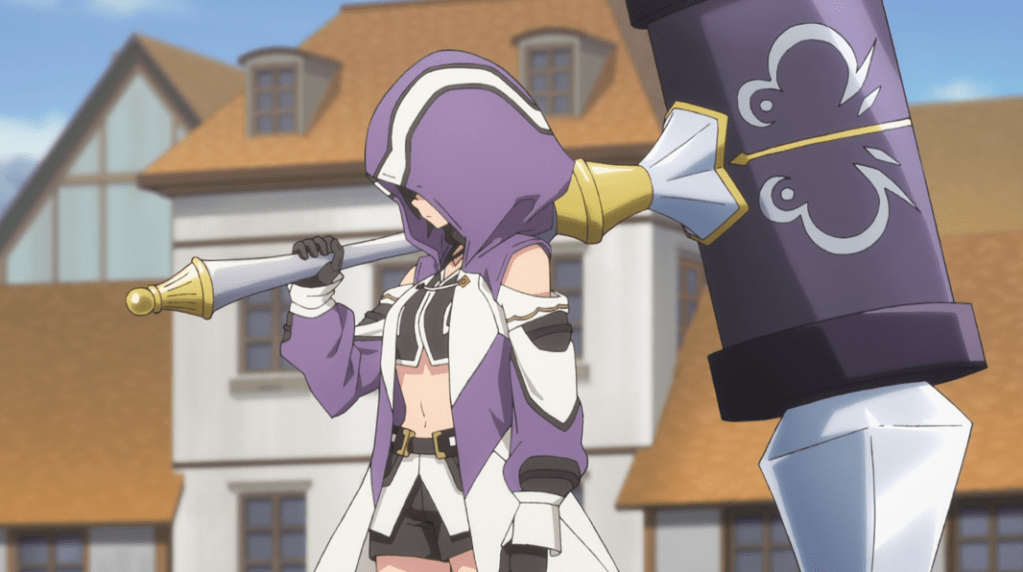
And that’s where some of the series’ strongest appeal lies. Yeah, Alina’s almost singular focus could be seen as overdone, but to people like me, her Executioner alter ego is an avenging angel – or, as one character puts it after seeing her in action, a “dark god.” She’s a cute, snarky ball of rage and frustration who’s gained the ability to vent in violent fashion by obtaining one of her world’s most elite powers: a mythical Dia skill. It takes the form of a giant hammer (and the physical prowess to wield it effortlessly) and is aptly-named Dia Break, since it can shatter or strike down anything which gets in Alina’s path, and it’s the most direct and personal of the offensive-focused skills we’ve seen so far. That Alina gained this skill (as detailed in episode 2) doesn’t feel like a coincidence, either; while series has yet to dwell on this issue, there’s a definite sense that Alina getting this skill at that time was purposeful on some higher power’s part, rather than just a reward for her intense feelings. That isn’t all there is to Alina, as she does show a more caring side than she’s willing to admit as the series progresses and may not be as completely immune to Jade’s attempts to charm her as she acts like she is. This aspect gradually shows up more over time, so I don’t buy arguments that she’s too static a character.
The series also does well with its supporting cast. Jade is very likable as the young man trying his best to win Alina over on two fronts without being too pushy about it, and the two do have some chemistry developing. Lululee, the female healer in Jade’s party, also gets a surprising amount of attention and characterization in the middle episodes, as does Guildmaster Glen Garia in the season’s last quarter. And then there’s Laila, Alina’s junior at the guild’s reception desks, who crucially serves as both the coworker in need of guidance and the series’ most humorously ironic character; she idolizes the Executioner and thinks he’s a guy, and has no clue that the Executioner is actually Alina. (In one of the series’ most inspired gags, Laila imagines a male Executioner getting BL with Jade, when the truth is that it’s not far from happening in a hetero sense.)
While the series has been predominately character-driven so far, it does have a distinct (if somewhat thin) plot to provide it structure. Someone out there with a skill on Alina’s level seems to be manipulating circumstances to produce “dark gods” – i.e., bioengineered humanoid weapons from the past civilization which have Dia Skills themselves. Exactly who would want to do this, and why, are questions beyond the scope of these 12 episodes to answer, but each of the series’ three main arcs (which correspond to the first three source novels) have something to do with this. Why Alina seems to be special even among Dia Skill users is another mystery; is the way she can power up a manifestation of her particular Dia Skill or an indicator of the strength of the emotions fueling her actions? Through the course of these events, the series smoothly varies in tone from being lightly humorous through darkly dramatic and even at one point heartbreaking.
The production effort by studio CloverWorks doesn’t do anything terribly fancy, but there’s not a big need for that, either, since Alina’s fighting style is very direct and focused on overpowering rather than outmaneuvering foes. Still, fights use fewer cut scenes than many series in the same category do, and animation elsewhere is solid. Character designs make Alina look cheekier than normal, but while they give her a generous figure, the adaptation doesn’t flaunt it; her Executioner outfit is more practical than sexy and true fan service is kept to a minimum. Jade, meanwhile, is one of the more attractive recent male characters who still looks manly, rather than specifically bishonen. By comparison, design work on the dark gods is much less impressive, and nothing about presented monster designs stands out much. The series is arguably at its sharpest visually when magical and energy effect are in play, as background visuals are well-done but not exciting. Overall, this is an above-average but not spectacular series on the visual front.
The series is stronger on the auditory front. The musical score delivers a strong dramatic flair in action scenes while also maintaining jaunty signature pieces to back its more light-hearted moments. However, its theme songs are where it truly shines. Opener “Perfect Day” by 310 is a great, wistful song backed by full and detailed 3DCG animation primarily involving Alina interacting with and flying on a dinosaur-like bird, although one scene where Alina is walking on a city street with groceries is also fascinating for its detail work and staging; this is easily the early contender being the year’s top OP. Closer “Ashita no Watashi ni Sachi Are” is one of the most peppy and upbeat anisongs in recent memory, with an infectious energy and cutesy dance animation which can be catchy in an entirely different way. It’s also one to remember come end-of-year awards.
Crunchyroll was English dubbing the series on a two week delay, and the whole series is now available in dubbed form. Jill Harris (Noelle from Black Clover, Suletta from Mobile Suit Gundam The Witch from Mercury) tackles the title role with every bit as much gusto as original performer Rie Takahashi does, in the process using inflections which adapt Alina’s attitude into English form perfectly well. Kamen Casey (Duke Seeker in I’ll Become a Villainess Who Goes Down in History) also hits all the right notes as Jade. The rest of the cast, while not as spectacular, still suit and perform their roles mostly well, with the only minor weak point possibly being Silha, the first of the dark gods. Still, a strong effort overall.
Guild Receptionist does come up a bit short on the world-building front, and I’d like to see more about Alina’s background beyond just her interactions with the one adventurer as a child. (No mention is ever made of her family, for instance.) But those are far from being big enough flaws to interfere with how thoroughly I’ve enjoyed this series; I have probably watched each episode at least 3-4 times already. The final episode rounds out the current story arc but definitely leaves a big hook for future story developments, and at its current adaptation pace, enough content is available in Japan for at least one more full season. There’s been no indication yet on whether we’ll get another season of this one, but it will be quite welcome if it does come.


















 USA Anime