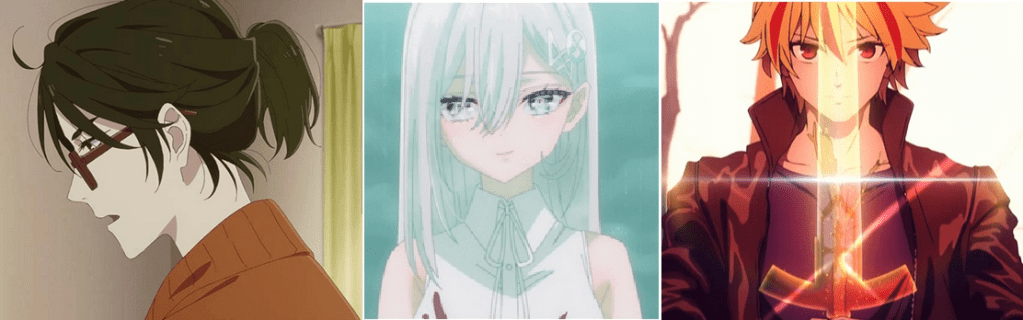
We’re past the midway point of the series (with the earliest-starting series even looking at episode 8 now!), so it’s past time to take a look at how the titles I’ve wound up following are doing.
In all, I’ve kept up with 19 series this season. The two which are getting episode reviews (Frieren and Oshi no Ko) are not getting covered here, since I’ve written plenty about them in other posts. The other 17 are all being covered here. Most notable among this group is the first A+ grade I’ve given in a long time (if ever?) for a series on a Mid-Season Report. It’s not the only high grade, either; this has proven to be a quite strong season for quality titles so far.
Chained Soldier 2

Rating So Far: C+
This season actually may look even better than the first and certainly doesn’t disappoint on the fan service front. However, it has struggled to come up with anything interesting on plot and character development fronts, and minimizing Yuki’s time with Kyouka in favor of introducing other girls isn’t helping. The fan service and quality character designs are the only reasons I’m still watching this one at this point, and it’s currently my lowest-priority view among titles I’m current on.
Champignon Witch
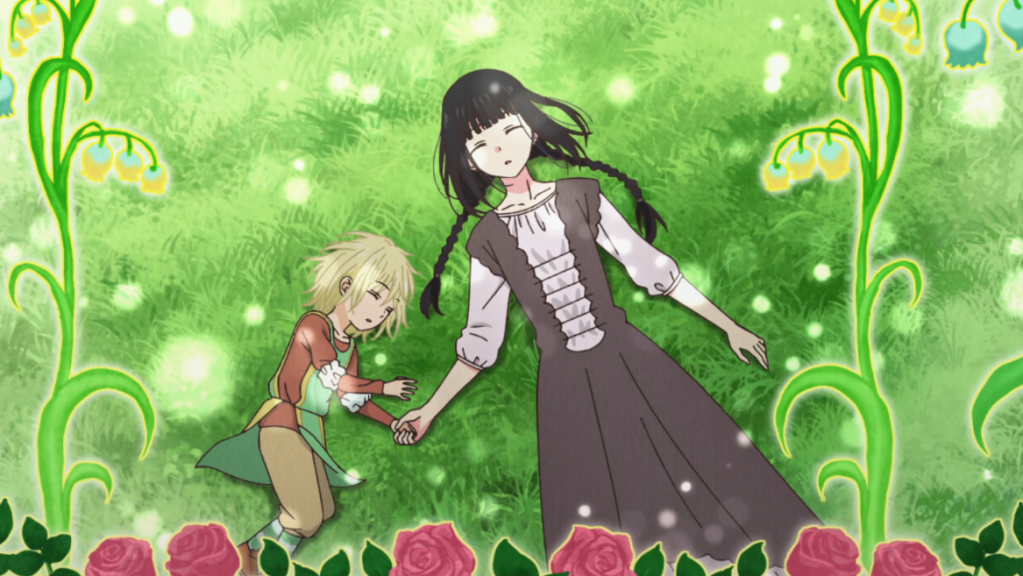
Rating So Far: B+
There are so many truly good series this season that the special things this series is doing can easily get overlooked. It offers some of the most fascinating world-building in recent memory, especially in terms of what distinguishes Luna from other witch characters in anime and the very unconventional way her magic works. That Luna is the titular character but not the viewpoint character is also an interesting choice; in retrospect, the view of the world is always from outside her, and this is especially true once Lize becomes a regular cast member. More recent episodes also add in more philosophical commentaries, such as by virtually outright stating that a personal can’t properly grow if they eschew all bad memories. And while it’s far from being the season’s most visually dynamic series, its visual style does give it the children’s storybook kind of feel I think the series was aiming for. (Especially those hats worn by the other dark witches!) While it’s far from a priority view, it’s much too interesting a series to give up.
Dark Moon: Blood Altar
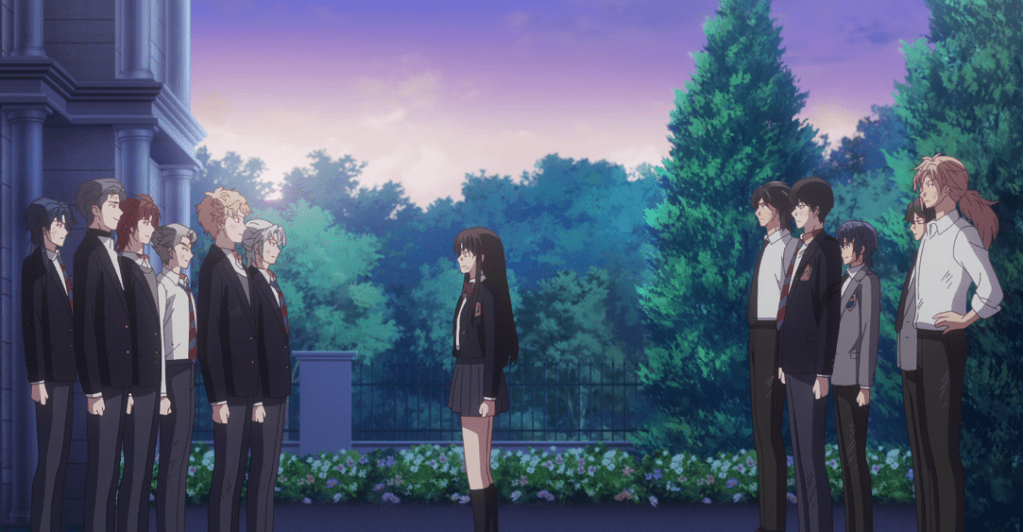
Rating So Far: C
By the halfway point of the series, protagonist Sooha now has nearly a dozen hot guys hanging around; the potential problem for her is that they’re all either vampires or werewolves (or, in one case, both). At least the series doesn’t continue to drag out that secret, as the whole “we like her but she’d hate us if she knew we were vampires” angst was already getting old. With those revelations coming out at the midway point, the plot also thickens some – a welcome development. Of course, there’s still the mystery of why Sooha is so strong (which is underplayed in the mid-season reveal since the guys have to be allowed to come to her rescue) and why she can seem to compel both sides of the vampire/werewolf conflict (although she’s still unaware of that ability). At its core it’s still nothing more than a supernatural reverse harem series, though.
Fate/Strange Fake
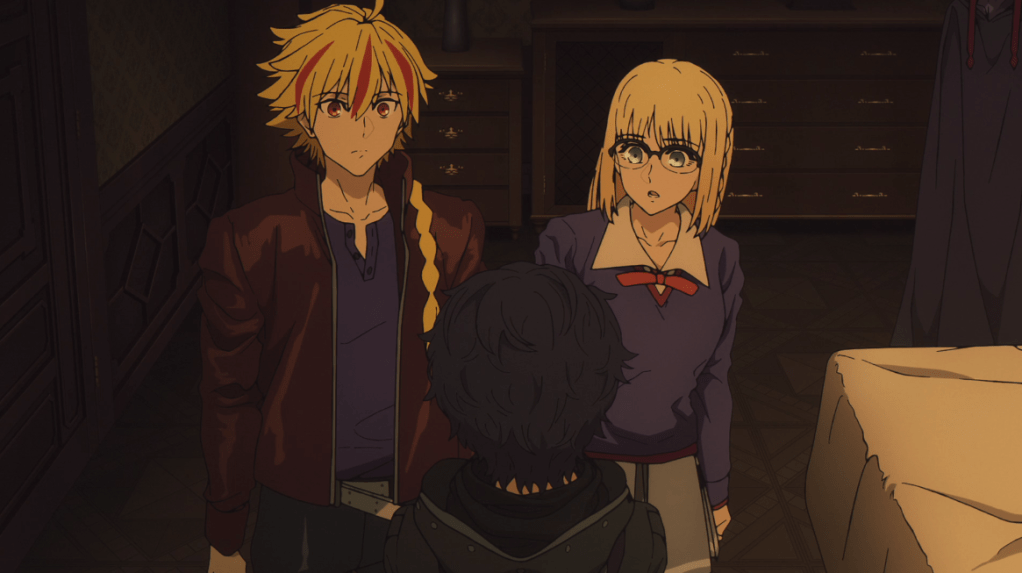
Rating So Far: A-
I have seen nearly all of the Fate franchise (notably excepting the Fate/Grand Order game), but apparently that’s not enough to keep up with everything this series is throwing at the viewer. However, I swiftly found myself not caring one bit about that because the series is just that much of a spectacle. We have a fake Grail War being used as the foundation to seed a real Grail War, so there’s to be 13 Mage/Servant pairings in all (including some very unconventional ones), and that makes for all kinds of dynamic possibilities even if we didn’t have a priest who should theoretically be supervising the war going balls-to-the-wall against a Dead Apostle (read: vampire) in one of the most eye-popping action battles in series animation in recent memory. The writing even finds time for significant character development, too! It stakes a strong case for being the season’s top action-focused title and is easily among the top 5 overall.
Hell’s Paradise 2
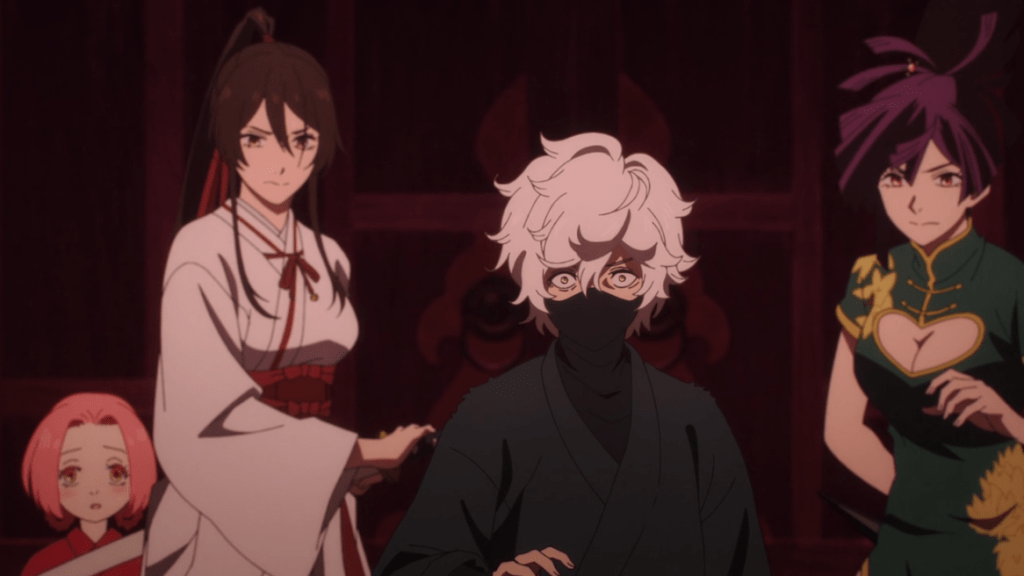
Rating So Far: B
This season got off to a bit of a rough start, but by episode 3 the series settled back into its more normal routine of intricate martial arts scenarios and fantastical monsters. The season does focus even more heavily than the previous one on Taoism and related spiritual elements, though, and that can be hard to follow at times. It’s still also too early to tell how the newcomers to the island are going to affect the efforts of the Gabimaru-led alliance of most of the survivors of the first wave and their efforts to secure the Elixir of Life from the Tensen. For now, the personalities are distinct and interesting enough, and the exotic designs and animation flashy enough, to merit continuing with the series.
Journal With Witch
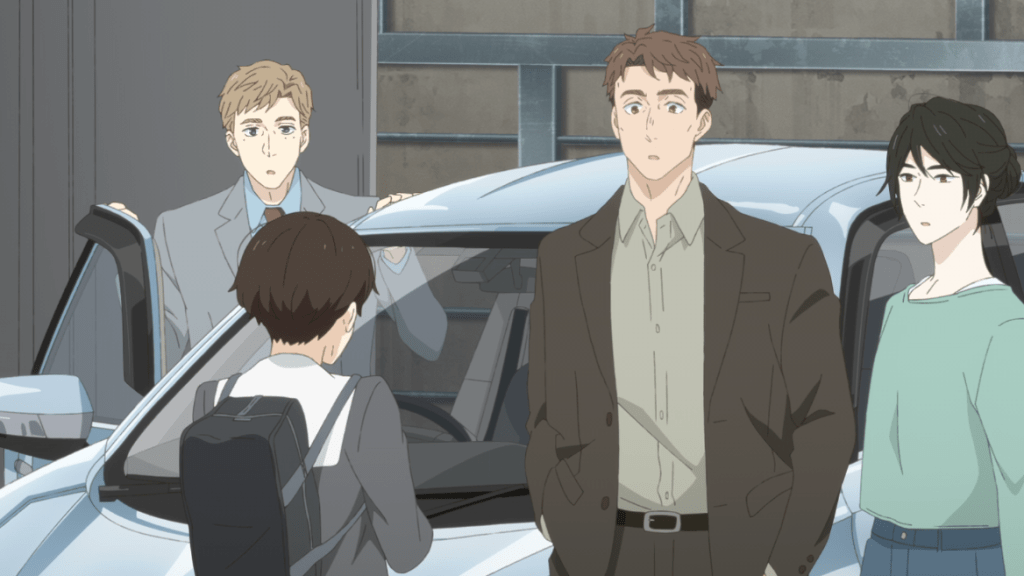
Rating So Far: A+
Calling this the best series of the season so far seems inadequate; this one is a contender for one of the best titles of the decade if it maintains at the level it’s been operating on so far. With some artistic interpretation but no sensationalism, the series takes an achingly deep look at how Makio and Asa struggle to relate to each other, define their current relationship, and move forward as they deal with the memory of the woman who was sister to one and mother to the other. Particularly fascinating is the markedly different views each has about Minori and the insight in a recent episode that neither of them actually at all understood how Minori really felt herself. While not exactly a tearjerker, there is plenty of content here which can be emotionally devastating, and Makio in particular is a fascinating mess of a character on her own. The direction, musical support, and voice acting are all outstanding, but it’s the keenly insightful original writing which most carries the show. This is a show I strongly recommend even if you think this kind of fare is not normally your thing.
Kunon the Sorcerer Can See
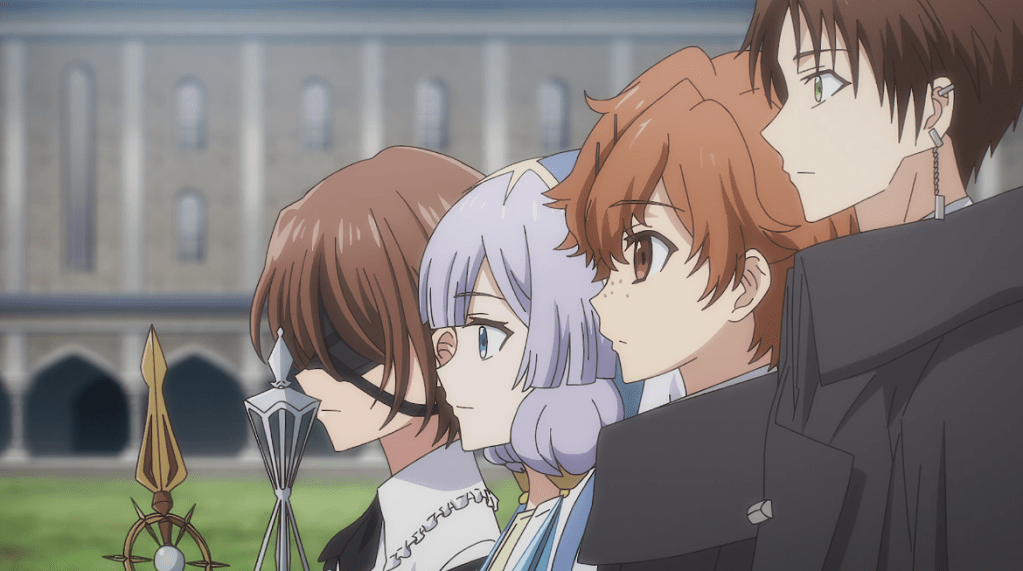
Rating: B
This one has offered a surprise or two. The notion of a protagonist who seeks to use magic in a creative way to enable himself to see is novel enough, but what’s even more novel is the mystery which appears when he finally succeeds. What do the odd things that he can see which no one else apparently can perceive at all mean? That mystery has become a driving force in the series as it transfers to a Magic School arc, which I have some trepidation about partly because it could shift the series to a more ordinary format and partially because it will separate Kunon from his fiancee (with whom he has a neat relationship) for a time. Still, it’s been a better-than-expected series so far, and the most recent episode has shown that Kunon being an irrepressible flirt has not dimmed, so I’m willing to give it the benefit of the doubt for now.
Noble Reincarnation: Born Blessed, So I’ll Obtain Ultimate Power
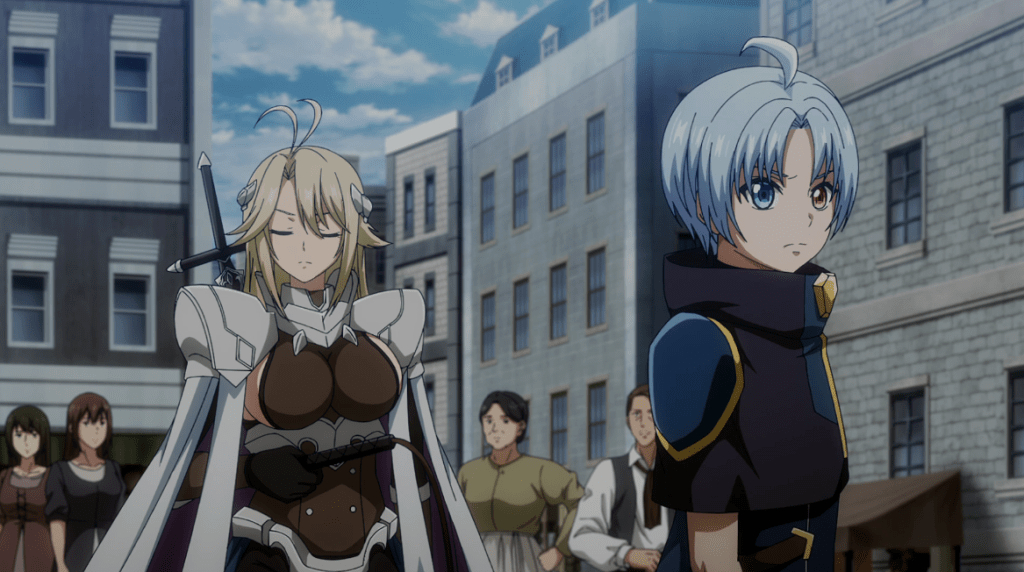
Rating: B-
While I perfectly understand how difficult it is to get past the protagonist’s name (Noah Ararat), this has proved to be a halfway decent isekai reincarnation story so far. Noah takes a pragmatic and sometimes ruthless approach not too dissimilar from Tanya in Saga of Tanya the Evil, though he does show at least some compassion. And while he does have some personal power, he advances himself more through administrative acumen and insight. Still, the series can’t fully escape power fantasy trappings, such as his corps of sexy maids and bodyguards. The series is graced by the season’s second-best closing song (after only Frieren‘s), though I wish the series would do something with the character who sings it. (She’s only appeared in regular content so far as Noah’s favorite live performer, and I don’t think she’s had a word of non-sung dialog.)
Reincarnated as a Dragon Hatchling
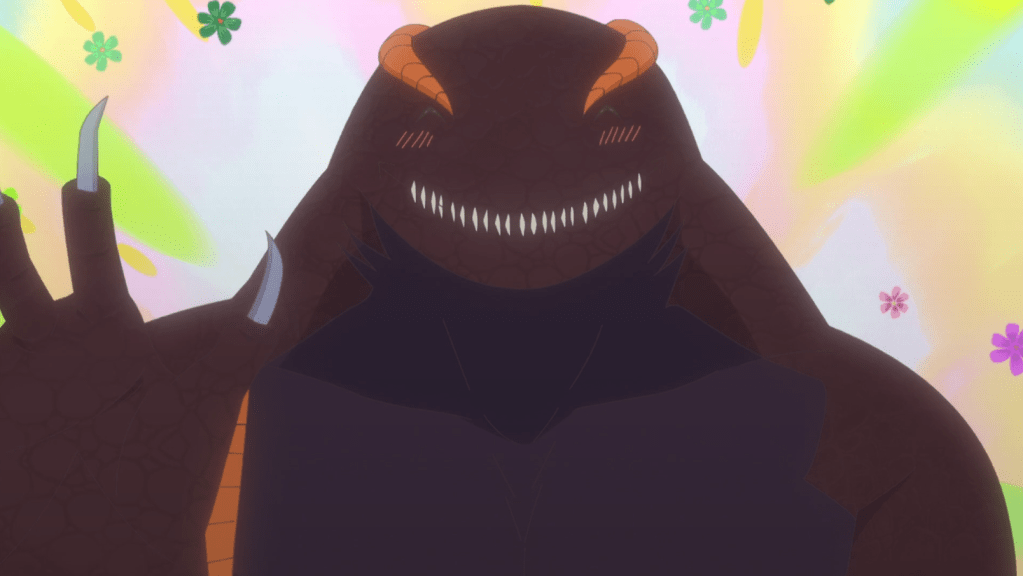
Rating So Far: B-
Honestly, this series is mostly just a standard “reincarnated as a monster in a game mechanics-based world” isekai variation, with a spirit and approach somewhat in line with So I’m a Spider, So What? While Shunichi Toki can’t quite carry this series like Aoi Yuki did in its predecessor, he does adequately in making the hatchling an engaging character, and the addition of the Venom Lizard certainly helps. The series manages just enough charm with the hatchling’s antics, the somewhat snarky System Voice, occasional looks at the human side, and suggestions of something more dire going on that neither the human nor monster side has fully identified yet to carry the series along just enough to a mild recommendation. Don’t expect anything more than a genre staple from this one and it probably won’t disappoint.
Roll Over and Die
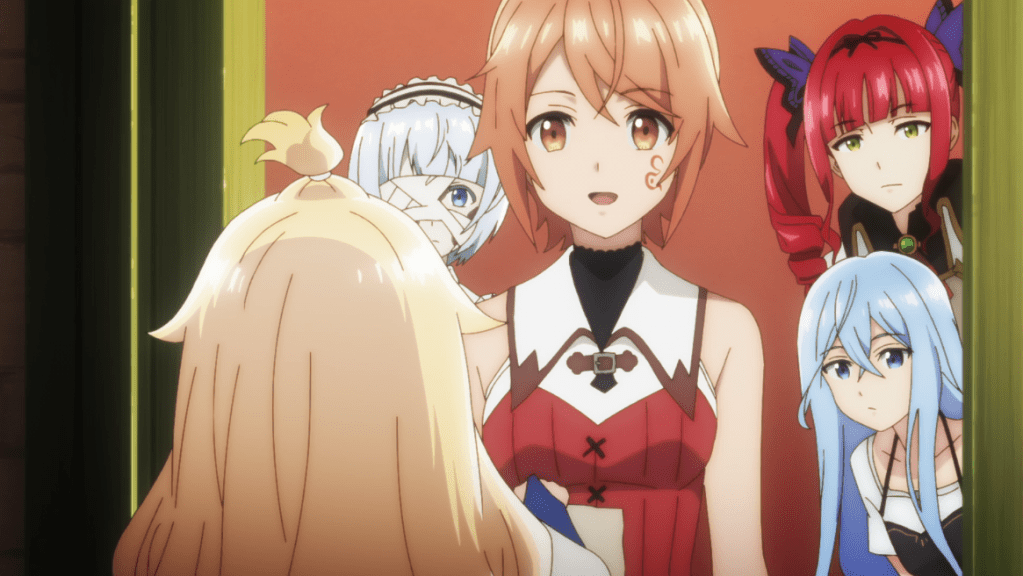
Rating So Far: B-
Although this one is a favorite, I do have to acknowledge that it suffers some from technical limitations and a few questionable adaptation choices, including significantly altering and rearranging some of the events from episodes 6 and 7 in particular. However, the story is also a bit more involved than normal for the “banished from the Hero’s party” scenario and offers a few unusual twists. It also helps a lot that Flum makes for a great lead character, one who is balanced well between action capabilities and empathy and gradually shows that she’s made of sterner stuff than may initially be apparent. Her yuri-leaning relationship with Milkit is also quite neat. The body horror elements are starting to ramp up further as the series ventures into his second half, but the series has already shown that its edginess isn’t just posing.
Sentenced to Be a Hero
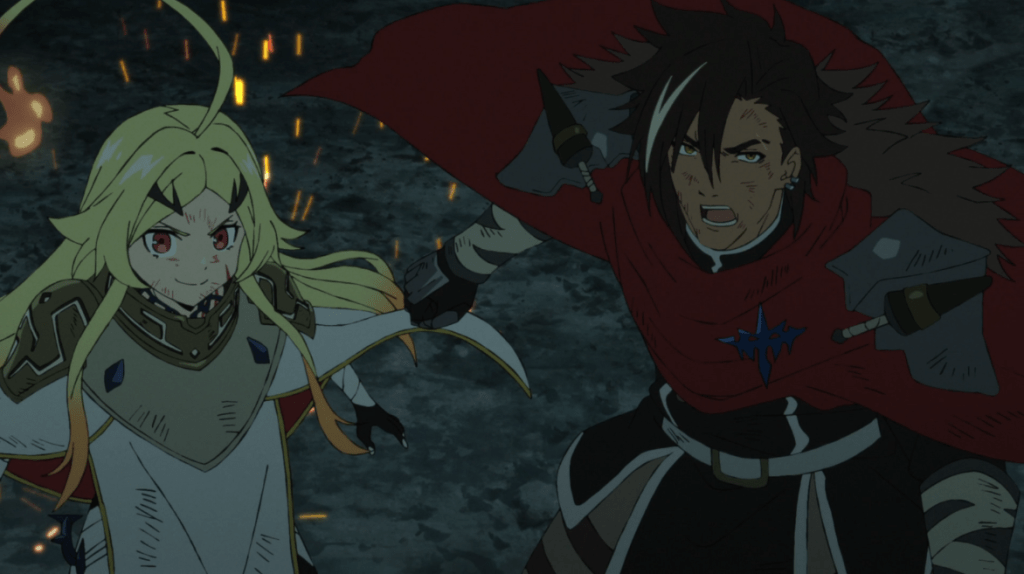
Rating So Far: A-
This season has two top-tier action series, ones capable of producing incredible visual and animation spectacles, and this is the other one. It’s also the much grosser one, as for all the graphic violence in Fate/Strange Fake, it doesn’t have anywhere near the level of body horror embodied in the Faeries which Xylo and crew must face here. Kudos to director Hiroyuki Takashima and Studio Kai for producing a visual feast every bit as colorful as it is grim, but the concept and characters also do their part; I am especially a fan of Norgalle, the hero who thinks he’s a king. Recent episodes have also had some highly satisfying developments on the central Xylo/Teoritta relationship; the series is definitely at its dramatic best when the two are in sync. Kudos also to an excellent English vocal effort. This one may not be on the sublime level of Journal With Witch, but it still earns its place among the top five titles in this packed season.
SHIBOYUGI: Playing Death Games to Put Food on the Table
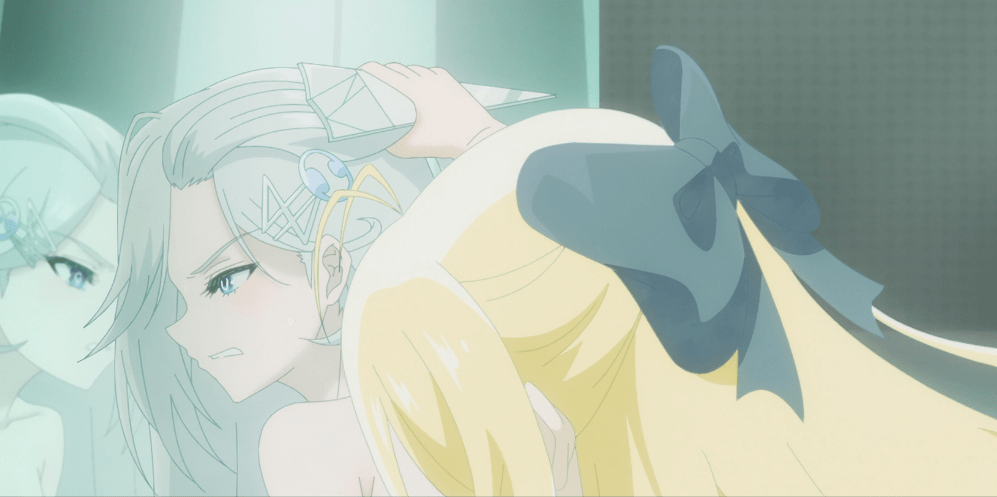
Rating So Far: A
This is easily the most artistically stylish series of the season, and somewhat surprisingly for the death game genre, legitimately one of the best. A big chunk of the credit for that goes to director Sota Ueno and his very precise use of scene framing, dramatic pauses, and sparse but impactful background music, but this series is more than just an amazing technical achievement. By carefully not explaining anything more than it absolutely has to through the three story arcs so far, it heightens the sense of unease both in the games and the dystopian world which could bring something like this about, and using plushie stuffing in place of blood to reduce the gore factor somehow makes this all the more monstrous. Kudos also to an especially strong English vocal effort led by Suzie Yeung (Lena from 86, Makima from Chainsaw Man). Not a series for everyone (and actually not because of graphic violence, which isn’t high), but still an absolute treat to watch.
Tamon’s B Side
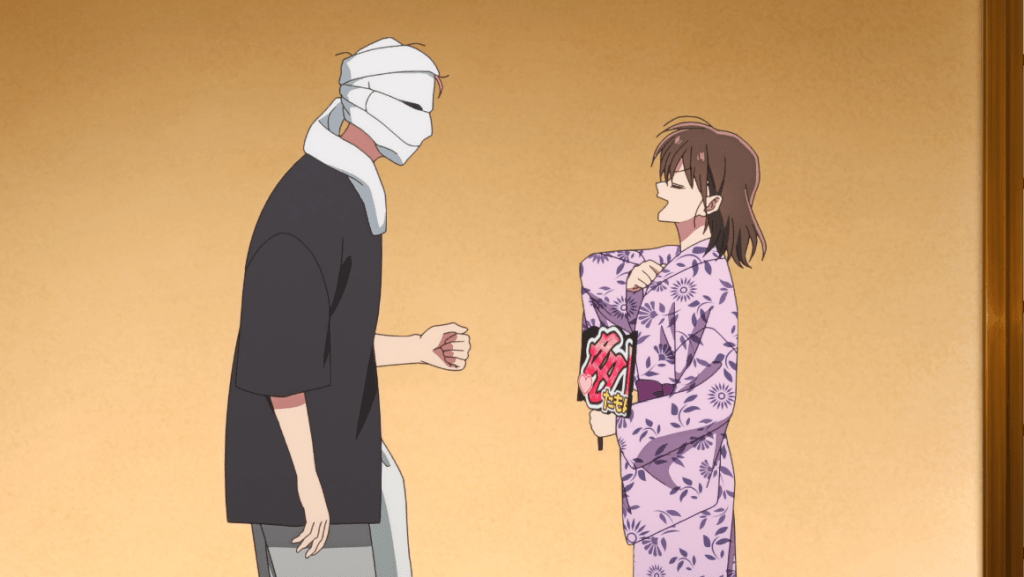
Rating So Far: B
Is there a funnier show airing this season? This series should not work as well as it does, but every episode it finds just the right balance as Utage tries to be a completely supportive fangirl while still maintaining a respectful distance from her idol Tamon, whether he’s in “Gloomyhara” or “Hottiehara” mode. It gets good humor out of both the contrasts between Tamon’s two sides and her own superfan obsessions and develops some romantic tension without actually getting into the romance aspect. The technical merits here aren’t great, but that’s hardly holding the series back.
The Holy Grail of Eris
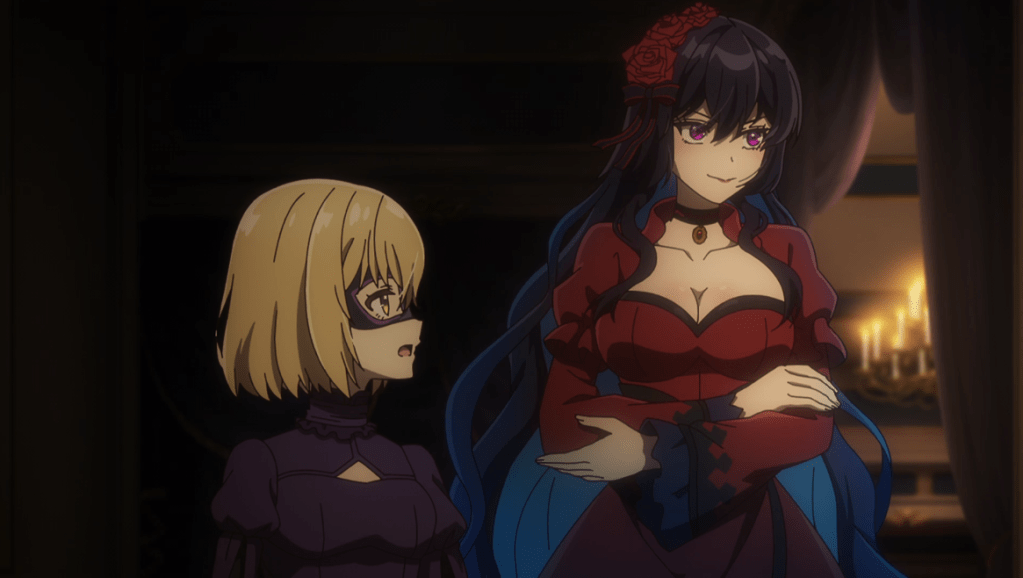
Rating So Far: B
The source novels for this series have been lauded for their intricate plotting, and the series has certainly lived up to that billing, especially through its second quarter. The execution isn’t perfect, as sometimes situations develop so quickly that I have to wonder if some details aren’t being skipped over, but in general the series has done a fine job of showing that the intrigues which got Scarlet killed may be part of something much, much bigger and more ominous. Constance and Scarlet also make an excellent team; while Scarlet is certainly the more savvy of the two and regularly bails Constance out of tough situations, Constance is increasingly showing her own grit, too. This one is always a delight to watch and would probably be among my favorites of the season in a weaker season.
The Invisible Man and His Soon-To-Be Wife
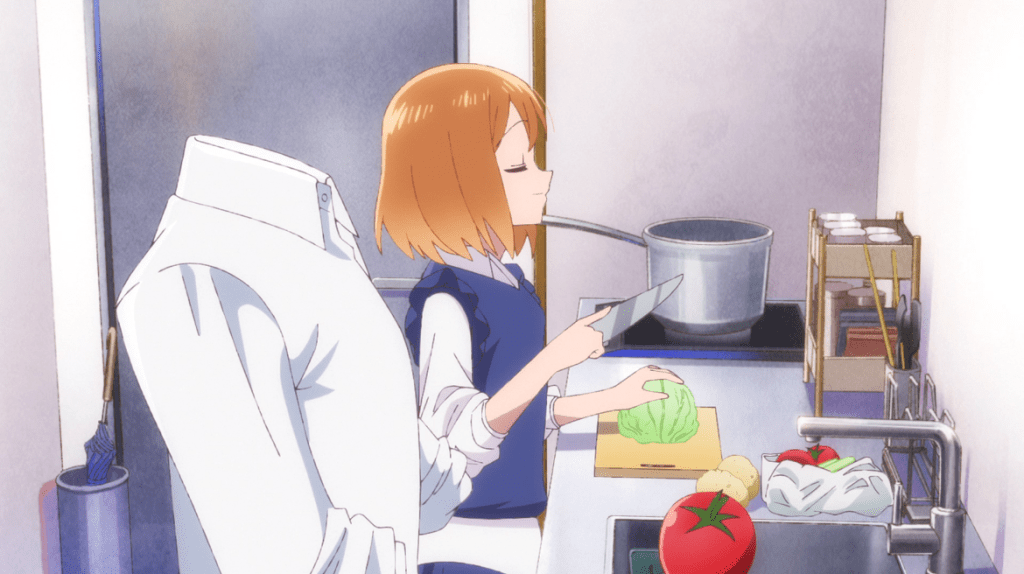
Rating So Far: B
Though it definitely has its share of light-hearted moments, this series is closer to being a pure romance than a romantic comedy, and it’s a pure, sweet delight in that regard. I love the way it just casually populates a modern society with all sorts of non-human races (Akira isn’t even the only invisible person to appear), and vignettes in a couple of episodes even explore that more deeply; the dark elf in an elf couple has curse powers that he’s concerned could influence a potential child, and the catperson on Akira’s staff worries over finding clothing that works well with the patterns on her fur. The series is also quite thoughtful and specific about portraying the adaptations for Shizuka’s blindness and its technical merits, while pretty plain overall, do a fantastic job of maintain design consistency around Akira being invisible. Of course, the core attraction of the series is the gradually developing Akira/Shizuka romance. It’s one of the season’s better low-key views.
The Villainess is Adored by the Prince of the Neighbor Kingdom
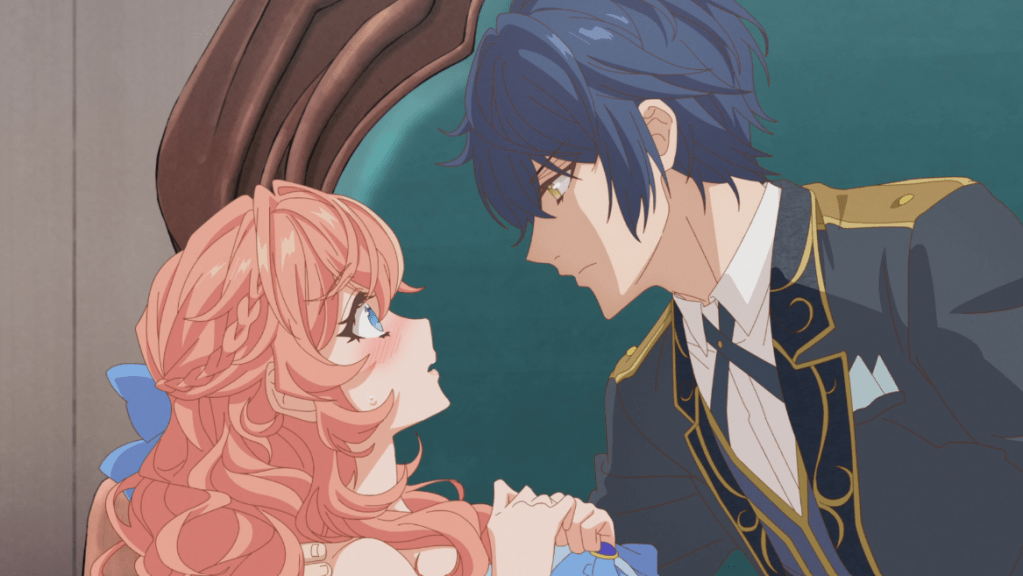
Rating: D
In the “why am I still watching this?” category, we have this revers harem/villainess series. It wars with Roll Over and Die for the season’s most ridiculous naming conventions but far undercuts it on technical merits; even accounting for stylistic choices that tend to give this a storybook art feel, this is at least among the worst-looking and worst-animated titles of the season. But its flaws aren’t just on the technical front. A change of venue in episode 5 dispenses with the one interesting plot point (i.e., that this is a double-isekai situation) and Tiararose is easily one of the most pathetic heroines we’ve seen yet from this kind of series; she doesn’t really do much more than worry over things. (It doesn’t help that Mai Fuchigami, whose vocal work I have liked in other titles, has somehow found a singularly annoying vocal quality to infuse Tiararose with.) Even the occasional hints that there might be a compelling force in this setting guiding the story in a certain direction isn’t all that interesting, as it’s been done much better elsewhere. I’ll probably limp along with this one to conclusion, but it’s certainly my bottomfeeder of the season so far.
There Was a Cute Girl in the Hero’s Party, So I Tried Confessing to Her
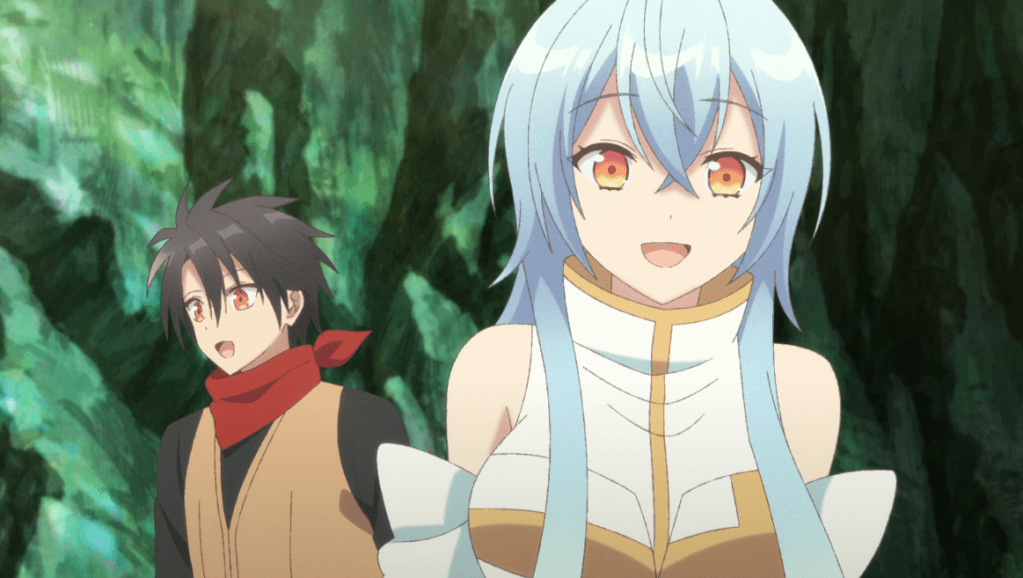
Rating So Far: B-
I actually was considering rating this one a notch higher, but a mind-numbingly stupid and anachronistic Valentine’s Day episode discouraged me for forgiving the series for some artistic weak points. It’s still a decidedly different take on the standard isekai scenario, with at least two other potential, independent romantic couples besides central duo Yoki and Cecilia (three if you count the married couple of the Guildmaster and Cecilia’s head maid) and a generally solid supporting cast overall. Yoki’s efforts to woo Cecilia gradually being successful (and, amusingly, having her mother’s full approval!) is also fun to watch, and Yoki isn’t the only (kinda-former) demon integrating peacefully into human society, either. Not a great series by any means, but mostly a fun view.
That’s it for this time around. Weekly episode reviews will continue, and watch for the Winter ’26 Wrap-Up the last week of March.
 USA Anime
Honestly the manga for Cute Girl in the Hero’s Party was boring and too sow for me as it is, can’t imagine being able to stand watching the anime version of it, I ended up dropping the manga because got tired of the sloth slowness to it.
LikeLike
How far did you get into the manga before dropping it? The last episode was Valentine’s Day-themed and the last episode with actual plot involved curing the gargoyle.
LikeLike