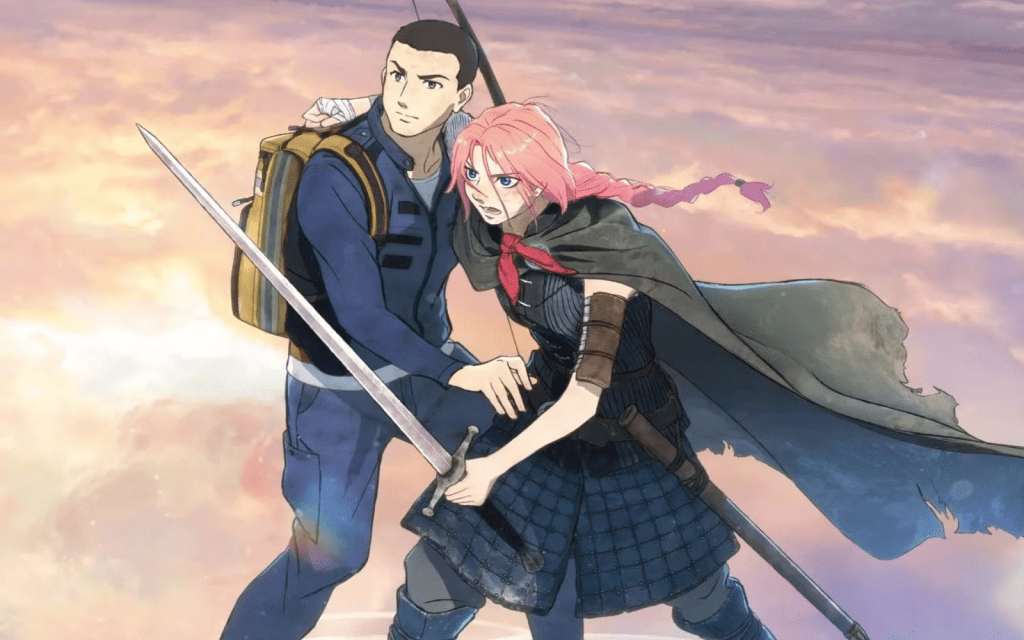
Scarlet is the latest original project from Mamoru Hosoda, the director acclaimed for movies like Summer Wars, Wolf Children, and BELLE. In this case the story is more an original take on one of the classics of English literature: Shakespeare’s Hamlet. This being anime, this naturally wasn’t going to be a straight or close adaptation; given the format available, why do an effort like this without applying a few fantastical spins?
In this case, the base setting (16th century Denmark) and many of the key character names are largely the same as the source material, with the major difference being, of course, that the role of Hamlet is replaced by young princess Scarlet. There are a couple of other key differences: rather than Hamlet/Scarlet learning from her father’s ghost about her uncle’s treachery, she witnesses it first-hand but she’s powerless to do anything about it. That leaves her powerfully driven by revenge as she determinedly trains for the opportunity. Unlike Hamlet, she doesn’t try hide it (or at least doesn’t appear to), which raises the question of why Claudius doesn’t get rid of her, too. This isn’t the last significant logical gap the movie faces, but it’s also largely pushed into irrelevance because the physical world isn’t the main venue for this movie.
No, that would be a barren landscape that isn’t explicitly called Purgatory but might as well be that, one which Scarlet winds up in after being poisoned. There she meets people of many different cultures and times, but also some familiar faces; many of the key characters from Hamlet (though, interestingly, not Queen Gertrude) are also present. The logic behind this is also quite shaky in most cases, even if one accounts for the fact that they wouldn’t have all had to die at the same time to wind up here. You’re also not supposed to think too hard about how Claudius got himself set up as king here, where he got that castle from, or how he came to control access to the setting’s literal Stairway to Heaven stand-in. And hey, let’s not be too concerned about the ultra-massive dragon swimming around in the sea in the sky which generates electrical discharges like a storm. That’s not explained, either.
And that’s at least partly because explaining any of that would distract from the most important person Scarlet meets in that wasteland: a paramedic from modern-day Japan named Hijiri, who’s pretty sure he doesn’t belong here because he doesn’t remember dying. His pure, kind, helping nature presents a stark contrast to Scarlet’s anger and fixation on revenge, which allows him to show her that revenge isn’t necessarily the only way to live. In effect, this is a gender-reversed version of the normal scenario where the woman is the one who soothes the violence and revenge-driven man, and Hijiri was likely made a paramedic specifically to allow a good reason for him to be empathetic. Though he isn’t entirely successful in dissuading Scarlet from revenge, he at least shows her that a life not dominated by it is possible.
Whereas the original Hamlet was a tragedy defined by the destructiveness of revenge, this version ultimately takes the opposite approach by making the story all about Scarlet finding a way to step beyond revenge and despair. Of course, having such a laudable theme doesn’t prevent the movie from liberally sprinkling violent action scenes throughout and finding other excuses for spectacle (see the aforementioned dragon, among others), but those parts are fine, and Scarlet does herself make for a somewhat compelling character as a young woman struggling with revenge. And I have to give the movie some credit for finding a way to fit in Hawaiian dance and song in a credible fashion.
The problem comes with the execution of the story’s structure. The film clocks in at 112 minutes but feels like it was edited down from a significantly longer plan, as there are several places (especially in the late going) where events jump from scene to scene with little plausible progression and some events seem to be there just for spectacle’s sake. The writing also tries too hard to shoehorn in additional Hamlet characters and allusions and never explains why Claudius sees Scarlet as such a threat in Purgatory (or how he’s even aware she’s appeared there). Who or what the old woman who occasionally pops up is supposed to be is also left a mystery, but that’s less of an issue. On the plus side, Hijiri’s efforts to get through to Scarlet are convincing enough to at least partially offset the other narrative problems, a sub-theme about finding a balance between idealism and pragmatism does gel, and the movie does stick firmly to its overall themes about the self-destructiveness of becoming obsessed with revenge.
Despite the writing issues, the movie is worth seeing for its visual component. While there are a few places where the animation is a little stiff, it fluidly handles its fighting action scenes and produces some true visual spectacles, such as an early scene where Scarlet has to struggle to break free of a horde of grasping hands or a late scene involving a volcanic eruption. The movie also looks great in general, with striking character designs and stark depictions of barren landscapes; especially impressive was its willingness to let Scarlet (an unquestionable beauty) get all grimy. There were some slips in artistic quality (one shot at the very end looks rough, and I wasn’t particularly impressed by a couple of sequences in modern-day Japan), and a visual style more reminiscent of limited-animation titles might throw some viewers off, but overall it’s a solid visual presentation. The musical aspect impressed much less, but wasn’t a hindrance.
I went to a showing featuring the English dub and found the vocal performances to generally be quite satisfying, especially Erin Yvette (Tia Noto Yoko in the more recent version of BASTARD!!) as Scarlet; she has one sustained scream scene early on which could put her in the Scream Queen Hall of Fame. She’s fine but less impressive in a couple of places where she’s singing, though the flaws in those cases may be more an issue of working with an awkward translation for the songs. Chris Hackney (Gohan in Dragon Ball Super) also hits exactly the right notes as Hijiri and does well enough in one place where he sings, too. In fact, the only song which isn’t translated into English is the Hawaiian one.
Overall, this isn’t Hosoda’s best work, and I have to agree with it not getting an Academy Awards nomination. However, it’s still plenty worth seeing, especially on a big screen.
Story: B-
Visuals: A-
Overall Rating: B
 USA Anime
Chris Hackney huh? If memory serves he was the same voice actor to voice Yuito Sumeragi in Scarlet Nexus and he also Alfred from Hortensia Saga.
LikeLike
Thanks for writing the review, I am not surprised this is not one of Hosoda best works I enjoyed summer wars.
LikeLike