Rating: B
On paper, this series’ core concept – the protagonist dies but awakens in a setting similar to a game he had mastered – doesn’t seem to stick out much from other isekai series which take place either inside games or in settings utilizing game mechanics as a shell. And indeed, it’s hardly the first series to use civilization-building as a major element; similar aspects can be seen in series like Farming Life in Another World and That Time I Got Reincarnated as a Slime (and, to a lesser extent, the second half of I’m a Noble on the Brink of Ruin, So I May As Well Try Mastering Magic). However, as this one shows more clearly with its second and third episodes, it differs from similar-seeming series in one fundamental aspect: this one is founded on full-blown civilization-builder mechanics rather than RPG game mechanics. Because of that, the series has already shown a propensity to focus more on Big Picture moves than minutiae. As someone who’s played entries in Sid Meier’s Civilization game series for decades, that’s an intriguing enough aspect to warrant weekly commentary.
The series is already showing signs of how this different approach matters in developmental structure. Whether Ira can actually see the game screens the view can is unclear; they may just be abstractions representing what’s going on in game terms. But they’re absolutely the kinds of screens you’d see in old-school civilization-building games, and the steps shown being taken in episodes 2 and 3 – absorbing refugees as new citizens, setting building and research priorities, creating and sending out scout units – are absolutely actions familiar to anyone who’s played that genre of games even a bit. The RPG-styled alignment codification is a less familiar element (at least in Western entries in this genre) and definitely harkens back to ’90s or even ’80s-era games which had heavier RPG influences, but it’s apparently important in this setting, and the way episode 2 showed the dark elves being influenced by shifting to Evil alignment was quite intriguing; I am now very curious to see what effect shifting from Neutral to Good alignment has on a person’s mental state in this setting.
Other practical adaptations of game mechanics are highlights here, too. Episode 3 clarifies that alignment can affect the nature of the civilization’s home territory, and that there are “home ground” bonuses for that civilization which can be penalties for others. Here it manifests as minor buffs for citizens and them not only being able to consume, but even find tasty, water that wouldn’t be potable to outsiders. I especially liked how the writing thought out the visual aspect of this enough to raise concerns about how obvious a shift to dark, menacing woods would be to outsiders, too. Too early to see how that’s going to apply to the Research aspect, but I practically giggled over the semi-sentient “flesh trees” (which sound a LOT dirtier than they actually are!) serve as Mynoghra’s core food source, rather than relying on regular agricultural methods – although the latter does seem like it’s going to be at least partly in play, too. Again, this is good imagination being applied to basic game concepts.
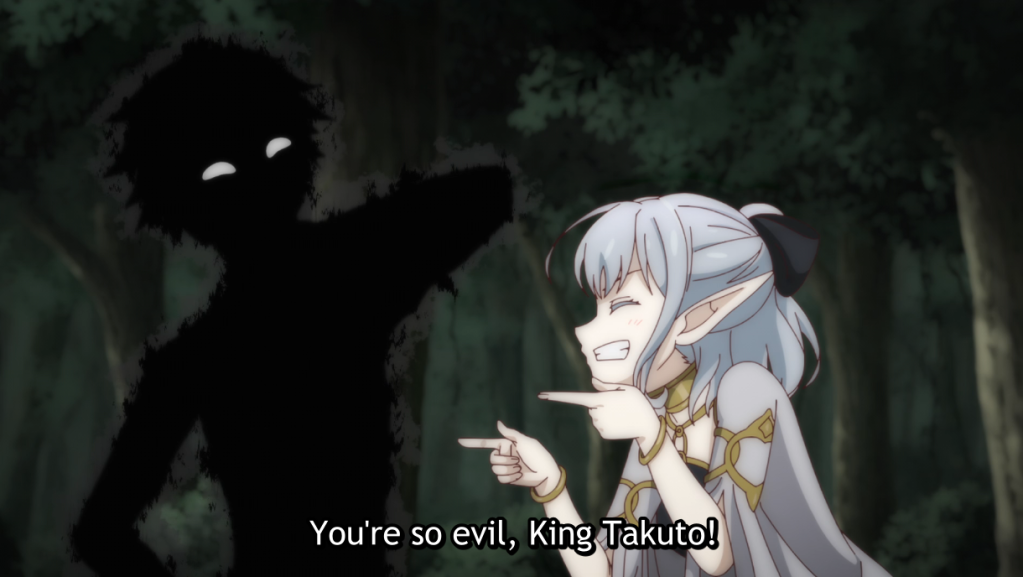
The character development aspect so far impresses much less, but it doesn’t need to do a whole lot with it being anchored by the cute relationship between Ira and Atou. Though the writing has shown no romantic inclinations between them (at least not yet), they have such a wonderfully dorky byplay that the series is almost worth watching for that alone. Amusingly, Ira doesn’t seem to be bothering to try to act the part of an imperious evil ruler (unlike Momonga in Overlord), so I hope the series at some point shows more of how the dark elves interpret the lighter and more playful interactions between such a terrifying-looking leader and a woman who can be quite intimidating on her own. (The scene in episode 3 where they get to see their dark lord scolding Atou for being destructive in showing off her power has to be leaving them mighty confused.) Besides maybe Emle as the Scholarly Type, none of the dark elves are distinguishing themselves much; the two sisters (twins?) focused on in the ED have yet to make more than cameo appearances, much less contributions. But it’s still early and this clearly isn’t going to be a character-driven series.

With episode 3, more of the world outside Mynoghra’s home forest gets introduced. Though she technically appears first at the end of episode 2, episode 3 sees the formal introduction of Saint Soalina of the Holy Kingdom, who theoretically is being set up as one of the main antagonists for Ira and Mynoghra, though there are also seems to be some question about how strong her position is politically. (She’s clearly a Hero-level powerhouse in battle.) But is she just (relative to Ira) an NPC, or perhaps another player? Nothing is specifically pointing to the latter at this point, but it can’t be ruled out, either. We also have some capable Paladins who look like they could be interacting directly with Mynoghra soon. As someone whose default strategy in civilization-building games is to sit back, develop, and avoid conflict as long as possible, this feels like the kind of potential incident which can quickly force a fledgling civilization to switch to a war footing against its will, and Mynoghra isn’t prepared for it; the comments about the look of the forest feel like foreshadowing by the end of the episode.
More could probably be said about the series’ visual aspect, but I’ll delve more into that next time. This one isn’t on a trajectory to be one of the season’s top-quality shows, but it’s still showing enough appeal to reinforce the recommendation I made for the series in the Preview Guide.
 USA Anime
The integration of civilization-building mechanics into the isekai genre offers a unique and refreshing approach. The focus on strategic development over typical RPG elements sets this series apart. Character dynamics, especially between Ira and Atou, add a compelling layer to the narrative. Looking forward to how the plot and world-building evolve.
LikeLike