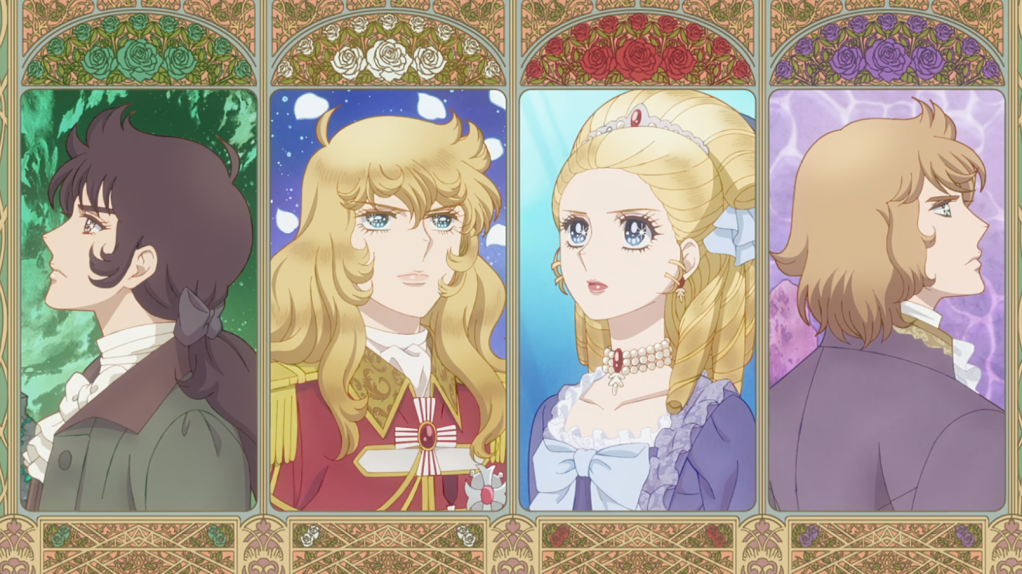
No list of the most important and influential of all manga titles would be complete without including The Rose of Versailles. Its 1972-73 publication transformed the shojo genre by introducing fully-rounded characters, complex plotting, deep exploration of sexuality and gender roles, and permanent deaths, thus elevating the genre from being just kiddie fare. It inspired a generation of shojo manga-ka, triggered a wave of interest in France (especially Versailles) in Japan, and played a significant role in encouraging the regular publication of manga in collected (tankoubon) format. Unsurprisingly, it has seen multiple adaptations over the last 50 years, including a 1979-80 anime series adaptation, a 1979 live-action movie, a 1987 OVA compilation of the TV series, and various musical performances over the years by the all-female Takarazuka Revue. This movie, released in theaters in Japan in January 2025 and now available on Netflix, is the franchise’s 50th anniversary project.
The movie tells the story of two women – one real, one fictional – who stood at the heart of France in the two decades leading up to the French Revolution. The historical one is Marie Antoinette, the 14-year-old daughter of Maria Theresa of Austria, who comes to France to marry the Dauphin, the prince who would become King Louis XVI, in 1770. The fictional one is Oscar Francois de Jarjayes, a noblewoman raised as a man, who encounters Marie Antoinette during her service in the Royal Guard and becomes the princess’s personal protector. Though the two are initially quite close, they gradually grow more distant over the years as Oscar becomes dismayed over Marie’s flirting with a Swedish nobleman and her lack of financial restraint as France starts to become more economically distressed. Things eventually completely fall apart as the French Revolution gets underway. Also factoring prominently into the story are two men: the real-life Hans Axel von Fersen (lighter hair above), whom both Marie and (less prominently) Oscar have romantic entanglements with, and the fictional Andre, a loyal lifetime servant and eventual lover for Oscar.
As the story weaves through actual historical events, it places great emphasis on the roles each woman take on and how they react emotionally to them. Early emphasis falls mostly on Marie, who seems to have everything but what she really wants the most: a storybook love. This version of the story heavily implies that her long-standing emotional (but, based on letters, apparently not physical) connection to von Fersen is a product of her seeking the emotional fulfillment that Louis cannot give her. As time passes (and, likely not coincidentally, Marie becomes a less sympathetic character), the focus shifts more purely to Oscar, who has so thoroughly embraced the role of behaving like a man that she has trouble seeing herself as a woman when faced with later challenges such as her own crush on von Fersen and a potential arranged marriage. She is also, for a long time, unsure how she feels about Andre. But for all of her uncertainties of the heart, she is still at her strongest when boldly and uncompromisingly pushing forward, even if that means eventually leaving the Royal Guard and ultimately siding with the citizens as revolution brews. Oscar may not be an original as a cross-dressing noblewoman (that would go to Sapphire in the even earlier Princess Knight), but it’s not hard to see from this why she became a template for innumerable strong female characters who followed.
The movie’s biggest flaw is evident early on: because it’s condensing a story which took 10 manga volumes and 41 TV episodes into a mere 114 minutes, it never escapes the feel of being a compilation movie, even if it technically isn’t. Some important characters (most notably Madame du Barry, Louis XV’s mistress) are skipped over entirely and others have only cameo appearances, and many parts of the story are greatly reduced or simplified. It partly covers for this by using musical numbers to suggest relationships and circumstances rather than fully playing them out, with mixed results; this definitely isn’t Les Miserables, but some of the songs are still effective at conveying where various characters stand in more compact form. For all the compacting, though, the emotional aspects of the story do come through well enough and the course of events is suitably compelling, especially in the late stages. You won’t feel like you’re missing anything major even if this is your first exposure to the franchise.
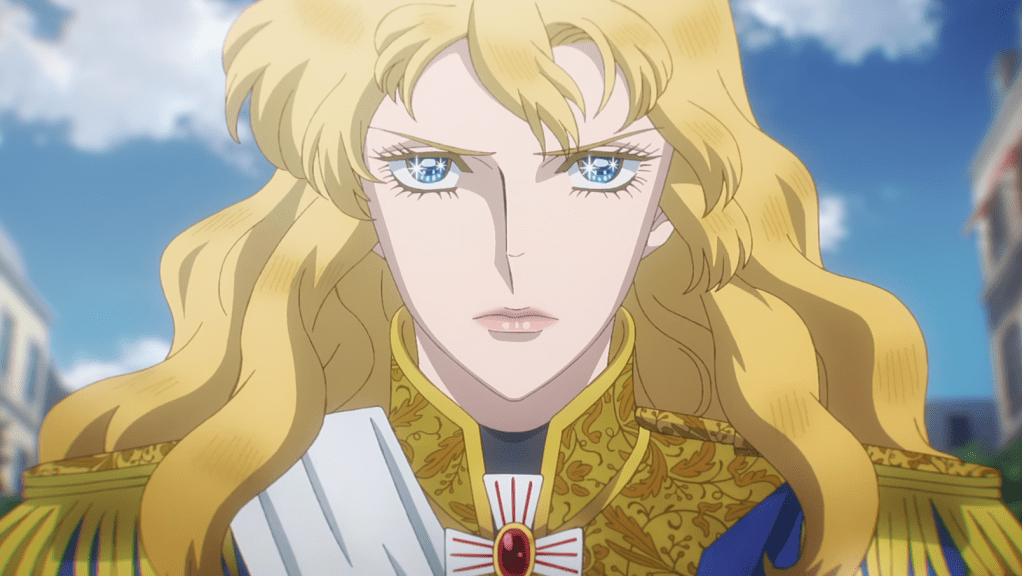
The production effort is led by studio MAPPA and directed by Ai Yoshimura, who is probably best-known for previously directing My Teen Romantic Comedy SNAFU. For the most part the movie looks gorgeous, with particular strengths in background design, costume, design, and especially vibrant uses of colors. Character designs also do a fine job of aging both Marie, Louis, and Andre over the years, though Oscar remains more static in design beyond a uniform change. The starry-eyed looks can be a little much, and seems out of place in more mature characters (Oscar would have to be be in her late 30s in the screenshot above), and the flower-themed motifs typical of shojo titles abound, but the artistry can also get effectively graphically violent in battle scenes near the end. Some visual flaws show up in some less-than-perfect CG integration and an animation effort that isn’t always the smoothest, but this is still a step up from most TV series.
The musical score outside of the numerous songs is also a strength, but you’d expect nothing less from the individuals behind the scores for 86, Attack on Titan, Aldnoah.Zero, and Solo Leveling. The Japanese dub is capably anchored by veterans Aya Hirano as Marie and Miyuki Sawashiro (Celty from Durarara, Sinon from SAO), who presumably do all their own singing since both are well-established singers. The English dub is perfectly fine in speaking roles, with Caitlin Glass feeling like an especially good fit for Oscar. However, it works much less well in the singing elements. Male singing voices are generally fine, but key male roles also have designated singing voices. Female singing is much more shaky, though much of the problem is definitely some translated lyrics which fit awkwardly with the music and don’t flow well when sung.
In all, the movie version of Rose of Versailles isn’t a flawless production, but it is one that any audience – whether familiar with previous versions or not and whether shojo storytelling is normally your thing or not – can appreciate. At essence, it’s a story about what one does with the freedoms one has, for better or wore, and that and the historical elements ultimately stand at least equal with the romantic parts. The story is also notable for the way it ultimately handles Marie Antoinette; she’s not made out to be the villainess (which some at the time certainly strove for), but neither does it let her off the hook for the selfish ways she acted and how her actions at best contributed to a public relations fiasco and at worst towards the French Revolution. It’s willing to fully acknowledge the costs of the paths both women chose, and that helps make it more compelling than what it might seem at first.
Overall Rating: B+
 USA Anime
One thought on “Review: The Rose of Versailles (2025 movie)”