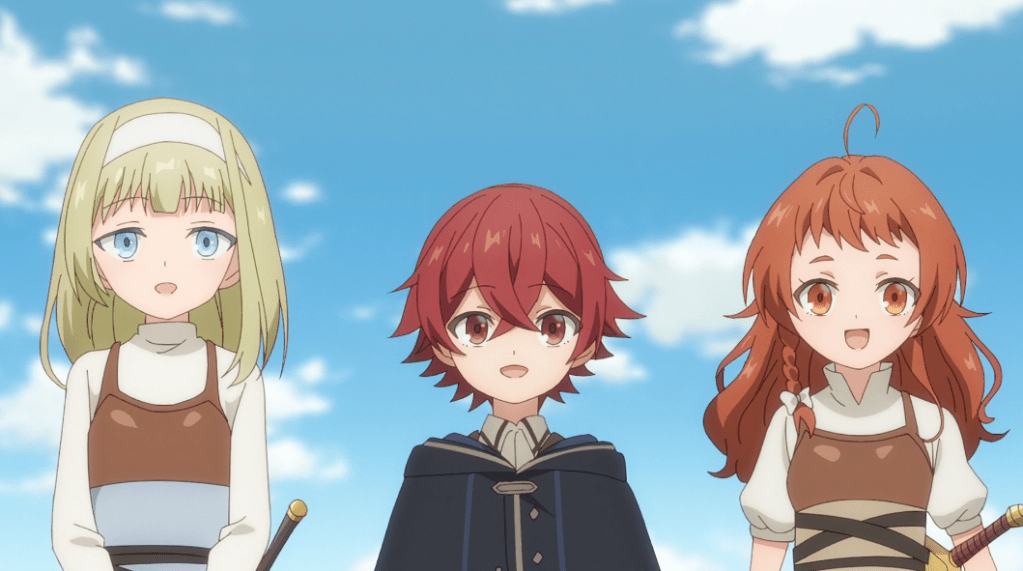
I was not originally planning to give a separate review for this series as a whole, but this is easily the most underrated and underappreciated series I saw in the Winter 2025 season, so I’m doing this review in part to call attention to the merits of a series which is more unconventional than it might seem at first glance.
The initial premise doesn’t seem like anything special: an unnamed man in the modern world dies with the disappointment that magic did not manifest for him when he turned 30 and was still a virgin. When he finds himself reborn in a new world as Shion, the only son and second child of country nobles, he looks forward to learning magic but soon discovers that even the concept of magic doesn’t seem to exist in this world. Dejected but undeterred, he draws his doting tomboyish older sister Marie and her commoner friend Rose into his efforts to try to find any phenomenon in his new world that might resemble magic, which he eventually discovers in a magic-like effect in the breeding habits of fish. From that basis, he gradually builds a rudimentary understanding and control of magic as he ages up through childhood, despite the fact that most can’t perceive the magic phenomenon at all. (Fortunately, Marie and Rose are two of the few people who can both see it and, to a degree, use it themselves.)
The “build a magic system from nothing” aspect is what separates this series from other contemporary isekai reincarnation titles, and how important that is in shaping the series cannot be overstated. Shion doesn’t have some OP skill and isn’t instantly powerful; indeed, there’s no game-like system or even magical tradition to draw on. Revelations late in the season establish that this is, indeed, a setting where magic has been lost over time rather than never existing, and there are hints scattered throughout the series pointing in that direction, but since this isn’t current knowledge, Shion has to develop a new magic over time rather than just time-skipping into becoming powerful. The only advantage he has is some knowledge of modern science which helps with the energy manipulation aspects of what he’s doing, but most of the first half of the series involves trial and error to figure out how to gather enough magical energy to generate effects, how to standardize methods that are essentially spells, and how to fashion rudimentary magical devices. And yes, this is more interesting in execution than it may sound.
The other interesting aspect is present throughout but gets developed more in the second half: that not everyone can even perceive magic, much less control it. The affinity for magic in this setting naturally varies dramatically; people who do have some are unusual but definitely present throughout the local populace. Only people with a high affinity for magic can even perceive it unless it creates concrete effects, which becomes a big issue in the second half of the series when monsters which can only be perceived by magic-sensitives (or within the scope of a magic light) appear. The presence of a sickness which seems to only affect magic-sensitives (which may actually be caused by complete mana depletion) adds an additional wrinkle to this and becomes a major plot driver, with strong suggestions that it’s connected to the entities which can’t be seen without magic. All of that leads to an actual villain, who wasn’t necessarily orchestrating the challenges Shion faces in the last third but is certainly both connected to them and a gateway to some bigger truths of the setting which get revealed in the final episode. So while he’s functionally a boss villain, he’s not a mastermind.
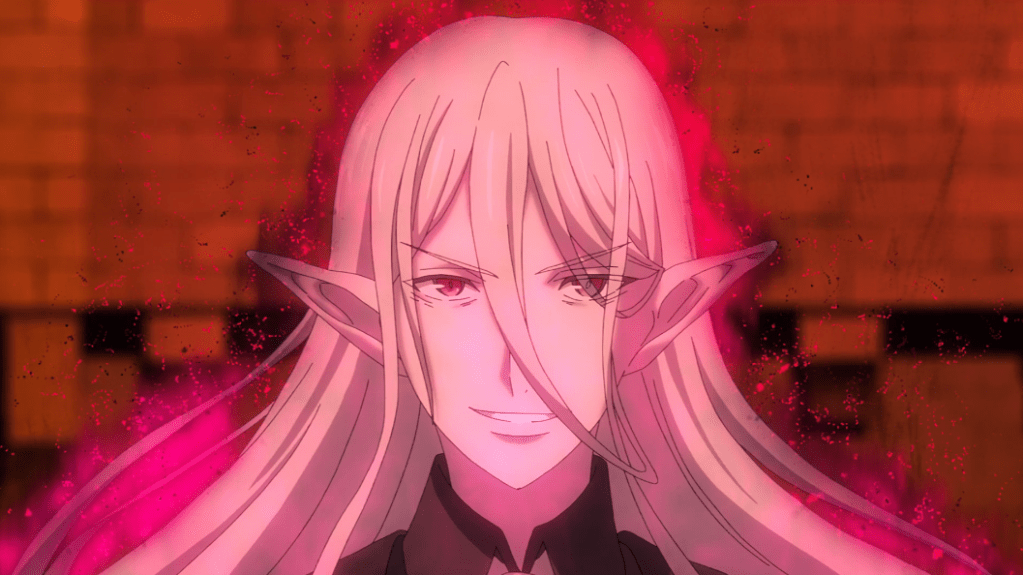
Surprisingly, the occasional action elements in the series are at least a mild plus. An early encounter with a goblin is one of the most harrowing uses of a such a creature that you’ll see in any fantasy anime, and Shion and Marie’s desperate struggle against it is a tense affair which sets the standard for other battles later on. Later battles against the creatures only perceivable by magic offer further thrills, but the true spectacle is the battle between Shion (with some help from others) and the boss, which composes the entirety of episode 11. It isn’t the animation spectacle that one of the featured fights in Solo Leveling or DanMachi is, but it doesn’t lack for dramatic staging or musical support and serves well as a climax for everything that has come before.
Characterization is more of a mixed bag but leans towards the positive overall. Shion carries the series as a boy (he ages up to 13 by the end of the season) whose obsession with developing magic sometimes leads him into somewhat goofy mannerisms but never keeps him from caring deeply about others; nothing dramatically different from other isekai protagonists, but a well-realized balance nonetheless. Supporting cast quality varies more; Marie has been accused of a devotion to her little brother that borders on incestuous, but that’s over-reading her relationship to Shion. She seems to see herself more as Shion’s champion. By contrast, the writing seems not to know what to do with Rose; she’s underused, even though she can also use at least basic magic and becomes a fledgling adventurer alongside Marie and Shion. Some supporting characters who appear later on are more stereotypical, even bordering on cartoonish to a tonally dissonant extent; this is the series’ biggest flaw, as it otherwise takes itself generally seriously. The series does get a plus for having Shion’s parents both present and actively involved, and a smith who’s a friend of Shion’s father, and helps Shion with item creation, is easily the best-developed and most likable of the adult characters.
The technical and artistic merits of the series are above average, with highlights being its depiction of energy displays, its use of color schemes in situations which require alternate lighting, the way character designs are advanced as the child characters age, and the very creepily distorted way the goblin threat early on is depicted. Musical support is solid, though neither the opener nor the closer is memorable.
For inexplicable reasons, this was one of the few series in the Winter ’25 season that was simuldubbed. For the most part the English dub is a very solid one, especially Rowan Gilvie (Wizard Boy in Goblin Slayer II, Guideau in The Witch and the Beast) as Shion and Dalton Tindall as the smith Grast. The one odd casting choice and performance is Whitney Rodgers as the young female knight Raphina; if they were aiming to make the character sound obnoxious, they succeeded, but I’m not so sure that was the intent.
On the whole, Magic Maker isn’t a spectacular effort, but it spins its tale well enough to be a satisfying and distinctive view. The final episode delivers some major developments which open broad paths for future developments. I’ll certainly be returning if more is animated, though that seems unlikely, since this series seems to animate the first two of the three novels released so far. In other words, if a sequel is coming, it won’t be anytime soon.
Overall Rating: B
 USA Anime
2 thoughts on “SERIES REVIEW: Magic Maker: How to Make Magic in Another World”