Over the past several months I’ve started looking into current isekai stories from non-Japanese sources. That trends in this genre outside of Japan closely mirror what’s going on in Japan is no surprise, though some of these works ape the construction and signature characteristics of current Narou-influenced isekai more than others. Before we get into anime season-ending business (some Spring ’25 titles complete their runs as early as this weekend!), I’ll take this opportunity to do a deeper dive into three titles that have at least some potential to both stand out and appeal to fans of Japanese isekai, though their appeal isn’t necessarily limited to that audience.
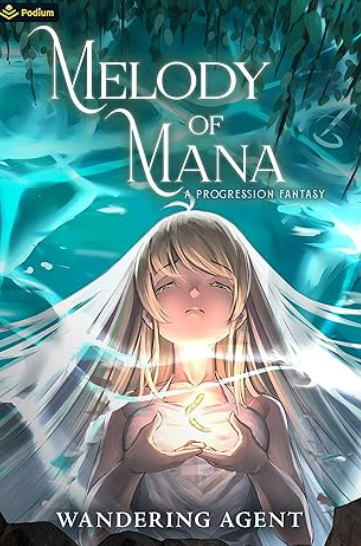
Melody of Mana
Author: Wandering Agent
Volumes: 6 (complete)
Overall Rating: B
The initially-unnamed protagonist is a woman in her 20s who lives in modern-day United States. She suffers an accident while spelunking which isolates her from her traveling companions, then discovers a strange pool which seems to result in her death as it imbues her with some kind of energy. Instead she awakens in a wholly new place as Alana, the baby daughter and youngest child of a retired soldier living in the farming hamlet of Orksen in a world that is decidedly not modern or, as she eventually discovers, Earth. At a young age she discovers that she is a bard, which means that she can work magic through the use of song (and, much later on, dance and acting as well). Bards in this world are jack-of-all-trades casters – not the best at combat magic, healing, or enhancement but capable of doing all of them to some degree and specializing in illusion and creation magic. As Alana gradually learns about her magic, it serves her well to survive the many challenges she faces throughout her life, including famine, war, monsters, rebellions, kidnappings, magical catastrophes, politics, parties (no, really – how deadly parties are is practically a running joke in the series), and even school.
This one is labeled as a “progression fantasy,” which means the story almost entirely focuses on Alana and how she very gradually grows into becoming one of her new world’s most powerful figures. We do occasionally briefly see other viewpoints, which help give a sense of bigger events going on beyond Alana’s immediate scope (albeit events which typically at least peripherally connect to her), but while the overall plot might affect the situations that Alana finds herself in, it never guides the story; mostly Alana is reacting to what’s going on rather than being a driving force behind it, and she certainly has no sense of destiny guiding her. She spends significant chunks of the story (especially in the early going) in pure survival mode and, when things eventually settle down for her, goes on to explore the mysteries of magic and the world in general. Occasionally this does force her into sometimes-deadly action, but while this does come in semi-regular doses, it’s not a main focus of the storytelling approach.
The world of this story is clearly heavily-influenced by tabletop RPGs, as the magic of the world falls into types whose strengths align with standard RPG classes: bard magic is versatile but not overly powerful; wizard magic is stronger, faster in combat situations, and more elemental-based; cleric magic is superior at healing and body manipulation; and physical enhancement magic doesn’t involve spellcasting but instead personal buffs which enhance physical capabilities in much the same way that gaining levels in martial classes would in an RPG. The magic system does have some unique quirks, though, and the exploration of these is one of the series’ greatest strengths. Bards can get power boosts from people singing along with them (and those singers don’t have to be magic-users themselves, so this isn’t just typical cooperative casting) and priests, who more proscribe to enclaves than specific gods, are very tightly-regulated and slavishly politically and militarily neutral because the magic which makes them great at healing also makes them horrifying opponents if they go on the offensive. (The setting has records of priests who go berserk single-handedly wiping out entire towns.) The basis for the magic system and how magic items are created – which is explored heavily in the second and third novels in particular – is also quite interesting and carries likenesses to computer programming.
Beyond the magic system, the world-building is more of a mixed bag. Nothing about the monsters which occasionally pop up is terribly novel, and the geopolitical situation is also pretty standard, although the first novel does emphasize more than most the indirect impact that war can have on a country’s populace. The second half of the series innovates more and delves more into the setting’s longer history as it brings into play the much more magitech homeland of the elvish stand-in race and takes several decidedly different twists on standard human-elf interactions. (For instance, elves were the aggressors in interracial conflicts in the past and in more recent centuries have actively sought to mix blood to bolster birth rates and prevent cultural stagnation.) The only other humanoid race which appears in the story is goblins, and then only briefly and in a decidedly different fashion than how they’re used in other fantasy settings.
The isekai aspect of the story, while not a major component, nevertheless maintains its relevance. It can show up in some interesting ways; for instance, that Alana knows a more precise value for pi than her new world knows actually becomes a plot point at times, and her magical research is sometimes influenced by things she knows from standard modern-world education that aren’t common knowledge in this world. As the series progresses, that Alana may not be the only individual from Earth who has ever made it to this world also comes into play in a big way, though, again, it never becomes a dominant story element. Being more mature and worldly as a child also plays a huge role in her surviving early perils.
While the world-building is, on the balance, a strength, and the magic system certainly is, the whole thing wouldn’t work if Alana wasn’t a character who can be easily rooted for. She is smart and quickly adaptive, sassy, full of attitude, and plenty mentally tough without sacrificing believable emotional vulnerability. She is far from overpowered, so she commonly survives more on her wits than on overwhelming opponents and challenges, even in the later stages of the story when she stands among her land’s most powerful casters. While she is shown flirting with bisexuality at one point in the story, she is firmly hetero on the long run; I bring that up to discourage readers from getting their hopes up rather than to indicate it as a negative. In general, the romance aspect, while present in the middle and later stages of the story, is expressed more as simply a part of Alana’s life rather than a focus. The supporting cast around Alana is competently-portrayed and helps flesh out the setting’s bigger picture but is far less memorable; she firmly carries the series on her shoulders.
The series’ one significant negative is the way its last volume is handled. It employs a number of time skips to round out the story of Alana’s life (she dies in the last novel’s final page), and this disrupts the smooth flow the story had going up until that point. The way it skips over some things you’d like to know more details about isn’t very satisfying, either, even if it does help give a fuller sense of a life lived rather than just going into a “happily ever after.” Still, the series is solid enough up to that point that I can give it a firm recommendation overall. I also heartily recommend the audiobook version, which is available for all novels. Reba Buhr (the English voice of Myne from Ascendance of a Bookworm and Karen/LLENN from Sword Art Online: Gun Gale Online) does a fantastic job bringing Alana to life and providing varied voices for other characters.
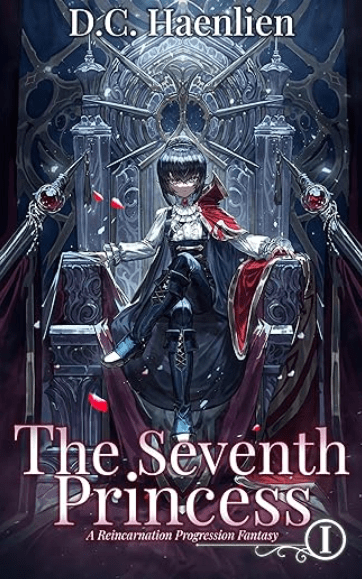
Adelheid novels:
The Seventh Princess, The Reginnaglar Ceremony, The Shadow of Glory, The Grave of Valor
Author: D.C. Haenlien
Volumes So Far: 4
Rating: B-
An unnamed individual from Earth dies and is reincarnated by an apparently-dark goddess with enigmatic motives into the body of Adelheid von Vuldar, the 7-year-old granddaughter of the Emperor of the Vuldar Empire and thus a potential candidate to inherit the throne. (The first novel’s title comes from her being the seventh of the royals.) Since her mother was an elven princess who died shortly after childbirth, Adelheid is an extremely rare half-elf, one with a petite stature but bewitchingly perfect features and a strong talent for magic. She quickly realizes that she lives in a cutthroat world where all royals are expected to compete for the throne of her militaristic nation; her father’s feeling towards her are mixed and an older half-brother seems to regard her favorably, but potential enemies and intrigues are everywhere, so even despite her young age she quickly sets about building a power base and developing her magic and combat abilities. Over the course of the four currently-available novels, Adelheid ages six years or so as she gathers loyal followers and noble supporters, establishes businesses to give herself an independent economic base, develops a feeder system of future talent, trains in magic and weaponry, makes plays for status in court, undergoes the traditional combat trial of potential imperial heirs (which takes up most of the second novel), and assembles special equipment for herself and her (eventually) knights, all while braving various existential dangers from threats both human and monstrous. Oh, and she eventually awakens as a vampire, too.
Technically that last item is a major spoiler for late in the third novel, but there are enough signs pointing in that direction (her strongest magical talent is a secret talent for blood magic, for instance) that it’s more a “how didn’t this happen sooner” note than a surprise when it finally happens. Even before that point, Adelheid is one of the coldest and most ruthless isekai protagonists you’re ever likely to run across, almost to the point of being an anti-hero. She does care for those who are loyal to her (revenge for the death of a loyal subordinate is a major motivating factor for her in one novel), but she’s not an emotive type and not above cruelty or even psychological torture when crossed. Some of this is a product of her setting, as there are multiple attempts to specifically kill her over the course of the first three novels, so she is still relatable, but this one definitely leans a bit more to the darker side of fantasy than most.
Over the course of the four novels, the world-building, history, and especially cosmology of the setting are well-developed, to the point that there are even brief parts from the points of view of gods (although the gods play almost no direct role in the story themselves). On the downside, this too frequently comes through info-dumps. The magic system is moderately well-developed but doesn’t vary much from standard RPG mechanics concerning tiered/leveled spells and magic item creation. For other RPG parallels, divine magic doesn’t seem to exist as a separate category in this setting, but it does use “auras” to explain the power increases of leveling in martial-types. (The titles of Aura Disciple, Journeyman, Master, and Grand Master roughly correspond in strength to low-tier, mid-tier, high-tier, and top-tier combatant levels in fantasy RPG systems.) Monsters and humanoid races are also mostly fantasy-standard (though there’s no equivalent to halflings, gnomes, orcs, or goblins in the setting), and the existence of dungeons at least has an explanation connected to the setting’s cosmology. The setting also has magitech in its distant past; what happened to that society is a mystery that occasionally pops up past the first novel.
As with Melody of Mana, this is squarely a progression fantasy, although this one has a greater sense of overall plot and Adelheid is guided by an overriding purpose: she must become the next Emperor to ensure her survival. (This becomes especially important after she turns into a vampire, as it’s the only way she can see to keep the truth about her hidden long-term.) The isekai aspect partly follows common progressions and partly doesn’t; Adelheid’s earliest business ventures involve food, especially honey (which it has partly in common with Melody of Mana), but later ones veer into things like concrete. The dungeon aspect is utterly bog-standard beyond the cosmological explanation for their existences. The supporting cast here is stronger and more distinctive than in Melody of Mana, although at least one of the most major supporting characters borders on being over-the-top in characterization.
On the whole, this one isn’t quite as sharp on the writing quality, particularly with its tendency to info dump and, upon occasion, over-dramatize. When it gets really in-depth in its processes, the writing can even get a bit tedious. The audiobook version has a plus of featuring both a male and a female reader, but it tends to get annoyingly elaborate in the way it presents spellcasting (complete with sound effects!). This is – thankfully! – dispensed with when a new reading duo takes over for the fourth novel, but the new duo isn’t quite as adept at doing different voices.
Overall, this one gets a mild recommendation, especially if you’re a fan of political intrigue. While a bit more grounded and detail-intensive than your typical isekai series, it doesn’t in a major way stand out from the pack. The story feels far from finished at the end of the fourth novel (which was published in July ’24), so more should be coming eventually.
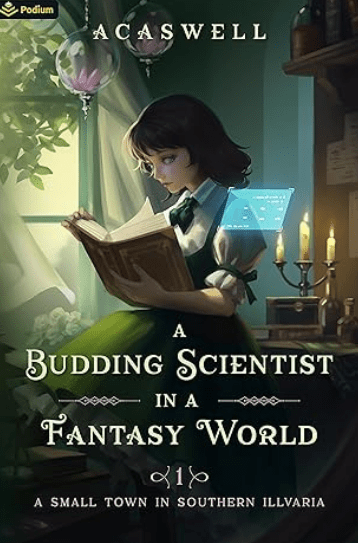
A Budding Scientist in a Fantasy World
Book 1: A Small Town in Southern Illvaria
Author: Acaswell
Volumes So Far: 2 (only the first reviewed here)
Rating: C+
Unlike the other two entries, this isn’t a reincarnation isekai, but rather a straight “hijacked to another world” scenario focused on Alice, a 15-year-old high school student from modern-day Colorado who goes to bed in her room one night but wakes up in the midst of a devastated wasteland, without the faintest clue about where she is or how she got there. The first third or so of the very long first novel (585 pages, or around 27½ hours in audiobook form) involve Alice’s efforts to survive in the wilderness over a long winter before she eventually finds and joins a frontier town on the southern fringe of the country of Illvaria, which is definitely not on Earth. Most of the rest of the novel involves Alice’s efforts to integrate into human society and learn about the new world, especially about how magic works (since she unwittingly survives a very dangerous baptism to become a spellcaster who wasn’t born with her magic) and about the System which guides everything in this world.
Yes, this one is a full-blown LitRPG scenario, with game stats, game-like status screens, classes, levels, class perks, skills, and achievements all being integral to the setting. What distinguishes this one a little is how complete the integration of the game-like components are, to the point that this feels like a deliberate exercise in imagining how one of these game-like worlds would really work in a practical sense. Everybody has and benefits from stats, even down to lowly farmers, obsessing over builds is second nature, and the guiding System is even the basis for the setting’s main religion. There are even classes for things like “Good Husband” and “Good Wife,” and class-based perks rule everything, whether it’s adding special features to clothes, making wagon travel smoother and faster, or detecting lies and criminal activities. Although everyone has mana which seems to be the basis for their stats and abilities, true spellcasting is uncommon but not unknown. Monsters also exist as animals which exclusively feed off mana. Humanoid racial diversity is very limited so far – elves are mentioned but not yet present – but Immortals do exists as rare individuals who have leveled up enough that they have effectively ceased their aging. (The higher-level someone is, the slower they tend to age.)
The other distinguishing feature of this one is how thoroughly it explores the structure of how magic and the System works in this world. As a science-leaning student, Alice is a very curious sort, and so pursues this diligently as her abilities gradually develop, to the point of even looking at the exact mechanics of how mana works with the System to grant skills, levels, and stat increases. The novel is arguably at its most interesting when delving into this and the broader structure of how magic works; all mages have “magic cores” within their bodies which determine which class of magic they can use, for instance, and they aren’t necessarily the standard ones. (An organic mage, for instance, is good at healing and body manipulation/modification, to the point of being able to endure attacks that would be fatal to anyone else.) Everything is very customizable – even magic cores can be customized at the cost of efficiency – and the options seem nearly endless.
But that’s also where one of the novel’s biggest faults comes into play: it winds up dwelling too much on the choices Alice has to make as she advances in skills and levels. Sure, there can be some interest factor in seeing what all options are available at certain levels – you’re not a true tabletop RPG gamer if you haven’t occasionally lost an entire afternoon or evening to doing this for a character you’re building – but watching Alice thoroughly consider her options gets tedious after a while. That Alice’s isekai status primarily comes into play as a top-rarity Achievement and the fact that she has a lower baseline attribute status than the norm for this world (the average person here is superhuman by real-world standards thanks to the System) is a little amusing and an interesting twist, but it doesn’t offset how the writing can sometimes get bogged down by the mechanics.
The novel’s other major flaw is, unfortunately, its protagonist. In isolation, Alice comes across as a cautious, analytical type, which is fine for the situation she’s in. When she finally starts interacting with other people, though, a tendency towards being overly expressive starts to show, to the point of obnoxiousness. Whether this is meant to suggest that she’s possibly neurodivergent is unclear, but it’s more annoying than quirky. Essentially, Alice is compelling entirely because of her situation and not at all because of her personality. Because Alice spends close to half the novel functionally or entirely solo, the supporting cast is somewhat limited, with only four characters – a sponsor, a System priest, an adult mage she travels with on one task, and an enchanter her own age whom Alice trains with and befriends – having much of a presence, though collectively they do partly compensate for Alice’s deficiencies.
While most of the story so far would fall into the “progression” category, there are indicators of a bigger plot that Alice is (unwittingly) just touching the fringes of thanks to her research, one which may have to do with instabilities in the System and definitely involves an organization cast as major potential antagonists. Immortals are also doing investigations which may eventually intersect with Alice’s, and there’s a big mystery surrounding the circumstances which brought her to this world (and what else came along with her) which seems connected to all of this, so this one looks to eventually be more plot-intensive than the other two. While the story does have some action elements, it has distinctly less of that than the other two, and really only a couple of action scenes once Alice is out of pure survival mode.
Overall, this one has just enough potential that I’ll probably check out the next novel, but its flaws are more substantial, and a more run-of-the-mill audiobook delivery tends to bring those out more than hide them.
 USA Anime
One thought on “Special: A Look at Non-Japanese Isekai”