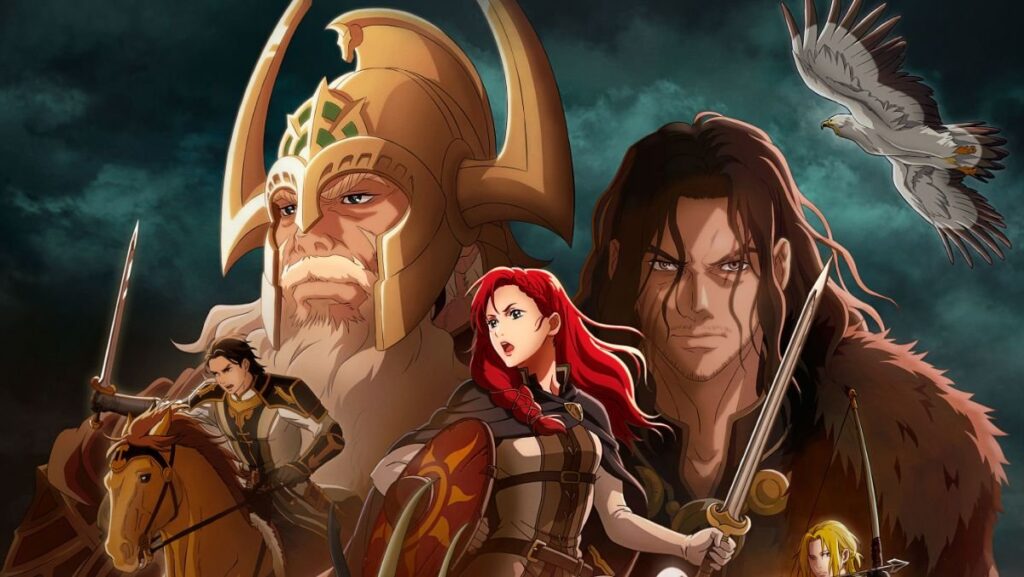
Though written, produced, and given a musical score by non-Japanese individuals (including Fran Walsh and Peter Jackson from the live-action The Lord of the Rings movies as Executive Producers), this wide theatrical release is officially an anime because it was animated by Japanese studio Sola Entertainment (Rick and Morty: The Anime, Tower of God), supported by a number of other Japanese studios, and directed by Kenji Kamiyama (Ghost in the Chell: Stand Alone Complex, Moribito – Guardian of the Spirit, Napping Princess). That being said, it’s clearly a film targeted at Western audiences, especially those who are long-standing fans of J.R.R. Tolkein’s works. It does have enough appeal that it could stand on its own as a rousing action-adventure story, however.
Of course, those not at all familiar with The Lord of the Rings and The Hobbit will miss several important call-outs, such as a late reference to Gandalf, a brief late appearance by Saruman, references to and/or appearances of locations which are important in LotR’s main story, and even a brief, unexplained-in-the-movie appearance by Mordor lackeys looking for a ring. Newcomers will also miss the importance of the narrator’s identity (which is only revealed in the credits, but which should be recognized by anyone who’s seen the LotR movies in either live-action or animated form). However, the base story is not at all dependent on its setting: a princess who hasn’t outgrown her tomboyish ways despite reaching adulthood gets caught in the midst of a power struggle between her overbearing father and an ambitious noble, whose son, a former childhood friend of the princess, swears vengeance on her family after his father is accidentally killed in a duel. Driven by revenge, the former friend seeks to conquer the princess’s land (Rohan) by becoming the lord of outside forces, and partly through an act of treachery, drives the princess, her father, and the people they protect into a corner. The problems for the former friend are that the corner is a stalwart mountain fortress that would come to be known as Helm’s Deep and that he’s trying to conduct a siege in the dead of winter.
So yes, for LotR fans, this is a story set two centuries before the main story of LotR, about Helm Hammerhand and how that fortress which played such a crucial role in the LotR live-action movies came to be known as Helm’s Deep. More precisely, it’s the story of Hera, the youngest child of Helm, a character “unknown to history” who nonetheless played a pivotal role in Rohan existing as a nation in the form that it does in the modern times of LotR. (In fact, the current royal family of Rohan is a direct result of her actions, though not in the way you might initially expect.) Hera is both the story’s primary protagonist and its visual star, as her red hair dramatically stands out in contrast to everyone around her, and saying that she saves Rohan through her direct actions and leadership is not the slightest bit of an exaggeration. She also stands also the story’s strongest and most interesting character, as she’s a young woman who spurns any thought of marriage, is clever, can fight well on her own, is quick to adapt to changing circumstances, and accomplishes all of these without losing her emotional core. By contrast, her cousin Wulf is much more ordinary as a main antagonist who has strong leadership traits but gets so caught up in revenge and love for Hera turning into hate that he can’t listen to the good advice of a loyal subordinate. Helm Hammerhand is a little more interesting as the personally-indomitable king who’s too pridefully stubborn to trust the daughter he seeks to protect until it’s almost too late.
Essentially, the story beats form a fairly standard and generally predictable fantasy/historical epic power struggle. The general course of the story also bears striking similarities to how the LotR movie The Two Towers plays out; in particular, there are many (probably intentional) parallels to the events surrounding Helm’s Deep in that movie. Hence the main selling factors are Hera, the action scenes, and the visuals. Set designs, character designs, and use of color are all gorgeous, with Hera being predictably beautiful but also solid-looking enough to be convincing as an action figure. (She’s also clothed in practical fashion for the most part, and the somewhat awkward way she looks when in a dress in one early scene is a neat fine detail. The only exception to this is the wedding dress she wears for symbolic purposes for her big showdown at the movie’s climax.)
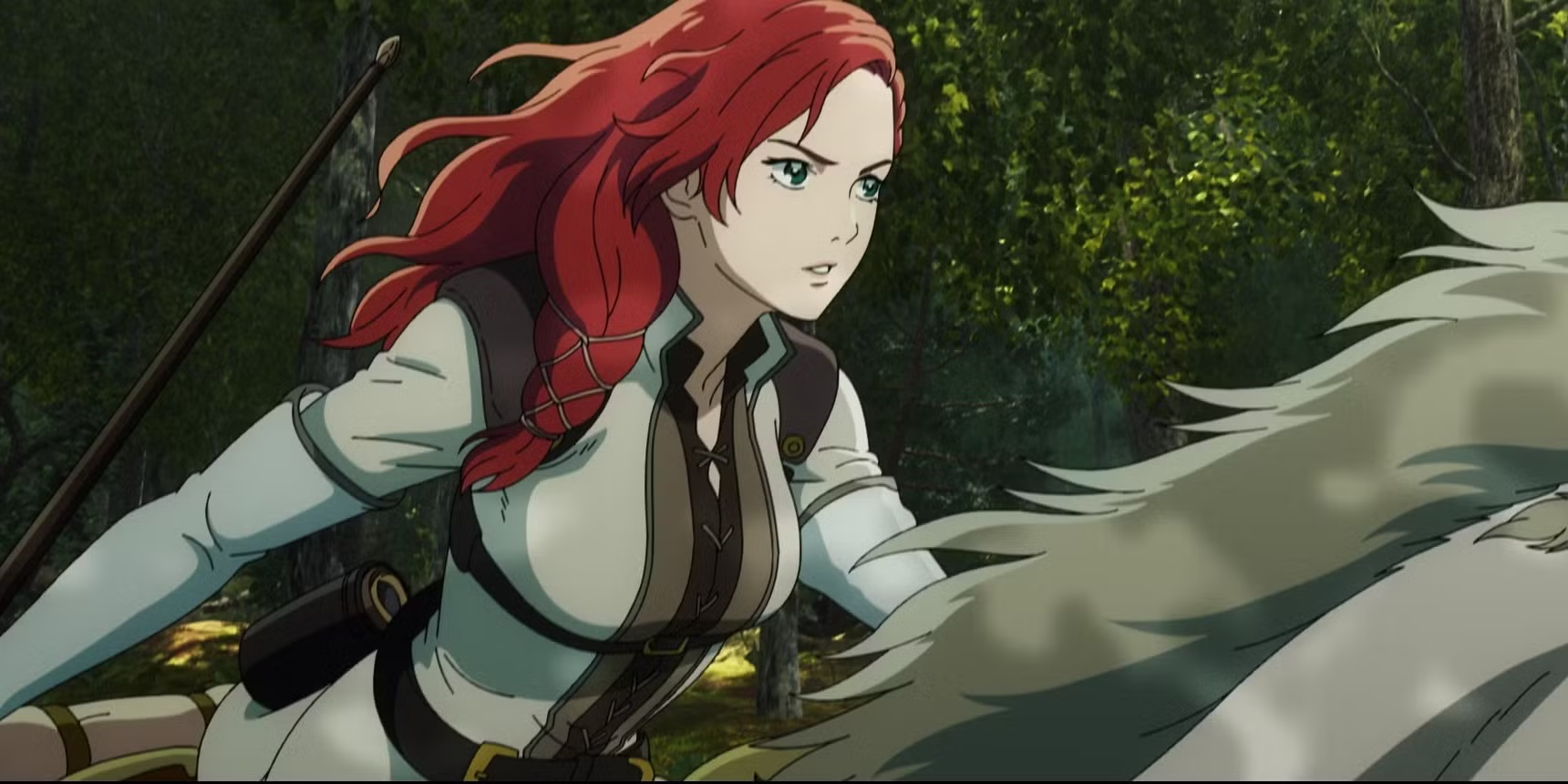
The animation effort, which depends partly on motion capture, is also a strong one, though not one without flaws. The integration of animated characters and backgrounds is the main issue, but thankfully it’s only a spotty one, and the movie dazzles in several of its elaborate action sequences. These aren’t all fights, either; one of the movie’s best-looking sequences is one where Hera must use climbing picks and crampons to scale a rock overhang to reach a giant eagle’s nest. But there are plenty of sharp-looking action sequences, too, ones which use shifting cameras to create greater dynamic movement and don’t rely at all on typical anime shortcuts; seeing characters do fully-animated dive-rolls in the middle of a fight is a joy. The sense of movement in fights is in some ways reminiscent of director Kamiyama’s earlier work Moribito, which only reinforces why he was the correct choice for this project.
The musical score for the movie outright borrows some of the musical themes from The Two Towers, and many others carry a similar flavor. That shouldn’t be a surprise; music composer Stephen Gallagher did work on Peter Jackson’s The Hobbit movies in a lesser role. Featured songs all fit that same feel, especially ending song “The Rider,” which I could see being a potential Academy Award nominee.
Though the movie does have a Japanese dub available, it is circulating in the U.S. with its English dub. The most interesting stories here are the casting of Brian Cox (who was once lauded for his performance in the titular role of King Lear) as Helm, a return to the franchise by Miranda Otto to narrate as Eowyn (a character from LotR who’s the spiritual descendant of Hera), and Saruman being voiced by the long-dead Christopher Lee using archival recordings. (Lee’s widow approved this and said her late husband probably would have been flattered by it.) The latter does, admittedly, sound slightly incongruous with the rest of the vocal performances, but it’s still a neat stunt. None of the other cast members are likely to be familiar to anime fans, but all filled their roles anywhere from adequately to very well.
Ultimately, the movie is a few minutes too long for its own good, and its unimpressive narrative somewhat hampers its visual appeal. Its strong musical score, good action scene and character designs, and appealing lead all help compensate, however, making this a middle-of-the-pack entry by franchise standards. It’s hardly a must-watch for franchise fans but one that I can recommend both as a standalone and as a franchise offering.
Overall Rating: B
 USA Anime
One thought on “Review: The Lord of the Rings: The War of the Rohirrim”