Rating: A-
Despite the regular cast mostly being relegated to supporting roles, the aptly-named episode “Game of Telephone” is, in its own way, nearly as searing an episode as the first season’s “Egosurfing” was, though for substantially different reasons. It’s about the conflicts that can arise within the multimedia creative process, cast within the framework of a stark contrast to the production of Sweet Today, and it results in a blistering commentary on how screenwriters can get helplessly caught in the middle.
Last season, Sweet Today ended up being a mess in live-action form heavily due to poor acting, something which Melt either had impressed upon him or else came to recognize himself, leading to him being sheepishly apologetic to Kana and Aqua about it here. Despite its problems, its manga-ka (for whom Samejima, the manga-ka of Tokyo Blade, was once an assistant) apparently stayed completely hands-off in the production. Samejima, however, isn’t so passive when a story she clearly feels very passionate about is, in her view, threatened. Akane’s concern last episode about how Princess Kiryu(?)’s character changed in the play version is not specifically brought up here but is clearly part of what Samejima is getting so furious about.
The way this problem came about is the most interesting aspect, though. Samejima has apparently been pushing for revisions all along, but she wasn’t communicating directly with the scriptwriter; in fact, several people were involved in that communication chain, resulting in her exact wishes getting the “telephone game” treatment. Thus the scriptwriter thought he was doing the tweaks she asked for, only to be blind-sided when she castigated him for his efforts. It’s not fair to him at all, especially when we can see that he did care about the source material, but Samejima doesn’t understand enough of the production process to realize that the blame for this should, at the least, be spread out across multiple parties. (She also doesn’t seem to appreciate that she’s not the only stakeholder here, even if she is an important enough one to throw her proverbial weight around.) That also raises big concerns about how she’ll manage to write the script when she’s a novice at this format. I don’t doubt that the story isn’t done with this point.
I would also be very surprised if this isn’t at least partly based on personal experience by one or both of the original manga-ka, or at the very least it happened to someone they personally know. The “insider knowledge” feel here is just too on-the-nose to be pure artifice. I have no doubt that the comment in the episode about manga-ka being a bunch of eccentrics is also based on personal experience; in fact, I would be very surprised if the brief shots of Samejima’s work area aren’t based on someone in particular. And man, you have to feel for the poor original screenwriter, who can’t even salvage his pride by having his name removed from the credits when Samejima is the one who’s content to do the uncredited/unpaid scriptwriting.
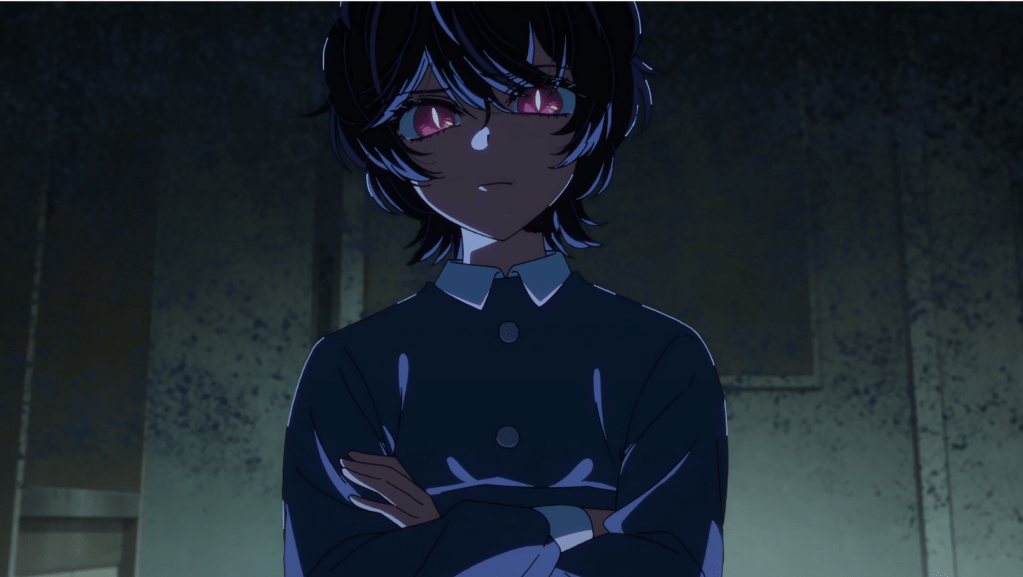
One especially attention-catching visual point about this episode (though it really came up first last episode) is the shape of Samejima’s pupils. The series has freely played about with the look of other characters’ eye, usually with great meaning, so it may be significant that her eyes have catlike slits.
The arc’s first big complication has arisen, which should set the stage (figuratively as well as literally!) for future developments. There’s a lot to look forward to here.
 USA Anime