Rating: B+
The original adaptation fell into a steady and familiar pattern throughout its two seasons: the first two episodes of each arc set up the circumstances as Lawrence and Holo move to a new location, encounter someone new who figures into the overall arc, and generally engage in more relaxed banter. The third episode introduces the scheme or crises, which comes to a head in the fourth episode. The fifth episode features Lawrence trying to figure his way out of the scheme or predicament, and the sixth episode is the resolution of both the crisis/scheme and Lawrence’s efforts. This new adaptation is following the exact same pattern, mostly because that’s the way the source novels are structured, too. Get used to it, because most of the novels in the series which aren’t short story collections have that same structure.
The crisis in this case is the most ordinary of events for a businessman of any era: a market upheaval has suddenly left Lawrence on the brink of bankruptcy. The reason for all the strange reactions he’s been getting the last couple of episodes is because he was unaware that the armor market had collapsed due to the annual crusade being called off. (While this point is specifically mentioned, it probably could have been emphasized more.) That on its own wouldn’t have been a total disaster, but he’s also been bushwhacked by the trading company whom he bought the armor from on a promissory note, who sold the debt to a company desperate to cover its own rear after taking a bath on the armor market itself. It’s not in a position to allow Lawrence any leniency, and medieval economics had no safeguards against this kind of dirty dealing.
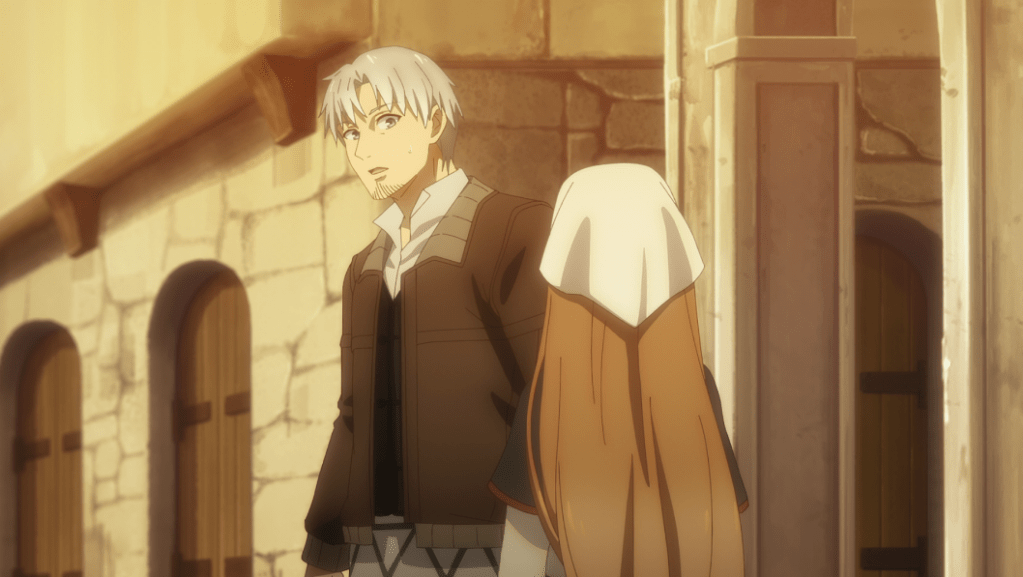
While Lawrence did get treated rotten here, this can also be looked at as punishment for his own hubris. He was riding high on having forced what he thought was a great deal out of the merchant in the previous town, but he both overestimated his own knowledge and failed to consider that said merchant would also be eager to wiggle his way out of being in the hole. The finishing blow in this situation is also this arc’s great irony: his efforts to try to get loans for the payment due are actually hampered because Holo is present, not helped. Though Holo was well-meaning in her effort to provide moral support (and perhaps also some help with her intuition and wolf instincts), neither she nor Lawrence was savvy enough to consider how established locals would see the situation. Lawrence has often complained about how expensive Holo is to have around, and that’s exactly how others see it, too. Could a man truly be that desperate if he can afford to have a woman hanging around?
Fine details like this, which the average person wouldn’t even stop to consider, are as much the reason why I have long been a fan of this franchise as the central relationship. It’s also the kind of complication that you’d be hard-pressed to find in almost any other anime series. The way Lawrence snaps at Holo – and then instantly regrets it – is also a great moment, as it both reverses the situation from back in episode 2 and serves as a fine contrast to the banter between the two in the first third of the episode. Yes, Holo actually is the problem in that case, but not intentionally so, and he knows that.
Lawrence isn’t the only one having concerns, either. Nora only appears briefly, but she’s around long enough for us to see that her efforts to improve her situation are fruitless. The Church official won’t let her switch to safer fields, and other travelers would be loathe to engage her because of her Church connections. In other words, she’s boxed in, too. While their situations seem too disparate to be connected, in a meta sense, that scene wouldn’t be there if the story wasn’t angling to have Lawrence and Nora’s paths cross again.
In comparison to the original adaptation, this episode covers the exact same territory and scenes as episode 10 of the original’s first season. One trend that is becoming more distinct as the season progresses is that this new adaptation tends to be a bit more effective in the lighter, more playful moments, while the original tended to fare better in the more dramatic moments. The scene where Lawrence was confronted in the loading dock played out too casually in this version, which drags down what was otherwise a very fine episode.
What game plan will Lawrence come up with for how to get out of this situation? And how will Nora fit into it? Find out next episode!


S&W Ep9- Holo’s presence can also be seen as a “cheap” trick to gain sympathy “coloring” Lawrence as a manipulator and so untrustworthy/dishonest
LikeLike