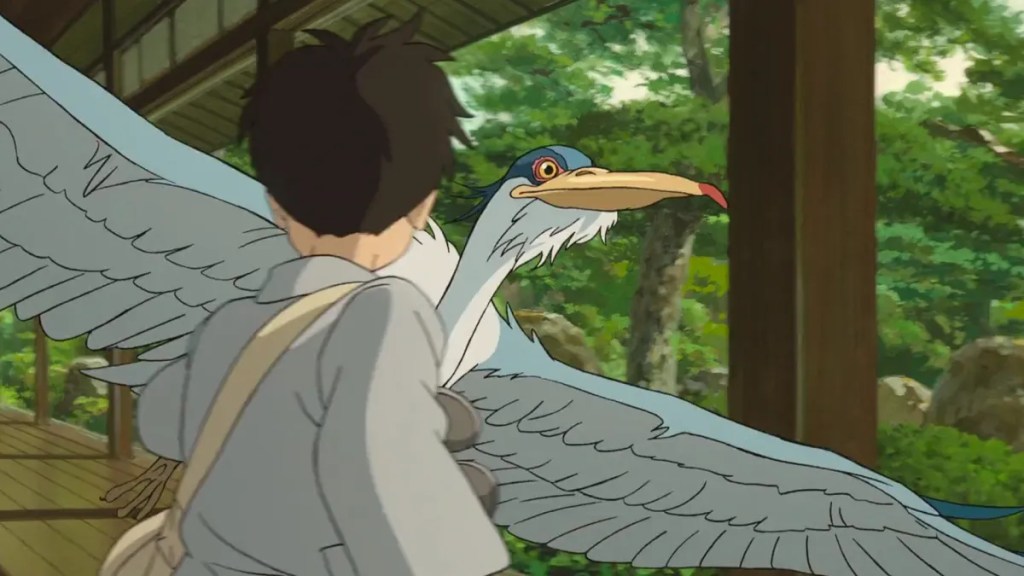
Whether this ends up being Miyazaki’s last film or not, all of the work that went into it is quite evident on the screen. The movie is resplendent with all manner of visual creativity, a fair amount of symbolism, and a wealth of fine details. What it does or does not accomplish narratively is another story, however, and in that respect the movie is one of the least of Miyazaki’s titles.
In the story, which is set in 1945 Japan, Mahito is a boy whose mother is killed in the firebombings of Tokyo during World War II (specifically, March 9-10 1945), much like protagonist Seita from Studio Ghibli’s Grave of the Fireflies. Unlike Seita, though, Mahito’s father is still around and both move out to the countryside to live at the family home with his pregnant aunt. There Mahito encounters the titular heron and its connection to a mysterious, ruined tower nearby, one that belonged to a great uncle who mysteriously disappeared decades earlier. Naturally, Mahito investigates once he learns that the heron can talk, and that sends him on a world-hopping adventure when his aunt goes missing.
That’s a perfectly fine set-up, but the biggest problem is that Mahito just isn’t that compelling as a protagonist. Compared to the likes of a Nausicaa, Ashitaka, or Chihiro, he has little character or distinguishing traits, beyond resorting to self-harm to get himself out of problematic relationships at his new school. He’s handy and determined, but that’s about it, and he doesn’t feel like he’s carrying the expected emotional baggage. This hampers the film greatly in the late stages, making some attempts at emotional resonance feel a bit flat. A second problem is that the movie operates at a smooth and gradual pace for much of its run, only to rush its climax and cut its follow-up short. Because of this, one character who doesn’t appear at all until near the end has an outsized role in the climax. The justifications for certain actions – like why the aunt wanders off, for instance – are also poorly-developed and explained.
Despite these problems, the movie still has a lot of admirable content. The artistic style may not be the crispest we’ve seen from Ghibli, but it is so rich in detail that a second viewing may be necessary to catch it all, especially little things like how furniture or even roof tiles look worn from weather and/or usage. The animation is amazing, and the venues and character and critter designs don’t lack for variety and expressiveness. Symbolism – which Miyazaki is certainly no stranger to using – is also liberally scattered throughout the project, and often a bit subtler than that seen in films like Spirited Away or Howl’s Moving Castle. This site provides a good breakdown of details that those not raised in Japanese culture might not catch. Some of the symbolism present here may also be speculative; I’ve heard a theory that the mysterious tower is meant to represent Studio Ghibli, for instance, and certain characters are meant to represent certain prominent Ghibli personnel. I am inclined to believe this, since too many details fit too neatly into that interpretation, including how some characters look suspiciously like characters from other Ghibli titles, the way the tower accesses other worlds, and some other details that are too spoilerish to bring up here.
Despite some flaws, this is still a movie well worth seeing. It’s just not one of Miyazaki’s best and not the anime movie released in 2023 that’s most worthy of an Academy Award nomination.
Overall Rating: B+
 USA Anime
One thought on “Review: The Boy and the Heron”