Posted: 11/13/2023
Note: This review is based on the subtitled version. A dubbed version is apparently also circulating, but that was not shown in my area.
The Tunnel to Summer is a late 2022 movie which has only recently had a U.S. theatrical run, courtesy of HIDIVE. It adapts a 2019 light novel and is adapted and directed by Tomohisa Taguchi, the current director of Bleach: Thousand-Year Blood War and past efforts including Twin Star Exorcists and the 2017 Kino’s Journey revival. Given his action-oriented pedigree, this project about love and loss is a distinct departure from the norm for Taguchi, but the result is an indication that he’s well-capable of branching out beyond action fare. It didn’t win an award at the 2023 Annecy Film Festival for nothing.
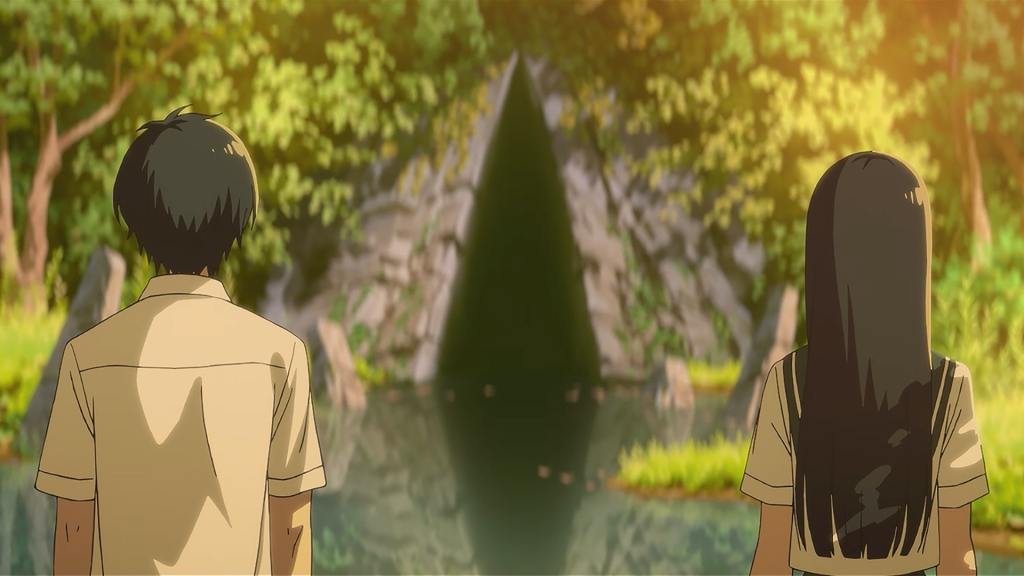
In the story, Kaoru Tono is a teenager in a rural area who has heard rumors about a secret area tunnel that can grant one who enters it a wish, but at the cost of 100 years of the person’s life. He certainly has a wish he’d like to see fulfilled, too: a younger sister died and he feels like he’s to blame, both for it and the way it tore his family apart. (And his father certainly thinks so.) One day while fleeing from strife at home, he stumbles across said tunnel, and after an initial experiment proves that there may be something to the stories, he finds himself joined by new classmate Anzu, who also has a wish she wants to see fulfilled. As they agree to study and quantify the properties of the tunnel before making a serious effort to journey to its end, a deeper relationship starts to blossom between the two. But even though they figure out some things about the tunnel, it ultimately isn’t what either of them initially thinks, and that leads to big complications when one of them eventually finds less reason to gamble on the possibilities the tunnel may offer.
I would be shocked if both original writer Mei Hachimoku and director Taguchi don’t admit to being at least partially influenced by the works of Makoto Shinkai, as The Tunnel to Summer has a very similar feel to his works. It doesn’t aim for the depth of sentimentality that Shinkai is known for, but themes about connections and separations across space and time resonate as powerfully here as they do in Shinkai’s works, as does the budding romance which lies as much as the core of the story as its more fantastical elements do. Kaoru and Anzu are two kids who find common ground in both being detached from their families (albeit for entirely different reasons) and seeking to recover something precious that they have lost. They are individually well-rounded and believable characters and make a convincing couple, and the development of their relationship from an initially somewhat antagonist one to a cooperative and supportive one feels very natural. That is absolutely critical to making the crisis which composes the last quarter of the movie emotionally effective. I won’t get into the details of that here, other than to say that certain aspects of it resemble a certain Shinkai work too much for it to be a coincidence.
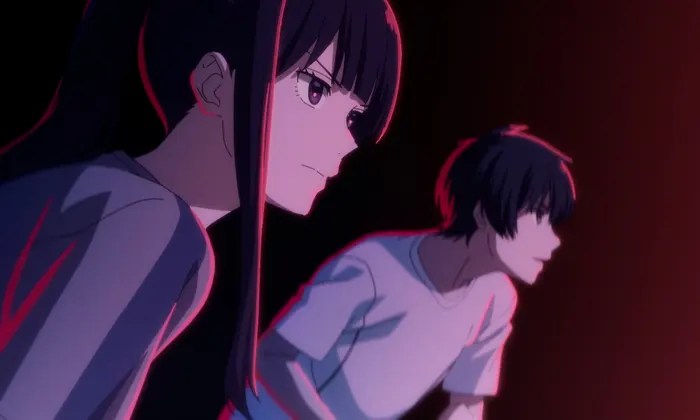
The feel of the movie may be familiar and the plot may be on the simplistic side, but it certainly doesn’t lack for visual support. This is animated by studio CLAP, which previously earned attention for animating the wonderful-looking 2021 film Pompo: The Cinephile. Here the film takes a more subdued, realistic approach most of the time, with quality animation, detail work, and setting designs all being features. The only place it truly gets showy is in its vibrant depiction of the interior of the tunnel, but this is a film meant to impress more on the little details than on the big ones, and it does that quite well.
The Tunnel to Summer, the Exit of Goodbyes may not blow you away, but it will impress and entertain, and it is well worth checking out when HIDIVE eventually gets to the point of streaming it. (It is also due out in January on Blu-Ray.)
Overall Rating: A- (B+ for writing, A for visuals)
 USA Anime
One thought on “Movie Review: The Tunnel to Summer, the Exit of Goodbyes”