Among the sea of isekai (and isekai-like) titles in the Spring 2023 season are a couple of sweet, tame, more old-fashioned anime romantic comedy titles: TONIKAWA: Over The Moon For You and A Galaxy Next Door. While the two titles have some distinct similarities, the way each of them approaches its romantic elements, and how each mixes in the comedic elements, is distinct enough that viewers can easily enjoy both of them without the shows feeling redundant.
The Basics: TONIKAWA

Nasa Yuzaki was a middle schooler on a fast track to greatness (or at least so he imagined) when he nearly died from being hit by a truck. Instead of getting transported to another world in a literal sense, his world was undone by the teenage girl who saved him. When he immediately declares his love, she agrees to be with him if he’ll marry her. Three years later, she shows up on his doorstep to fulfill the agreement, and so the two settle into married life as a young couple. Mysteries abound about who Tsukasa really is, as she saved Nasa by bearing the brunt of the truck impact herself and yet walked away largely unscathed. She also seems both ageless and somehow connected to the moon, giving the impression that the story is a “what might have happened if Princess Kaguya didn’t go back to the Moon in The Tale of the Bamboo Cutter” situation, but that mostly doesn’t matter to the thoroughly smitten Nasa.
During the first season (which aired in Fall 2020), a variety of friends and veritable family on both sides get involved as Nasa and Tsukasa go through many of the common procedures of learning to live together, including having to get a new residence after a fire destroys their apartment building. This pattern continues into the second season, with all manner of lovey-dovey behavior as the two continue to be enamored with each other’s base charms and gradually grow more intimate, though the mysteries continue to linger over the girl who is strongly implied to be ageless.
The Basics: A Galaxy Next Door

Ichiro Kuga has been scraping by as a landlord and manga artist ever since the death of his parents, all the while looking after his two younger siblings, but he’s in desperate need of an assistant to keep up with his deadlines. That problem gets solved when Shiori Goshiki, a tall, pretty 18-year-old woman, arrives on the scene and proves she’s quite passionate and capable despite having only been drawing herself for about a year. Ichiro soon learns that Shiori is actually the princess of the island she grew up on, and her people aren’t entirely human. Accidental contact with her inhuman aspect binds the two together, to the point that Ichiro suffers consequences if he’s too far from her or in certain other situations involving Shiori. Fortunately for both, they were already gradually growing attracted to each other and Ichiro’s younger siblings have also taken a liking to her. Eventually they formally acknowledge that they are dating for real.
The Comparison
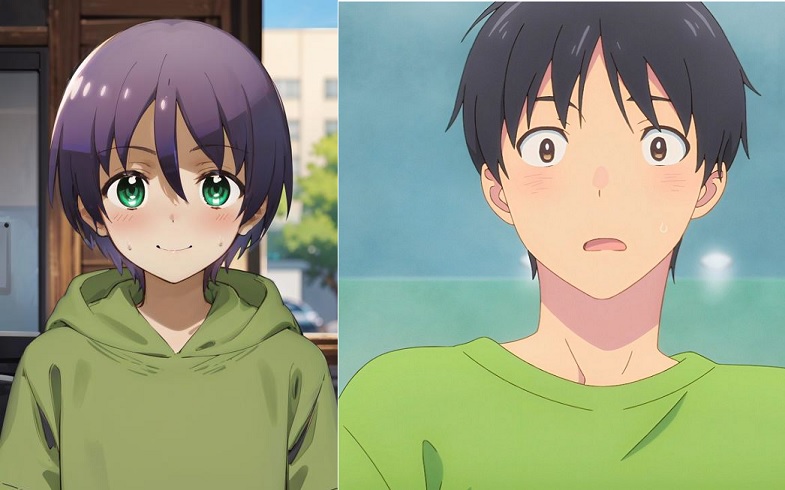
Both titles are based on manga by manga-ka who had already established themselves on earlier titles: Galaxy‘s Gido Amagakure was previously the creator of (among others) Sweetness and Lightning, while TONIKAWA‘s Kenjiro Hata had previously hit it big with Hayate the Combat Butler and (to a lesser extent) Seiyu’s Life! The female co-protagonists in both technically fall under the Magical/Alien Girlfriend trope, though in both cases that element is sparingly used beyond establishing the premises. As a result, the vast bulk of the content in each plays out in pure slice-of-life format, including generous doses of stock scenes for light romances (though each series does, to some degree, put their own spin on some of those scenes).
Perhaps most importantly, both series are on the light and tame side – for better or worse. Galaxy has not even a whiff of fan service through its first eight episodes, while TONIKAWA has used it very sparingly and mostly mildly. In fact, there’s little to no indication that Nasa and Tsukasa have yet been intimate despite being married and despite one of the daughters in a family Nasa is close with making lewd, pestering suggestions about it. Still, in both cases the attraction between the central couples is evident, well-established, cute, and believable. (That the male leads in both cases are demonstrably competent certainly helps here.) Both series also show little for romantic competition and no harem leaning; while at least one other girl is strongly implied to be interested in Nasa, that’s more a background element than anything which goes anywhere, and the same can be said for Ichiro. (Some implication has been shown that the teen female cousin which lives in the boarding house he runs is interested, but she declines to pursue it as she sees Shiori, whom she also likes, matching up well with him.)
The Contrast
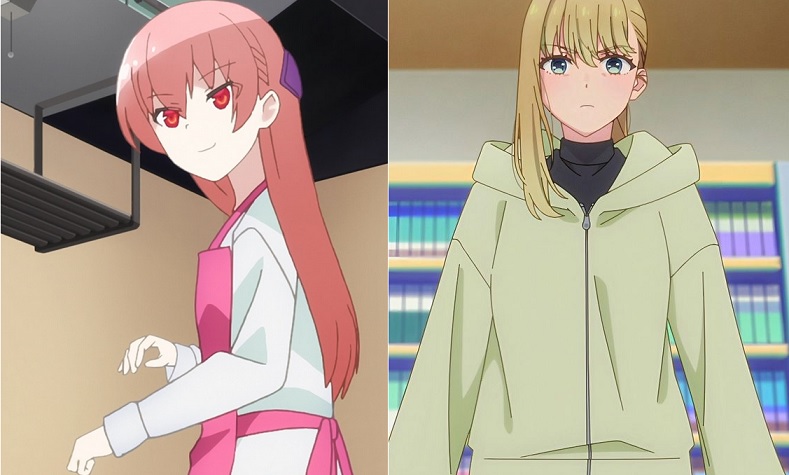
The two series do also have distinct differences, though not very dramatic ones. TONIKAWA starts with its central couple being definitively declared and committed before its first episode is over, and by the time this season starts, they have been living together for a while. Galaxy, contrarily, has taken a much more gradual course to drawing the central couple together, although (thankfully!) the series does not stretch out the build-up too much; they are a dating couple for more than just necessity by the end of episode 8. The presence of Ichiro’s much younger siblings also puts an extra kink in the relationship dynamics, as Shiori has to be accepted by them as well as Ichiro for the relationship to work. (Thankfully for Ichiro, they quickly take a liking to Shiori.) That TONIKAWA has shonen origins while Galaxy has seinen origins also shows in the attitude and feel of the series; the former feels more playful, while the latter has a more mature feel to it (even if the romance is initially teenager-level cutesy).
The biggest difference, though, is the way each series handles its female co-lead. Shiori clearly looks older, more poised, and more mature, and on paper she is; she’s 18 to Tsukasa’s claim of 16. She directly participates in her love interest’s work as his assistant, and her big secrets get laid out very early on. Tsukasa, on the other hand, admires what Nasa does but is simply not a part of his work world, instead taking care of domestic affairs and working at the frequently-featured bath house. Unlike Shiori, Tsukasa also plays much tighter with the mysteries of her background. A flashback in the recently-aired episode 9 of season 2 clearly shows that she still looked the same age at least 75 years earlier (assuming that those scenes are meant to depict the aftermath of WW2 and the current time for the series is the late 2010s) and various references she made in the first season suggest that she may be much older even than that, though nothing definitive has yet been revealed. She’s clearly associated with the moon somehow, but does Princess Kaguya somehow fit into this or is that just a convenient parallel? The second season has avoided even bringing the issue up, much less exploring it. Nasa does not seem particularly concerned about it, either, since he has certainly had many opportunities to learn more of her truth but has not pursued them.
Ultimately, neither title is in any way groundbreaking (or even, for that matter, all that fresh), but both provide consistent low-key charm ideally-suited to making them casual views. I grade Galaxy slightly higher (at a B compared to TONIKAWA‘s B-) because its technical merits are a little better and it has more story/chracter development, but I can recommend both.
 USA Anime
One thought on “Love’s Gentle Spring. . .”