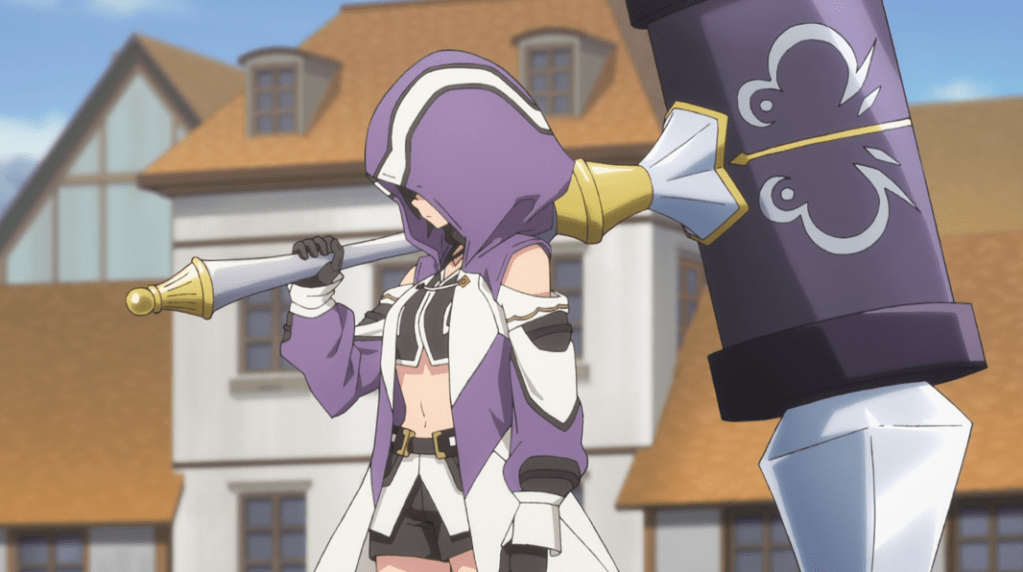
In Alina Clover’s fantasy world, adventuring is a real (if dangerous) profession and an Adventurers Guild exists to manage job requests and dungeons left behind by a lost, more powerful predecessor civilization. Alina isn’t an adventurer, though, or at least not officially; she opted instead to become a guild receptionist, partly on the recommendation of an adventurer she knew in her youth and partly because it’s a safe, stable, well-paying job that – at least theoretically – has consistent hours, allowing her to afford a home where she can just laze around after work. She values a good work-life balance above all else, so she’s positively mortified by overtime caused by paperwork which can crop up especially heavily when new dungeons are discovered or adventurers take a long time to clear established dungeons. At times, her frustration about overtime boils over to the point where she decides to take matters into her own hands. And due to a quirk of fate, she secretly has the power to do something about that, something which Jade, the handsome tank and leader for top adventuring group Silver Swords, accidentally discovers. Now he’s trying to both recruit her to be the Silver Swords’ striker and woo her romantically.
Adventurers Guilds have been a staple in anime for at least a decade now, and so has the Guild Receptionist Girl. While GRGs can occasionally do more – Eina in DanMachi is also protagonist Bell’s dungeoneering coach and adviser, for instance – they’re usually just pretty faces who interact with adventurers and occasionally serve as potential love interests. This adaptation of an award-winning light novel series turns that stereotype on its head by making the GRG secretly be the setting’s most powerful adventurer. This is hardly a fresh gimmick, as the “innocuous person is secretly the strongest” trope goes as least as far back as the Clark Kent/Superman alter ego and has appeared in many other forms in anime over the years, but it’s the first time that it’s been done in this context. That alone gives this series a fresher angle than many of its contemporaries, but it also has the added twist of squarely focusing the titular character’s motivations on a proper work-life balance.
Alina’s near-obsession with avoiding overtime is somewhat of a double-edged sword, however. Her relentless emphasis on it leads to many of the series’ funniest moments, but in the later stages of this season it can also start to feel overdone. (This is the most common complaint I’ve seen lodged against the series, though I haven’t personally felt this way.) However, there’s also something eminently relatable about it for viewers old enough to be out in the workforce for a while, and doubtless that’s intentional. What working adult hasn’t shared laments similar to Alina’s comments about how it’s not work which gets her out of bed in the morning, but knowing that if she does her job then she can both relax at the end and have a place to do it? Who hasn’t said “been there, done that” on having missed out on cherished activities because work took too long to complete, or has never faced the prospect that if you don’t put overtime in on the work now, it’ll be even worse the next day? I know I’ve been in Alina’s shoes many, many times over the years.

And that’s where some of the series’ strongest appeal lies. Yeah, Alina’s almost singular focus could be seen as overdone, but to people like me, her Executioner alter ego is an avenging angel – or, as one character puts it after seeing her in action, a “dark god.” She’s a cute, snarky ball of rage and frustration who’s gained the ability to vent in violent fashion by obtaining one of her world’s most elite powers: a mythical Dia skill. It takes the form of a giant hammer (and the physical prowess to wield it effortlessly) and is aptly-named Dia Break, since it can shatter or strike down anything which gets in Alina’s path, and it’s the most direct and personal of the offensive-focused skills we’ve seen so far. That Alina gained this skill (as detailed in episode 2) doesn’t feel like a coincidence, either; while series has yet to dwell on this issue, there’s a definite sense that Alina getting this skill at that time was purposeful on some higher power’s part, rather than just a reward for her intense feelings. That isn’t all there is to Alina, as she does show a more caring side than she’s willing to admit as the series progresses and may not be as completely immune to Jade’s attempts to charm her as she acts like she is. This aspect gradually shows up more over time, so I don’t buy arguments that she’s too static a character.
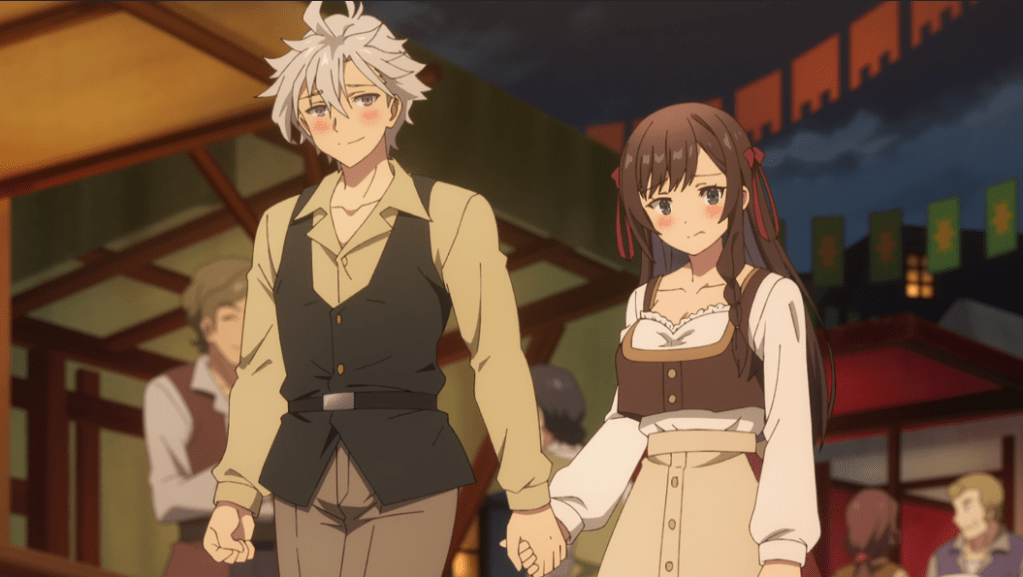
The series also does well with its supporting cast. Jade is very likable as the young man trying his best to win Alina over on two fronts without being too pushy about it, and the two do have some chemistry developing. Lululee, the female healer in Jade’s party, also gets a surprising amount of attention and characterization in the middle episodes, as does Guildmaster Glen Garia in the season’s last quarter. And then there’s Laila, Alina’s junior at the guild’s reception desks, who crucially serves as both the coworker in need of guidance and the series’ most humorously ironic character; she idolizes the Executioner and thinks he’s a guy, and has no clue that the Executioner is actually Alina. (In one of the series’ most inspired gags, Laila imagines a male Executioner getting BL with Jade, when the truth is that it’s not far from happening in a hetero sense.)
While the series has been predominately character-driven so far, it does have a distinct (if somewhat thin) plot to provide it structure. Someone out there with a skill on Alina’s level seems to be manipulating circumstances to produce “dark gods” – i.e., bioengineered humanoid weapons from the past civilization which have Dia Skills themselves. Exactly who would want to do this, and why, are questions beyond the scope of these 12 episodes to answer, but each of the series’ three main arcs (which correspond to the first three source novels) have something to do with this. Why Alina seems to be special even among Dia Skill users is another mystery; is the way she can power up a manifestation of her particular Dia Skill or an indicator of the strength of the emotions fueling her actions? Through the course of these events, the series smoothly varies in tone from being lightly humorous through darkly dramatic and even at one point heartbreaking.
The production effort by studio CloverWorks doesn’t do anything terribly fancy, but there’s not a big need for that, either, since Alina’s fighting style is very direct and focused on overpowering rather than outmaneuvering foes. Still, fights use fewer cut scenes than many series in the same category do, and animation elsewhere is solid. Character designs make Alina look cheekier than normal, but while they give her a generous figure, the adaptation doesn’t flaunt it; her Executioner outfit is more practical than sexy and true fan service is kept to a minimum. Jade, meanwhile, is one of the more attractive recent male characters who still looks manly, rather than specifically bishonen. By comparison, design work on the dark gods is much less impressive, and nothing about presented monster designs stands out much. The series is arguably at its sharpest visually when magical and energy effect are in play, as background visuals are well-done but not exciting. Overall, this is an above-average but not spectacular series on the visual front.
The series is stronger on the auditory front. The musical score delivers a strong dramatic flair in action scenes while also maintaining jaunty signature pieces to back its more light-hearted moments. However, its theme songs are where it truly shines. Opener “Perfect Day” by 310 is a great, wistful song backed by full and detailed 3DCG animation primarily involving Alina interacting with and flying on a dinosaur-like bird, although one scene where Alina is walking on a city street with groceries is also fascinating for its detail work and staging; this is easily the early contender being the year’s top OP. Closer “Ashita no Watashi ni Sachi Are” is one of the most peppy and upbeat anisongs in recent memory, with an infectious energy and cutesy dance animation which can be catchy in an entirely different way. It’s also one to remember come end-of-year awards.

Crunchyroll was English dubbing the series on a two week delay, and the whole series is now available in dubbed form. Jill Harris (Noelle from Black Clover, Suletta from Mobile Suit Gundam The Witch from Mercury) tackles the title role with every bit as much gusto as original performer Rie Takahashi does, in the process using inflections which adapt Alina’s attitude into English form perfectly well. Kamen Casey (Duke Seeker in I’ll Become a Villainess Who Goes Down in History) also hits all the right notes as Jade. The rest of the cast, while not as spectacular, still suit and perform their roles mostly well, with the only minor weak point possibly being Silha, the first of the dark gods. Still, a strong effort overall.
Guild Receptionist does come up a bit short on the world-building front, and I’d like to see more about Alina’s background beyond just her interactions with the one adventurer as a child. (No mention is ever made of her family, for instance.) But those are far from being big enough flaws to interfere with how thoroughly I’ve enjoyed this series; I have probably watched each episode at least 3-4 times already. The final episode rounds out the current story arc but definitely leaves a big hook for future story developments, and at its current adaptation pace, enough content is available in Japan for at least one more full season. There’s been no indication yet on whether we’ll get another season of this one, but it will be quite welcome if it does come.
Overall Rating: B+
 USA Anime
One thought on “Review: I May Be a Guild Receptionist,but I’ll Solo Any Boss to Clock Out on Time”